
Buying a Mobile Kitchen Trailer? 5 Things to Consider First
With property prices soaring and large gatherings back on the calendar, expanding your physical locations may not be in the budget. Now might be the...
9 min read
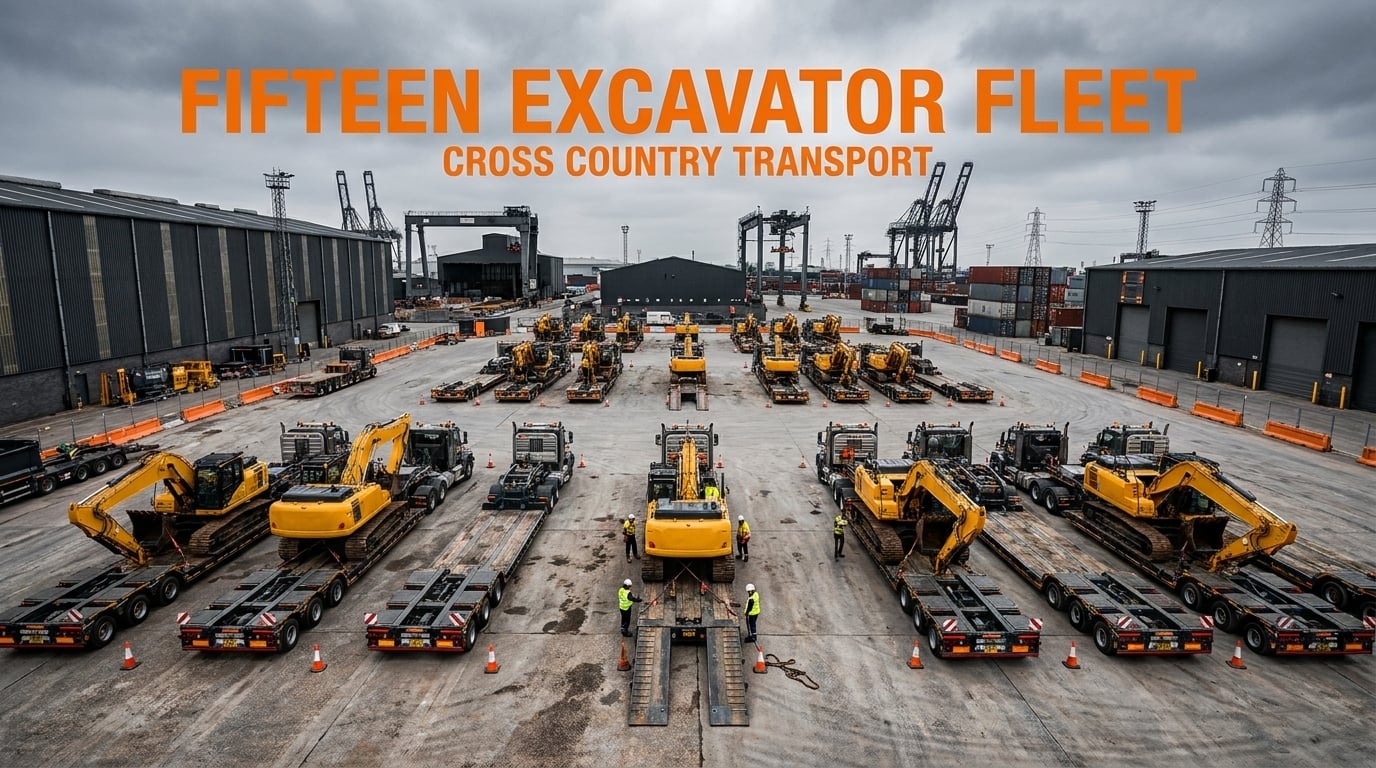
Moving 15 excavators cross-country for a rental fleet is a coordinated logistics program that requires simultaneous management of route planning, regulatory compliance, specialized equipment, and real-time execution across multiple states.
This case study covers how Bear Down Logistics approached pre-move planning, overcame the logistical complexity of a 15-unit deployment, selected and operated the right transport equipment, maintained reliability throughout execution, and delivered measurable results for the rental fleet customer.
Planning for a move of this scale begins with route selection and permitting. With roughly 10% of the nation's bridges carrying weight restrictions, corridor audits and state-by-state permit sequencing must be completed before a single unit departs.
Coordinating 15 shipments simultaneously introduces compounding challenges in scheduling, communication, and weather response. Fragmented information flow is one of the fastest routes to cascading delays, making structured dispatch protocols and GPS-integrated tracking essential from the first load to the last.
Trailer selection and securement methods are non-negotiable at this scale. RGN and lowboy configurations keep oversized excavators within legal height clearances, while federal tiedown standards apply individually to every unit across every trailer in the fleet.
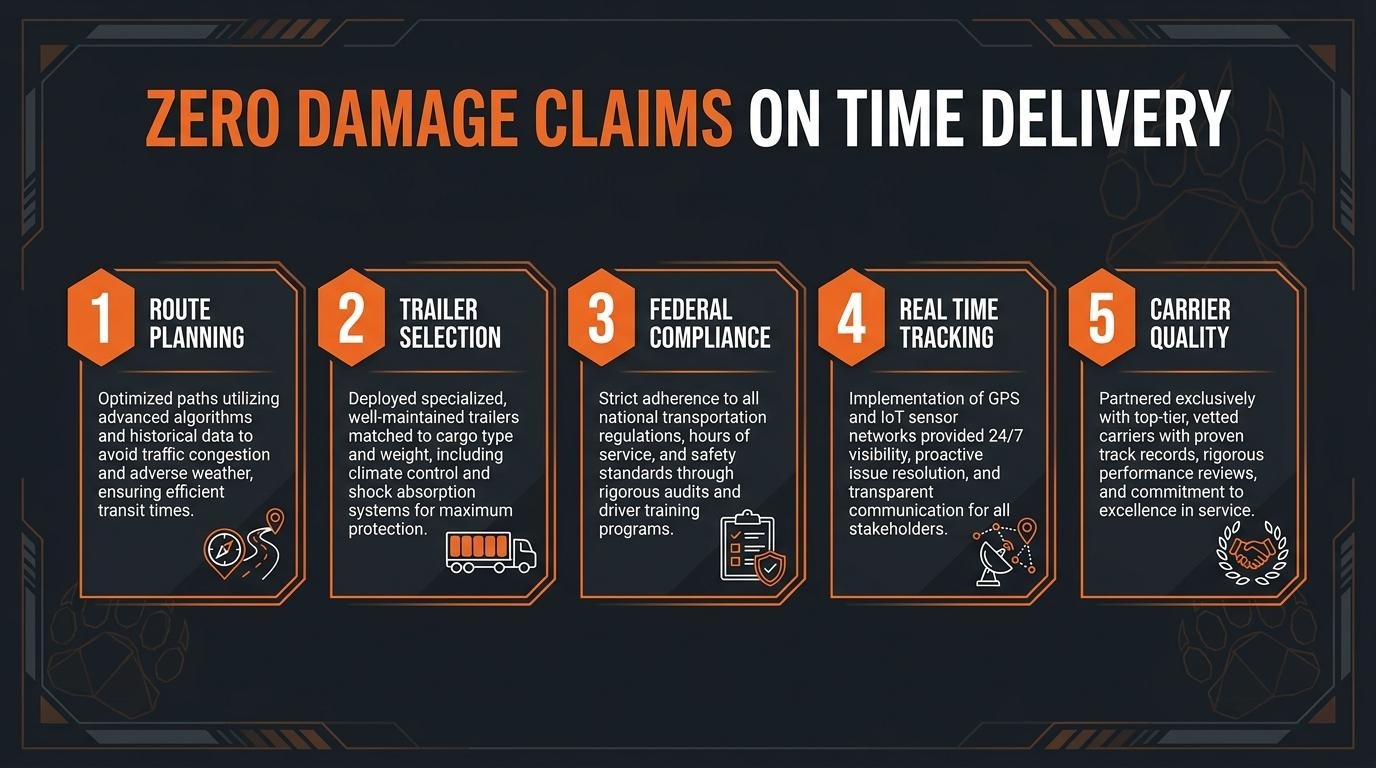
Bear Down Logistics maintained on-time performance and zero damage claims by combining carrier vetting, TMS technology, and proactive contingency planning. All 15 excavators arrived on schedule and ready for immediate deployment, producing direct revenue value for the rental operation from day one.
The key planning considerations for transporting multiple excavators long distance include route selection, permitting and regulatory compliance, and safety securement. Each factor directly affects delivery timelines, legal exposure, and equipment integrity across state lines.
The route selection factors that impact heavy equipment relocation include bridge weight limits, road clearances, and state-specific access restrictions. Approximately 10% of the nation's 600,000 bridges currently carry weight restrictions under National Bridge Inspection Standards, according to the Federal Highway Administration. This means planners must audit every bridge along a proposed corridor before dispatching a single load. For a 15-excavator fleet move, a single overlooked restriction can cascade into costly reroutes for every subsequent truck.
Key route factors to evaluate include:
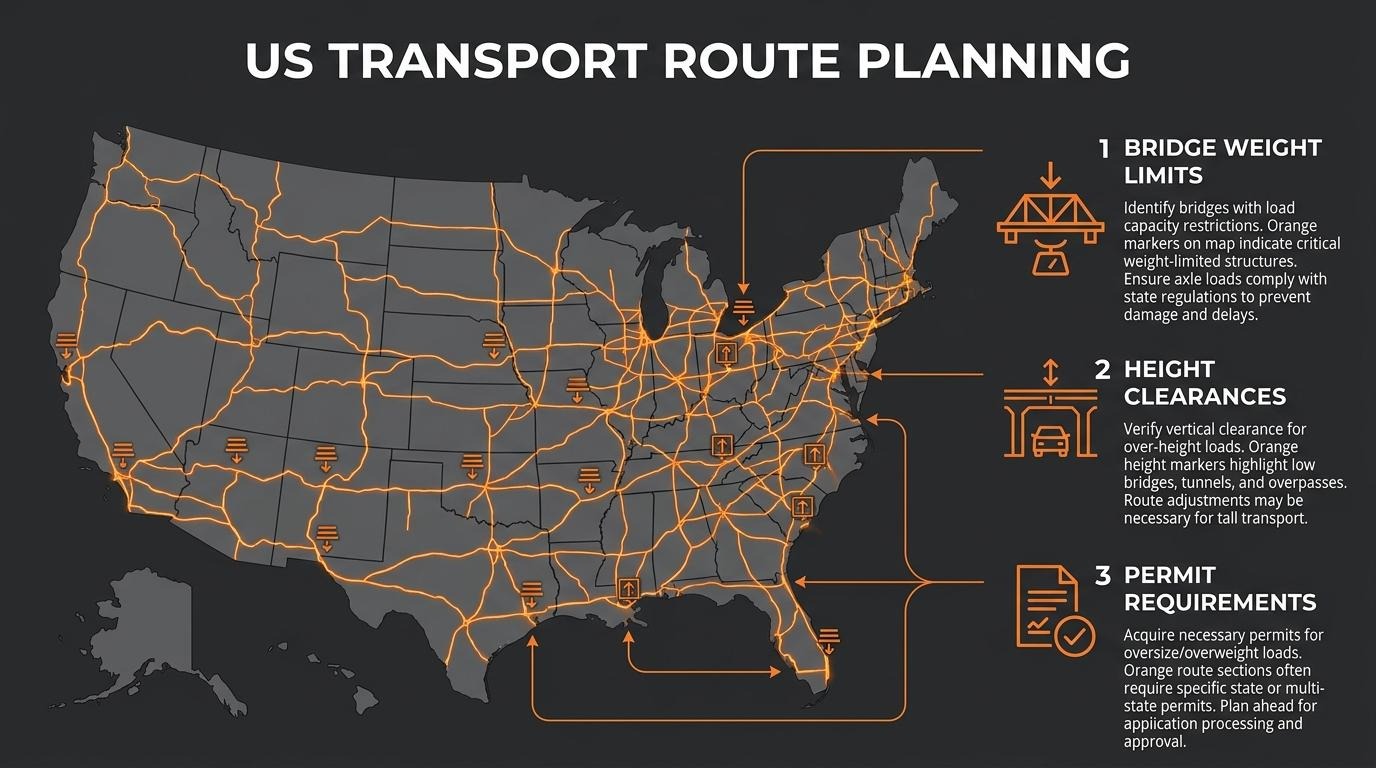
Permitting and regulatory compliance affect cross-country equipment moves by adding state-by-state requirements that must be satisfied before any oversized load departs. Most states require motor carriers to obtain a permit for freight that does not conform to standard size and weight regulations, per the Owner-Operator Independent Drivers Association. States like Florida allow self-issued trip permits for loads up to 200,000 pounds, while others use automated systems such as Maryland's Maryland One platform to streamline real-time route analysis.
For a multi-excavator project, permit requirements vary across:
Permit mismanagement on a 15-load project is not just a compliance risk; it is a scheduling risk for every unit in the convoy.
The safety measures essential for multi-excavator freight projects include proper tiedown compliance, accessory equipment securement, and force-resistance standards for cargo systems. Under 49 CFR 393.130, federal regulations require that heavy equipment weighing 10,000 pounds or more be secured with a minimum of four tiedowns affixed as close as practicable to the front and rear of the vehicle. The FMCSA further requires that accessory equipment such as hydraulic shovels be completely lowered and secured to the transport vehicle before movement begins.
Cargo securement systems must also meet minimum dynamic force thresholds:
|
Direction |
Minimum G-Force Requirement |
|
Forward deceleration |
0.8 g |
|
Rearward acceleration |
0.5 g |
|
Lateral acceleration |
0.5 g |
These standards apply to each individual excavator, making multi-unit moves a cumulative compliance obligation across every trailer in the fleet.
Coordinating a large-scale equipment move introduces compounding challenges across scheduling, communication, and environmental variables. The sections below cover staging multiple shipments, managing information flow, and responding to weather and terrain disruptions in transit.
Scheduling and staging for multiple excavator shipments works by sequencing dispatch windows, loading zones, and delivery handoffs so that each unit moves without bottlenecking others. With 15 excavators crossing multiple states, a single delayed carrier cascades across the entire fleet timeline. According to the Institute for Supply Management, efficient heavy-haul logistics strategies track KPIs including transportation cost per unit, on-time delivery rate, and damage rate to maintain operational efficiency. Each shipment requires its own permit, route approval, and driver coordination, meaning that staging must account for permit lead times in every jurisdiction crossed. Pre-assigning carriers to specific units, confirming loading sequences before departure, and building buffer windows between dispatch slots are the most effective ways to keep a multi-unit move on schedule.
The communication strategies that help minimize delays and misunderstandings are structured check-in protocols, centralized dispatch coordination, and proactive stakeholder updates. In a 15-unit cross-country move, fragmented communication is one of the fastest routes to costly delays. Heavy equipment delays are frequently attributed to four primary issues: mechanical failure, operator error, late delivery, or a lack of proper maintenance, all of which worsen when information is siloed. Transportation Management Systems (TMS) with integrated GPS tracking provide real-time fleet visibility, geofencing, and automated reporting to optimize heavy haul workflows, according to Geotab. Assigning a single point-of-contact for the client, carriers, and permitting agents eliminates the confusion that comes from multi-channel handoffs.
Weather, terrain, and unforeseen events in transit can be managed through advance forecasting, route contingency planning, and coordinated escort response protocols. No cross-country heavy haul is fully predictable, and the gap between a minor disruption and a project-halting event is often preparation. According to NOAA, weather and climate data improve the accuracy of transportation decision support systems, giving logistics providers measurable advantages in route timing. Industry professionals also emphasize the importance of coordinating with escorts and using real-time tracking to account for weather conditions and ensure on-time performance. Contingency protocols should address alternate routing for flooded or iced-over roads, standby carriers for mechanical breakdowns, and pre-approved stoppage points for severe weather holds.
With these three coordination layers in place, large-scale excavator moves gain the structural predictability needed to execute consistently across long distances.
Transporting 15 large excavators cross-country requires purpose-built trailers, structured loading protocols, and specialized handling practices. The subsections below cover trailer selection, loading execution, and damage-prevention techniques.
The types of trucks and trailers best suited for oversized construction equipment are lowboy trailers and Removable Gooseneck (RGN) trailers, paired with heavy-haul semi-trucks rated for overweight loads. Lowboy trailers provide a deck height between 18 and 24 inches and a well length of 24 to 29 feet, keeping tall excavators within legal height clearances. RGN trailers offer an added advantage: the front gooseneck detaches entirely, creating a ground-level drive-on ramp that eliminates the need for external lifting equipment during loading. For a 15-unit move, matching each excavator's weight and dimensions to the correct trailer configuration reduces permitting complications and minimizes handling risk at every stop.
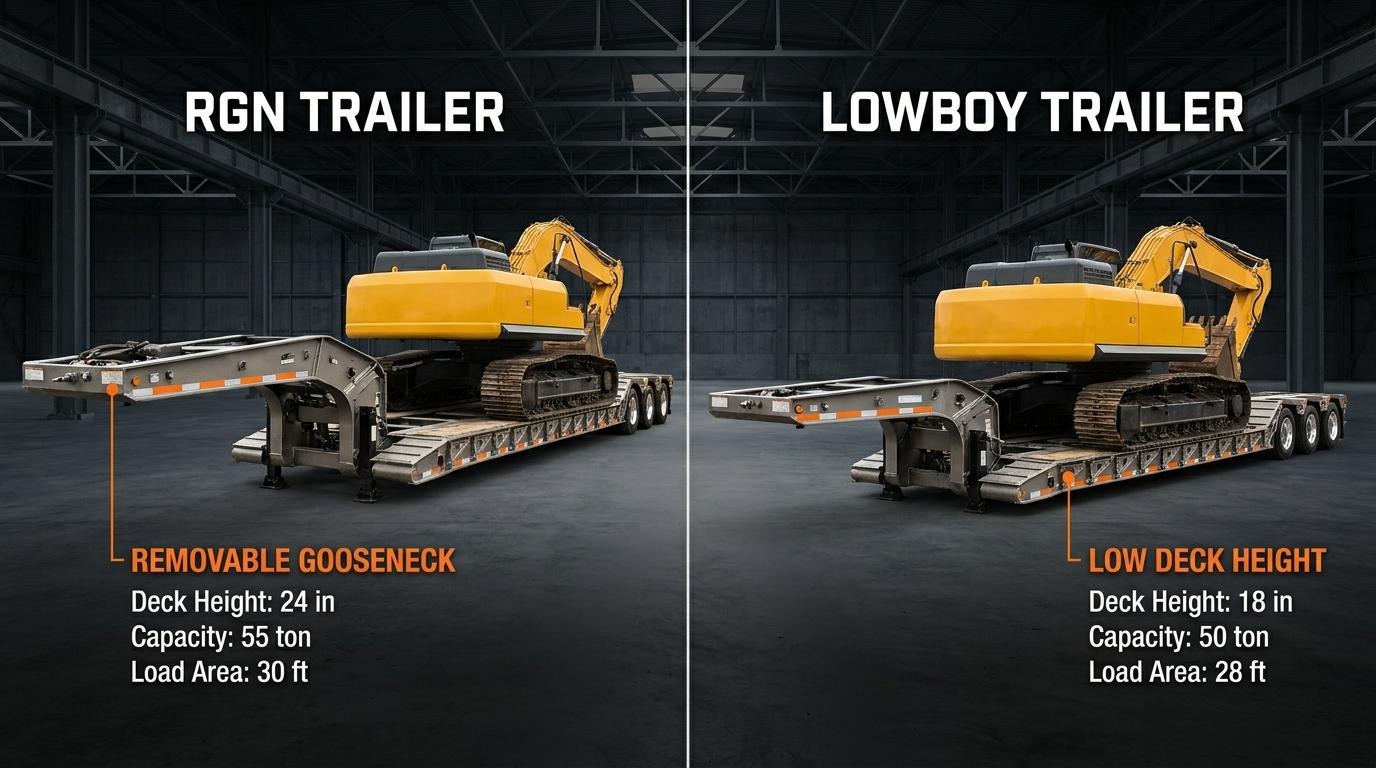
Loading and unloading multiple excavators is planned by sequencing each unit to its assigned trailer based on weight, dimensions, and delivery order, then executing each transfer through a step-by-step ground-level or ramp-based process. Federal regulations under 49 CFR 393.130 require that heavy equipment weighing 10,000 lbs or more be secured using a minimum of four tiedowns affixed as close as practicable to the front and rear of the vehicle. The FMCSA also requires that accessory equipment such as hydraulic shovels be completely lowered and secured before transport begins. Pre-loading site surveys confirm that ground conditions support trailer positioning, while a staged departure schedule prevents multiple units from loading simultaneously without adequate supervision.
Specialized handling plays a direct role in preventing equipment damage by applying engineered securement, blocking, and monitoring protocols that account for the forces acting on freight in motion. Cargo securement systems must withstand 0.8 g deceleration in the forward direction, 0.5 g rearward acceleration, and 0.5 g lateral acceleration, according to FMCSA cargo securement rules. OSHA standards further require that machinery suspended by slings, hoists, or jacks be substantially blocked or cribbed to prevent falling or shifting. Industry data shows approximately 1 to 2% of all freight shipments result in damage claims, making rigorous handling procedures a measurable factor in protecting asset value across a 15-unit fleet move.
With the right equipment and methods established, consistent execution and professional coordination become the determining factors in delivering every excavator on time and undamaged.
Bear Down Logistics maintained reliability, timeliness, and professionalism by combining GPS-enabled tracking systems, structured stakeholder communication, and proactive contingency planning. The sections below cover each pillar: the technologies driving on-time performance, the communication framework used across the project, and the protocols for managing unexpected disruptions.
The processes and technologies that enabled consistent on-time performance include Transportation Management Systems (TMS) with integrated GPS tracking, pre-cleared route data, and coordinated escort scheduling. TMS platforms provide real-time fleet visibility, geofencing, and automated reporting to optimize heavy haul workflows, according to Geotab. These tools allowed Bear Down Logistics to monitor each excavator shipment individually and flag deviations before they compounded across the 15-unit fleet. Bear Down Logistics also drew on its network of over 30,000 A+ rated carriers to assign drivers with proven heavy haul records, reducing the risk of mechanical failure or operator error, two of the four most common causes of heavy equipment delays. Carrier vetting, technology, and route pre-qualification together form the most dependable foundation for on-time delivery in large-scale equipment moves.
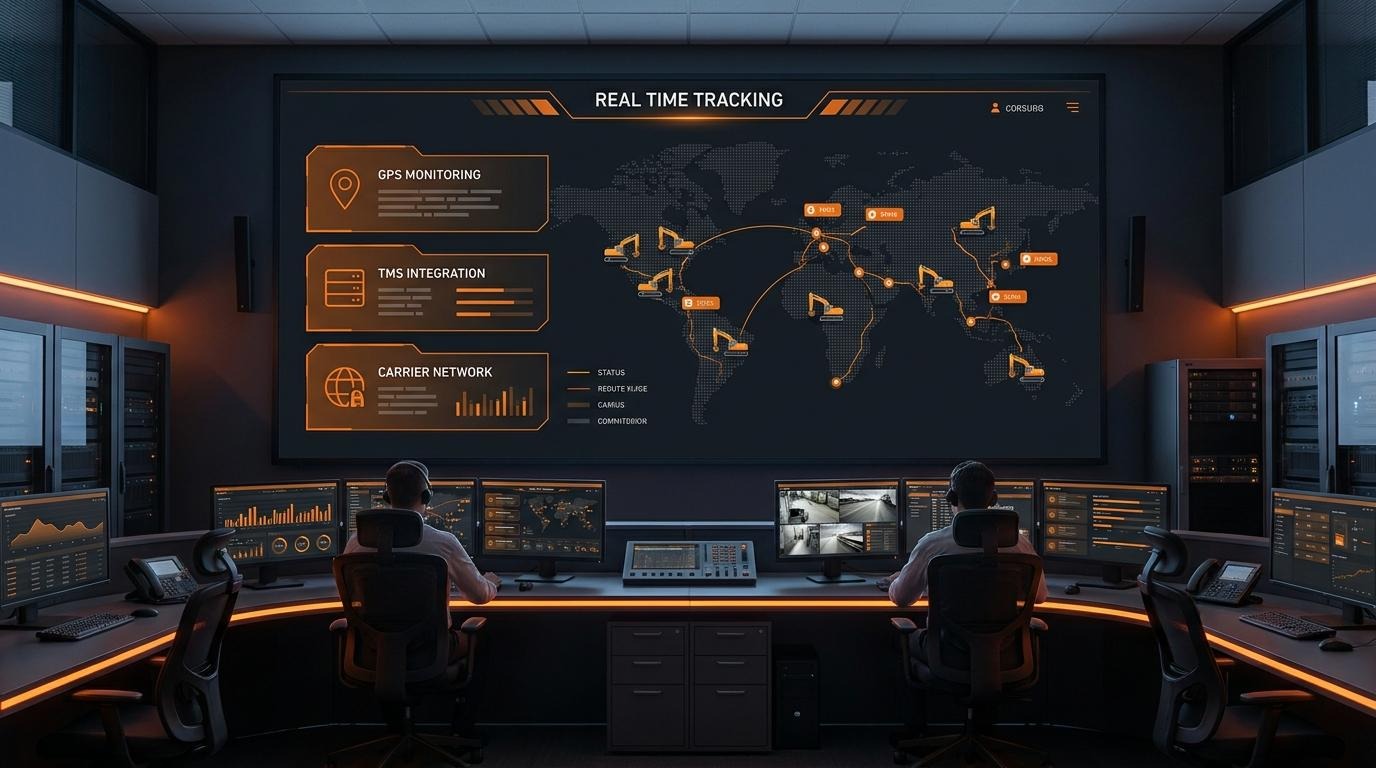
Communication was maintained among stakeholders throughout the move through centralized dispatching, real-time shipment status updates, and defined escalation contacts for the rental fleet client. For large-scale equipment moves, logistics professionals emphasize the importance of "coordinating with escorts and using real-time tracking" to account for weather conditions and ensure on-time performance, per Freedom Heavy Haul. Bear Down Logistics applied this principle by keeping the client informed at each transit milestone, from departure confirmation through state crossings to final delivery windows. Clear communication channels eliminate the ambiguity that causes costly scheduling misalignments, particularly when multiple loads move concurrently across different states.
Unexpected obstacles and schedule changes were managed during execution through contingency routing, weather monitoring integration, and rapid carrier reallocation from Bear Down Logistics' carrier network. NOAA data shows that weather and climate information improves the accuracy of transportation decision support systems, giving logistics providers an actionable lead time before conditions deteriorate. When permitting delays or road restrictions arose, Bear Down Logistics leveraged its network depth to reroute or reschedule without disrupting the overall delivery sequence. The company's core operating standard, described internally as a "genetic code of ALWAYS being consistent, reliable, and professional," meant that disruptions were treated as execution problems to solve, not reasons to miss delivery commitments.
The results and lessons learned from this case study center on three outcomes: successful on-time delivery, measurable operational improvements, and a replicable framework for large-scale equipment logistics.
The outcomes the rental fleet customer experienced upon delivery included all 15 excavators arriving on schedule, undamaged, and ready for immediate deployment. Zero damage claims were recorded across the entire fleet move, a strong result given that industry data indicates approximately 1-2% of all freight shipments result in damage claims. For a rental operation, machine availability directly drives revenue, so damage-free, on-time delivery translated into measurable business value from day one. Coordinated staging and carrier vetting were decisive factors in achieving this outcome.
The operational improvements that emerged for future heavy equipment moves include standardized carrier pre-qualification, proactive permit sequencing, and KPI-based performance tracking. According to the Institute for Supply Management, efficient heavy haul logistics focuses on KPIs such as transportation cost per unit, on-time delivery rate, and damage rate to drive continuous improvement. Applying these metrics across the 15-unit move identified staging efficiency and carrier communication as the highest-leverage variables for future multi-unit projects.
This case illustrates best practices in large-scale equipment logistics by demonstrating how coordinated planning, regulatory compliance, and real-time tracking combine to produce consistent results. Freedom Heavy Haul logistics professionals emphasize that coordinating with escorts and using real-time tracking is essential to account for weather conditions and ensure on-time performance. The 15-excavator move confirmed that these practices are not optional on complex projects; they are the baseline for professional execution. Operators who treat multi-unit moves as a system rather than a series of individual loads consistently outperform those who do not.
Bear Down Logistics supports complex heavy equipment transport projects through a carrier network, multi-state permitting expertise, and proven logistics coordination. The H3s below cover large-scale fleet relocation capabilities and the key takeaways from this excavator case study.
Yes, heavy equipment transport services from Bear Down Logistics can help with large-scale fleet relocation. Bear Down Logistics operates a network of over 30,000 A+ rated carriers specializing in heavy hauling across industries such as construction, manufacturing, and farming.
For fleet relocation projects involving multiple oversized units, three capabilities set Bear Down Logistics apart:
According to Freedom Heavy Haul, coordinating escorts and using real-time tracking are essential practices for ensuring on-time performance in large-scale equipment moves — both are central to how Bear Down Logistics operates.
The key takeaways about moving 15 excavators cross-country for a rental fleet center on planning depth, regulatory compliance, and carrier reliability. Projects of this scale demand coordinated execution across every phase, from permit acquisition to final delivery.
The most actionable lessons from this case study are:
A project moving 15 excavators cross-country is not simply a scaling exercise — it is a logistics program requiring the same rigor as an industrial relocation. Bear Down Logistics brings the carrier network, compliance knowledge, and operational consistency to execute it without compromise.
With property prices soaring and large gatherings back on the calendar, expanding your physical locations may not be in the budget. Now might be the...
Mobile medical units are an essential part of remote healthcare. They’re crucial for patients needing immediate medical attention, and their lives...

Disaster response trailers play an important role in emergency work. These units support teams when they enter areas affected by storms, floods, or...