
13 min read
What Is the Difference Between CNC Machining and Manual Fabrication?
Craftsmen Industries May 13, 2026 3:48:46 PM
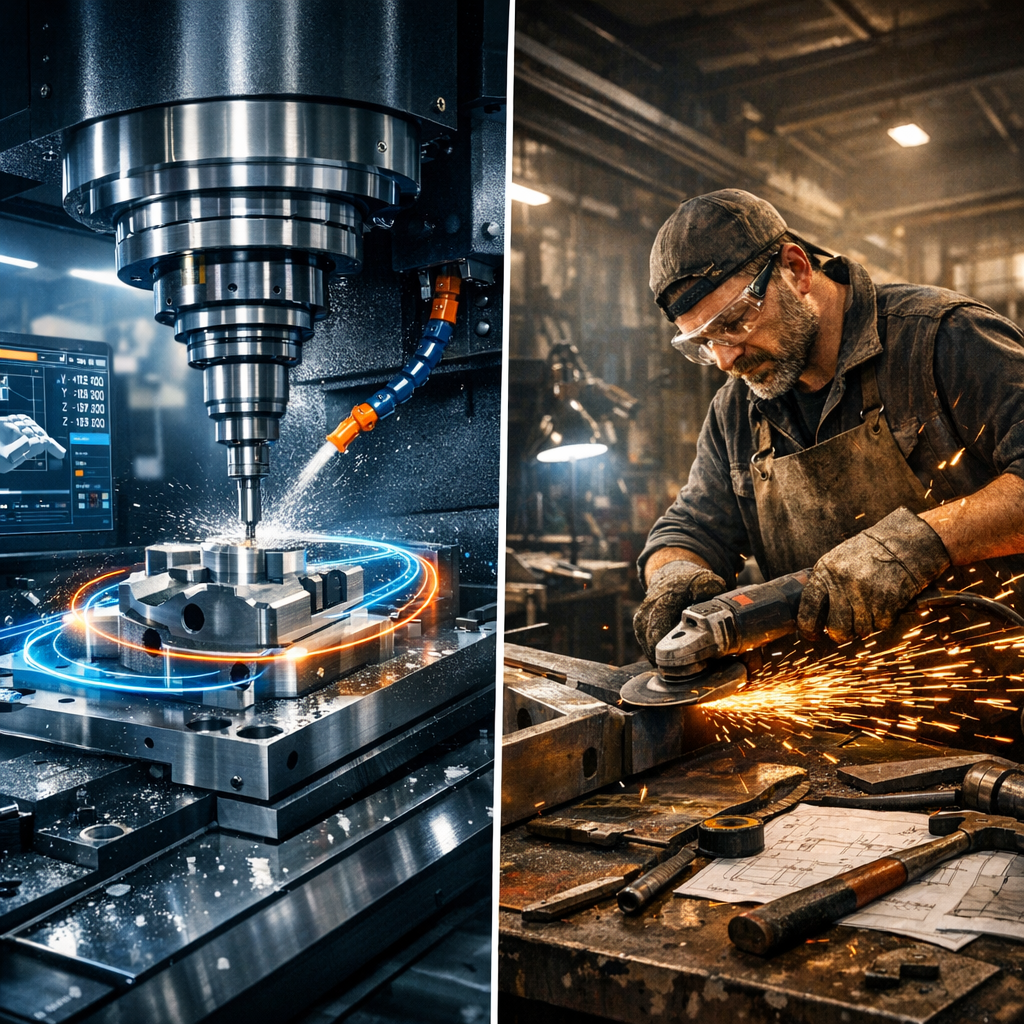
CNC machining is a computer-controlled subtractive process that removes material along programmed toolpaths, while manual fabrication relies on skilled craftspeople using hand-operated tools to cut, weld, form, and assemble components directly.
This guide covers process selection criteria, material compatibility, cost and lead time analysis, quality standards, and hybrid workflow integration.
CNC machining suits projects requiring high-volume runs, tolerances below ±0.005 inches, complex multi-axis geometries, or batch-to-batch repeatability. Automated G-code execution eliminates operator variability and enables lights-out production across hundreds or thousands of identical parts.
Manual fabrication holds the advantage for one-off custom builds, oversized structural assemblies that exceed CNC work envelopes, materials prone to delamination or burr formation under automated cutting, and on-site modifications where portable tools and real-time adaptation replace programmed rigidity.
Material choice influences process selection directly. Metals, engineered plastics, and composites requiring dimensional consistency align with CNC capabilities, while sheet metal forming, structural steel weldments, wood, and mixed-media assemblies benefit from a fabricator's tactile control.
Cost dynamics shift with volume: manual methods cost less for short runs because they skip CAD/CAM programming overhead, while CNC per-unit costs drop as batch size increases and setup amortizes. Lead times follow a similar pattern, with manual starts faster for single pieces but CNC delivering dramatically shorter cycle times once a program exists.
Both processes achieve distinct quality tiers. CNC holds ±0.001" to ±0.005" and aligns with aerospace-grade compliance frameworks, while manual fabrication meets structural and architectural standards through inspection-driven quality assurance. Combining both processes in a single vertically integrated facility captures the precision of automation alongside the adaptability of skilled hand work.
What Is CNC Machining and How Does It Work?
CNC machining is an automated manufacturing process that uses computer-programmed instructions to control machine tools, removing material from a workpiece to produce precision parts. The system converts digital design files into G-code, which directs cutting tools along precise paths across multiple axes.
CNC machining works by interpreting programmed coordinates to guide spindles, cutters, and drills through subtractive operations. According to a National Institute of Standards and Technology technical report, CNC provides automated control of machine tools via a computer, enabling the machining of complex geometries in a single setup to increase throughput and accuracy. Configurations range from 3-axis systems for simple planar cuts to 6-axis platforms capable of producing intricate contours without repositioning the workpiece.
The process follows a consistent sequence:
- A CAD model defines part geometry and dimensions.
- CAM software generates toolpaths and converts them to G-code.
- The CNC controller reads G-code and executes movements with sub-millimeter precision.
- Automated tool changers swap cutters mid-cycle for multi-feature parts.
Robotics integration and lights-out production capabilities allow CNC cells to run unattended, significantly reducing cycle times while maintaining consistent output quality. For projects requiring repeatable accuracy across hundreds or thousands of identical components, this level of automation eliminates the variability inherent in operator-dependent methods.
Understanding how CNC machining operates provides essential context for evaluating when manual fabrication offers a better fit.
What Is Manual Fabrication and How Does It Work?
Manual fabrication is the process of shaping, cutting, joining, and assembling materials using hand-operated tools and skilled human labor rather than computer-controlled automation. It works by relying on a craftsperson's direct control over each operation, from layout and cutting to welding, bending, and finishing.
Manual fabrication encompasses several core techniques:
- Cutting and shaping with hand-operated saws, shears, plasma torches, and grinders.
- Welding and joining through processes such as Shielded Metal Arc Welding (SMAW), MIG, and TIG performed by certified welders.
- Bending and forming using press brakes, rollers, and hand tools guided by operator judgment.
- Assembly and fitting where mechanical fastening, adhesive bonding, and hardware installation are performed manually or semi-automatically depending on production volume and complexity.
Each step depends on the fabricator's experience to interpret drawings, select tooling, and adapt technique in real time. This adaptability makes manual fabrication particularly effective for one-off builds, oversized structural components, and projects requiring on-site modification where programming a CNC machine would be impractical.
According to a NASA Technical Reports Server publication, manual fabrication techniques for sheet metal components typically follow learning factors of 80% to 90% during assembly and prototype phases. This learning curve reflects how skilled fabricators progressively improve efficiency with each successive unit, making the process increasingly cost-effective for short prototype runs.
For manufacturers weighing automation against hands-on methods, understanding where manual skill outperforms programmed precision is essential to selecting the right process.
When Should You Choose CNC Machining Over Manual Fabrication?
You should choose CNC machining over manual fabrication when your project demands high volume, tight tolerances, complex geometry, or consistent repeatability across production runs.
When Does Your Project Require High-Volume Production Runs?
Your project requires high-volume production runs when identical parts must be produced in quantities where manual labor becomes inefficient and cost-prohibitive. CNC machining excels here because automated tool paths execute the same program repeatedly without fatigue or variation. Once a program is proven, cycle times remain consistent whether producing 100 or 10,000 units. According to research published in Acta Mechanica et Automatica, robotics and automation in CNC machine tools significantly reduce cycle times and enable "lights-out" production. For manufacturers facing large orders with firm deadlines, CNC automation eliminates the per-unit labor scaling that makes manual fabrication unsustainable at volume.
When Do Tight Tolerances Demand CNC Precision?
Tight tolerances demand CNC precision when part specifications require dimensional accuracy that human hands cannot reliably achieve. CNC systems, driven by G-code interpreters capable of controlling 3-axis to 6-axis configurations, maintain micron-level consistency throughout a production run. Manual fabrication introduces variability from operator skill, tool wear awareness, and measurement interpretation. When engineering drawings specify tolerances below ±0.005 inches, or when mating surfaces must align across assemblies without rework, CNC machining delivers the controlled repeatability those specifications require. For projects in aerospace, medical devices, or precision industrial components, this level of accuracy is non-negotiable.
When Does Part Complexity Exceed Manual Capabilities?
Part complexity exceeds manual capabilities when geometries involve multi-axis contours, internal channels, or compound angles that cannot be reliably produced by hand. According to the Society of Manufacturing Engineers, manual assembly and joining methods are often performed manually or semi-automatically depending on production volume and complexity. This means that as geometric difficulty increases, manual processes hit a ceiling where quality and efficiency degrade simultaneously. Five-axis CNC machines handle undercuts, deep pockets, and organic surfaces in a single setup. For manufacturers weighing this transition, the challenge is real; a 2018 study in Sustainability Journal found that SMEs face a "sustainability decision-making" challenge when transitioning from manual to robotic processes, balancing labor costs against technology investment.
When Does Repeatability Matter More Than Flexibility?
Repeatability matters more than flexibility when every part in a batch must be dimensionally identical, and deviation creates downstream assembly failures or quality rejections. CNC machining guarantees this consistency because digital programs eliminate human variability between cycles. Manual fabrication offers flexibility to adapt mid-process, but each part carries slight differences from operator judgment. Industries requiring interchangeable components, such as automotive assemblies or modular industrial systems, prioritize repeatability over the adaptability manual methods provide. When your quality standards demand statistical process control across hundreds or thousands of parts, CNC is the clear choice.
With the decision criteria for CNC established, understanding when manual fabrication holds the advantage completes the picture.
When Should You Choose Manual Fabrication Over CNC Machining?
You should choose manual fabrication over CNC machining when projects involve one-off builds, oversized structural components, difficult-to-machine materials, or on-site modifications. The following scenarios outline when hand fabrication delivers superior results.
When Does a One-Off Custom Build Favor Manual Methods?
A one-off custom build favors manual methods when programming and setup costs for CNC exceed the value of a single part. CNC machining requires CAD modeling, toolpath generation, and machine calibration before cutting begins. For a unique prototype or single custom component, a skilled fabricator can interpret drawings and begin work immediately, eliminating digital setup overhead entirely. This approach proves especially practical for experiential marketing builds or specialty vehicles where no two units are identical. When production quantity is one, the craftsman's adaptability outperforms automated efficiency.
When Do Oversized or Structural Components Require Hand Fabrication?
Oversized or structural components require hand fabrication when parts exceed the physical work envelope of available CNC machines. Large-scale steel frames, structural beams, and vehicle chassis assemblies often surpass the travel limits of standard 3-axis or 5-axis machining centers. Manual processes such as MIG welding, plasma cutting, and hand fitting allow fabricators to work on components at virtually any scale without machine-size constraints. Structural weldments for mobile command centers or trailer frames, for example, are assembled in place using portable equipment rather than being constrained to a fixed machine bed.
When Does Material Type Limit CNC Feasibility?
Material type limits CNC feasibility when a substrate's properties cause tool damage, delamination, or uncontrollable burr formation during automated cutting. As Bill Kennedy, contributing editor for SME Media, observes, "The properties that enhance advanced material performance also make them more difficult to deburr and finish." Carbon fiber reinforced polymers (CFRP) produce characteristic "fuzz" or fine burrs during machining that require manual deburring solutions to resolve cleanly. Thin-gauge sheet metal prone to vibration, soft composites that delaminate under aggressive feeds, and mixed-media assemblies combining dissimilar substrates all benefit from a fabricator's tactile control and adaptive technique.
When Do On-Site Modifications Require Manual Techniques?
On-site modifications require manual techniques when components cannot be transported to a shop or when field conditions demand immediate adaptive work. Portable tools such as grinders, welders, and hand brakes allow fabricators to cut, fit, and join materials directly at installation sites. This capability proves essential for vehicle upfits, structural repairs, and retrofit installations where precise measurements must be taken from existing conditions and adjustments made in real time. The high skill requirements for this work are reflected in labor market data; according to the U.S. Bureau of Labor Statistics, tool and die makers earned a median wage of $63,180 in May 2024. For most field modification scenarios, the fabricator's ability to problem-solve on location outweighs any benefit CNC repeatability could offer.
Understanding when manual methods excel helps clarify how material selection further influences process choice.
What Materials Work Best for CNC Machining vs. Manual Fabrication?
The best materials for CNC machining include metals, engineered plastics, and composites requiring tight tolerances. Manual fabrication handles sheet metal, structural steel, wood, and mixed media more effectively.
How Does CNC Machining Perform with Metals?
CNC machining performs exceptionally well with metals, delivering repeatable precision across aluminum, steel, titanium, and high-temperature superalloys. Multi-axis configurations handle complex geometries in these materials within a single setup.
According to a NIST technical report, the RS274NGC interpreter serves as a standard G-code dialect capable of driving machining centers from 3-axis to 6-axis systems. This range of axis control allows CNC equipment to approach hard metals from multiple angles, reducing secondary operations. Aluminum machines quickly with minimal tool wear, while titanium and superalloys demand specialized tooling and slower feed rates. Advanced workpiece materials like nickel-based alloys require ceramic-impregnated nylon deburring filaments because they stay sharper longer than traditional silicon carbide abrasives.
How Does CNC Machining Perform with Plastics and Composites?
CNC machining performs well with plastics and composites when operators apply material-specific parameters for heat management and tool selection. Thermoplastics and fiber-reinforced polymers both benefit from the dimensional consistency CNC provides.
According to research from the University of Florida, high-performance plastics such as PEEK and nylon require specific CNC machining parameters to maintain tight tolerances and prevent material deformation during the cutting process. Heat buildup is the primary concern; improper speeds generate enough friction to warp or melt the workpiece. Carbon fiber reinforced polymers present a different challenge, producing fine "fuzz" burrs that demand dedicated deburring solutions. For projects requiring repeatable composite parts, CNC offers consistency that hand-trimming simply cannot match.
How Does Manual Fabrication Handle Sheet Metal and Structural Steel?
Manual fabrication handles sheet metal and structural steel through hands-on forming, welding, and fitting techniques that accommodate large-scale and one-off structural work. Skilled fabricators bend, cut, and join heavy-gauge materials where CNC envelope sizes become limiting.
According to a NASA technical report, manual fabrication techniques for sheet metal components typically follow learning factors of 80% to 90% during assembly and prototype phases. This means each successive unit requires less labor time as fabricators refine their approach. For oversized structural steel assemblies, manual processes allow in-place adjustments that programmed toolpaths cannot anticipate. The flexibility to adapt mid-build makes hand fabrication ideal for architectural steel, custom frames, and structural weldments.
How Does Manual Fabrication Handle Wood and Mixed Media?
Manual fabrication handles wood and mixed media through adaptive craftsmanship that responds to natural material variations in grain, density, and moisture content. These organic inconsistencies make full CNC automation impractical for many wood and mixed-media builds.
Key advantages of manual methods for these materials include:
- Artisans adjust cuts and joints in real time based on wood grain direction and defects.
- Mixed-media assemblies combining wood, fabric, metal, and acrylic require varied joining techniques within a single piece.
- Finishing processes like hand-sanding, staining, and laminating demand tactile feedback.
- Oversized or curved wooden components often exceed standard CNC bed dimensions.
For projects combining multiple substrates, the fabricator's judgment determines sequencing and attachment methods that no single program can automate. With material selection clarified, understanding cost implications helps determine which process fits a given budget.
How Do Costs Compare Between CNC Machining and Manual Fabrication?
Costs between CNC machining and manual fabrication depend on production volume, part complexity, and setup requirements. The following subsections break down cost factors for low-volume projects, high-volume projects, and complex geometry parts.
What Are the Cost Factors for Low-Volume Projects?
The cost factors for low-volume projects center on setup time, programming, and per-unit labor allocation. CNC machining carries higher upfront costs because each job requires CAD/CAM programming, toolpath verification, and fixture preparation before a single part is cut. Manual fabrication, by contrast, demands minimal setup; a skilled fabricator can begin work with basic layout tools and standard equipment.
According to research published in the International Journal of Productivity and Performance Management, advanced manufacturing technology implementation in SMEs often requires a specific investment threshold to offset higher setup costs compared to manual machinery. For runs under roughly 10 to 25 units, manual methods frequently deliver lower total project costs because that setup investment never amortizes across enough parts.
What Are the Cost Factors for High-Volume Projects?
The cost factors for high-volume projects shift toward cycle time, labor efficiency, and machine utilization. CNC machining reduces per-unit cost as volume increases because the initial programming and setup expense spreads across hundreds or thousands of identical parts. Automated tool changes and consistent feed rates keep cycle times short and predictable.
Manual fabrication scales poorly at volume. Each additional unit requires the same hands-on labor, and fatigue-related variability can introduce scrap costs. Key high-volume cost drivers include:
- CNC cycle time per part, which remains fixed regardless of batch size.
- Operator-to-machine ratio, since one CNC operator can monitor multiple machines simultaneously.
- Scrap and rework rates, which rise with manual repetition but stay low under CNC repeatability.
For most production runs exceeding a few dozen units, CNC machining becomes the more cost-effective path.
What Are the Cost Factors for Complex Geometry Parts?
The cost factors for complex geometry parts involve multi-axis machining capability, skilled labor rates, and achievable tolerances. CNC machines with 4- or 5-axis configurations produce intricate contours, undercuts, and compound angles in a single setup, reducing handling time and cumulative error. Programming these toolpaths costs more upfront, but the consistency eliminates costly manual rework.
Manual fabrication of complex geometries depends heavily on craftsman expertise, which commands premium labor rates. Each compound angle or tight-radius feature adds layout time and increases the risk of dimensional errors. When tolerances tighten below what hand tools reliably achieve, secondary operations or iterative fitting become necessary, further raising costs.
For parts where geometry drives the majority of manufacturing difficulty, CNC machining typically offers better cost predictability and fewer hidden expenses from rework. Understanding these cost dynamics helps determine which process suits an upcoming project's lead time and budget requirements.
How Do Lead Times Differ Between CNC and Manual Processes?
Lead times differ between CNC and manual processes primarily in setup duration, production speed, and scalability. CNC machining requires longer initial programming and setup but delivers faster per-unit cycle times at volume. Manual fabrication starts faster for single pieces but scales poorly. The break-even point between these approaches depends on batch size, part complexity, and available tooling.
A life cycle cost analysis published in the Journal of Quality in Maintenance Engineering found that while CNC machine tool acquisition costs are high, the resulting reduction in work-in-process inventory and lead times often justifies the investment for manufacturing SMEs. This trade-off defines when each process makes sense: CNC excels once programming is complete and volume absorbs setup time, while manual methods remain faster for immediate, low-quantity needs where no CAM programming or fixturing is required.
For projects requiring rapid turnaround on custom, one-off builds, manual fabrication eliminates the digital front-end entirely. Skilled fabricators can begin cutting, welding, or forming immediately from drawings. However, once a CNC program exists, subsequent parts ship dramatically faster because the machine repeats the operation without operator variability or fatigue. Understanding where your project falls on this spectrum helps determine which process delivers the shortest total lead time from order to delivery.
What Quality and Tolerance Standards Does Each Process Achieve?
Each process achieves different quality and tolerance standards based on its level of automation and control. CNC machining holds tighter dimensional tolerances, while manual fabrication relies on craftsman skill and inspection protocols.
CNC machining routinely holds tolerances of ±0.001" to ±0.005" across production runs. Computer-controlled toolpaths eliminate the variability introduced by human hand movements, producing identical parts batch after batch. For industries like aerospace and defense, this precision is non-negotiable. According to research from Stellenbosch University, quality management standards such as AS9100 are essential for aerospace SMEs to ensure compliance with aviation, space, and defense organization requirements. CNC processes align naturally with these standards because every cut follows a programmed path verified through GD&T (geometric dimensioning and tolerancing) specifications embedded in model-based technical data packages.
Manual fabrication typically achieves tolerances of ±1/16" to ±1/8", depending on the technique and the fabricator's experience. Skilled welders and metalworkers can produce structurally sound assemblies that meet building codes and structural engineering requirements, though part-to-part variation is inherently higher. Quality control in manual work depends on:
- Operator training and certification levels
- In-process measurement with calipers, gauges, and templates
- Post-fabrication inspection using visual and dimensional checks
- Weld quality testing through non-destructive examination methods
For projects requiring certified traceability, CNC machining simplifies documentation because the machine logs feeds, speeds, and tool positions automatically. Manual processes require more rigorous human-driven quality assurance workflows to achieve comparable documentation standards.
The practical takeaway is straightforward: when a project specification calls for tight, repeatable tolerances or must meet aerospace-grade compliance frameworks, CNC machining is the safer path. Manual fabrication remains fully capable for structural and architectural work where tolerances are broader and craftsmanship quality is assessed through inspection rather than programmatic control. Understanding these quality boundaries helps determine which process fits a project's compliance requirements before production begins.
Can You Combine CNC Machining and Manual Fabrication in One Project?
Yes, you can combine CNC machining and manual fabrication in one project. Hybrid workflows leverage the precision of CNC for complex components while using manual techniques for assembly, finishing, and structural work.
According to a ScienceDirect publication on future manufacturing platforms, hybrid manufacturing platforms are being developed to integrate subtractive CNC milling with additive fabrication into a single convergent manufacturing system. This convergence reflects a broader industry shift toward multi-process builds where automated and manual steps complement each other within the same production timeline.
Projects that benefit most from this combined approach include:
- Large custom structures requiring CNC-machined precision components welded into hand-fabricated frames.
- Prototypes needing CNC-cut parts assembled and finished by skilled craftspeople.
- Mixed-material builds where some substrates suit automated cutting and others demand manual forming or joining.
For manufacturers with vertically integrated capabilities, combining both processes under one roof eliminates coordination delays between separate vendors and maintains tighter quality control across every fabrication stage.
How Should You Approach Custom Fabrication Projects That Need Both CNC and Manual Processes?
You should approach custom fabrication projects that need both CNC and manual processes by partnering with a vertically integrated fabricator capable of managing both workflows under one roof. The sections below cover in-house integration benefits and key takeaways from this guide.
Can Vertically Integrated In-House Fabrication Simplify Multi-Process Builds?
Yes, vertically integrated in-house fabrication can simplify multi-process builds by consolidating CNC machining, manual welding, finishing, and assembly within a single facility. This eliminates coordination delays between outside vendors and reduces quality risks at handoff points.
According to a U.S. Nuclear Regulatory Commission report, manual welding processes like Shielded Metal Arc Welding (SMAW) are associated with specific quality issues and discontinuities not present in fully automated arc welding systems. When both processes operate under one quality management system, inspectors catch these discontinuities before components move to the next stage.
For projects requiring geometries that push conventional limits, integrated shops can also layer in additive processes alongside CNC and manual methods. Craftsmen Industries operates from a 127,000 sq. ft. facility where design, engineering, fabrication, and finishing happen in-house, giving project managers direct oversight of every process transition.
What Are the Key Takeaways About CNC Machining vs. Manual Fabrication We Covered?
The key takeaways about CNC machining vs. manual fabrication we covered are:
- CNC machining excels in high-volume production, tight tolerances, complex geometries, and repeatable output.
- Manual fabrication remains the better choice for one-off builds, oversized structural components, on-site modifications, and projects where material type limits CNC feasibility.
- Cost analysis should weigh setup investment against per-unit savings; the break-even point shifts depending on volume and complexity.
- Combining both processes in a single project delivers the precision of automation with the adaptability of skilled hand work.
- Quality standards like AS9100 apply equally to CNC and manual operations, requiring consistent inspection regardless of method.
For most custom fabrication projects, the strongest outcomes come from selecting a partner that maintains both capabilities internally rather than splitting work across multiple vendors. Craftsmen Industries brings CNC machining and manual fabrication together under one roof, managing projects from ideation to creation.