
15 min read
What Is Automation and Robotics in Modern Industrial Fabrication?
Craftsmen Industries May 13, 2026 4:09:07 PM
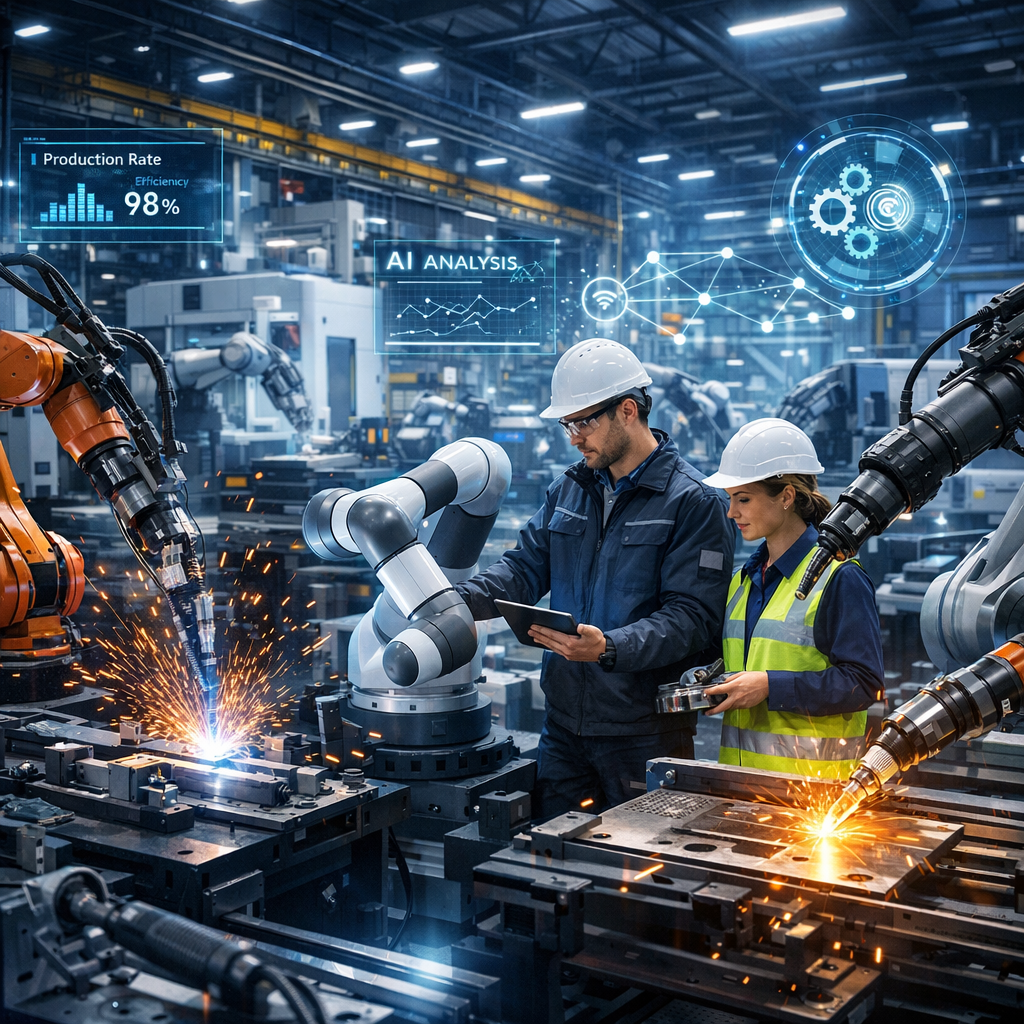
Automation and robotics in modern industrial fabrication is the application of computer-controlled machinery, reprogrammable manipulators, and intelligent software to perform manufacturing processes such as welding, cutting, assembly, and material handling with minimal human intervention.
This guide covers automation system types and robot classifications, core automated fabrication processes, measurable benefits and implementation challenges, the role of AI and IoT in connected production, and strategic approaches to automating custom and low-volume work.
We break down four distinct automation architectures (fixed, programmable, flexible, and integrated) alongside five robot categories, from 6-axis articulated arms to collaborative robots now representing nearly 10% of all new industrial installations. Each serves specific production volumes and variability requirements.
Robotic welding, automated cutting, CNC machine tending, material handling, and painting each gain distinct advantages through automation; AI-driven systems like foundational welding models now scan seams and plan paths in real time, while force-torque sensors enable sub-millimeter process control.
The operational gains are substantial: continuous lights-out production compresses lead times, sensor-integrated quality systems eliminate manual variability, and robotic cells remove workers from hazardous environments. Over time, compounding efficiency improvements lower per-unit costs as systems mature.
Implementation demands realistic planning around capital investment, workforce upskilling, legacy system integration, and maintenance strategies. We address each barrier with specific data on cost thresholds, training requirements, and predictive maintenance returns.
For custom fabricators, collaborative robots, digital twins, and programmable platforms now make short-run and one-off builds economically viable with automated equipment; vertically integrated operations that control their automation stack in-house respond faster and iterate without third-party dependencies.
What Are the Key Types of Automation Used in Industrial Fabrication?
The key types of automation used in industrial fabrication are fixed, programmable, flexible, and integrated automation. Each type serves different production volumes and product variability requirements.
Fixed Automation
Fixed automation is a production system designed for high-volume manufacturing of standardized products, characterized by custom-designed equipment. The machinery performs a single set of operations continuously, making it ideal for dedicated production lines where output volume justifies the initial engineering investment. Because the equipment configuration is permanent, changeover to new products requires significant retooling. According to Wevolver, this system architecture relies on purpose-built mechanical and electrical components that execute repetitive sequences at maximum speed. For fabricators producing large quantities of identical parts, fixed automation delivers the lowest per-unit cost.
Programmable Automation
Programmable automation allows for changes in the sequence of operations to accommodate different product configurations, making it suitable for batch production. Operators reprogram the equipment between production runs, adjusting parameters for each new batch. While changeover periods reduce overall throughput compared to fixed systems, this approach provides the flexibility needed when product designs shift periodically. According to EAM Inc., the reprogrammable nature of these systems makes them practical for mid-volume fabrication environments where multiple product variants share common equipment.
Flexible Automation
Flexible automation systems are capable of producing a variety of products with minimal changeover time, often utilizing computer-controlled machines and robots. Unlike programmable systems that require downtime between batches, flexible configurations switch between product types almost instantaneously through software commands. This makes them well suited for fabrication operations handling frequent design changes or mixed-model production schedules. For custom fabrication environments, flexible automation represents the most adaptable option without sacrificing throughput.
Integrated Automation
Integrated automation systems are comprehensive frameworks that automate an entire manufacturing process through computer control. These systems connect design, production planning, machining, assembly, quality inspection, and material handling into a unified digital workflow. According to Conger.com, this level of integration eliminates manual handoffs between process stages, reducing errors and cycle time across the full production chain. For fabricators managing complex, multi-step builds, integrated automation ensures every subsystem communicates seamlessly, from initial CAD files through final inspection.
Understanding these automation categories helps fabricators match the right system architecture to their production demands and product complexity.
What Types of Industrial Robots Are Used in Fabrication?
The types of industrial robots used in fabrication include articulated robots, SCARA robots, Cartesian robots, collaborative robots, and delta robots. Each type serves distinct fabrication tasks based on reach, payload, speed, and workspace requirements.
Articulated Robots
Articulated robots are classified by the number of rotational axes they possess. According to a NIST manufacturing innovation blog, the most common configuration is the 6-axis articulated robot, which provides maximum flexibility for complex fabrication tasks such as welding, painting, and material handling. Six rotational joints allow the end effector to reach virtually any position and orientation within the work envelope, making these robots the most versatile option for multi-step fabrication processes. Their dexterity comes at the cost of requiring more sophisticated programming and calibration compared to simpler configurations.
SCARA Robots
SCARA robots (Selective Compliance Articulated Robot Arm) excel at vertical assembly tasks. Their design provides rigidity in the vertical axis while allowing compliance in the horizontal plane, making them well-suited for operations such as inserting pins without binding. This mechanical characteristic makes SCARA robots ideal for:
- Pick-and-place operations requiring vertical precision
- Electronic component insertion
- Screw-driving and fastening applications
- Small parts assembly on flat surfaces
For fabrication environments that require rapid, repeatable vertical motion without the complexity of a full 6-axis system, SCARA robots offer an effective middle ground between cost and capability.
Cartesian Robots
Cartesian robots typically consist of three or more linear actuators arranged along the X, Y, and Z axes. Their linear motion system can be elevated above the workspace to maximize floor space and accommodate a wide range of workpiece sizes. Because each axis moves independently in a straight line, programming is intuitive and positioning accuracy is high. These robots are commonly deployed for:
- CNC machine tending and part loading
- Dispensing adhesives or sealants along defined paths
- Large-format cutting and drilling operations
- Overhead gantry applications spanning wide work areas
Collaborative Robots
Collaborative robots (cobots) are industrial robots designed to work safely alongside human operators without traditional safety caging. According to the International Federation of Robotics, newly deployed collaborative robots grew by 31% to almost 55,000 units in 2022, representing 9.9% of total industrial robots installed. At Brimind, an Italian manufacturer, deploying two GoFa cobots on a sensor assembly line increased productivity from near 90% to 97% Overall Equipment Effectiveness while reducing scrap to near zero. With payload capacities now ranging from 6 to 30 kilograms across models like OMRON's TM S Series, cobots support palletizing, inspection, pick-and-place, and precision assembly tasks.
Delta Robots
Delta robots, also known as "spider robots," use three base-mounted motors to actuate control arms that position the wrist. This parallel-link design enables rapid movement ideal for high-speed operations with light loads. Because the motors remain stationary at the base rather than moving with the arm, the lightweight linkage achieves exceptional acceleration. Delta robots are predominantly used for high-speed sorting, packaging, and pick-and-place applications where cycle time is the primary constraint.
With the global operational stock reaching 4,664,000 units in 2024, selecting the right robot type for each fabrication process directly impacts throughput, quality, and return on investment.
What Fabrication Processes Are Most Commonly Automated?
The fabrication processes most commonly automated include welding, cutting, material handling, assembly, CNC machining, and painting. Each process benefits from robotics in distinct ways.
How Is Robotic Welding Used in Industrial Fabrication?
Robotic welding is used in industrial fabrication to perform repetitive, high-precision joins with consistent quality across production runs. Modern systems combine robot arms with vision sensors, force-torque sensing, and laser trackers to monitor seam alignment and adjust parameters in real time.
According to Assembly Magazine, Path Robotics has introduced Obsidian, a foundational AI model for welding that uses a proprietary vision system to scan every welding seam and develop weld and path plans in real time, adjusting for heat distortion. This represents a shift from pre-programmed paths to adaptive systems that respond to part variability. For fabricators handling custom or mixed-material builds, AI-driven welding reduces rework and eliminates the bottleneck of manual programming between jobs.
How Does Automated Cutting and Laser Processing Work?
Automated cutting and laser processing works by directing high-energy beams or plasma arcs along computer-generated toolpaths to separate material with sub-millimeter accuracy. CNC-controlled laser cutters, plasma tables, and waterjet systems receive geometry directly from CAD files, eliminating manual layout.
These systems maintain consistent kerf width and edge quality across thousands of parts without operator fatigue. Nesting software optimizes sheet utilization automatically, reducing material waste. For complex profiles or tight tolerances on structural steel and specialty alloys, automated cutting delivers repeatability that manual methods cannot sustain across high-volume or mixed-part production schedules.
How Are Robots Applied in Material Handling and Assembly?
Robots are applied in material handling and assembly to move, position, and join components with speed and precision that reduces cycle times. Cobots and industrial manipulators perform pick-and-place, palletizing, and part-feeding tasks across fabrication workflows.
According to Assembly Magazine, Universal Robots' UR18 cobot delivers a 950-millimeter reach and motion speeds up to 4 meters per second, suitable for pick-and-place, assembly, and material handling applications. Six-axis force-torque sensors from manufacturers like SCHUNK enable accurate monitoring across six degrees of freedom, supporting quality control during assembly operations. These capabilities make robotic handling especially valuable where heavy or repetitive lifts would otherwise expose workers to injury.
How Does Automated CNC Machining Integrate with Robotics?
Automated CNC machining integrates with robotics through robotic loading, unloading, and in-process part transfer that keeps spindles running continuously. Robots feed raw stock into machining centers, reposition workpieces between operations, and move finished parts to inspection or secondary processes.
According to Assembly Magazine, Dobot Robotics' CR 30H cobot offers a 30-kilogram payload and joint speeds up to 300 degrees per second, with motion control technology that increases efficiency by up to 20 percent. Despite these gains, a 2023 McKinsey survey found that 42 percent of respondents cite challenges finding holistic, end-to-end solution providers for robotics integration. Partnering with vertically integrated fabricators who control machining and automation under one roof simplifies this complexity considerably.
How Is Robotic Painting and Coating Applied in Fabrication?
Robotic painting and coating is applied in fabrication to deliver uniform film thickness, consistent finish quality, and reduced material waste across complex geometries. Programmed spray robots follow precise paths that maintain optimal gun-to-surface distance and overlap patterns throughout each cycle.
Key advantages of robotic painting include:
- Eliminating human exposure to volatile organic compounds and isocyanates.
- Reducing overspray by 30 to 50 percent compared to manual application.
- Maintaining consistent mil thickness on curved, recessed, or multi-angle surfaces.
- Enabling rapid color or coating changeovers through automated purge and fluid-switching systems.
For fabricators producing custom assets at scale, robotic coating ensures every unit meets the same visual and protective standards regardless of batch size.
With these core processes automated, the next consideration is understanding the measurable benefits automation delivers across an entire fabrication operation.
What Are the Benefits of Automation and Robotics in Fabrication?
The benefits of automation and robotics in fabrication include faster production speed, higher precision, improved safety, lower long-term costs, and relief from labor shortages.
How Does Automation Improve Production Speed and Throughput?
Automation improves production speed and throughput by enabling continuous, uninterrupted operation cycles that eliminate human fatigue constraints. Robotic systems execute repetitive tasks at consistent velocities without breaks, shift changes, or slowdowns. Automated cells can run lights-out manufacturing overnight, compressing lead times that manual processes cannot match. For fabrication shops handling high-volume runs, this translates to more parts completed per shift with predictable cycle times. The compounding effect across multiple stations means that even modest per-task speed gains multiply into substantial throughput increases across an entire production line.
How Do Robots Enhance Precision and Quality Consistency?
Robots enhance precision and quality consistency by eliminating variability inherent in manual operations. According to Economy Insights, advanced robotics integration enhances the precision of high-volume assembly lines by combining robots with machine vision, force-torque sensing, adaptive grippers, simulation software, quality-control systems, plant data, and upstream production planning.
These integrated sensor technologies allow robotic systems to:
- Detect sub-millimeter positional deviations in real time.
- Apply uniform force across every weld, cut, or assembly joint.
- Self-correct for thermal expansion and material inconsistencies.
- Maintain identical output quality from the first unit to the ten-thousandth.
This level of repeatability is virtually impossible to sustain through manual fabrication alone, particularly across multi-shift operations.
How Does Automation Reduce Workplace Safety Risks?
Automation reduces workplace safety risks by removing human operators from hazardous tasks such as heavy lifting, high-temperature welding, and repetitive motions that cause musculoskeletal injuries. Robots handle toxic fumes, sharp materials, and confined-space work without injury exposure. According to a McKinsey analysis, robotic automation can reduce costs by 30 to 60 percent while increasing delivery quality in operations centers, a dual benefit that reflects fewer error-related incidents alongside productivity gains. For any fabrication facility, delegating dangerous processes to automated systems is one of the most immediate and measurable safety improvements available.
How Do Robotics Lower Long-Term Fabrication Costs?
Robotics lower long-term fabrication costs through compounding efficiency gains over time. According to the Information Technology and Innovation Foundation, for every doubling of robotics adoption, robotics companies reduce costs and improve quality. This learning-curve effect means early investment in automation pays dividends as systems mature and operators optimize programming.
Key cost reduction drivers include:
- Decreased material waste from precision cutting and joining.
- Lower rework rates due to consistent quality output.
- Reduced overtime labor expenses through continuous automated operation.
- Extended equipment lifespan through predictive maintenance integration.
The initial capital outlay, while significant, is offset by these cumulative savings within a relatively short payback period for most high-volume fabrication operations.
How Does Automation Address Skilled Labor Shortages?
Automation addresses skilled labor shortages by filling production gaps that unfilled positions would otherwise create. The manufacturing sector faces a structural workforce deficit; existing employees can be redeployed from repetitive manual tasks to higher-value roles such as programming, quality oversight, and process engineering. Collaborative robots are particularly effective here because they work alongside remaining staff rather than replacing entire teams. This approach allows fabrication shops to maintain or increase output without competing for an increasingly scarce pool of skilled welders, machinists, and assemblers.
With cost, quality, and workforce benefits established, the practical challenges of implementing these systems deserve equal consideration.
What Are the Challenges of Implementing Robotics in Fabrication?
The challenges of implementing robotics in fabrication include high capital costs, workforce skill gaps, integration complexity with legacy systems, and ongoing maintenance risks. Each obstacle requires strategic planning to overcome.
How Do High Capital Costs Affect Adoption Decisions?
High capital costs affect adoption decisions by creating significant financial barriers that delay or prevent automation investments, particularly for mid-size fabricators. According to a McKinsey survey, 71% of respondents cited the capital cost of robots as the primary challenge to automation adoption, while 61% pointed to a general lack of experience with automation. These two factors combined mean many companies stall at the evaluation stage, unable to justify upfront expenditure without clear ROI projections. For custom fabrication environments where production volumes vary, the financial calculus becomes even more difficult to resolve favorably.
What Workforce Training Is Needed for Robotic Systems?
Workforce training needed for robotic systems spans programming, operation, safety compliance, and troubleshooting. Operators must learn robot teach-pendant programming, coordinate system setup, and path planning. Maintenance technicians require training in servo motor diagnostics, sensor calibration, and controller software updates. Safety training aligned with ISO 10218 standards is essential for all personnel working near robotic cells. Given that 40% of skill requirements in advanced manufacturing will evolve over the next five years, according to the World Economic Forum's 2023 Future of Jobs report, ongoing upskilling programs are not optional. Manufacturers who treat training as a one-time event rather than a continuous investment consistently underperform in automation utilization.
How Do Integration Complexities Impact Legacy Operations?
Integration complexities impact legacy operations by forcing manufacturers to bridge incompatible communication protocols, outdated PLC architectures, and physical workspace constraints not designed for robotic cells. Older equipment often lacks digital interfaces, requiring custom middleware or retrofit hardware to communicate with modern robotic controllers. Additionally, 42% of survey respondents cite difficulty finding holistic, end-to-end solution providers capable of addressing the full scope of robotics technologies across their operations. Floor layouts designed decades ago rarely accommodate the safety zones, cable routing, and sensor arrays that robotic systems demand, making phased integration the only practical approach for most legacy facilities.
What Maintenance and Downtime Risks Come with Automation?
Maintenance and downtime risks that come with automation include scheduled servicing interruptions, unexpected component failures, and calibration drift. Maintenance-related downtime accounts for 15% of lost production time in automated plants, according to PatentPC data on robotics operating efficiency. Annual maintenance costs typically range between 5% and 12% of the robot's original purchase price, covering:
- Servo motor and gearbox replacement
- Sensor recalibration and software updates
- Lubrication and belt wear inspection
- Controller firmware patching
Predictive maintenance strategies, which use vibration analysis and thermal monitoring, can improve robot uptime by up to 25%. For fabricators running custom builds on tight deadlines, even brief unplanned stoppages can cascade into missed delivery windows.
Understanding these implementation challenges helps fabricators plan realistic automation roadmaps with proper budgeting and phased deployment.
How Do AI and Machine Learning Enhance Industrial Robotics?
AI and machine learning enhance industrial robotics by enabling real-time decision-making, adaptive process control, and predictive maintenance capabilities that traditional programming cannot achieve. These technologies transform robots from fixed-sequence machines into intelligent systems that learn, adapt, and optimize continuously.
Machine learning algorithms allow industrial robots to process sensor data, adjust parameters mid-operation, and improve performance over time without manual reprogramming. In welding applications, for example, Path Robotics introduced Obsidian, a foundational AI model that uses a proprietary vision system to scan every welding seam and develop weld and path plans in real time, adjusting for heat distortion, according to Assembly Magazine. This represents a shift from pre-programmed paths to autonomous decision-making at the tool level.
Predictive maintenance is another critical application where AI delivers measurable value. By analyzing vibration patterns, temperature data, and operational cycles, machine learning models identify component degradation before failure occurs. Given that unplanned downtime due to robot failure costs manufacturers an average of $260,000 per hour, the economic case for AI-driven maintenance is compelling.
AI-powered machine vision systems enable robots to handle variability in parts, positions, and environmental conditions. Rather than requiring exact fixture placement, vision-guided robots can identify and adapt to inconsistencies in real time. ABB's visual-servoing High Speed Alignment software demonstrates this capability by reducing cycle times by 70 percent while improving accuracy by 50 percent in electronics manufacturing applications.
For fabricators working with custom and variable production runs, AI removes one of the biggest historical barriers to robotic adoption: the cost and time of programming each new part. When a robot can interpret geometry, plan paths, and adjust execution autonomously, the economics of automation shift dramatically in favor of low-volume and mixed-production environments.
With intelligent systems handling real-time adaptation, the next layer of connectivity through IoT further amplifies these capabilities across entire fabrication networks.
What Role Does IoT Play in Automated Fabrication Systems?
IoT plays a central role in automated fabrication systems by connecting machines, sensors, and control platforms into a unified data network that enables real-time monitoring, predictive maintenance, and process optimization. This connectivity transforms isolated equipment into intelligent, communicating assets.
Sensor-equipped robots and CNC machines transmit operational data continuously, allowing manufacturers to detect anomalies before failures occur. According to PatentPC, predictive maintenance can improve robot uptime by up to 25%, while unplanned downtime due to robot failure costs manufacturers an average of $260,000 per hour. These figures underscore why IoT-driven condition monitoring has become essential rather than optional.
IoT networks feed data into centralized dashboards where production managers can track cycle times, energy consumption, and equipment health across entire fabrication lines simultaneously. When combined with edge computing, this architecture reduces latency in decision-making, enabling automated systems to self-adjust parameters without waiting for cloud-based processing.
For custom fabrication environments where production runs vary significantly, IoT provides the flexibility to reconfigure workflows digitally. Connected systems share job specifications across workstations automatically, reducing manual setup errors and changeover time. This capability proves especially valuable in facilities handling diverse project types, from industrial structures to specialized vehicle builds.
The integration of IoT with automated fabrication ultimately creates a feedback loop: sensors collect performance data, analytics identify optimization opportunities, and connected controllers implement adjustments in near real-time, driving continuous improvement across operations.
How Is Automation Changing Custom and Low-Volume Fabrication?
Automation is changing custom and low-volume fabrication by making collaborative robots, programmable systems, and digital twins accessible for short runs and one-off builds. The following sections explore how each technology supports small-batch flexibility.
How Do Collaborative Robots Enable Small-Batch Production?
Collaborative robots enable small-batch production by working alongside human operators without safety caging, allowing rapid task reassignment between unique parts. Their lightweight design and intuitive programming let fabricators teach new motions in minutes rather than days.
According to the International Federation of Robotics, newly deployed collaborative robots grew by 31% to almost 55 thousand units in 2022, representing 9.9% of total industrial robots installed. This surge reflects growing demand from shops that produce custom work in limited quantities, where traditional fixed automation cannot justify its setup costs. For fabricators handling diverse one-off projects, cobots represent the most practical entry point into automation without sacrificing the flexibility that custom work demands.
How Does Programmable Automation Support One-Off Builds?
Programmable automation supports one-off builds by allowing operators to change the sequence of operations through software rather than physical retooling. This capability makes it suitable for batch production where each run may involve a different product configuration.
When a fabricator receives a unique design, programmable systems accept new instructions and execute modified cutting paths, weld sequences, or assembly routines without mechanical changeover. The distinction matters for custom shops: fixed automation locks equipment into a single product geometry, while programmable platforms adapt to each new specification digitally. This flexibility is what makes single-piece and short-run fabrication economically viable with automated equipment.
How Do Digital Twins Streamline Custom Fabrication Workflows?
Digital twins streamline custom fabrication workflows by creating virtual replicas of physical production systems that simulate toolpaths, robot behavior, and process variables before any material is cut. Siemens describes robotics virtual commissioning as the use of a digital twin to test actual control logic and planned robot behavior before deployment, reducing debugging, rework, and startup delays on the live line.
For custom builds where first-article success is critical, this pre-validation eliminates costly trial-and-error on expensive materials. The global digital twin market reflects this value; MarketsandMarkets projects growth from USD 21.14 billion in 2025 to USD 149.81 billion by 2030. In low-volume fabrication, where margins depend on getting it right the first time, digital twins convert uncertainty into predictable outcomes.
With custom fabrication increasingly supported by these technologies, emerging trends in AI and advanced sensing are accelerating adoption further.
What Emerging Trends Are Shaping the Future of Robotic Fabrication?
The emerging trends shaping the future of robotic fabrication include digital twin expansion, collaborative robot market growth, generative AI for production planning, and shifting global deployment patterns.
The global digital twin market reflects one of the most significant shifts in robotic fabrication strategy. According to MarketsandMarkets, this market is expected to grow from USD 21.14 billion in 2025 to USD 149.81 billion in 2030 at a CAGR of 47.9%. Digital twins allow manufacturers to simulate, test, and optimize robotic workflows before committing physical resources, reducing commissioning errors and accelerating time-to-production.
Collaborative robots represent another accelerating trend. The global collaborative robot market is projected to grow from USD 1.42 billion in 2025 to USD 3.38 billion by 2030 at a CAGR of 18.9%. This growth is driven partly by workforce constraints; the IFR projects more than 2.1 million manufacturing jobs in the U.S. will remain unfilled by 2030, making cobots essential for bridging labor gaps without full-scale automation overhauls.
Generative AI is reshaping production planning by analyzing historical data, real-time machine status, and inventory levels to optimize scheduling decisions. When paired with robotic systems, this capability removes guesswork from sequencing complex fabrication tasks.
Global deployment geography continues to shift as well. Asia accounted for 74% of new industrial robot deployments in 2024, compared with 16% in Europe and 9% in the Americas. China alone represented 54% of global deployments with 295,000 units installed. For domestic fabricators, this concentration underscores the competitive urgency of adopting advanced robotic capabilities.
In-house production paired with robotics can shorten lead times and boost market responsiveness compared to outsourcing, particularly for custom builds where iteration speed determines project success. As Bill Gates noted, "automation applied to an efficient operation will magnify the efficiency," while applying it to an inefficient one magnifies the inefficiency. This principle makes strategic planning inseparable from technology adoption.
For fabricators evaluating where to invest, prioritizing digital twins and collaborative robots offers the strongest near-term returns given current labor market realities and the pace of AI integration into manufacturing workflows.
How Should You Approach Automation in Custom Industrial Fabrication?
You should approach automation in custom industrial fabrication by matching technology to your operation's efficiency level and production variability. The sections below cover how vertical integration accelerates automated custom builds and the key takeaways for applying robotics strategically.
Can Vertically Integrated In-House Fabrication Deliver Automated Custom Builds Faster?
Yes, vertically integrated in-house fabrication can deliver automated custom builds faster by consolidating design, engineering, and production under one roof. In-house production shortens lead times and boosts market responsiveness compared to outsourcing manufacturing to third parties, according to NetSuite. When programmable and flexible automation systems operate within a single facility, changeover delays between custom projects shrink because teams control every stage. Craftsmen Industries operates from a 127,000 sq. ft. vertically integrated facility in St. Charles, Missouri, where in-house design, engineering, fabrication, printing, and installation enable complete project control. This structure eliminates handoff gaps that fragment timelines in outsourced workflows, making it well suited for one-off and low-volume custom fabrication.
What Are the Key Takeaways About Automation and Robotics in Modern Industrial Fabrication?
The key takeaways about automation and robotics in modern industrial fabrication are:
- Automation magnifies whatever it is applied to; efficient operations become more efficient, while inefficient ones become worse.
- Capital cost remains the primary barrier, cited by 71% of respondents in a McKinsey survey, followed by a general lack of experience with automation at 61%.
- Finding holistic, end-to-end solution providers remains difficult for 42% of organizations evaluating robotics technologies.
- Collaborative robots, flexible automation, and digital twins are closing the gap between high-volume production and custom, low-volume work.
- Vertically integrated fabricators that control their automation stack in-house can respond faster and iterate without third-party dependencies.
For custom fabrication specifically, the most effective strategy pairs programmable automation with skilled human oversight, reserving fixed automation only for truly repetitive sub-processes. Craftsmen Industries applies this principle through its end-to-end capabilities, bringing clients from ideation to creation while maintaining the flexibility that one-off industrial builds demand.