
16 min read
What Are the Most Important Routine Safety Tips for Medical Trailers?
Craftsmen Industries May 13, 2026 1:57:59 PM
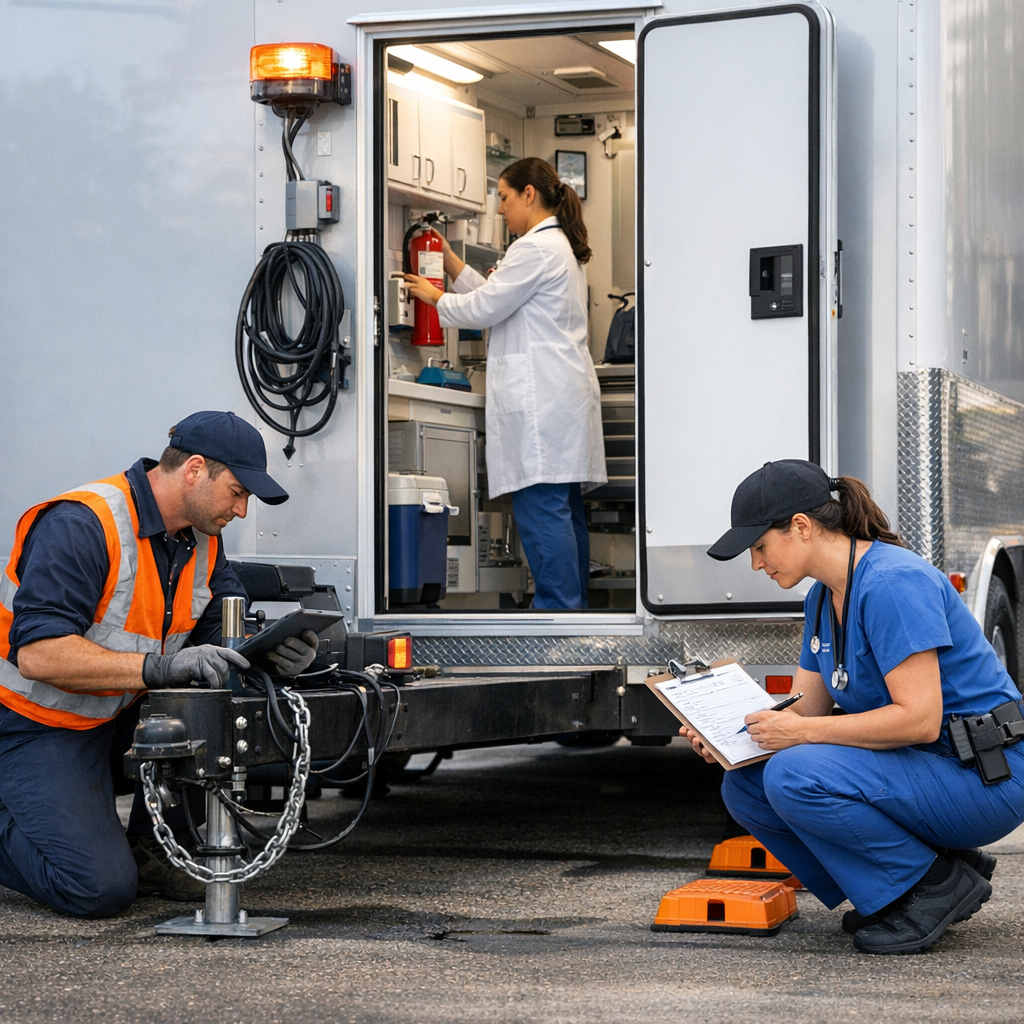
Routine safety tips for medical trailers are systematic inspection and maintenance practices that protect patients, staff, and equipment across every phase of mobile clinical operation. These protocols address hazards unique to mobile healthcare: transport stress on mechanical and electrical systems, compact workspaces that concentrate clinical risks, and variable deployment conditions that fixed facilities never encounter.
This guide covers pre-trip mechanical inspection, interior clinical safety, electrical and HVAC system maintenance, infection control and sanitation, regulatory compliance and documentation, weather and environmental preparedness, staff training, and how purpose-built trailer design eliminates hazards at the engineering level.
Pre-trip inspections target the systems most vulnerable to road stress, including tire tread depth, hitch security, exterior lighting, leveling jack function, and brake response under realistic load conditions.
Interior checks focus on maintaining clear emergency exits, current fire suppression equipment on NFPA-mandated schedules, secure handrails and anti-slip surfaces, properly anchored medical devices, and fully stocked sharps and biohazard disposal stations.
Electrical and HVAC maintenance ensures stable generator or shore power grounding, functional GFCI protection in wet clinical areas, consistent temperature and air quality control, and circuit breaker integrity against transit vibration damage.
Infection control protocols require EPA-registered disinfection between patients, adequate air exchange rates with HEPA filtration, and segregated medical waste handling with scheduled licensed removal.
Regulatory compliance spans OSHA workplace standards, ADA accessibility requirements, and FMCSA vehicle inspection cycles, all supported by centralized documentation on daily, monthly, and annual schedules.
Weather preparedness and staff training ensure teams can secure trailers during storms, prevent water intrusion, manage extreme temperatures, and execute every protocol confidently under real conditions. Custom fabrication by Craftsmen Industries integrates these safety features directly into each unit's design.
Why Is a Routine Safety Protocol Essential for Medical Trailers?
A routine safety protocol is essential for medical trailers because these mobile clinical environments face unique hazards that fixed facilities do not, including transport stress, variable site conditions, and compact workspace constraints. Mobile health clinics now serve millions of patients annually, making systematic safety checks critical to protecting both staff and patients.
Healthcare workers already face elevated injury risks. According to a 2017 Bureau of Labor Statistics report, private industry hospital workers experience 6.0 injury and illness cases per 100 full-time workers, a rate higher than manufacturing and construction. Medical trailers concentrate these same hazards into smaller, mobile spaces where equipment shifts during transit, electrical systems depend on temporary power sources, and infection control must be maintained without permanent infrastructure.
The operational demands are significant. A 2020 study published in the International Journal of Equity in Health estimated 5.2 to 7.0 million annual visits to mobile health clinics nationwide. Each visit depends on properly functioning equipment, stable utilities, and sanitary conditions that only consistent safety protocols can guarantee. Without routine checks, small issues like a loose handrail, an expired fire extinguisher, or a faulty ground-fault circuit interrupter can escalate into serious incidents.
A structured safety protocol also supports regulatory compliance across multiple overlapping frameworks. Medical trailers must satisfy OSHA workplace safety standards, ADA accessibility requirements, FMCSA vehicle inspection rules, and state health department regulations simultaneously. Routine protocols ensure nothing falls through the gaps between these requirements.
The sections that follow break down these safety practices into actionable categories: pre-trip inspections, interior checks, electrical and HVAC maintenance, infection control, regulatory documentation, weather preparedness, staff training, and how custom trailer design from Craftsmen Industries can build safety into the unit from the start.
What Pre-Trip Inspection Steps Should You Complete Before Deploying a Medical Trailer?
The pre-trip inspection steps you should complete before deploying a medical trailer cover tires, hitch systems, lights, leveling equipment, and brakes. Each checkpoint prevents mechanical failures that could endanger patients, staff, and other motorists.
Are the Tires and Wheel Assemblies in Safe Condition?
The tires and wheel assemblies are in safe condition when tread depth, inflation pressure, and lug nut torque all meet federal minimums. According to 49 CFR § 393.75, front-axle tires on trucks require a tread groove depth of at least 4/32 of an inch, while all other tires require at least 2/32 of an inch measured in any major tread groove. Before each deployment, inspect every tire for:
- Sidewall cracks, bulges, or punctures.
- Uneven wear patterns indicating alignment or suspension issues.
- Proper inflation set to the manufacturer's cold-pressure specification.
- Lug nuts torqued to the wheel manufacturer's rating.
Worn or underinflated tires on a loaded medical trailer dramatically increase stopping distances and blowout risk, making this the single most time-sensitive check in any pre-trip routine.
Is the Trailer Hitch and Towing System Properly Secured?
The trailer hitch and towing system are properly secured when the coupler is fully latched, the safety chains are crossed beneath the tongue, and the breakaway cable is connected. Verify these points before every departure:
- Coupler lock pin or latch is fully engaged with no vertical play.
- Safety chains are crossed in an X pattern to cradle the tongue if the coupler separates.
- Breakaway switch lanyard is attached to the tow vehicle frame.
- Electrical connector is seated and pins are free of corrosion.
- Weight-distribution bars or sway-control devices, if equipped, are tensioned correctly.
A disconnected trailer carrying sensitive medical equipment poses catastrophic risk. Treating hitch verification as a two-person task, where one connects and another visually confirms, eliminates the most common single-operator oversights.
Are All Exterior Lights and Reflective Markings Functional?
All exterior lights and reflective markings are functional when every running light, brake light, turn signal, and reflective strip illuminates or reflects as designed. Walk-around verification requires one person inside the tow vehicle cycling through each function while a second person confirms from outside. Check these elements:
- Headlights, taillights, and side marker lights.
- Turn signals and hazard flashers on both the tow vehicle and trailer.
- License plate illumination.
- Reflective tape along the lower rear and sides, per DOT conspicuity standards.
Replace any burned-out bulb or damaged lens immediately. Even a single non-functioning marker light can trigger a roadside violation and, more importantly, reduce visibility for other drivers during patient-transport operations.
Have the Leveling Jacks and Stabilizers Been Tested?
The leveling jacks and stabilizers have been tested when each unit extends, retracts, and locks without binding, fluid leaks, or abnormal noise. Cycle every jack through its full range during the pre-trip check, whether the system is manual crank, electric, or hydraulic. Confirm the following:
- Jack pads or foot plates are present and undamaged.
- Hydraulic lines show no seepage or cracking.
- Manual overrides function in case of power failure.
- Mounting brackets are secure with no cracks or loose fasteners.
A medical trailer that cannot level properly on-site creates uneven flooring, which compromises equipment calibration, rolling carts, and patient safety. For most clinical deployments, this single check determines whether the interior workspace will be stable enough for safe care delivery.
Is the Braking System Responding Correctly?
The braking system is responding correctly when the trailer's electric or hydraulic brakes engage smoothly, the breakaway system activates independently, and there is no pulling to one side. Perform a low-speed controlled stop in an open area before entering traffic. Verify:
- Brake controller gain is set appropriately for the trailer's loaded weight.
- Each wheel's brake engages without grinding or delayed response.
- Breakaway battery is fully charged and triggers brakes when the lanyard is pulled.
- Brake fluid levels, if hydraulic, are within the marked range.
A loaded medical trailer significantly increases stopping distance compared to an empty unit. Testing brakes under realistic load conditions, not just visually inspecting them, is the only reliable way to confirm safe stopping performance before reaching public roads.
With the exterior and mechanical systems verified, the next priority shifts to the interior safety checks that protect patients and staff once the trailer is on-site.
What Interior Safety Checks Should You Perform Inside a Medical Trailer?
Interior safety checks inside a medical trailer should cover emergency egress, fire suppression, slip prevention, equipment anchoring, and biohazard disposal. The following subsections detail each critical checkpoint.
Are Emergency Exits Clearly Marked and Unobstructed?
Emergency exits in a medical trailer must be clearly marked and unobstructed at all times. Illuminated exit signs should remain visible even during power failures, which requires battery-backed or photoluminescent signage at every exit point. Staff should verify that doors open fully outward without catching on deployed equipment, stored supplies, or temporary furniture.
Because medical trailers reconfigure between deployments, exit pathways can shift. A quick walkthrough before each patient day confirms that no gurney, supply cart, or cable run blocks the route. Keeping a minimum 36-inch-wide clear path to every exit is a practical baseline that accommodates wheelchair egress and stretcher movement simultaneously.
Is the Fire Suppression Equipment Inspected and Up to Date?
Fire suppression equipment should be inspected and kept current according to a strict, tiered schedule. According to the National Fire Protection Association, NFPA 10 requires extinguishers to be inspected at initial installation and monthly thereafter, with an external maintenance examination conducted annually and internal examinations performed at five-to-twelve-year intervals depending on extinguisher type.
Inside a medical trailer, portable extinguishers should be:
- Mounted in accessible, clearly labeled locations near exits and clinical workstations.
- Rated for Class ABC hazards to cover ordinary combustibles, flammable liquids, and electrical fires.
- Tagged with the date of the most recent monthly visual inspection.
- Replaced or recharged immediately after any use, regardless of how brief.
Given the confined space of a trailer, even a small fire escalates faster than in a fixed facility, making strict adherence to these intervals non-negotiable.
Are Handrails and Anti-Slip Surfaces Secure and Intact?
Handrails and anti-slip surfaces inside a medical trailer must be secure and intact before every deployment. Trailer floors experience constant vibration during transport, which loosens fasteners and degrades adhesive-backed tread strips over time. Inspect each handrail bracket for play or wobble, and tighten or replace hardware as needed.
Anti-slip flooring in clinical areas, restrooms, and entryways should show no curling edges, worn patches, or residue buildup that reduces traction. The National Safety Council reports that falls on the same level remain a leading cause of workplace injury, reinforcing why routine checks of these surfaces matter in a mobile clinical environment where wet conditions are common.
Is Medical Equipment Properly Anchored for Transport?
Medical equipment must be properly anchored for transport to prevent shifting, damage, or injury during transit. Exam tables, diagnostic devices, oxygen tanks, and portable monitors each require dedicated mounting brackets, tie-down straps, or locking casters rated for the equipment's weight.
Key anchoring checks include:
- Confirming wall-mounted brackets have no visible cracks or deformed fastener holes.
- Testing locking casters on rolling equipment to ensure they hold under lateral force.
- Verifying that compressed gas cylinders are chained or strapped in upright, approved racks.
- Checking that loose accessories, such as power cords and tubing, are bundled and secured away from walkways.
A single unsecured monitor or oxygen cylinder can become a serious projectile during sudden braking, making pre-transport verification essential.
Are Sharps Containers and Biohazard Disposal Stations Stocked?
Sharps containers and biohazard disposal stations should be fully stocked and accessible in every treatment area of the medical trailer. The CDC estimates that 385,000 needlestick and sharps-related injuries occur among hospital-based healthcare personnel each year, with similar incidents reported in clinics and mobile care settings.
Before each shift, staff should confirm that:
- FDA-cleared sharps containers are no more than three-quarters full and securely wall-mounted.
- Biohazard bags line every waste receptacle designated for regulated medical waste.
- Spill kits with absorbent material, disinfectant, and personal protective equipment are within reach.
- Replacement containers and bags are stored on-site so a full container can be swapped immediately.
Maintaining proper biohazard disposal prevents needlestick injuries and keeps the trailer compliant with OSHA's Bloodborne Pathogens Standard. With interior checks complete, attention should turn to the trailer's electrical and HVAC systems.
How Do You Maintain Safe Electrical and HVAC Systems in a Medical Trailer?
You maintain safe electrical and HVAC systems in a medical trailer through routine inspection of power connections, outlet protection, climate control, and panel integrity. The following subsections cover grounding, GFCI outlets, temperature management, and breaker inspection.
Is the Generator or Shore Power Connection Grounded and Stable?
The generator or shore power connection must be properly grounded and stable before any clinical operations begin. Portable generators pose a serious risk when improperly ventilated or connected; according to the U.S. Consumer Product Safety Commission, more than 100 deaths each year in the United States are linked to portable generator carbon monoxide poisoning.
Grounding verification should include:
- Confirming the grounding rod or chassis ground is securely attached and free of corrosion.
- Testing voltage output with a multimeter to ensure stable power delivery.
- Inspecting shore power cords for frayed insulation, exposed conductors, or loose plug connections.
- Verifying transfer switches engage correctly when alternating between generator and shore power.
Unstable power connections can damage sensitive medical equipment and create electrocution hazards, making this one of the most critical pre-operation checks for any mobile medical unit.
Are GFCI Outlets Functioning in Wet or Clinical Areas?
GFCI outlets functioning in wet or clinical areas are essential for preventing electrical shock in a medical trailer. Ground-fault circuit interrupter outlets detect current imbalances as small as 4 to 5 milliamps and cut power in milliseconds.
Every GFCI outlet should be tested monthly using the built-in test and reset buttons. Areas requiring GFCI protection include:
- Handwashing sinks and decontamination stations.
- Exam rooms where fluids may contact the floor.
- Exterior-facing outlets exposed to rain or condensation.
Outlets that fail to trip during testing must be replaced immediately. For mobile clinical environments where water exposure is more likely than in fixed facilities, consistent GFCI verification is a non-negotiable safety practice.
Is the HVAC System Maintaining Proper Temperature and Air Quality?
The HVAC system maintaining proper temperature and air quality protects both patients and staff inside a medical trailer. Clinical environments typically require temperature ranges between 68°F and 75°F with relative humidity between 30% and 60%.
Key HVAC maintenance tasks include:
- Replacing air filters on a monthly schedule, or more frequently in dusty deployment environments.
- Inspecting ductwork seals for leaks that reduce efficiency and allow unfiltered air entry.
- Cleaning condensate drain lines to prevent mold growth and water damage.
- Verifying thermostat calibration against an independent thermometer.
Poor air quality in enclosed mobile units concentrates airborne contaminants faster than in larger fixed buildings. Proactive HVAC maintenance is, in my experience, one of the most overlooked yet impactful safety measures for medical trailers.
Have Electrical Panels and Circuit Breakers Been Inspected?
Electrical panels and circuit breakers should be inspected at least quarterly, with a comprehensive evaluation performed annually by a licensed electrician. Road vibration and repeated setup cycles subject mobile electrical systems to stresses that fixed installations rarely encounter.
Inspection priorities include:
- Checking for tripped or stuck breakers and testing each breaker's trip mechanism.
- Looking for signs of overheating, such as discoloration, melted insulation, or a burning smell.
- Verifying circuit labels match actual loads so staff can isolate circuits quickly during emergencies.
- Tightening all terminal connections loosened by transit vibration.
According to the U.S. Fire Administration, an estimated 5,800 medical facility fires were reported annually from 2014 to 2016, causing 150 injuries and $56 million in property loss per year. Electrical faults remain a leading ignition source, making panel inspection a frontline defense for any mobile clinical environment.
With electrical and climate systems verified, infection control and sanitation practices become the next layer of protection.
What Infection Control and Sanitation Practices Apply to Medical Trailers?
Infection control and sanitation practices for medical trailers include surface disinfection between patients, ventilation management for airborne contaminants, and proper medical waste handling. Each practice prevents cross-contamination in compact mobile clinical spaces.
How Should High-Touch Surfaces Be Disinfected Between Patients?
High-touch surfaces should be disinfected between patients using EPA-registered, hospital-grade disinfectants applied with proper contact time. In a medical trailer, limited square footage concentrates patient interactions around shared surfaces, making turnover cleaning essential.
Key high-touch surfaces requiring disinfection include:
- Exam tables, armrests, and stirrups
- Door handles, light switches, and cabinet pulls
- Countertops and equipment control panels
- Blood pressure cuffs, pulse oximeter clips, and IV poles
Staff should follow a wipe-discard-wipe protocol: clean visible soil first, then apply disinfectant with a fresh wipe and allow the manufacturer's recommended dwell time. Skipping dwell time is one of the most common errors in mobile settings, where fast patient turnover creates pressure to cut corners. Disposable barrier covers on frequently touched equipment further reduce cross-contamination risk between appointments.
What Ventilation Standards Help Reduce Airborne Contamination?
Ventilation standards that help reduce airborne contamination require adequate air exchange rates, proper filtration, and controlled airflow direction within clinical spaces. Medical trailers should maintain a minimum of six air changes per hour in general exam areas, consistent with guidelines for outpatient healthcare facilities.
Effective ventilation strategies include:
- HEPA filtration rated at 99.97% efficiency for 0.3-micron particles
- Negative pressure capability in areas where aerosol-generating procedures occur
- Routine filter replacement on a documented schedule
- Exhaust vents positioned to direct airflow away from patient breathing zones
Compact trailer interiors amplify airborne pathogen concentration faster than conventional clinic rooms. Portable air purifiers with HEPA filters serve as a practical supplemental layer when built-in HVAC systems cannot achieve recommended exchange rates alone. Regular ventilation performance testing should be logged alongside other safety inspections.
How Should Medical Waste Be Stored and Removed Safely?
Medical waste should be stored and removed safely through color-coded containment, segregation at the point of generation, and scheduled pickups by licensed haulers. Proper handling prevents pathogen exposure for staff, patients, and the surrounding community.
Medical waste categories requiring separate containment include:
- Sharps (needles, scalpels, broken glass) in puncture-resistant red containers
- Biohazardous materials (blood-soaked items, cultures) in leak-proof red bags
- Pharmaceutical waste in designated containers per DEA and EPA guidelines
- General clinical waste in standard lined receptacles
According to the U.S. Environmental Protection Agency, more than 90 percent of potentially infectious medical waste was incinerated before 1997, which prompted stricter regulatory frameworks under the Resource Conservation and Recovery Act. Today, autoclaving, chemical treatment, and regulated landfill disposal have largely replaced open incineration. In a medical trailer, limited storage space demands more frequent waste removal cycles than fixed facilities typically require. Designating a secure, ventilated exterior compartment for waste staging between pickups keeps clinical areas uncluttered and reduces odor or contamination risk.
With sanitation protocols established, maintaining regulatory compliance and thorough documentation ensures these practices hold up under inspection.
How Do You Ensure Regulatory Compliance and Documentation for Medical Trailers?
You ensure regulatory compliance and documentation for medical trailers by meeting OSHA workplace safety standards, satisfying ADA accessibility requirements, and maintaining consistent inspection logs. The sections below cover each requirement.
Which OSHA Standards Apply to Mobile Medical Environments?
The OSHA standards that apply to mobile medical environments include the Bloodborne Pathogens standard (29 CFR 1910.1030), the Hazard Communication standard (29 CFR 1910.1200), and the General Duty Clause requiring employers to maintain hazard-free workplaces. These regulations govern sharps handling, chemical labeling, personal protective equipment, and emergency action planning inside any clinical setting, including trailers.
Mobile medical units must also comply with electrical safety provisions under 29 CFR 1910 Subpart S and fire protection requirements under Subpart L. Because trailer-based clinics often use generators and compressed gases, lockout/tagout procedures under 29 CFR 1910.147 are equally relevant. According to OSHA, organizations that comply with the lockout/tagout standard prevent an estimated 120 fatalities and 50,000 injuries each year. Operators who treat mobile units as extensions of fixed clinical facilities, rather than temporary structures, consistently maintain stronger compliance records.
What ADA Accessibility Requirements Must a Medical Trailer Meet?
The ADA accessibility requirements a medical trailer must meet center on entrance access, interior maneuvering space, and accessible restroom facilities. Ramp runs are among the most critical specifications. According to the 2010 ADA Standards for Accessible Design (Section 405.2), ramp runs shall have a running slope not steeper than 1:12.
Key ADA elements for medical trailers include:
- Ramps with edge protection, handrails on both sides, and a firm, stable, slip-resistant surface.
- A minimum 60-inch turning radius inside exam and waiting areas for wheelchair users.
- Doorways at least 32 inches wide in the clear when the door is open 90 degrees.
- Accessible signage with tactile characters and Braille at patient check-in and restroom locations.
Designing these features into the trailer from the start is far more cost-effective than retrofitting after production.
How Often Should Safety Inspections Be Logged and Reviewed?
Safety inspections should be logged and reviewed on daily, monthly, and annual cycles depending on the system being evaluated. According to the Federal Motor Carrier Safety Administration (FMCSA), every commercial vehicle requires a periodic inspection performed at least once every 12 months, with inspection reports retained for 14 months from the report date.
A practical inspection schedule for medical trailers includes:
- Daily: Walk-around checks of entry ramps, emergency exits, and sharps containers before each deployment.
- Monthly: Fire extinguisher visual inspections per NFPA 10, GFCI outlet testing, and generator function verification.
- Annually: Full FMCSA-compliant vehicle inspection, ADA compliance audit, and OSHA documentation review.
Every inspection should be recorded in a centralized digital log with the inspector's name, date, findings, and corrective actions taken. Consistent documentation does more than satisfy regulators; it creates a defensible compliance history that protects both staff and patients.
With compliance frameworks established, preparing for weather and environmental hazards adds another layer of protection.
What Weather and Environmental Hazards Should You Prepare For?
Weather and environmental hazards you should prepare for include high winds, storms, water intrusion, moisture damage, and extreme temperatures. The following subsections cover securing the trailer during severe weather, preventing water damage, and managing interior climate.
How Do You Secure a Medical Trailer During High Winds or Storms?
You secure a medical trailer during high winds or storms by deploying all stabilizer jacks, anchoring the unit with ground tie-downs, and retracting awnings or external fixtures. Wheel chocks should remain in place on every tire. Loose exterior items, such as signage, ramps, and storage bins, need to be stowed or fastened before conditions deteriorate.
Monitor weather forecasts before and during deployment. If sustained winds exceed the manufacturer's rated threshold, suspend operations and evacuate staff and patients. Verify that emergency power-off procedures are established so generators and electrical connections can be safely disconnected. After the storm passes, inspect the trailer's roof seams, sidewall panels, and undercarriage for structural damage before resuming clinical services.
What Precautions Prevent Water Intrusion and Moisture Damage?
Precautions that prevent water intrusion and moisture damage start with regular inspection of roof seams, door gaskets, and window seals. Even minor gaps in these areas can allow rainwater to reach interior walls, subfloor materials, and sensitive medical electronics.
Key preventive measures include:
- Applying fresh sealant to roof penetrations, such as HVAC curbs and antenna mounts, at least twice per year.
- Replacing cracked or compressed weather stripping around entry doors and compartment hatches.
- Ensuring that condensate drain lines from the HVAC system remain clear and route water away from the chassis.
- Installing moisture sensors in concealed cavities where leaks may go unnoticed until mold develops.
Standing water beneath the trailer also poses a risk. Park on graded surfaces whenever possible, and use leveling blocks to keep the frame above pooling rainwater. Catching water intrusion early protects both patient safety and the long-term structural integrity of the unit.
How Should You Manage Extreme Heat or Cold Inside the Unit?
You should manage extreme heat or cold inside the unit by maintaining a fully operational HVAC system and supplementing it with passive insulation strategies. According to the U.S. Department of Labor, 344 worker-related deaths from environmental heat exposure were reported between 2011 and 2019, with actual figures likely higher due to underreporting.
In high heat, pre-cool the trailer before patient arrivals and verify that refrigerated medication storage holds proper temperature ranges. Reflective window film and exterior shade structures reduce solar heat gain. In freezing conditions, insulate exposed water lines to prevent burst pipes, and keep auxiliary heaters running overnight when the trailer is stored with temperature-sensitive supplies inside. Digital thermometers placed at multiple interior zones help staff detect HVAC failures before they compromise patient comfort or medication efficacy.
With environmental safeguards in place, well-trained staff can respond to these hazards quickly and effectively.
What Staff Training Is Needed for Medical Trailer Safety?
Staff training needed for medical trailer safety covers emergency response procedures, infection control protocols, equipment operation, patient handling, and hazard communication. These competencies protect both healthcare workers and patients in compact mobile environments where risks concentrate in smaller spaces.
Medical trailer safety training should address these core areas:
- Emergency evacuation procedures prepare teams to clear confined trailer interiors quickly during fires, severe weather, or structural failures.
- Infection control and hand hygiene reduce healthcare-associated infections. According to the World Health Organization, approximately 70% of healthcare workers do not routinely practice hand hygiene, making targeted training essential in mobile settings.
- Sharps safety and bloodborne pathogen handling protect staff from needlestick injuries, which are common across all clinical environments including mobile units.
- Safe patient handling and ergonomics prevent musculoskeletal injuries; limited space inside trailers increases strain during patient transfers and repositioning tasks.
- Hazard communication (HazCom) ensures every team member can identify chemical labels, access safety data sheets, and respond to spills in enclosed trailer quarters.
- Fire extinguisher operation and suppression protocols give staff confidence to act during the critical first moments of a trailer fire.
- Generator safety and carbon monoxide awareness address ventilation risks unique to mobile units that rely on portable power sources.
- HIPAA compliance for mobile workflows covers proper handling of patient records and electronic health data in nontraditional clinical spaces.
Training frequency matters as much as content. Initial onboarding should cover all modules before a staff member works independently in a medical trailer. Quarterly refresher drills on evacuation routes and infection control reinforce habits that degrade over time. Annual competency assessments, documented and filed, satisfy OSHA recordkeeping requirements and demonstrate regulatory compliance during audits.
For operations deploying across multiple locations, scenario-based drills tailored to each site's layout and local hazards build adaptability that classroom instruction alone cannot provide. With trained staff as the foundation, purpose-built trailer design can further reduce risk at every operational stage.
How Does Custom Medical Trailer Design Improve Routine Safety?
Custom medical trailer design improves routine safety by engineering hazard prevention directly into the vehicle's structure, layout, and systems. The following subsections cover Craftsmen Industries' integrated safety capabilities and the key takeaways from this article.
Can Craftsmen Industries Build Mobile Medical Units With Integrated Safety Features?
Yes, Craftsmen Industries can build mobile medical units with integrated safety features. With over 40 years of experience in custom fabrication, Craftsmen Industries designs each mobile medical vehicle from the ground up, engineering safety into every component rather than retrofitting generic trailers after the fact. Purpose-built layouts allow for proper placement of sharps disposal stations, ADA-compliant entry ramps, anchored medical equipment, GFCI-protected electrical circuits, and dedicated ventilation zones.
This demand for specialized mobile healthcare continues to accelerate. According to the National Association of Community Health Centers, the number of Community Health Center mobile units increased 139% from 2015 to 2021. That growth makes design-level safety integration more critical than ever, since each unit must meet clinical, regulatory, and transport standards simultaneously. Craftsmen Industries' vertically integrated process, from ideation through final delivery, ensures every safety feature is tested before deployment.
What Are the Key Takeaways About Routine Safety Tips for Medical Trailers We Covered?
The key takeaways about routine safety tips for medical trailers center on consistent protocols across every phase of operation:
- Pre-trip inspections protect against tire failures, hitch malfunctions, and brake issues before the trailer reaches a deployment site.
- Interior safety checks ensure emergency exits remain clear, fire suppression equipment stays current, and medical devices are properly anchored for transport.
- Electrical and HVAC maintenance prevents generator grounding failures, GFCI faults, and temperature fluctuations that compromise patient care.
- Infection control practices reduce cross-contamination through surface disinfection, ventilation standards, and compliant medical waste disposal.
- Regulatory documentation keeps OSHA, ADA, and inspection records audit-ready at all times.
- Weather preparedness guards against wind damage, water intrusion, and extreme temperature hazards.
- Staff training equips every team member to execute these protocols confidently under real conditions.
For operators seeking mobile medical units where these safety measures are built in from day one, Craftsmen Industries provides end-to-end custom design, fabrication, and delivery from its St. Charles, Missouri facility.