
17 min read
What Are the Key Specifications for a Mobile MRI Trailer?
Craftsmen Industries May 13, 2026 3:28:09 PM
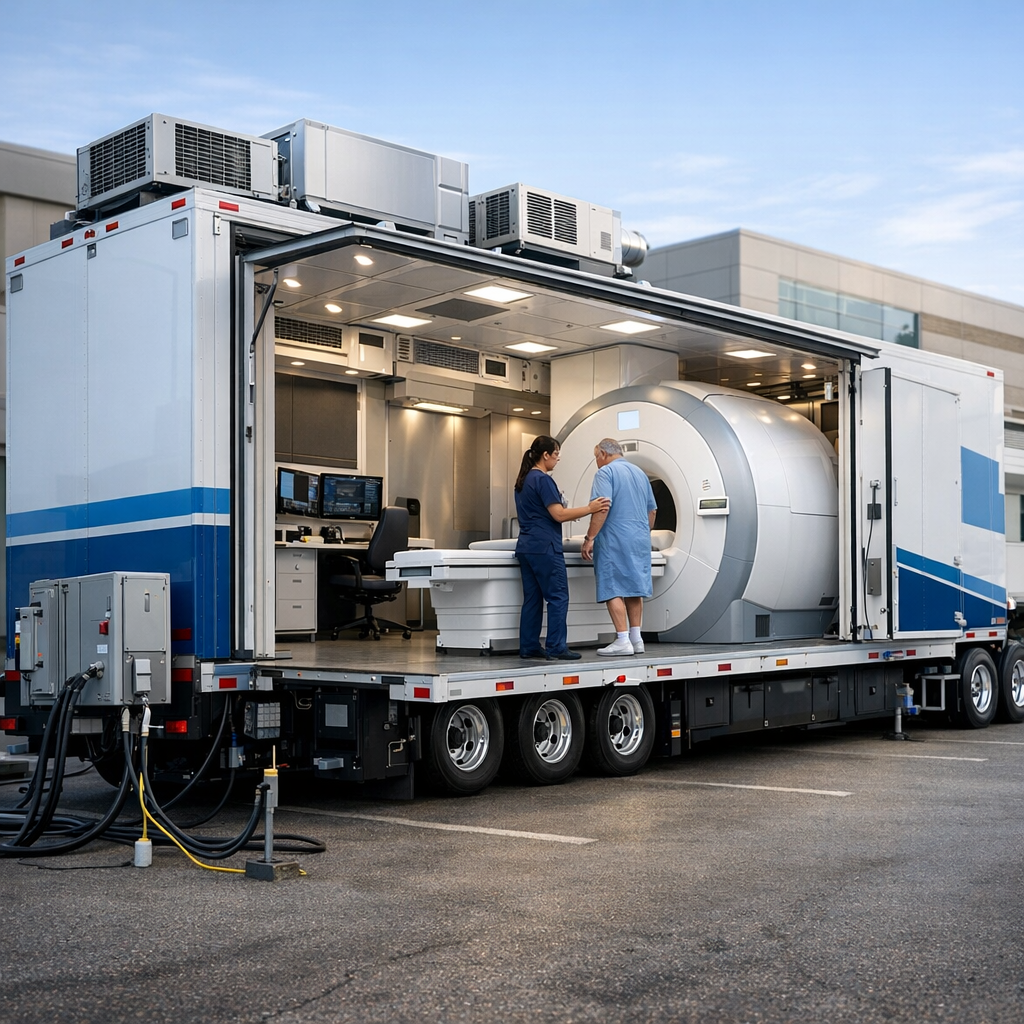
A mobile MRI trailer is a purpose-built semitrailer that houses a fully operational magnetic resonance imaging scanner, engineered to meet strict dimensional, electrical, shielding, and structural standards for safe transport and clinical use. This guide covers trailer dimensions and weight, electrical power and backup systems, RF and magnetic shielding, climate control and structural integrity, and site preparation, regulatory compliance, and transport requirements.
Typical mobile MRI trailer configurations are often in the range of approximately 48 feet in length and 8.5 feet in width, with overall heights around 13 to 14 feet and fully loaded weights that can approach or exceed 70,000 to 80,000 lbs depending on the system design. When configured for 3T systems, trailers are frequently extended to roughly 53 to 60 feet to accommodate increased shielding, cooling, and structural requirements, with corresponding increases in axle load, gross vehicle weight, and enclosure mass. Exact specifications vary based on manufacturer design, MRI system requirements, and regulatory constraints.
RF shielding enclosures must achieve around 70 to 130 dB of attenuation across defined frequency ranges, while magnetic shielding, both active coils inside the magnet and passive ferromagnetic plates in the trailer walls, keeps the 5-gauss safety boundary within controlled zones.
Precision HVAC maintains the scan room at 20°C ± 1–2°C with dedicated chillers ranging from 5 to 15 tons, and reinforced decking supports concentrated magnet loads at roughly 6 psi with vibration tolerances approximately 10 times stricter than other medical equipment.
Site preparation includes support pads, utility connections, and grounding requirements, while regulatory and compliance obligations may involve FDA medical device regulations, Department of Transportation rules for transport size and weight, and state-level licensing requirements. Additional accreditation and quality standards such as those from the American College of Radiology or the Joint Commission may also apply depending on the operating model and facility affiliation.
What Are the Standard Size Dimensions of a Mobile MRI Trailer?
The standard size dimensions of a mobile MRI trailer vary by magnet strength and configuration. Most 1.5T systems use around a 48-foot trailer, while 3T units often require longer platforms. The sections below cover length, width, height, and interior ceiling requirements.
How Long Is a Mobile MRI Trailer for a 1.5T System?
A mobile MRI trailer for a 1.5T system is typically around 48 feet long. According to Armor Mobile, the standard mobile MRI trailer configuration measures 48 feet long by 8.5 feet wide, with a height of 13 feet 5 inches and a total weight of 79,000 lbs, though custom fabrications can have deviating measurements. Because a semi-tractor is required to move and park the system, the total length needed for the complete unit reaches approximately 70 feet.
Larger configurations are also available. The biggest standard medical imaging trailer option measures 12 feet by 60 feet, providing extra room for patient flow, operator consoles, and ancillary equipment. Systems like the Siemens Mobile MAGNETOM Avanto fit within the standard 48-foot platform, though space constraints remain one of the key barriers to mobile MRI integration alongside regulatory compliance and patient handling complexity.
How Long Is a Mobile MRI Trailer for a 3T System?
A mobile MRI trailer for a 3T system is typically 53 to 60 feet long. The heavier magnet, larger gradient coils, and expanded RF shielding in a 3T scanner demand a longer platform than the standard 48-foot 1.5T configuration. Extended trailers in the 53-to-60-foot range accommodate the additional equipment room, wider 5-gauss line clearance, and supplementary cooling infrastructure that higher field strength requires. For facilities considering 3T mobile imaging, planning for the longer footprint is critical to ensuring adequate internal workspace and DOT transport compliance.
How Wide Is a Typical Mobile MRI Trailer?
A typical mobile MRI trailer is around 8 feet to 8.5 feet wide. This width aligns with the federal standard maximum of 8 feet 6 inches (102 inches) for vehicles on interstate highways, allowing the trailer to travel without requiring an oversized load permit in most states. The standard 8.5-foot exterior width provides enough interior space for the MRI bore, patient table, and a narrow operator corridor. Wider configurations, such as the 12-foot-wide expandable models, exist but require special transport permits and route planning due to exceeding federal width limits.
How Tall Is a Mobile MRI Trailer Including the Roof Equipment?
A mobile MRI trailer including the roof equipment stands approximately 13 feet 5 inches tall. Roof-mounted components such as HVAC units, RF shielding enclosures, and helium vent stacks add significant height above the trailer shell. Because oversized loads may require state permits, police escorts, or utility coordination, confirming route clearances before transport is essential. A firm, level surface is also required around the mobile unit to provide safe access for patient handling, equipment servicing, and tractor positioning. Height restrictions vary by state, so verifying bridge and overpass clearances along the planned route prevents costly delays during deployment.
What Interior Ceiling Height Does a Mobile MRI Suite Require?
The interior ceiling height a mobile MRI suite requires is a minimum of 7.5 to 8 feet of clear vertical space above the finished floor. This clearance must accommodate the MRI bore opening, overhead lighting, fire suppression systems, and RF shielding panels integrated into the ceiling structure. Taller ceiling heights improve patient comfort and reduce claustrophobia during scans, particularly for larger patients. Since the exterior height is constrained to approximately 13 feet 5 inches, the usable interior ceiling depends on floor thickness, vibration isolation platforms, and the depth of roof-mounted mechanical systems.
With dimensions established, the next consideration is how much a fully equipped mobile MRI trailer weighs.
How Much Does a Mobile MRI Trailer Weigh?
A fully loaded mobile MRI trailer weighs approximately 79,000 lbs. The sections below break down the gross vehicle weight, magnet weight, how field strength affects total mass, and axle and tire load rating requirements.
What Is the Gross Vehicle Weight of a Fully Loaded MRI Trailer?
Fully loaded mobile MRI trailers can vary significantly in weight depending on system configuration, with gross vehicle weights commonly ranging from approximately 60,000 to 80,000 lbs. Heavier configurations, particularly those supporting 3T systems, may require reinforced multi-axle designs to distribute load within DOT and state permitting limits. Specific weight and axle distributions depend on the manufacturer’s design and equipment package rather than a universal standard configuration. Federal Highway Administration regulations set the minimum allowable semitrailer length at 14.63 m (48 feet), which aligns with the standard mobile MRI trailer footprint. The remaining weight above the axle rating accounts for the kingpin load transferred to the tractor. Given these figures, site planners should confirm that parking surfaces, access roads, and bridge ratings along the transport route can support loads of this magnitude.
How Much Does the MRI Magnet Itself Weigh?
The MRI magnet itself is the single heaviest component inside the trailer, though exact weights vary by manufacturer and field strength. A 1.5T superconducting magnet typically ranges between 8,000 and 15,000 lbs depending on the system. According to GE Healthcare documentation for the Optima 1.5T MR430s, the magnet assembly concentrates its weight over an area of just 1.0 square foot, producing a local floor loading of 6 psi (42 kPa). This concentrated load demands reinforced trailer decking and specialized structural support directly beneath the magnet bore. For facility operators, understanding this point-load intensity is just as important as knowing the total magnet weight.
How Does Magnet Strength Affect Overall Trailer Weight?
Magnet strength affects overall trailer weight because higher-field magnets require larger, heavier superconducting coils and more extensive shielding materials. A 3T magnet usually weighs more than a 1.5T unit due to the increased windings needed to generate double the magnetic flux density. Stronger magnets also produce larger fringe fields; as MRI Questions notes, fringe fields of 10 G can affect computers while fields of 30 G may magnetize watches and erase credit cards. Containing these extended fringe fields demands additional passive shielding mass integrated into the trailer walls, further increasing gross vehicle weight. This compounding effect makes field strength one of the most consequential variables in trailer design and transport planning.
What Are the Axle and Tire Load Rating Requirements?
The axle and tire load rating requirements for a mobile MRI trailer must accommodate the total gross vehicle weight distributed across multiple axle positions. Standard MRI trailers use two heavy-duty axles rated at 20,000 lbs each with a 10-foot spread, providing a combined axle capacity of 40,000 lbs. Tires must carry load ratings that match or exceed per-axle weight when fully loaded, and most configurations use low-profile, high-capacity radial tires rated for sustained highway transport. Proper axle spacing also matters for DOT bridge formula compliance, which regulates how weight is distributed across a vehicle's length. Underspecifying either axle capacity or tire ratings risks structural failure, tire blowouts, and regulatory violations during transport.
With weight distribution established, the next consideration is the power needed to operate the MRI system on-site.
What Are the Power Requirements for a Mobile MRI Trailer?
The power requirements for a mobile MRI trailer center on high-voltage, three-phase electrical service capable of sustaining the magnet, gradient coils, and cooling systems simultaneously. Below, each sub-section covers amperage by field strength, voltage configuration, generator sizing, and UPS needs.
How Much Electrical Power Does a 1.5T Mobile MRI Unit Need?
A 1.5T mobile MRI unit needs 480-volt, 3-phase AC power with a minimum service capacity of 125 to 200 amps, depending on the system and its ancillary equipment. According to Cube Mobile Imaging, facilities must provide 480-volt, 3-phase power at 150 to 200 amps for mobile MRI operation, with the electrical connector located no more than 40 feet from the trailer. The Siemens Mobile MAGNETOM system similarly requires a single 480-volt AC, 3-phase power source. Peak draw occurs during gradient-intensive pulse sequences, so the host facility's electrical infrastructure should be rated above minimum thresholds to accommodate simultaneous HVAC and helium compressor loads. Undersizing the circuit is one of the most common site preparation mistakes and can delay deployment by weeks.
How Much Electrical Power Does a 3T Mobile MRI Unit Need?
A 3T mobile MRI system generally requires more electrical capacity than a 1.5T system due to higher demands from gradient, RF, and cooling subsystems. Many mobile configurations are designed to operate on 480V, 3-phase power, with service requirements often falling in the range of roughly 200–300 amps depending on manufacturer and system configuration. The higher field strength drives greater radiofrequency transmission energy and faster gradient slew rates, both of which increase instantaneous current draw. Facilities evaluating a 3T mobile deployment should confirm that their switchgear and cabling can handle the upper amperage range without voltage sag during peak scanning cycles.
What Voltage and Phase Configuration Is Required?
The voltage and phase configuration required for a mobile MRI trailer is 480-volt, 3-phase AC power. Single-phase or lower-voltage connections cannot supply the sustained, balanced load that MRI gradient amplifiers and cryogenic compressors demand. Three-phase delivery distributes the electrical load evenly across three conductors, reducing line losses and preventing the voltage fluctuations that degrade image quality. The site's electrical panel must include a dedicated, properly rated disconnect switch located within cable reach of the trailer's power inlet.
What Size Generator Can Support a Mobile MRI Trailer?
The size generator that can support a mobile MRI trailer is typically rated between 150 kW and 300 kW, depending on field strength and auxiliary loads. A 1.5T system generally operates on a 150 to 200 kW generator, while a 3T unit may require 250 kW or more. The generator must deliver clean, stable 480-volt, 3-phase output with minimal harmonic distortion; MRI electronics are sensitive to power quality issues that standard construction-grade generators often produce. For facilities without permanent utility hookups, generator-backed mobile MRI represents a growing segment of the U.S. mobile MRI services market, which Grand View Research estimated at USD 3.67 billion in 2024.
What Are the Uninterruptible Power Supply Requirements?
The uninterruptible power supply requirements for a mobile MRI trailer mandate a 480-volt, 3-phase circuit rated at a minimum of 112.5 kVA to maintain stable, continuous power delivery. A UPS protects the superconducting magnet's cryogenic systems from momentary outages that could trigger a quench, an uncontrolled loss of superconductivity that can damage the magnet and release helium gas. Smaller MRI systems, such as the Fonar Upright MRI, consume approximately 47 kVA during operation at 480 volts and 100 amps, illustrating how power consumption varies by platform. Pairing a properly sized UPS with automatic transfer switching is essential for any mobile MRI deployment where utility reliability is uncertain.
With power infrastructure established, the next consideration is RF shielding integrity.
What RF Shielding Is Required in a Mobile MRI Trailer?
RF shielding required in a mobile MRI trailer includes conductive enclosure materials, specific attenuation levels, sealed penetration points, and post-installation verification testing.
What Materials Are Used for RF Shielding in MRI Trailers?
The materials used for RF shielding in MRI trailers are conductive metals that form a continuous enclosure around the scan room. Copper and aluminum sheets are the most common choices, applied as bonded panels or foil layers to create a seamless Faraday cage within the trailer walls, floor, and ceiling. According to Gaven Industries, MRI magnetic shielding contains the scanner's fringe magnetic fields within a specified boundary using high-permeability materials to absorb and redirect fringe fields produced by the static magnet. Every seam, joint, and corner must maintain electrical continuity; even a small gap compromises the entire enclosure's effectiveness.
What Shielding Attenuation Level Must a Mobile MRI Achieve?
The shielding attenuation level a mobile MRI must achieve ranges from around 70 to 130 dB, depending on the scanner's operating frequency and manufacturer specifications. According to MPB Electronics, the IEEE 299 standard requires at least 100 dB for frequencies up to 10 MHz, 80 dB between 10 MHz and 1 GHz, and 60 dB for higher frequencies. Any structure traversing the RF shielding wall, such as a wire, pipe, or duct, must pass through a penetration panel containing RF filters and waveguides. Mobile units face additional challenges because the trailer must also be parked and leveled on a stable surface to avoid operational difficulties that could affect shielding integrity.
How Are RF Shielding Penetrations Sealed in a Mobile Unit?
RF shielding penetrations in a mobile unit are sealed using dedicated penetration panels equipped with RF filters and waveguides. Every electrical cable, HVAC duct, plumbing line, and data conduit that crosses the shielded boundary passes through these filtered panels. Waveguides, which are hollow metal tubes cut below the RF operating frequency, allow airflow without leaking electromagnetic energy. Door assemblies use continuous fingerstock gaskets or beryllium copper contact strips to maintain conductivity when closed. In mobile trailers, where road vibration loosens connections over time, these sealing points require periodic inspection to ensure no degradation has occurred.
How Is RF Shielding Tested and Verified After Installation?
RF shielding is tested and verified after installation through standardized attenuation measurements performed across a defined frequency range. Technicians use signal generators and spectrum analyzers to measure the difference between transmitted and received signal strength across the enclosure walls, following the IEEE 299 testing protocol. Measurements are taken at multiple points, including doors, penetration panels, and seam locations, to identify any weak spots. Most MRI scanner manufacturers require documented test results confirming 70 to 130 dB attenuation before commissioning the system. For mobile units specifically, retesting after transport to a new site is a wise practice, since road vibration can compromise gasket seals and panel joints over time.
With RF shielding performance confirmed, the next consideration is managing the scanner's magnetic fringe fields through dedicated magnetic shielding.
What Magnetic Shielding Does a Mobile MRI Trailer Need?
Magnetic shielding in a mobile MRI trailer contains the scanner's fringe magnetic fields within a defined boundary. This section covers the 5 gauss line safety threshold, active shielding built into the magnet, and passive shielding integrated into the trailer structure.
What Is the 5 Gauss Line and Why Does It Matter?
The 5 gauss line is the safety boundary drawn around the perimeter of the main magnet of the MRI scanner, specifying the distance at which the stray magnetic field equals 5 gauss (0.5 mT). According to Radiopaedia, this threshold has been used for the last 40 years to demarcate the maximum allowable fringe field safety limit around an MR scanner.
In a mobile trailer, controlling where the 5 gauss line falls is especially critical. The confined footprint means fringe fields can easily extend beyond the trailer walls into public walkways, parking areas, or adjacent buildings. Anyone with a pacemaker, ferromagnetic implant, or electronic device who crosses this boundary faces serious safety risks. Magnetic shielding strategies, both active and passive, work together to pull the 5 gauss line inward so it remains within controlled zones.
How Is Active Magnetic Shielding Used in Mobile MRI Units?
Active magnetic shielding is used in mobile MRI units through secondary superconducting coils built directly into the magnet assembly. These coils generate an opposing magnetic field that cancels a significant portion of the main magnet's fringe field, pulling the 5 gauss line closer to the scanner bore.
Most modern mobile MRI systems, including the Siemens MAGNETOM platform, rely on actively shielded magnets as standard. This approach reduces the external footprint of the magnetic field without adding structural weight to the trailer. For mobile deployments where the trailer parks near occupied buildings, active shielding is often the single most effective method for keeping fringe fields contained within the unit's physical boundaries.
How Is Passive Magnetic Shielding Integrated Into the Trailer?
Passive magnetic shielding is integrated into the trailer by lining the walls, floor, and ceiling with high-permeability ferromagnetic materials, typically steel plates or specialized iron alloys. These materials absorb and redirect the MRI's residual fringe fields that active shielding alone cannot fully contain.
In practice, passive shielding adds considerable weight to the trailer structure. Engineers must balance the thickness and placement of shielding plates against the gross vehicle weight limits for road transport. Strategic placement around the magnet room, rather than uniform coverage of the entire trailer, helps optimize this tradeoff. For most mobile MRI configurations, passive shielding serves as the complementary second layer that ensures the 5 gauss line stays within the trailer footprint under all operating conditions.
With magnetic shielding strategies defined, climate control keeps the magnet and electronics operating within safe tolerances.
What HVAC and Climate Control Does a Mobile MRI Trailer Require?
A mobile MRI trailer requires dedicated HVAC systems that maintain precise temperature, humidity, and cooling for both the magnet and the scanner room. The subsections below cover cooling capacity, environmental tolerances, and chiller specifications.
What Cooling Capacity Is Needed for the MRI Equipment Room?
The cooling capacity needed for the MRI equipment room typically ranges from 5 to 15 tons of refrigeration, depending on magnet strength and scanner model. According to Drycool Systems, the most common chiller sizes in medical applications are 7.5-ton (90,000 BTU/hr) and 5-ton (60,000 BTU/hr) units, with 12.5- or 15-ton MRI chillers available for higher-demand configurations.
MRI magnets, gradient amplifiers, and RF electronics all generate substantial heat within a confined trailer space. Because mobile units lack the thermal mass of permanent buildings, cooling systems must respond quickly to prevent temperature drift. Oversizing the HVAC capacity by 10 to 20 percent is a practical safeguard that accounts for outdoor ambient extremes and the limited insulation envelope of a trailer shell.
What Are the Temperature and Humidity Tolerances for MRI Operation?
The temperature and humidity tolerances for MRI operation require the scan room to be maintained at around 20°C ± 1–2°C (68°F ± 2–3°F) with tightly controlled relative humidity, typically between 40% and 60%. As noted by RT Mechanical Engineering, MRI equipment is sensitive to temperature, humidity, and air pressure, so mechanical systems must meet the technical requirements of the equipment.
Even minor deviations outside these ranges can affect image quality, magnet stability, and electronic component longevity. Condensation from excess humidity poses a particular risk inside an RF-shielded enclosure where moisture can degrade shielding integrity. Dedicated dehumidification stages, separate from general cooling, help maintain safe conditions year-round regardless of deployment climate.
What Chiller System Specifications Support a Mobile MRI Magnet?
Chiller system specifications that support a mobile MRI magnet include closed-loop glycol cooling circuits, redundant compressors, and flow rates matched to the magnet manufacturer's thermal load requirements. These chillers must deliver coolant at precise temperatures, often between 15°C and 18°C, to remove heat from the magnet's cold head and gradient coils.
Structural planning intersects directly with chiller selection. The floor must support the considerable weight of the magnet, table, and accessories, which means chiller mounting locations require reinforced framing. Newer magnet technologies are changing chiller demands as well; Philips' BlueSeal magnet technology, with more than 600 helium-free systems installed globally, eliminates traditional helium recondensing chillers entirely, reducing both weight and mechanical complexity.
With climate control systems properly specified, attention turns to the structural and flooring requirements that support these heavy, vibration-sensitive components.
What Structural and Flooring Requirements Apply to MRI Trailers?
Structural and flooring requirements for MRI trailers encompass load capacity, vibration isolation, and fire-rated construction materials. Each factor directly affects scanner performance and occupant safety.
What Floor Load Capacity Must the Trailer Deck Provide?
The floor load capacity a trailer deck must provide depends on the combined weight of the magnet assembly, patient table, and ancillary equipment. MRI magnets concentrate thousands of pounds over a small footprint, so the deck requires reinforced structural steel framing capable of handling extreme point loads without deflection.
Mobile MRI trailer specifications commonly include heavy-duty dual axles with capacities in the range of approximately 20,000 lbs per axle and a wide axle spread to support weight distribution and compliance with road regulations. This axle configuration distributes the trailer's total weight across the chassis while the internal deck structure must independently support localized magnet loads. Reinforced cross-members and load-distributing plates are typically integrated beneath the magnet mounting area to prevent structural fatigue over time.
What Vibration Isolation Is Needed for MRI Image Quality?
The vibration isolation needed for MRI image quality must be significantly more stringent than standard medical equipment tolerances. Even minor floor vibrations from nearby traffic, HVAC systems, or generator operation can introduce motion artifacts that degrade diagnostic images.
According to an Acentech study on mitigating noise and vibration from MRIs, allowable floor vibration limits for MRI systems are typically about 10 times lower than other medical equipment. Achieving this level of isolation requires specialized mounting systems, including pneumatic or elastomeric isolators positioned between the magnet and the trailer deck. Decoupling the scanner from road-transmitted vibrations is one of the most overlooked factors in mobile MRI deployment, yet it directly determines whether images meet diagnostic standards.
What Fire-Rated Materials Are Required in Construction?
Fire safety in mobile MRI trailer construction is addressed through compliance with applicable Department of Transportation regulations and relevant NFPA and state or local fire codes for occupied transportable structures. Interior materials such as wall panels, ceilings, and insulation are often selected to meet fire-resistance standards, with many components designed to achieve Class A or equivalent flame-spread ratings to reduce flame propagation and smoke development.
Non-combustible or fire-retardant composites line the scan room and technical equipment areas, where electrical components and cooling systems generate heat. Fire-rated materials serve a dual purpose in MRI trailers: they protect occupants and sensitive electronics while maintaining compatibility with RF shielding layers that cannot be compromised by material substitutions. Selecting construction materials that satisfy both fire safety and electromagnetic performance requirements demands careful engineering from the design phase forward.
With structural integrity addressed, proper site preparation ensures the trailer operates safely once deployed.
What Site Preparation Is Needed to Deploy a Mobile MRI Trailer?
Site preparation needed to deploy a mobile MRI trailer includes a support pad, electrical service, mobile grounding, telephone and data connectivity, water supply, and adequate clearance around the unit.
A firm, level surface is the foundational requirement. Whether a facility uses a full concrete support pad or minimum support with metal plates, the unit must be parked and leveled to avoid operational difficulties. According to Amber USA, additional site preparation requirements include electricity, mobile grounding, telephone and data service, water supply, and sufficient clearance for patient access and equipment servicing. Each utility connection must be positioned within reach of the trailer's hookup points, typically no more than 40 feet away. For facilities evaluating deployment feasibility, addressing these infrastructure elements early prevents costly delays once the trailer arrives on site.
What Regulatory and Safety Standards Govern Mobile MRI Trailers?
The regulatory and safety framework relevant to mobile MRI trailers includes FDA medical device classification for the MRI system itself, state and federal requirements governing medical imaging operations, and voluntary accreditation or certification programs such as those from the American College of Radiology and the Joint Commission. These frameworks collectively address device safety, operational quality, and clinical best practices, depending on the provider’s regulatory and accreditation pathway.
Mobile MRI systems are regulated under 21 CFR 892.1000 (product code LNH) as Class II medical devices requiring 510(k) premarket notification, according to the National Center for Biotechnology Information. This FDA classification ensures every scanner meets baseline safety and effectiveness benchmarks before clinical use.
ACR Accreditation is a voluntary quality assurance program that requires confirmation that medical imaging staff has appropriate experience and qualifications, and that all quality control tests are performed as established by ACR and the MRI unit manufacturer. Facilities operating mobile units must meet the same accreditation criteria as fixed-site MRI installations, covering image quality, technologist credentials, and equipment maintenance protocols.
The Joint Commission established specific accreditation standards addressing MRI safety in 2008, responding to ongoing risks associated with magnetic resonance, CT, and fluoroscopy environments. These standards govern screening procedures, zone access controls, and emergency protocols inside the scan room.
State health departments may impose additional licensing requirements for mobile diagnostic units, including periodic inspections, radiation safety officer designations, and patient privacy safeguards under HIPAA. Because mobile MRI trailers operate across multiple jurisdictions, compliance teams must verify requirements for every deployment location.
For organizations planning a mobile MRI program, treating regulatory compliance as a design input rather than an afterthought simplifies both the approval timeline and long-term operational overhead. Understanding how these standards intersect with transport regulations ensures a seamless path from trailer fabrication to patient scanning.
What Transport and Road Compliance Rules Apply to Mobile MRI Units?
The transport and road compliance rules that apply to mobile MRI units include federal DOT size and weight limits, state-level permit requirements, and route-specific coordination for oversized loads.
Mobile MRI trailers at 48 feet long and 8.5 feet wide align with federal highway maximums. According to the Federal Highway Administration, the minimum allowable length limit for a semitrailer in a commercial motor vehicle combination is 14.63 meters (48 feet), or the grandfathered limit for a particular state. The federal standard maximum width on interstate highways is 8 feet 6 inches (102 inches), with states able to issue special permits for wider vehicles.
At around 79,000 lbs total trailer weight, a fully loaded MRI unit approaches or exceeds the federal gross vehicle weight limit of 80,000 lbs, making weight compliance a critical planning factor. Route selection must account for bridge weight ratings, overhead clearances for the 13-foot 5-inch height, and turning radius requirements when the semi-tractor brings total length to approximately 70 feet.
Oversized loads may require state permits, police escorts, or utility coordination for mobile medical imaging equipment transport. Each state enforces its own permitting process, so operators moving MRI trailers across state lines must secure permits in every jurisdiction along the route.
For operators planning frequent relocations, understanding these DOT constraints early in the design phase prevents costly compliance issues later. Craftsmen Industries factors transport compliance into the initial trailer engineering process, ensuring dimensions, weight distribution, and axle configurations meet federal and state road requirements from the start.
How Should You Approach Mobile MRI Trailer Design with a Custom Manufacturer?
You should approach mobile MRI trailer design by partnering with a manufacturer that offers end-to-end engineering, fabrication, and integration under one roof. The following sections cover Craftsmen Industries' capabilities and key specification takeaways.
Can Craftsmen Industries Build a Custom Mobile MRI Trailer?
Yes, Craftsmen Industries can build a custom mobile MRI trailer. With over 40 years of experience in custom vehicle fabrication, Craftsmen Industries designs, engineers, and produces mobile medical vehicles from a 127,000 sq. ft. vertically integrated facility in St. Charles, Missouri. Every build moves through in-house design, structural engineering, fabrication, printing, and installation, giving project teams complete control over dimensional tolerances, shielding integration, HVAC routing, and power distribution. This single-source approach eliminates coordination gaps between separate vendors, which is especially critical when a trailer must satisfy 480V 3-phase electrical specs, RF attenuation above 100 dB, and DOT road-compliance standards simultaneously. Craftsmen Industries serves healthcare providers, government agencies, and corporations nationwide.
What Are the Key Takeaways About Mobile MRI Trailer Specifications?
The key takeaways about mobile MRI trailer specifications center on five interdependent systems that must be engineered as a unified platform:
- Dimensions and weight: Typical measurement ranges of standard trailers are around 48 feet long and around 8.5 feet wide, with a total weight around 79,000 lbs, requiring heavy-duty axles and DOT-compliant transport planning.
- Electrical power: Operation demands 480V, 3-phase service at 125 to 200 amps, paired with UPS protection rated at a minimum of 112.5 kVA.
- RF and magnetic shielding: Enclosures must achieve 70 to 130 dB attenuation while containing the 5-gauss fringe field safety boundary within or near the trailer walls.
- Climate control: Precision HVAC holds the scan room at 20°C ± 1–2°C, with dedicated chiller systems supporting magnet cooling.
- Structural integrity: Reinforced decking handles concentrated magnet loads typically in the low single-digit to low double-digit psi range depending on system design and load distribution, while vibration isolation standards run approximately 10 times stricter than those for other medical equipment.
No single specification exists in isolation. A change in magnet strength cascades into heavier fringe-field shielding, greater cooling demand, and increased structural reinforcement. Working with a custom manufacturer like Craftsmen Industries ensures these variables are resolved together from the earliest design phase.