
17 min read
What Are the Key Differences Between a Mobile Command Center and a Mobile Office Trailer?
Craftsmen Industries May 13, 2026 2:32:59 PM
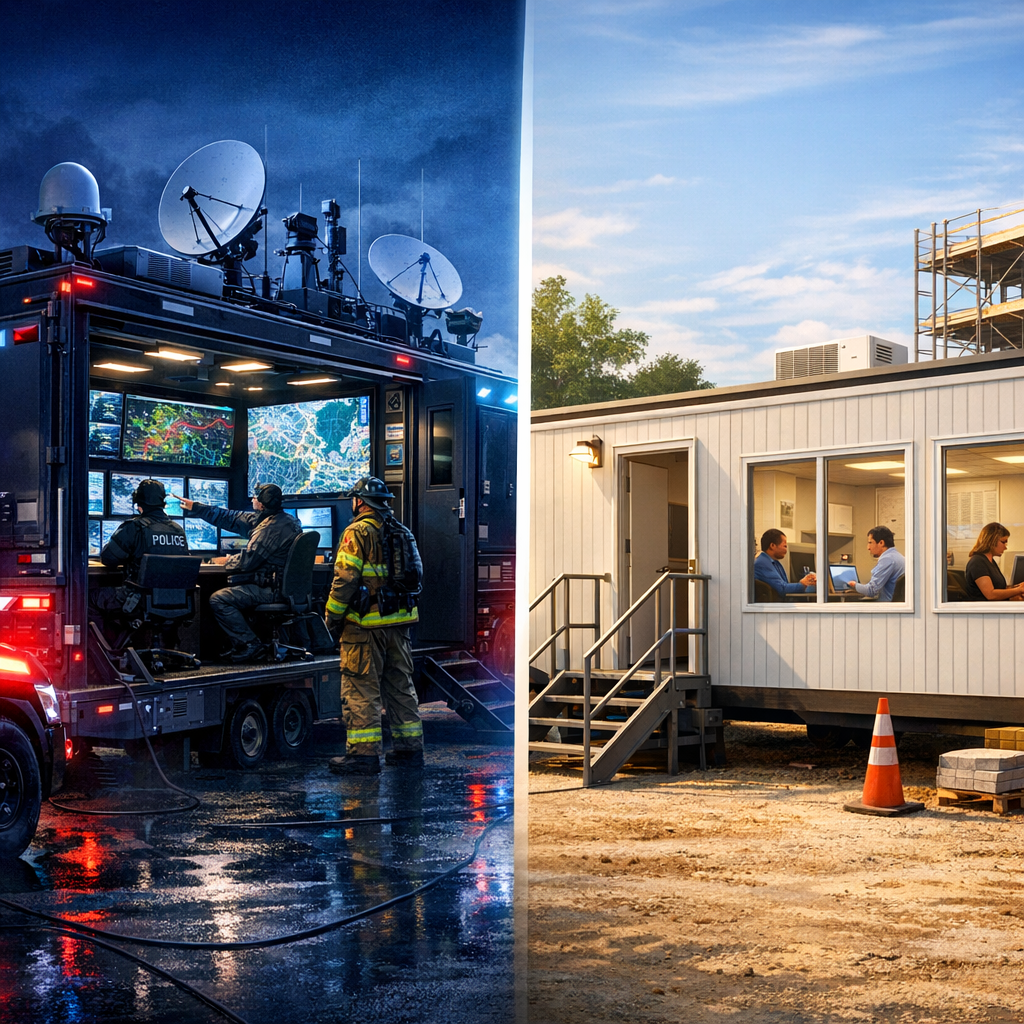
A mobile command center is a self-contained operations hub equipped with advanced communication, data processing, and control systems that deploys directly to incident or mission sites. A mobile office trailer is a relocatable, prefabricated structure designed to provide temporary administrative workspace. Both are mobile units, but they solve fundamentally different problems.
This guide covers definitions and core use cases, technology and communication systems, design and construction standards, power and cost comparisons, security and compliance requirements, and procurement decision frameworks.
Mobile command centers serve emergency response agencies, law enforcement departments, military branches, and various field operations management that need real-time command, control, and communication (C3) capabilities in the field. Mobile office trailers tend to serve construction firms, corporations, school districts, and healthcare organizations that need functional workspace at temporary sites. The mission dictates the unit.
Technology separates these platforms most sharply. Command centers integrate interoperable radio networks, satellite uplinks with cellular failover, cybersecurity-hardened servers, and video surveillance arrays. Office trailers include commercial Wi-Fi, standard electrical service, and basic HVAC. This gap in system complexity drives a corresponding gap in construction; MCCs require ruggedized framing, EMI/RFI shielding, and redundant power sources, while office trailers use prefabricated modular construction designed for comfort and fast setup.
Cost reflects this divergence. Custom command centers range from $150,000 for van-based units to over $1 million for multi-room builds, with annual lifecycle costs running around 10 to 20% of the initial investment. Mobile office trailers rent for $300 to $900 per month.
Compliance requirements, buyer profiles, and acquisition methods (buying, leasing, or custom fabrication) all vary by unit type, and matching the right platform to your operational mission is the single most important procurement decision.
What Is a Mobile Command Center?
A mobile command center is a movable operations hub equipped with advanced communication, data processing, and control systems that deploys directly to an incident or mission site. According to the Department of Homeland Security, mobile command vehicles support incident management by providing interior and exterior workspaces along with command and control capabilities for on-scene incident commanders or remote locations.
The primary mission of a mobile command center is to deliver command, control, and communication (C3) capabilities in real time. Decision-makers use these units to manage field operations from the heart of an event, whether that involves emergency response coordination, law enforcement surveillance, or military logistics. Core technology systems typically include two-way and digital radio networks, satellite and cellular connectivity, network servers with cybersecurity protections, video monitoring arrays, and dispatch or GIS software.
Unlike general-purpose mobile structures, these vehicles are purpose-built for high-stakes operational environments where communication reliability and situational awareness determine outcomes. Understanding this specialized role is essential before comparing mobile command centers to other mobile unit types.
What Is a Mobile Office Trailer?
A mobile office trailer is a relocatable, prefabricated structure designed for short-term or temporary use. According to Satellite Shelters, these units typically arrive ready to use, providing functional workspace that can be transported between locations as project needs change.
Unlike mobile command centers built around advanced communication and control systems, mobile office trailers prioritize general-purpose office functionality. Standard configurations include climate control, basic electrical wiring, lighting, restrooms, and open floor plans suited for desks and meeting areas. Most units range from single-wide trailers offering 500 to 700 square feet to double-wide configurations exceeding 1,400 square feet, giving organizations flexible space options without permanent construction.
Common buyers include construction firms needing on-site project management space, corporations requiring temporary administrative offices during renovations, and event organizers setting up field operations. Because these trailers are widely available through rental networks, they offer a lower barrier to entry; in 2025, the average monthly rental cost ranges from $300 to $900 depending on size, configuration, duration, and location, according to National Office Trailer. This affordability makes mobile office trailers practical for organizations that need functional workspace quickly but do not require mission-critical technology integration.
For buyers weighing this option against a mobile command center, the distinction is straightforward: mobile office trailers solve a space problem, while command centers solve an operational coordination problem.
How Do Mobile Command Centers and Mobile Office Trailers Differ in Primary Purpose?
Mobile command centers and mobile office trailers differ in primary purpose based on mission criticality. Command centers deliver real-time command, control, and communication for high-stakes operations, while office trailers provide relocatable administrative workspace. The following sections break down specific use cases for each.
How Is a Mobile Command Center Used in Emergency Response?
A mobile command center is used in emergency response as an on-site coordination hub that unifies communication, situational awareness, and decision-making during crises. During natural disasters, mass casualty events, or large-scale evacuations, these units deploy directly to the incident site. According to a 2025 Domestic Preparedness report, mobile command buses enhance response efficiency, interagency collaboration, and situational awareness by providing on-site coordination, communication, and decision-making capabilities in one place. Incident commanders use integrated satellite links, radio networks, and video surveillance to manage multiple agencies from a single location. Without this centralized capability, field coordination during fast-moving emergencies often breaks down.
How Is a Mobile Command Center Used in Military Operations?
A mobile command center is used in military operations as a deployable tactical headquarters for battlefield coordination. These units provide secure communication systems, encrypted data processing, and real-time intelligence feeds in austere or forward-deployed environments. Commanders rely on them to maintain situational awareness across dispersed forces, coordinate logistics, and issue directives without depending on fixed infrastructure. Because military MCCs must function in contested or remote terrain, they incorporate hardened electronics, redundant power systems, and ruggedized construction. This self-contained capability makes them essential for operations where permanent facilities are unavailable or compromised.
How Is a Mobile Command Center Used in Law Enforcement?
A mobile command center is used in law enforcement as a field operations base for planned events, tactical responses, and ongoing investigations. According to an Instant Connect case study, the City of Sikeston's mobile command center serves as a rugged, versatile command-and-control vehicle that helps the Department of Public Safety and other first responders keep the community safe. Police departments deploy these units for SWAT operations, large public gatherings, and multi-agency task forces. Onboard surveillance arrays, dispatch consoles, and interoperable radio systems allow officers to coordinate in real time. For agencies managing unpredictable scenarios, this mobile capability eliminates dependence on a fixed precinct.
How Is a Mobile Office Trailer Used on Construction Sites?
A mobile office trailer is used on construction sites as a temporary workspace for project managers, engineers, and administrative staff. These prefabricated units arrive ready to use, providing climate-controlled offices, meeting rooms, and plan review areas directly at the job site. Construction teams use them to store blueprints, conduct safety briefings, and manage subcontractor documentation without leaving the project location. Because construction timelines and locations shift frequently, the relocatable design of a mobile office trailer allows teams to move administrative operations alongside active work zones. This proximity to the field improves coordination and reduces downtime.
How Is a Mobile Office Trailer Used for Corporate Field Operations?
A mobile office trailer is used for corporate field operations as a satellite workspace that supports remote teams, seasonal projects, or overflow staffing needs. Companies deploy these units at pipeline routes, mining sites, film sets, and energy installations where permanent office space does not exist. A 2025 industry report from National Office Trailer notes the average monthly rental cost ranges from $300 to $900, depending on size, configuration, duration, and location. This cost-effective flexibility allows organizations to scale workspace up or down without long-term real estate commitments. For field operations that shift between regions, mobile office trailers deliver consistent workspace wherever the project moves.
How Is a Mobile Office Trailer Used for Temporary Administrative Space?
A mobile office trailer is used for temporary administrative space during building renovations, campus expansions, or post-disaster recovery periods. Schools, hospitals, and government offices rely on these units to maintain daily operations while permanent facilities are under construction or repair. Standard configurations include workstations, restrooms, HVAC systems, and basic IT connectivity. Unlike mobile command centers, which prioritize mission-critical technology, these trailers focus on comfort and functional workspace for routine tasks. For organizations facing facility disruptions, mobile office trailers offer the fastest path to operational continuity.
With primary purpose clarified, the next consideration is what technology and communication systems each unit includes.
What Technology and Communication Systems Come Standard in Each?
The technology and communication systems that come standard in a mobile command center differ dramatically from those in a mobile office trailer. Mobile command centers integrate mission-critical communication infrastructure, while mobile office trailers include standard commercial technology.
What Communication Systems Are Built Into a Mobile Command Center?
The communication systems built into a mobile command center include multi-layered, mission-critical networks designed for real-time command and control. Core systems typically encompass two-way and digital radio networks for interoperability, satellite and cellular connectivity, network servers with cybersecurity systems, video monitoring and surveillance arrays, and dispatch, GIS, and data management software.
These systems must function simultaneously under field conditions, often in areas where conventional infrastructure has failed. Key communication components include:
- Two-way and digital radio networks enabling interagency interoperability
- Satellite uplinks with cellular failover for redundant connectivity
- Fiber-optic or shielded copper cabling supporting high-bandwidth video walls
- Cybersecurity systems protecting classified or sensitive operational data
- GIS mapping and dispatch software for situational awareness
EMI/RFI shielding and surge protection are built into the electrical architecture to prevent signal interference between densely packed systems. For buyers evaluating communication reliability, this layered redundancy is what separates a true command center from any other mobile platform.
What Technology Is Typically Included in a Mobile Office Trailer?
The technology typically included in a mobile office trailer covers standard commercial-grade systems that support everyday administrative work. These units prioritize connectivity and comfort over tactical communication.
Standard technology features include:
- Commercial Wi-Fi routers and ethernet ports for internet access
- Standard electrical outlets and USB charging stations
- Phone line connections or VoIP capability
- Basic HVAC controls with programmable thermostats
- LED lighting with standard circuit breaker panels
Mobile office trailers arrive ready to use with plug-and-play infrastructure, making setup fast and straightforward. However, they lack the interoperable radio networks, satellite uplinks, and cybersecurity hardening found in command centers. For organizations needing reliable office connectivity at construction sites or temporary administrative locations, this technology package is sufficient. Buyers requiring encrypted communication or multi-agency coordination capabilities will need the specialized systems that a mobile command center provides.
How Do the Design and Construction Standards Compare?
The design and construction standards for mobile command centers and mobile office trailers diverge significantly, reflecting their distinct operational demands. Below, each unit type's build approach is covered in detail.
How Is a Mobile Command Center Built for Rugged Deployment?
A mobile command center is built for rugged deployment through integrated engineering, reinforced chassis systems, and environment-hardened construction. The process begins with detailed 3D modeling and CAD engineering according to Craftsmen Industries, creating virtual prototypes that simulate vehicle layout, equipment placement, and load distribution before fabrication starts.
Electrical wiring must adhere to automotive and mobile-unit standards. Surge protection, grounding, EMI/RFI shielding, and network redundancy are critical for reliable field performance. Fiber-optic or shielded copper cabling supports high-bandwidth video walls and operator consoles. Structural elements typically include:
- Reinforced steel or aluminum framing to withstand transit vibration and harsh terrain
- Climate-sealed compartments protecting sensitive electronics from dust, moisture, and temperature extremes
- Ballistic or impact-resistant exterior panels for law enforcement and military applications
This level of construction ensures an MCC operates reliably whether deployed to a disaster zone, a forward operating base, or a large-scale public safety event. For buyers comparing durability alone, no standard commercial trailer matches this build rigor.
How Is a Mobile Office Trailer Built for Comfort and Functionality?
A mobile office trailer is built for comfort and functionality using prefabricated modular construction methods. These relocatable structures prioritize climate-controlled workspace, efficient floor plans, and fast site-readiness over ruggedization.
Standard construction features include:
- Steel I-beam or channel-steel chassis rated for highway transport
- Insulated wall panels, commercial-grade HVAC, and finished interior surfaces
- Standard electrical systems wired for 120/240V service, fluorescent or LED lighting, and multiple outlet circuits
- ADA-compliant entry ramps and restroom configurations where required
Because mobile office trailers serve construction sites, corporate field offices, and temporary administrative facilities, the build emphasizes occupant comfort over environmental hardening. Units typically arrive ready to use, with minimal on-site setup beyond utility connections and leveling. This practical, cost-efficient construction approach is what makes mobile office trailers accessible to a far wider range of buyers than mission-critical command vehicles.
Understanding how each unit is constructed helps clarify the power and utility differences covered next.
How Does Interior Layout Differ Between the Two?
The interior layout of a mobile command center differs from a mobile office trailer in purpose-driven space allocation. Command centers prioritize operator workstations, video walls, and secure communications rooms, while office trailers emphasize conventional workspace with desks, meeting areas, and break rooms.
A mobile command center typically divides its interior into distinct functional zones: a dispatch and communications area with multi-monitor operator consoles, a briefing or conference section for real-time decision-making, and dedicated equipment bays for servers, routers, and surveillance arrays. Industry-leading manufacturers begin with detailed 3D modeling and CAD engineering to create virtual prototypes that simulate vehicle layout, equipment placement, and load distribution. Every square foot serves a tactical function, leaving little room for general-purpose amenities.
Mobile office trailers, by contrast, follow a commercial workspace model. Standard configurations include:
- Private offices or partitioned cubicles for administrative staff.
- Open-plan areas for collaborative work or temporary project teams.
- Restrooms, kitchenettes, and climate-controlled break spaces.
- Reception areas for visitor check-in on construction sites or corporate campuses.
Because these trailers are prefabricated, relocatable structures designed for short-term or temporary use, their floorplans prioritize comfort and day-to-day functionality over mission-critical systems integration.
The distinction matters for buyers because layout drives operational capability. A command center's segmented, technology-dense interior supports simultaneous radio dispatch, live video monitoring, and incident briefings within a single vehicle. An office trailer's open, modular interior supports routine administrative tasks across longer occupancy periods. Choosing the wrong layout means either paying for technology infrastructure you will never use or lacking the communications backbone your mission demands.
Understanding how interior space is allocated helps clarify the power and utility requirements each unit needs to function properly.
How Do Power and Utility Systems Compare?
Power and utility systems differ significantly between these two unit types. Mobile command centers demand independent, redundant power for mission-critical technology, while mobile office trailers rely on simpler connections to external utilities.
What Power Systems Does a Mobile Command Center Require?
A mobile command center requires independent power sources such as diesel generators, solar panels, or battery storage systems capable of sustaining high-draw technology around the clock. These units must power satellite uplinks, video walls, server racks, and multiple operator consoles simultaneously, often in locations without grid access.
Industry research indicates that hybrid power setups may add 5–8% to total expenditure but significantly reduce long-term fuel costs and noise output. Redundancy is essential; if a primary generator fails during a disaster response, a backup system must engage instantly to maintain communications. Electrical wiring in these vehicles also requires surge protection, grounding, and EMI shielding to prevent interference with sensitive equipment. For most agencies, investing in hybrid or dual-source power configurations is the smartest long-term decision, even when upfront costs are higher.
What Power Systems Does a Mobile Office Trailer Require?
A mobile office trailer requires standard electrical service, typically a 100- to 200-amp single-phase connection to an existing site power grid or a temporary utility pole. These units support conventional loads: lighting, HVAC, computers, and standard office equipment.
Utility hookups for mobile office trailers generally include:
- Electrical service via external panel connection
- Plumbing for restrooms and break areas, when included
- HVAC systems rated for the trailer's square footage
- Internet and phone through hardwired or wireless site infrastructure
Mobile office trailers that rely on external utility connections may have lower operational complexity and reduced energy costs in environments where infrastructure is readily available, but setup speed depends on site access to power and may not always be faster than self-contained power systems. This dependency means they cannot function in remote or off-grid locations without supplemental generators, but for buyers who only need reliable workspace in well-serviced areas, this usually is not an important consideration.
With power requirements established, the next consideration is how costs compare between the two units.
How Much Does a Mobile Command Center Cost vs. a Mobile Office Trailer?
A custom mobile command center typically costs $150,000 to over $1 million, while a standard mobile office trailer rents for $300 to $900 per month. The sections below break down pricing for each unit type.
What Does a Custom Mobile Command Center Typically Cost?
A custom mobile command center can cost anywhere around $150,000 and over $1 million, depending on vehicle size, mission scope, and integrated technology. Smaller van-based MCCs used for regional coordination generally fall in the $150,000 to $350,000 range, while mid-sized truck-based command vehicles can reach $400,000 to $800,000. Large, fully equipped units with satellite links and multi-room layouts often exceed $1 million.
Technology represents the most expensive portion of the build. Core systems include satellite and cellular connectivity, interoperable radio networks, cybersecurity infrastructure, and video surveillance arrays. A dual-satellite failover system alone may add $50,000 to $100,000 to the total budget.
Beyond the initial capital investment, the annual lifecycle cost of an MCC can run 10 to 20% of the purchase price. For buyers evaluating total cost of ownership, that ongoing expense for maintenance, software updates, and training is just as critical as the upfront number.
What Does a Standard Mobile Office Trailer Typically Cost?
A standard mobile office trailer typically costs $300 to $900 per month to rent. According to a 2025 report from National Office Trailer, this range depends on size, configuration, rental duration, and location.
Because mobile office trailers are prefabricated, relocatable structures designed for temporary administrative use, their cost structure differs fundamentally from custom-built command vehicles. Purchasing a basic unit outright is also possible, though most buyers opt for monthly rental agreements that align with project timelines.
The price gap between a mobile office trailer and a mobile command center reflects the difference in mission complexity. Office trailers provide workspace; command centers deliver integrated C3 capabilities with hardened technology systems. Understanding which requirements drive your budget helps ensure the right investment for your operation.
What Security and Compliance Requirements Apply to Each?
Security and compliance requirements differ significantly between mobile command centers and mobile office trailers. The sections below cover the specific standards each unit type must satisfy.
What Security Standards Must a Mobile Command Center Meet?
The security standards a mobile command center must meet span federal vehicle regulations, fire safety codes, cybersecurity protocols, and accessibility requirements. Because these units operate in emergency, law enforcement, and military environments, the compliance burden is substantial.
According to the National Fire Protection Association, NFPA 1901 defines the requirements for new automotive fire apparatus designed for use under emergency conditions, covering personnel transport, equipment handling, and hazardous situation mitigation. Mobile command centers built for fire service deployment may be built to align with these requirements.
Key security and compliance areas include:
- DOT vehicle compliance: Chassis weight ratings, lighting, braking, and road-safety certifications for highway transport.
- ADA accessibility: Vehicles covered by the ADA must comply with Department of Transportation standards based on the U.S. Access Board's original ADA Accessibility Guidelines for Transportation Vehicles.
- Cybersecurity systems: Network servers, routers, and EMI shielding protect classified or sensitive operational data.
- Electrical safety: Wiring must adhere to automotive and mobile-unit standards, including surge protection, grounding, and redundancy.
For agencies handling sensitive intelligence, additional CJIS or FIPS encryption requirements often apply. Buyers should factor these layered compliance needs into both budgeting and build timelines.
What Compliance Standards Apply to Mobile Office Trailers?
The compliance standards that apply to mobile office trailers focus on building codes, workplace safety, and site-level permitting rather than federal vehicle or tactical security mandates. These units function as temporary structures, so they fall under a different regulatory framework than command vehicles.
Core compliance requirements include:
- Local building codes: Jurisdictions enforce standards for structural integrity, egress, ventilation, and fire resistance in temporary structures.
- OSHA workplace safety: Electrical systems, lighting, climate control, and walkway clearances must meet occupational safety standards for employee work environments.
- ADA accessibility: Ramps, door widths, and restroom configurations must comply with ADA guidelines when units serve as public-facing or employee workspaces.
- Zoning and site permits: Most municipalities require temporary-use permits specifying placement duration, setback distances, and utility connections.
Mobile office trailers rarely require cybersecurity hardening or tactical-grade EMI/RFI shielding, which keeps their compliance costs lower. Even so, overlooking local permitting or OSHA requirements can cause costly project delays.
Understanding these distinct compliance landscapes helps buyers allocate the right budget and timeline for procurement.
Should You Buy, Lease, or Custom-Build a Mobile Unit?
The right acquisition method depends on your mission profile, budget structure, and deployment timeline. Buying, leasing, and custom-building each serve different operational needs.
Buying suits organizations with long-term, recurring deployment needs. Outright ownership eliminates monthly payments and gives full control over modifications, maintenance schedules, and equipment upgrades. However, the upfront capital requirement is significant. According to a 2025 Semper Communications analysis, buyers should consider all costs involved in a mobile command center, not only the initial capital investment; annual lifecycle expenses can add substantially to total ownership cost.
Leasing works best for temporary or seasonal requirements. Mobile office trailers rented on short-term agreements let organizations scale workspace up or down without large capital commitments. This path also shifts maintenance responsibility to the lessor in most contracts, which simplifies budgeting for organizations that lack dedicated fleet management staff.
Custom-building is the strongest option when no off-the-shelf unit meets your operational specifications. Agencies requiring mission-specific technology integration, ruggedized construction, or specialized interior layouts benefit most from a ground-up build. The trade-off is a longer lead time and higher initial cost, but the result is a unit purpose-built for exact operational demands.
Key factors that determine the best path include:
- Deployment frequency: Daily or weekly use favors buying or custom-building; occasional use favors leasing.
- Technology requirements: Standard office needs can be leased; advanced C3 systems, satellite links, or surveillance arrays require a custom build.
- Budget structure: Grant-funded agencies often benefit from a single capital purchase, while organizations with operating budgets may prefer monthly lease payments.
- Timeline urgency: Leasing delivers units fastest, buying pre-built stock is next, and custom fabrication requires the longest lead time.
For most buyers, the decision ultimately comes down to whether the unit is a core operational asset or a temporary workspace solution. Mission-critical platforms that define how your team operates in the field justify custom-building; supplemental office space that supports routine administrative tasks may be better served by leasing.
Who Are the Typical Buyers of Each Unit Type?
The typical buyers of each unit type split along mission complexity and operational urgency. Mobile command center buyers need real-time coordination under high-stakes conditions, while mobile office trailer buyers need functional workspace at temporary sites.
Mobile command center buyers include:
- Law enforcement agencies requiring on-scene incident coordination and interagency communication.
- Fire departments and emergency management offices deploying disaster response operations.
- Military branches needing forward-deployed command, control, and communication hubs.
- Mining and energy companies managing remote-site safety monitoring and crew coordination.
- Federal agencies like FEMA and DHS overseeing large-scale planned events or national emergencies.
- Large event hosts and experiential marketing organizations for on-site coordination, production control, and real-time event operations management
According to a Police1 report, appointing a dedicated project manager for the MCC purchasing process can save jurisdictions valuable time and money, since procurement involves grant identification, budgeting, vendor coordination, and post-delivery training.
Mobile office trailer buyers include:
- General contractors and construction firms needing jobsite administrative space.
- Corporations establishing temporary field offices during facility expansions or relocations.
- School districts and universities requiring swing space during campus renovations.
- Healthcare organizations setting up temporary intake or administrative centers.
- Event management companies creating on-site coordination offices.
The procurement process for these two buyer groups differs significantly. Command center purchases often involve multi-year capital planning, grant funding, and compliance reviews across multiple stakeholders. Office trailer acquisitions typically follow simpler rental or lease agreements with shorter lead times. For organizations weighing both options, understanding which buyer profile fits their mission is the first step toward choosing the right unit.
How Do You Decide Which Mobile Unit Is Right for Your Organization?
You decide which mobile unit is right for your organization by matching mission requirements, deployment conditions, and budget to the correct vehicle type. The questions differ significantly by sector, as outlined below for government agencies, corporate buyers, and healthcare organizations.
What Questions Should Government Agencies Ask Before Buying?
Government agencies should ask questions that address interoperability, grant funding, compliance, and long-term lifecycle costs before buying a mobile unit.
Key procurement questions include:
- Does the mission require real-time command, control, and communication (C3) capabilities, or primarily administrative workspace?
- Will the unit need interoperable radio and satellite systems to coordinate with multiple agencies during emergencies?
- Does the vehicle need to meet standards for emergency apparatus, ADA accessibility, or DOT requirements?
- Has a dedicated project manager been appointed to oversee the purchase?
According to Police1, appointing a project manager whose sole responsibilities are associated with the purchasing process can save a jurisdiction valuable time and money. That project manager should also identify revenue sources such as federal grants and coordinate post-delivery training. For most government buyers, skipping this step is the single biggest source of budget overruns and deployment delays.
What Questions Should Corporate Buyers Ask Before Buying?
Corporate buyers should ask questions focused on total cost of ownership, deployment flexibility, and whether the unit supports field operations or temporary office needs.
Essential questions include:
- Is the primary need a mobile workspace for construction sites and remote projects, or a technology-equipped operations hub?
- Does the budget favor a monthly rental ($300 to $900 per month for standard mobile office trailers) or a capital purchase?
- Will the unit require integrated technology systems such as satellite connectivity, cybersecurity infrastructure, or video monitoring?
- How frequently will the unit relocate, and what transport logistics does that demand?
Corporate buyers who only need temporary administrative space often overspend by specifying command-grade technology they will never use. Matching the unit's capability tier to actual operational demands is the most effective way to control costs.
What Questions Should Healthcare Organizations Ask Before Buying?
Healthcare organizations should ask questions centered on patient care requirements, medical compliance standards, and the clinical environment the unit must support.
Critical questions include:
- Will the unit function as a mobile clinic, diagnostic vehicle, or administrative coordination hub?
- Does the interior layout need to accommodate medical equipment, patient privacy partitions, and ADA-compliant access?
- Are climate control, backup power, and sterile workspace conditions required for the intended medical services?
- Must the unit comply with state health department regulations or federal standards for mobile healthcare delivery?
Healthcare procurement sits at the intersection of vehicle engineering and clinical design, making it one of the most complex mobile unit purchases. Organizations that define clinical workflows before selecting a platform consistently avoid costly post-delivery retrofits.
With these procurement frameworks established, understanding the custom fabrication process ensures the selected unit meets every operational requirement.
How Should You Approach Custom Mobile Unit Fabrication?
You should approach custom mobile unit fabrication by defining your operational mission first, then selecting a fabricator with end-to-end design, engineering, and build capabilities. The following sections cover what Craftsmen Industries offers and the key takeaways for buyers.
Can Craftsmen Industries Build a Custom Mobile Command Center or Mobile Unit for Your Needs?
Yes, Craftsmen Industries can build a custom mobile command center or mobile unit tailored to your specific operational requirements. The fabrication process begins with consultation and mission scoping, and then moves into detailed 3D modeling and CAD engineering, where virtual prototypes simulate vehicle layout, equipment placement, and load distribution before any material is cut. Craftsmen Industries operates from a 127,000 sq. ft. vertically integrated facility in St. Charles, Missouri, handling design, engineering, fabrication, printing, and installation under one roof.
This in-house control matters because technology integration is the most expensive portion of an MCC build, spanning satellite connectivity, cybersecurity systems, video surveillance arrays, and dispatch software. Craftsmen Industries manages each of these systems internally, ensuring compliance with standards such as NFPA 1901, ADA accessibility requirements, and DOT regulations. Whether the project calls for a van-based unit for regional coordination or a multi-room command vehicle with satellite links, Craftsmen Industries scales the build to match the mission.
What Are the Key Takeaways About Mobile Command Centers vs. Mobile Office Trailers for Buyers?
The key takeaways about mobile command centers vs. mobile office trailers center on mission alignment, cost structure, and long-term value:
- Mobile command centers deliver command, control, and communication capabilities for emergency response, law enforcement, and military operations; mobile office trailers provide relocatable administrative workspace for construction sites and corporate field use.
- MCC pricing can range from around $150,000 for van-based units to over $1 million for fully equipped builds, while mobile office trailers rent for $300 to $900 per month.
- Annual lifecycle costs for an MCC can run 10–20% of the initial capital investment, so buyers should evaluate total cost of ownership rather than purchase price alone.
- Appointing a dedicated project manager streamlines procurement, grant identification, budgeting, and post-delivery training, according to a Police report on mobile command center purchasing best practices.
For most organizations, the deciding factor is whether the unit must function as an autonomous operations hub or simply provide temporary office space. Matching the platform to the mission prevents overspending on unnecessary technology or underinvesting in critical communication systems.