
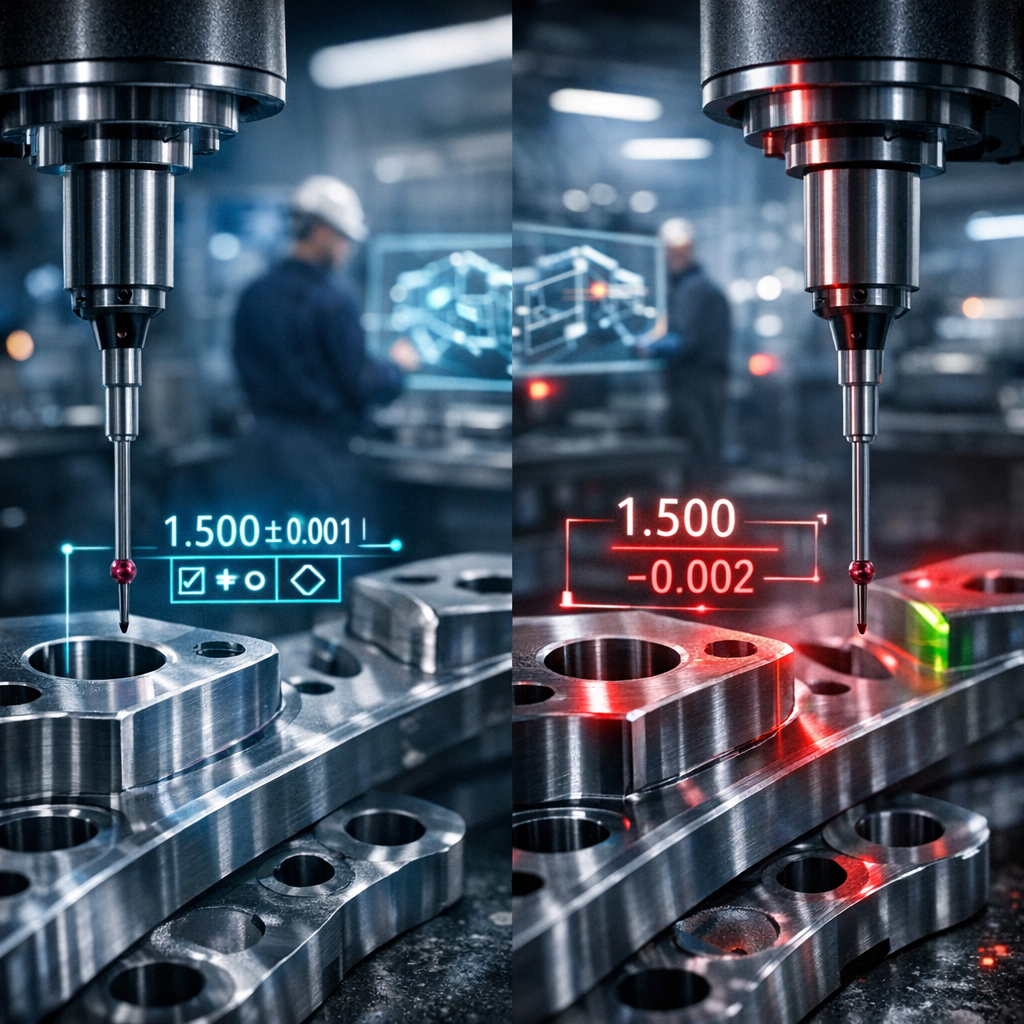
Metal tolerances in fabrication are the permissible dimensional variations between a part's maximum and minimum limits, defining how much a finished component can deviate from its design specifications while still functioning correctly.
This guide covers tolerance types and their functions, process-specific precision ranges, material behavior and its effect on accuracy, governing standards and drawing specifications, root causes of tolerance failures, cost implications of precision requirements, and inspection and verification methods.
Dimensional, geometric, surface finish, flatness, and angular tolerances each control a different aspect of part conformance. Standard sheet metal fabrication holds ±0.010" to ±0.030" reliably, while specialized processes achieve far tighter results.
Fabrication processes carry distinct precision capabilities. CNC machining holds ±0.001" to ±0.005", laser cutting achieves ±0.002" to ±0.005", and plasma cutting ranges from ±0.020" to ±0.030". Sheet metal bending must compensate for spring-back, and welding introduces thermal distortion that widens allowable variation.
Material properties directly influence achievable accuracy. Aluminum's high thermal expansion coefficient requires careful heat management, copper's ductility causes smearing during cutting, and titanium's low thermal conductivity accelerates tool wear. Steel remains the most dimensionally predictable metal for precision work.
ISO 2768 and ASME Y14.5 establish the universal framework for specifying and communicating tolerances on engineering drawings. Thermal expansion, material thickness variation, and progressive tool wear are the primary root causes when parts drift outside acceptable limits.
Tighter tolerances drive exponential cost increases rather than linear ones, making selective application to critical mating surfaces essential. Vertically integrated fabrication consolidates all processes under one roof, eliminating vendor hand-off errors and maintaining tighter cumulative accuracy on complex multi-process builds.
Why Do Metal Tolerances Matter in Custom Fabrication?
Metal tolerances matter in custom fabrication because they determine whether parts fit together correctly, function as designed, and meet quality standards. Without defined tolerances, dimensional variation accumulates across components, causing assembly failures, performance issues, and costly rework.
Tolerance control directly affects part conformance in every fabrication stage. According to a 2026 aPriori report, approximately 70% of manufacturers believe tolerancing is the most important factor affecting costs within manufacturing. This statistic reflects how deeply dimensional accuracy influences production decisions, from material selection through final inspection.
For custom builds involving multiple fabricated components, even small deviations compound across an assembly. A part that measures 0.015" oversize may seem insignificant alone, but when mated with other out-of-spec components, the cumulative error can prevent proper fit or compromise structural integrity. Precise tolerance specifications prevent this stack-up effect by establishing clear acceptance boundaries for every critical dimension.
Machining precision and dimensional accuracy also serve as the shared language between designers, engineers, and fabricators. When tolerances are clearly specified, each team member understands the acceptable range of variation, reducing miscommunication and ensuring the final product matches design intent.
Understanding why tolerances matter provides the foundation for selecting the right tolerance types, ranges, and standards covered in the sections that follow.
What Are the Standard Types of Metal Fabrication Tolerances?
The standard types of metal fabrication tolerances are dimensional, geometric, surface finish, flatness, and angular. Standard sheet metal fabrication tolerances generally range from ±0.010" to ±0.030" and can be held reliably without special operations.
Dimensional Tolerances
Dimensional tolerances define the total amount a specific dimension is permitted to vary between maximum and minimum limits. These tolerances govern linear measurements such as length, width, hole diameter, and feature spacing on fabricated parts.
ISO 9013 defines tolerance ranges for thermal cutting by considering both the nominal size of the feature and the material thickness. Dimensional accuracy, machining precision, and part conformance all depend on correctly specified dimensional tolerances. For most custom fabrication projects, this tolerance type carries the greatest impact on fit and assembly performance.
Geometric Tolerances
Geometric tolerances control the form, orientation, and location of part features beyond simple plus/minus dimensions. Geometric Dimensioning and Tolerancing (GD&T), as defined by ASME Y14.5, provides a symbolic system for specifying how much a feature can deviate in profile, position, concentricity, or runout.
Where dimensional tolerances address size, geometric tolerances address shape relationships between features. This distinction matters when parts must align precisely within assemblies or maintain consistent profiles across complex geometries.
Surface Finish Tolerances
Surface finish tolerances specify the allowable roughness or texture of a fabricated metal surface. According to Xometry, surface finish requirements for "As Milled" CNC parts typically have a minimum 125 micro-inch surface finish.
Tighter surface finish specifications require additional machining passes or post-processing operations such as grinding and polishing. The required finish depends on functional needs; sealing surfaces and bearing interfaces demand smoother finishes than structural components.
Flatness Tolerances
Flatness tolerances define a zone between two parallel planes where the entire surface must lie. This tolerance ensures the sheet remains even without warping, bowing, or local deformation after fabrication.
Thermal processes, residual stress from cutting, and improper clamping can all compromise flatness. Controlling flatness is particularly critical for mating surfaces that must seal or for components that undergo secondary bonding operations.
Angular Tolerances
Angular tolerances govern the permissible rotation of features, ensuring that bends in sheet metal are formed at the correct specified angle. Every bend operation introduces some deviation from the nominal angle due to material spring-back and tooling variation.
Typical angular tolerances for standard sheet metal bending fall within ±1° for most commercial work, though tighter control is achievable with specialized tooling. Consistent angular accuracy across multiple bends determines whether a final assembly closes properly or requires rework.
Understanding these tolerance categories helps engineers specify requirements that balance part performance with manufacturability.
What Tolerance Ranges Apply to Different Fabrication Processes?
Tolerance ranges vary significantly by fabrication process, from ±0.001" in CNC machining to ±0.030" in plasma cutting. The following subsections break down typical tolerances for CNC machining, laser cutting, sheet metal bending, welding, and plasma/waterjet cutting.
What Are Typical Tolerances for CNC Machining?
Typical tolerances for CNC machining range from ±0.001" to ±0.005" (0.025 mm to 0.127 mm). According to Cheetah Precision, this level of dimensional accuracy qualifies CNC machining as a precision process capable of producing parts with extremely tight conformance to design specifications.
These figures represent standard capabilities; multi-axis machines holding the tighter end of that range require careful tool management and thermal stability. For custom projects demanding consistent repeatability across production runs, CNC machining remains the most dimensionally precise subtractive process available.
What Are Typical Tolerances for Laser Cutting?
Typical tolerances for laser cutting are ±0.005 inches (±0.127 mm) as a standard, with precision setups reaching ±0.002 inches. Material thickness directly influences achievable accuracy. According to TEPROSA GmbH, ISO 9013-1 Tolerance Class 1 specifies a limit dimension of ±0.1 mm for workpieces with thickness greater than 1 mm up to 3.15 mm.
Thinner materials generally produce cleaner kerf edges and tighter dimensional results, while thicker stock introduces more thermal distortion at the cut zone. For most sheet metal applications under 3 mm, laser cutting delivers tolerances competitive with CNC machining at faster throughput rates.
What Are Typical Tolerances for Sheet Metal Bending?
Typical tolerances for sheet metal bending range from ±0.010" to ±0.030", depending on material properties and bend complexity. Sheet metal folding processes must account for spring-back, the elastic recovery that occurs after the forming tool releases pressure.
A ResearchGate study on size effects in thin sheet metal forming found that material strength decreases with increasing grain size and decreasing sheet thickness, directly affecting achievable precision. Evenness tolerances for cold-rolled sheet metal follow DIN EN 10259, with 1.5–2.0 mm thick sheets holding ±0.10 mm. Compensating for spring-back through overbending or tool adjustment is essential; without it, angular deviations compound across multi-bend assemblies.
What Are Typical Tolerances for Welding and Assembly?
Typical tolerances for welding and assembly range from ±0.030" to ±0.060" for standard structural work, with precision fixtures enabling tighter results on critical joints. Welding introduces thermal distortion as localized heating and cooling causes metal to expand and contract unevenly.
Key factors affecting weld tolerances include:
- Joint preparation consistency and fit-up gaps
- Weld sequence planning to balance heat input
- Fixturing and clamping methods that resist warpage
- Post-weld stress relief or straightening operations
Assembly tolerances stack across multiple joined components, making individual part accuracy essential for final dimensional conformance.
What Are Typical Tolerances for Plasma and Waterjet Cutting?
Typical tolerances for plasma cutting range from ±0.020" to ±0.030", while waterjet cutting achieves ±0.003" to ±0.010" depending on material and thickness. Plasma cutting uses a high-temperature ionized gas arc that produces a wider kerf and more heat-affected zone than laser or waterjet methods.
Waterjet cutting, by contrast, is a cold-cutting process that eliminates thermal distortion entirely, making it well suited for heat-sensitive alloys and thick plate stock. ISO 9013 classifies thermal cutting tolerances by material thickness and nominal feature size, with plasma typically falling into Class 2 or 3. For projects requiring clean edges without secondary finishing, waterjet offers a strong balance between precision and material versatility.
With process-specific tolerances established, understanding how different metals respond to these processes adds another critical layer of control.
How Do Different Metals Affect Achievable Tolerances?
Different metals affect achievable tolerances through their unique properties, including hardness, thermal expansion, and machinability. The following sections cover tolerance capabilities for steel, aluminum, copper, brass, and titanium.
What Tolerances Can You Hold with Steel and Stainless Steel?
You can hold tolerances of ±0.001" to ±0.005" with steel and stainless steel during CNC machining operations. Steel's high rigidity and dimensional stability make it one of the most predictable metals for precision fabrication. Stainless steel requires slightly more consideration due to work-hardening tendencies, which can increase tool wear and introduce minor variation if feed rates are not optimized. Carbon steel, with its lower alloy content, machines cleanly and holds tight tolerances with less tool deflection. For most structural and precision applications, steel remains the benchmark material against which other metals are measured.
What Tolerances Can You Hold with Aluminum?
You can hold tolerances of ±0.001" to ±0.003" with aluminum, making it one of the easiest metals to machine precisely. Its softness and excellent machinability allow higher cutting speeds with minimal tool wear. However, aluminum's higher thermal expansion coefficient (characteristic temperature of 400°K, per NIST data) means parts can shift dimensionally during machining if heat management is inadequate. Thin aluminum sheets are particularly susceptible to distortion during clamping and cutting. Proper fixturing and coolant strategies compensate for these tendencies, enabling aluminum to achieve tolerances comparable to steel in controlled environments.
What Tolerances Can You Hold with Copper and Brass?
You can hold tolerances of ±0.001" to ±0.005" with copper and brass, though each presents distinct challenges. Copper's high ductility causes material to smear rather than shear cleanly, requiring sharp tooling and aggressive chip evacuation. NIST identifies copper's characteristic temperature at 325°K, indicating significant thermal expansion behavior during fabrication. Brass machines more predictably due to its free-cutting zinc content, producing clean chips and excellent surface finishes. For both materials, controlling thermal buildup during operations is essential to maintaining dimensional accuracy across production runs.
What Tolerances Can You Hold with Titanium?
You can hold tolerances of ±0.001" to ±0.005" with titanium, though the material demands specialized processes. According to TIMET (Titanium Metals Corporation), titanium design and fabrication follow traditional standards established for other materials, with ASTM mill product specifications guiding its construction. Titanium's low thermal conductivity concentrates heat at the cutting edge, accelerating tool wear and increasing the risk of dimensional drift. Slower feed rates, rigid setups, and high-pressure coolant systems are necessary to maintain precision. Despite these challenges, titanium's spring-back resistance after forming is minimal compared to stainless steel, which benefits bending accuracy.
With material properties established, understanding the governing standards ensures tolerances are specified correctly across all metals.
What Tolerance Standards and Systems Govern Metal Fabrication?
The tolerance standards and systems that govern metal fabrication include ISO 2768, ASME Y14.5, and the GD&T symbolic framework. These systems define how dimensional, angular, and geometric tolerances are communicated and verified across engineering drawings.
ISO 2768 provides general tolerances for linear and angular dimensions when specific tolerances are not indicated on engineering drawings. According to Xometry Pro, ISO 2768-1 defines four tolerance classes: f (fine), m (medium), c (coarse), and v (very coarse), simplifying accuracy definitions across fabrication projects.
ASME Y14.5 is the formal publication for Dimensioning and Tolerancing, providing the framework for GD&T symbols and datum references. This standard enables engineers to describe part features regarding:
- Form (flatness, straightness, circularity)
- Orientation (angularity, perpendicularity, parallelism)
- Location (position, concentricity, symmetry)
- Runout (circular and total runout)
Angular tolerance governs the permissible rotation of features, ensuring that bends in sheet metal are formed at the correct specified angle. GD&T moves beyond simple plus/minus dimensions by using a symbolic system to control size, form, profile, orientation, location, and runout according to ANSI Y14.5.
For fabricators managing complex custom builds, mastering these standards is non-negotiable. The difference between a part that assembles correctly and one that requires rework often comes down to whether tolerances were properly specified using the right standard for the application.
Understanding these governing systems prepares engineers to specify tolerances effectively on their drawings.
How Do You Specify Tolerances on Engineering Drawings?
You specify tolerances on engineering drawings using general tolerance standards, GD&T symbols, or explicit plus/minus callouts on individual dimensions.
Engineers indicate tolerances through several methods on technical drawings:
- General tolerance blocks reference standards like ISO 2768, which provides default tolerances for linear and angular dimensions when individual callouts are not shown.
- Plus/minus annotations place explicit allowable variation directly beside each critical dimension.
- GD&T feature control frames define form, orientation, and location tolerances using standardized symbols per ASME Y14.5.
- Datum references establish fixed measurement points from which all toleranced features are measured.
- Notes and title block entries specify default surface finish, material conditions, or tolerance class (fine, medium, coarse).
According to Xometry Pro, ISO 2768 provides general tolerances for linear and angular dimensions when specific tolerances are not indicated on engineering drawings. This standard simplifies drafting by eliminating the need to annotate every non-critical feature individually.
For most custom fabrication projects, combining a general tolerance note with explicit GD&T callouts on critical interfaces produces the clearest communication between design and shop floor. Over-annotating every dimension adds clutter without improving part quality, while under-specifying leaves interpretation to the machinist.
Understanding how tolerances are documented prepares you to evaluate what happens when those specifications are not met.
What Causes Tolerance Failures in Metal Fabrication?
Tolerance failures in metal fabrication result from thermal expansion, material inconsistencies, and equipment degradation. The following subsections examine each root cause.
How Does Thermal Expansion Affect Tolerances?
Thermal expansion affects tolerances by causing dimensional drift as metal parts heat during machining or cutting operations. The thermal expansion coefficient measures a material's fractional change in length divided by the change in temperature, meaning even moderate heat buildup shifts critical dimensions beyond acceptable limits.
Different metals respond differently to process heat. According to NIST data, pure metals like copper and aluminum have specific characteristic temperatures (325°K for Cu, 400°K for Al) that influence their thermal expansion behavior during fabrication. Copper's lower characteristic temperature makes it more susceptible to dimensional change at typical shop-floor conditions than aluminum. Managing workpiece temperature through coolant strategies and controlled feed rates is one of the most effective ways to prevent thermal-induced tolerance failures.
How Does Material Thickness Variation Impact Final Parts?
Material thickness variation impacts final parts by introducing dimensional uncertainty before any cutting or forming operation begins. When incoming sheet or plate stock deviates from its nominal thickness, downstream processes compound that initial error into the finished geometry.
According to Modulus Metal's analysis of ISO 9013, tolerance ranges for thermal cutting are defined by considering both the nominal size of the feature and the material thickness, with Class 1 representing the highest precision. This means a part cut from stock that runs at the high end of its thickness range may fall outside acceptable tolerances even when the cutting equipment performs flawlessly. Verifying incoming material against mill certifications before production begins eliminates this preventable source of failure.
How Do Tool Wear and Machine Calibration Cause Drift?
Tool wear and machine calibration cause drift by introducing progressive dimensional error that compounds over production runs. According to the Journal of Sustainable Development and Policy, machining stages introduce measurable variation through tool wear progression, vibration, and thermal growth of the machine tool.
These factors interact: as a cutting tool dulls, it generates more friction heat, which accelerates thermal growth of the spindle and workpiece. Condition monitoring systems now track gradual tool wear and operational drift in real-time to maintain accuracy retention. Environmental stability also plays a role; ISO 230-3:2020 governs temperature control standards for machine tools to mitigate errors from ambient fluctuations. Proactive calibration schedules, combined with real-time monitoring, prevent small deviations from accumulating into rejected parts.
Understanding these root causes helps fabricators specify realistic tolerances from the start.
How Do Tighter Tolerances Affect Fabrication Cost and Lead Time?
Tighter tolerances affect fabrication cost and lead time by driving exponential increases in machining expense, inspection complexity, and production scheduling demands.
Tighter tolerances create a nonlinear cost curve. According to research published by Frigate on CNC machining economics, tighter tolerances lead to an exponential, rather than linear, increase in manufacturing costs. This relationship means halving an allowable deviation can more than double the fabrication expense.
The cost escalation stems from several compounding factors:
- Slower feed rates and additional finishing passes extend machine cycle time.
- More frequent tool changes and calibration checks reduce throughput.
- Higher scrap rates occur when parts fall outside narrower acceptable ranges.
- Advanced inspection equipment, such as CMMs and optical metrology, becomes mandatory rather than optional.
Approximately 70% of manufacturers consider tolerancing the most important factor affecting production costs. Specifying tolerances too tightly without functional justification causes lead times to extend dramatically, as shops must schedule additional quality gates and rework cycles. Each rejected part resets the production clock.
However, modern fabrication is narrowing this penalty. Real-time monitoring and data automation in manufacturing inspection are helping reduce scrap costs and accelerate new product launches in 2026, allowing shops to hold tighter specifications without proportional schedule delays.
For most custom fabrication projects, the practical approach is applying tight tolerances only to critical mating surfaces and functional interfaces while allowing standard ranges elsewhere. This selective strategy controls costs without compromising assembly fit or performance.
With cost drivers clearly understood, knowing when to specify tighter versus looser tolerances becomes the next critical design decision.
When Should You Request Tighter vs Looser Tolerances?
You should request tighter tolerances only on critical mating surfaces, sealing interfaces, and features that directly affect part function or assembly. Looser tolerances apply to non-functional surfaces, cosmetic areas, and dimensions without assembly constraints.
Tighter tolerances are appropriate for:
- Mating surfaces where two parts must fit precisely together.
- Sealing interfaces that prevent fluid or gas leakage.
- Bearing bores, shaft fits, and rotating assemblies.
- Features governing structural alignment under load.
Looser tolerances are appropriate for:
- Non-critical exterior surfaces with no assembly interaction.
- Internal features hidden from view after final assembly.
- Dimensions with generous clearance by design intent.
- Prototype or low-volume parts where fit verification is iterative.
According to a 2025 report by aPriori, approximately 70% of manufacturers believe that tolerancing is the most important factor affecting costs within manufacturing. This statistic underscores why selective tolerance application matters: specifying tight tolerances everywhere inflates cost without improving function.
For most custom fabrication projects, the practical approach is straightforward. Apply tight tolerances to the three to five features that truly drive performance, and allow standard tolerances on everything else. This balances precision with production efficiency, reducing both lead time and inspection burden.
Understanding when precision is functionally necessary versus when it simply adds cost is one of the most valuable design decisions an engineer can make.
How Do You Inspect and Verify Metal Tolerances After Fabrication?
You inspect and verify metal tolerances after fabrication using contact measurement tools, non-contact optical systems, and standardized verification protocols that confirm dimensional and geometric conformance.
Metal tolerance verification relies on two primary measurement approaches:
- Contact measurement (CMM): A Coordinate Measuring Machine uses a physical probe to touch part surfaces, recording precise spatial coordinates to verify linear dimensions, flatness, and form tolerances.
- Non-contact measurement (optical metrology): Laser scanners and vision systems capture surface geometry without touching the part, enabling rapid inspection of complex profiles.
According to CMM Quarterly, ISO 10360-2 and -5 are used in automotive manufacturing to verify CMMs inspecting engine blocks, ensuring linear dimensions and form tolerances are met. These standards establish traceable accuracy benchmarks that qualify inspection equipment itself.
For most custom fabrication projects, combining both methods yields the most reliable results. CMMs excel at verifying critical datums and tight-tolerance features, while optical systems efficiently scan large surfaces where full-field data matters more than single-point precision.
Understanding how inspection methods validate your tolerances provides the foundation for appreciating how vertically integrated fabrication keeps those tolerances consistent throughout production.
How Does Vertically Integrated Fabrication Improve Tolerance Control?
Vertically integrated fabrication improves tolerance control by consolidating engineering, cutting, forming, welding, and finishing under one roof, eliminating hand-off errors between vendors. The subsections below explain how in-house capability tightens precision and summarize the essential takeaways on metal tolerances.
Can In-House Engineering and Fabrication Help Hold Tighter Tolerances on Complex Custom Builds?
Yes, in-house engineering and fabrication can help hold tighter tolerances on complex custom builds. When design, programming, and production share a single facility, feedback loops between engineers and machinists shorten dramatically. A designer can walk to the shop floor, verify a first-article measurement, and adjust toolpaths within hours rather than days.
This matters most for complex assemblies where tolerances stack across multiple operations. According to the Society of Manufacturing Engineers, automated systems in a job-shop environment require machinists with higher skill levels to manage the entire workflow through a machining system. Vertically integrated shops retain that skilled workforce in one location, ensuring each fabrication stage references the same datum points and quality standards.
For custom builds involving mixed processes, such as CNC machining, laser cutting, and welding, a single-source facility eliminates the dimensional drift that occurs when parts ship between separate vendors operating under different calibration protocols. The result is tighter cumulative tolerances without exponential cost increases.
What Are the Key Takeaways About Metal Tolerances in Fabrication?
The key takeaways about metal tolerances in fabrication are:
- Dimensional tolerance defines the total permissible variation between maximum and minimum limits for any given feature.
- Each fabrication process carries a characteristic precision range; CNC machining holds ±0.001" to ±0.005", while standard sheet metal work holds ±0.010" to ±0.030".
- Material properties, thermal expansion, tool wear, and machine calibration are the primary root causes of tolerance drift.
- Tighter tolerances increase costs exponentially, so specifying precision only where function demands it reduces lead time and expense.
- Standards such as ISO 2768 and ASME Y14.5 provide the universal language for communicating tolerances on engineering drawings.
- Vertical integration, where engineering and fabrication operate under one roof, reduces hand-off errors and maintains tighter cumulative tolerances on complex multi-process builds.
Craftsmen Industries operates as a vertically integrated fabricator with in-house design, engineering, and production capabilities within a 127,000 sq. ft. facility, giving project teams direct control over tolerance outcomes from ideation to final inspection.