
19 min read
What Affects Custom Fabrication Lead Times and How Can You Plan Your Build Timeline?
Craftsmen Industries May 13, 2026 3:06:44 PM
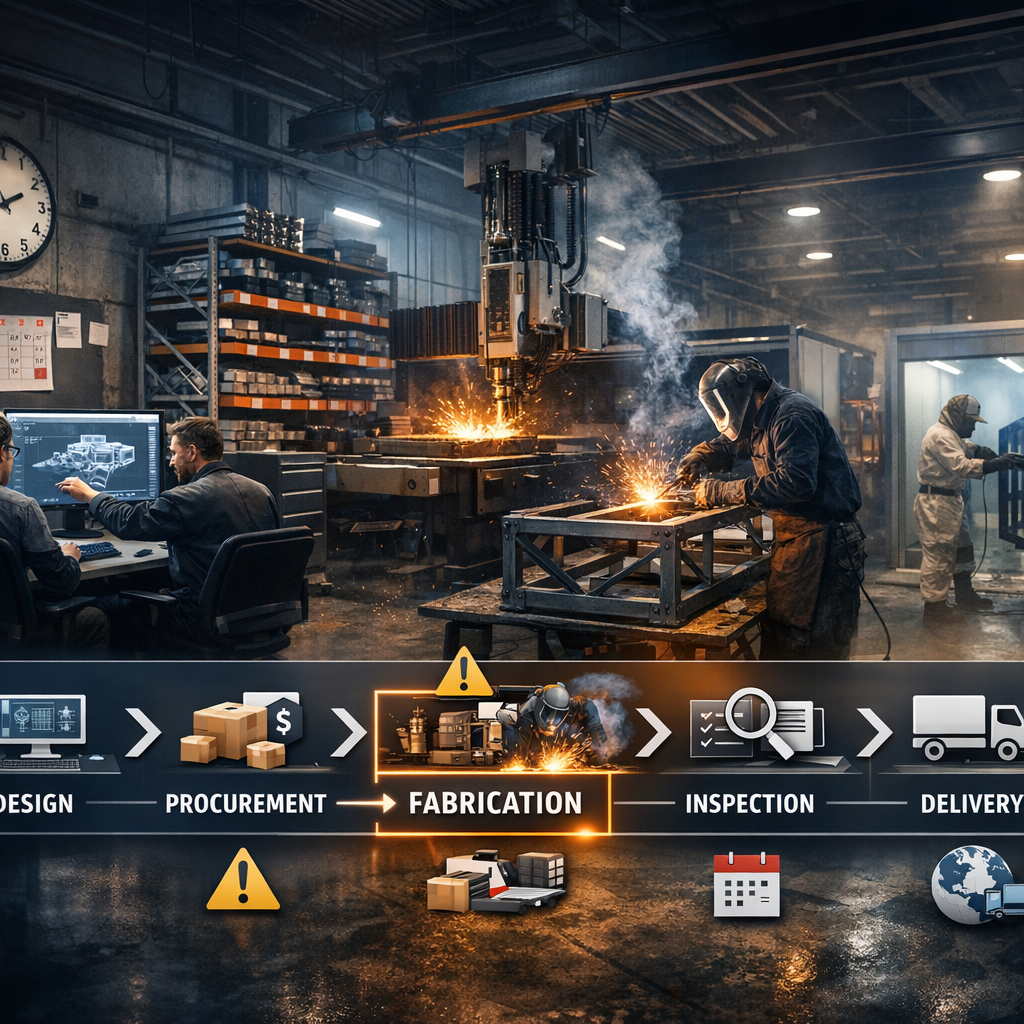
A custom fabrication lead time is the total duration between placing a project order and receiving the finished build, encompassing design engineering, material procurement, fabrication, finishing, quality inspection, and delivery. Every project introduces a unique combination of variables that makes each timeline different.
This guide covers design and engineering factors, material sourcing constraints, project scale and fabrication methods, supply chain and coordination risks, and proven strategies for compressing your schedule.
Design decisions set the foundation for every downstream milestone. Project complexity determines how many materials, processes, and coordination steps a build demands, while revision cycles and regulatory compliance reviews can add weeks before production even begins. Locking designs early eliminates the cascading delays that mid-project changes create.
Material selection is one of the most volatile timeline drivers. Steel lead times currently range from 4 weeks for hot rolled coil to 6 months for internationally sourced seamless tubing, and electronic components can stretch beyond 40 weeks when suppliers shift to allocation models. Pre-ordering long-lead materials during the design phase removes procurement from the critical path.
Project scale shapes timelines from weeks for small builds to six months or longer for multi-unit production runs. Fabrication methods like CNC machining, welding, and finishing each carry distinct cycle times, and mandatory post-weld inspection holds of 16 to 48 hours add non-negotiable scheduling requirements.
Supply chain disruptions, vendor coordination gaps, and seasonal demand surges compound these variables; raw material deliveries now average 81 days compared to 65 days before the pandemic according to a 2025 supply chain analysis by MRPeasy. Choosing a vertically integrated fabricator, building phased approval milestones, and adding 15% to 20% buffer time are the most effective strategies for protecting your schedule.
What Is a Custom Fabrication Lead Time?
A custom fabrication lead time is the total duration between placing a project order and receiving the finished, delivery-ready build. This timeline encompasses every phase of production: design engineering, material procurement, fabrication and assembly, finishing, quality inspection, and final delivery. Unlike standard manufacturing with fixed cycle times, custom fabrication lead times fluctuate based on project-specific variables such as design complexity, material availability, build scale, and the fabrication methods required.
Each phase carries its own time requirements that compound across the full project. Material sourcing alone can shift dramatically depending on what a build demands. According to the 2025 supply chain analysis cited by MRPeasy, raw material deliveries now take 81 days on average, compared to 65 days before the pandemic. That 25% increase in procurement time ripples through every downstream milestone, from cutting and welding to final inspection and shipping.
For project managers and procurement teams, understanding lead time means recognizing it as a chain of dependent stages rather than a single number. A delay in any one phase, whether a late design approval, a back-ordered alloy, or a mandatory post-weld inspection hold, extends the entire build timeline. Planning effectively requires visibility into each stage and realistic buffers for the variables most likely to shift.
The sections ahead break down what drives these timelines, covering design factors, material impacts, fabrication methods, supply chain risks, and proven strategies for compressing your schedule.
Why Do Custom Fabrication Lead Times Vary So Much?
Custom fabrication lead times vary so much because every project introduces a unique combination of design complexity, material availability, production methods, and external supply chain conditions. No two builds share identical requirements, so timelines shift accordingly.
The factors driving this variability fall into several interconnected categories:
- Design and engineering scope determines how many revision cycles, structural calculations, and regulatory reviews a project requires before production begins.
- Material sourcing introduces unpredictable wait times; raw material deliveries now take 81 days on average versus 65 days before the pandemic.
- Fabrication method selection affects production speed, since CNC machining, welding, finishing, and graphics application each carry different cycle times.
- Project scale changes the timeline dramatically; a single prototype follows a different path than a multi-unit production run.
- Vendor coordination adds layers of scheduling dependency when outside specialists handle electrical, hydraulic, or technology integration work.
- Quality assurance requirements impose mandatory hold periods, particularly for weld inspections and structural testing.
- Seasonal demand patterns create capacity constraints during peak ordering periods, compressing available shop floor time.
What makes lead time estimation especially challenging is the compounding effect. A two-week delay in material delivery does not simply add two weeks to the schedule; it can cascade through engineering holds, labor reallocation, and downstream vendor commitments. Projects with tight interdependencies between fabrication stages are most vulnerable to this ripple effect.
For teams planning a custom build, understanding which of these variables applies to their specific project is the first step toward building a realistic timeline. The sections that follow break down each factor in detail, starting with design decisions and moving through materials, production methods, and supply chain conditions.
What Design Factors Influence Your Fabrication Timeline?
Design factors influence your fabrication timeline by determining how many engineering hours, approval stages, and compliance steps a project requires. The subsections below cover project complexity, revision cycles, and regulatory engineering.
How Does Project Complexity Extend Lead Times?
Project complexity extends lead times by increasing the number of materials, processes, and coordination steps required. A straightforward single-material build might need one procurement cycle, while a multi-system project demands several running in parallel, each with its own wait time.
Material selection alone illustrates this effect. According to a March 2025 report from Industrial Tube and Steel Corporation, Dura-Bar continuous cast iron lead times sit at 2 to 8 weeks, while Drawn Over Mandrel (DOM) tubing ranges from 8 to 12 weeks. When a complex design requires both, the longer lead time sets the pace. Projects incorporating electronic subsystems face even steeper delays; if integrated components are involved, those procurement windows can stretch well beyond structural material timelines. Each added layer of complexity, whether mechanical, electrical, or finishing, compounds the overall schedule.
How Do Revision Cycles and Design Approvals Cause Delays?
Revision cycles and design approvals cause delays by inserting waiting periods between each phase of engineering and production. Every design change restarts portions of the review process, and stacked revisions can push a timeline weeks beyond the original estimate.
The most common bottlenecks include:
- Client feedback loops: Each round of stakeholder review adds days or weeks, especially when multiple decision-makers are involved.
- Engineering rework: Revised dimensions, materials, or features require updated drawings, recalculated tolerances, and new material specifications.
- Procurement resets: A late-stage material change can void existing orders and trigger fresh lead times.
- Approval sequencing: When approvals depend on one another, a single delayed sign-off holds up every downstream task.
Finalizing design intent before production begins is one of the most effective ways to protect a fabrication schedule.
How Does Engineering for Structural or Regulatory Compliance Add Time?
Engineering for structural or regulatory compliance adds time by requiring load calculations, code reviews, material certifications, and third-party inspections that run sequentially with, or in addition to, standard fabrication steps.
Compliance-driven material sourcing creates its own timeline pressure. According to Industrial Tube and Steel Corporation's March 2025 data, structural tubing lead times have ticked up to 6 to 8 weeks due to demand and logistical issues. When a project specifies code-rated structural steel, the fabricator cannot substitute freely; the wait is fixed by supply conditions. Beyond procurement, engineering teams must document compliance through stress analyses, weld procedure qualifications, and inspection hold points, all of which require time that standard non-regulated builds avoid.
Understanding these compliance requirements early helps prevent surprises once fabrication is underway.
What Materials Impact Custom Fabrication Lead Times?
Material selection directly impacts custom fabrication lead times. The subsections below cover how steel, aluminum, specialty metals, composites, and electronic components each introduce unique sourcing timelines and potential delays.
How Do Steel and Aluminum Availability Affect Timelines?
Steel and aluminum availability affect timelines by introducing variable lead times based on product form, grade, and sourcing origin. Steel remains the most commonly specified structural material in custom fabrication, yet its lead times fluctuate significantly by type.
According to a March 2025 report from Industrial Tube and Steel Corporation, Hot Rolled Coil sits at 4–6 weeks while Cold Rolled Coil requires 8–12 weeks, representing a sharp incline over the prior month. Structural tubing has ticked up to 6–8 weeks due to demand and logistical pressures. Seamless mechanical tubing ranges from 8–14 weeks domestically and 4–6 months internationally.
Aluminum generally tracks shorter domestic lead times than specialty steel forms, but high-demand periods can compress availability quickly. For projects requiring both materials, the longer lead item sets the pace.
How Do Specialty Metals and Exotic Alloys Affect Timelines?
Specialty metals and exotic alloys affect timelines by requiring extended procurement cycles and limited supplier networks. Materials such as titanium, Inconel, and Hastelloy serve niche structural or thermal demands, but fewer mills produce them in fabrication-ready forms.
Drawn Over Mandrel (DOM) tubing, often specified for precision mechanical applications, carries lead times of 8–12 weeks according to Industrial Tube and Steel Corporation's March 2025 data. Dura-Bar continuous cast iron ranges from 2–8 weeks depending on size and grade.
Exotic alloys frequently require minimum order quantities that small custom projects struggle to meet. This often forces fabricators to source from specialty distributors at premium pricing, adding both cost and scheduling uncertainty. Planning material orders before finalizing design details is one of the most effective ways to prevent exotic alloy procurement from becoming the project's impediment.
How Do Composite and Engineered Materials Affect Timelines?
Composite and engineered materials affect timelines by introducing specialized processing requirements that standard metal fabrication workflows do not accommodate. Carbon fiber, fiberglass, and reinforced polymers each demand dedicated tooling, controlled curing environments, and material-specific bonding techniques.
Unlike steel or aluminum, composites cannot be sourced from broad distributor networks. Many engineered materials are produced to order, which adds weeks before fabrication even begins. Layup schedules, autoclave curing cycles, and post-cure machining extend production beyond what equivalent metal assemblies require.
For projects blending composites with metal structures, sequencing becomes critical. The composite components often carry the longest internal production timeline, so initiating those processes early prevents them from holding up final assembly. Multi-material builds reward fabricators with vertically integrated capabilities who can run parallel workflows.
How Do Electronics and Integrated Components Affect Timelines?
Electronics and integrated components can influence procurement timelines in custom mobile fabrication, primarily through the lead times associated with commercial off-the-shelf medical and industrial systems rather than custom-designed medical devices. Most medical equipment used in mobile clinics, such as diagnostic monitors, imaging consoles, and point-of-care systems, is manufactured as fully validated, pre-engineered products, while integrators focus on installation and system integration rather than component-level design.
According to Sourceability's Q4 2025 lead time report, DRAM lead times now exceed 40 weeks in some cases, with major suppliers shifting to allocation models as inventory buffers collapse to under eight weeks. DDR4 and DDR5 memory lead times range from 26 to over 40 weeks depending on the supplier.
These timelines can dwarf the fabrication schedule itself. For builds integrating electronic systems, pre-ordering components at the design phase rather than the production phase prevents electronics from becoming the bottleneck that delays the entire project.
With material timelines mapped, the next factor to evaluate is how project scale and scope shift overall lead times.
How Does Project Scale and Scope Change Your Lead Time?
Project scale and scope change your lead time by directly affecting material volume, production complexity, and scheduling demands. Small builds may take weeks, while large or multi-unit projects can extend into months.
What Is the Typical Lead Time for Small-Scale Custom Builds?
The typical lead time for small-scale custom builds ranges from 2 to 6 weeks, depending on material choice and design complexity. Single-unit prototypes, small enclosures, and simple structural components generally require less engineering review, fewer material orders, and shorter production runs. However, material procurement alone can consume most of that window. According to a March 2025 report from Industrial Tube and Steel Corporation, Hot Rolled Coil lead time sits at 4 to 6 weeks, while Cold Rolled Coil extends to 8 to 12 weeks. Even a straightforward small build can stall if it requires a material with longer sourcing timelines. Selecting readily available stock materials is one of the most effective ways to keep small projects on track.
What Is the Typical Lead Time for Mid-Size Fabrication Projects?
The typical lead time for mid-size fabrication projects falls between 6 and 14 weeks. Projects at this scale, such as custom marketing vehicles, mobile medical units, or multi-component industrial assemblies, involve more design iterations, multiple material types, and coordinated production stages. Engineering reviews, structural calculations, and approval cycles add time before fabrication begins. Production scheduling also becomes a factor; mid-size builds compete for shop floor capacity alongside other active projects. Phased material ordering helps here, since staggering procurement across long-lead and short-lead items prevents a single delayed shipment from halting the entire build.
What Is the Typical Lead Time for Large-Scale or Multi-Unit Builds?
The typical lead time for large-scale or multi-unit builds ranges from 14 weeks to 6 months or longer. Fleet deployments, multi-vehicle experiential programs, and complex industrial installations require extended engineering, bulk material sourcing, sequential production scheduling, and multi-phase quality inspections. Each additional unit introduces compounding variables across procurement, fabrication, finishing, and logistics. Coordinating vendors for specialty components can further extend timelines when inventory buffers are thin. For projects at this scale, starting the planning process 6 to 12 months before the target delivery date is a practical baseline; builds requiring specialty metals or integrated electronics often need even more lead time.
Understanding how scale shapes timelines helps you set realistic expectations before fabrication methods add further scheduling variables.
How Do Fabrication Methods Affect Your Build Schedule?
Fabrication methods affect your build schedule by determining how long each production phase takes, from precision cutting to final finishing. CNC machining, welding and structural assembly, and paint and graphics application each introduce distinct timing factors.
How Does CNC Machining Affect Production Speed?
CNC machining affects production speed by enabling rapid, repeatable cuts with minimal manual intervention. Once a program is loaded, multi-axis CNC routers and mills produce complex parts at consistent cycle times, reducing per-unit fabrication hours compared to manual shaping.
However, the speed advantage depends on setup complexity. Custom one-off components require unique tooling configurations and test cuts that can consume hours before production begins. Multi-axis parts with tight tolerances demand slower feed rates and additional passes. For projects requiring dozens of identical brackets, panels, or structural components, CNC machining compresses timelines significantly. For single prototype pieces, the programming and setup phase can rival the actual cutting time. Planning CNC work early in the schedule prevents it from becoming a bottleneck downstream.
How Does Welding and Structural Assembly Affect Production Speed?
Welding and structural assembly affect production speed by introducing mandatory hold times that extend beyond the physical joining process. Fit-up, tack welding, full penetration passes, and cooling sequences must follow a strict order that cannot be parallelized.
According to AWS D1.1 as cited by TWI Global, a 48-hour delay is required for specific high-strength steels before non-destructive testing. These inspection windows are non-negotiable and must be built into every structural assembly schedule. Complex weldments with multiple joints compound these delays, since each joint may need its own inspection cycle before the next assembly phase begins.
How Does Paint, Finish, and Graphics Application Affect Production Speed?
Paint, finish, and graphics application affects production speed by adding sequential cure and drying stages that cannot be rushed without compromising adhesion or durability. Each coat of primer, base color, and clear coat requires specific flash times and environmental conditions before the next layer can be applied.
Large-format graphics, wraps, and custom decals introduce additional scheduling constraints. Surface preparation, application, and post-heat treatment each demand dedicated time. Temperature and humidity fluctuations in the finishing environment can extend cure windows by hours or even days. Because finishing is typically the final fabrication step, any delay here directly pushes the delivery date. Scheduling finish work with realistic cure buffers prevents last-minute timeline compression that risks quality defects.
With production methods mapped, understanding external supply chain risks reveals the next layer of timeline variables.
What Supply Chain Disruptions Can Delay Custom Fabrication?
Supply chain disruptions that can delay custom fabrication include raw material shortages, transportation bottlenecks, supplier allocation limits, and global trade instability. These disruptions affect material availability, delivery windows, and overall production scheduling.
According to 2025 supply chain statistics cited by MRPeasy, supply disruptions cost manufacturers 8% of annual revenue on average. That figure reflects not just lost production time but also expediting fees, material substitutions, and rescheduled labor. The European Central Bank reported that supply chain disruptions accounted for one-third of the lengthening in delivery times over a six-month period ending November 2021, with their contribution growing. During that same window, global industrial production would have been approximately 1.4% higher without those shocks.
For custom fabrication specifically, disruptions compound because each project relies on a unique bill of materials. A single delayed component, whether structural steel, specialty hardware, or electronic controls, can stall an entire build. Even post-fabrication stages are affected; Welding standards such as AWS D1.1 may require hold times before final inspection for certain materials to account for delayed hydrogen cracking, meaning any upstream delay can push inspection and delivery windows further out. Even where not explicitly mandated, many fabrication processes incorporate waiting periods or staged inspections as a precaution based on material properties and project specifications.
Proactive material sourcing and strong supplier relationships remain the most effective buffers against these unpredictable timeline threats. Understanding how vendors coordinate deliveries adds another layer of schedule protection.
How Does Vendor Coordination Affect Lead Times?
Vendor coordination affects lead times by introducing external dependencies that sit outside a fabricator's direct control. When multiple suppliers must deliver materials, components, or specialty services on overlapping schedules, a single delayed vendor can stall the entire build sequence. Poor alignment between vendors and the production team creates gaps in material flow, pushes back fabrication starts, and compresses downstream finishing and inspection windows.
Custom fabrication projects rarely depend on a single source. Structural steel, electronics, paint systems, hydraulic components, and graphic substrates often come from different suppliers, each operating on independent production cycles. If one vendor's lead time shifts from six weeks to ten, the fabricator must either hold partially assembled work in progress or restructure the production schedule around the delay. Both options add cost and time.
Communication frequency is the most controllable variable in vendor coordination. Fabricators that establish weekly status updates, shared milestone trackers, and escalation protocols catch slippage early enough to source alternatives or adjust sequencing. Without these touchpoints, delays surface only when a shipment fails to arrive, leaving no room to recover.
According to the 2025 supply chain data cited by MRPeasy, raw material deliveries now take 81 days versus 65 days before the pandemic. That 16-day expansion applies across the supply base, meaning every vendor relationship carries more scheduling risk than it did just a few years ago. Projects with five or more external vendors compound this risk, since the probability that at least one delivery slips increases with each additional supplier.
Vendor coordination is where vertically integrated fabricators hold a distinct advantage. Consolidating more processes under one roof reduces the number of external handoffs, shrinks the coordination burden, and keeps more of the timeline within direct control.
What Role Does In-House vs Outsourced Production Play in Lead Times?
In-house production consolidates fabrication steps under one roof, reducing handoff delays and shipping between vendors. Outsourced production splits those steps across multiple facilities, adding coordination time and transit gaps to every phase of a build.
A vertically integrated fabricator controls design, engineering, metal fabrication, finishing, and graphics installation within a single facility. This consolidation eliminates the waiting periods that occur each time a partially completed project ships to an outside specialist. When one team manages every stage, scheduling adjustments happen in real time rather than through chains of vendor communications.
Outsourced production introduces lead time risk at each transfer point. Every subcontractor operates on their own production queue, and delays at one vendor cascade downstream. Shipping between facilities adds transit days that compound across multiple outsourced stages. Quality discrepancies between vendors can also force rework, extending the overall timeline further.
The lead time difference between the two models becomes most pronounced on complex custom builds requiring welding, CNC machining, paint, and graphics. For projects needing four or five distinct processes, an outsourced approach may add weeks of cumulative transit and queue time that a single-facility operation avoids entirely.
In-house production also enables parallel workflows. A fabricator with integrated capabilities can begin metal cutting while engineering finalizes downstream details, or start graphics production while structural assembly continues. Outsourced models typically require sequential completion, since each vendor needs a finished handoff before beginning their scope.
For timeline-sensitive custom fabrication projects, the production model is one of the most controllable variables available. Selecting a fabricator with broad in-house capabilities compresses the schedule at every stage where an outsourced approach would otherwise introduce waiting. Understanding quality inspection requirements further shapes how these production timelines play out.
How Do Quality Assurance and Inspection Requirements Affect Timelines?
Quality assurance and inspection requirements affect timelines by introducing mandatory hold periods, testing sequences, and compliance checkpoints that pause production until verification is complete. These delays are often dictated by industry standards rather than fabricator preference.
Weld inspection alone can add significant downtime. Welding standards may require or recommend hold times before final inspection for certain materials to account for delayed hydrogen cracking. For higher-strength materials, the wait extends further: According to AWS D1.1 as cited by TWI Global, a 48-hour delay is required for specific high-strength steels before non-destructive testing for steels such as ASTM A 514 and A 517.
These are not arbitrary buffers. Research by Richard Pargeter, cited by TWI Global, found that in 690 MPa yield low-alloy steel, delays of up to 21 hours were recorded before first detectable cracking, with new cracks continuing to appear for up to 64 hours and crack growth persisting for up to 140 hours after welding. Inspecting too early risks missing defects entirely, which would compromise structural integrity and require costly rework later.
Beyond weld inspections, quality assurance timelines compound through additional checkpoints:
- Dimensional verification against engineering drawings at each assembly stage.
- Coating thickness and adhesion testing after paint or protective finishes cure.
- Functional testing of integrated mechanical or electrical systems.
- Documentation review for regulatory or client-specific compliance packages.
Each checkpoint requires qualified personnel, and scheduling third-party inspectors adds its own coordination lag. For projects governed by military, aerospace, or medical standards, inspection protocols are more rigorous and the hold periods longer.
This is one of the most underestimated timeline factors in custom fabrication. Clients frequently account for cutting, welding, and finishing in their schedules but overlook the days lost to mandatory inspection holds. Building these windows into the project timeline from day one prevents the false impression that a project is "behind schedule" when it is simply following required protocol. Seasonal demand patterns can further compress inspector availability, making early scheduling even more critical.
What Seasonal or Industry Demand Patterns Affect Lead Times?
Seasonal and industry demand patterns affect lead times by creating predictable surges that strain fabrication capacity, material availability, and vendor schedules. These cycles vary by sector but follow recurring trends that informed project managers can anticipate and plan around.
Custom fabrication shops experience concentrated demand spikes tied to industry event calendars, fiscal cycles, and construction seasons. Experiential marketing builds peak before major trade show seasons and summer touring windows, compressing shop capacity during Q1 and Q2. Government and military contracts often cluster around fiscal year-end deadlines, as agencies rush to allocate remaining budgets before October. Construction-related fabrication surges during warmer months when site work accelerates.
These overlapping cycles create compounding pressure. When multiple industries hit peak demand simultaneously, material suppliers face order backlogs, and fabrication queues extend. Steel and aluminum mills, for instance, adjust production schedules based on seasonal construction demand, which tightens availability for custom fabricators competing for the same stock.
Holiday shutdowns at mills, component suppliers, and logistics providers introduce additional gaps. Year-end closures in December and early January can stall material shipments for weeks, catching teams off guard if orders were not placed in advance. Similarly, supplier maintenance shutdowns in late summer occasionally reduce output at critical moments.
For projects involving electronics integration, demand patterns from the broader tech industry amplify lead times further. According to a Q4 2025 report from Sourceability, industry inventory buffers have fallen to under eight weeks compared to 31 weeks in the prior timeframe, meaning seasonal demand spikes now hit harder because there is less safety stock to absorb them.
The most practical defense against seasonal delays is early engagement. Teams that lock in fabrication schedules and material orders well ahead of known demand peaks avoid the worst bottlenecks. Understanding which industries share your fabrication partner's capacity helps you anticipate when shop floors will be busiest, giving you leverage to secure priority scheduling before queues fill.
How Can You Shorten Your Custom Fabrication Lead Time?
You can shorten your custom fabrication lead time by finalizing designs early, selecting a vertically integrated fabricator, pre-ordering long-lead materials, and planning approvals in phases.
How Does Finalizing Design Early Reduce Your Timeline?
Finalizing design early reduces your timeline by eliminating revision cycles that stall engineering, procurement, and production sequencing. Each design change after kickoff forces re-quoting of materials, updated shop drawings, and revalidation of structural or regulatory requirements.
Locked designs allow fabricators to:
- Release material purchase orders immediately.
- Begin CNC programming and fixture setup in parallel with procurement.
- Schedule welding, assembly, and finishing without waiting on approval loops.
Even one major revision mid-project can push a build back by weeks, since downstream tasks cascade from design completion. For complex custom builds, investing extra time upfront in design review consistently compresses the overall schedule more than any other single strategy.
How Does Choosing a Vertically Integrated Fabricator Save Time?
Choosing a vertically integrated fabricator saves time by consolidating design, engineering, fabrication, finishing, and graphics under one roof. When these disciplines operate within a single facility, handoff delays between vendors disappear.
Outsourced production introduces coordination gaps at every transition: shipping partially completed assemblies, aligning separate quality standards, and managing multiple schedules. A vertically integrated partner controls sequencing internally, so overlapping tasks run concurrently rather than sequentially. If a design question arises during fabrication, the engineering team resolves it on the shop floor rather than through days of emails between separate companies. This operational compression is one of the most reliable ways to protect a custom fabrication timeline from unnecessary expansion.
How Does Pre-Ordering Long-Lead Materials Help Your Schedule?
Pre-ordering long-lead materials helps your schedule by removing material wait times from the critical path of production. According to a March 2025 report by Industrial Tube and Steel Corporation, seamless mechanical tubing currently sits at approximately 8 to 14 weeks domestically and 4 to 6 months for international sourcing.
When materials arrive before fabrication begins, production crews can start immediately upon design approval. Key steps include:
- Identifying specialty metals, electronic components, or engineered materials during the design phase.
- Placing purchase orders before final drawings are complete, using preliminary specifications.
- Storing pre-ordered stock at the fabrication facility for immediate availability.
Delaying procurement of long-lead materials until final design sign-off can contribute to avoidable schedule overruns, particularly in projects with complex supply chains or extended lead times.
How Does Phased Approval Planning Prevent Bottlenecks?
Phased approval planning prevents bottlenecks by breaking the client review process into scheduled milestones rather than a single final approval gate. When all stakeholders must approve one comprehensive package at once, conflicting feedback and internal review delays can stall production for weeks.
Effective phased approval includes:
- Concept approval before detailed engineering begins.
- Engineering and structural sign-off before material cutting starts.
- Finish, paint, and graphics approval before the coating phase.
Each gate releases the next production stage, so fabrication progresses continuously while later-phase details are still under review. Without phased planning, a single delayed approval holds every downstream task hostage. Building realistic project timelines requires these approval checkpoints to be embedded from the start.
How Should You Build a Realistic Project Timeline for Custom Fabrication?
You should build a realistic project timeline for custom fabrication by mapping key milestones from design approval through delivery, then adding buffer time for delays. The sections below cover essential milestones and how much contingency to plan for.
What Milestones Should You Include in a Fabrication Schedule?
The milestones you should include in a fabrication schedule are the critical checkpoints that define progress from concept to delivery. A well-structured schedule typically includes:
- Design finalization and engineering sign-off, confirming all drawings, specs, and compliance requirements are locked.
- Material procurement completion, marking the date all raw materials and long-lead components arrive on-site.
- Fabrication start and stage gates, tracking cutting, welding, machining, and assembly phases individually.
- Quality inspection and testing hold points, built in after major assembly steps to catch issues before they compound.
- Finish work and graphics application, covering paint, coatings, wraps, and branding installation.
- Final walkthrough and client approval, allowing time for punch-list corrections before shipping.
- Logistics and delivery, accounting for transport coordination and site-specific installation needs.
Treating each milestone as a hard date, rather than an estimate, keeps teams accountable and surfaces slippage early.
What Buffer Time Should You Add for Unexpected Delays?
The buffer time you should add for unexpected delays is typically 15% to 20% of the total projected timeline. This contingency absorbs the supply chain volatility, inspection holds, and revision cycles that routinely affect custom builds.
With raw material deliveries now taking around 81 days versus 65 days before the pandemic according to a 2025 Supply Chain Statistics report cited by MRPeasy, this shift alone justifies significant schedule padding. Weld inspection standards add further mandatory hold time; certain high-strength steel codes require a 48-hour minimum wait before non-destructive testing can even begin.
For most custom fabrication projects, distributing buffer time across procurement, production, and QA stages works better than stacking it all at the end. Front-loaded contingency catches material delays before they cascade into missed production windows.
With a milestone-driven timeline and built-in contingency, the next step is choosing a fabrication partner whose capabilities compress that schedule.
How Can a Vertically Integrated Fabricator Reduce Your Build Timeline?
A vertically integrated fabricator can reduce your build timeline by consolidating design, engineering, fabrication, finishing, and graphics under one roof. This eliminates vendor handoffs, shipping delays, and communication gaps that fragment schedules across multi-vendor projects.
Can Craftsmen Industries' In-House Capabilities Accelerate Your Custom Build?
Yes, Craftsmen Industries' in-house capabilities can accelerate your custom build. Leading custom fabricators operate from large integrated facilities where design, engineering, fabrication, printing, and installation happen under a single production workflow. This vertically integrated structure removes the coordination lag that occurs when separate vendors handle individual phases.
When a single organization manages multiple phases of design, fabrication, and assembly, coordination improves and approval cycles can move more quickly. Companies like Craftsmen Industries handle much of the process in-house, which reduces handoff delays and helps align material procurement with production schedules. While external suppliers are still required for some key components and materials, this integrated approach can limit the impact of vendor-related delays. For projects with tight deadlines or complex multi-discipline requirements, this level of integration is often the single biggest factor in compressing lead times.
What Are the Key Takeaways About Custom Fabrication Lead Times and Planning Your Build Timeline?
The key takeaways about custom fabrication lead times and planning your build timeline center on early preparation, material awareness, and fabricator selection:
- Design complexity, material availability, and project scale are the three primary drivers of lead time variability.
- Steel and specialty metal lead times currently range from 4 weeks to 6 months depending on grade and sourcing region, making early material orders essential.
- Supply chain disruptions remain a persistent factor; raw material deliveries now average 81 days compared to 65 days before the pandemic, according to 2025 supply chain data cited by MRPeasy.
- Quality assurance steps, including weld inspection hold periods, add days that must be built into every schedule.
- Finalizing designs before production begins and selecting a vertically integrated fabricator are the most effective strategies for shortening timelines.
- Building buffer time into milestone schedules protects against cascading delays from material shortages, revision cycles, or inspection requirements.
For most custom fabrication projects, the best outcomes come from treating timeline planning as a design-phase activity rather than an afterthought. Understanding where delays originate gives you the leverage to prevent them before production begins.