
7 min read
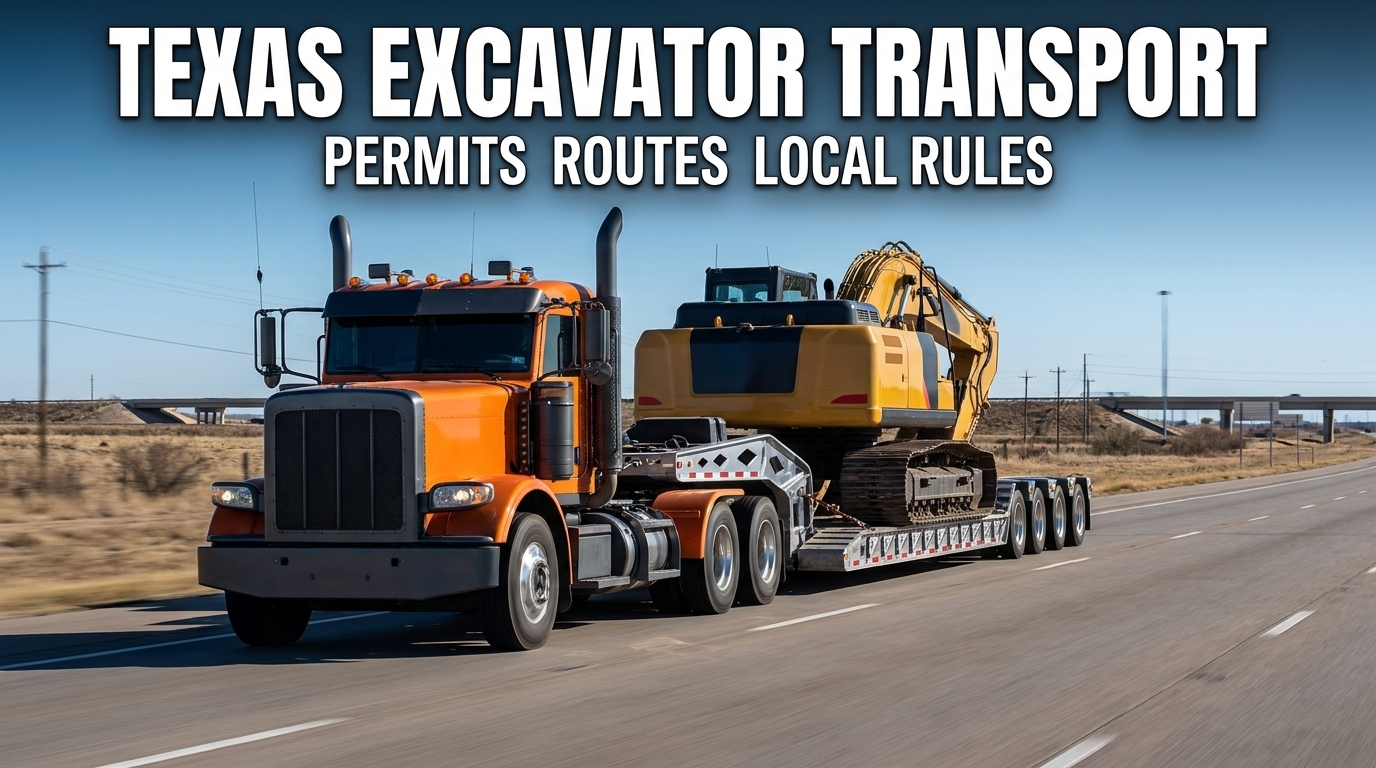
Texas excavator transport is the process of moving oversized or overweight construction equipment across state highways and local roads under TxDMV oversize and overweight permits, which are legally required any time a load exceeds 8'6" wide, 14'0" high, 65' long, or 80,000 pounds.
This guide covers the permit requirements, route planning process, local jurisdiction rules, and equipment securement standards that govern every legal excavator move in Texas.
Texas excavator transport permitting involves selecting the correct permit type through TxDMV's TxPROS system, assembling the required documentation, and understanding which state agencies, including TxDMV, TxDOT, and TxDPS, each govern a distinct part of the compliance process.
Route planning determines which corridors your load can legally travel, based on dimensions, time of day, and whether a Route Inspection Certification or escort vehicles are required before a permit is issued.
Local rules in counties and cities like Harris County, Houston, and Dallas add jurisdiction-specific bond requirements and peak-hour curfews on top of state permit conditions, creating compliance obligations that vary by destination.
Equipment preparation covers the federal cargo securement standards and Texas lighting requirements that apply to every excavator move, including minimum tie-down counts, working load limits, and accessory lockdown rules.
Finally, we cover how Bear Down Logistics manages each of these elements, from TxDMV permit filing through escort coordination and delivery, for excavator transport throughout Texas.
What Permits Are Required for Transporting Excavators in Texas?
Transporting excavators in Texas requires oversize or overweight permits from the Texas Department of Motor Vehicles whenever the load exceeds legal size or weight thresholds. The sections below cover how to apply, what documentation to prepare, and which agencies oversee compliance.
How Do You Apply for Oversize or Overweight Permits in Texas?
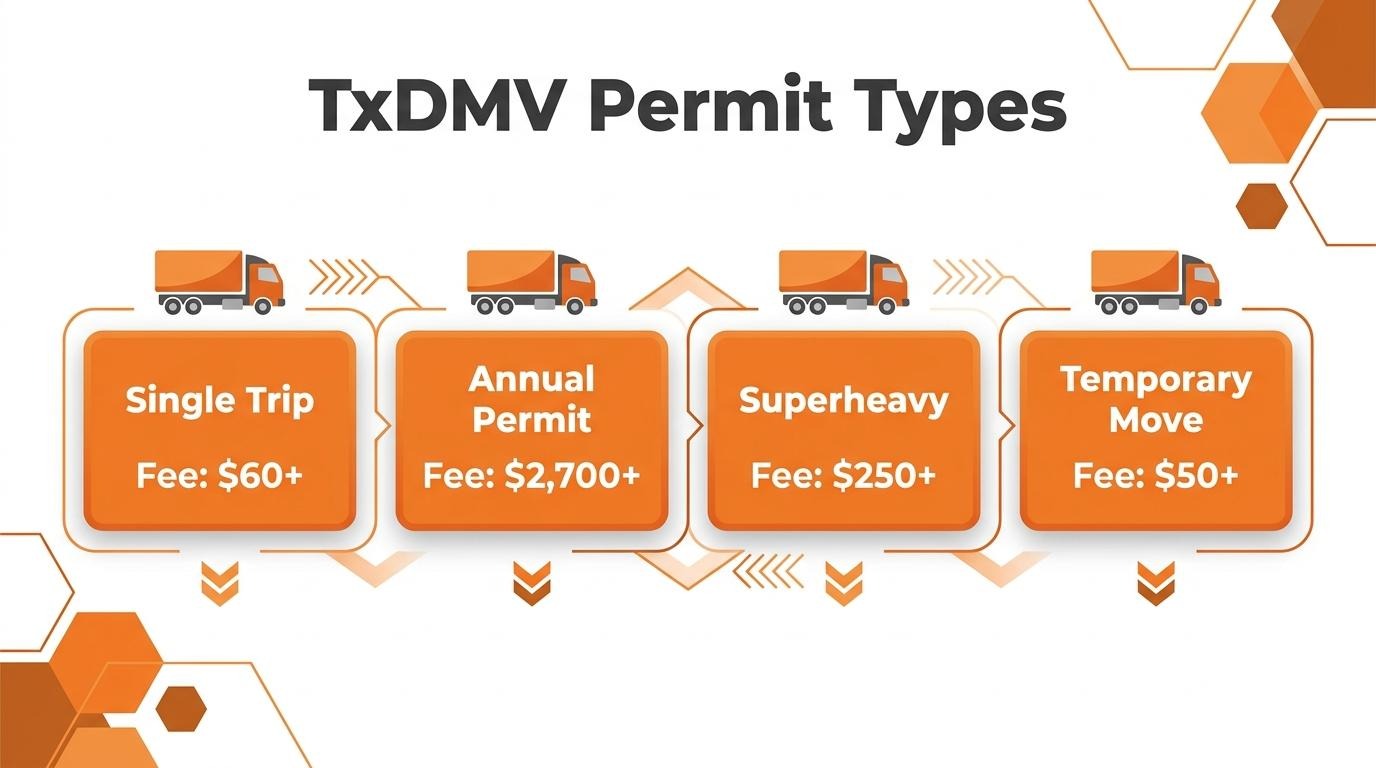
Applying for oversize or overweight permits in Texas begins through the TxDMV's online permitting system, TxPROS. According to the TxDMV, "TxPROS modernizes the routing and permitting of oversize and overweight loads and provides real-time restriction management." An oversize permit is required when your load exceeds 8'6" wide, 14'0" high, 65' long, or 80,000 pounds.
Permit types and associated fees include:
- Single-trip permit: Covers non-divisible loads up to 254,300 pounds, plus a highway maintenance fee for loads over 80,000 pounds.
- Annual over-axle/over-gross permit: Base fee of $90, plus county fees ranging from $175 for 1-5 counties to $1,000 for 101-254 counties.
- Superheavy single-trip permit: Required for loads exceeding 254,300 pounds gross weight or exceeding maximum axle weights.
- 72-hour temporary movement permit: $25; 144-hour permit: $50.
Selecting the correct permit type before applying prevents costly delays on excavator moves.
What Documentation Is Needed for Legal Excavator Transport in Texas?
The documentation needed for legal excavator transport in Texas includes vehicle registration, insurance certificates, load dimensions, and weight certifications. For loads exceeding 20' in width, 18'11" in height, or 125' in length, the TxDMV requires a Route Inspection Certification on file before issuing any permit. Carriers transporting loads over 80,000 pounds must also document highway maintenance fee payment. Having accurate axle weight data is especially critical: superheavy loads require proof that spacing and per-axle weights comply with permit thresholds. Incomplete or inaccurate documentation is one of the most common reasons permit applications are delayed, making pre-trip verification essential.
Which Agencies Regulate Heavy Equipment Transport Permits in Texas?
The agencies that regulate heavy equipment transport permits in Texas are the Texas Department of Motor Vehicles, the Texas Department of Transportation, and the Texas Department of Public Safety. TxDMV serves as the primary permit-issuing authority for oversize and overweight loads. TxDOT governs road conditions, load-restricted routes, and infrastructure clearances. TxDPS enforces commercial vehicle compliance at roadside inspection points. In Fiscal Year 2025, TxDMV issued approximately 770,000 oversize/overweight permits, reflecting the volume of regulated moves across the state. Understanding which agency controls each aspect of your move, whether permitting, routing, or enforcement, helps avoid compliance gaps that can result in fines or load shutdowns.
What Are the Key Route Planning Considerations for Excavator Transport in Texas?
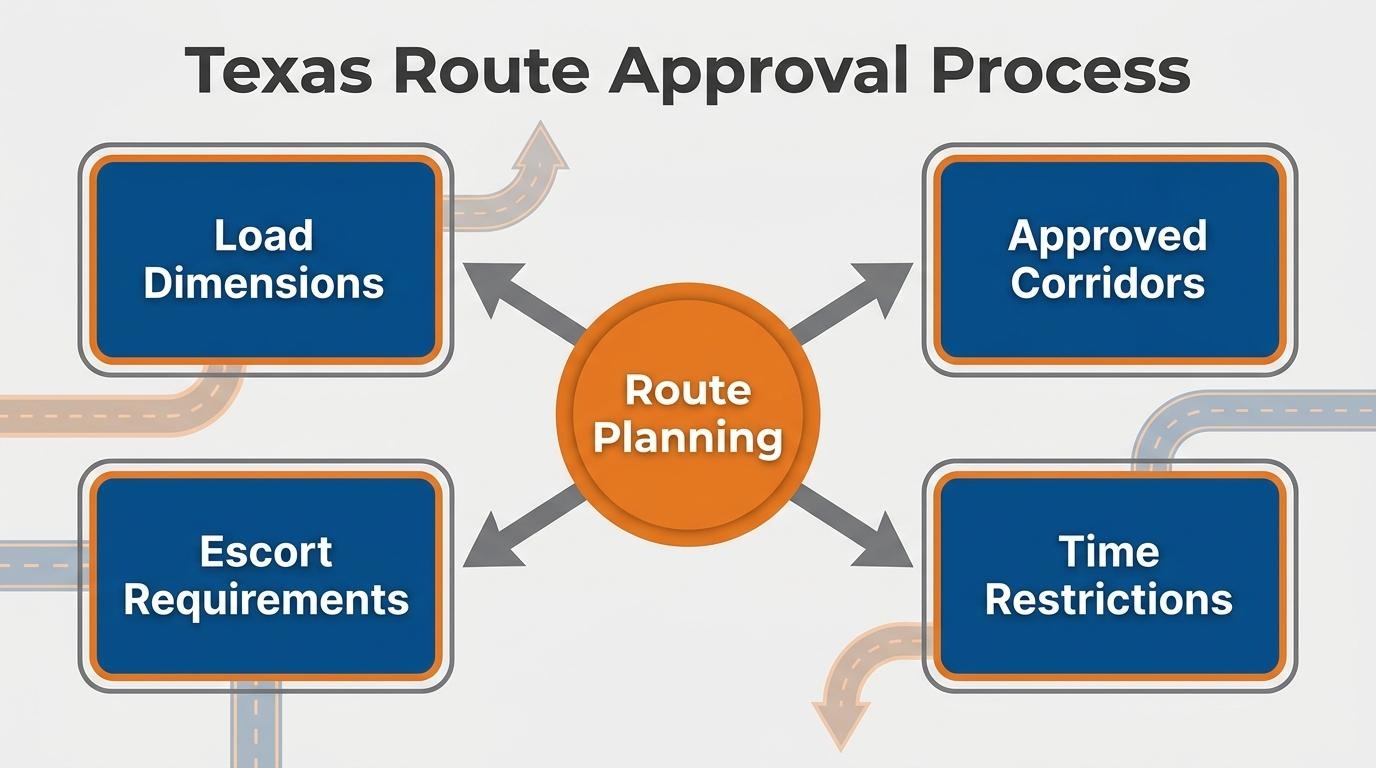
The key route planning considerations for excavator transport in Texas include load dimensions, approved corridors, escort requirements, and travel-time restrictions. The following sections cover how to identify approved routes, understand applicable restrictions, and avoid delays before and during transport.
How Do You Identify Approved Routes for Oversized Excavator Loads?
Approved routes for oversized excavator loads are identified through TxDMV's permitting system, TxPROS, which provides real-time restriction management for oversize and overweight loads. According to TxDMV, "TxPROS modernizes the routing and permitting of oversize and overweight loads and provides real-time restriction management."
Route identification depends on your load's dimensions:
- Loads exceeding 20' in width, 18'11" in height, or 125' in length require a Route Inspection Certification on file before a permit is issued.
- Loads exceeding 16' in width require one front and one rear escort on all roads.
- Loads exceeding 17' in height require a front escort equipped with a nonconductive metal height pole to measure overhead obstructions.
Proactive route inspection is often underestimated but directly prevents permit delays and mid-route compliance failures.
What Restrictions or Limitations Apply to Texas Transport Routes?
The restrictions that apply to Texas transport routes include time-of-day bans, load-zoning requirements, and interstate dimension caps. Travel windows and weight limits vary based on road type and load size.
Key restrictions include:
- Vehicles not exceeding 10' wide or 100' long may operate on the interstate system 24/7, including weekends.
- Travel on load-restricted roads requires axle and axle group weights to be load-zoned, meaning 10% less than the maximum permitted weight.
- Escort flag vehicles must be single units with a gross vehicle weight between 1,000 and 10,000 pounds.
- Escort flaggers must complete a TCOLE-approved training program before directing traffic under a TxDMV permit.
How Can You Avoid Common Obstacles or Delays During Route Planning?
Common obstacles during Texas excavator route planning are avoided by confirming escort requirements, submitting Route Inspection Certifications early, and accounting for local travel curfews before departure. Overlooking city-specific restrictions is one of the most frequent causes of permit rejections and transport delays.
Preventive steps include:
- Verifying load dimensions against TxDMV thresholds for width, height, and length before applying.
- Submitting Route Inspection Certification before permit issuance for loads exceeding the dimensional thresholds.
- Checking for peak-hour bans in major metros, since Houston restricts permit loads over 12' wide between 7-9 a.m. and 4-6 p.m. on weekdays, and Dallas bans oversized loads on key corridors from 6-9 a.m. and 3-6 p.m.
- Confirming escort flagger credentials to avoid compliance failures at enforcement checkpoints.
With route restrictions clearly mapped, understanding local rules adds the final layer of compliance for Texas excavator transport.
What Local Rules and Regulations Impact Excavator Transport in Texas?
Local rules and regulations that impact excavator transport in Texas vary by county and city, layering additional requirements on top of state permits. The H3s below cover jurisdiction-specific bonding and corridor rules, plus curfews, escort mandates, and seasonal restrictions.
Which Texas Counties or Cities Have Unique Transport Requirements?
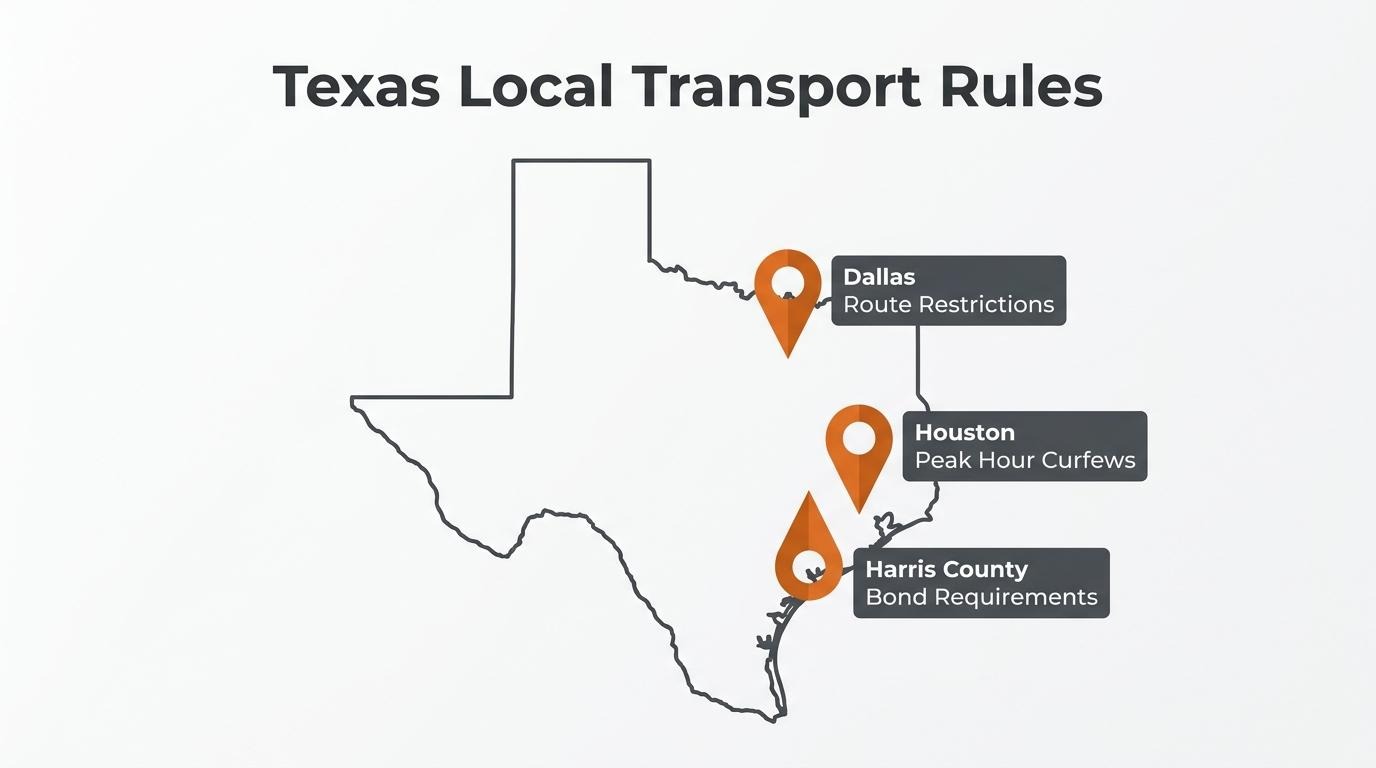
Texas counties and cities with unique transport requirements include Harris County and major urban centers like Houston and Dallas. Harris County requires a minimum $5,000 bond for oversize/overweight permits, and an existing bond will not be accepted for new permit applications, according to the Harris County Office of the County Engineer. Dallas imposes route-specific restrictions, banning oversized loads on key corridors such as I-35E and the LBJ Freeway during peak periods. Carriers transporting excavators through these jurisdictions must verify local bonding, corridor access, and permit conditions before departure. Missing a county-level bond requirement is one of the most common and avoidable compliance failures on Texas heavy haul moves.
How Do Local Curfews, Escorts, or Seasonal Restrictions Affect Transport?
Local curfews, escorts, and seasonal restrictions affect transport by adding time and equipment requirements beyond state-level permit conditions. Key restrictions include:
- Houston curfew: Permit loads over 12' wide cannot move between 7–9 a.m. and 4–6 p.m., Monday through Friday.
- Dallas curfew: Oversized loads are banned on I-35E and the LBJ Freeway from 6–9 a.m. and 3–6 p.m. on weekdays.
- Escort requirements: Loads exceeding 16' in width require one front and one rear escort on all roads, per TxDMV.
- Height pole mandate: Any load exceeding 17 feet requires a front escort equipped with a nonconductive metal height pole.
Scheduling around urban curfews and pre-staging compliant escort vehicles is essential to avoiding costly delays on Texas excavator moves.
How Can You Prepare Your Excavator and Equipment for Safe and Compliant Transport?
Preparing your excavator for transport requires meeting both federal cargo securement standards and Texas-specific lighting and accessory rules. The H3 sections below cover loading and securing best practices, then pre- and post-transport safety checks.
What Are the Best Practices for Loading and Securing Excavators?
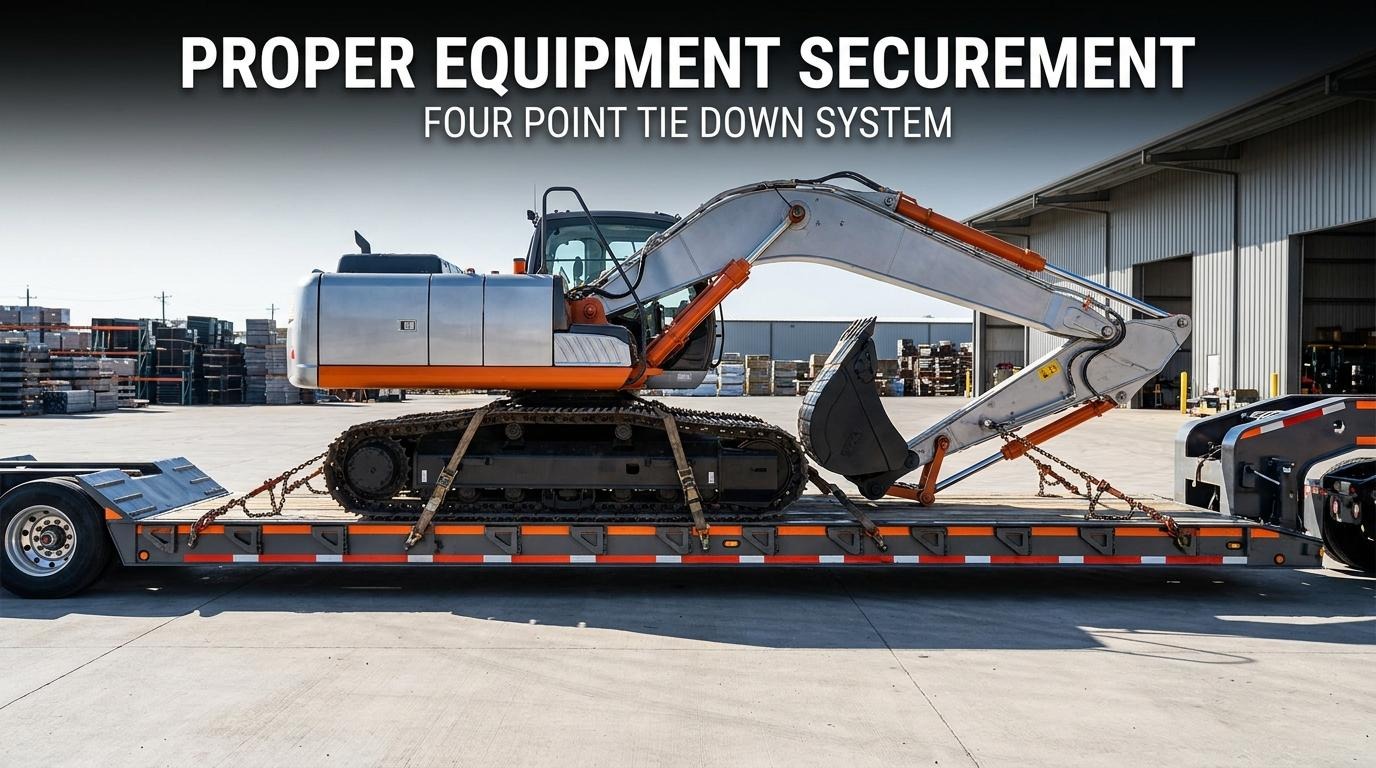
The best practices for loading and securing excavators address tie-down counts, load limits, and accessory lockdown requirements. FMCSA 49 CFR Part 393, Subpart I requires cargo securement systems to withstand a forward deceleration force equal to 80% of the cargo weight. For excavators weighing over 10,000 pounds, the FMCSA mandates a minimum of four tie-downs placed at independent corners. Beyond tie-down count, the aggregate working load limit of the entire securement system must equal at least one-half the weight of the load being secured. All attachments and accessory equipment must be locked in place before departure, since unsecured accessories can shift independently and compromise overall load stability. Proper weight distribution across the trailer deck also reduces stress on axle groups and helps maintain compliance on load-restricted roads.
What Safety Checks Should Be Performed Before and After Transport?
Safety checks before and after transport cover lighting compliance, securement integrity, and load stability verification. Before departure, confirm that any load extending more than four feet beyond the rear displays two red lamps visible at 500 feet and two red reflectors visible between 100 and 600 feet at night, per TxDMV requirements. Verify that all tie-downs show no signs of fraying or reduced tension and that equipment is secured against shifting during acceleration, braking, turning, and road surface variations. After delivery, inspect all securement points for wear, recheck that accessories remain locked in position, and document any tie-down or lighting issues for the next move. Thorough pre- and post-trip inspections are often the simplest safeguard against citation, cargo damage, and crash risk on Texas highways.
How Should You Approach Texas Excavator Transport with Heavy Hauling Services from Bear Down Logistics?
Approaching Texas excavator transport requires coordinating permits, compliant routes, city-specific curfews, and proper equipment securement. Bear Down Logistics handles each of these elements, from TxDMV permit filing through final delivery.
Can Bear Down Logistics' Heavy Hauling Expertise Help With Texas Excavator Transport?
Yes, Bear Down Logistics' heavy hauling expertise can help with Texas excavator transport across every compliance layer. Bear Down Logistics manages TxDMV oversize and overweight permit applications, route planning, escort coordination, and cargo securement for excavator moves throughout Texas. With over 20 years of combined experience and more than 20,000 loads completed, Bear Down Logistics brings proven operational depth to moves that trigger superheavy permit thresholds, city curfew restrictions, or mandatory Route Inspection Certifications.
Texas construction is entering a major expansion cycle, with $142 billion in infrastructure, LNG, grid, and semiconductor projects converging in 2026 according to The Birm Group. That volume drives excavator demand statewide, making a logistics partner who already understands local rules across Houston, Dallas, and Harris County a decisive operational advantage.
What Are the Key Takeaways About Texas Excavator Transport: Permits, Routes, and Local Rules We Covered?
The key takeaways about Texas excavator transport center on four areas: permit selection, route qualification, local curfew compliance, and securement standards.
- Permits: Any load exceeding 8'6" wide, 14'0" high, 65' long, or 80,000 pounds requires a TxDMV oversize or overweight permit. Loads above 254,300 pounds require a superheavy single-trip permit.
- Routes: Loads exceeding 20' wide, 18'11" high, or 125' long require a Route Inspection Certification before permit issuance. Loads over 16' wide require front and rear escorts on all roads.
- Local rules: Houston restricts permit loads over 12' wide during peak hours (7–9 a.m. and 4–6 p.m., Monday–Friday). Dallas bans oversized loads on corridors like I-35E during 6–9 a.m. and 3–6 p.m. weekday windows. Harris County requires a minimum $5,000 bond.
- Securement: FMCSA regulations require a minimum of four tie-downs on independent corners for equipment over 10,000 pounds, with aggregate working load limits at least half the cargo weight.
Treating permit type, route certification, city curfews, and tie-down compliance as a single integrated checklist, rather than separate tasks, is what separates clean excavator moves from costly violations or delays. Bear Down Logistics can help you manage that checklist from start to finish.