
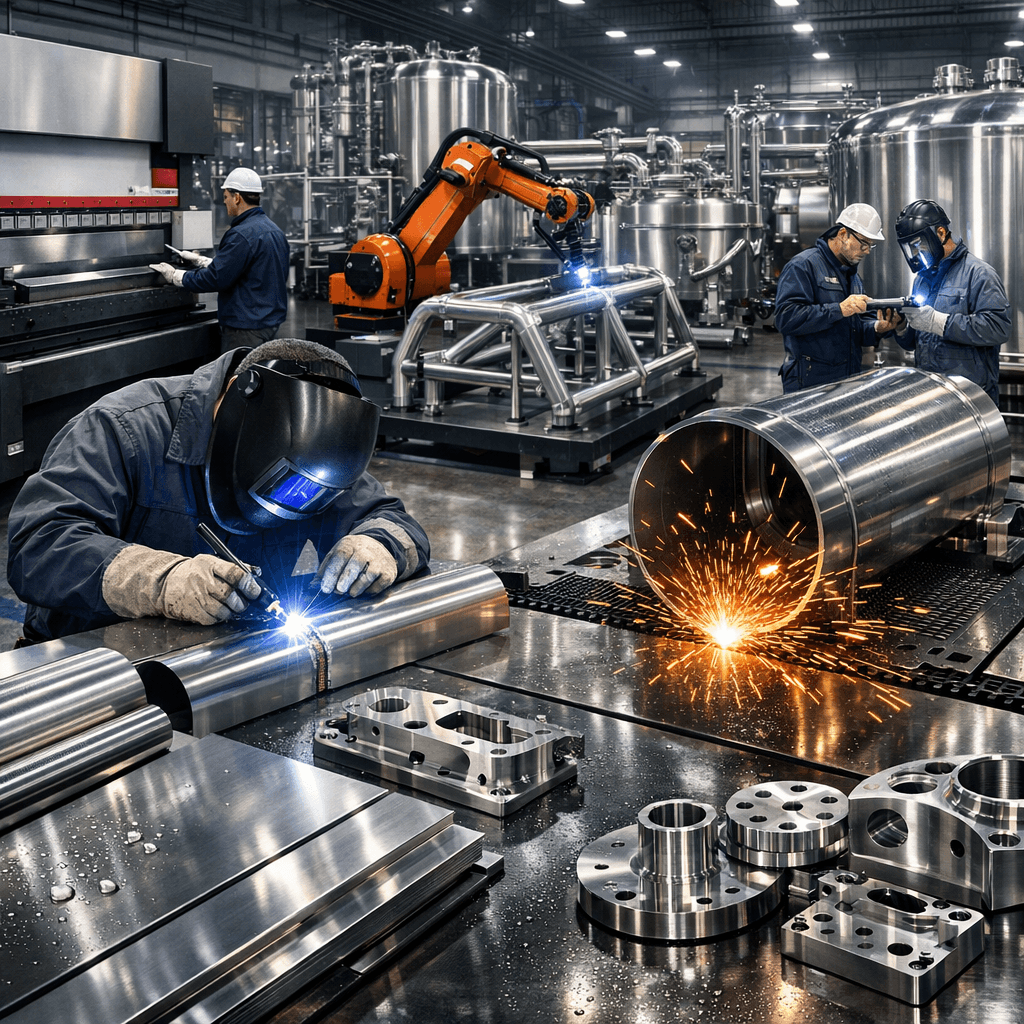
Stainless steel fabrication is the process of transforming raw stainless steel into finished components through cutting, welding, forming, machining, and surface finishing, leveraging the material’s inherent corrosion resistance and structural durability for demanding industrial environments.
This guide covers sector-specific applications, quantified performance benefits, core fabrication techniques, grade selection, common fabrication challenges, and partner evaluation criteria.
Stainless steel fabrication serves military, aerospace, medical, food processing, transportation, architectural, and chemical industries. Each sector requires specific alloy grades and compliance standards, from AS9100 in aerospace to 3-A Sanitary Standards in food processing, matched to the environmental demands of the application.
The material’s benefits extend beyond corrosion resistance. A self-healing chromium oxide passive layer, high-temperature structural integrity, hygienic non-porous surfaces, and lifecycle cost savings that outperform cheaper alternatives over multi-decade service horizons all contribute to its dominance in critical infrastructure.
We break down six primary fabrication methods, including laser and plasma cutting, TIG and MIG welding, press brake forming, CNC machining, electropolishing, and final assembly. Each technique addresses a specific production stage with parameters unique to stainless steel’s work-hardening behavior.
Grade selection between 304, 316, 410, 2205 Duplex, and 17-4 PH depends on balancing corrosion environment, mechanical loads, and thermal exposure. Fabrication challenges like sensitization, contamination, and warping require controlled heat input, dedicated tooling, and inert gas shielding to preserve material integrity.
Choosing the right fabrication partner requires evaluating in-house capabilities, vertical integration, and industry-specific certifications that ensure quality and traceability from raw material through finished product.
What Are the Key Applications of Stainless Steel Fabrication?
The key applications of stainless steel fabrication span military, aerospace, medical, food processing, transportation, architecture, and chemical industries. Each sector leverages specific alloy properties and fabrication standards.
How Is Stainless Steel Fabrication Used in Military and Aerospace?
Stainless steel fabrication is used in military and aerospace for structural components, exhaust systems, and armored assemblies that must withstand extreme temperatures and corrosive environments. Precipitation-hardened grades like 17-4 PH deliver the high tensile strength these applications demand.
According to NQA, AS9100 compliance is required for aerospace fabrication to manage quality systems, adding specific requirements for safety, risk management, and counterfeit part prevention beyond ISO 9001. Military applications also require traceability at every fabrication stage, from raw material certification through final inspection. For organizations operating in defense and aerospace, selecting a fabricator with both AS9100 certification and vertically integrated capabilities significantly reduces supply chain risk.
How Is Stainless Steel Fabrication Used in Medical and Healthcare Equipment?
Stainless steel fabrication is used in medical and healthcare equipment for surgical instruments, implants, diagnostic devices, and mobile medical units. Grade 316L is the standard choice because its low carbon content minimizes sensitization during welding while molybdenum enhances resistance to bodily fluids.
The FDA’s Quality Management System Regulation incorporates ISO 13485:2016 by reference, meaning fabricators producing medical device components must maintain compliant quality systems. Electropolished surfaces reduce bacterial adhesion on equipment surfaces, making stainless steel essential for sterile environments. Mobile medical vehicles, which combine structural fabrication with clinical-grade interiors, represent one of the more demanding applications in this sector.
How Is Stainless Steel Fabrication Used in Food and Beverage Processing?
Stainless steel fabrication is used in food and beverage processing for tanks, piping, conveyors, and preparation surfaces that must resist corrosion from acidic foods and aggressive cleaning chemicals. Grade 304 handles most general food-contact applications, while 316 serves environments exposed to salt or chlorinated sanitizers.
According to 3-A Sanitary Standards, food processing equipment must have a surface finish at least as smooth as a No. 4 polish, typically defined as a Ra value of 32 microinches (0.8 µm) or less. This smoothness prevents bacterial harborage in micro-crevices. Weld joints require full penetration and smooth interior profiles to eliminate areas where product residue could accumulate.
How Is Stainless Steel Fabrication Used in Transportation and Mobile Units?
Stainless steel fabrication is used in transportation and mobile units for chassis reinforcements, exterior panels, interior frameworks, and specialized enclosures. These applications demand materials that resist road salt, humidity, and mechanical vibration over extended service lives.
- Mobile command centers require corrosion-resistant structural framing that supports heavy electronic payloads.
- Promotional and experiential marketing vehicles use stainless steel substructures beneath custom exteriors for long-term touring durability.
- Specialty trailers benefit from stainless steel’s weldability, allowing complex custom geometries without sacrificing structural integrity.
For mobile assets expected to travel thousands of miles annually, stainless steel’s combination of strength and corrosion resistance eliminates costly refurbishment cycles that plague carbon steel alternatives.
How Is Stainless Steel Fabrication Used in Architecture and Construction?
Stainless steel fabrication is used in architecture and construction for cladding, structural supports, railings, canopies, and decorative facades. According to the International Molybdenum Association, the Chrysler Building has utilized Type 302 stainless steel cladding since 1930 with minimal maintenance, demonstrating the material’s multi-generational durability.
Modern architectural projects specify grades 304 and 316 for exterior applications where aesthetic appearance must endure decades of weather exposure. The material accepts diverse surface finishes, from mirror polish to brushed textures, giving designers flexibility without sacrificing longevity. For high-profile installations, stainless steel’s self-healing passive layer means the building’s appearance improves with age rather than degrading.
How Is Stainless Steel Fabrication Used in Chemical and Energy Industries?
Stainless steel fabrication is used in chemical and energy industries for pressure vessels, heat exchangers, storage tanks, and piping systems exposed to highly corrosive process fluids. 2205 Duplex stainless steel is specified for its high resistance to chloride stress corrosion cracking, offering a minimum yield strength of 450 MPa.
- Refineries use duplex grades in desalination and seawater cooling systems.
- Chemical plants require fabricated components that resist pitting from hydrochloric and sulfuric acid exposure.
- Nuclear energy facilities specify low-carbon austenitic grades to prevent sensitization during extended high-temperature service.
Across these demanding sectors, proper fabrication technique matters as much as grade selection, since weld defects in chemical service can lead to catastrophic failures.
What Are the Benefits of Stainless Steel Fabrication?
The benefits of stainless steel fabrication include corrosion resistance, high strength-to-weight performance, thermal stability, hygienic surface properties, long-term cost savings, and aesthetic versatility. Each advantage makes fabricated stainless steel components suitable for demanding environments.
Why Does Corrosion Resistance Make Stainless Steel Ideal for Fabrication?
Corrosion resistance makes stainless steel ideal for fabrication because the material forms a self-healing passive chromium oxide layer, typically between 1 and 3 nanometers thick, that shields the base metal from environmental degradation. This microscopic barrier regenerates when scratched, providing continuous protection without coatings or treatments.
According to accelerated corrosion testing per ASTM B117, 304 and 316 series stainless steel components passed a 336-hour salt spray exposure without significant degradation. Electropolishing can further reduce surface roughness by up to 50% while enhancing the chromium-to-iron ratio in the passive layer. Grade selection matters; austenitic grades like 304 offer broad corrosion protection, while 17-4 PH stainless steel delivers comparable resistance with higher tensile strength for aerospace applications. For fabricators, this inherent corrosion resistance eliminates recurring maintenance costs and extends component service life across marine, chemical, and outdoor environments.
How Does Stainless Steel’s Strength-to-Weight Ratio Benefit Fabricated Structures?
Stainless steel’s strength-to-weight ratio benefits fabricated structures by delivering high tensile strength and load-bearing capacity without requiring excessively thick material sections. Engineers can design thinner wall profiles that maintain structural integrity, reducing overall component weight while preserving durability.
This property proves especially valuable in transportation, mobile units, and architectural applications where excess weight increases fuel costs or complicates installation. Austenitic grades work-harden during forming, gaining additional strength through the fabrication process itself. The result is lighter assemblies that still meet rigorous load specifications, making stainless steel a practical choice when both performance and weight efficiency are critical design requirements.
Why Is Stainless Steel Fabrication Valued for High-Temperature Applications?
Stainless steel fabrication is valued for high-temperature applications because austenitic grades maintain structural integrity at elevated operating temperatures where carbon steel and aluminum lose strength. Steel is approximately 2.5 times denser than aluminum, contributing to significantly higher tensile strength and structural reliability in heavy-duty industrial environments, as noted by Federal Steel Supply.
This thermal stability makes fabricated stainless steel components essential in exhaust systems, furnace parts, heat exchangers, and power generation equipment. Components retain their mechanical properties through repeated thermal cycling without becoming brittle or deforming. For industries requiring consistent performance under sustained heat exposure, stainless steel fabrication remains the preferred solution.
How Does Stainless Steel Fabrication Support Hygiene and Sanitation Requirements?
Stainless steel fabrication supports hygiene and sanitation requirements by producing non-porous surfaces that resist bacterial adhesion and tolerate aggressive cleaning protocols. The material does not absorb moisture, harbor pathogens, or react with cleaning chemicals, making it the standard for food processing, pharmaceutical, and medical environments.
Fabricated components can be polished to precise surface finishes that meet regulatory standards. The smooth, crevice-free geometry achievable through skilled fabrication prevents contamination buildup in joints and welds. These characteristics explain why stainless steel dominates equipment specifications in industries where microbial control is non-negotiable and surfaces must withstand daily sanitization without degradation.
Why Is Long-Term Durability a Cost Advantage in Stainless Steel Fabrication?
Long-term durability is a cost advantage in stainless steel fabrication because higher initial material costs are offset by dramatically reduced maintenance, replacement, and coating expenses over the asset’s service life. According to the Steel Construction Institute’s life cycle cost analysis of a highway bridge, stainless steel girders were 20–31% more expensive initially but 11–20% cheaper over a 120-year service life due to eliminated painting costs.
This lifecycle economics principle applies across industries. Fabricated stainless steel components rarely need protective coatings, anti-corrosion treatments, or premature replacement. For any project with a multi-decade service horizon, the total cost of ownership favors stainless steel over cheaper alternatives that demand ongoing upkeep.
How Does Stainless Steel’s Aesthetic Versatility Benefit Custom Projects?
Stainless steel’s aesthetic versatility benefits custom projects by offering multiple surface finishes, from mirror-polished to brushed, satin, and patterned textures, all achievable through standard fabrication processes. Designers gain both structural performance and visual appeal in a single material.
The metal accepts coloring through electrochemical processes, PVD coating, and bead blasting without sacrificing corrosion resistance. Architectural features, signage, custom enclosures, and branded environments all benefit from stainless steel’s ability to complement modern design language while enduring outdoor exposure indefinitely. For projects where appearance matters as much as function, few materials match this combination of durability and design flexibility.
Understanding these benefits clarifies which fabrication techniques best leverage stainless steel’s properties.
What Are the Common Techniques Used in Stainless Steel Fabrication?
The common techniques used in stainless steel fabrication are cutting, welding, forming and bending, machining, surface finishing, and assembly. Each method addresses a specific stage in transforming raw stainless steel into precision-engineered components.
Cutting
Cutting is the initial fabrication step that separates stainless steel into workable shapes and sizes. According to MRC Industries, laser cutting is most efficient for stainless steel thicknesses under 10mm, while plasma cutting is preferred for thicker plates up to 25mm where high tolerance is less critical. Waterjet cutting offers an alternative for heat-sensitive applications since it introduces no thermal distortion. The choice between these methods depends on material thickness, required tolerances, and production volume.
Welding
Welding joins stainless steel components through controlled fusion of base metals. TIG (GTAW) welding is the most common method for stainless steel because it produces clean, precise welds with minimal contamination. MIG welding offers faster deposition rates for thicker sections, while resistance welding suits high-volume sheet metal assembly. Proper shielding gas selection and heat input control are essential; excessive heat can cause sensitization and compromise corrosion resistance. For fabricators working with austenitic grades, back-purging with argon protects the weld root from oxidation.
Forming and Bending
Forming and bending reshape flat stainless steel sheets or plates into three-dimensional geometries without removing material. Press brakes apply controlled force along a die to create precise angles, while roll forming produces continuous curves for cylindrical or conical shapes. Because stainless steel work hardens more rapidly than carbon steel, forming operations require greater force and careful tooling selection. Springback compensation is also critical, as austenitic grades tend to recover more elastically after bending than ferritic types.
Machining
Machining removes material from stainless steel workpieces to achieve tight tolerances and complex geometries. CNC milling, turning, and drilling are the primary operations. Stainless steel’s tendency toward work hardening demands sharp carbide or ceramic tooling, lower cutting speeds, and consistent feed rates to avoid surface hardening. Flood coolant application reduces heat buildup at the cutting interface. These parameters differ significantly from carbon steel machining, making operator expertise a determining factor in part quality.
Surface Finishing
Surface finishing enhances the appearance, corrosion resistance, and functional performance of fabricated stainless steel. According to Amardeep Steel, electropolishing can reduce surface roughness by up to 50% while simultaneously enhancing the chromium-to-iron ratio in the passive layer for superior corrosion resistance. Common finishing methods include:
- Mechanical polishing to achieve mirror or brushed textures
- Passivation to restore the protective chromium oxide layer after fabrication
- Bead blasting for uniform matte appearances
- Electropolishing for pharmaceutical and food-grade smoothness
The required finish often depends on industry standards; food processing equipment typically demands a No. 4 polish or smoother.
Assembly and Integration
Assembly and integration combine individually fabricated stainless steel components into complete functional systems. This stage involves mechanical fastening, adhesive bonding, and final welding to join sub-assemblies. Dimensional inspection verifies that tolerances stack correctly across mating parts. For complex builds, fixtures and jigs maintain alignment during assembly. Quality control at this stage ensures the finished product meets design specifications before deployment.
With fabrication techniques established, understanding which stainless steel grades best suit each application further refines material selection.
What Grades of Stainless Steel Are Used in Fabrication?
The grades of stainless steel used in fabrication include 304, 316, 410, 2205 Duplex, and 17-4 PH. Each grade offers distinct mechanical properties suited to specific environments and performance requirements.
304 Stainless Steel
304 stainless steel is the most widely used austenitic grade in fabrication. It contains approximately 18% chromium and 8% nickel, delivering excellent corrosion resistance and formability for general-purpose applications. According to SSM Alloys, austenitic grades such as 304 can maintain structural integrity at intermittent operating temperatures up to 870°C (1600°F). This thermal tolerance, combined with easy weldability, makes 304 the default choice for food equipment, architectural trim, and chemical containers where extreme corrosive exposure is not present.
316 Stainless Steel
316 stainless steel is an austenitic grade enhanced with 2–3% molybdenum for superior resistance to chlorides and acidic environments. Fabricators select 316 for marine hardware, pharmaceutical vessels, and coastal architectural elements where pitting corrosion would compromise 304. The molybdenum addition also improves creep resistance at elevated temperatures. For projects involving saltwater exposure or aggressive chemical processing, 316 consistently outperforms lower-alloy alternatives in long-term service life.
410 Stainless Steel
410 stainless steel is a basic martensitic grade containing 11.5% to 13.5% chromium, as documented by Atlas Steels. Heat treatment gives 410 high strength and hardness, making it suitable for turbine blades, valve components, and fasteners. However, its lower chromium content provides less corrosion resistance than austenitic grades. Fabricators choose 410 when mechanical strength and wear resistance take priority over environmental exposure protection.
2205 Duplex Stainless Steel
2205 Duplex stainless steel is a dual-phase grade combining austenitic and ferritic microstructures. This composition delivers high resistance to chloride stress corrosion cracking with a minimum yield strength of 450 MPa. Chemical processing plants, offshore oil platforms, and desalination systems rely on 2205 where both mechanical load and corrosive media demand performance beyond standard austenitic grades. Its roughly twice the yield strength of 304 or 316 allows thinner wall sections, reducing material costs in pressure vessels.
17-4 PH Stainless Steel
17-4 PH stainless steel is a precipitation-hardened grade offering high tensile strength with corrosion resistance comparable to Grade 304. According to Nifty Alloys, this combination makes 17-4 PH suitable for aerospace and chemical applications requiring tight dimensional tolerances after heat treatment. Fabricators use it for gears, shafts, and nuclear reactor components where strength, hardness, and moderate corrosion protection must coexist.
Selecting the right grade depends on balancing corrosion environment, mechanical loads, and fabrication method, factors that directly influence how a project is welded, formed, and finished.
What Challenges Arise During Stainless Steel Fabrication?
The challenges that arise during stainless steel fabrication include work hardening, heat-related metallurgical changes, contamination, and warping. Each demands specific mitigation strategies to preserve material integrity.
How Does Work Hardening Affect Stainless Steel Fabrication?
Work hardening affects stainless steel fabrication by increasing material hardness and reducing ductility during mechanical processing. Austenitic grades like 304 and 316 are particularly susceptible because their crystal structure readily deforms under cold working operations such as bending, rolling, and machining.
This progressive hardening accelerates tool wear, increases cutting forces, and can cause cracking if not managed. Fabricators counter work hardening by using sharp tooling, maintaining consistent feed rates, and applying intermediate annealing steps to restore ductility between forming operations. For most projects, planning the forming sequence to minimize repeated passes over the same area is the simplest preventive measure.
Why Is Heat Management Critical When Welding Stainless Steel?
Heat management is critical when welding stainless steel because excessive or prolonged thermal exposure causes sensitization, warping, and degraded corrosion resistance. According to Atlantic Stainless, sensitization in austenitic stainless steels occurs when material is held between 425°C and 815°C, leading to chromium carbide precipitation at grain boundaries that depletes the protective chromium layer.
Precise heat input control directly determines weld quality. Research on TIG welding of 304 stainless steel found that optimal hydrogen embrittlement resistance is achieved at a welding heat input of 0.778 kJ/mm. Fabricators mitigate thermal damage through:
- Controlling heat input per pass to stay below sensitization thresholds
- Back-purging with inert gas to protect the weld root from oxidation
- Using proper interpass temperature monitoring
This is one area where experience matters more than equipment alone; knowing exactly when to pause between passes separates competent fabrication from compromised results.
How Can Contamination Be Prevented During Stainless Steel Fabrication?
Contamination can be prevented during stainless steel fabrication by maintaining strict material separation and dedicated tooling protocols. Carbon steel particles, iron dust, and shop debris embed in stainless surfaces and create localized corrosion initiation sites that compromise the passive layer.
Effective prevention measures include:
- Using grinding wheels, wire brushes, and clamps designated exclusively for stainless steel
- Storing stainless steel separately from carbon steel and other ferrous metals
- Cleaning all surfaces with acetone or alcohol before welding
- Wearing clean gloves to prevent chloride transfer from skin oils
Even microscopic contamination can trigger pitting corrosion within weeks of installation, making disciplined shop practices non-negotiable for quality fabrication.
What Causes Warping and Distortion in Stainless Steel Components?
Warping and distortion in stainless steel components are caused by uneven thermal expansion and contraction during welding and cutting operations. Stainless steel’s lower thermal conductivity compared to carbon steel concentrates heat in narrow zones, creating steep temperature gradients that produce residual stresses.
To mitigate warping, fabricators use heat input control, back-purging with inert gas, and proper cleaning to prevent carbon steel contamination. Additional techniques include tack welding in alternating sequences, using fixtures and jigs to restrain movement, and selecting balanced weld joint designs that distribute shrinkage symmetrically.
Understanding these fabrication challenges helps determine what capabilities a fabrication partner needs.
How Do You Choose the Right Stainless Steel Fabrication Partner?
You choose the right stainless steel fabrication partner by evaluating in-house capabilities, vertical integration, and relevant certifications. The following subsections cover what to look for in each area.
What Capabilities Should a Stainless Steel Fabricator Have In-House?
A stainless steel fabricator should have in-house capabilities spanning the full production workflow, including:
- CNC cutting (laser and plasma)
- TIG and MIG welding with certified welders
- Precision forming and bending
- CNC machining for tight tolerances
- Surface finishing such as electropolishing and passivation
- Assembly, quality inspection, and testing
When all these processes exist under one roof, a fabricator maintains tighter control over material handling, scheduling, and dimensional accuracy. Outsourcing individual steps introduces handoff delays and increases contamination risk, particularly problematic with stainless steel’s sensitivity to carbon steel contact.
Why Does Vertically Integrated Fabrication Improve Quality and Speed?
Vertically integrated fabrication improves quality and speed because it eliminates multi-vendor coordination, reduces lead times, and keeps accountability within a single team. Each production stage, from design engineering through final finishing, follows unified quality standards without translation gaps between separate shops.
This structure also enables faster iteration. When an engineer identifies a tolerance issue during welding, the fix can propagate upstream to cutting and forming within the same facility, the same day. For industries requiring strict traceability, such as aerospace or medical device manufacturing, vertical integration simplifies documentation and audit trails considerably. The result is fewer defects, shorter project timelines, and more predictable delivery schedules.
What Certifications and Standards Matter in Stainless Steel Fabrication?
The certifications and standards that matter in stainless steel fabrication depend on the end-use industry:
- ISO 9001: Baseline quality management system for general fabrication.
- AS9100: Required for aerospace fabrication, adding safety, risk management, and counterfeit part prevention requirements beyond ISO 9001.
- NADCAP: Focuses on technical audits of special processes such as welding, heat treating, and chemical processing.
- ASME certification: Ensures adherence to the Boiler and Pressure Vessel Code for pressurized equipment.
- ISO 13485: Required for medical device manufacturing under the FDA’s Quality Management System Regulation.
- 3-A Sanitary Standards: Govern surface finish requirements for food processing equipment.
According to Valance Surface Tech, NADCAP accreditation is distinct from AS9100 as it focuses specifically on the technical audit of special processes, making it essential for fabricators handling welding or heat treatment on critical components. Always verify that your fabrication partner holds the certifications relevant to your specific application before committing to a contract.
With partner selection criteria established, the next step is applying these principles to specialized projects.
How Does Custom Industrial Fabrication Apply to Specialized Mobile and Defense Solutions?
Custom industrial fabrication applies to specialized mobile and defense solutions through vertically integrated design, engineering, and production under one roof. The following sections cover Craftsmen Industries’ in-house capabilities and key takeaways from this guide.
Can Craftsmen Industries’ In-House Fabrication Capabilities Support Your Stainless Steel Project?
Yes, Craftsmen Industries can support your stainless steel project through comprehensive in-house fabrication capabilities. Craftsmen Industries operates from a 127,000 sq. ft. facility in St. Charles, Missouri, providing end-to-end services including design, engineering, fabrication, and finishing. This vertically integrated approach eliminates coordination gaps between vendors, reduces lead times, and maintains tighter quality control throughout production.
Craftsmen Industries serves military, aerospace, government, and healthcare sectors, where stainless steel components must meet strict performance and certification standards. Verification of a fabricator’s quality includes checking for ASME certification, which ensures adherence to the Boiler and Pressure Vessel Code for pressurized equipment, according to Northern Manufacturing. With over 40 years of custom fabrication experience, Craftsmen Industries brings the technical depth needed for complex stainless steel builds requiring precision welding, forming, and surface finishing.
What Are the Key Takeaways About Stainless Steel Fabrication Applications, Benefits, and Techniques?
The key takeaways about stainless steel fabrication applications, benefits, and techniques are:
- Stainless steel fabrication transforms raw material into finished products through cutting, bending, welding, machining, and surface finishing.
- Applications span military, aerospace, medical, food processing, transportation, architecture, and chemical industries.
- Corrosion resistance, high-temperature performance, strength, and hygiene compliance make stainless steel ideal for demanding environments.
- Grade selection matters: 304 offers general versatility, 316 provides superior chloride resistance, 2205 Duplex delivers high yield strength, and 17-4 PH combines hardness with corrosion protection.
- Fabrication challenges such as work hardening, sensitization, contamination, and warping require controlled heat input, proper tooling, and inert gas shielding.
- Choosing a fabrication partner with in-house capabilities, vertical integration, and relevant certifications ensures quality, speed, and accountability.
For projects requiring precision stainless steel fabrication combined with custom mobile or defense solutions, Craftsmen Industries delivers complete project control from ideation to creation.
Filter Posts by Tag
related posts
Laser cutting is a precise, noncontact fabrication method that [...]
Metal tolerances in fabrication are the permissible dimensional variations between [...]
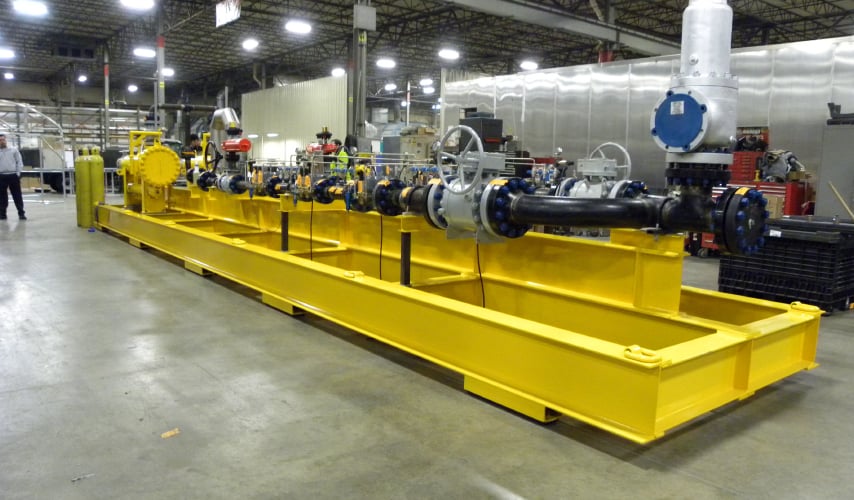
Are you wondering how does industrial fabrication work? Read this article to discover everything you need to know about industrial fabrication processes!
