
7 min read
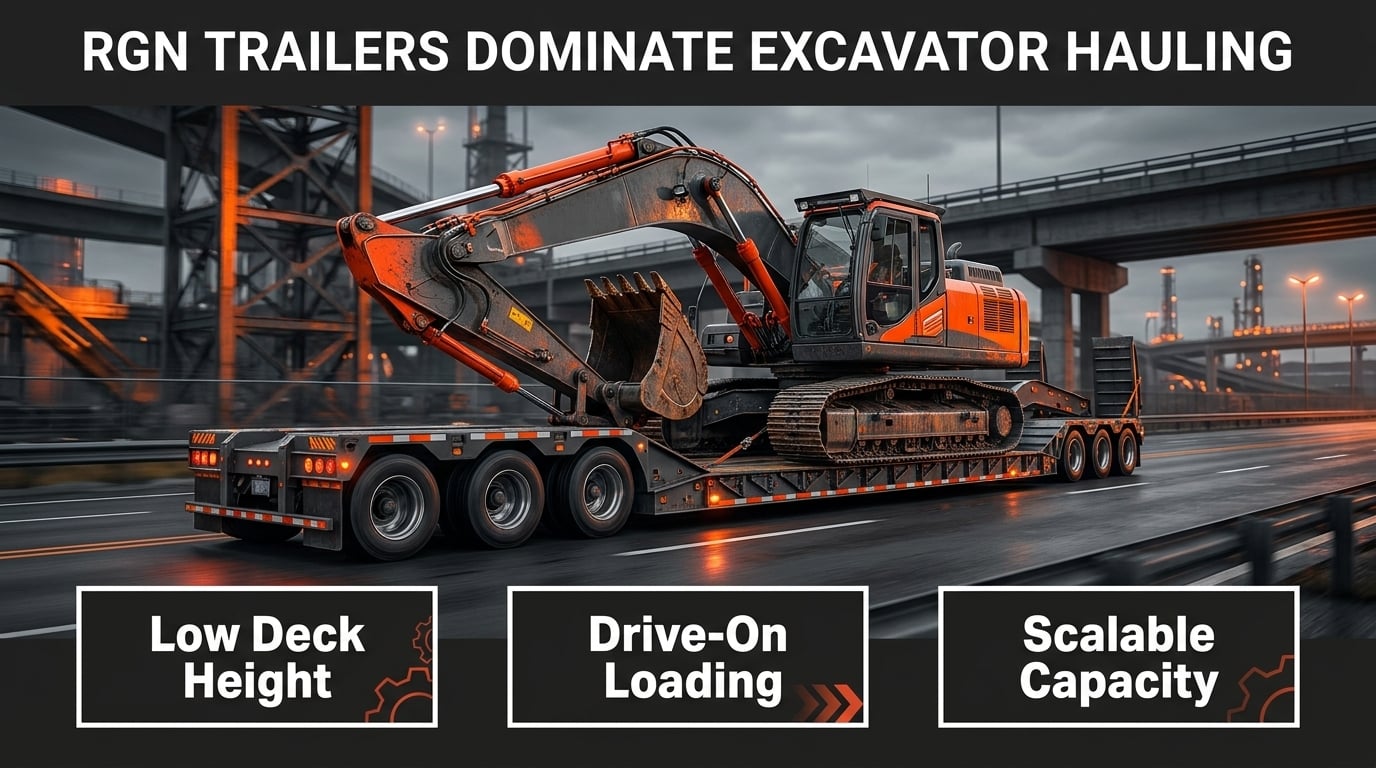
RGN (Removable Gooseneck) trailers dominate large excavator hauling because their low deck height, detachable front ramp, and scalable multi-axle configurations solve the core challenges that standard flatbeds and step decks cannot.
This guide covers what makes RGN trailers uniquely suited to excavator transport, the operational and cost advantages they deliver, the hauling challenges they address, how technology is advancing their design, and why provider expertise determines whether those advantages translate into a successful move.
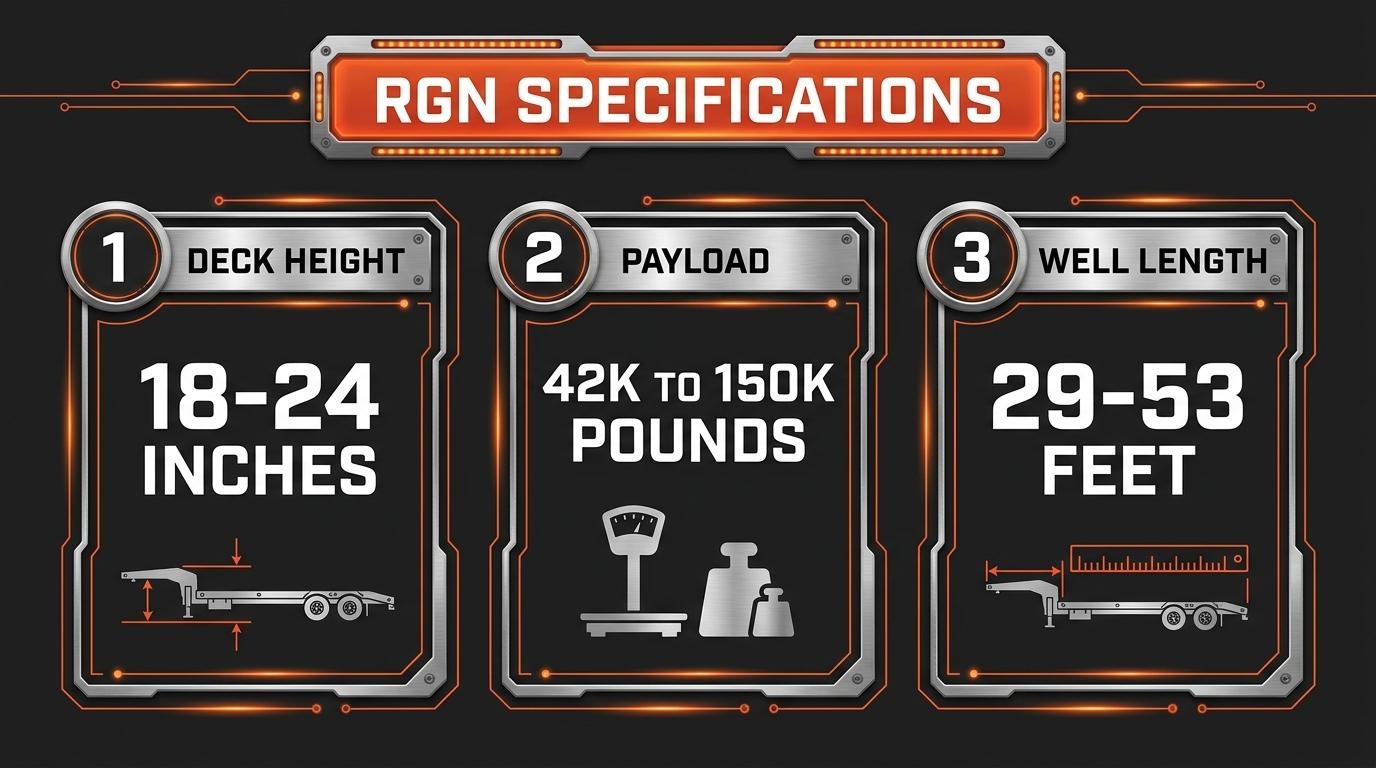
RGN trailers offer structural and mechanical capabilities that set them apart from all other trailer types. Their well deck sits between 18 and 24 inches off the ground, far lower than flatbeds or step decks, and their detachable gooseneck converts the trailer front into a ground-level drive-on ramp. Multi-axle configurations scale payload capacity from 42,000 pounds to over 150,000 pounds, making them adaptable to virtually any excavator size.
Those structural advantages produce measurable operational benefits. The low deck height reduces permit requirements and the associated escort costs, while drive-on loading eliminates crane rental and cuts load cycle times. Selecting the right axle configuration upfront remains the single most impactful cost decision in any excavator transport job.
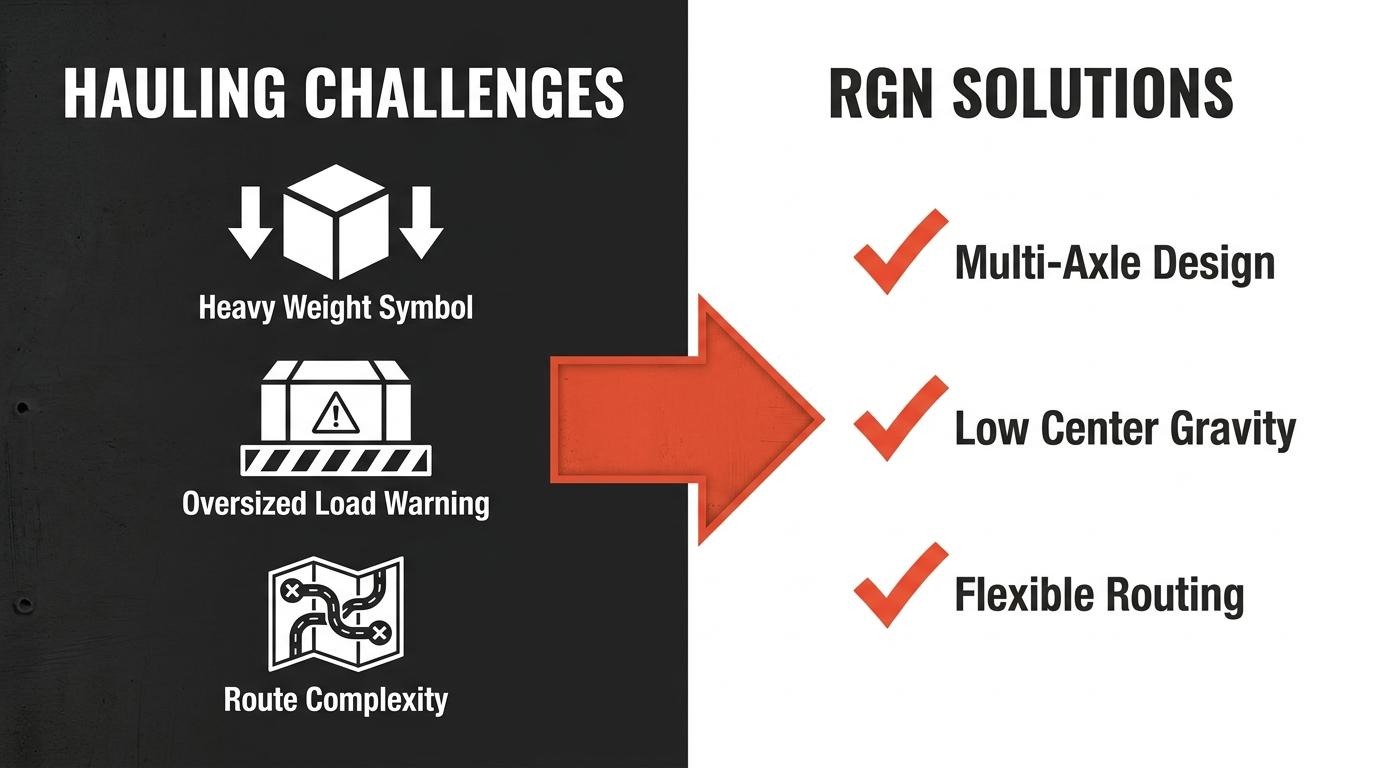
Despite those advantages, hauling large excavators still involves real logistical complexity. RGN trailers address extreme weights, oversized dimensions, tipping risk, and multi-state route compliance through design flexibility and a lower center of gravity that can reduce tipping risk by 40% compared to higher-deck alternatives.
Material innovations, sustainability pressures, and emerging telematics tools are reshaping how RGN trailers are built and operated. Composite axle materials, stability control systems, and GPS-integrated compliance tools are moving the industry toward safer, smarter oversized load management.
Provider experience determines whether these mechanical advantages are fully realized. Bear Down Logistics brings over 20 years of combined experience and more than 20,000 completed loads to every excavator haul, managing permit coordination, load securement, and route planning from start to finish.
What Makes RGN Trailers Uniquely Suited for Transporting Heavy Construction Equipment?
RGN trailers are uniquely suited for transporting heavy construction equipment because of their low deck height, removable gooseneck, and scalable payload capacity. The sections below cover how RGN trailers compare to other trailer types, the safety features they provide, and why the detachable gooseneck matters for efficient loading.
How Do RGN Trailers Differ from Other Trailer Types in Large Excavator Hauling?
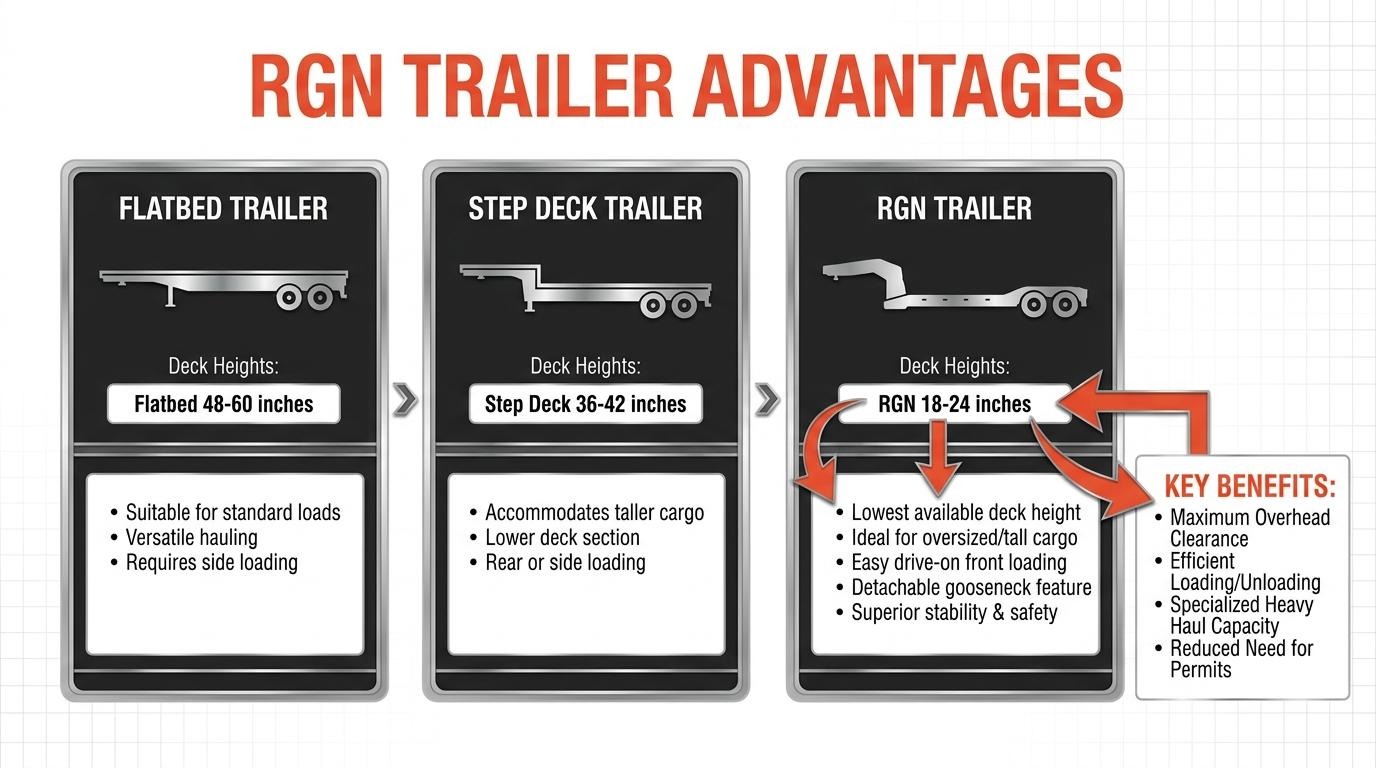
RGN trailers differ from other trailer types in large excavator hauling through three measurable advantages: lower deck height, higher payload capacity, and self-contained drive-on loading.
RGN trailers feature well deck heights between 18 and 24 inches, compared to 48 to 60 inches on standard flatbeds and 36 to 42 inches on step decks. That lower profile is critical for tall excavators approaching bridge and overpass clearance limits. According to Freedom Heavy Haul, well lengths start at approximately 29 feet and stretch to 53 feet or more, accommodating long-reach excavator configurations that shorter trailers cannot fit.
Payload capacity scales with axle count. Multi-axle RGN configurations support:
- 42,000 pounds on a 2-axle setup
- Up to 150,000 pounds on 13 to 20-axle superload trailers
Most long-reach excavator moves ride on lowboy or RGN trailers because logistics specialists must account for specific excavator specs and axle weights. In contrast, the 1990 Caterpillar 245B Crawler Excavator transport from Pauma Valley to Long Beach required specialized loading cranes precisely because a step-deck trailer was used instead of an RGN. That comparison illustrates why RGN trailers are the more efficient default choice for heavy excavator hauling.
What Safety Features Do RGN Trailers Offer for Oversized and Heavy Loads?
The safety features RGN trailers offer for oversized and heavy loads include structural low-deck stability, multi-point securement compatibility, and increasingly, advanced active safety systems.
The low well deck height reduces the center of gravity of the loaded excavator, directly lowering the risk of tipping during cornering and lane changes. This structural advantage works alongside DOT-compliant tie-down systems that must meet FMCSA cargo securement force thresholds for loads of this size.
Manufacturers are increasingly focusing on improved safety features in 2025, including advanced stability control systems and better passive safety components, according to Adado Sales. This trend is especially relevant for oversized excavator loads, where dynamic load shift during braking or evasive maneuvers presents the highest risk. Investing in trailers equipped with modern stability controls is, in practical terms, one of the strongest risk-reduction measures available to heavy hauling operators today.
Why Are Detachable Goosenecks Important for Loading and Unloading Excavators?
Detachable goosenecks are important for loading and unloading excavators because they eliminate the need for cranes or forklifts by converting the trailer front into a ground-level drive-on ramp.
According to Kaufman Trailers, the detachable gooseneck mechanism raises and separates the front section from the main trailer, creating a gentle slope that allows excavators to drive directly onto the deck under their own power. First introduced in 1958, this design solved the core problem of loading tall, heavy machinery without external lifting equipment.
The practical impact on job-site operations is significant: loading time decreases, crane rental costs are eliminated, and the process requires fewer personnel. For excavators with crawler undercarriages, drive-on loading also reduces the mechanical stress that crane-assisted lifts can place on attachment points and frames.
What Are the Main Advantages of Using RGN Trailers in Large Excavator Logistics?
The main advantages of using RGN trailers in large excavator logistics include improved loading efficiency, reduced permitting costs, and stronger regulatory compliance. The sections below cover how RGN trailer design streamlines transport operations, the cost and time savings they deliver, and how they help haulers navigate legal requirements.
How Does the Design of RGN Trailers Improve Efficiency in Equipment Transport?
RGN trailer design improves efficiency in equipment transport by eliminating the need for cranes or forklifts during loading. The detachable gooseneck lowers the deck to ground level, creating a drive-on ramp that lets excavators board under their own power. According to Heavy Equipment Transport, most long-reach excavator moves ride on lowboy or RGN trailers because logistics specialists must account for specific excavator specs and axle weights. This design also reduces loading time significantly, keeping project schedules tight. For high-volume operations, faster load cycles translate directly into more deliveries per day.
What Cost and Time Benefits Are Associated with RGN Trailer Use?
The cost and time benefits associated with RGN trailer use center on payload capacity, permit avoidance, and streamlined scheduling. A two-axle RGN can carry up to 40,000 pounds, expandable to 80,000 pounds with multi-axle configurations, reducing the need for multiple trips. Because the low deck height can allow haulers to move large cargo without an oversize permit, permit-related delays are often avoided entirely. When permits are required, superload processing can take 5 to 10 business days in some states, according to Freedom Heavy Haul, making early planning critical. Selecting the right axle configuration upfront is the single most impactful cost decision in any excavator transport job.
How Do RGN Trailers Help Meet Legal and Regulatory Requirements in Heavy Hauling?
RGN trailers help meet legal and regulatory requirements in heavy hauling by keeping load heights within compliant limits through their low well deck design. This reduces the frequency of oversize permits and the associated escort vehicle requirements for taller loads. According to Yahoo Finance's industry report, industry players are increasingly focused on trailer lightweighting, durability, and smart technology integration to meet new regulatory standards. Lead operator Jay at Heavy Haulers reinforced the operational side of compliance, noting that using shorter highway routes like CA-76 W and I-5 N is essential when meeting urgent delivery deadlines while staying within legal routing restrictions.
What Challenges Can Occur When Hauling Large Excavators, and How Do RGN Trailers Address Them?
Hauling large excavators presents challenges including extreme weight, oversized dimensions, route compliance, and tipping risk. The following sections cover how RGN trailers address each of these challenges through design, planning, and load management.
How Do RGN Trailers Handle Extreme Weights and Dimensions in Excavator Hauling?
RGN trailers handle extreme weights and dimensions through scalable multi-axle configurations and extendable deck designs. A 2-axle setup supports up to 42,000 pounds, while 13 to 20-axle superload configurations exceed 150,000 pounds. Deck lengths start at 29 feet and stretch beyond 53 feet for longer machines. This flexibility makes RGN trailers one of the most adaptable solutions available for excavator hauling across varying load profiles.
What Role Does Route Planning Play When Using RGN Trailers?
Route planning plays a critical role in RGN trailer transport because oversized excavator loads must meet different permit and escort requirements in every state along the route. According to TruckTabs, escort vehicles may be required for loads exceeding 12 feet in width or 14 feet in height, with separate planning required per state. Effective route planning reduces permit delays, avoids restricted roads, and keeps deliveries on schedule.
How Can RGN Trailer Transport Mitigate Risks Associated with Oversized Loads?
RGN trailer transport mitigates oversized load risks primarily through a lower center of gravity and enhanced vertical clearance. According to Naxin Truck, lowbed trailers can reduce tipping risks by 40% compared to higher-deck alternatives, enabling safe, compliant transport of 60-ton excavators. The low well deck also provides greater clearance headroom for tall machinery, reducing infrastructure strike risk on bridges and overpasses. For heavy excavator moves, this combination of stability and clearance is difficult to replicate with standard trailer types.
How Is Technology Shaping the Future of RGN Trailers and Large Equipment Transportation?
Technology is shaping the future of RGN trailers through material innovations, sustainability-driven design, and automation. The H3s below cover recent performance upgrades, environmental pressures on trailer design, and how telematics may redefine operations.
What Recent Innovations Have Improved RGN Trailer Performance and Safety?
Recent innovations that have improved RGN trailer performance and safety include lightweight composite materials, advanced stability control systems, and better passive safety components. According to Qingte Group, the 2025 shift toward composite axle materials reduces trailer weight while improving load performance and durability. Manufacturers are also integrating advanced stability control systems to reduce rollover risk under heavy, uneven loads. These upgrades directly address the weight and balance challenges that define large excavator hauling.
How Are Sustainability and Environmental Concerns Impacting RGN Trailer Design?
Sustainability concerns are impacting RGN trailer design by pushing manufacturers toward lighter materials, lower-emission systems, and cleaner power sources. Some utility trailers now use battery-powered hydraulic systems, reducing both emissions and job-site noise. Renewable diesel is also proving more effective than electric alternatives for heavy-duty vehicles in reducing lifecycle carbon emissions, according to the American Trucking Associations. Industry players are increasingly prioritizing trailer lightweighting and smart technology integration to meet tightening regulatory standards.
How Might Automation and Telematics Evolve RGN Trailer Operations?
Automation and telematics are positioned to evolve RGN trailer operations through real-time load monitoring, predictive maintenance, and route optimization. Telematics systems can flag weight distribution issues before they become safety violations, reducing liability exposure on oversize hauls. Automated load sensors and GPS-integrated compliance tools are likely to replace manual permitting checks for multi-state routes. For heavy equipment transport, this shift toward connected trailers is not just an efficiency gain; it is a fundamental improvement in how safely oversized loads reach their destinations.
How Does Choosing an Experienced Hauling Provider Like Bear Down Logistics Impact RGN Trailer Transport Success?
Choosing an experienced hauling provider directly impacts RGN trailer transport success through proper load securement, regulatory compliance, and route expertise. The sections below cover Bear Down Logistics' excavator transport services and key takeaways about RGN trailer dominance.
What Equipment Transport Services Does Bear Down Logistics Offer for Large Excavator Hauling?
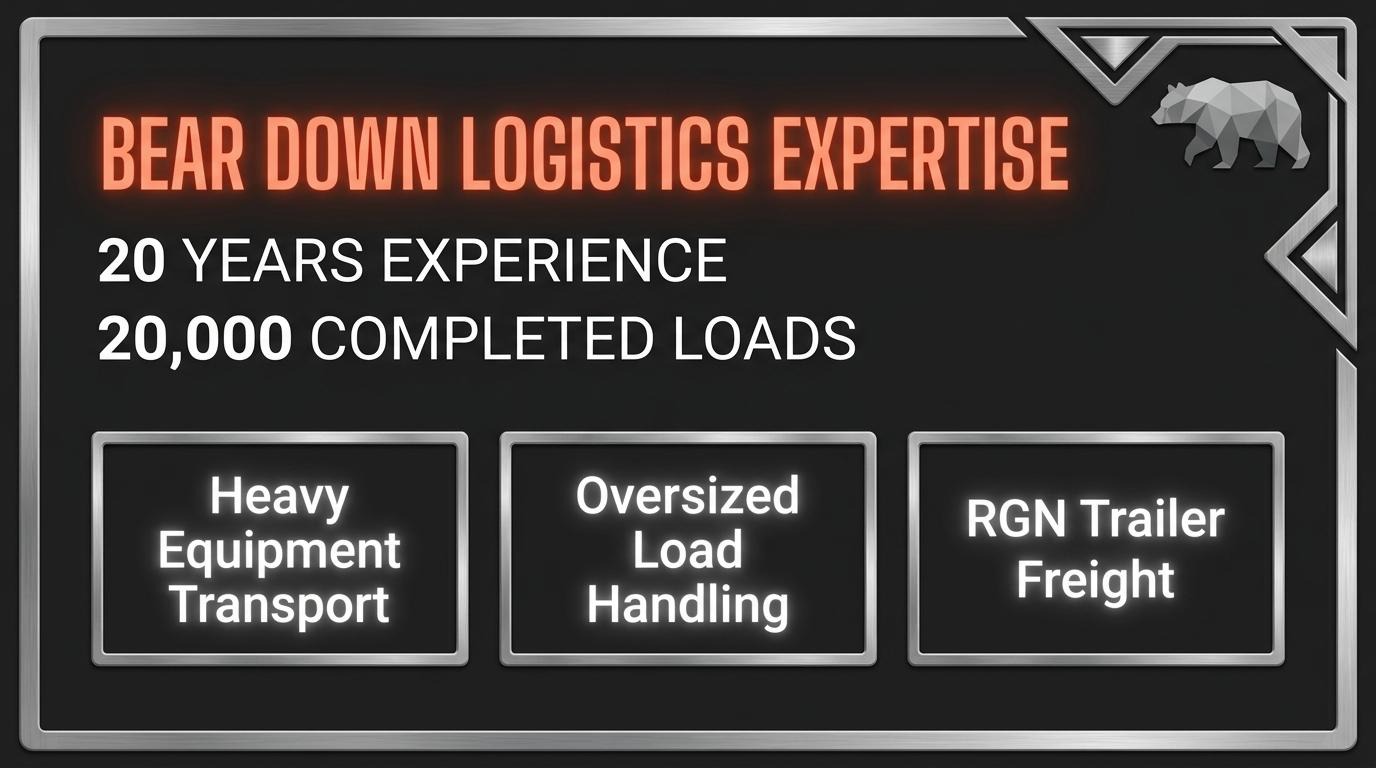
The equipment transport services Bear Down Logistics offers for large excavator hauling include heavy equipment transport, oversized load handling, and specialized RGN trailer freight. With over 20 years of combined experience and more than 20,000 completed loads, Bear Down Logistics manages the full scope of large excavator moves, from permit coordination to compliant load securement. DOT regulations require at least 4 tie-downs for any piece of equipment over 10,000 lbs, with 1 tie-down required for every 10 feet of cargo, a standard Bear Down Logistics applies to every haul. Long-reach excavator moves specifically demand carriers who account for individual excavator specs and axle weights, making provider experience a decisive factor in transport success.
What Are the Key Takeaways About Why RGN Trailers Dominate Large Excavator Hauling?
The key takeaways about why RGN trailers dominate large excavator hauling center on three core advantages: superior ground clearance, flexible payload capacity, and drive-on loading that eliminates crane dependency. RGN trailers accommodate excavators that exceed standard height and weight thresholds that flatbeds and step decks cannot legally or safely carry. Multi-axle configurations scale payload capacity to match virtually any excavator size, while the detachable gooseneck simplifies loading at any job site. Partnering with a licensed, bonded, and insured provider like Bear Down Logistics ensures these mechanical advantages are fully realized through expert execution on every move.