
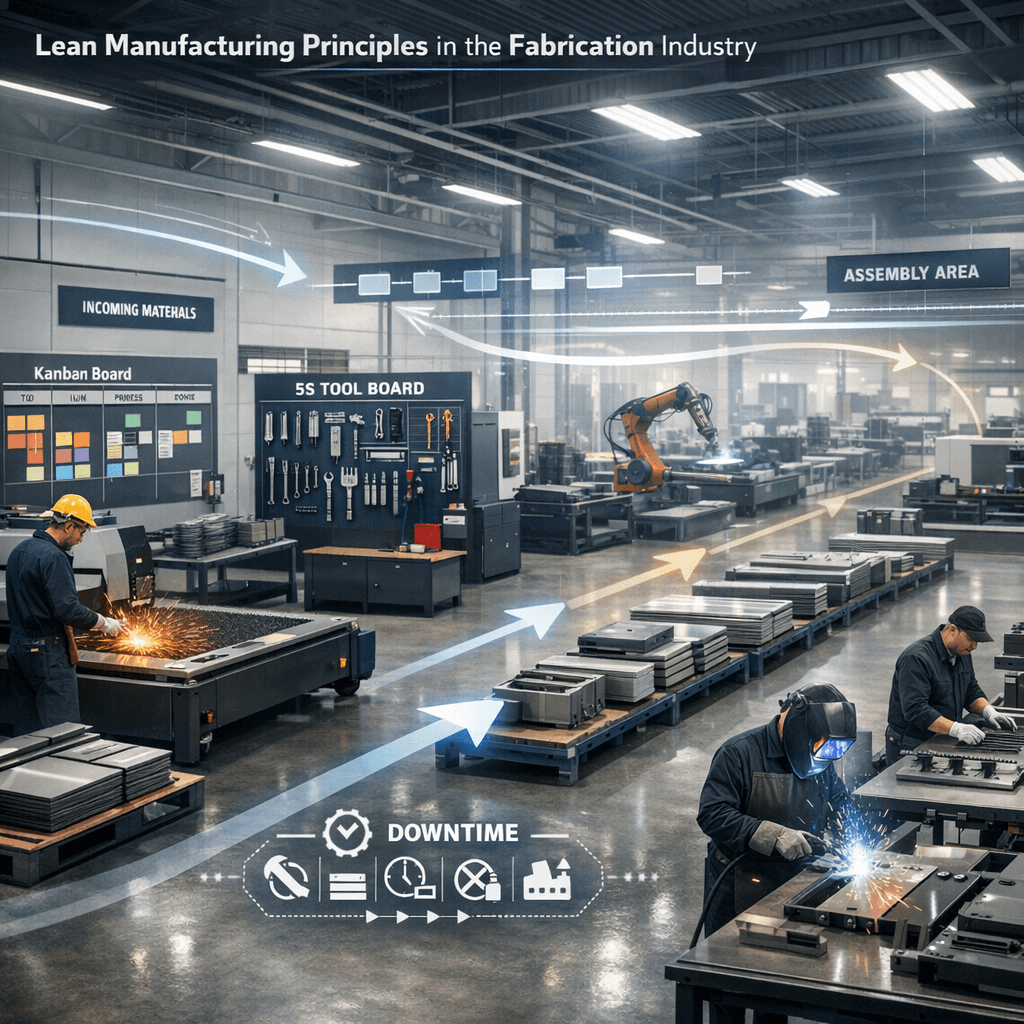
Lean manufacturing principles in the fabrication industry are a systematic methodology for maximizing productivity while eliminating anything that does not add value customers are willing to pay for. Applied to cutting, forming, welding, and assembly operations, these principles compress lead times, reduce costs, and improve quality across both high-volume and custom fabrication environments.
This guide covers core lean principles and waste identification, essential lean tools for metal fabrication, implementation strategies and common barriers, lean applications in custom and low-volume work, and the role of vertical integration in accelerating delivery.
Five interconnected principles form the foundation: defining value from the customer’s perspective, mapping the value stream, creating uninterrupted flow, establishing pull systems triggered by demand, and pursuing perfection through Kaizen. Eight categories of waste, remembered by the acronym DOWNTIME, represent the specific inefficiencies these principles target across fabrication workflows.
Tools like 5S, Kanban, SMED, Total Productive Maintenance, and Poka-Yoke each address distinct waste sources, from disorganized workstations to unplanned equipment failures and preventable defects. Documented results include lead time reductions from 14 weeks to 8 weeks and production efficiency gains exceeding 10 percentage points in metalworking operations.
Successful implementation requires leadership commitment, structured team training, and KPI tracking through metrics like Overall Equipment Effectiveness and Takt Time. Cultural resistance and resource constraints remain the primary barriers that derail lean initiatives when treated as one-time events rather than ongoing operational philosophy.
Vertical integration amplifies lean results by consolidating processes under one roof, eliminating inter-process transportation waste, handoff errors, and vendor coordination delays that inflate lead times in fragmented supply chains.
What Is Lean Manufacturing and Why Does It Matter in Fabrication?
Lean manufacturing is a production methodology that maximizes productivity while minimizing waste. In fabrication environments, lean principles eliminate non-value-added activities across cutting, forming, welding, and assembly processes to compress lead times, reduce costs, and improve quality.
According to TWI Global, lean manufacturing is a production process based on an ideology of maximizing productivity while simultaneously minimizing waste, where waste is defined as anything that does not add value that customers are willing to pay for. This distinction between value-added and non-value-added work becomes especially critical in custom fabrication, where every project carries unique specifications and tight deadlines.
Lean matters in fabrication because the methodology directly addresses the high variability and complex workflows that characterize metal fabrication shops. Unlike repetitive mass production, fabrication involves diverse materials, custom tooling, and multi-step processes where waste accumulates quickly if left unchecked. By systematically identifying inefficiencies, fabricators achieve faster throughput, fewer defects, and more predictable delivery schedules.
For fabrication operations handling complex, one-off builds, lean provides the structured framework to maintain efficiency without sacrificing the flexibility that custom work demands.
What Are the Core Principles of Lean Manufacturing?
The core principles of lean manufacturing are five interconnected concepts that guide fabrication operations toward maximum efficiency. According to the Association for Supply Chain Management, these principles are: defining value from the customer’s perspective, mapping the value stream to identify waste, creating flow by removing functional barriers, establishing a pull system triggered by demand, and pursuing perfection through continuous improvement (Kaizen).
Value Definition
Value definition is the first lean principle, requiring fabricators to identify what customers are willing to pay for. In custom fabrication, value includes precision, material quality, on-time delivery, and design accuracy. Every activity that does not directly contribute to these customer-defined outcomes is classified as waste. Starting here ensures all downstream decisions align with what actually matters to the end user.
Value Stream Mapping
Value stream mapping is a visual tool that documents every step in a fabrication process, from raw material intake to finished product delivery. Each step is classified as value-adding, non-value-adding but necessary, or pure waste. The American Society for Quality recognizes value stream mapping as a foundational lean methodology for identifying bottlenecks, redundant handoffs, and excessive queue times across cutting, welding, finishing, and assembly stages.
Flow
Flow is the principle of ensuring work moves continuously through fabrication stages without interruption or backflow. Removing functional barriers between departments, such as separating cutting from welding with batch queues, allows parts to progress seamlessly. When flow breaks down, work-in-process accumulates, lead times expand, and defect detection gets delayed. Smooth flow demands balanced workloads and standardized processing sequences across the shop floor.
Pull
Pull is a production control method where downstream processes signal upstream operations to produce only what is needed. Rather than pushing fabricated components based on forecasts, a pull system triggers work based on actual customer demand. This principle prevents overproduction, reduces excess inventory, and ensures resources are allocated to confirmed orders rather than speculative output.
Continuous Improvement (Kaizen)
Continuous improvement, known as Kaizen, is the principle of pursuing perfection through incremental, ongoing refinements to fabrication processes. Kaizen empowers every team member to identify inefficiencies and propose solutions. Small, frequent changes compound over time into significant gains in quality, throughput, and cost reduction. For fabrication shops handling diverse custom projects, this iterative discipline prevents process stagnation and builds a culture where excellence is never treated as a fixed destination.
With these five principles established, identifying the specific wastes they target clarifies where fabrication shops find the greatest efficiency gains.
What Are the Most Common Types of Waste in Fabrication?
The most common types of waste in fabrication are remembered by the acronym DOWNTIME: Defects, Overproduction, Waiting, Non-utilized talent, Transportation, Inventory, Motion, and Extra processing. Each waste category drains resources without adding customer value.
Overproduction
Overproduction is the fabrication of more parts or assemblies than current demand requires. According to the Lean Enterprise Institute, overproduction is the most dangerous form of waste because it creates excess work-in-process, hides defects that could have been caught earlier, and imposes significant cost overruns in capital expenditure and running costs. In custom fabrication environments, building ahead of schedule ties up materials and floor space that other active projects need.
Waiting
Waiting occurs when fabrication operators, machines, or materials sit idle between process steps. Common causes include:
- Unbalanced workloads between cutting, welding, and finishing stations
- Delayed material deliveries from suppliers
- Equipment breakdowns requiring unplanned maintenance
- Pending engineering approvals or design clarifications
Idle time compounds quickly across a production floor, especially in high-mix shops where job sequencing is complex.
Transportation
Transportation waste refers to unnecessary movement of materials, parts, or assemblies between workstations. Every time a component travels across the shop floor without being transformed, it adds handling time, increases damage risk, and extends lead times. Poorly planned facility layouts are the primary driver. Vertically integrated facilities reduce this waste by co-locating sequential processes like cutting, forming, and welding within a single production flow.
Overprocessing
Overprocessing means performing work beyond what the customer specification requires. Examples include applying tighter tolerances than necessary, adding extra finishing passes, or using premium materials where standard grades suffice. This waste often stems from unclear customer requirements or outdated standard operating procedures that have never been challenged.
Excess Inventory
Excess inventory is raw material, work-in-process, or finished goods held beyond immediate production needs. Surplus stock consumes warehouse space, ties up working capital, and risks material degradation or obsolescence. In fabrication shops running custom projects, excess inventory often results from bulk purchasing decisions that fail to account for actual project schedules.
Unnecessary Motion
Unnecessary motion is any physical movement by operators that does not add value to the product. Walking to retrieve tools, searching for drawings, or reaching across poorly organized workbenches all qualify. Unlike transportation (which involves moving product), motion waste involves moving people. Well-organized workstations and standardized tool placement eliminate most motion waste without requiring capital investment.
Defects
Defects are fabrication outputs that fail to meet specifications, requiring rework, scrap, or replacement. Each defect multiplies waste by consuming additional material, labor, and machine time. Common sources in metal fabrication include weld porosity, dimensional errors, and surface finish failures. The cost extends beyond the defective part itself; it disrupts downstream scheduling and erodes customer confidence.
Underutilized Talent
Underutilized talent is the failure to leverage the skills, knowledge, and creativity of fabrication team members. As Shigeo Shingo noted, “The most dangerous kind of waste is the waste we do not recognize.” When experienced welders, machinists, or assemblers are excluded from process improvement discussions, shops lose access to frontline insights that could prevent the other seven wastes. Engaging operators in problem-solving transforms them from task executors into continuous improvement contributors.
Recognizing these eight waste categories is the foundation for selecting targeted lean tools.
How Does Value Stream Mapping Work in a Fabrication Shop?
Value stream mapping works in a fabrication shop by visually documenting every step a product takes from raw material to delivery, distinguishing value-added activities from waste. Teams draw the current state map, identify bottlenecks such as excessive queue times between cutting and welding stations, then design a future state map that eliminates non-value-added steps.
The process typically begins with selecting a product family, walking the shop floor to record cycle times, wait times, and inventory levels at each workstation, then calculating the ratio of processing time to total lead time. This ratio often reveals that actual fabrication accounts for a small fraction of total throughput time, with the remainder consumed by waiting, transportation, and batching delays.
According to a 2025 Purdue Manufacturing Extension Partnership case study, implementation of lean training and digital value stream mapping at a limestone fabrication facility resulted in a 9.8% increase in production without requiring additional labor. For fabrication shops running high-mix workflows, digital value stream mapping accelerates the analysis by capturing real-time data across workstations rather than relying solely on manual observation.
From a practical standpoint, shops that revisit their value stream maps quarterly rather than treating mapping as a one-time event see compounding efficiency gains, since each iteration uncovers waste layers that were invisible before upstream constraints were resolved.
What Lean Tools Are Most Effective for Metal Fabrication?
The most effective lean tools for metal fabrication are 5S, Kanban, SMED, Total Productive Maintenance, and Poka-Yoke. Each tool targets a specific source of waste in fabrication workflows.
How Does 5S Improve Fabrication Workshop Efficiency?
5S improves fabrication workshop efficiency by organizing the work area to eliminate waste from poor organization. The 5S method follows five steps: Sort, Straighten, Shine, Standardize, and Sustain. According to Lean Production, this system eliminates time spent searching for tools, a common productivity drain in fabrication shops with multiple workstations and shared equipment. When operators can locate fixtures, clamps, and measuring instruments within seconds, cycle times drop and throughput increases. For high-mix fabrication environments, 5S is often the first lean tool implemented because it creates the visual order necessary for all subsequent improvements.
How Does Kanban Control Work-in-Progress in Fabrication?
Kanban controls work-in-progress in fabrication by using visual signals to regulate the flow of materials between workstations. Each Kanban card or bin authorizes production only when downstream demand exists, preventing overproduction. According to a study published in Inderscience Online, implementing a Kanban pull system in a fabrication facility significantly reduced lead times by streamlining the supply chain and regulating the flow of goods within the factory. This approach is particularly valuable in metal fabrication, where partially completed assemblies consume floor space and create bottlenecks at welding or finishing stations. Kanban transforms fabrication from a push-based schedule into a demand-driven workflow.
How Do Fabricators Use Single-Minute Exchange of Die (SMED)?
Fabricators use Single-Minute Exchange of Die by separating internal setup tasks from external ones and converting as many steps as possible to offline preparation. According to Vorne Industries, SMED aims to reduce setup or changeover time to less than 10 minutes, enabling manufacturing in smaller lots and improving customer responsiveness. In metal fabrication, this means pre-staging press brake tooling, programming CNC parameters before the current job finishes, and standardizing fixture mounting points. Shorter changeovers allow fabricators to run economically small batches without sacrificing machine utilization, which is critical for shops handling diverse part geometries.
How Does Total Productive Maintenance Reduce Downtime?
Total Productive Maintenance reduces downtime by shifting maintenance responsibility from reactive repair crews to a shared model where operators perform routine upkeep. According to OEE.com, TPM focuses on proactive and preventative maintenance to maximize equipment operational time by empowering operators to help maintain their equipment. In fabrication shops, this includes daily checks on hydraulic press seals, laser lens cleaning schedules, and vibration monitoring on CNC spindles. Unplanned breakdowns on critical assets like plasma tables or welding robots can halt entire production lines; TPM prevents these failures before they cascade into missed delivery dates.
How Does Poka-Yoke Prevent Defects in Custom Fabrication?
Poka-Yoke prevents defects in custom fabrication by designing physical or digital safeguards that make errors impossible or immediately detectable. Common examples include fixture pins that only allow correct part orientation, weld sequence interlocks, and go/no-go gauges for critical dimensions. According to Oxmaint, modern manufacturers integrating AI and computer vision into Poka-Yoke programs are reducing defect rates by up to 90% by catching errors before they reach the next production stage. For custom fabrication where rework costs are high and parts are often one-of-a-kind, mistake-proofing at each operation prevents expensive scrap and schedule delays.
With effective lean tools in place, implementing them systematically across a fabrication facility determines long-term results.
How Do You Implement Lean Manufacturing in a Fabrication Facility?
You implement lean manufacturing in a fabrication facility by securing leadership commitment, training teams on lean methods, establishing measurable KPIs, and addressing cultural resistance systematically.
What Is the First Step in a Lean Fabrication Transformation?
The first step in a lean fabrication transformation is securing genuine commitment from top and middle management. Without leadership buy-in, shop floor teams lack the authority and resources to sustain process changes. According to a study published in MDPI Sustainability (2022), a significant obstacle to lean transformation in manufacturing is workers’ resistance to adopting new methods, often stemming from insufficient support from top and middle management during the transition.
Leadership must visibly champion the initiative before deploying any tools like 5S or value stream mapping. This means allocating dedicated time, budget, and personnel to the effort rather than treating lean as a side project layered onto existing responsibilities.
How Do You Train Fabrication Teams for Lean Adoption?
You train fabrication teams for lean adoption by combining structured classroom instruction with hands-on application directly on the shop floor. Effective programs pair lean concepts, such as value stream mapping and waste identification, with real production scenarios so operators internalize the methodology through practice.
According to a 2025 NIST MEP success story, lean training combined with digital value stream mapping at a fabrication facility produced a 9.8% increase in production without requiring additional labor. Key barriers that training must address include:
- Lack of resource availability for dedicated learning time
- Insufficient funds allocated to lean and continuous improvement projects
- Absence of managerial commitment to reinforce new behaviors
Training programs that ignore these systemic constraints rarely achieve lasting adoption, regardless of curriculum quality.
How Do You Measure Lean Progress on the Shop Floor?
You measure lean progress on the shop floor by tracking KPIs that quantify waste reduction, throughput gains, and quality improvements. The most effective metrics for fabrication environments include:
- Overall Equipment Effectiveness (OEE): multiplies availability, performance, and quality rates into a single percentage
- Takt time adherence: compares actual cycle times against the rate required to meet customer demand
- First-pass yield: measures the percentage of parts completed correctly without rework
- Lead time reduction: tracks days from order to delivery against baseline
Visual management boards displaying these metrics daily keep teams accountable and reinforce continuous improvement culture. For high-mix fabrication shops, grouping similar jobs into value streams and measuring weighted-average cycle times provides a meaningful rhythm even when no two projects are identical.
What Are Common Barriers to Lean Implementation in Fabrication?
The common barriers to lean implementation in fabrication are cultural resistance, resource constraints, and lack of sustained management engagement. These obstacles derail more lean initiatives than any technical challenge.
- Workforce resistance: operators accustomed to established routines push back when methods change without clear communication of benefits
- Insufficient funding: lean projects require investment in training, tooling reorganization, and potentially new technology
- Lack of managerial commitment: when leadership attention fades after initial rollout, improvements erode
- Technology gaps: outdated systems make data collection for KPI tracking difficult or unreliable
Most fabrication shops that fail at lean implementation do so because they treat it as a one-time event rather than an ongoing operational philosophy. Sustained success requires embedding lean thinking into daily routines, performance reviews, and capital planning decisions.
With implementation strategies defined, understanding how lean applies to custom and low-volume work reveals its flexibility beyond repetitive production.
How Does Lean Manufacturing Apply to Custom and Low-Volume Fabrication?
Lean manufacturing applies to custom and low-volume fabrication by maximizing productivity while minimizing waste, even when each project is unique. The following sections cover maintaining flow, adapting lean to variable work, and reducing setup time.
How Do You Maintain Flow With One-Off Custom Projects?
You maintain flow with one-off custom projects by standardizing the process rather than the product. While the end result changes with every order, the sequence of operations, such as design review, material staging, cutting, welding, and finishing, can follow a consistent pathway. Grouping similar custom jobs into value streams and establishing clear handoff protocols between stations prevents bottlenecks. Visual scheduling boards and daily stand-ups keep teams aligned on priorities when no two projects share identical specifications. For shops handling complex, one-off builds, the discipline of flow comes from predictable process steps, not repeatable outputs.
How Does Lean Work When Every Fabrication Job Is Different?
Lean works when every fabrication job is different by focusing on eliminating waste in shared processes rather than standardizing the final product. Setup procedures, material handling, quality checks, and communication workflows remain consistent across varying jobs. According to a study published in MDPI Processes, a lean manufacturing intervention in metalworking SMEs demonstrated a gain in production efficiency from 80.20% to 90.80%. This improvement came from targeting non-value-added activities common to all jobs, regardless of part geometry or material type. High-mix fabricators benefit most when they apply lean thinking to the infrastructure surrounding production rather than attempting to force identical routines onto inherently variable work.
How Do You Reduce Setup Time for Short-Run Fabrication?
You reduce setup time for short-run fabrication by applying Single-Minute Exchange of Die (SMED) principles, which separate internal tasks (performed while equipment is stopped) from external tasks (completed while equipment runs). Pre-staging tools, fixtures, and materials before a changeover eliminates idle machine time. As Eliyahu M. Goldratt, author of The Goal, explained: “If we reduce batch sizes by half, we also reduce by half the time it will take to process a batch. That means we reduce queue and wait by half as well.” Smaller batches paired with faster changeovers allow short-run fabrication shops to remain responsive without sacrificing throughput.
With setup waste minimized, vertical integration becomes the next lever for compressing lead times further.
What Role Does Vertical Integration Play in Lean Fabrication?
Vertical integration plays a critical role in lean fabrication by consolidating multiple production processes under one roof, eliminating inter-process waste and compressing lead times. The following sections explain how in-house capability removes waste and why single-facility production accelerates delivery.
How Does In-House Capability Eliminate Waste Between Processes?
In-house capability eliminates waste between processes by removing transportation delays, handoff errors, and communication gaps that occur when work moves between separate facilities. A vertically integrated fabrication shop handles cutting, forming, welding, and assembly in one location, which eliminates the need to ship partially completed work to external vendors.
According to Schuette Metals, vertical integration in fabrication eliminates inter-process waste and significantly compresses project lead times by up to 90%. Complementary lean tools like the 5S method (Sort, Straighten, Shine, Standardize, Sustain) further reduce waste from poor organization, such as time spent searching for tools between process stages.
For fabricators managing complex custom builds, consolidating capabilities in-house is one of the most effective structural decisions for waste elimination.
Why Does Single-Facility Production Reduce Lead Times?
Single-facility production reduces lead times because work flows continuously from one process to the next without queuing for external logistics, vendor scheduling, or inbound inspection of outsourced components. Every handoff to an outside supplier introduces waiting time, transportation waste, and potential quality discrepancies that require rework.
When all processes exist within the same building, production teams communicate directly, resolve issues in real time, and maintain a unified schedule. This eliminates the batching delays that accumulate when subassemblies travel between locations. The result is a compressed timeline where days or weeks of transit and coordination shrink to hours of internal movement.
Craftsmen Industries operates from a 127,000 sq. ft. vertically integrated facility, handling design, engineering, fabrication, printing, and installation in-house to maintain complete project control and accelerate delivery.
With vertical integration supporting waste-free process flow, the measurable benefits of lean become quantifiable across lead time, quality, and cost.
What Are the Measurable Benefits of Lean in Fabrication?
The measurable benefits of lean in fabrication include shorter lead times, higher quality output, and lower cost per unit. The following sections detail specific gains in each area.
How Much Can Lean Reduce Fabrication Lead Times?
Lean can reduce fabrication lead times by 40% or more, depending on which tools are applied. According to a 2023 NIST MEP success story, a lean transformation at C4 Fabrication reduced lead times from 14 weeks to 8 weeks through implementing a one-piece flow concept. Kanban pull systems achieve similar results by regulating material flow and eliminating bottlenecks between workstations.
These reductions come from attacking wait time and batch queuing simultaneously. For fabricators managing complex, multi-stage projects, even modest flow improvements compound across the production timeline, making lean one of the fastest paths to improved delivery performance.
How Does Lean Impact Quality and Rework Rates?
Lean impacts quality and rework rates by building defect prevention into each process step rather than relying on end-of-line inspection. Overall Equipment Effectiveness (OEE) quantifies losses related to unplanned downtime, slowdowns, and production defects by multiplying Availability, Performance, and Quality rates, according to ProAction International.
When fabricators track OEE as a lean KPI, quality issues become visible in real time. Root-cause analysis then eliminates recurring defect patterns at their source. In my experience, shops that embed quality checks within each operation rather than batching inspection at final stage typically see the most dramatic reduction in scrap and rework costs.
How Does Lean Affect Fabrication Cost Per Unit?
Lean affects fabrication cost per unit by systematically removing non-value-added activities that inflate labor, material, and overhead expenses. Shorter cycle times mean more parts produced per shift without additional labor investment. Reduced scrap lowers raw material consumption, while streamlined material handling cuts transportation and motion waste.
These savings compound as lean matures. For custom fabricators handling complex builds, the cost-per-unit benefit is most pronounced when vertical integration keeps all processes under one roof, eliminating markup and transit delays between vendors.
With these quantifiable outcomes established, lean principles also shape how fabricators deliver complex, multi-phase projects.
How Does Lean Fabrication Support Complex Project Delivery?
Lean fabrication supports complex project delivery by combining waste elimination with demand-driven scheduling across vertically integrated operations. The following sections explore how custom fabricators achieve lean results and summarize key takeaways.
Can Vertically Integrated Custom Fabrication Achieve Lean Results?
Yes, vertically integrated custom fabrication can achieve lean results. When a single facility controls multiple processes, lean principles eliminate non-value-added activities throughout production to enhance efficiency while providing the best possible price to the customer. Craftsmen Industries operates from a 127,000 sq. ft. facility with in-house design, engineering, fabrication, printing, and installation, giving complete project control that naturally reduces handoff waste.
Takt Time, calculated by dividing available production time by customer demand, serves as the scheduling backbone. According to Scout Systems, Takt Time defines the rate at which a finished product must be completed to meet customer demand. Even with one-off custom builds, establishing takt for shared process steps keeps complex projects on schedule without overproduction.
What Are the Key Takeaways About Lean Manufacturing in Fabrication?
The key takeaways about lean manufacturing in fabrication center on systematic waste elimination, measurable KPIs, and continuous improvement as a cultural commitment.
- Lean targets eight wastes, remembered by the acronym DOWNTIME: Defects, Overproduction, Waiting, Non-utilized talent, Transportation, Inventory, Motion, and Extra processing.
- Metrics such as OEE and Takt Time provide objective measures of progress.
- Professional bodies including the Fabricators and Manufacturers Association, the Society of Manufacturing Engineers, and the American Society for Quality offer frameworks and certification paths for fabricators pursuing lean excellence.
- Vertical integration compresses lead times by keeping all processes under one roof.
- Custom and low-volume shops benefit from lean by grouping similar jobs into value streams and standardizing repeatable sub-processes.
For fabricators managing complex, multi-discipline projects, lean is not a one-time initiative; it is an operational philosophy that compounds gains over every production cycle. Craftsmen Industries applies these principles across experiential marketing vehicles, industrial fabrication, and mobile medical builds, turning ideation into creation with minimal waste.
Filter Posts by Tag
related posts
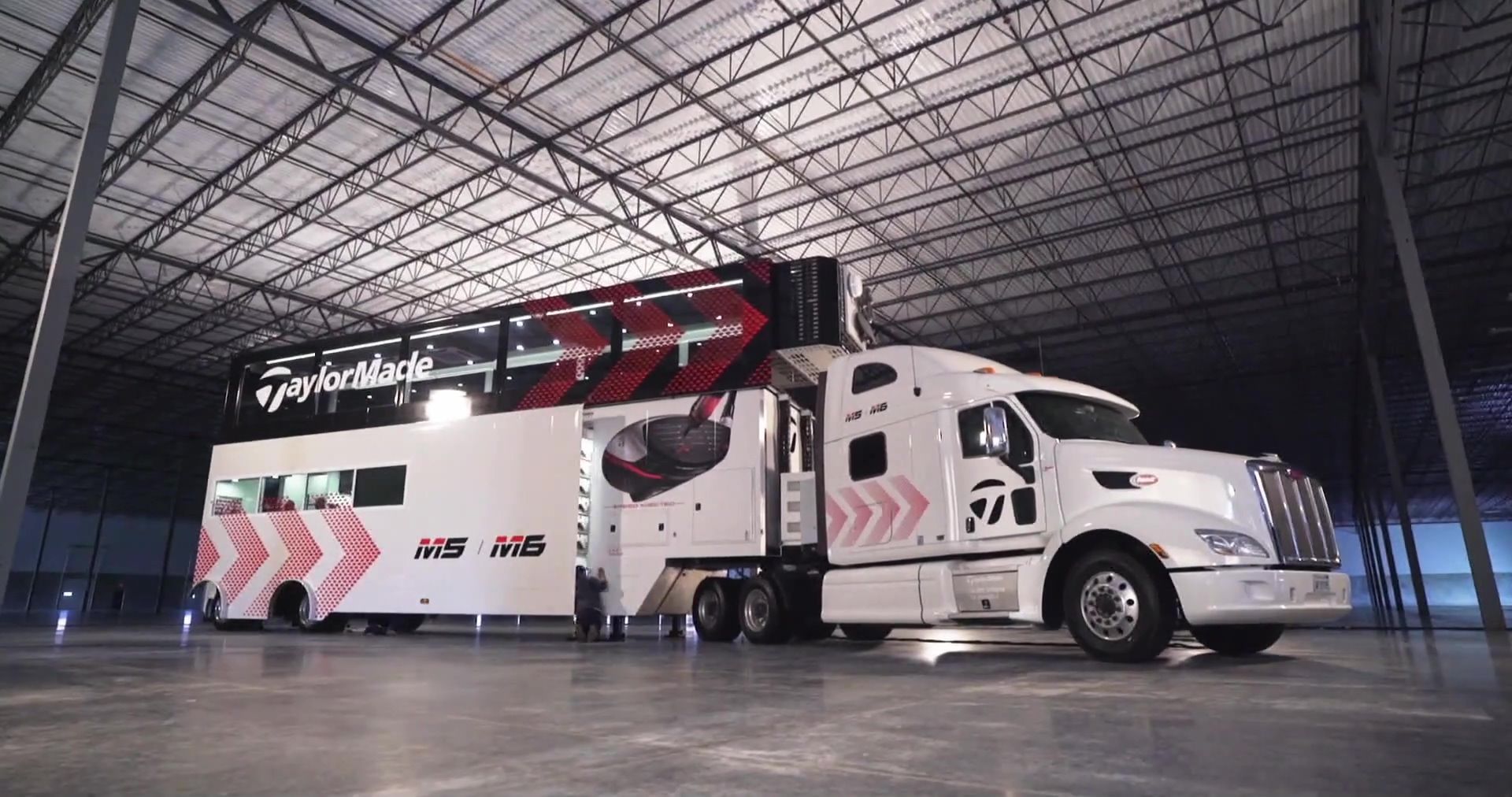
Have you heard about the hype surrounding the new Disney+ show? Read this article to discover why our services are known as the real-life Rennervations!
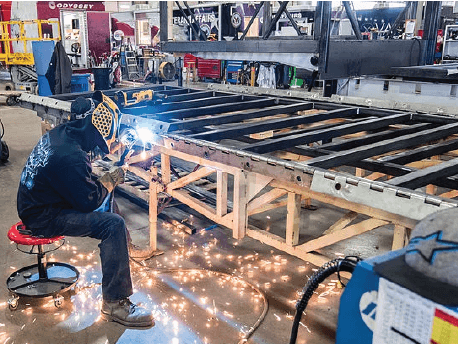
Are you wondering what is welding in industrial fabrication and how can you use it for your business? Check our guide to discover the best industry insights.

Choosing the best metal fabrication company is a vetting process [...]
