
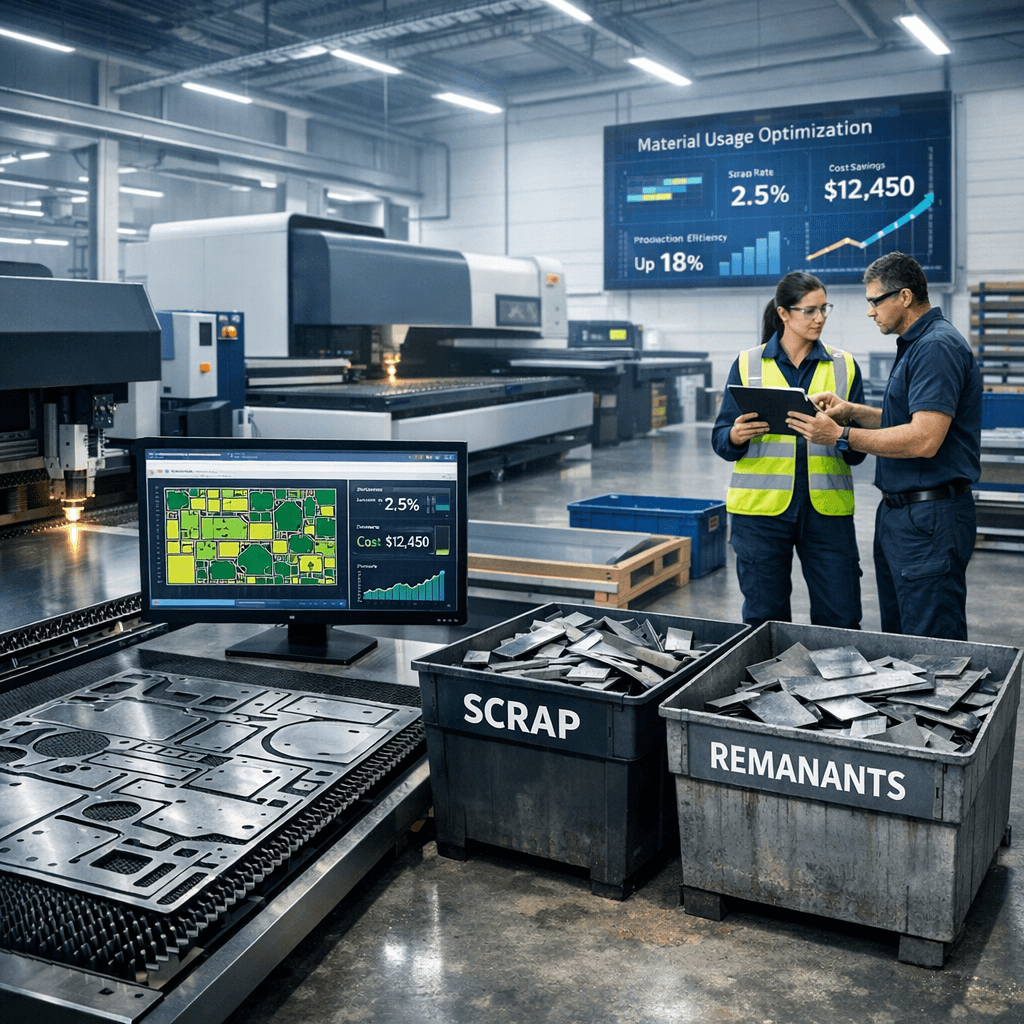
Material waste in metal fabrication is the loss of raw stock through inefficient cutting, design errors, poor nesting, and excess inventory that never reaches a finished part. The average scrap rate across the industry sits at approximately 6.5%, though top-performing shops achieve below 2%.
We cover waste sources and design strategies, cutting and nesting optimization, process selection comparisons, inventory and supply chain controls, technology-driven monitoring, lean manufacturing methodologies, workforce practices, scrap recycling programs, and vertically integrated production.
Poor nesting, design rework, overordering, and inefficient cutting collectively account for the largest controllable losses, with manual nesting alone wasting 30–40% of each sheet and manufacturability errors consuming up to half of production time in fixes.
Design for Manufacturability, parts standardization, and early designer-fabricator collaboration prevent scrap at the source by aligning part geometry with shop floor capabilities before material is ever cut.
Automated nesting software pushes material utilization from 60–70% to 82–90%, while common-line cutting and multi-job sheet consolidation reclaim material that traditional toolpaths discard. Laser cutting’s narrow 0.025-inch kerf and coil-fed lines producing only 2–3% scrap represent the lowest-waste process options.
Just-in-Time ordering, remnant tracking systems, and vendor-managed inventory reduce the capital tied up in unused stock, while CAD/CAM simulation, real-time machine monitoring, and ERP scrap tracking catch inefficiencies before they compound.
Lean tools like Value Stream Mapping and Kaizen expose hidden losses; structured operator training and standardized work instructions ensure gains persist. Scrap recycling with proper classification recovers 20–40% more value from unavoidable remnants, and vertical integration consolidates these strategies under one roof for maximum material control.
What Are the Main Sources of Material Waste in Metal Fabrication?
The main sources of material waste in metal fabrication are poor nesting, design errors, overordering raw materials, and inefficient cutting processes. Each source compounds costs through lost material, rework labor, and excess inventory.
How Does Poor Nesting and Layout Planning Create Scrap?
Poor nesting and layout planning creates scrap by leaving large unusable gaps between parts on a sheet. When operators arrange components manually without optimization, material utilization drops significantly. According to LaserSpecHub, manual nesting typically achieves only 60–70% material utilization, meaning 30–40% of each sheet becomes waste. Skeleton offcuts, irregular remnants, and oversized margins between parts all contribute to this loss. Without software-driven layout planning, fabricators consistently sacrifice usable material that could otherwise be allocated to smaller components or future jobs.
How Do Design Errors and Rework Contribute to Waste?
Design errors and rework contribute to waste by consuming raw materials on parts that must be scrapped and refabricated. Disconnects between CAD designs and shop floor capabilities cause dimensions, tolerances, or features that cannot be produced as specified. According to Metalworking World Magazine, manufacturers spend 30–50% of their time fixing errors, with 24% directly related to manufacturability issues. Each rejected part doubles material consumption for that component while adding labor costs. Rework cycles also disrupt production schedules, increasing the likelihood of further errors on subsequent jobs.
How Does Overordering Raw Materials Increase Costs?
Overordering raw materials increases costs by tying capital into stock that may never be used, degraded, or become obsolete. Fabricators often purchase extra material as a buffer against quality rejections or project changes, but surplus inventory accumulates quickly. According to The Fabricator’s financial survey, material costs averaged 43% of sales in 2023, making excess purchasing one of the largest controllable expenses. Unused remnants occupy floor space, require tracking, and risk damage from improper storage. For shops already operating at a 6.5% average scrap rate, overordering amplifies financial losses beyond what production waste alone generates.
How Do Inefficient Cutting Processes Generate Excess Scrap?
Inefficient cutting processes generate excess scrap through wide kerf widths, inaccurate cuts, and unoptimized toolpaths. Processes with broader material removal per cut leave less usable area on each sheet. According to Pareto Base, traditional sheet metal processes involving skeleton offcuts can generate 15% or more material scrap, while optimized coil-fed production lines reduce this to 2–3%. Dull tooling, incorrect feed rates, and poorly calibrated machines compound the problem by producing parts that fall outside tolerance, requiring additional material for replacement cuts.
Understanding these waste sources provides a clear framework for targeting reductions through better nesting software, design practices, and process selection.
What Design Strategies Help Minimize Metal Fabrication Waste?
Design strategies help minimize metal fabrication waste by addressing errors at the source, before material is ever cut. The key approaches include Design for Manufacturability, parts standardization, and early designer-fabricator collaboration.
How Does Design for Manufacturability Reduce Scrap Rates?
Design for Manufacturability reduces scrap rates by aligning part geometry with actual shop floor capabilities, eliminating the disconnect between CAD designs and production realities. According to Metalworking World Magazine, 30% to 50% of a manufacturer’s time is spent fixing errors, with 24% directly related to manufacturability issues. DFM guidelines prevent these problems through specific rules:
- Hole diameters should exceed sheet thickness (T).
- Spacing between holes should be at least twice the sheet thickness (2T).
- Distance between holes and bends should equal 1.5T plus the bend radius.
Following these parameters prevents excessive burr, slug-pulling, and material-wasting rework. For most fabrication shops, investing in DFM review at the design stage delivers far greater returns than optimizing downstream processes alone.
How Can Standardizing Parts and Dimensions Cut Material Use?
Standardizing parts and dimensions cuts material use by reducing the variety of raw stock sizes required and enabling more efficient nesting across multiple projects. When components share common hole patterns, bend radii, and sheet gauges, fabricators can consolidate orders and nest parts from different assemblies on the same sheet. This approach minimizes remnants that are too small for future use. Standardization also reduces setup changes, which lowers the risk of first-piece scrap during machine recalibration.
How Does Early Collaboration Between Designers and Fabricators Prevent Waste?
Early collaboration between designers and fabricators prevents waste by catching costly design assumptions before they reach production. When fabricators review designs during the concept phase, they can flag features that require excessive material removal, identify opportunities to use standard stock sizes, and recommend geometry changes that improve nesting efficiency. This upstream communication closes the gap between design intent and manufacturing reality, which is the root cause of most specification scrap.
With design-phase waste eliminated, optimized cutting and nesting techniques can further improve material yield.
What Cutting and Nesting Techniques Reduce Sheet Metal Scrap?
Cutting and nesting techniques reduce sheet metal scrap through automated software optimization, shared-edge cutting strategies, and multi-job sheet consolidation.
How Does Automated Nesting Software Optimize Material Yield?
Automated nesting software optimizes material yield by algorithmically arranging part geometries to maximize usable area on each sheet. Manual nesting typically achieves 60–70% material utilization, while advanced nesting software boosts this to 82–90%.
According to a LaserSpecHub guide on nesting software ROI, premium platforms costing $8,000 to $40,000 deliver annual waste reductions of $36,000 to $240,000, with payback periods between 2 and 14 months.
Leading platforms include:
- SigmaNEST, ideal for high-mix job shops and OEMs
- ProNest, strong in ERP integration and production costing
- Lantek Expert, suitable for multi-technology shops
- TruTops Boost, optimized for Trumpf equipment
For shops still relying on manual layout, the 20–30 percentage point improvement in utilization makes nesting software one of the highest-ROI investments available.
How Does Common-Line Cutting Reduce Kerf Waste?
Common-line cutting reduces kerf waste by allowing adjacent parts to share a single cut edge, eliminating the material that would otherwise be consumed by separate parallel cuts. This technique reduces pierce points by 30–50%, which also lowers consumable costs by $2,000 to $5,000 annually.
Because each pierce and separate toolpath removes additional material equal to the kerf width, shared edges effectively halve the material lost between neighboring parts. The result is tighter part spacing, fewer thermal distortion zones, and faster cycle times. For high-volume sheet metal operations, common-line cutting represents one of the simplest ways to reclaim material that traditional cut paths discard.
How Can Combining Multiple Jobs on One Sheet Improve Utilization?
Combining multiple jobs on one sheet improves utilization by filling gaps that single-job nesting leaves unused. When parts from different orders, sizes, and geometries are nested together, the software identifies complementary shapes that interlock more efficiently than uniform layouts allow.
This approach transforms remnant areas and skeleton waste into productive cutting zones. Shops that batch diverse work orders onto shared sheets often push utilization rates toward the upper range of 85–90%, especially when pairing large rectangular parts with smaller irregular components that fit into leftover spaces.
Effective multi-job nesting does require robust production tracking to ensure parts route correctly after cutting, but the material savings typically justify the added scheduling complexity.
Which Fabrication Processes Produce the Least Material Waste?
Fabrication processes that produce the least material waste include laser cutting, coil-fed production lines, and forming/bending operations. The sections below compare laser versus plasma cutting, CNC punching on thin-gauge metals, and forming methods against subtractive alternatives.
How Does Laser Cutting Compare to Plasma for Waste Reduction?
Laser cutting compares to plasma for waste reduction primarily through its narrower kerf width and tighter accuracy tolerance. According to a comparison published on Engineering.com, laser cutting produces a kerf width of 0.025 inches with +/- 0.005 inches accuracy, while plasma cutting generates a kerf of 0.150 inches with +/- 0.020 inches accuracy. That six-fold difference in kerf width translates directly into less material removed per cut.
Fiber lasers also reach cutting speeds up to 1,417 inches per minute in 16-gauge mild steel, compared to 260 IPM for CO2 lasers. Faster processing with tighter tolerances means fewer rejected parts and less rework scrap. For shops prioritizing waste reduction on precision components, laser cutting remains the superior choice over plasma in most thin-to-medium gauge applications.
How Does CNC Punching Minimize Scrap on Thin-Gauge Metals?
CNC punching minimizes scrap on thin-gauge metals by removing only small slugs of material rather than vaporizing a continuous kerf line. Each punch stroke displaces a discrete shape, leaving the surrounding sheet intact for adjacent features. When patterns are nested tightly, the distance between punched features can approach material thickness limits, maximizing usable area per sheet.
However, traditional CNC punching machines can still generate 15% or more scrap when skeleton waste from sheet edges and between parts remains unoptimized. Pairing CNC punching with coil-fed lines, which deliver strip material directly to the tooling, reduces scrap rates to 2-3%. For high-volume thin-gauge production, this combination offers one of the lowest waste profiles available in sheet metal fabrication.
How Does Forming and Bending Reduce Waste Versus Subtractive Methods?
Forming and bending reduce waste versus subtractive methods by reshaping material rather than removing it. Press brakes, roll forming equipment, and stamping dies transform flat sheet into three-dimensional geometry without generating chips, kerf waste, or cutting dust. The original material volume is preserved almost entirely in the finished part.
Subtractive processes like milling, routing, or plasma cutting remove material to achieve final geometry, producing scrap proportional to the complexity of the shape. Forming operations avoid this entirely. When a part can be designed with bend features instead of machined pockets or cut profiles, material utilization approaches near 100%. This makes forming and bending the lowest-waste fabrication category for components where geometry permits.
With process selection established, managing inventory and supply chains further compounds these material savings.
How Does Inventory and Supply Chain Management Lower Material Costs?
Inventory and supply chain management lowers material costs by reducing excess stock, recovering usable remnants, and aligning purchasing with actual production demand. The following sections cover Just-in-Time ordering, remnant tracking, and vendor-managed inventory.
How Does Just-in-Time Ordering Prevent Excess Raw Material Waste?
Just-in-Time ordering prevents excess raw material waste by synchronizing material deliveries with production schedules, eliminating the accumulation of unused stock. Rather than purchasing large quantities that sit in storage, JIT aligns procurement to immediate fabrication needs. According to a 2023 financial survey published by The Fabricator, material costs averaged 43% of sales across the metal fabrication industry, making over-purchasing a significant financial risk. When inventory sits unused, it becomes vulnerable to damage, obsolescence, and specification changes that render sheets or plate unusable. JIT disciplines purchasing teams to order only what upcoming jobs require, reducing carrying costs and preventing material from aging into scrap.
How Can Tracking Remnants and Offcuts Recover Usable Material?
Tracking remnants and offcuts recovers usable material by cataloging leftover pieces in a searchable system so they can be matched to future jobs instead of discarded. Without a formal tracking system, partially used sheets and cutoffs accumulate unmanaged, often ending up in scrap bins despite having viable dimensions. Digital remnant management logs each piece by alloy, gauge, and dimensions, making it available for nesting on subsequent orders. Given that scrap and rework costs accounted for an average of 1.4% of sales in recent industry surveys, even modest recovery improvements translate into meaningful savings. For fabricators processing diverse jobs, this approach turns would-be waste into a secondary material source.
How Does Vendor-Managed Inventory Reduce Overstock Losses?
Vendor-managed inventory reduces overstock losses by shifting replenishment responsibility to the supplier, who monitors usage data and delivers only what consumption patterns justify. This model prevents the speculative bulk ordering that creates surplus. The decline in inventory turns from 18.5 in 2019 to 10.3 in 2023 across the fabrication industry signals growing inefficiency in how shops manage on-hand stock. VMI addresses this by using real-time consumption signals rather than forecast-based purchasing. For most metal fabrication operations, this represents one of the simplest structural changes available to reduce capital tied up in raw materials that may never reach production.
With supply chain controls in place, technology offers additional tools to monitor and reduce waste in real time.
What Role Does Technology Play in Reducing Fabrication Waste?
Technology plays a central role in reducing fabrication waste by enabling predictive simulation, real-time monitoring, and data-driven scrap tracking. The subsections below cover CAD/CAM simulations, machine monitoring systems, and ERP-based scrap analysis.
How Do CAD/CAM Simulations Identify Waste Before Production?
CAD/CAM simulations identify waste before production by modeling part geometry, toolpaths, and material layouts digitally, revealing inefficiencies that would otherwise become physical scrap. These simulations detect clashes between design intent and shop floor capabilities, flag excessive material removal, and test nesting arrangements virtually. According to a case study reported by OS For Your Business, a mid-sized fabricator implementing AI-driven automation reduced material waste by 23% within six months. By catching errors at the digital stage, fabricators avoid costly rework and raw material losses that compound across production runs.
How Does Real-Time Machine Monitoring Catch Inefficiencies Early?
Real-time machine monitoring catches inefficiencies early by continuously tracking equipment performance metrics such as cycle times, feed rates, and error codes during active production. When sensors detect deviation from programmed parameters, operators receive immediate alerts to correct issues before additional material is wasted. This approach directly improves Overall Equipment Effectiveness; AI-integrated monitoring systems have demonstrated OEE improvements from 68% to 82%, according to the same fabricator case study. Reduced unplanned downtime and fewer mid-run defects translate to lower scrap volumes per shift. For most shops, the monitoring layer is what turns reactive waste management into proactive prevention.
How Can ERP Systems Track Scrap Rates Across Projects?
ERP systems track scrap rates across projects by aggregating material input data, finished output quantities, and scrap weight into centralized dashboards organized by job, operator, or machine. This project-level visibility enables fabricators to identify which jobs, materials, or processes consistently generate above-average waste. With material costs averaging 43% of sales in 2023 according to The Fabricator’s financial survey, even small percentage improvements in scrap tracking yield significant dollar savings. Effective ERP reporting also supports continuous improvement cycles by providing the baseline data lean teams need to measure Kaizen results.
Paired with lean principles, these technology layers create a closed-loop system for ongoing waste elimination.
How Does Lean Manufacturing Apply to Metal Fabrication Waste?
Lean manufacturing applies to metal fabrication waste by providing systematic methodologies that identify, measure, and eliminate non-value-adding activities throughout production. Two core tools drive this effort: Value Stream Mapping and Kaizen.
How Does Value Stream Mapping Expose Hidden Material Losses?
Value Stream Mapping exposes hidden material losses by visualizing the entire production process to pinpoint where waste accumulates unnoticed. VSM traces material flow from raw stock through each fabrication step, revealing inefficiencies that standard reporting often misses.
According to a 2020 study published in the APEM Journal, lean manufacturing principles such as VSM and Kaizen are effective in identifying and reducing hidden material losses by emphasizing continuous improvement and waste elimination throughout the fabrication process. By mapping every stage where material enters, transforms, or exits, fabricators can quantify:
- Excess material consumed during setup and changeover.
- Scrap generated between process handoffs.
- Inventory sitting idle between operations.
- Overproduction that leads to obsolete stock.
Once visualized, these losses become actionable targets rather than accepted overhead costs.
How Does Kaizen Drive Continuous Scrap Reduction on the Shop Floor?
Kaizen drives continuous scrap reduction on the shop floor by implementing small, incremental improvements that compound over time. Rather than relying on large capital investments, Kaizen empowers operators to identify waste at the source and propose immediate corrections.
This approach works because the people closest to fabrication equipment notice patterns first: recurring material jams, consistent offcut sizes that could be reused, or setup sequences that generate unnecessary test pieces. When these observations feed into structured improvement cycles, scrap rates decline steadily without disrupting production schedules. For fabrication teams already tracking operator-specific metrics, Kaizen provides the framework to convert that data into targeted action.
With lean principles establishing waste visibility, workforce training and standardized practices ensure these gains persist over time.
What Workforce Practices Help Control Material Waste and Costs?
Workforce practices that help control material waste and costs include structured operator training programs and standardized work instructions. These two approaches address the human factors behind setup scrap, handling errors, and material misuse.
How Does Operator Training Reduce Setup Scrap and Errors?
Operator training reduces setup scrap and errors by ensuring workers develop competency in machine setup, material handling, and quality assessment. Inadequately trained operators contribute directly to fabrication errors that generate avoidable waste. According to Tractian’s research on scrap rate reduction, implementing structured training programs and tracking operator-specific metrics helps identify training gaps and measurably reduce scrap rates.
Effective training programs should include:
- Hands-on machine setup procedures for each equipment type
- Material identification and handling protocols
- Quality inspection techniques at critical process stages
- Error documentation and root-cause analysis skills
Tracking individual operator scrap metrics reveals who needs additional coaching, turning reactive waste management into proactive skill development. For most fabrication shops, investing in operator competency yields faster returns than investing in new equipment alone.
How Do Standardized Work Instructions Prevent Material Misuse?
Standardized work instructions prevent material misuse by establishing consistent, repeatable procedures for every fabrication task. When operators follow documented steps for material selection, machine settings, and process sequencing, they eliminate the guesswork that leads to incorrect material pulls, improper cutting parameters, and avoidable rework.
Key elements of effective standardized work instructions include:
- Specified material grades, thicknesses, and sheet sizes for each job
- Required machine parameters, including feed rates and tooling selections
- Step-by-step setup sequences with visual references
- Acceptance criteria for in-process quality checks
Without standardization, each shift may handle identical jobs differently, producing inconsistent quality and variable scrap rates. Documented instructions create accountability and make deviations immediately identifiable. This consistency is especially critical in high-mix environments where operators switch between job types frequently.
With workforce fundamentals established, recycling and reclamation programs capture value from whatever scrap remains.
How Can Scrap Recycling and Reclamation Offset Material Costs?
Scrap recycling and reclamation offset material costs by converting production waste into recoverable revenue through proper sorting, classification, and market-based resale of metal remnants.
Proper classification of scrap metals can increase material recovery rates by 20–40%, significantly enhancing the value of recyclables, according to Okon Recycling’s fabrication scrap management guidelines. This means a shop generating thousands of pounds of steel or aluminum offcuts monthly can recapture a meaningful percentage of raw material expenditure simply by segregating scrap by alloy, grade, and condition before selling to recyclers.
The financial opportunity is substantial. Fortune Business Insights valued the global scrap metal recycling market at $435.5 billion in 2025, reflecting strong demand for reclaimed ferrous and non-ferrous metals. Fabricators who track scrap market pricing and negotiate reclamation offset percentages with recycling partners position themselves to recover consistent revenue from material that would otherwise represent pure loss.
For operations producing high volumes of sheet metal scrap, establishing a structured recycling program with dedicated collection bins, weight tracking, and scheduled pickups transforms an unavoidable byproduct into a predictable cost offset. The key is treating scrap not as waste disposal, but as inventory with recoverable value.
With recycling revenue flowing back into operations, vertically integrated fabrication offers even greater control over total material costs.
How Does Vertically Integrated Fabrication Reduce Waste and Cost?
Vertically integrated fabrication reduces waste and cost by consolidating design, engineering, and production under one roof, eliminating markup payments to external suppliers and optimizing material flow. The following subsections explore how in-house control minimizes scrap and highlight key takeaways.
Can In-House Custom Metal Fabrication From Design Through Production Minimize Material Waste?
Yes, in-house custom metal fabrication from design through production can minimize material waste. When a single facility controls every stage, designers collaborate directly with fabricators to apply Design for Manufacturability principles, catching errors before they generate scrap. According to Metalworking World Magazine, 30% to 50% of a manufacturer’s time is spent fixing errors, with 24% directly tied to manufacturability issues arising from disconnects between CAD designs and shop floor capabilities.
Vertical integration eliminates these gaps by enabling real-time feedback between departments. Material flow becomes predictable when one team manages cutting layouts, remnant tracking, and production scheduling without handoffs to outside vendors. According to a University of Bristol working paper, vertically integrated producers are often more productive and larger than non-integrated counterparts, partly because internal coordination reduces lead times and specification mismatches that cause over-ordering.
For fabricators still outsourcing multiple stages, the compounding effect of markup payments, transit damage, and miscommunication often exceeds the visible cost of scrap alone.
What Are the Key Takeaways About Reducing Material Waste and Costs in Metal Fabrication?
The key takeaways about reducing material waste and costs in metal fabrication center on integrated planning, technology adoption, and process discipline:
- Design for Manufacturability applied early prevents the costliest rework errors before cutting begins.
- Optimized nesting software and coil-fed production lines can reduce scrap from over 15% to 2–3%.
- AI-driven scheduling and monitoring deliver measurable ROI by catching inefficiencies in real time.
- Lean principles such as Value Stream Mapping expose hidden losses that standard reporting misses.
- Vertical integration ties these strategies together, giving one team full accountability over material from intake to finished part.
Shops that combine these approaches systematically, rather than adopting them in isolation, achieve the compounding gains that move scrap rates from industry average toward top-quartile performance. With waste reduction strategies in place, partnering with a vertically integrated fabricator accelerates results.
Filter Posts by Tag
related posts
Are you wondering how does industrial fabrication work? Read this article to discover everything you need to know about industrial fabrication processes!

Do you need something built from scratch? Check the benefits of outsourcing industrial fabrication services to make the best decision for your business.
CNC machining is a computer-controlled subtractive process that removes [...]
