
11 min read
How Does Industrial Fabrication Support Aerospace and Defense Projects?
Craftsmen Industries May 14, 2026 4:12:23 PM
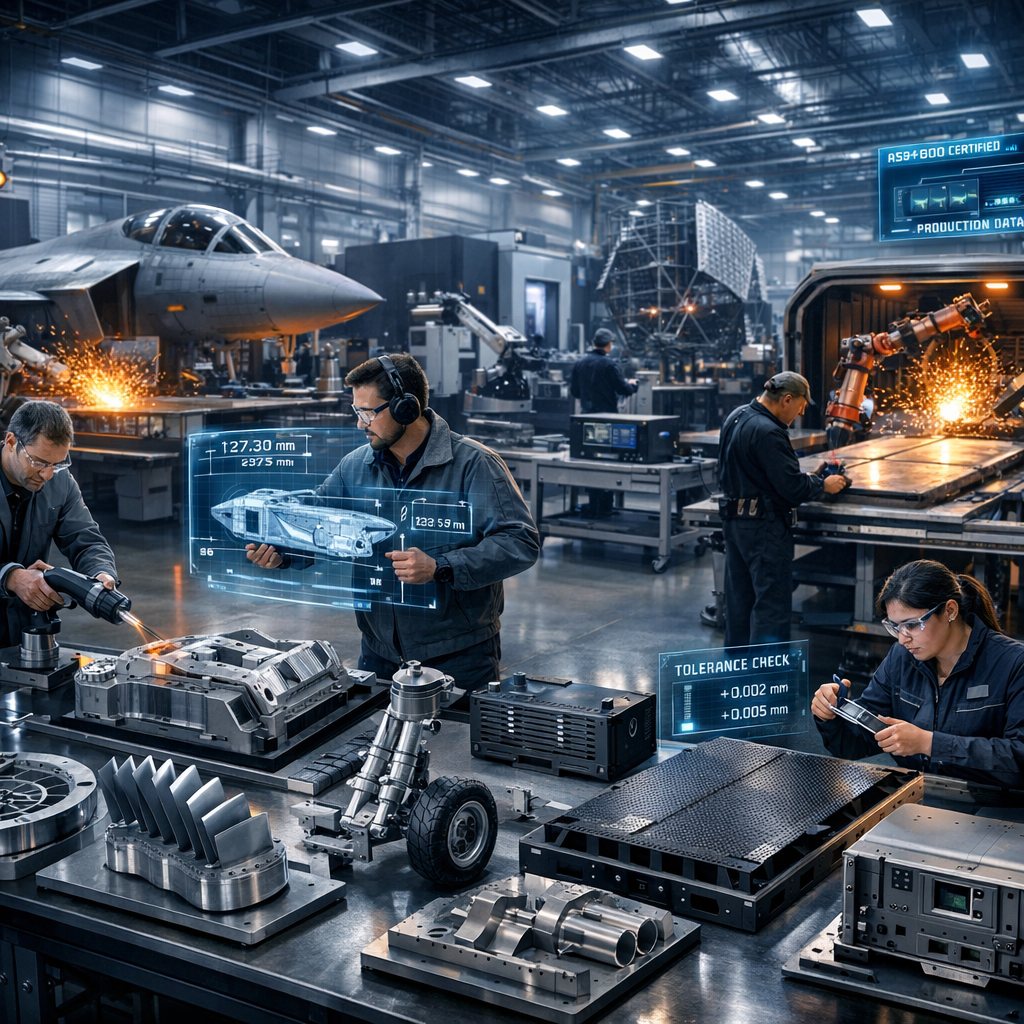
Industrial fabrication for aerospace and defense is the precision manufacturing of mission-critical components, structural assemblies, and tactical assets under strict regulatory oversight for aircraft, spacecraft, and military systems.
This guide covers fabrication's role in aerospace and defense production, the core processes and materials involved, quality and compliance standards, the strategic value of vertical integration, production challenges unique to this sector, and custom fabrication for military mobile assets.
Aerospace fabrication produces components ranging from turbine blades and landing gear assemblies to structural frames and hydraulic fittings, all held to tolerances 5 to 10 times stricter than general manufacturing. Processes like CNC machining, friction stir welding, and composite layup each address specific structural and performance demands.
Materials selection drives both capability and cost. Aluminum 7075 serves airframe structures, Ti-6Al-4V titanium handles extreme heat and corrosion in defense hardware, and polymer matrix composites now account for roughly 30% of material weight in fifth-generation fighter jets.
Compliance frameworks including AS9100 certification, ITAR regulations, and Nadcap accreditation govern every stage of production, separating defense-grade fabrication from commercial manufacturing through complete traceability, facility security, and process validation requirements.
Vertical integration consolidates design through finishing under one operation, reducing lead times, eliminating multi-vendor quality gaps, and protecting classified program data within a single secured facility. This model proves especially valuable when fabricators face tight tolerances, low-volume custom runs, and evolving MIL-SPEC requirements simultaneously.
For military mobile assets, custom fabrication delivers tactical vehicles, transportable shelters, and rapid deployment units engineered for combat zone survivability and standard logistics transport.
What Role Does Industrial Fabrication Play in Aerospace and Defense?
Industrial fabrication produces mission-critical components for aircraft, spacecraft, and defense systems under strict regulatory oversight. The following sections detail the specific components produced and how defense fabrication differs from standard manufacturing.
What Types of Components Does Industrial Fabrication Produce for Aerospace?
Industrial fabrication produces precision components for aircraft, spacecraft, and defense systems, including turbine blades, structural frames, landing gear assemblies, and hydraulic fittings. Aerospace parts manufacturing encompasses the design, production, and testing of these components to tolerances far beyond commercial standards.
According to TiRapid, aerospace components require ±0.002 mm to 0.01 mm linear tolerances, approximately 5 to 10 times stricter than the ±0.02 to 0.05 mm range found in general manufacturing. Precision machining enables the production of intricate metal components with micron-level accuracy, ensuring reliable system operation. Advanced processes like friction stir welding join lightweight alloys for airframe structures, while laser shock peening moderates tensile residual stresses produced during welding. This combination of tight tolerances and specialized joining techniques makes aerospace fabrication a fundamentally different discipline than conventional parts production.
How Does Fabrication Differ From Standard Manufacturing in Defense Applications?
Fabrication differs from standard manufacturing in defense applications through layered regulatory requirements, complete traceability mandates, and security-controlled production environments. Every component must meet exacting standards established by aviation and military authorities.
Key distinctions include:
- Aerospace and defense manufacturers operate under rigorous standards demanding complete component genealogies and material certifications.
- AS9100 Rev D serves as the internationally recognized quality management system standard for aviation, space, and defense organizations.
- ITAR compliance dictates material selection, traceability, facility security, and production protocols for defense and aircraft parts suppliers.
According to Advantage Metal, adherence to ITAR shapes everything from how materials are sourced to how finished components are stored and shipped. Standard commercial manufacturing rarely requires this level of documentation or facility access control. For organizations needing defense-grade fabrication, the gap between commercial quality and military-specification compliance represents months of additional certification effort and infrastructure investment.
Understanding these regulatory distinctions helps clarify which fabrication processes meet aerospace and defense requirements.
What Fabrication Processes Are Used in Aerospace and Defense?
The fabrication processes used in aerospace and defense include CNC machining, sheet metal forming, welding, surface treatment, and composite fabrication. Each process addresses specific structural, performance, and compliance demands.
CNC Machining
CNC machining produces aerospace components with micron-level precision through computer-controlled material removal. Multi-axis mills and lathes cut titanium, aluminum, and high-strength steel into complex geometries for turbine housings, structural brackets, and flight-critical fittings. According to Taylor & Francis Online, additive manufacturing, precision machining, and advanced manufacturing techniques deliver greater accuracy, surface finish, and complexity in aircraft components. For aerospace work, this process remains indispensable because it consistently holds the ultra-tight tolerances that hand methods simply cannot achieve.
Sheet Metal Forming and Assembly
Sheet metal forming and assembly transforms flat metal stock into structural panels, enclosures, and airframe skins through bending, stamping, and hydroforming. Aluminum and titanium sheets are shaped using press brakes and stretch-forming equipment, then assembled with rivets, fasteners, or adhesive bonding. These assemblies become fuselage sections, engine cowlings, and radar housings. Precision forming is essential here; even minor dimensional variation in sheet metal assemblies can compromise aerodynamic performance or structural integrity in flight.
Welding and Joining
Welding and joining bonds aerospace metals into unified structures capable of withstanding extreme operational stresses. According to NASA Technical Reports Server, friction stir welding is a solid-state welding process used in the fabrication of various aerospace structures, offering advantages for light alloys without melting the base material. TIG welding, electron beam welding, and laser welding also serve critical roles. Each method is selected based on material type, joint geometry, and required fatigue life, with parameters documented for full traceability.
Surface Treatment and Finishing
Surface treatment and finishing protects aerospace components from corrosion, fatigue, and environmental degradation. Processes include anodizing, chemical conversion coating, passivation, and shot peening. According to the Performance Review Institute, Nadcap accreditation covers critical processes in the aerospace supply chain, including heat treating, chemical processing, and non-destructive testing. These treatments are not cosmetic; they extend service life and ensure components perform reliably across temperature extremes and harsh operating environments.
Composite Fabrication
Composite fabrication produces lightweight, high-strength structures by layering carbon fiber, fiberglass, or aramid materials with resin matrices. Autoclave curing, resin transfer molding, and filament winding create parts with superior strength-to-weight ratios compared to metal equivalents. Wing skins, radomes, and structural fairings commonly use composite construction. For programs demanding weight reduction without sacrificing structural performance, composite fabrication has become one of the most strategically valuable processes available.
With processes established, the materials fed into these operations determine whether finished components meet aerospace performance thresholds.
What Materials Are Required for Aerospace and Defense Fabrication?
The materials required for aerospace and defense fabrication include aluminum alloys, titanium, high-strength steel, and advanced composites. According to FutureDataStats, the global Aerospace Materials Market was valued at USD 29.5 billion in 2025 and is projected to expand at a CAGR of 7.5%, reaching USD 62.3 billion by 2030.
How Is Aluminum Used in Aerospace Fabrication?
Aluminum is used in aerospace fabrication for airframes, fuselage panels, wing skins, and structural components where high strength-to-weight ratio is essential. Aluminum alloy 7075 (B95) is a high-strength alloy that performs in extreme conditions and is used in modern construction of aircraft, spacecraft, and satellites.
According to Grand View Research, the global composite materials and aluminum alloys in aerospace market was valued at USD 21.1 billion in 2022 and is expected to grow at a CAGR of 9.3%. Friction stir welding, a solid-state welding process, is used in the fabrication of various aerospace structures made from aluminum. For most airframe applications, aluminum remains the most cost-effective structural material when weight savings and machinability are balanced against budget constraints.
How Is Titanium Used in Defense Fabrication?
Titanium is used in defense fabrication for engine components, airframe structures, armor plating, and fasteners that must withstand extreme heat and corrosive environments. Ti-6Al-4V is the most widely used titanium alloy in aerospace applications, offering exceptional fatigue resistance and a strength-to-weight ratio superior to steel.
Defense programs favor titanium for components exposed to high temperatures, ballistic threats, or saltwater corrosion. Its biocompatibility and resistance to stress cracking also make it suitable for submarine hull fittings and helicopter rotor systems. Despite higher raw material costs, titanium's longevity and performance under combat conditions justify its selection for mission-critical defense hardware.
How Are High-Strength Steel Alloys Used in Military Applications?
High-strength steel alloys are used in military applications for landing gear, armored vehicle hulls, ballistic-resistant structures, and load-bearing airframe joints. These alloys provide superior hardness and impact resistance where titanium or aluminum cannot meet structural demands.
Maraging steels and ultra-high-strength variants such as 300M withstand extreme stress concentrations in arrestor hooks and rocket motor casings. When weight is secondary to survivability, steel remains the preferred choice for armor systems and structural reinforcements in ground vehicles and naval platforms.
How Are Advanced Composites Used in Aircraft Structures?
Advanced composites are used in aircraft structures to reduce weight while maintaining structural integrity in wings, fuselage sections, and control surfaces. Currently, Polymer Matrix Composites (PMCs) used in fifth-generation fighter jets account for about 30% of total material weight, and usage is projected to reach 40% for future generations, according to ScienceDirect.
Additive manufacturing, precision machining, and advanced manufacturing techniques deliver greater accuracy, surface finish, and complexity in composite aircraft components. Carbon fiber reinforced polymers and glass fiber laminates resist fatigue and corrosion better than metals in many structural applications.
With material selection driving both performance and cost, understanding fabrication processes ensures these materials reach their full potential.
What Quality and Compliance Standards Govern Aerospace Fabrication?
The quality and compliance standards that govern aerospace fabrication include AS9100 certification, ITAR regulations, and NADCAP accreditation. Each standard addresses a distinct aspect of manufacturing quality, export control, and process validation.
What Is AS9100 Certification in Aerospace Manufacturing?
AS9100 certification is the internationally recognized quality management system standard for aviation, space, and defense organizations. Built on the ISO 9001 framework, AS9100 Rev D adds aerospace-specific requirements for risk management, quality control, and continual improvement. According to NQA, "the aerospace industry has unique requirements for quality management, which is why many companies that deliver products and services within the aviation, space and defense spheres work to earn AS9100 certification." Fabricators pursuing this certification demonstrate their ability to consistently produce components that meet the elevated reliability demands of flight-critical and mission-critical applications.
What Are ITAR Requirements for Defense Fabrication?
ITAR requirements for defense fabrication are the regulatory controls codified in 22 CFR parts 120 through 130. According to the DDTC Public Portal, the ITAR governs the manufacture, export, and temporary import of defense articles, the furnishing of defense services, and brokering activities involving items described on the United States Munitions List. Compliance dictates facility security protocols, personnel access restrictions, material traceability, and documentation controls. For fabricators serving defense programs, even a single ITAR violation can result in severe civil and criminal penalties, making rigorous internal compliance systems non-negotiable.
How Do NADCAP Standards Apply to Special Processes?
NADCAP standards apply to special processes by providing third-party accreditation that validates a fabricator's competence in critical operations. According to the Performance Review Institute, Nadcap accreditation is a global mark of excellence that signifies compliance with rigorous aerospace industry requirements for critical processes and products. These special processes include heat treating, chemical processing, and non-destructive testing. Unlike general quality certifications, NADCAP audits evaluate the technical execution of individual process categories, ensuring that results are repeatable and traceable regardless of which prime contractor receives the finished component.
With compliance frameworks established, vertical integration determines how efficiently fabricators maintain these standards across every production stage.
Why Does Vertical Integration Matter in Aerospace and Defense Fabrication?
Vertical integration matters in aerospace and defense fabrication because it consolidates design, production, and quality assurance under one operation, reducing delays, strengthening accountability, and protecting classified programs. The following subsections cover lead time reduction, quality control improvements, and security for sensitive defense work.
How Does In-House Design-to-Production Reduce Lead Times?
In-house design-to-production reduces lead times by enabling concurrent manufacturing processes. When engineering, fabrication, and finishing operate within the same facility, production stages overlap rather than waiting on external handoffs. According to SVI, consolidating various production stages under one roof allows manufacturers to streamline OEM operations and reduce lead times more effectively. This elimination of vendor coordination delays is especially critical for defense programs operating on compressed schedules, where even short procurement gaps can cascade into missed delivery milestones.
How Does Single-Source Accountability Improve Quality Control?
Single-source accountability improves quality control by placing every production stage under one quality management system. According to RCO Engineering, vertically integrated manufacturing leads to improved quality control, greater supply chain reliability, and cost efficiency. When a single entity owns the process from raw material intake through final inspection, traceability gaps disappear. Non-conformances are caught and corrected in real time rather than discovered after components arrive from a subcontractor. This unified approach aligns naturally with AS9100 Rev D requirements for risk management and continual improvement, reducing the audit complexity that fragments across multiple suppliers.
How Does End-to-End Fabrication Protect Sensitive Defense Programs?
End-to-end fabrication protects sensitive defense programs by keeping controlled technical data, ITAR-regulated materials, and classified processes within a single secured facility. When production moves between multiple vendors, each transfer point introduces a potential security vulnerability. A vertically integrated operation minimizes external data sharing, limits personnel access to need-to-know participants, and simplifies compliance documentation for government oversight. For programs governed by ITAR and facility security clearances, fewer touchpoints mean fewer opportunities for unauthorized disclosure. This containment model is particularly valuable for low-volume defense builds where each unit carries significant intelligence sensitivity.
With integration benefits established, understanding the production challenges that test these capabilities provides further context.
What Are the Biggest Challenges in Aerospace and Defense Fabrication?
The biggest challenges in aerospace and defense fabrication are maintaining ultra-tight tolerances, managing low-volume custom production costs, and adapting to constantly evolving specifications.
How Do Tight Tolerances Affect Production Complexity?
Tight tolerances affect production complexity by demanding specialized equipment, slower machining speeds, and rigorous inspection at every stage. According to Jiga.io, standard aerospace tolerances often reach ±0.0005 in (±12.7 μm) or tighter. Achieving these dimensions consistently requires advanced CNC systems with thermal compensation, vibration isolation, and dedicated tooling for each material type. Even minor deviations from these micro-level specifications can render a finished component unusable, increasing scrap rates and extending production timelines. For fabricators without purpose-built aerospace workflows, these tolerances represent a significant barrier to entry.
How Do Low-Volume Custom Runs Impact Cost and Scheduling?
Low-volume custom runs impact cost and scheduling by eliminating the economies of scale that reduce per-unit pricing in commercial manufacturing. Each aerospace or defense component often requires unique fixturing, custom tooling, dedicated programming, and first-article inspection before production begins. These setup costs spread across only a handful of parts dramatically increase the price per unit. Scheduling becomes equally challenging because short runs compete for machine time against longer, more predictable jobs. Fabricators must balance capacity allocation carefully, often absorbing idle time between custom orders while maintaining readiness for urgent defense requirements.
How Do Evolving Specifications Create Supply Chain Pressure?
Evolving specifications create supply chain pressure by forcing fabricators to continuously re-qualify materials, update processes, and retool production lines mid-program. When MIL-SPEC requirements or OEM engineering changes arrive after procurement has started, previously approved materials may no longer comply. Suppliers must then source new certified stock on compressed timelines, often from a limited pool of approved vendors. This cascading effect delays downstream operations and increases costs at every tier. Maintaining agile supplier relationships and carrying qualified material inventory are essential strategies for managing specification volatility in defense programs.
With production challenges defined, selecting the right fabrication partner becomes the next critical decision.
How Does Industrial Fabrication Support Military Mobile Assets?
Industrial fabrication supports military mobile assets by producing custom tactical vehicles, transportable shelters, and rapid deployment units engineered for combat zone conditions. The following sections cover fabrication for tactical vehicles and shelters, and how rapid deployment units are built.
What Custom Fabrication Is Needed for Tactical Vehicles and Shelters?
Custom fabrication needed for tactical vehicles and shelters includes structural metalwork, environmental protection systems, and modular framing designed to meet military transport and survivability requirements. Tactical shelters are presized, transportable structures designed to protect personnel and equipment from environmental and combat zone conditions, according to the Defense Technical Information Center.
These assets demand fabrication processes that account for weight restrictions, ballistic protection, and field-serviceability. Key custom fabrication requirements include:
- Reinforced chassis and frame modifications for armored vehicle platforms
- Modular wall and roof panel systems sized for standard military transport
- Integrated mounting points for communication and surveillance equipment
- Climate control and NBC (nuclear, biological, chemical) filtration housings
Each component must comply with MIL-STD specifications for labeling, material traceability, and dimensional tolerances. For fabricators, this means controlling every production stage from raw material selection through final assembly and inspection.
How Are Rapid Deployment Units Built Through Industrial Fabrication?
Rapid deployment units are built through industrial fabrication by combining modular design principles with accelerated production timelines that prioritize transportability and field assembly speed. These units must ship via standard military logistics channels, meaning every subassembly is dimensioned for airlift, sealift, or ground convoy transport.
The fabrication process typically follows this sequence:
- Engineers design modular sections that bolt or pin together without specialized tools.
- CNC machining and sheet metal forming produce standardized, interchangeable structural panels.
- Welding and surface treatment ensure corrosion resistance under harsh operational environments.
- Final integration incorporates electrical, HVAC, and communication system pass-throughs.
Speed and repeatability define this production model. Vertically integrated fabricators hold a distinct advantage here because consolidating design, cutting, welding, and finishing under one facility eliminates handoff delays that compromise deployment readiness.
With mobile asset fabrication established, selecting the right fabrication partner ensures these capabilities align with program-specific defense requirements.
How Should You Choose a Fabrication Partner for Complex Defense and Aerospace Needs?
You should choose a fabrication partner based on vertical integration, proven aerospace capabilities, and regulatory compliance. The following sections cover how Craftsmen Industries meets these criteria and the key takeaways from this guide.
Can Vertically Integrated Industrial Fabrication From Craftsmen Industries Serve Aerospace and Defense Requirements?
Yes, vertically integrated industrial fabrication from Craftsmen Industries can serve aerospace and defense requirements. Craftsmen Industries operates as a vertically integrated provider with in-house design, engineering, fabrication, and finishing capabilities from a 127,000 sq. ft. facility. This single-source model consolidates production stages under one roof, which reduces lead times and strengthens quality control for defense programs requiring traceability.
Aerospace materials must demonstrate consistent properties under stress and temperature cycling from -55°C to +260°C, according to Modus Advanced. Craftsmen Industries' end-to-end fabrication workflow addresses these demands by maintaining oversight across every production phase, from material selection through final assembly.
For organizations navigating a U.S. aerospace and defense market growing at a CAGR of 5.67% toward $610.15 billion by 2031, partnering with a fabrication provider that controls the full production chain offers meaningful advantages in schedule certainty and program security.
What Are the Key Takeaways About How Industrial Fabrication Supports Aerospace and Defense Projects?
The key takeaways about how industrial fabrication supports aerospace and defense projects are:
- Industrial fabrication produces mission-critical components, from structural frames to tactical shelters, using processes such as CNC machining, friction stir welding, and composite layup.
- Defense fabrication demands stricter compliance than commercial manufacturing, requiring AS9100 certification, ITAR adherence, and Nadcap accreditation for special processes.
- Materials like aluminum 7075, Ti-6Al-4V titanium, and polymer matrix composites must perform across extreme temperature ranges and sustained environmental exposure.
- Vertical integration reduces lead times, improves quality control, and protects sensitive program data by eliminating multi-vendor handoffs.
- Tight tolerances, low-volume custom runs, and evolving MIL-SPEC requirements remain the sector's most persistent production challenges.
Craftsmen Industries combines over 40 years of custom fabrication experience with a vertically integrated model purpose-built for complex defense and aerospace programs.