
14 min read
How Is Laser Cutting Transforming Modern Industrial Fabrication?
Craftsmen Industries May 13, 2026 3:51:41 PM
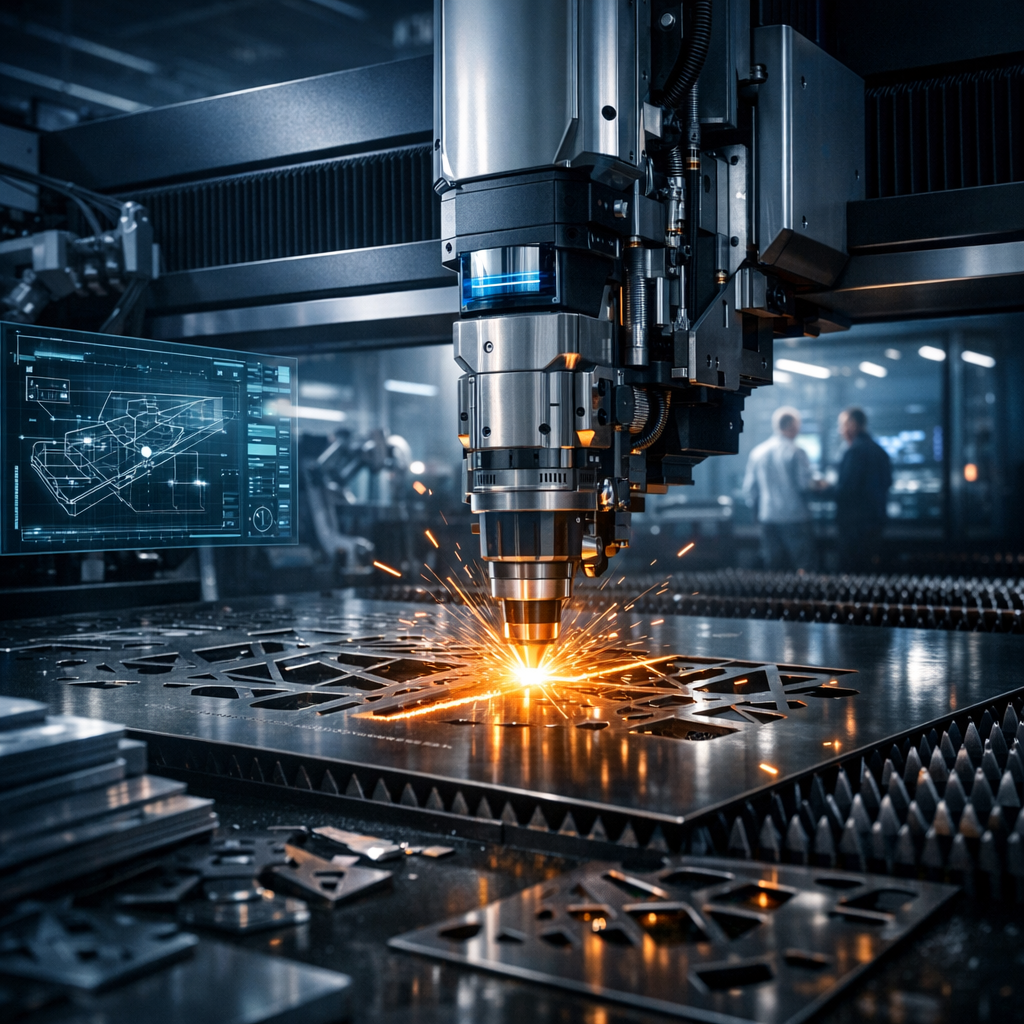
Laser cutting is a precise, noncontact fabrication method that uses a focused laser beam directed by CNC software to cut or engrave metals, plastics, wood, and composites along a programmed path. This technology is redefining how manufacturers approach precision, efficiency, and scalability across virtually every industrial sector.
This guide covers laser cutting fundamentals and system components, the primary laser technologies available, material performance across substrates, comparative advantages over traditional cutting methods, industry-specific applications, design and prototyping capabilities, quality and efficiency parameters, emerging innovations, sustainability benefits, and the role of vertically integrated fabrication.
Laser cutting systems consist of a resonator, beam delivery optics, CNC motion control, and assist gas supply, with AI-assisted platforms now making real-time corrections to cutting parameters based on cloud-based model databases. Four core technologies serve different needs: fiber lasers dominate metal processing for speed and energy efficiency, CO2 lasers excel on nonmetals like wood and acrylic, crystal lasers handle micro-machining applications, and direct diode systems offer compact, cost-effective alternatives with improving beam quality.
Material capabilities span carbon steel up to 80mm, stainless steel up to 60mm, aluminum up to 40mm, and non-metals up to 25mm, with assist gas selection directly determining edge quality. Compared to plasma, waterjet, and mechanical cutting, laser systems deliver tighter tolerances (±0.15 mm or better), minimal burrs, and narrower heat-affected zones while operating at roughly 50 percent lower cost.
Aerospace, automotive, medical device, and custom experiential fabrication industries each leverage laser precision differently, from flight-critical titanium components to micron-level surgical implants. CNC integration enables kerf widths between 0.1 and 0.3 mm with tolerances of ±0.1 mm, compressing prototyping cycles from weeks to hours.
Innovations in AI monitoring, high-power fiber systems, and green manufacturing practices are reducing energy consumption and waste generation. Vertically integrated fabricators capture the full return on investment by consolidating laser cutting, engineering, and finishing under one roof, eliminating vendor delays and maintaining quality from first cut to final assembly.
What Is Laser Cutting in Industrial Fabrication?
Laser cutting in industrial fabrication is a precise, noncontact method for cutting metal and other materials using a focused laser beam directed by CNC software. The subsections below explain how the process works and what components make up an industrial system.
How Does a Laser Cutter Actually Work?
A laser cutter works by focusing a high-energy laser beam onto a fine focal point on the workpiece surface, where concentrated heat melts or vaporizes the material along a CNC-programmed path. An assist gas, typically oxygen, nitrogen, or compressed air, blows molten material away from the kerf to produce clean, precise cuts.
The process is entirely noncontact, meaning no physical tooling touches the material. This eliminates mechanical wear and allows continuous cutting without tool changes. Modern high-power systems can cut metals up to 50mm thick and non-metals up to 25mm, depending on laser type and material properties. Because intense laser energy creates workplace hazards, OSHA standard 29 CFR 1910.132 requires a hazard assessment and selection of appropriate personal protective equipment for all laser operations.
What Are the Main Components of an Industrial Laser Cutting System?
The main components of an industrial laser cutting system are the laser source (resonator), beam delivery optics, cutting head with focus lens, CNC motion control system, assist gas supply, and material handling equipment.
Key system components include:
- Laser resonator: Generates the beam; fiber or CO2 sources are most common.
- Beam delivery optics: Fiber-optic cables or mirrors guide the beam to the cutting head.
- Cutting head: Houses the focusing lens and nozzle for assist gas delivery.
- CNC controller: Directs motion axes along the programmed cutting path.
- Assist gas system: Supplies oxygen, nitrogen, or air to clear molten material.
- Automated material handling: Loading and unloading systems that reduce labor requirements and increase throughput.
According to The Fabricator, AI-assisted cutting systems can now scan part edges to build a cloud-based model database, allowing machines to make real-time corrections to cutting parameters. This level of intelligence, combined with automated handling, represents why in-house laser cutting consistently improves ROI for fabricators willing to invest in complete systems.
Understanding these core components sets the stage for comparing the specific laser technologies available today.
What Are the Types of Laser Cutting Technologies Used in Fabrication?
The types of laser cutting technologies used in fabrication are CO2, fiber, crystal, and direct diode lasers. Each technology operates at different wavelengths and power levels, making them suited to specific materials and applications.
CO2 Laser Cutting
CO2 laser cutting uses a gas mixture (primarily carbon dioxide) to generate a beam at a 10.6 μm wavelength. This longer wavelength makes CO2 lasers ideal for processing nonmetals such as wood, acrylic, plastics, and textiles. The technology delivers smooth edge quality on organic materials and remains a reliable choice for engraving applications. However, CO2 systems require more maintenance due to their mirror-based beam delivery and consume more energy than solid-state alternatives when cutting metals. For fabricators working primarily with non-metallic substrates, CO2 remains the preferred solution.
Fiber Laser Cutting
Fiber laser cutting generates a beam through optical fibers doped with rare-earth elements, producing wavelengths near 1.06 μm. Fiber lasers dominate metal cutting applications due to their superior power and energy efficiency. According to OMTech, fiber lasers excel at metal processing while CO2 lasers remain better suited for nonmetals like wood and plastics.
Key advantages of fiber laser cutting include:
- Higher electrical efficiency (up to three times greater than CO2 systems)
- Faster cutting speeds on thin to medium-gauge metals
- Lower maintenance costs with no mirrors or gas refills required
- Positive return on investment through increased throughput and reduced material waste
High-power fiber laser systems can cost upwards of $500,000, but the throughput gains and labor reductions justify the investment for high-volume operations. For most metal fabrication shops processing steel, aluminum, or copper alloys, fiber technology delivers the strongest combination of speed, precision, and operating cost savings.
Crystal Laser Cutting
Crystal laser cutting uses solid-state crystals, typically Nd:YAG (neodymium-doped yttrium aluminum garnet) or Nd:YVO4, to produce beams at 1.064 μm wavelength. This technology cuts both metals and nonmetals effectively, offering higher peak power than CO2 systems. Crystal lasers are particularly valued for micro-machining, marking, and applications requiring extremely fine beam focus. The primary trade-off is shorter component lifespan; pump diodes in crystal systems degrade faster than fiber laser components, increasing long-term maintenance costs for continuous-production environments.
Direct Diode Laser Cutting
Direct diode laser cutting converts electrical energy directly into laser light using semiconductor diodes, eliminating intermediate gain stages. According to SPIE Digital Library research, direct diode lasers with power levels of 4 to 6 kW achieve a Beam Parameter Product in the range of 4 mm-mrad, comparable to fiber and CO2 sources.
GaAs-based broad-area laser diodes operating in the 780 to 1060 nm wavelength range continue advancing in both power output and wall-plug efficiency. These characteristics make direct diode systems attractive for:
- High-efficiency welding and cladding applications
- Surface treatment and heat processing
- Compact system designs with smaller footprints
- Lower capital costs compared to equivalent-power fiber systems
Direct diode technology represents the newest entrant in industrial cutting, and as beam quality continues improving, it will likely capture more market share from established laser types.
With each technology offering distinct wavelength and material advantages, selecting the right laser type depends on the specific fabrication requirements at hand.
What Materials Can Laser Cutting Process in Industrial Applications?
Laser cutting can process metals, plastics, wood, and composite materials across a wide range of thicknesses. ISO 11553-1:2020 specifies safety requirements for laser processing machines, ensuring regulatory conformity across all material types. The following sections detail performance on specific material categories.
How Does Laser Cutting Perform on Steel and Stainless Steel?
Laser cutting performs on steel and stainless steel with exceptional thickness capacity and edge quality, making these the most common materials processed industrially. According to GoldMark Power, high-power fiber lasers can cut carbon steel up to 80mm and stainless steel up to 60mm thick. For standard fiber laser systems, the carbon steel thickness limit is approximately 1 inch, while brass is limited to about 5/8 inch.
Assist gas selection determines the final edge quality for each steel type:
- Oxygen is used for carbon steel to provide additional exothermic heat, increasing cutting speed on thicker sections.
- Nitrogen is used for stainless steel to prevent oxidation and ensure a clean, oxide-free edge.
This gas-material pairing is one of the most overlooked factors in achieving production-ready cuts without secondary finishing.
How Does Laser Cutting Perform on Aluminum and Non-Ferrous Metals?
Laser cutting performs on aluminum and non-ferrous metals effectively, though these materials present unique challenges due to their high reflectivity and thermal conductivity. High-power fiber lasers can cut aluminum up to 40mm thick. Non-ferrous metals such as copper, brass, and titanium require higher power densities because their reflective surfaces redirect laser energy away from the cut zone.
Fiber lasers in the 1μm wavelength range absorb more efficiently into these materials compared to CO2 lasers, which is why fiber technology has largely replaced CO2 for non-ferrous metal processing. For fabricators working with aluminum regularly, investing in anti-reflective optics and adaptive power control yields noticeably better consistency.
How Does Laser Cutting Perform on Acrylic and Plastics?
Laser cutting performs on acrylic and plastics with flame-polished edges that require no secondary finishing. CO2 lasers are the preferred technology for these materials because their 10.6μm wavelength absorbs efficiently into organic polymers. Acrylic produces the cleanest results, with optically clear edge quality directly from the laser.
Other processable plastics include:
- Polycarbonate
- Polyethylene (PE)
- Polypropylene (PP)
- Delrin (POM)
PVC and vinyl are notably excluded from laser processing because they release toxic chlorine gas when heated. Material selection requires careful evaluation of chemical composition to ensure operator safety and regulatory compliance.
How Does Laser Cutting Perform on Wood and Composite Materials?
Laser cutting performs on wood and composite materials by vaporizing or burning material along a programmable path, producing intricate detail impossible with mechanical saws. CO2 lasers handle plywood, MDF, hardwoods, and engineered composites effectively at thicknesses up to 25mm.
Edge charring increases with material density and thickness, so optimizing speed-to-power ratios is critical for clean results. Composite materials like fiberglass and carbon fiber laminates require careful parameter tuning because mixed material layers absorb energy at different rates.
From a business perspective, 2025 market data from Arcus CNC indicates that laser cutting ROI can be calculated by evaluating net profit from increased revenue and savings on materials and labor. For shops processing diverse substrates, the ability to cut metals, plastics, and composites on a single platform significantly compresses lead times.
With material capabilities established, the advantages of laser cutting over traditional methods become clear.
What Are the Key Advantages of Laser Cutting Over Traditional Methods?
The key advantages of laser cutting over traditional methods include superior precision, faster processing speeds, and greater material versatility. Operating fiber laser systems costs 50 percent less than conventional approaches while eliminating the need for physical tooling. The sections below compare laser cutting directly against plasma, waterjet, and mechanical cutting.
How Does Laser Cutting Compare to Plasma Cutting for Precision?
Laser cutting compares to plasma cutting for precision by delivering significantly tighter tolerances and cleaner edge quality. Unlike plasma cutting, laser technology produces minimal burrs and a much narrower heat-affected zone, reducing the need for secondary processing. Plasma arcs generate wider kerf widths and rougher edges, making post-cut finishing almost unavoidable for close-tolerance work.
According to Allied Market Research, the global laser cutting machines market is projected to reach $13.3 billion by 2032 at a 9.9% CAGR, driven largely by aerospace and automotive adoption. This growth trajectory reflects how many manufacturers are transitioning away from plasma for precision-critical applications. For any fabrication shop still relying on plasma for detailed parts, the quality gap alone often justifies the switch.
How Does Laser Cutting Compare to Waterjet Cutting for Speed?
Laser cutting compares to waterjet cutting for speed by processing thin and medium-gauge materials substantially faster. Waterjet systems rely on a high-pressure abrasive stream that moves slowly through the material, while laser beams cut at rates several times higher on metals under 32 mm thick.
According to LaserBend, laser cutting excels at producing intricate shapes with tight tolerances of ±0.15 mm or better, while waterjet is preferred for materials over 32 mm thick. Waterjet does avoid thermal distortion entirely, which gives it an edge on heat-sensitive composites. However, for the vast majority of standard metal fabrication, laser cutting's speed advantage translates directly into higher throughput and lower per-part costs.
How Does Laser Cutting Compare to Mechanical Cutting for Versatility?
Laser cutting compares to mechanical cutting for versatility by handling complex geometries, thin profiles, and delicate materials that contact-based methods cannot match. Mechanical processes such as shearing, sawing, and punching require physical tool contact, which limits shape complexity and accelerates tool wear.
Laser systems cut intricate contours without tooling changeovers, switching between material types and thicknesses through CNC software adjustments alone. Green manufacturing processes like laser cutting also reduce energy consumption and waste generation while improving material utilization. Mechanical cutting still suits high-volume straight-line operations, but for mixed-part production runs requiring frequent design changes, laser technology offers unmatched flexibility.
With these comparative advantages established, the next section explores the industries benefiting most from laser cutting's transformation.
What Industries Are Being Transformed by Laser Cutting Technology?
Laser cutting technology is transforming aerospace, automotive, medical device production, and custom experiential fabrication. Each industry leverages the precision and speed of laser systems differently.
How Is Laser Cutting Used in Aerospace Fabrication?
Laser cutting is used in aerospace fabrication to produce lightweight structural components, engine parts, and heat shields that demand extreme dimensional accuracy. The process focuses a laser beam on a fine focal point while oxygen, nitrogen, or air blows molten material away, creating clean cuts with minimal thermal distortion. Aerospace-grade alloys like titanium and Inconel benefit from this noncontact approach because it preserves material integrity without introducing mechanical stress. For flight-critical parts where tolerances are measured in fractions of a millimeter, laser cutting remains one of the few processes capable of meeting both weight and safety requirements simultaneously.
How Is Laser Cutting Used in Automotive Manufacturing?
Laser cutting is used in automotive manufacturing to produce high-performance structural components, body panels, and safety-critical assemblies with repeatable precision. According to Hygrade Laser, automotive manufacturers rely on tube laser cutting for precision, cost efficiency, and high-performance components. Tube laser systems cut roll cages, chassis members, and exhaust components from tubular stock in a single operation, eliminating secondary processing steps. This capability allows engineers to reduce vehicle weight without compromising structural strength. For high-volume production lines, the speed and consistency of laser cutting help manufacturers meet tight delivery schedules while maintaining quality across thousands of identical parts.
How Is Laser Cutting Used in Medical Device Production?
Laser cutting is used in medical device production to manufacture implants, surgical instruments, and vascular components requiring micron-level accuracy. According to MassDevice, "laser micromachining is one of the highest-precision processes utilized in medical device manufacturing," often being the only viable option for complex components. The technology delivers precise, burr-free parts for stents, catheter tips, and orthopedic implants, helping manufacturers move seamlessly from prototyping to full-scale production. Because these devices interact directly with human tissue, the clean edge quality and tight tolerances that laser cutting provides are not merely preferred; they are essential for regulatory compliance and patient safety.
How Is Laser Cutting Used in Custom and Experiential Fabrication?
Laser cutting is used in custom and experiential fabrication to produce one-of-a-kind structural elements, branded environments, and interactive installations that demand both visual precision and structural integrity. Experiential builds often require complex geometries cut from aluminum, steel, and specialty materials, all fabricated to exact specifications within compressed timelines. The noncontact nature of laser cutting allows fabricators to work with finished or coated surfaces without causing damage, which is critical for display-quality components. For companies building mobile marketing vehicles, trade show exhibits, or immersive brand experiences, laser cutting enables rapid iteration from concept to finished asset.
With industry applications this diverse, understanding the design capabilities laser cutting enables reveals how fabricators translate complex concepts into production-ready components.
What Design Capabilities Does Laser Cutting Enable?
Laser cutting enables intricate designs, complex geometries, and rapid prototyping through CNC-driven precision. The following subsections cover how this technology handles tight tolerances and accelerates production workflows.
How Does Laser Cutting Handle Complex Geometries and Tight Tolerances?
Laser cutting handles complex geometries and tight tolerances by producing kerf widths typically between 0.1 and 0.3 mm, allowing designers to nest intricate shapes with minimal material waste. According to Komacut's guide to designing laser cut parts, these narrow kerf widths must be factored into part nesting strategies to optimize sheet utilization.
This precision makes features like internal cutouts, sharp corners, and fine lattice patterns achievable without secondary tooling. For fabricators working on custom or experiential builds, the ability to cut complex profiles in a single pass eliminates manual finishing steps that slow production timelines.
How Does CNC Integration Accelerate Prototyping and Production?
CNC integration accelerates prototyping and production by enabling tolerances in the range of ±0.1 mm, which allows parts to be iterated quickly during concept development. According to Yicen Precision's laser tube cutting guide, this level of accuracy supports rapid prototyping where design changes translate directly from CAD files to finished components without retooling.
Digital file-to-cut workflows eliminate the lead times associated with physical dies or fixtures. Engineers can test multiple design iterations in hours rather than weeks, compressing development cycles significantly. For complex industrial projects requiring precision across hundreds of unique parts, CNC-driven laser cutting provides the repeatability needed to scale from prototype to full production.
With design flexibility established, understanding quality and efficiency factors ensures these capabilities translate into consistent real-world results.
What Factors Affect Laser Cutting Quality and Efficiency?
Laser cutting quality and efficiency depend on material thickness, cutting speed, and assist gas selection. Each factor influences edge finish, dimensional accuracy, and production throughput.
How Does Material Thickness Influence Laser Cutting Performance?
Material thickness influences laser cutting performance by determining the required power output, feed rate, and focal depth needed to achieve a clean through-cut. Thicker materials demand slower speeds and higher wattage, which increases heat input and can widen the heat-affected zone.
According to IvyCNC, modern laser cutters can handle thicknesses up to 50mm for metals and 25mm for non-metals, depending on laser type and material selection. Beyond these thresholds, edge quality degrades as the beam struggles to maintain focus through the full material depth. For fabricators handling diverse substrates, matching laser power to material thickness remains the single most important parameter for consistent results.
How Does Cutting Speed Impact Edge Quality and Accuracy?
Cutting speed impacts edge quality and accuracy by controlling how much thermal energy the material absorbs per unit length. Too fast, and the beam fails to fully penetrate, leaving dross and incomplete cuts. Too slow, and excessive heat accumulates, causing wider kerf, burn marks, and warped edges.
Optimal speed settings balance throughput against finish quality. Thinner gauge materials tolerate higher speeds while maintaining smooth edges, whereas thicker sections require reduced feed rates to prevent striations. In practice, dialing in speed for each material and thickness combination is where experienced operators add the most value to a fabrication program.
How Does Assist Gas Selection Affect the Final Cut?
Assist gas selection affects the final cut by determining oxidation levels, edge cleanliness, and cutting speed for a given material. According to Xometry, oxygen is typically used for carbon steel to provide additional exothermic heat that accelerates cutting, while nitrogen is used for stainless steel to prevent oxidation and ensure a clean, silver edge.
- Oxygen increases cutting speed on mild steel but produces an oxide layer on the cut face.
- Nitrogen delivers oxide-free edges ideal for stainless steel and aluminum, though at reduced speeds.
- Compressed air offers a lower-cost alternative for thin materials where edge finish is less critical.
Choosing the wrong gas leads to discolored edges, additional post-processing, or wasted material, making this a decision that directly impacts both quality and cost per part.
With quality parameters defined, emerging innovations are pushing these performance boundaries even further.
What Are the Latest Innovations Advancing Laser Cutting Technology?
The latest innovations advancing laser cutting technology include AI-assisted cutting systems, high-power fiber lasers, and automation platforms that collectively improve precision, throughput, and sustainability.
AI-assisted cutting systems can now scan part edges to build a cloud-based model database, allowing the machine to sample from accumulated learning and make real-time corrections to cutting parameters, according to The Fabricator. This closed-loop intelligence eliminates manual trial-and-error adjustments that once slowed production changeovers. Combined with advances in fiber laser power output and automated material handling, these systems represent a significant leap in autonomous fabrication capability.
Innovations in fiber lasers, automation, and green technology are also enhancing efficiency while reducing the carbon footprint of laser-cutting machines. For fabricators evaluating next-generation equipment, AI integration offers the clearest competitive advantage because it compounds productivity gains over time as the system's model database grows.
With these innovations reshaping what laser systems can achieve, sustainability practices represent the next frontier for responsible adoption.
How Does Laser Cutting Support Sustainable Manufacturing Practices?
Laser cutting supports sustainable manufacturing practices by reducing material waste, lowering energy consumption, and minimizing the need for secondary processing. These efficiency gains translate directly into a smaller environmental footprint across production operations.
Precision nesting with kerf widths between 0.1–0.3 mm maximizes sheet utilization, meaning less raw material ends up as scrap. The noncontact cutting process eliminates tooling wear, removing the resource cycle of manufacturing, sharpening, and replacing physical cutting tools. Because laser cuts produce minimal burrs and narrow heat-affected zones, parts often require no finishing steps, which saves additional energy and chemical inputs.
According to a 2024 report published by OAE Publishing on green manufacturing in precision machining, processes such as laser cutting can significantly reduce energy consumption and waste generation while improving material utilization. Fiber lasers in particular amplify these benefits; their higher wall-plug efficiency converts more electrical input into usable cutting power compared to older CO2 systems.
- Narrow kerf widths reduce scrap material per sheet.
- Noncontact operation eliminates consumable tooling waste.
- Minimal heat-affected zones remove secondary finishing requirements.
- Higher electrical efficiency in fiber lasers lowers per-part energy costs.
- Automated nesting software optimizes material usage before cutting begins.
For manufacturers pursuing leaner operations, laser cutting represents one of the most measurable sustainability levers available, delivering environmental gains without sacrificing precision or throughput.
How Can Vertically Integrated Fabrication Maximize Laser Cutting Benefits?
Vertically integrated fabrication maximizes laser cutting benefits by consolidating design, cutting, finishing, and assembly under one roof. This eliminates handoff delays and quality inconsistencies between vendors. The sections below cover in-house turnaround advantages and key takeaways on laser cutting's role in modern fabrication.
Can Custom Industrial Fabrication With In-House Laser Cutting Deliver Faster Turnaround?
Yes, custom industrial fabrication with in-house laser cutting can deliver faster turnaround. When a single facility controls programming, cutting, welding, and finishing, projects avoid the multi-vendor scheduling gaps that typically add days or weeks. According to a report published by MDPI's Applied Sciences journal, industrial laser cutting relies on the focused energy of a laser as a heat source for melting the workpiece, with heat transfer playing a critical role in overall performance. Optimizing that heat transfer in-house, without outsourcing, allows fabricators to adjust parameters in real time and move parts immediately to the next production stage.
Craftsmen Industries operates from a 127,000 sq. ft. vertically integrated facility where laser cutting, engineering, and finishing happen under one roof. This structure compresses timelines from ideation to creation, delivering completed assets on schedule.
What Are the Key Takeaways About How Laser Cutting Is Transforming Modern Industrial Fabrication?
The key takeaways about how laser cutting is transforming modern industrial fabrication are:
- Laser cutting delivers precision tolerances, minimal heat-affected zones, and intricate geometry capabilities that traditional mechanical methods cannot match.
- Fiber laser technology dominates metal cutting for speed and energy efficiency, while AI-assisted systems enable real-time parameter corrections.
- Material versatility spans carbon steel, stainless steel, aluminum, plastics, and composites across thickness ranges suited to each laser type.
- Sustainability gains come from reduced waste, lower energy consumption, and improved material utilization compared to conventional processes.
- Vertically integrated fabricators capture the full ROI of laser cutting by eliminating vendor markups, reducing lead times, and maintaining quality control from first cut to final assembly.
For manufacturers seeking these advantages without managing multiple suppliers, Craftsmen Industries combines in-house laser cutting with full-service design, engineering, and production capabilities.