
19 min read
How Do You Properly Clean a Medical Trailer?
Craftsmen Industries May 13, 2026 12:54:04 PM
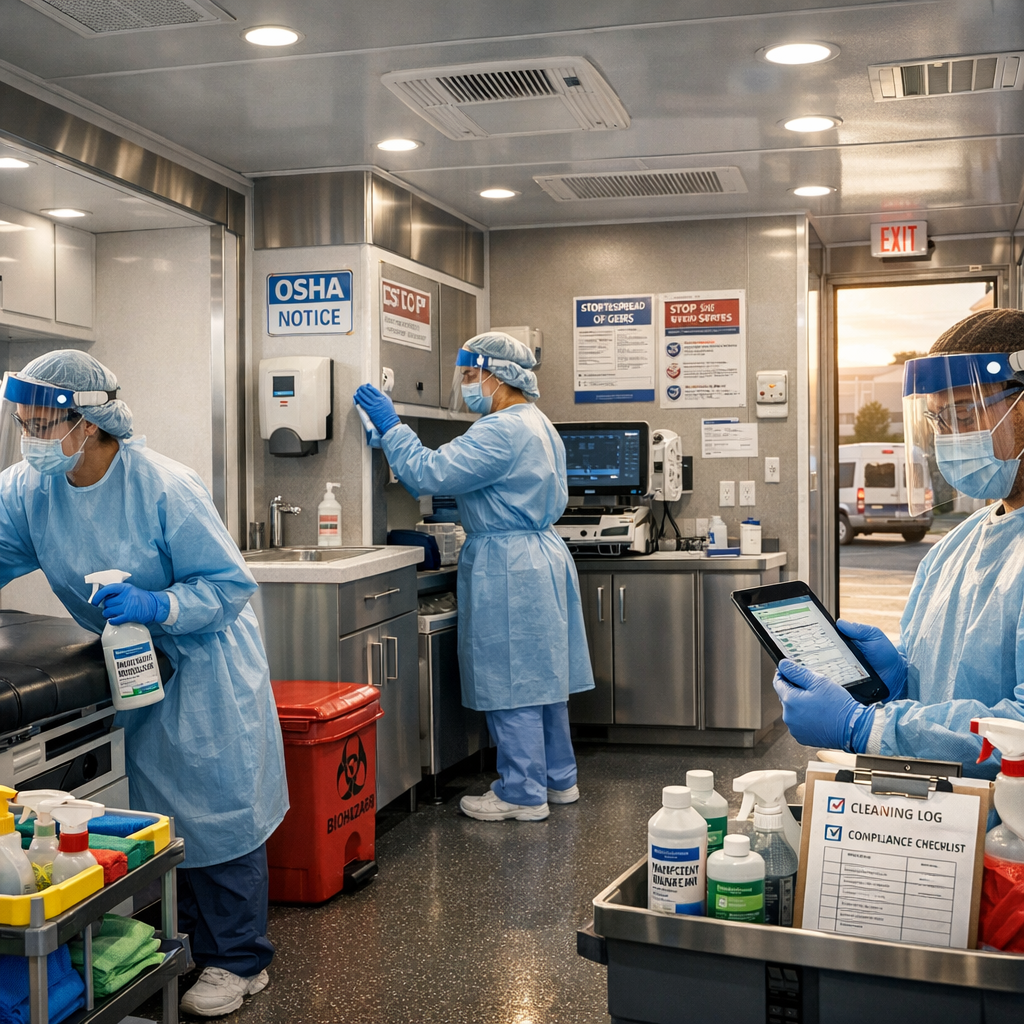
Cleaning a medical trailer is the process of disinfecting, decontaminating, and maintaining a mobile healthcare environment to meet the same clinical hygiene standards required of permanent medical facilities.
This guide covers regulatory compliance, zone-specific cleaning methods, product selection, step-by-step deep cleaning protocols, cleaning frequency, common mistakes, environmental factors, exterior biosecurity, and design considerations that affect long-term sanitation efficiency.
Medical trailers operate under overlapping regulatory frameworks, including OSHA bloodborne pathogen rules, CDC disinfection guidelines, state health department inspection criteria, and HIPAA physical safeguards. Each framework dictates specific cleaning procedures, chemical handling requirements, and documentation obligations that standard vehicle maintenance never involves.
Every clinical zone inside a medical trailer requires targeted disinfection methods. Patient examination areas, laboratory equipment surfaces, pharmaceutical storage spaces, HVAC filtration systems, and waste disposal compartments each demand distinct protocols, products, and cleaning frequencies to prevent cross-contamination in a confined mobile space.
Selecting the right EPA-registered hospital disinfectants depends on surface material, equipment sensitivity, and interior finishes like vinyl and composite walls. Using incompatible products degrades trailer surfaces, compromises diagnostic equipment, or leaves residues that threaten patient safety.
Cleaning frequency operates on multiple intervals: between every patient visit, at the end of each service day, on a recurring deep-clean schedule, and immediately after any infectious exposure event. Each interval serves a specific infection control function.
Environmental conditions at deployment sites, including humidity levels, temperature extremes, and dust infiltration, alter disinfectant performance and introduce contaminants that fixed facilities rarely encounter. Protocols must account for these variables at every location.
Purpose-built trailer design directly reduces cleaning burden. Non-porous surfaces, coved flooring transitions, recessed cabinetry, and integrated waste compartments engineered during fabrication make daily sanitation faster, more consistent, and easier to sustain across deployments.
Why Is Cleaning a Medical Trailer Different From Cleaning Standard Trailers?
Cleaning a medical trailer is different from cleaning standard trailers because medical trailers function as healthcare environments, requiring infection control protocols, regulatory compliance, and specialized disinfection methods that standard cargo or transport trailers never demand.
Standard trailers typically need basic sweeping, washing, and cosmetic upkeep. Medical trailers, by contrast, must meet the same sanitation standards as brick-and-mortar clinical facilities while operating in mobile, often unpredictable environments. Every surface that contacts patients, biological samples, or pharmaceutical supplies requires hospital-grade disinfection rather than general-purpose cleaning.
The regulatory burden alone sets medical trailers apart. OSHA mandates specific handling procedures for regulated waste, including contaminated sharps and materials caked with dried blood. CDC infection prevention guidelines apply to all settings where healthcare is delivered, regardless of whether that setting is a permanent building or a trailer parked at a disaster relief site. These requirements introduce documentation, training, and chemical handling obligations that do not exist for standard trailer maintenance.
Material considerations also differ significantly. Medical trailers contain non-porous clinical surfaces, sensitive diagnostic equipment, and pharmaceutical storage zones that react poorly to conventional cleaning agents. Using the wrong product can degrade interior composites, compromise equipment calibration, or leave chemical residues that interfere with patient safety.
According to A 360 Cleaning, proper cleaning supports HIPAA compliance by ensuring a medical facility remains a clean and organized environment; while HIPAA is often associated with digital security and administrative policies, physical cleaning practices play a vital role in compliance. This connection between physical sanitation and patient privacy regulations simply does not apply to standard trailers.
The mobile nature of medical trailers introduces additional complexity. Exposure to varying climates, road dust, and deployment in remote locations means cleaning protocols must account for environmental contamination that fixed facilities rarely face. For organizations operating custom mobile medical units, understanding these distinctions is the foundation of every cleaning decision that follows.
What Regulations and Standards Apply to Cleaning Medical Trailers?
The regulations and standards that apply to cleaning medical trailers include OSHA bloodborne pathogen rules, CDC disinfection guidelines, state health department inspection requirements, and HIPAA physical safeguards. Each framework shapes specific cleaning protocols.
What Does OSHA Require for Medical Trailer Sanitation?
OSHA requires medical trailer sanitation to follow the Bloodborne Pathogens Standard (29 CFR 1910.1030), which mandates strict handling of regulated waste and contaminated surfaces. Key OSHA requirements for medical trailer cleaning include:
- Decontaminating work surfaces after contact with blood or other potentially infectious materials.
- Using appropriate personal protective equipment during all cleaning tasks.
- Disposing of regulated waste, including contaminated sharps and pathological materials, in labeled, leak-proof containers.
- Maintaining a written exposure control plan that covers cleaning schedules and methods.
- Training all employees who perform cleaning duties on hazard recognition and safe procedures.
OSHA also enforces the Hazard Communication Standard (29 CFR 1910.1200), which requires safety data sheets and proper labeling for every chemical cleaning product used inside the trailer. Overlooking these documentation requirements is one of the most common compliance gaps in mobile medical settings.
What Are the CDC Guidelines for Disinfecting Mobile Medical Units?
The CDC guidelines for disinfecting mobile medical units follow the same core infection prevention framework applied to all healthcare settings. The CDC recommends using EPA-registered hospital disinfectants on noncritical surfaces, following each product's label instructions for contact time and safety precautions.
What makes mobile medical units uniquely challenging is the regulatory patchwork at the state level. According to a review by Mission Mobile Medical, at least 20 states have enacted rules or laws affecting mobile medical program operations, while the majority of states still do not address mobile medical units to any noticeable extent in existing codes.
This inconsistency means operators cannot rely on a single national standard. Instead, they must cross-reference CDC disinfection protocols with whatever state-specific rules apply at each deployment location.
How Do State Health Department Inspections Affect Cleaning Protocols?
State health department inspections affect cleaning protocols by establishing enforceable standards that medical trailer operators must meet at each deployment site. These inspections typically evaluate:
- Surface disinfection practices and documentation logs.
- Waste disposal procedures for biohazardous materials.
- Storage conditions for sterile supplies and pharmaceuticals.
- HVAC filtration and air quality maintenance records.
- Staff training documentation for infection control procedures.
Because inspection criteria vary by state, operators deploying across multiple jurisdictions should maintain cleaning protocols that meet the most stringent requirements they are likely to encounter. Building to the highest common standard eliminates last-minute scrambles before inspections and reduces the risk of citations that could suspend operations.
What Does HIPAA Compliance Have to Do With Cleaning Procedures?
HIPAA compliance has a direct connection to cleaning procedures because physical cleaning practices protect patient information in tangible ways. According to A 360 Cleaning, proper cleaning supports HIPAA compliance by ensuring a medical facility maintains a clean and organized environment, and while HIPAA is often associated with digital security, physical cleaning plays a vital role.
In a medical trailer, HIPAA-relevant cleaning tasks include:
- Shredding or securely disposing of paper records found during cleaning.
- Wiping down screens and monitors where patient data may be visible.
- Clearing examination areas of any leftover patient documentation between visits.
- Restricting cleaning staff access to areas containing protected health information unless properly trained.
Disinfection and privacy protection overlap more than most operators realize. Every surface wipe-down is also an opportunity to verify that no protected health information has been left exposed, making cleaning staff an active part of the compliance chain.
Understanding these overlapping regulatory frameworks ensures medical trailers remain both clinically safe and legally compliant across every deployment.
What Are the Key Areas Inside a Medical Trailer That Require Cleaning?
The key areas inside a medical trailer that require cleaning include patient examination areas, laboratory and diagnostic zones, pharmaceutical storage spaces, waiting and reception areas, HVAC systems, and restroom compartments.
How Do You Clean Patient Examination Areas?
You clean patient examination areas by disinfecting all surfaces between each patient encounter. Examination tables, instrument trays, and counter surfaces require wiping with an EPA-registered hospital disinfectant after every use. Floors should be mopped with a clinical-grade solution, working from the cleanest zone toward the most contaminated. Disposable barriers on exam tables need replacement between patients. Light switches, drawer handles, and adjustable lamp arms are high-touch points that demand consistent attention. According to the CDC, adherence to infection prevention and control practices is essential to providing safe and high-quality patient care across all settings where healthcare is delivered. In a confined trailer environment, even a single missed surface can compromise the entire clinical space.
How Do You Clean Laboratory and Diagnostic Equipment Zones?
You clean laboratory and diagnostic equipment zones by following manufacturer specifications for each device while maintaining broader disinfection protocols for surrounding surfaces. Sensitive instruments like portable analyzers and imaging components often require lint-free wipes with approved, non-corrosive solutions. Countertops and specimen processing areas need decontamination with hospital-grade disinfectants after each use cycle. Spill containment should be immediate, using absorbent materials designed for biological fluids. Because mobile trailers experience vibration during transport, equipment calibration surfaces accumulate particulates faster than in fixed facilities, making pre- and post-transport cleaning essential for both hygiene and diagnostic accuracy.
How Do You Clean Pharmaceutical Storage and Dispensing Areas?
You clean pharmaceutical storage and dispensing areas by maintaining strict contamination controls that protect medication integrity. Key steps include:
- Wiping shelving, countertops, and dispensing surfaces with non-residue disinfectants daily.
- Inspecting refrigeration units for spills or condensation that could compromise stored medications.
- Cleaning dispensing trays and counting tools between medication types to prevent cross-contamination.
- Verifying that temperature-controlled zones remain within specified ranges after cleaning.
Residue from harsh chemicals can degrade pharmaceutical packaging or alter medication stability, so product selection matters. Only solutions compatible with both the trailer's interior materials and stored pharmaceuticals should be used in these zones.
How Do You Clean Waiting and Reception Spaces?
You clean waiting and reception spaces by disinfecting all shared surfaces, seating, and check-in areas at regular intervals throughout the day. Chairs, armrests, reception counters, and sign-in devices are high-touch points requiring frequent attention. Floors should be swept and mopped with a hospital-grade cleaner. Printed materials like pamphlets, often handled by multiple patients, should be replaced or eliminated in favor of digital alternatives. Trash receptacles need emptying and sanitizing before they reach capacity. Though waiting areas carry lower clinical risk than exam rooms, they serve as the first line of defense against pathogen transmission between incoming patients in a compact trailer environment.
How Do You Clean HVAC Vents and Air Filtration Systems?
You clean HVAC vents and air filtration systems by inspecting, vacuuming, and replacing filters on a scheduled basis appropriate to the trailer's deployment frequency. Vent covers should be removed and wiped with a disinfectant solution to eliminate dust and microbial buildup. HEPA or MERV-rated filters, common in medical trailers, need replacement according to manufacturer timelines, though dusty deployment locations may demand shorter intervals. Return air grilles accumulate contaminants quickly in enclosed mobile spaces, making them a priority. Neglected air systems circulate pathogens and particulates throughout every clinical zone, effectively undermining all surface-level disinfection efforts performed elsewhere in the trailer.
How Do You Clean Restroom and Waste Disposal Compartments?
You clean restroom and waste disposal compartments by applying terminal-level disinfection protocols to every surface, fixture, and waste receptacle. Toilets, sinks, faucet handles, and door hardware require hospital-grade disinfectant applied at the manufacturer's recommended contact time. Sharps containers and regulated waste bins must be handled according to OSHA standards. As defined by OSHA, regulated waste includes liquid or semi-liquid blood, contaminated items that would release infectious materials if compressed, items caked with dried blood, contaminated sharps, and pathological wastes containing blood. Floor drains should be flushed and disinfected to prevent biofilm accumulation. Given the limited ventilation in trailer restrooms, proper airflow during and after cleaning prevents chemical vapor buildup and supports a safe environment for both staff and patients.
With each interior zone addressed, the right cleaning products ensure these protocols deliver consistent results.
What Cleaning Products and Disinfectants Should You Use in a Medical Trailer?
You should use EPA-registered, hospital-grade disinfectants in a medical trailer. The subsections below cover approved disinfectants, surface-specific cleaners, equipment-safe products, and chemicals to avoid on interior finishes.
Which EPA-Registered Disinfectants Are Approved for Medical Settings?
EPA-registered disinfectants approved for medical settings are products that carry an EPA registration number and specific healthcare-use claims on their labels. These include quaternary ammonium compounds, sodium hypochlorite solutions, hydrogen peroxide-based formulas, and phenolic disinfectants. Each product must list its approved contact time, target pathogens, and compatible surfaces directly on the label.
For medical trailers, selecting a disinfectant with broad-spectrum efficacy against bacteria, viruses, and fungi is critical. Always verify the EPA registration number before purchasing, as unregistered products lack validated kill claims. In practice, quaternary ammonium compounds tend to be the most versatile choice for mobile medical environments because they combine effective disinfection with relatively low corrosivity on common trailer materials.
What Hospital-Grade Cleaners Work Best on Non-Porous Trailer Surfaces?
Hospital-grade cleaners that work best on non-porous trailer surfaces are products formulated for hard, sealed materials such as stainless steel, laminate countertops, and sealed composite panels. Effective options include:
- Quaternary ammonium wipes designed for non-porous clinical surfaces.
- Hydrogen peroxide-based spray cleaners rated for hard surface disinfection.
- Bleach-based solutions diluted to manufacturer specifications for countertop use.
Non-porous surfaces in medical trailers resist moisture absorption, which makes them ideal for wet-application disinfectants. However, residue buildup from repeated cleaning can dull finishes over time. Rinsing surfaces after disinfectant contact time expires helps preserve material integrity without compromising sanitation.
Which Products Are Safe for Sensitive Medical Equipment?
Products safe for sensitive medical equipment are alcohol-based wipes (typically 70% isopropyl alcohol), manufacturer-approved cleaning solutions, and low-residue disinfectants specifically labeled for use on electronic and diagnostic devices. Harsh chemicals like bleach or ammonia-based cleaners can damage screens, sensors, and protective coatings on medical instruments.
According to OSHA's Hazard Communication Standard (29 CFR 1910.1200), employers must maintain safety data sheets for all cleaning chemicals and train employees on their proper use, including which products are compatible with specific equipment. Always consult the equipment manufacturer's instructions for cleaning before applying any disinfectant; using an unapproved product can void warranties and compromise diagnostic accuracy.
What Should You Avoid Using on Vinyl and Composite Interior Walls?
You should avoid using abrasive cleaners, undiluted bleach, solvent-based products, and ammonia-heavy formulas on vinyl and composite interior walls. These chemicals cause:
- Discoloration and fading from harsh oxidizers like concentrated sodium hypochlorite.
- Surface cracking from solvent-based degreasers that strip protective coatings.
- Material warping from ammonia solutions that weaken adhesive bonds in composite panels.
Vinyl and composite materials are common in medical trailers because they resist moisture and simplify sanitation. To protect these surfaces, use pH-neutral, non-abrasive hospital-grade cleaners applied with soft microfiber cloths. Avoid steel wool, scouring pads, or any tool that could scratch the finish, since scratches create micro-harbors for pathogens.
Choosing the right products for each surface sets the foundation for an effective step-by-step deep cleaning process.
What Is the Step-by-Step Process for Deep Cleaning a Medical Trailer?
The step-by-step process for deep cleaning a medical trailer follows a structured sequence: preparation, surface decontamination, floor sanitization, high-touch disinfection, biohazard waste handling, and final verification.
How Do You Prepare the Trailer Before Deep Cleaning Begins?
You prepare the trailer before deep cleaning begins by completing a series of pre-cleaning tasks that establish a safe, organized workspace. Proper preparation prevents cross-contamination and ensures cleaning agents perform effectively.
Key preparation steps include:
- Powering down and unplugging all non-essential medical equipment.
- Removing disposable items, soiled linens, and loose waste from every surface.
- Donning appropriate personal protective equipment, including gloves, gowns, eye protection, and masks.
- Ventilating the trailer by opening vents or activating the HVAC system to promote airflow.
- Staging all EPA-registered disinfectants, mops, microfiber cloths, and waste containers in an accessible area.
- Reviewing the cleaning checklist and safety data sheets for every product being used.
Completing these steps before any disinfectant touches a surface ensures the deep cleaning process starts from a controlled baseline.
How Do You Perform Surface Decontamination on Clinical Areas?
You perform surface decontamination on clinical areas by cleaning all examination tables, countertops, and equipment surfaces using a two-step method. First, remove visible soil and organic matter with a detergent solution. Then apply an EPA-registered hospital disinfectant, allowing full wet contact time as directed on the product label.
Work from the cleanest zones toward the most contaminated to avoid spreading pathogens. Wipe in one direction rather than circular motions, and use a fresh microfiber cloth for each distinct surface grouping. For mobile medical environments, where space is compact and surfaces sit closer together, this disciplined approach is especially critical to prevent adjacent-surface recontamination.
How Do You Sanitize Flooring in a Mobile Medical Environment?
You sanitize flooring in a mobile medical environment by starting at the farthest point from the trailer entrance and working toward the door. This pattern prevents stepping on freshly cleaned areas.
The recommended flooring sanitization sequence is:
- Sweep or vacuum the floor to remove loose debris, dust, and particulates.
- Mop with a hospital-grade disinfectant solution, using a single-pass technique to avoid redistributing contaminants.
- Allow the disinfectant to remain wet on the floor for the full manufacturer-specified contact time.
- Replace mop heads between distinct zones to avoid cross-contamination between clinical and non-clinical areas.
- Inspect seams and edges where flooring meets walls, since moisture and biofilm accumulate in these junctions.
Vinyl and composite flooring common in medical trailers can trap residues at seam joints, making edge cleaning a step operators should never skip.
How Do You Disinfect High-Touch Points and Fixtures?
You disinfect high-touch points and fixtures by targeting every surface patients and staff contact frequently. These areas harbor the highest microbial loads and require dedicated attention during each deep cleaning cycle.
Priority high-touch surfaces include:
- Door handles, push plates, and latches.
- Light switches and electrical outlet covers.
- Cabinet pulls, drawer handles, and supply cart rails.
- Handrails, grab bars, and step assists at entry points.
- Touchscreen displays, keyboards, and diagnostic device interfaces.
- Faucet handles, soap dispensers, and paper towel dispensers.
Apply disinfectant with a saturated wipe, ensuring the surface remains visibly wet for the required contact time. For sensitive electronic fixtures, use manufacturer-approved disinfecting wipes to avoid damage to screens and circuitry.
How Do You Address Biohazard and Sharps Waste During Cleaning?
You address biohazard and sharps waste during cleaning by following strict containment and disposal protocols aligned with federal standards. According to OSHA's Bloodborne Pathogens Standard (29 CFR 1910.1030), regulated waste includes liquid or semi-liquid blood, items caked with dried blood capable of releasing infectious materials during handling, contaminated sharps, and pathological or microbiological wastes containing blood or other potentially infectious materials.
Essential handling procedures include:
- Collecting all sharps in puncture-resistant, labeled sharps containers before any surface cleaning begins.
- Placing biohazardous soft waste into red-bagged, leak-proof containers marked with the universal biohazard symbol.
- Never compressing waste bags, since compression can release infectious liquids.
- Arranging pickup or transport through a licensed medical waste hauler.
Treating waste removal as the first containment step, before wiping down surrounding surfaces, reduces exposure risk for the cleaning team.
How Do You Verify Cleaning Effectiveness After Completion?
You verify cleaning effectiveness after completion by conducting a structured post-cleaning inspection that confirms every zone meets clinical hygiene standards. Visual inspection alone is insufficient for medical environments.
Effective verification methods include:
- Performing ATP bioluminescence testing on high-touch surfaces to measure residual organic matter with quantifiable readings.
- Using fluorescent marking gel before cleaning to confirm staff properly wiped targeted surfaces during the process.
- Completing a room-by-room checklist that documents each surface, the disinfectant used, and the contact time achieved.
- Logging all results in a cleaning verification record for regulatory audits and internal quality reviews.
Documentation transforms a cleaning routine into a defensible compliance record, which matters during state health department inspections or accreditation reviews. With verified results in hand, operators can confidently move into routine maintenance scheduling.
How Often Should You Clean a Medical Trailer?
You should clean a medical trailer at multiple intervals: between every patient visit, at the end of each service day, on a recurring deep-clean schedule, and immediately after any infectious exposure.
How Often Should You Clean Between Patient Visits?
You should clean between patient visits every single time a patient exits the trailer. This point-of-care cleaning targets all surfaces the patient contacted, including exam tables, armrests, countertops, and any diagnostic equipment used during the encounter. According to the CDC, adherence to infection prevention and control practices is essential to providing safe, high-quality patient care across all settings where healthcare is delivered. Wiping high-touch surfaces with an EPA-registered disinfectant and allowing proper contact time prevents cross-contamination before the next patient enters. Skipping even one between-visit wipe-down compounds risk across every subsequent appointment that day.
How Often Should You Perform End-of-Day Terminal Cleaning?
You should perform end-of-day terminal cleaning after the last patient is seen each operational day. Terminal cleaning goes beyond between-visit wipe-downs by addressing every surface in the trailer, including floors, walls, light switches, door handles, sinks, and equipment housings. This process resets the entire environment to a baseline sanitary state overnight.
Key tasks in a terminal cleaning session include:
- Mopping all flooring with a hospital-grade disinfectant solution.
- Disinfecting every high-touch fixture, from cabinet pulls to IV poles.
- Emptying and sanitizing waste receptacles and sharps containers.
- Inspecting HVAC vents for visible contamination or dust accumulation.
Terminal cleaning is the single most important daily defense against pathogen buildup in a confined mobile environment.
How Often Should You Schedule Full Deep Cleaning Sessions?
You should schedule full deep cleaning sessions at least once per month, with more frequent sessions warranted during high-volume deployments or multi-site rotations. Deep cleaning differs from terminal cleaning in scope: it includes moving equipment to clean behind and beneath units, scrubbing grout lines, inspecting seals and gaskets for mold, and servicing air filtration systems.
For trailers deployed to rural or high-dust locations, biweekly deep cleaning sessions are a more practical standard. Facilities that treat higher-acuity patients or perform invasive procedures should also increase frequency. Documenting each deep cleaning session with dates, personnel, and products used supports regulatory compliance during state health department inspections.
How Often Should You Clean After Known Infectious Exposure?
You should clean after known infectious exposure immediately, before any other patient enters the trailer. Infectious exposure cleaning is an unscheduled, event-driven protocol triggered whenever a patient presents with or is confirmed to have a communicable disease, or when a blood or body fluid spill occurs.
This response requires:
- Isolating the contaminated zone and restricting access.
- Donning appropriate personal protective equipment before re-entering.
- Applying an EPA-registered disinfectant with demonstrated efficacy against the specific pathogen.
- Disposing of all regulated waste, including contaminated sharps and materials caked with dried blood, in compliance with OSHA's Bloodborne Pathogens Standard.
- Documenting the incident, cleaning actions taken, and products used.
No fixed calendar governs this frequency; the trigger is the exposure event itself. Treating post-exposure cleaning as non-negotiable protects both patients and clinical staff operating within the trailer's confined space.
What Are Common Cleaning Mistakes to Avoid in Medical Trailers?
Common cleaning mistakes to avoid in medical trailers include skipping proper disinfectant contact times, using non-approved cleaning agents, neglecting high-touch surfaces, and failing to document sanitation procedures.
- Ignoring manufacturer contact times. Some EPA-registered hospital disinfectants require a label contact time of up to 10 minutes. Wiping surfaces dry before the required dwell period renders the disinfectant ineffective against pathogens. According to CDC disinfection and sterilization guidelines, scientific studies have demonstrated efficacy against pathogens with a contact time of at least 1 minute, yet users must follow all applicable label instructions on EPA-registered products by law.
- Using household cleaners instead of hospital-grade disinfectants. Standard consumer products lack the antimicrobial potency required for clinical environments. Only EPA-registered hospital disinfectants should contact patient care surfaces inside a mobile medical unit.
- Overlooking high-touch points between patients. Door handles, exam table rails, light switches, and equipment controls accumulate pathogens rapidly. Skipping these surfaces between visits creates cross-contamination pathways that routine end-of-day cleaning cannot correct.
- Neglecting HVAC vents and air filtration systems. Airborne contaminants settle on supply grilles and return vents. Without scheduled filter changes and vent cleaning, recirculated air reintroduces particulates into sterile zones.
- Failing to maintain cleaning logs. Undocumented sanitation creates compliance gaps during state health department inspections. Every cleaning cycle, product used, and staff member responsible should be recorded in a standardized log.
- Mixing incompatible chemicals. Combining bleach-based and ammonia-based products generates toxic fumes, particularly dangerous in a trailer's confined, low-volume airspace. Always consult safety data sheets before switching between product lines.
- Treating biohazard waste as general trash. Contaminated sharps, blood-soaked materials, and pathological waste require dedicated disposal containers and handling procedures that follow OSHA's bloodborne pathogen standard.
For operators managing mobile medical fleets, the most costly mistake is inconsistency. A single missed protocol step during a busy deployment can undo an otherwise thorough sanitation program, so building repeatable checklists tied to each cleaning frequency level is the most practical safeguard.
With cleaning protocols firmly established, environmental conditions at each deployment site introduce additional variables that affect how those protocols perform.
How Do Environmental Conditions Affect Medical Trailer Cleaning?
Environmental conditions affect medical trailer cleaning by altering disinfectant efficacy, degrading cleaning products, and introducing contaminants unique to deployment sites. The subsections below cover humidity, extreme temperatures, and dust.
How Does Humidity Impact Disinfectant Effectiveness in a Trailer?
Humidity impacts disinfectant effectiveness in a trailer by altering how chemical solutions interact with surfaces and how quickly they dry. High humidity slows evaporation, which can extend wet contact time beyond what product labels specify, potentially leaving residue that fosters microbial regrowth. Low humidity accelerates drying, often causing disinfectants to evaporate before achieving the minimum contact time required for pathogen elimination.
Since EPA-registered hospital disinfectants require strict adherence to label contact times by law, according to the CDC, uncontrolled humidity inside a trailer can render an otherwise compliant cleaning protocol ineffective. Monitoring interior relative humidity with a hygrometer and adjusting HVAC settings before disinfection helps maintain consistent results across varying climates.
How Do Extreme Temperatures Affect Cleaning Product Performance?
Extreme temperatures affect cleaning product performance by changing the chemical stability and activation rate of active ingredients. Freezing conditions can cause emulsions to separate, rendering certain disinfectants and detergents ineffective even after thawing. Excessive heat accelerates chemical degradation, shortening shelf life and reducing antimicrobial potency.
Most EPA-registered hospital disinfectants specify storage and application temperature ranges on their safety data sheets. Operating outside those ranges, common when medical trailers sit in direct sun or sub-zero staging areas, risks non-compliant disinfection. Allowing interior temperatures to stabilize within the manufacturer's recommended range before beginning any cleaning procedure is the simplest corrective step. Pre-conditioning the trailer's climate control system for 15 to 30 minutes before cleaning ensures products perform as tested.
How Does Dust From Deployment Locations Complicate Sanitation?
Dust from deployment locations complicates sanitation by depositing particulate layers on surfaces that physically shield pathogens from direct disinfectant contact. When medical trailers operate in arid, construction-adjacent, or rural environments, fine particulates infiltrate through door seals, HVAC intakes, and equipment pass-throughs.
Disinfectants cannot penetrate a dust barrier to reach the underlying surface, so skipping a thorough pre-cleaning step compromises the entire sanitation cycle. Effective protocols require:
- Dry-removing loose particulates with HEPA-filtered vacuums before applying any wet disinfectant.
- Inspecting and replacing HVAC filters more frequently in high-dust deployments.
- Sealing gaps around doors and utility pass-throughs to reduce infiltration between cleanings.
Accounting for site-specific dust loads is especially critical for mobile units, where each deployment may introduce an entirely different contaminant profile. With environmental variables addressed, the trailer's design and build quality play an equally important role in long-term cleaning efficiency.
How Do You Maintain Exterior Cleanliness and Biosecurity on a Medical Trailer?
You maintain exterior cleanliness and biosecurity on a medical trailer by establishing routine wash protocols, securing entry points against cross-contamination, and managing waste staging areas outside the unit. Key practices include exterior surface decontamination, wheel well and undercarriage cleaning, controlled access zones, and proper biohazard containment at transition points.
Medical trailers face unique exterior biosecurity challenges that fixed facilities do not encounter. Frequent deployment to varying locations exposes exterior surfaces to environmental contaminants, road debris, and biological material that can transfer inside through foot traffic, equipment loading, or airflow intake. According to the CDC, adherence to infection prevention and control practices is essential to providing safe and high-quality patient care across all settings where healthcare is delivered, and that principle extends to exterior surfaces that serve as the first barrier against contamination.
Effective exterior maintenance requires attention to several critical areas:
- Exterior wall and panel decontamination. Wash all exterior surfaces with an EPA-registered disinfectant after each deployment, paying close attention to areas near entry doors, generator compartments, and waste access panels.
- Wheel wells and undercarriage. Road grime, standing water, and organic material accumulate in these zones. Pressure washing followed by disinfectant application prevents pathogen harborage beneath the trailer.
- Entry and exit transition zones. Place disposable boot covers or antimicrobial mats at every access point. These controlled zones reduce tracked-in contaminants from reaching clinical areas inside.
- Biohazard waste staging. Exterior waste receptacles and sharps containers must be sealed, labeled, and positioned away from patient entry paths. Decontaminate the staging area after every pickup.
- HVAC intake vents and exterior filters. Exterior air intake grilles collect dust, pollen, and airborne particulates. Clean and inspect these before each clinical use to protect interior air quality.
- Generator and utility access panels. Fuel residue and exhaust soot near generator housings create surfaces where contaminants adhere. Wipe these panels during every exterior wash cycle.
For operators managing mobile medical programs, exterior biosecurity is easily overlooked because it falls outside the clinical space. However, neglecting it creates a direct contamination pathway into the interior environment. Every exterior surface that staff or patients touch, and every vent that draws outside air, functions as a potential vector. Treating the trailer's exterior as the first line of biosecurity defense, not just an aesthetic concern, significantly strengthens overall infection control.
With exterior biosecurity protocols in place, the trailer's design and build quality determine how easy these routines are to sustain long-term.
How Does the Design and Fabrication of a Medical Trailer Impact Ease of Cleaning?
The design and fabrication of a medical trailer impacts ease of cleaning by determining surface materials, layout accessibility, and integrated sanitation systems. Custom fabrication choices made during the build phase directly influence how efficiently staff can disinfect, maintain, and keep clinical spaces compliant over the trailer's operational life.
Can Custom-Built Mobile Medical Units From Craftsmen Industries Simplify Ongoing Sanitation?
Yes, custom-built mobile medical units from Craftsmen Industries can simplify ongoing sanitation. When a medical trailer is designed from the ground up with cleaning protocols in mind, every material selection, layout decision, and system integration serves a practical hygiene purpose.
Craftsmen Industries designs and fabricates mobile medical vehicles in-house at a 127,000 sq. ft. facility in St. Charles, Missouri, controlling the full build process from ideation to creation. This vertically integrated approach allows infection control considerations to be embedded at the engineering stage rather than retrofitted later. Key design features that reduce cleaning burden include:
- Non-porous interior surfaces, such as sealed composite walls and antimicrobial countertops, resist moisture absorption and biofilm formation.
- Coved flooring transitions eliminate hard-to-reach seams where contaminants accumulate.
- Recessed cabinetry and flush-mounted fixtures reduce ledges that collect dust and require extra wipe-down time.
- Integrated HVAC filtration systems with accessible filter compartments simplify routine air quality maintenance.
- Dedicated biohazard waste compartments with sealed access points streamline sharps and regulated waste handling during cleaning.
According to the CDC, adherence to infection prevention and control practices is essential to providing safe, high-quality patient care across all settings where healthcare is delivered. A trailer built with these principles at the fabrication stage makes that adherence far more practical for daily operations. For most mobile healthcare programs, investing in purpose-built design pays for itself through reduced cleaning time, lower supply costs, and fewer compliance gaps over the vehicle's lifespan.
What Are the Key Takeaways About Cleaning Medical Trailers We Covered?
The key takeaways about cleaning medical trailers center on three priorities: regulatory compliance, systematic protocols, and design-driven efficiency.
- Medical trailers require cleaning standards distinct from standard vehicles, governed by OSHA bloodborne pathogen rules, CDC disinfection guidelines, state health department inspections, and HIPAA physical environment requirements.
- Every clinical zone, from examination areas to HVAC systems and waste compartments, demands targeted cleaning methods using EPA-registered hospital disinfectants applied according to label contact times.
- Cleaning frequency must adapt to context: between-patient surface wipes, end-of-day terminal cleans, scheduled deep cleaning sessions, and immediate response after known infectious exposures.
- Environmental factors like humidity, temperature extremes, and deployment-site dust directly affect disinfectant performance and should inform product selection and technique.
- Common mistakes, such as insufficient contact time, skipping high-touch points, or using unapproved products on sensitive surfaces, undermine even well-intentioned cleaning efforts.
- Thoughtful trailer design and fabrication, including non-porous materials, accessible layouts, and integrated waste systems, reduces the daily effort required to maintain clinical-grade sanitation.
Choosing a medical trailer purpose-built for cleanability is one of the most practical long-term decisions a mobile healthcare program can make. Craftsmen Industries specializes in designing mobile medical vehicles where every surface, system, and layout detail supports efficient, compliant sanitation from day one.