
16 min read
How Do You Monitor Medical Trailer Performance Effectively?
Craftsmen Industries May 13, 2026 2:17:26 PM
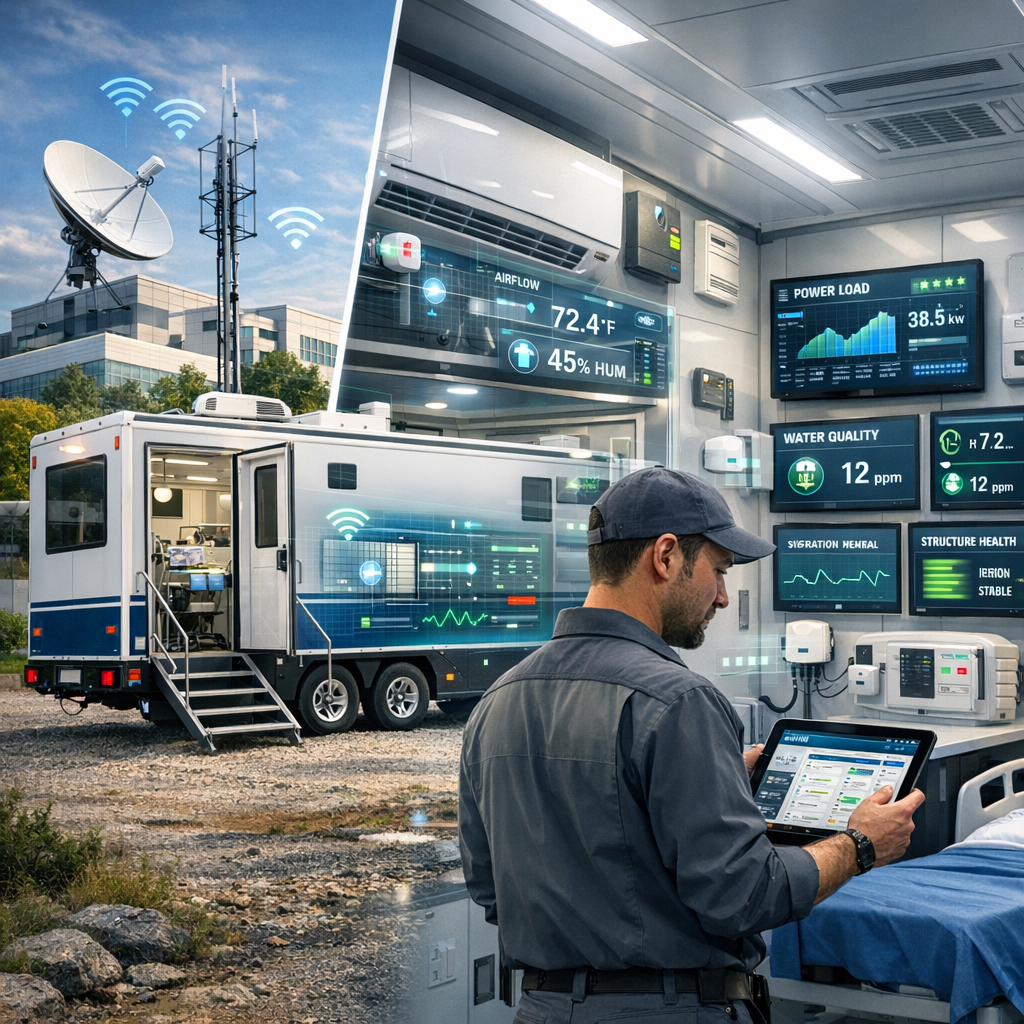
Medical trailer performance monitoring is the systematic, data-driven tracking of every critical system inside a mobile medical unit, from HVAC and electrical distribution to water quality and structural integrity. This guide covers clinical and environmental KPIs, monitoring tools and technology, inspection scheduling and regulatory compliance, common performance failures, and data-driven operational improvement.
Clinical environment and HVAC metrics form the foundation of effective monitoring. Tracking supply air temperature deviations, relative humidity ranges, refrigerant pressures, compressor cycling frequency, and airborne particle counts ensures mobile treatment spaces maintain the strict parameters that protect both patients and sterile supplies. Electrical load KPIs, water quality sampling, and structural integrity checks complete the picture, treating every subsystem as part of an interconnected network rather than isolated components.
IoT sensors, telematics platforms, CMMS software, and remote dashboards each address a different layer of fleet visibility. Together, they replace periodic manual checks with continuous, gap-free oversight that aggregates real-time readings, maintenance histories, and compliance documentation into a single interface.
A tiered inspection schedule assigns tasks across daily, weekly, monthly, quarterly, and annual intervals, with each frequency targeting different system layers. These schedules align directly with FDA QMSR requirements, OSHA workplace safety rules, state health department standards, and Joint Commission accreditation mandates that require 100% documented annual preventive maintenance for all medical equipment.
HVAC failures, electrical overloads, generator malfunctions, and structural wear represent the most common performance issues in mobile medical environments. Risk scoring matrices and AI-driven predictive analytics convert raw performance data into prioritized repair schedules that prevent costly breakdowns before they disrupt patient care.
What Does It Mean to Monitor Medical Trailer Performance?
Monitoring medical trailer performance means systematically tracking the operational health of every critical system inside a mobile medical unit. The subsections below cover the key systems that define performance and how ongoing monitoring differs from routine maintenance.
What Key Systems Define Medical Trailer Performance?
The key systems that define medical trailer performance are HVAC and climate control, electrical distribution and backup power, water supply and plumbing, structural integrity, and onboard medical equipment. Each system must function within strict parameters to maintain a safe clinical environment during deployment.
HVAC reliability deserves particular attention. Compressor failures represent the most expensive HVAC repair category, and according to OxMaint, up to 80% of these failures result from inadequate maintenance, misdiagnosed problems, or unaddressed issues. When climate control fails inside a medical trailer, temperature-sensitive medications, sterile environments, and patient comfort all face immediate risk.
Electrical systems must deliver stable, clean power to diagnostic devices and life-support equipment. Water quality and plumbing integrity protect against contamination, while chassis and structural condition ensure safe transport between sites. Performance monitoring treats these systems as an interconnected network rather than isolated components.
How Does Performance Monitoring Differ from Routine Maintenance?
Performance monitoring differs from routine maintenance by shifting the focus from scheduled task completion to continuous data-driven system evaluation. Routine maintenance follows a fixed calendar: filter changes, fluid top-offs, and visual inspections at set intervals. Monitoring, by contrast, tracks real-time and trend-based data to detect degradation before a scheduled check would catch it.
Consider an HVAC compressor drawing higher amperage over several weeks. Routine maintenance might not flag this until the next quarterly inspection, but continuous monitoring identifies the trend early enough to intervene. This distinction matters because reactive repairs in mobile medical settings carry disproportionate consequences, including canceled patient appointments, compliance gaps, and compromised sterile conditions.
For operators managing medical trailer fleets, the most effective strategy layers monitoring on top of maintenance rather than treating them as interchangeable. Understanding which tools and metrics support this approach is the next step.
Why Is Monitoring Medical Trailer Performance Critical?
Monitoring medical trailer performance is critical because it directly protects patients, satisfies regulatory mandates, and minimizes costly service interruptions. The subsections below cover patient safety, regulatory compliance, and downtime reduction.
Why Does Patient Safety Depend on Continuous Monitoring?
Patient safety depends on continuous monitoring because undetected equipment or environmental failures create conditions for healthcare-associated infections and compromised care. According to CDC data, about 1 in 31 hospital patients has at least one healthcare-associated infection on any given day, with equipment maintenance failures directly linked to these rates.
Medical trailers face the same infection control risks as fixed facilities, yet their mobile nature introduces additional variables. ASHRAE Standard 170 mandates strict temperature, humidity, and air change requirements for clinical spaces. When HVAC sensors drift or filtration systems degrade without detection, environmental conditions can fall outside safe ranges. Continuous monitoring catches these deviations before they reach patients, making real-time performance tracking a frontline defense against preventable harm.
Why Does Regulatory Compliance Require Performance Tracking?
Regulatory compliance requires performance tracking because multiple federal agencies mandate documented evidence of safe, maintained medical environments. OSHA's General Duty Clause requires employers to provide a workplace free from known hazards likely to cause death or serious injury, and mobile medical units are no exception.
Beyond OSHA, the FDA's Quality Management System Regulation and Joint Commission accreditation standards require comprehensive equipment maintenance and monitoring protocols. Without continuous performance data, operators cannot produce the documentation these bodies demand during inspections. For mobile medical programs that deploy across state lines, consistent tracking creates an auditable compliance record that satisfies overlapping jurisdictions simultaneously.
Why Does Downtime Reduction Matter for Mobile Medical Programs?
Downtime reduction matters for mobile medical programs because every hour a trailer is offline directly eliminates patient access to care. Unlike fixed facilities where patients can be rerouted to another department, a mobile unit often serves as the sole clinical resource in its deployment area.
Unplanned downtime also compounds costs rapidly. Performance monitoring identifies degrading components, such as aging compressors, fluctuating generators, or weakening electrical connections, before they cause full system failures. Proactive detection converts emergency shutdowns into scheduled service windows that preserve appointment availability. For programs serving rural or underserved communities, this reliability is not merely operational; it determines whether patients receive care at all.
With these stakes established, tracking the right performance indicators turns monitoring from a general priority into a measurable discipline.
What Key Performance Indicators Should You Track?
The key performance indicators you should track span clinical environment conditions, HVAC performance, electrical loads, water quality, structural integrity, and equipment uptime. Each KPI category targets a specific system within the mobile medical unit.
What Clinical Environment KPIs Should You Measure?
The clinical environment KPIs you should measure include interior air quality particle counts, surface contamination levels, ambient noise readings, and lighting intensity at workstations. Temperature stability within treatment zones is another critical metric, since even minor fluctuations can compromise specimen integrity and patient comfort.
- Airborne particle count per cubic meter at rest and during active procedures
- Surface ATP bioluminescence readings after each cleaning cycle
- Ambient noise levels in decibels within exam and procedure areas
- Light intensity measured in lux at clinical workstations
- Negative/positive pressure differential between clinical and non-clinical zones
Tracking these metrics at defined intervals creates a verifiable record that supports both infection control and accreditation readiness.
What HVAC and Climate Control Metrics Should You Watch?
The HVAC and climate control metrics you should watch are supply and return air temperature differentials, relative humidity percentages, refrigerant pressure levels, and air change rates. Mobile medical trailers face unique thermal loads because of frequent door openings, generator heat, and variable ambient conditions that fixed facilities rarely encounter.
- Supply air temperature versus setpoint deviation
- Relative humidity maintained between 20% and 60%, per ASHRAE Standard 170
- Refrigerant suction and discharge pressures logged at each deployment
- Compressor cycling frequency to flag short-cycling or overwork
- Filter differential pressure indicating restricted airflow
Consistent HVAC logging is one of the most cost-effective ways to prevent cascading system failures in a confined mobile environment.
What Electrical System and Power Load KPIs Matter Most?
The electrical system and power load KPIs that matter most are total amperage draw per circuit, voltage stability under peak load, generator fuel consumption rate, and transfer switch response time. Medical trailers run high-demand equipment on limited circuits, so even minor imbalances create significant risk.
- Total load as a percentage of rated capacity for each panel
- Voltage fluctuation range during simultaneous equipment operation
- Generator runtime hours and fuel burn rate per deployment
- Automatic transfer switch activation time in seconds
- Ground fault circuit interrupter (GFCI) trip frequency
According to a 2024 reliability analysis published in MDPI Applied Sciences, the A/C evaporator and blower front sides contribute to approximately 50% of all HVAC failures, which directly stresses electrical subsystems sharing the same power bus.
What Water Quality and Plumbing Metrics Should You Track?
The water quality and plumbing metrics you should track are potable water bacterial counts, hot water temperature at point of use, drain flow rates, and backflow preventer test results. Mobile units draw from varying municipal or onsite water sources, making consistent testing essential.
- Coliform and Legionella bacterial counts from periodic water sampling
- Hot water delivery temperature at the tap, targeting 110°F to 120°F for handwashing
- Water pressure measured in PSI at inlet and fixture
- Gray water tank fill levels to prevent overflow during extended deployments
- Backflow preventer certification status and test dates
Water system failures are often silent until contamination occurs, which makes scheduled sampling more valuable than reactive testing alone.
What Structural Integrity and Chassis KPIs Are Essential?
The structural integrity and chassis KPIs that are essential include frame deflection measurements, axle alignment tolerances, tire tread depth, suspension travel limits, and exterior seal conditions. Repeated transport over uneven terrain places cumulative stress on joints, welds, and mounting points that static buildings never experience.
- Frame deflection measured at designated reference points after each transport
- Axle alignment verified against manufacturer tolerances
- Tire pressure and tread depth logged before every road deployment
- Door and window seal compression checked for gaps or deformation
- Weld inspection results at high-stress connection points
Structural KPIs protect every other system inside the trailer; a compromised chassis undermines climate control, electrical integrity, and clinical environment stability.
What Equipment Uptime and Calibration Rates Should You Log?
The equipment uptime and calibration rates you should log are individual device operational hours, mean time between failures, calibration due dates, and first-pass inspection results. Every diagnostic or treatment device inside a medical trailer requires documented proof of performance to remain compliant and clinically reliable.
- Uptime percentage per device, calculated as operational hours divided by scheduled hours
- Mean time between failures (MTBF) trended monthly for each critical asset
- Calibration compliance rate, targeting 100% of devices calibrated on schedule
- Work order turnaround time from failure report to return-to-service
These metrics feed directly into predictive maintenance models, helping fleet managers forecast part replacements and budget cycles with greater accuracy. With equipment KPIs established, the right monitoring tools and technology make continuous tracking practical across deployments.
What Tools and Technology Are Used to Monitor Performance?
The tools and technology used to monitor medical trailer performance include IoT sensors, telematics platforms, CMMS software, and remote dashboards. Each system addresses a different layer of fleet visibility.
How Do IoT Sensors Enable Real-Time Trailer Monitoring?
IoT sensors enable real-time trailer monitoring by continuously measuring environmental and mechanical conditions inside mobile medical units. These sensors track temperature, humidity, air pressure differentials, and vibration levels, then transmit readings to centralized platforms at set intervals.
For medical trailers, this matters because clinical environments require strict parameter ranges. A temperature sensor detecting drift outside ASHRAE-compliant thresholds can trigger an automated alert before conditions compromise sterile supplies or patient safety. Vibration sensors mounted on HVAC compressors detect irregular patterns that precede mechanical failure, giving maintenance teams time to intervene. This continuous data stream replaces periodic manual checks with persistent, gap-free oversight.
How Does Telematics Track Mobile Medical Unit Conditions?
Telematics tracks mobile medical unit conditions by combining GPS location data with onboard diagnostic feeds from critical systems. These platforms monitor engine health, generator runtime, fuel consumption, and route-based stress indicators simultaneously.
During transit, telematics captures data points that static monitoring cannot: road vibration intensity, ambient temperature exposure, and generator load fluctuations at each deployment site. According to a study published in NIH/PubMed Central, AI algorithms can detect possible failure trends by evaluating massive volumes of data collected from equipment sensors. Telematics makes this possible by aggregating sensor outputs from moving assets into a single, location-aware data stream. For operators managing deployments across multiple regions, this GPS-linked context is essential for correlating environmental exposure with equipment wear patterns.
How Does CMMS Software Centralize Performance Data?
CMMS software centralizes performance data by aggregating sensor readings, maintenance records, work orders, and compliance documentation into a single digital platform. This eliminates fragmented spreadsheets and paper logs that create visibility gaps across mobile medical fleets.
A properly configured CMMS links each asset's real-time IoT data to its maintenance history, so technicians see both current conditions and past interventions in one view. The software automates scheduling for preventive maintenance tasks, generates audit-ready compliance reports, and flags overdue inspections. For medical trailers subject to regulatory oversight, this centralized record-keeping simplifies documentation during facility reviews. CMMS platforms also enable risk-based prioritization, routing urgent alerts above routine tasks.
How Do Remote Dashboards Support Multi-Trailer Fleets?
Remote dashboards support multi-trailer fleets by presenting consolidated, real-time performance views across every deployed unit from a single interface. Fleet managers can monitor temperature, humidity, power loads, and equipment status for dozens of trailers without physically visiting each site.
Color-coded alerts highlight units operating outside acceptable parameters, enabling rapid triage. Customizable dashboard layouts let operators prioritize the metrics most relevant to their clinical mission, whether that involves HVAC stability for surgical trailers or generator uptime for diagnostic units. Historical trend overlays reveal which trailers consistently underperform, guiding capital replacement decisions. For organizations scaling mobile medical programs, remote dashboards transform scattered data into actionable fleet intelligence.
With the right monitoring tools in place, establishing a consistent performance schedule keeps these systems effective.
How Do You Establish a Performance Monitoring Schedule?
You establish a performance monitoring schedule by assigning inspection tasks across daily, weekly, monthly, quarterly, and annual intervals. Each frequency targets different system layers, from rapid pre-deployment checks to deep compliance audits.
What Should a Daily Pre-Deployment Inspection Cover?
A daily pre-deployment inspection should cover the operational readiness checks performed before each patient encounter. These rapid walkthroughs catch issues that develop overnight or during transport.
Essential daily checkpoints include:
- Verifying HVAC output temperatures and airflow at supply registers.
- Confirming generator fuel levels, battery voltage, and transfer switch status.
- Inspecting water supply pressure and hot water functionality.
- Testing emergency lighting, exit signage, and fire extinguisher access.
- Checking door seals, leveling jacks, and slide-out mechanisms for proper function.
- Scanning infection control surfaces for visible contamination or damage.
Completing these checks before the first patient arrives prevents avoidable disruptions once clinical operations begin.
What Should Weekly System Checks Include?
Weekly system checks should include deeper diagnostic assessments that daily inspections cannot capture. These checks focus on trending performance data and catching early degradation.
Key weekly tasks are:
- Logging HVAC differential pressures and comparing readings against ASHRAE Standard 170 baselines for temperature and humidity.
- Inspecting electrical panel connections, breaker conditions, and grounding integrity.
- Testing generator load-bank performance under simulated clinical demand.
- Flushing water lines and sampling for microbial contamination indicators.
- Reviewing IoT sensor data logs for anomalies in vibration, amperage, or temperature drift.
- Documenting tire pressure, suspension condition, and exterior structural wear.
According to a 2024 reliability analysis published in MDPI Applied Sciences, evaporator and blower front sides contribute to approximately 50% of all HVAC failures, making weekly airside inspections particularly valuable.
What Should Monthly and Quarterly Audits Assess?
Monthly and quarterly audits should assess system-level performance trends, calibration accuracy, and regulatory documentation completeness. These intervals bridge the gap between routine checks and annual reviews.
Monthly priorities include:
- Calibrating clinical environment sensors for temperature, humidity, and air pressure.
- Inspecting refrigerant charge levels and checking for joint leakage.
- Auditing maintenance logs for completeness and corrective action follow-through.
- Testing all backup power systems, including automatic transfer sequences.
Quarterly priorities expand to:
- Conducting full electrical thermographic scans to detect hot spots.
- Assessing structural mounting points, welds, and chassis fasteners for fatigue.
- Reviewing infection control protocol compliance against CDC disinfection guidelines.
- Updating risk scoring models with accumulated performance data.
Refrigerant leak rates average 20% across comprehensive facility assessments spanning 33 years, according to Carbon Connector's analysis of leak detection requirements. Quarterly refrigerant inspections help identify losses before they compromise climate control.
What Should Annual Comprehensive Reviews Evaluate?
Annual comprehensive reviews should evaluate total system lifecycle health, regulatory compliance status, and long-term capital planning needs. This is the deepest inspection tier.
Critical annual evaluation areas include:
- Full mechanical system overhauls covering HVAC compressors, generators, and plumbing infrastructure.
- Complete recalibration of all clinical and environmental monitoring instruments.
- Structural integrity assessments including frame, flooring, roof membranes, and exterior panels.
- Regulatory compliance audits aligned with FDA QMSR, OSHA workplace safety standards, and state health department requirements.
- Documentation review to confirm all preventive maintenance records meet accreditation standards.
The Joint Commission requires 100% of medical equipment in accredited organizations to receive documented annual preventive maintenance, according to CME Corporation's compliance guidance. For mobile medical trailers, this annual review also serves as the foundation for updating predictive maintenance models and informing budget forecasts for the coming year.
With a structured schedule in place, understanding the regulatory standards behind each inspection tier ensures full compliance.
What Regulatory Standards Apply to Medical Trailer Monitoring?
The regulatory standards that apply to medical trailer monitoring include FDA quality management requirements, OSHA workplace safety rules, state health department inspections, and Joint Commission accreditation standards. Each framework shapes specific monitoring protocols.
How Do FDA Mobile Unit Guidelines Affect Monitoring?
FDA mobile unit guidelines affect monitoring by requiring any medical device used inside a trailer to comply with the Quality Management System Regulation (QMSR). This regulation, which became effective on February 2, 2026, amends device current good manufacturing practice requirements under 21 CFR Part 820 by incorporating ISO 13485:2016. For mobile medical trailers, this means every piece of diagnostic or treatment equipment must follow documented quality processes covering calibration, environmental controls, and traceability. Monitoring systems must log conditions that could compromise device performance, since the FDA holds manufacturers and operators accountable for consistent compliance regardless of whether equipment sits in a fixed facility or a mobile unit.
How Do OSHA Workplace Safety Rules Apply to Trailers?
OSHA workplace safety rules apply to trailers through the General Duty Clause, which requires employers to provide workers with a workplace free from known hazards that cause or are likely to cause death or serious injury. In a mobile medical environment, this obligation covers ventilation quality, electrical safety, ergonomic conditions, and exposure to biological hazards. Performance monitoring directly supports OSHA compliance by tracking air quality readings, temperature stability, and power system integrity. Without continuous data collection, operators risk undetected hazards that could trigger citations or, more critically, endanger clinical staff working in confined trailer spaces.
How Do State Health Department Inspections Shape Protocols?
State health department inspections shape protocols by imposing location-specific requirements that often exceed federal baselines. Each state establishes its own standards for mobile healthcare operations, covering areas such as:
- Sanitation and waste disposal procedures
- Water quality testing frequencies
- Infection control documentation
- Facility licensing and operational permits
Because requirements vary by jurisdiction, monitoring protocols must be flexible enough to capture the data each state demands. Operators deploying trailers across multiple states need adaptable tracking systems that satisfy the strictest applicable standard at any given deployment site. Failing a state inspection can suspend operations entirely, making proactive data collection essential.
How Does Joint Commission Accreditation Influence Tracking?
Joint Commission accreditation influences tracking by mandating rigorous, documented maintenance for every piece of medical equipment. According to CME Corporation's Joint Commission compliance guidance, the Joint Commission requires 100% of medical equipment in an accredited organization to receive documented annual preventive maintenance. Maintenance activities and frequencies must follow manufacturers' instructions for inspecting, testing, and servicing all devices. For mobile medical trailers, this means monitoring systems must generate audit-ready records proving that every scheduled service occurred on time. Organizations that fall short of these documentation standards risk losing accreditation, which directly impacts reimbursement eligibility and institutional credibility.
With regulatory frameworks defining the baseline, identifying common performance issues helps operators stay ahead of compliance gaps.
What Are Common Performance Issues in Medical Trailers?
Common performance issues in medical trailers include HVAC failures, electrical overloads, generator malfunctions, structural wear, and infection control gaps. Each issue compromises patient safety, regulatory compliance, or operational uptime.
What Causes HVAC Failures in Mobile Medical Environments?
HVAC failures in mobile medical environments are caused by inadequate maintenance, vibration-related damage, and refrigerant leaks. According to OxMaint, up to 80% of compressor failures, the most expensive HVAC repair, result from inadequate maintenance, misdiagnosed problems, or unaddressed issues.
Road vibration accelerates joint loosening and refrigerant line stress in ways stationary systems rarely experience. Common failure triggers include:
- Clogged evaporator coils from dust ingress during transport
- Refrigerant leaks at vibration-stressed joints and fittings
- Blower motor burnout from inconsistent power supply
- Thermostat sensor drift causing inaccurate climate readings
Proactive filter replacement and joint inspections after each deployment significantly reduce these risks.
What Leads to Electrical Overloads in Medical Trailers?
Electrical overloads in medical trailers result from simultaneous high-draw medical equipment exceeding circuit capacity. Diagnostic imaging systems, sterilization units, and HVAC compressors often share limited electrical infrastructure inside a confined trailer footprint.
Key contributing factors include:
- Undersized wiring that cannot handle cumulative device loads
- Simultaneous startup surges from multiple high-amperage devices
- Corroded or loosened connections from road vibration
- Inadequate circuit breaker sizing for added equipment
Load balancing through staggered equipment startup sequences and dedicated circuits for critical devices prevents most overload events. Routine amperage testing at each distribution panel identifies degradation before it triggers failures.
What Triggers Generator and Backup Power Failures?
Generator and backup power failures are triggered by fuel system contamination, insufficient load testing, and transfer switch malfunctions. Mobile medical trailers depend on generators as their primary or sole power source during field deployment, making reliability non-negotiable.
Frequent causes include:
- Stale or contaminated fuel from extended storage between deployments
- Coolant leaks caused by vibration during transit
- Automatic transfer switch failures that delay switchover to backup power
- Battery degradation in starter systems from temperature cycling
Monthly load bank testing under realistic conditions reveals weaknesses that idle run tests miss entirely. This single practice prevents more generator failures than any other maintenance step.
What Causes Structural Wear from Frequent Transport?
Structural wear from frequent transport is caused by repeated road vibration, thermal cycling, and load stress on the trailer chassis, walls, and mounting systems. Unlike stationary facilities, medical trailers endure constant dynamic forces that accelerate material fatigue.
Primary wear patterns include:
- Frame and subframe cracking at weld joints from cyclic stress
- Seal degradation around doors, windows, and utility penetrations
- Floor delamination beneath heavy mounted equipment
- Suspension component fatigue reducing ride stability
Even small seal failures allow moisture intrusion, which accelerates corrosion and compromises interior climate control. Regular post-transport inspections of welds, seals, and mounting hardware catch micro-damage before it compounds into costly structural failures.
What Creates Infection Control Risks from System Gaps?
Infection control risks from system gaps are created by equipment contamination, HVAC filtration failures, and lapses in cleaning protocols. According to the CDC, healthcare-associated infection outbreaks often result from either failures in infection control practices or contaminated equipment or medications.
In mobile medical trailers, specific system gaps that elevate infection risk include:
- HEPA filter bypass from improper seating or damage during transport
- Negative pressure loss in isolation areas due to door seal wear
- Biofilm accumulation in water lines during idle periods
- Surface contamination on shared equipment between patient encounters
These risks compound in mobile settings because transit disrupts the sealed environment that fixed facilities maintain continuously. Addressing these system gaps requires monitoring performance data alongside strict disinfection schedules.
How Do You Use Performance Data to Improve Operations?
You use performance data to improve operations by identifying failure patterns, scoring repair urgency, and applying predictive analytics. The following subsections cover recurring failure detection, risk-based repair prioritization, and breakdown prevention.
How Do You Identify Recurring Failure Patterns in Data?
You identify recurring failure patterns in data by aggregating sensor readings, maintenance logs, and incident reports across deployment cycles, then analyzing them for repeated anomalies. Patterns often emerge around specific subsystems, such as HVAC compressors, generator load circuits, or plumbing pressure regulators, that fail under consistent conditions.
According to research published by NIH/PubMed Central, AI algorithms can detect possible failure trends by evaluating massive volumes of data collected from equipment sensors. Once flagged, these trends reveal whether failures cluster around seasonal temperature extremes, transport vibration thresholds, or component age milestones. For mobile medical trailers, this level of pattern recognition turns reactive fixes into structured prevention protocols.
How Do You Prioritize Repairs Based on Risk Scoring?
You prioritize repairs based on risk scoring by assigning weighted values to each identified issue according to its potential impact on patient safety, regulatory compliance, and operational continuity. A scoring matrix typically evaluates three dimensions:
- Severity: How much harm could result if the issue is left unaddressed, ranging from minor inconvenience to patient safety compromise.
- Probability: How likely the failure is to occur based on historical data and current system condition.
- Detectability: How easily routine monitoring can catch the issue before it escalates.
Issues scoring highest across all three dimensions receive immediate attention. Lower-scoring items enter scheduled maintenance queues. This structured approach prevents teams from defaulting to first-come, first-served repair sequencing, which often leaves high-risk problems unresolved while low-impact fixes consume resources.
How Does Predictive Analytics Prevent Costly Breakdowns?
Predictive analytics prevents costly breakdowns by using historical performance data and real-time sensor inputs to forecast component failures before they occur. AI-driven predictive maintenance systems analyze vibration signatures, temperature drift rates, and power draw fluctuations to calculate remaining useful life for critical subsystems.
This approach shifts maintenance from calendar-based schedules to condition-based interventions. Rather than replacing a part every 90 days regardless of wear, predictive models trigger service only when data indicates degradation has reached an actionable threshold. The result is fewer unnecessary part replacements, reduced unplanned downtime, and more reliable medical trailer deployments. For organizations managing multi-trailer fleets, predictive analytics also enables smarter spare parts inventory planning.
With data-driven operations in place, trailer design choices shape how effectively these insights translate to long-term reliability.
How Does Custom Design and Engineering Impact Long-Term Performance?
Custom design and engineering impact long-term performance by building monitoring capabilities, structural resilience, and compliance readiness directly into a medical trailer from the start. The following sections cover how Craftsmen Industries achieves this and the key takeaways for sustained trailer performance.
Can Craftsmen Industries Mobile Medical Units Improve Monitoring Outcomes?
Yes, Craftsmen Industries mobile medical units can improve monitoring outcomes through purpose-built design that integrates performance tracking into every critical system. Craftsmen Industries designs, engineers, and fabricates mobile medical vehicles in-house at its 127,000 sq. ft. facility in St. Charles, Missouri, giving operators full control over how HVAC, electrical, plumbing, and structural systems are configured for ongoing monitoring.
Key advantages of this vertically integrated approach include:
- Custom HVAC layouts engineered to accommodate sensor placement for continuous temperature and humidity tracking.
- Electrical systems designed with dedicated circuits and load monitoring capacity to prevent overloads.
- Structural reinforcements tailored to reduce transport-related wear that degrades system accuracy over time.
- Pre-wired infrastructure for IoT sensors, telematics, and CMMS integration from initial build.
When monitoring is an afterthought, operators face retrofit costs and system blind spots. Craftsmen Industries eliminates these gaps by treating performance monitoring as a design requirement, not an add-on. With monitoring built into the foundation, identifying issues before they escalate becomes far more reliable.
What Are the Key Takeaways About Monitoring Medical Trailer Performance?
The key takeaways about monitoring medical trailer performance center on proactive system oversight, regulatory alignment, and data-driven decision-making. According to Censinet, equipment downtime costs healthcare facilities between $7,500 and $25,000 per minute, making continuous monitoring essential for financial and clinical protection.
The most actionable lessons from effective trailer performance monitoring are:
- Track HVAC, electrical, water quality, and structural KPIs daily to catch degradation before it causes downtime.
- Align every monitoring protocol with FDA QMSR, Joint Commission, OSHA, and ASHRAE Standard 170 requirements.
- Use predictive analytics and IoT sensor data to identify recurring failure patterns and prioritize repairs by risk.
- Invest in custom-engineered trailers that integrate monitoring infrastructure from day one rather than retrofitting later.
Performance monitoring is not a single task; it is a continuous discipline. Organizations that treat it as central to operations, rather than peripheral maintenance, consistently achieve better patient outcomes, lower costs, and longer asset life. Craftsmen Industries builds mobile medical units with this philosophy at the core, turning monitoring from a challenge into a competitive advantage.