
20 min read
How Do You Design Mobile Mental Health Clinics for Behavioral Health Services?
Craftsmen Industries May 13, 2026 3:14:17 PM
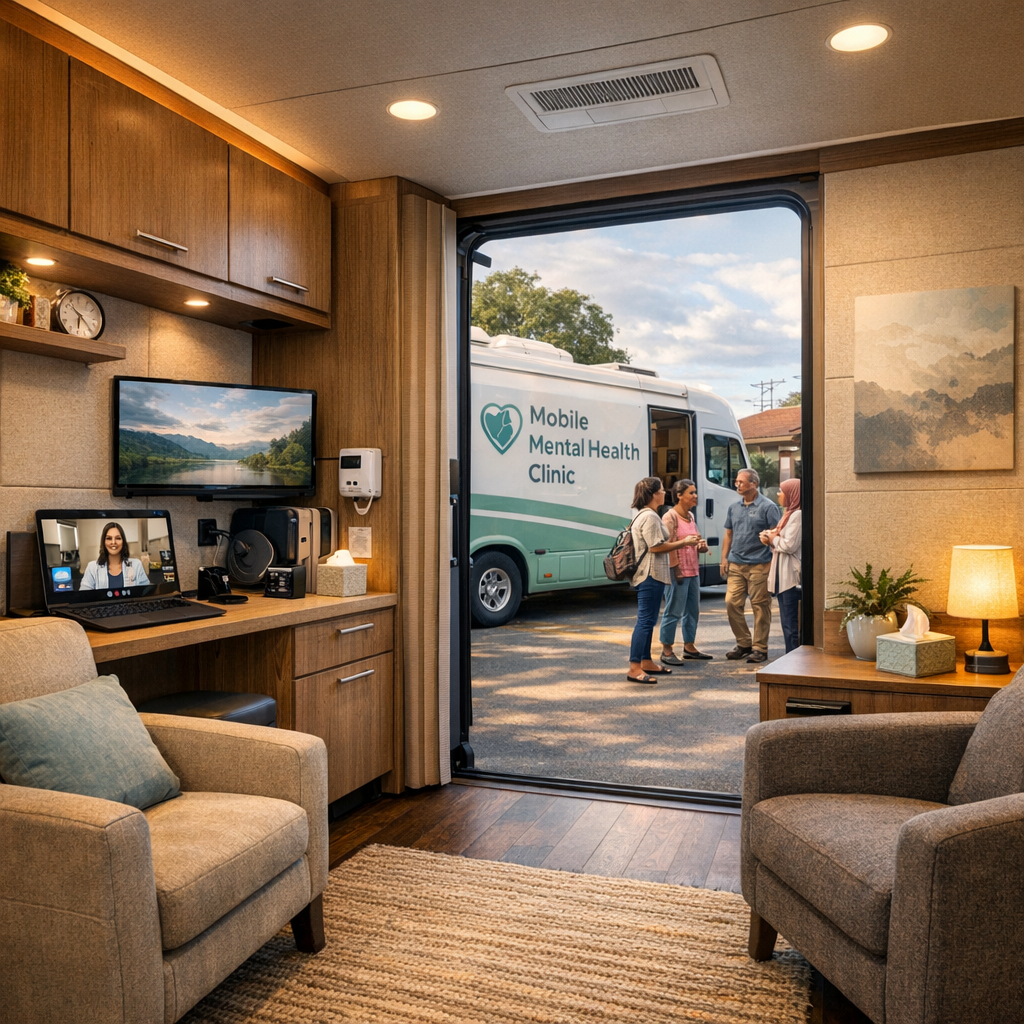
A mobile mental health clinic is a purpose-built vehicle that delivers behavioral health services directly to communities where permanent facilities and licensed providers are scarce. These clinics operate from converted vans, trucks, trailers, and buses equipped with private counseling rooms, telehealth technology, and clinical workstations to provide crisis intervention, therapy, medication management, and peer support on site.
This guide covers the populations these vehicles serve, vehicle platform selection and interior design, onboard technology and regulatory compliance, power systems and build costs, and deployment planning with a fabrication partner.
Mobile behavioral health vehicles reach underserved rural counties designated as Health Professional Shortage Areas, urban homeless populations who lack transportation to fixed clinics, veterans avoiding traditional VA settings, students on overwhelmed school campuses, and disaster response teams needing immediate psychological support at the point of crisis.
Vehicle platforms can range from compact sprinter vans suited for single-provider counseling to custom semi-trailers offering 400 to 600 square feet of configurable clinical space. Interior design decisions, including soundproofed counseling rooms, ADA-compliant layouts, therapeutic lighting, and dedicated HVAC zoning, directly shape patient comfort and session confidentiality.
Onboard technology systems connect these physical spaces to modern care delivery through HIPAA-compliant telehealth platforms, encrypted electronic health records, multi-carrier secure Wi-Fi, and ceiling-mounted sound masking emitters. Compliance requirements span federal privacy law, state facility licensing, ADA accessibility mandates, and DOT road-safety regulations.
Build costs range from roughly $75,000 for a small van conversion to $750,000 or more for a full-size trailer or bus, with annual operating costs averaging $275,000. Sustainable programs layer federal grants, Medicaid reimbursement, and equipment financing to cover both the vehicle and ongoing staffing. Reliable route logistics and a vertically integrated fabrication partner like Craftsmen Industries ensure each unit meets clinical, regulatory, and operational requirements from day one.
What Is a Mobile Mental Health Clinic?
A mobile mental health clinic is a specially designed vehicle that delivers behavioral health services directly to communities, eliminating the need for patients to travel to a fixed facility. These clinics operate from converted vans, trucks, trailers, or buses equipped with private counseling rooms, telehealth technology, and clinical workstations. According to the Rural Health Information Hub, mental health mobile unit programs can provide a wide range of services, such as crisis intervention, case management, individual and family therapy, suicide prevention, patient education, peer support, and medication management. By meeting patients where they are, mobile behavioral health vehicles reduce geographic, financial, and stigma-related barriers that often prevent people from seeking care. The sections below cover who benefits most, which vehicle platforms work best, and what design considerations shape an effective build.
Why Are Mobile Behavioral Health Vehicles in Growing Demand?
Mobile behavioral health vehicles are in growing demand because a widening gap between mental health needs and provider availability is pushing organizations to bring services directly to underserved populations. Workforce shortages, geographic barriers, and stigma all drive this shift toward mobile care delivery.
The mental health provider shortage sits at the center of this demand surge. According to the Health Resources & Services Administration, Health Professional Shortage Areas (HPSAs) are designations that indicate health care provider shortages in primary care, dental health, or mental health. These designations cover thousands of communities nationwide where residents face long wait times or no local access to behavioral health professionals at all. Mobile mental health clinics bypass this bottleneck by traveling to where patients already live, work, or seek shelter.
Geographic isolation compounds the problem significantly. Rural populations often must drive hours to reach the nearest behavioral health provider, and many lack reliable transportation. For individuals in crisis, that distance can be the difference between receiving timely intervention and going without care entirely. A vehicle-based model eliminates travel as a barrier, meeting patients in familiar community settings.
Stigma reduction also fuels adoption. Many individuals avoid walking into a traditional mental health facility due to social stigma, particularly in close-knit communities. Mobile units, often stationed at schools, community centers, or event sites, normalize the act of seeking help by embedding services into everyday environments.
The service versatility these vehicles offer makes them especially practical. As the Rural Health Information Hub notes, mental health mobile unit programs can provide a wide range of services, such as:
- Crisis intervention
- Case management
- Individual and family therapy
- Suicide prevention
- Patient education
- Peer support
- Medication management
This breadth of capability allows a single vehicle to function as a comprehensive outpatient behavioral health office. For organizations weighing fixed-location expansion against mobile deployment, the flexibility to serve multiple communities on a rotating schedule often delivers stronger reach per dollar invested. With demand for accessible behavioral health services continuing to outpace traditional infrastructure, mobile units represent one of the most adaptable solutions available today.
Who Benefits from Mobile Mental Health Clinic Services?
Mobile mental health clinic services benefit underserved rural communities, urban homeless populations, veterans and military families, schools and university campuses, and disaster response teams. Each group faces distinct barriers to behavioral health care that mobile units are designed to overcome.
How Do Underserved Rural Communities Benefit?
Underserved rural communities benefit from mobile mental health clinics by gaining direct access to behavioral health providers where permanent facilities and licensed professionals are scarce. According to the Health Resources & Services Administration (HRSA), Health Professional Shortage Areas (HPSAs) designate regions with critical provider shortages in primary care, dental health, or mental health. Many rural counties fall within these designations, leaving residents without local counseling, psychiatric evaluation, or crisis support. Mobile units eliminate the need for long-distance travel by bringing services such as individual therapy, medication management, and suicide prevention directly into these communities. For populations where stigma and geographic isolation compound each other, a vehicle-based clinic offers a discreet, accessible point of care.
How Do Urban Homeless Populations Benefit?
Urban homeless populations benefit from mobile mental health clinics by receiving care at the locations where they already congregate, such as shelters, encampments, and service centers. Traditional clinic settings often create barriers for individuals experiencing homelessness, including:
- Lack of transportation to fixed-site offices
- Inability to schedule and keep appointments without stable housing
- Distrust of institutional healthcare environments
- Missing identification or insurance documentation
Mobile behavioral health vehicles meet people where they are, offering walk-up access to crisis intervention, case management, peer support, and referrals. This street-level approach builds trust over repeated visits, which is essential for engaging a population that frequently avoids conventional care systems.
How Do Veterans and Military Families Benefit?
Veterans and military families benefit from mobile mental health clinics by accessing confidential behavioral health support outside traditional VA or military healthcare settings. Many veterans face long wait times at VA facilities, while others avoid seeking help due to concerns about stigma or career impact. Mobile units can deploy to veteran service organizations, military bases, and community events, offering:
- PTSD screening and trauma-focused counseling
- Substance use disorder assessments
- Family therapy for service-related stress
- Peer support from trained veteran counselors
By reducing the perceived formality of a clinical visit, these vehicles lower the threshold for veterans to begin or continue mental health treatment. For military families navigating frequent relocations, mobile clinics provide continuity of care that fixed facilities in a single location cannot.
How Do Schools and University Campuses Benefit?
Schools and university campuses benefit from mobile mental health clinics by providing students with on-site access to counseling and crisis support without requiring off-campus referrals. Campus counseling centers are frequently overwhelmed, and younger populations often hesitate to seek help through formal institutional channels. A mobile behavioral health vehicle parked near dormitories, student unions, or athletic facilities normalizes the act of seeking care. Services typically include individual therapy sessions, anxiety and depression screening, substance use education, and peer support programming. For K-12 schools in districts lacking dedicated counselors, mobile units fill a critical gap by rotating between campuses on scheduled routes. This model is particularly effective for reaching students who would never walk into a traditional counselor's office on their own.
How Do Disaster and Crisis Response Teams Benefit?
Disaster and crisis response teams benefit from mobile mental health clinics by deploying immediate psychological support to affected populations and first responders at the point of need. Natural disasters, mass casualty events, and community crises create acute mental health demand that fixed facilities cannot absorb, especially when infrastructure is damaged or inaccessible. Mobile behavioral health vehicles serve as self-contained counseling stations that can be positioned at evacuation shelters, staging areas, or community gathering points within hours. They provide crisis intervention, psychological first aid, grief counseling, and trauma debriefing for both survivors and emergency workers. For response teams operating in unpredictable environments, the self-sufficiency of a well-designed mobile unit, with onboard power, connectivity, and private counseling space, makes it an essential asset.
Understanding who these vehicles serve shapes every design decision, from interior layout to deployment logistics.
What Vehicle Types Work Best for Mobile Behavioral Health?
The vehicle types that work best for mobile behavioral health range from compact sprinter vans for rapid community outreach to custom semi-trailer units for full-service clinical operations. Each platform balances interior space, mobility, and budget differently.
Sprinter Vans
Sprinter vans are compact, maneuverable vehicles well suited for one-on-one counseling sessions and crisis screenings. Their smaller footprint allows easy navigation through urban neighborhoods, school parking lots, and rural roads where larger vehicles cannot access. A typical sprinter van conversion accommodates one private consultation area, a small intake zone, and basic telehealth equipment. These vehicles cost less to build and operate than larger platforms, making them practical entry points for organizations launching their first mobile behavioral health program. However, limited interior square footage restricts multi-room configurations and simultaneous patient appointments.
Box Trucks
Box trucks offer a larger, enclosed cargo area that can be converted into a dedicated mobile counseling space. Their flat interior walls simplify the installation of soundproofing panels, cabinetry, and partition walls for private therapy rooms. A standard box truck build-out typically supports one to two counseling rooms alongside a small waiting area. These vehicles remain Class 4 or 5 trucks in most configurations, so standard commercial driver requirements apply without specialized licensing in many states. Box trucks strike a practical balance between interior clinical space and urban maneuverability that sprinter vans cannot match.
Step Vans
Step vans feature a low floor entry and walk-in cabin design that creates natural ADA accessibility advantages. The low step-in height reduces the need for complex wheelchair lift installations, simplifying compliance with accessibility standards. Their boxy interior geometry maximizes usable floor space relative to the vehicle's external dimensions. Step vans work particularly well for community outreach programs that serve elderly patients or individuals with mobility challenges. According to the U.S. Access Board, vehicles covered by the ADA must comply with accessibility standards issued by the Department of Transportation, making step vans a practical starting chassis for compliant behavioral health builds.
Full-Size Trailers
Full-size trailers provide substantially more interior space than van-based platforms, enabling multi-room clinical layouts. A typical trailer conversion can include two to three private counseling rooms, a dedicated intake and waiting area, a restroom, and a staff workspace. Because trailers detach from the towing vehicle, organizations can position a trailer at a deployment site for days or weeks while the tow vehicle serves other logistics needs. This semi-permanent setup suits schools, community centers, and rural health fairs. The trade-off involves reduced mobility and the need for a dedicated towing vehicle and trained driver.
Coach-Style Buses
Coach-style buses deliver the highest ceiling heights and longest continuous floor plans among self-propelled mobile clinic platforms. Their spacious interiors support full clinical suites with multiple counseling rooms, group therapy areas, and integrated telehealth stations. The existing HVAC, electrical, and plumbing infrastructure in coach chassis reduces conversion complexity for climate control and power distribution. Coach buses project a professional, welcoming appearance that helps reduce stigma around seeking behavioral health services. For organizations planning multi-city tours or statewide outreach programs, coaches offer the road endurance and interior capacity that smaller vehicles cannot provide.
Custom Semi-Trailer Units
Custom semi-trailer units represent some of the largest mobile behavioral health platforms, typically offering approximately 400 to 600 square feet of usable clinical space. Within this footprint, designs can support a combination of private counseling or exam rooms, flexible group or telehealth areas, administrative workstations, and ADA-compliant restroom facilities, often through multi-use and reconfigurable layouts rather than fully dedicated rooms. Expandable slide-out sections can increase usable floor area even further at deployment sites. Semi-trailers require a commercial tractor for transport and a CDL-licensed driver, which adds operational complexity and cost. For organizations that need a full-scale behavioral health facility at temporary or rotating locations, custom semi-trailers deliver clinical capacity closest to a brick-and-mortar clinic. With vehicle selection established, interior design determines how effectively each platform supports confidential care.
What Interior Design Features Does a Mobile Mental Health Clinic Need?
A mobile mental health clinic needs private counseling rooms, soundproofing, a calming waiting area, therapeutic lighting and colors, ADA-compliant layouts, and proper climate control. Each feature directly affects patient comfort and clinical effectiveness.
How Should Private Counseling Rooms Be Configured?
Private counseling rooms should be configured as enclosed, self-contained spaces with floor-to-ceiling partitions and a solid-core door. Even within a compact vehicle footprint, each room needs enough square footage for two seated individuals, a small work surface, and clear sightlines to an exit for safety.
Flexible furniture arrangements matter in constrained mobile environments. Wall-mounted fold-down desks and swivel seating allow a single room to shift between individual therapy, psychiatric evaluations, and telehealth consultations. Frosted or tinted privacy glass in any window panels prevents visual exposure from the exterior while still admitting natural light. For clinicians conducting trauma-informed care, the room layout should avoid placing the patient between the provider and the only exit, since spatial autonomy reduces anxiety during sessions.
What Soundproofing Is Required for Confidential Sessions?
The soundproofing required for confidential sessions includes acoustic insulation in walls, ceilings, and floors to prevent speech from traveling between compartments. Standard vehicle panels transmit sound easily, so mobile mental health clinics need additional intervention beyond factory construction.
Key soundproofing measures include:
- Mass-loaded vinyl barriers layered behind interior wall panels to block airborne sound transmission.
- Closed-cell spray foam insulation in wall cavities and ceiling voids to dampen vibration.
- Acoustic door seals and sweeps on every counseling room entry to eliminate gaps.
- Sound-masking white noise emitters placed in the waiting area and corridor zones.
These layers work together to maintain HIPAA-compliant confidentiality. Without proper acoustic treatment, conversations in one room can be overheard in adjacent spaces, compromising patient trust and regulatory compliance.
How Should the Waiting and Intake Area Be Designed?
The waiting and intake area should be designed as a welcoming, low-stimulus zone positioned near the vehicle entrance. This space serves as the first point of contact, so its layout shapes a patient's initial impression of the clinical environment.
Seating should include individual chairs rather than shared benches, giving patients personal space during what is often an emotionally vulnerable moment. A small intake counter or check-in kiosk near the entry streamlines registration while maintaining visual separation from the counseling rooms further inside the vehicle. Durable, easy-to-clean materials like vinyl upholstery and laminate surfaces support cleanliness without feeling institutional. Keeping this area visually distinct from treatment spaces helps patients mentally transition from arrival to care.
What Lighting and Color Choices Support Patient Comfort?
Lighting and color choices support patient comfort by reducing environmental stressors that can heighten anxiety during behavioral health visits. Harsh fluorescent lighting and sterile white surfaces create clinical atmospheres that feel unwelcoming; mobile mental health clinics benefit from a more intentional approach.
Warm-toned LED lighting in the 2700K to 3500K range produces a calming effect without sacrificing task visibility for clinicians. Dimmable fixtures in counseling rooms allow providers to adjust brightness based on session type. For wall and surface colors, muted earth tones, soft greens, and warm neutrals reduce visual tension. These palette choices draw from evidence-based design principles used in inpatient behavioral health facilities, adapted here for a mobile environment where every surface is closer to the patient.
How Do You Create an ADA-Compliant Interior Layout?
You create an ADA-compliant interior layout by designing doorways, corridors, and floor space to accommodate wheelchair users and individuals with mobility limitations. According to the U.S. Access Board, accessibility guidelines for buses and vans were updated in 2016, and vehicles covered by the ADA must comply with standards issued by the Department of Transportation.
Essential ADA features for a mobile mental health clinic include:
- A wheelchair lift or ramp at the primary entry point with a non-slip surface.
- A minimum 36-inch clear width in interior corridors for wheelchair passage.
- At least one counseling room with a 60-inch turning radius for wheelchair maneuverability.
- Lever-style door handles and accessible signage with tactile lettering and Braille.
Integrating these requirements early in the design phase prevents costly retrofits and ensures equitable access from day one.
What HVAC Requirements Ensure Proper Climate Control?
HVAC requirements ensure proper climate control through a dedicated heating, ventilation, and air conditioning system sized for the vehicle's enclosed volume and occupant load. Standard automotive climate systems lack the capacity to maintain therapeutic comfort levels across multiple compartments.
A rooftop or undercarriage-mounted HVAC unit rated for the vehicle's square footage provides consistent temperature regulation. Separate zone controls for the waiting area and counseling rooms allow individualized comfort adjustments. Fresh air intake with HEPA or MERV-13 filtration improves indoor air quality, which is critical in a sealed environment where multiple patients cycle through daily. Proper ventilation also prevents condensation buildup that can damage electronic health record equipment and interior finishes over time.
With interior design features addressed, integrating the right onboard technology systems connects these physical spaces to modern telehealth capabilities.
What Technology Systems Should Be Integrated on Board?
The technology systems that should be integrated on board a mobile mental health clinic include telehealth platforms, electronic health records, secure connectivity, and audio privacy solutions. Each system supports clinical workflow and patient confidentiality.
What Telehealth and Video Conferencing Equipment Is Needed?
Telehealth and video conferencing equipment needed for a mobile mental health clinic includes HIPAA-compliant video platforms, HD cameras, clinical-grade monitors, directional microphones, and noise-canceling headsets. According to the U.S. Department of Health and Human Services, the Office for Civil Rights (OCR) issued resource documents explaining privacy and security risks to protected health information when using telehealth services and ways to reduce those risks.
Equipment should be hardwired to reduce latency during live psychiatric evaluations. A dedicated telehealth station, separate from the counseling room, allows simultaneous in-person and remote sessions. For mobile units serving areas with limited provider availability, reliable telehealth capability effectively doubles clinical capacity without adding staff.
How Should Electronic Health Record Systems Be Set Up?
Electronic health record systems should be set up using encrypted, cloud-based platforms accessible from ruggedized tablets or mounted workstations inside the vehicle. Offline-capable EHR software is essential because mobile clinics frequently operate in areas with intermittent connectivity. Data should sync automatically once a secure connection is restored.
Role-based access controls limit record visibility to authorized clinicians. Physical security matters too; the CDC instructs healthcare facilities to store regulated materials in labeled, leak-proof, puncture-resistant containers, and similar organizational discipline should extend to digital record management through structured access logs and audit trails. Mounting hardware securely prevents device damage during transit.
What Secure Wi-Fi and Connectivity Solutions Are Needed?
The secure Wi-Fi and connectivity solutions needed for mobile behavioral health vehicles include enterprise-grade cellular routers with multi-carrier failover, external MIMO antennas, and VPN encryption. Dual-SIM or multi-carrier bonding ensures uninterrupted service across rural and urban deployment zones where single-network coverage may drop.
All transmitted data, especially protected health information, must travel through encrypted channels that meet HIPAA technical safeguard requirements. A dedicated clinical network should be segmented from any patient-facing guest Wi-Fi. Signal boosters mounted on the vehicle exterior improve reception in remote locations, which is where many behavioral health mobile units operate most frequently.
What Audio Privacy and White Noise Systems Work Best?
The audio privacy and white noise systems that work best in mobile mental health clinics are ceiling-mounted sound masking emitters paired with calibrated white or pink noise generators. These systems raise the ambient noise floor just enough to render speech unintelligible outside the counseling room, without creating discomfort inside it.
Directional speakers focused on waiting areas and exterior walls add a secondary masking layer. Combined with solid soundproofing materials in walls and doors, electronic masking addresses the residual sound leakage that physical insulation alone cannot eliminate. For mobile environments where wall thickness is limited, this layered approach is the most practical path to true conversational privacy during sensitive behavioral health sessions.
What Regulatory and Compliance Standards Apply?
Regulatory and compliance standards for mobile mental health clinics span federal privacy law, state licensing, accessibility mandates, and transportation safety rules. The following subsections cover HIPAA, state licensing, ADA accessibility, and DOT regulations.
How Does HIPAA Affect Mobile Clinic Design?
HIPAA affects mobile clinic design by requiring physical, technical, and administrative safeguards that protect patient health information throughout every interaction. Counseling rooms need solid walls or partitions rather than curtains, and electronic health records must transmit over encrypted, secure networks. According to data published by the National Institutes of Health, an estimated 2,000 mobile clinics operate across the country and receive approximately 6.5 million visits annually. That volume underscores how critical standardized privacy protections are at scale. Soundproofing, locked storage for paper records, and role-based access controls on devices all stem directly from HIPAA's Privacy and Security Rules. For behavioral health vehicles specifically, where sensitive psychiatric and substance-use data is exchanged, these design-level safeguards are non-negotiable from the earliest planning stages.
What State Licensing Requirements Apply to Mobile Units?
State licensing requirements for mobile units vary by jurisdiction and typically cover facility permits, provider credentials, and operational authorizations. Most states require a mobile health unit to register as a healthcare facility, which means meeting the same clinical standards as a fixed-site clinic. Providers practicing onboard must hold active licenses in every state where the vehicle operates. Some states also mandate pharmacy permits if medications are dispensed or administered. Because behavioral health services often involve controlled substances and crisis intervention protocols, operators should consult each state's health department early in the build process. Failing to secure proper licensure before deployment can result in fines, service shutdowns, or liability exposure that undermines the entire program.
What ADA Accessibility Standards Must Be Met?
The ADA accessibility standards that must be met include wheelchair ramp or lift access, compliant doorway widths, interior maneuvering clearances, and accessible restroom fixtures. The U.S. Access Board updated its accessibility guidelines for buses and vans in 2016, and vehicles covered by the ADA must comply with standards issued by the Department of Transportation. For mobile mental health clinics, this means entry systems with slopes no steeper than 1:12, a minimum 36-inch clear passage width, and knee clearance at intake counters. Prioritizing accessibility during the design phase is far more cost-effective than retrofitting a completed build, and it ensures every patient can receive behavioral health services without physical barriers.
What DOT and Road-Safety Regulations Apply?
DOT and road-safety regulations apply to mobile mental health clinics based on the vehicle's gross vehicle weight rating, classification, and intended travel routes. Vehicles exceeding 10,001 pounds GVWR must meet Federal Motor Carrier Safety Administration requirements, including:
- Driver qualification standards and, for heavier units, commercial driver's license mandates.
- Regular vehicle inspections covering brakes, tires, lighting, and structural integrity.
- Hours-of-service limits for operators transporting the unit between deployment sites.
- Proper placarding and registration when hauling medical gases or hazardous materials.
State-level DOT rules add further layers, such as oversize permits for wide-body trailers and route restrictions on certain roadways. Accounting for these regulations during vehicle selection prevents costly redesigns after fabrication begins.
How Do You Power a Mobile Behavioral Health Vehicle?
You power a mobile behavioral health vehicle through a combination of generator systems, solar panels, and shore power connections. Each source addresses different deployment scenarios.
How Do Generator Systems Support Off-Grid Operations?
Generator systems support off-grid operations by providing self-contained electrical power wherever the vehicle is parked. A mobile behavioral health clinic running HVAC, lighting, telehealth equipment, and electronic health records requires a reliable onboard power source sometimes independent of external infrastructure.
Diesel or propane generators are common choices for mobile medical vehicles because they deliver consistent output across extended service hours. Key considerations when selecting a generator include:
- Wattage capacity matched to total electrical load, including climate control and medical-grade equipment.
- Noise output, since quiet operation is essential during confidential counseling sessions.
- Fuel efficiency for full-day deployments in remote or underserved areas.
- Automatic transfer switch integration to maintain uninterrupted power during source transitions.
For behavioral health vehicles specifically, generator noise levels deserve extra attention. A loud generator outside the vehicle can compromise the therapeutic environment inside, undermining soundproofing investments.
Can Solar Power Supplement a Mobile Clinic's Energy Needs?
Yes, solar power can supplement a mobile clinic's energy needs by offsetting generator runtime and reducing fuel costs. Rooftop solar panels paired with lithium battery storage systems allow a mobile behavioral health vehicle to run low-draw systems, such as LED lighting, device charging stations, and Wi-Fi routers, without activating the generator.
Solar supplementation works best as a secondary power layer rather than a primary source. The roof area on most mobile clinic vehicles limits total panel capacity, and high-draw systems like HVAC units typically exceed what solar alone can sustain. However, even partial solar offset extends generator fuel economy and reduces operational noise during patient intake periods. For organizations deploying in sunny climates on predictable schedules, solar integration can meaningfully lower the average annual operating cost of running a mobile clinic.
What Shore Power Connections Are Needed for Stationary Use?
Shore power connections needed for stationary use include a 30-amp or 50-amp external inlet, a transfer switch, and compatible wiring rated for the vehicle's total electrical load. Shore power allows a mobile behavioral health vehicle to draw electricity directly from a building or dedicated outdoor outlet when parked at a host site.
Essential shore power components include:
- External power inlet (typically 30A or 50A, 120/240V) mounted on the vehicle exterior.
- Automatic or manual transfer switch to shift between shore power and the onboard generator.
- Properly rated distribution panel to handle simultaneous operation of HVAC, telehealth systems, and lighting.
Stationary deployments at schools, community centers, or VA facilities benefit most from shore power because it eliminates generator noise entirely and provides unlimited runtime. Planning shore power compatibility during the build phase saves significant retrofit costs later.
With reliable power infrastructure in place, the next consideration is understanding what a full mobile mental health clinic build costs.
How Much Does a Mobile Mental Health Clinic Cost to Build?
A mobile mental health clinic costs between $75,000 and $750,000 or more to build, depending on vehicle size, interior complexity, and integrated technology. The sections below break down pricing for van conversions, box truck build-outs, and full-size trailer or bus conversions.
What Does a Small-Format Van Conversion Cost?
A small-format van conversion costs roughly $75,000 to $175,000 for a mental health configuration. Sprinter-style vans offer the lowest entry point, typically accommodating one private counseling room with basic soundproofing, a compact telehealth station, and essential HVAC. The limited interior footprint keeps material and labor costs down, though clinical-grade acoustic insulation and HIPAA-compliant technology add expense beyond a standard commercial upfit. For programs needing rapid deployment to schools or rural sites with a single provider, this format delivers functional capability without the capital burden of larger platforms.
What Does a Mid-Size Box Truck Build-Out Cost?
A mid-size box truck build-out costs approximately $200,000 to $400,000 for behavioral health use. This format provides enough interior space for a private counseling room, a separate intake or waiting area, and dedicated technology infrastructure, including secure Wi-Fi and electronic health record systems. According to Mobile Health Map, the average annual operating cost of a mobile clinic is $275,000, with personnel accounting for approximately 90% of the operating budget. That ongoing expense makes it important to right-size the vehicle investment relative to projected staffing and service volume. Box trucks strike a practical balance between clinical capacity and maneuverability for organizations serving multiple community sites.
What Does a Full-Size Trailer or Bus Conversion Cost?
A full-size trailer or bus conversion costs $400,000 to $750,000 or more, depending on clinical scope. These platforms can support a combination of multiple private therapy rooms, ADA-compliant layouts with wheelchair lifts, full HVAC zoning, and robust power systems for off-grid operation. Custom semi-trailers and coach-style buses can integrate telehealth suites, group therapy spaces, and administrative areas within a single vehicle. The higher build cost reflects expanded square footage, heavier structural engineering, and oftentimes more complex regulatory compliance. For organizations planning high-volume behavioral health programs across broad service areas, this investment delivers the most comprehensive mobile clinical environment available.
With build costs established, the next step is identifying funding and financing pathways.
How Do You Fund and Finance a Mobile Behavioral Health Unit?
You fund and finance a mobile behavioral health unit through a combination of federal grants, state behavioral health funding programs, private foundations, and organizational capital budgets. The most common funding sources include SAMHSA grants, HRSA awards, FEMA preparedness grants, Medicaid reimbursement for mobile-delivered services, and partnerships with hospital systems or community health centers. Some organizations also use equipment financing or lease-to-own arrangements to spread capital costs over time.
Key funding and financing options include:
- SAMHSA block grants and competitive grants fund substance abuse and mental health service expansion, including mobile delivery models.
- HRSA Community Health Center funding supports mobile units that serve Health Professional Shortage Areas, which HRSA designates for areas with provider shortages in primary care, dental health, or mental health.
- FEMA and emergency preparedness grants cover mobile crisis response units deployed during disasters or public health emergencies.
- Medicaid and insurance reimbursement offsets ongoing operating costs when mobile clinics bill for behavioral health services delivered on-site.
- Private foundations and corporate sponsors provide capital for community-focused mobile health programs, particularly those serving homeless, veteran, or rural populations.
- Equipment financing and leasing allows organizations to acquire custom-built vehicles without a single large capital outlay, preserving cash flow for staffing and operations.
The average annual operating cost of a mobile clinic is $275,000, with personnel accounting for approximately 90% of the operating budget according to Mobile Health Map. Securing sustainable funding means covering not just the vehicle build, but the staffing, fuel, maintenance, and technology costs that follow. Organizations that layer multiple funding streams, combining grant capital for the vehicle with Medicaid reimbursement for ongoing services, tend to sustain mobile programs far longer than those relying on a single source. With a financing strategy in place, the next step is planning where and how to deploy the unit effectively.
How Do You Plan Deployment and Route Logistics?
You plan deployment and route logistics by mapping service gaps, scheduling recurring stops in high-need areas, and coordinating with local partners to maximize patient access. Effective routing balances geographic coverage with operational efficiency, ensuring the mobile mental health clinic reaches the communities that need it most.
Identifying deployment locations starts with analyzing Health Professional Shortage Area (HPSA) designations and local behavioral health data. Community health centers, schools, shelters, and houses of worship often serve as ideal host sites because they already attract the populations a mobile clinic aims to reach. Establishing formal site agreements with these partners secures consistent parking, utility access, and referral pipelines before a single mile is driven.
Route planning should account for several operational factors:
- Service radius and drive time: Limit daily travel distance so the clinical team spends more time treating patients than sitting behind the wheel.
- Recurring schedule predictability: Returning to the same location on the same day each week builds community trust and encourages follow-up appointments, which are critical in behavioral health care.
- Seasonal and weather considerations: Road conditions, extreme temperatures, and daylight hours affect both vehicle performance and patient turnout.
- Permitting and parking requirements: Each municipality may impose different rules for oversized vehicle parking, generator noise, and signage; confirming these in advance prevents last-minute cancellations.
- Fuel, maintenance, and staffing logistics: Route density should allow realistic refueling windows, scheduled vehicle maintenance, and manageable clinician shift lengths.
According to a report cited by the National Institutes of Health, an estimated 2,000 mobile clinics operate across the country, collectively receiving roughly 6.5 million visits annually. That volume underscores how critical reliable routing is; even minor scheduling disruptions cascade into missed appointments and lost continuity of care for vulnerable patients.
Data-driven route optimization tools, similar to those used in fleet management, can help program administrators model coverage scenarios and adjust schedules based on real utilization metrics. Tracking appointment volume, no-show rates, and patient origin zip codes at each stop reveals which sites justify more frequent visits and which need repositioning. Over time, this feedback loop transforms an initial deployment plan into a precisely calibrated service network.
For behavioral health specifically, continuity matters more than raw volume. A patient beginning trauma-focused therapy needs assurance the clinic will return next week. Building that reliability into the route logistics is not just an operational detail; it is a clinical requirement that directly affects treatment outcomes.
How Should You Approach Custom Mobile Clinic Design with a Fabrication Partner?
You should approach custom mobile clinic design with a fabrication partner by prioritizing end-to-end collaboration, from initial concept through final deployment. The following subsections cover Craftsmen Industries' capabilities and key design takeaways.
Can Craftsmen Industries Build Your Mobile Mental Health Clinic?
Yes, Craftsmen Industries can build your mobile mental health clinic. Craftsmen Industries specializes in custom mobile medical vehicles, operating from a 127,000 sq. ft. facility in St. Charles, Missouri, with over 40 years of fabrication experience. The company's vertically integrated process handles design, engineering, fabrication, printing, and installation entirely in-house. This single-source approach gives healthcare providers, government agencies, and nonprofits complete project control over private counseling rooms, ADA-compliant layouts, telehealth integration, HIPAA-compliant infrastructure, and branded exterior graphics. Craftsmen Industries delivers each asset on time, working collaboratively from ideation to creation so that every behavioral health vehicle meets the exact clinical, regulatory, and operational requirements of the organization deploying it.
What Are the Key Takeaways About Designing Mobile Mental Health Clinic Vehicles?
The key takeaways about designing mobile mental health clinic vehicles center on balancing clinical function, patient privacy, regulatory compliance, and operational sustainability. According to the CDC, rural Americans face disproportionately higher mortality from leading causes of death, which underscores the urgency of deploying well-designed mobile behavioral health units to underserved areas.
The most critical design priorities include:
- Privacy-first interiors: Soundproofed counseling rooms and white noise systems protect session confidentiality and support HIPAA compliance.
- ADA and DOT compliance: Accessible layouts and road-safety standards must be integrated from the earliest design phase, not retrofitted.
- Reliable power and connectivity: Generator, solar, and shore power systems paired with secure Wi-Fi ensure uninterrupted telehealth and EHR access at any deployment site.
- Therapeutic environment: Lighting, color palettes, and climate control directly influence patient comfort and willingness to engage in care.
- Right-sized vehicle selection: Matching the vehicle platform to service scope, route logistics, and budget prevents costly overbuilds or limiting underbuilds.
Partnering with an experienced fabrication team like Craftsmen Industries ensures these priorities are engineered into the vehicle from day one, rather than addressed as afterthoughts.