
17 min read
How Do You Choose the Best Metal Fabrication Company?
Craftsmen Industries May 13, 2026 4:12:08 PM
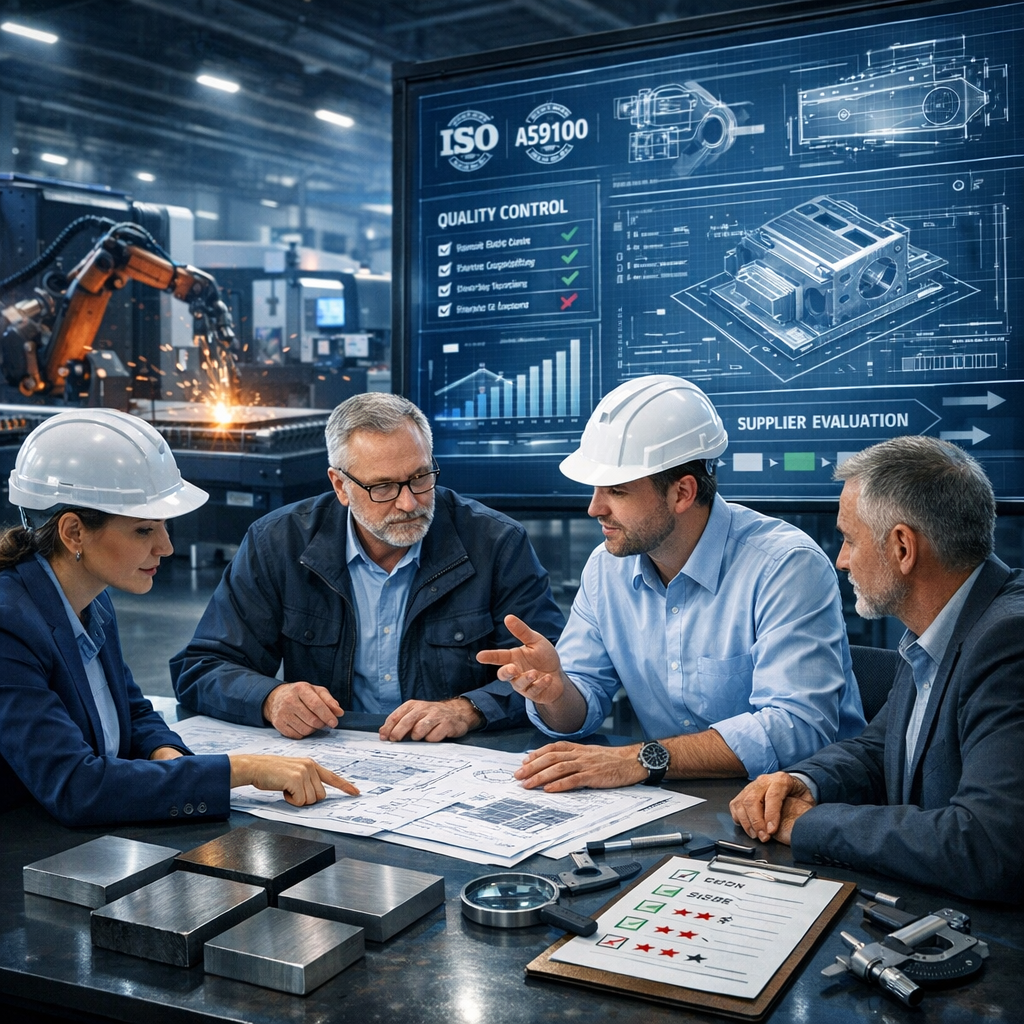
Choosing the best metal fabrication company is a vetting process that evaluates a fabricator's certifications, engineering capabilities, equipment, material expertise, quality control systems, and production model to ensure they can deliver accurate, reliable results for your specific project.
This guide covers fabricator qualification criteria, core service capabilities, vertical integration, material selection, quality control assessment, vetting questions, quote comparison, industry-specific requirements, and red flags to avoid.
Fabricator qualification starts with verifiable credentials. Certifications like ISO 9001, AS9100D, AISC, and ITAR registration confirm that a shop's processes have been independently audited, while proven experience across military, aerospace, and healthcare sectors signals the process maturity needed for complex builds.
Core service capabilities determine whether a single partner can take your project from raw material to finished product. Custom fabrication, structural steel work, sheet metal forming, CNC machining, welding, and surface finishing should all exist within one operation rather than being outsourced across disconnected vendors.
Vertical integration ties those services together by keeping design, fabrication, machining, and inspection under one roof. This model eliminates tolerance stack-up errors between handoffs, enables immediate corrective action, and compresses lead times by removing third-party scheduling and transit delays.
Material range and quality control rigor separate capable fabricators from those who overpromise. A qualified shop works confidently with steel, aluminum, copper, brass, titanium, and specialty alloys while maintaining documented inspection processes, weld verification methods, and full production traceability.
The vetting and pricing process reveals a fabricator's true reliability. Asking targeted questions about project management, capacity, and problem-solving exposes operational gaps, while comparing itemized quotes against certifications, defect rates, and delivery records prevents the costly rework that low-bid selections frequently produce.
What Should You Look for in a Metal Fabrication Company?
You should look for a metal fabrication company with proven experience, relevant certifications, strong engineering capabilities, advanced equipment, and sufficient facility capacity. The following subsections break down each criterion.
How Important Is Industry Experience and Track Record?
Industry experience and track record are critical indicators of a fabricator's reliability. A company with decades of completed projects demonstrates the ability to handle complex custom work across multiple sectors. According to an Amindus Consulting case study, inadequate vetting of a metal fabrication vendor led to financial consequences that nearly killed a project. Verifiable references and a portfolio of similar builds reveal whether the fabricator can deliver consistently. For high-stakes applications in military, aerospace, or healthcare, proven longevity signals process maturity that newer shops simply cannot replicate.
What Certifications and Quality Standards Should They Hold?
The certifications a metal fabrication company should hold depend on your industry, but several standards apply universally:
- ISO 9001:2015 reinforces a manufacturer's commitment to documenting and following standardized processes.
- AS9100D defines design and manufacture standards for aerospace products, including parts, components, and assemblies.
- AWS D1.1 validates a Certified Welding Inspector's knowledge in material, design, fabrication, and inspection for steel structures.
- AISC Certification verifies that a facility has the personnel, knowledge, and equipment to produce quality structural steel.
- ITAR registration is required for any entity manufacturing or exporting defense articles on the U.S. Munitions List.
According to NQA, AS9100 certification puts heavy emphasis on risk management, prevention, and strict material traceability. Certifications are non-negotiable proof that a fabricator's quality system has been independently audited.
How Do You Evaluate Their Engineering and Design Capabilities?
You evaluate engineering and design capabilities by examining a fabricator's in-house resources for CAD/CAM development, prototyping, and design-for-manufacturability analysis. A company that handles design and production under one roof ensures a single consistent interpretation of the drawing, reducing tolerance stack-up errors. Look for teams that can translate concept sketches into production-ready files using CNC programming and feature-based CAM workflows. The ability to identify design issues before cutting begins saves significant rework costs downstream.
What Role Does Equipment and Technology Play in Quality?
Equipment and technology play a direct role in fabrication quality by determining achievable tolerances, repeatability, and defect rates. According to a report from Zhouxiang, robotic welding achieves a defect rate of 2–3%, compared to 8–12% for manual welding. Key technologies that separate capable fabricators from outdated shops include:
- Laser cutting systems for precision profiling
- Robotic welding cells with path repeatability of ±0.05 mm
- CNC metal forming for consistent bends and shapes
- ERP systems enabling real-time tracking of materials and production schedules
Modern equipment does not just improve accuracy; it reduces rework rates from the 10–15% range down below 2%, directly lowering project costs.
Why Does Facility Size and Capacity Matter?
Facility size and capacity matter because they determine whether a fabricator can handle your project's scale without overpromising on lead times. According to U.S. Census Bureau data from Q2 2025, the full utilization rate for fabricated pipe and pipe fitting manufacturing sat at just 59.6%, indicating that many facilities operate near or beyond comfortable throughput. A fabricator who overpromises on lead times without the capacity or equipment to deliver is a major red flag. Larger facilities with dedicated staging areas, multiple production lines, and room for simultaneous projects offer scheduling flexibility that prevents bottlenecks.
With these evaluation criteria established, the next step is understanding which specific fabrication services a top company should offer.
What Fabrication Services Should a Top Company Offer?
A top metal fabrication company should offer custom fabrication, structural steel work, sheet metal forming, CNC machining, welding and assembly, and finishing services. These core capabilities determine whether a single partner can handle your project from raw material to completed product.
Custom Metal Fabrication
Custom metal fabrication is a manufacturing process that shapes metal into unique parts or end products through cutting, forming, and assembly. Unlike standard production runs, custom work requires a fabricator to engineer one-of-a-kind solutions tailored to specific project dimensions, tolerances, and functional requirements.
According to Metalcon, the process usually consists of three phases: cutting, forming, and assembly. A company offering true custom capability should handle prototyping, low-volume specialty builds, and full-scale production without outsourcing critical steps. For complex projects like mobile command centers or experiential vehicles, this flexibility is non-negotiable.
Structural Steel Fabrication
Structural steel fabrication involves the assembly of steel components to create frameworks for buildings, infrastructure, or heavy-duty custom platforms. This service requires compliance with specific AISC standards that verify a facility has the personnel, knowledge, and equipment to produce quality structural steel.
As fabrication expert Dylan Pritchard notes, "The most costly delay often comes down to the efficiency of the miscellaneous fabrication and structural steel coordination." Look for fabricators holding AISC certification and AWS D1.1 Structural Steel endorsements, which validate competency in material selection, design interpretation, and weld inspection for load-bearing structures.
Sheet Metal Fabrication
Sheet metal fabrication is a capital-intensive discipline that requires large investments in equipment to meet capacity requirements for precision parts. According to a NIST application summary on KARLEE, meeting these capacity demands separates capable fabricators from those who overpromise.
Key sheet metal processes include:
- Laser cutting for intricate profiles and tight tolerances
- Bending and forming using CNC press brakes
- Punching and stamping for repeatable hole patterns
- Deep drawing for complex three-dimensional shapes
A fabricator's sheet metal capability directly impacts part accuracy, surface quality, and production speed for enclosures, panels, brackets, and chassis components.
CNC Machining and Precision Cutting
CNC machining is the direct translation of feature-based CAM files into automated tool control programs, enabling repeatable accuracy across production runs. According to NIST, this computer numerical control approach eliminates human variability in complex cutting operations.
Precision metal fabrication transforms ordinary metal blanks and castings into highly accurate components. When evaluating a fabricator's machining department, confirm they operate multi-axis CNC mills, lathes, and plasma or laser cutting systems. These technologies allow tight-tolerance work for aerospace, military, and medical applications where dimensional accuracy cannot be compromised.
Welding and Assembly
Welding is a fabrication process that joins materials by using high heat to fuse parts together, allowing them to cool and form a permanent bond. A top fabricator should offer multiple welding methods, such as MIG, TIG, stick, and robotic welding.
According to Zhouxiang, robotic welding achieves a defect rate of 2-3%, compared to 8-12% for manual welding. Path repeatability for robotic systems reaches ±0.05 mm, a precision level impossible for human welders to sustain over a full shift. Assembly services should include mechanical fastening, hardware installation, and turnkey integration so finished components arrive ready for deployment.
Finishing and Surface Treatment
Finishing and surface treatment services protect fabricated components from corrosion, wear, and environmental degradation while meeting aesthetic and regulatory requirements. Common finishing processes include:
- Powder coating and wet painting for durability and color matching
- Anodizing for aluminum corrosion resistance
- Plating (zinc, nickel, cadmium) for conductivity or military specifications
- Chemical conversion coatings for aerospace applications
Traceability through every finishing stage, from raw material procurement to final inspection, is often required for defense and aerospace projects. For projects demanding NADCAP-accredited special processes, confirming in-house or qualified subcontractor finishing capabilities prevents costly delays.
With a clear picture of essential services, understanding how vertical integration ties these capabilities together reveals its impact on overall fabrication quality.
How Does Vertical Integration Affect Fabrication Quality?
Vertical integration affects fabrication quality by consolidating design, fabrication, machining, and finishing under one roof, which reduces errors and accelerates delivery. The following sections define vertical integration, explain how unified workflows prevent mistakes, and show why single-source manufacturing shortens lead times.
What Is Vertical Integration in Metal Fabrication?
Vertical integration in metal fabrication is a manufacturing model where one partner takes a part from raw material through fabrication, machining, hardware, finishing, and inspection. According to Advantage Metal Products, this approach ensures a single consistent interpretation of the drawing, reducing tolerance stack-up errors that commonly occur when multiple vendors handle separate production stages.
Rather than coordinating between disconnected shops, a vertically integrated fabricator maintains shared quality systems across every operation. This structure enables immediate corrective action when deviations arise, because the same team controls each phase. For complex custom builds requiring precision across multiple processes, this consolidation is one of the most reliable ways to maintain dimensional accuracy from first cut to final assembly.
How Does In-House Design-to-Production Reduce Errors?
In-house design-to-production reduces errors by eliminating the miscommunication that occurs when drawings transfer between separate companies. When engineering, CNC machining, welding, and assembly share the same facility, each department references identical specifications without reinterpretation.
Tolerance stack-up, a cumulative dimensional drift that worsens with each handoff, becomes far less likely under unified operations. Corrective action happens immediately rather than after parts ship back from a subcontractor. For projects requiring traceability from raw material procurement to final inspection, this closed-loop environment maintains documentation continuity that fragmented supply chains simply cannot replicate.
Why Does Single-Source Manufacturing Speed Up Turnaround?
Single-source manufacturing speeds up turnaround by eliminating multiple quotes, third-party schedules, and transit time between different suppliers. As fabrication expert Dylan Pritchard notes, "The most costly delay often comes down to the efficiency of the miscellaneous fabrication and structural steel coordination."
When one facility owns the full production sequence, scheduling conflicts between vendors disappear. Parts move directly from one process to the next without packaging, shipping, or re-inspection at receiving. This compressed timeline is especially critical for defense, aerospace, and medical vehicle projects where delays carry steep contractual penalties.
Understanding how vertical integration drives quality and speed helps establish baseline expectations when evaluating a fabricator's material capabilities.
What Materials Should a Metal Fabrication Company Work With?
A metal fabrication company should work with a broad range of metals, including steel, stainless steel, aluminum, copper, brass, titanium, and specialty alloys. The subsections below cover each material family's properties and best applications.
Steel and Stainless Steel
Steel and stainless steel are the most widely used materials in structural and custom metal fabrication. Structural steel fabrication involves assembling steel components to create frameworks for buildings or infrastructure, requiring specific AISC standards according to the American Institute of Steel Construction. Carbon steel offers high strength and weldability at lower cost, making it ideal for heavy structural frames and industrial equipment. Stainless steel provides superior corrosion resistance for medical, food-processing, and marine environments. A fabricator experienced in both grades can match the right alloy to load, exposure, and budget requirements, which ultimately determines long-term part performance.
Aluminum
Aluminum is a lightweight, corrosion-resistant metal used extensively in aerospace, transportation, and architectural fabrication. According to a ResearchGate study on aluminum alloys, Aluminum 7075 offers higher tensile strength and hardness than Aluminum 6061, making it preferred for high-stress aerospace structural components. Its lower density reduces vehicle weight without sacrificing durability, a critical factor in mobile medical units and experiential marketing builds. However, aluminum requires specialized welding parameters and fixturing to prevent warping. A qualified fabricator should demonstrate proven experience with multiple aluminum alloys and the precision equipment necessary to hold tight tolerances on thinner gauge material.
Copper and Brass
Copper and brass are non-ferrous metals valued for their electrical conductivity, thermal transfer, and antimicrobial properties. According to Okon Recycling's market data, bare bright copper consistently commands higher market prices per pound than brass, with copper trading around $4.70 compared to lower brass scrap rates. This cost difference matters when specifying materials for bus bars, heat exchangers, or decorative architectural elements. Brass offers improved machinability and wear resistance for fittings and hardware. A capable fabrication partner should source and process both materials efficiently, minimizing waste given their elevated raw material cost.
Titanium and Specialty Alloys
Titanium and specialty alloys are advanced materials reserved for aerospace, defense, and high-performance applications where extreme strength-to-weight ratios or temperature resistance are required. According to ACI Industries, titanium's low thermal conductivity of 6.7 W/m-K makes it one of the most challenging materials to machine compared to traditional steels. Ti-6Al-4V titanium alloy has a density of 0.160 lb/in³ and a 600°F max operating temperature, while Inconel 718 reaches 1,300°F capability. These demanding materials require specialized tooling, slower feed rates, and strict traceability protocols. For most projects involving superalloys, choosing a fabricator with AS9100D certification and documented experience in exotic metals is non-negotiable.
Understanding material capabilities helps, but verifying how a fabricator inspects and documents quality is equally critical.
How Do You Assess a Fabrication Company's Quality Control?
You assess a fabrication company's quality control by evaluating their inspection processes, weld verification methods, and documentation practices. The following subsections cover what to look for in each area.
What Inspection Processes Should Be in Place?
The inspection processes that should be in place include dimensional verification, in-process checks, and final quality testing before shipment. A reliable fabricator uses gauges, coordinate measuring machines, and stress checks at multiple production stages. According to a 2024 ResearchGate study on quality control in metal fabrication, implementing quality control systems helps prevent non-conformity, product scrapping, and unnecessary costs across the manufacturing process.
Look for fabricators who perform first-article inspection on initial production runs, followed by systematic sampling throughout the batch. Any company unable to provide a detailed quality control plan for your specific project presents a significant warning sign of potential defect risks. For complex builds like military vehicles or medical equipment, multi-stage inspection gates are non-negotiable.
How Do You Verify Weld Quality and Structural Integrity?
You verify weld quality and structural integrity by requesting evidence of certified welding procedures, non-destructive testing methods, and inspector qualifications. The AWS D1.1 Structural Steel endorsement, issued by the American Welding Society, validates a Certified Welding Inspector's knowledge in material, design, fabrication, and inspection for steel structures.
Key verification methods include:
- Visual inspection by certified welding inspectors (CWI)
- Ultrasonic or radiographic testing for critical joints
- Robotic welding systems with Through-Arc Seam Tracking (TAST), which uses real-time electrical feedback to adjust torch position
Robotic welding achieves defect rates of 2–3%, compared to 8–12% for manual welding, according to data reported by Zhouxiang. For structural or load-bearing assemblies, always confirm that the fabricator maintains documented weld procedures and employs inspectors with relevant endorsements.
What Documentation and Traceability Should They Provide?
The documentation and traceability a fabrication company should provide includes material certifications, inspection reports, weld maps, and complete production records tied to each component. Traceability is the ability to track every stage of manufacturing, from raw material procurement to final inspection. Defense and aerospace projects require this capability as a baseline.
Essential documentation includes:
- Material test reports and mill certifications
- Dimensional inspection records at each production phase
- Non-conformance reports with corrective action documentation
- Serialized part tracking linked to specific raw material lots
Modern ERP systems enable real-time tracking of materials, labor, and production schedules, making full traceability achievable even for complex multi-stage builds. For anyone evaluating a fabricator, the depth of their documentation reveals how seriously they take accountability and continuous improvement.
With quality control practices verified, the next step is preparing the right questions for the vetting process.
What Questions Should You Ask During the Vetting Process?
The questions you should ask during the vetting process cover project management, custom fabrication capability, lead time reliability, and problem-solving approach.
What Should You Ask About Project Management and Communication?
You should ask about project management and communication by requesting a clear explanation of the fabricator's process for handling issues during custom work. According to Wirefab, buyers should specifically ask: "What is your process for handling project management and communication when a problem arises during custom work?" Key questions include:
- Who serves as the dedicated point of contact throughout production?
- How frequently are progress updates delivered, and in what format?
- What escalation procedures exist when unexpected issues arise?
- Can they provide verifiable references from long-term project relationships?
A fabricator that struggles to articulate a structured communication workflow often signals deeper operational disorganization.
How Do You Confirm Their Ability to Handle Custom Projects?
You confirm their ability to handle custom projects by requesting evidence of past work with similar complexity, materials, and tolerances. Ask to review case studies or portfolios that demonstrate experience with your specific requirements, whether that involves precision machining, specialty alloys, or turnkey assembly.
Essential questions to ask include:
- What is your detailed quality control plan for this specific project?
- Which in-house capabilities cover design, fabrication, and finishing?
- Have you completed projects with similar material specifications before?
A fabricator's inability to provide a detailed quality control plan for a specific project is a significant warning sign of potential defect risks, as noted by AMG Industries.
What Should You Ask About Lead Times and Deadlines?
You should ask about lead times and deadlines by requesting specific production schedules backed by current capacity data. A major red flag for buyers is a fabricator who overpromises on lead times without having the capacity or equipment to support the claims, according to EVS Metal.
Ask these questions directly:
- What is your current production backlog and facility utilization rate?
- How do you handle schedule conflicts when multiple projects overlap?
- What contingency plans exist for equipment downtime or material delays?
- Can you provide on-time delivery metrics from recent projects?
Fabricators with ERP systems that track real-time production schedules can substantiate their timeline commitments with data rather than estimates.
How Do You Evaluate Their Problem-Solving Capabilities?
You evaluate their problem-solving capabilities by examining how a fabricator has responded to past production challenges and design obstacles. Request specific examples where they identified defects mid-production, adapted to engineering changes, or resolved material sourcing issues without compromising deadlines.
Strong indicators of problem-solving ability include:
- Documented corrective action processes within their quality system
- Engineering staff who participate in design-for-manufacturability reviews
- Willingness to suggest alternative approaches that improve cost or performance
The best fabrication partners treat unexpected challenges as collaborative opportunities rather than blame-shifting exercises. Understanding how a company navigates complexity reveals whether their pricing structure accounts for the true value of reliable execution.
How Do You Compare Metal Fabrication Quotes and Pricing?
You compare metal fabrication quotes by evaluating line-item cost breakdowns, assessing hidden risk in low bids, and weighing total value against project reliability. The following sections cover cost components, the dangers of choosing solely on price, and balancing cost with quality.
What Cost Factors Are Included in a Fabrication Quote?
Cost factors included in a fabrication quote are material, labor, overhead, specialized finishing, and material waste. Each line item reflects a distinct phase of production. Material costs fluctuate with alloy type and market pricing. Labor accounts for skilled welding, CNC programming, and assembly time. Overhead covers equipment depreciation, facility costs, and quality management systems. Specialized finishing, such as powder coating or plating, adds another variable.
According to Swanton Welding, material waste and scrap rates significantly impact the final quote, making efficient nesting and material usage a key cost-saving capability. Always request itemized breakdowns rather than lump-sum figures so you can identify where each dollar goes.
Why Is the Cheapest Quote Not Always the Best Value?
The cheapest quote is not always the best value because low bids frequently signal hidden costs, such as costly rework, assembly delays, and potential field failures. A fabricator undercutting competitors may be skipping inspection steps, using lower-grade materials, or lacking proper certifications.
According to Fab-Metal, the "real cost" of choosing the lowest bidder often manifests as rework expenses, missed deadlines, and parts that fail in the field. In automotive sheet metal fabrication, pursuing the lowest bid without due diligence often leads to rework after vehicle assembly is complete. For complex or mission-critical builds, the upfront savings rarely offset downstream losses.
How Do You Weigh Cost Against Quality and Reliability?
You weigh cost against quality and reliability by evaluating a fabricator's certifications, defect rates, on-time delivery record, and communication practices alongside price. A slightly higher quote from a certified, vertically integrated shop often delivers lower total project cost when you factor in fewer change orders, tighter tolerances, and dependable schedules.
As Wesgar states, "The real value of a supplier isn't in the lowest bid, but in the partnership that comes with it and a commitment to reliable delivery." Request references, review past project outcomes, and confirm quality control documentation before finalizing any decision based primarily on price.
Understanding total cost of ownership positions you to evaluate specialized industry requirements next.
What Industries Require Specialized Metal Fabrication Expertise?
Industries requiring specialized metal fabrication expertise include military and government, healthcare, and corporate or commercial sectors. Each demands distinct certifications, quality systems, and fabrication approaches.
What Should You Look for in a Military or Government Fabricator?
You should look for ITAR registration, MIL-SPEC compliance, and full material traceability in a military or government fabricator. ITAR (International Traffic in Arms Regulations) requires registration for any entity manufacturing or exporting defense articles listed on the U.S. Munitions List, according to the DDTC Public Portal. Beyond registration, the fabricator must demonstrate the ability to track every stage of production, from raw material procurement to final inspection.
Key qualifications to verify include:
- Active ITAR registration with documented compliance procedures
- MIL-SPEC finishing and material handling capabilities
- Secure facility protocols for classified project data
- AS9100D certification for aerospace-grade quality management
As George Giering, President and CEO of Giering Metal Finishing, states: "ITAR compliance basically confirms our ability to secure customers' classified information from anybody that shouldn't have access." For defense work, a fabricator without these credentials is simply not a viable option.
What Matters When Choosing a Healthcare Fabrication Partner?
What matters when choosing a healthcare fabrication partner is FDA quality system adherence, material biocompatibility knowledge, and cleanroom-capable assembly environments. Medical device fabrication requires compliance with FDA quality systems and often involves cleanroom environments for assembly and packaging, according to the FDA.
Critical evaluation criteria include:
- ISO 9001 certification as a baseline quality management system
- Experience with medical-grade materials and sterilization requirements
- Documentation systems that support full regulatory traceability
- Capacity for custom mobile medical vehicle builds, including diagnostic units and treatment trailers
Healthcare fabrication leaves zero margin for error. A partner who understands both the regulatory framework and the practical demands of medical environments will prevent costly compliance failures downstream.
How Do Corporate and Commercial Projects Differ in Requirements?
Corporate and commercial projects differ in requirements by prioritizing visual quality, brand consistency, and aggressive timelines over the regulatory burden found in military or medical work. These projects, such as experiential marketing vehicles, trade show exhibits, and promotional builds, demand precision fabrication paired with high-end finishing and graphics integration.
The key differentiators include:
- Emphasis on aesthetic finish quality and paint or graphic-ready surfaces
- Shorter lead times driven by event schedules and marketing campaigns
- Need for design flexibility to accommodate brand-specific customization
- Vertically integrated production that keeps design, fabrication, and graphics under one roof
While compliance requirements are lighter, corporate projects still demand consistent quality. A fabricator experienced in commercial builds understands that missed event deadlines carry financial consequences comparable to regulatory penalties in other sectors.
Understanding each industry's unique requirements ensures the fabricator you select can meet the specific demands of your project.
What Red Flags Should You Watch for When Choosing a Fabricator?
Red flags when choosing a fabricator include unrealistic lead time promises, poor communication during the quoting process, and an inability to provide verifiable references. The sections below break down each warning sign.
How Do You Spot a Company That Overpromises and Underdelivers?
You spot a company that overpromises and underdelivers by examining whether their lead time commitments align with their actual capacity and equipment. According to EVS Metal, a major red flag for buyers is a fabricator who overpromises on lead times without having the capacity or equipment to back up the claims. Ask for specifics: what machines will run your job, what is the current production schedule, and can they provide a detailed quality control plan? A fabricator unable to answer these questions concretely is likely padding promises to win the contract. In my experience, the shops that quote the fastest turnaround with the fewest questions are often the ones that deliver the most problems.
What Does Poor Communication During Quoting Signal?
Poor communication during quoting signals a deeper organizational problem that will likely worsen once production begins. If a fabricator is slow to respond, vague on specifications, or avoids clarifying questions during the quoting phase, expect those same patterns during project management. As Wirefab recommends, buyers should ask fabricators directly: "What is your process for handling project management and communication when a problem arises during custom work?" A credible shop will outline a clear escalation process, assign a dedicated project manager, and provide regular status updates. Silence or deflection at the quote stage almost always predicts costly surprises mid-build.
Why Should You Be Cautious of Companies Without References?
You should be cautious of companies without references because verifiable project history is one of the strongest indicators of reliability. According to Fab-Metal, poor communication and a lack of verifiable references are primary indicators that a metal fabrication vendor may not be reliable for long-term projects. Request references from projects similar to yours in scope, material, and industry. Credible fabricators will share case studies, client contacts, and portfolio documentation without hesitation. A company that cannot or will not provide this evidence likely lacks the proven track record needed to handle complex custom work.
Recognizing these warning signs early protects your budget, timeline, and final product quality.
How Can a Vertically Integrated Fabricator Bring Your Custom Vision to Life?
A vertically integrated fabricator brings your custom vision to life by controlling every phase of production, from initial design through final delivery, under one roof. The sections below cover how Craftsmen Industries handles complex builds and the key takeaways for choosing the best metal fabrication company.
Can Craftsmen Industries' End-to-End Fabrication Handle Complex Custom Builds?
Yes, Craftsmen Industries can handle complex custom builds through end-to-end fabrication capabilities housed within a 127,000 sq. ft. facility in St. Charles, Missouri. Craftsmen Industries holds ISO 9001 and AS9100D certifications, applying aerospace-grade quality management to custom military and medical vehicle projects. This vertically integrated model means design, engineering, fabrication, printing, and installation all happen in-house, eliminating the coordination delays and tolerance stack-up errors that plague multi-vendor approaches.
According to Advantage Metal Products, having fabrication, machining, and assembly under one roof ensures a single consistent interpretation of the drawing, reducing tolerance stack-up errors. Craftsmen Industries applies this same principle across experiential marketing vehicles, mobile medical units, and industrial fabrication for government and military clients. For projects requiring strict traceability or ITAR compliance, single-source control provides the accountability that distributed supply chains cannot match.
What Are the Key Takeaways About How to Choose the Best Metal Fabrication Company?
The key takeaways about how to choose the best metal fabrication company center on five critical evaluation areas:
- Verify certifications first. Confirm ISO 9001, AS9100D, AISC, or ITAR registration based on your industry requirements.
- Prioritize vertical integration. Single-source fabricators reduce lead times, minimize communication errors, and maintain tighter quality control than multi-vendor setups.
- Evaluate equipment and technology. Robotic welding, CNC machining, and laser cutting directly impact precision, consistency, and defect rates.
- Assess communication and transparency. A fabricator who provides detailed quality control plans, clear project management processes, and verifiable references signals long-term reliability.
- Look beyond the lowest bid. The cheapest quote often leads to costly rework, assembly delays, and field failures that far exceed any initial savings.
Choosing a fabrication partner is ultimately about finding a company whose capabilities, quality systems, and communication style align with the complexity and standards your project demands.