
10 min read
How Do Medical Trailer Interior Layouts Compare for Different Needs?
Craftsmen Industries May 13, 2026 8:33:54 AM
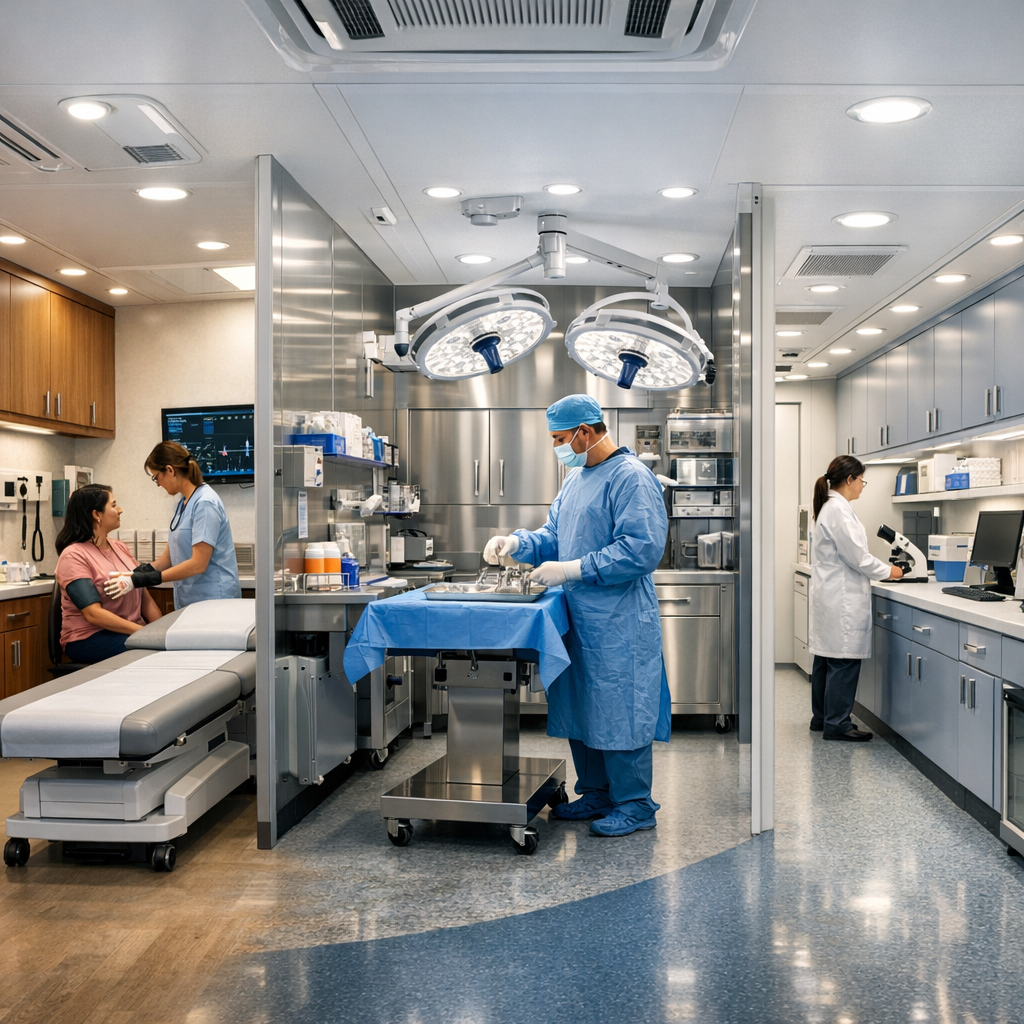
A medical trailer interior layout is the strategic arrangement of clinical zones, utility systems, and circulation paths within a mobile healthcare unit, designed to support specific medical functions while meeting regulatory standards. Layout decisions shape everything from diagnostic capability to patient safety, making comparison essential before committing to a build.
We cover the primary layout types and their clinical applications, patient flow and privacy optimization, equipment and utility integration, regulatory compliance and infection control, staff efficiency and workflow design, and customization flexibility for unique operational demands.
Medical trailer layouts divide into distinct configurations: examination rooms, surgical suites, and laboratory spaces. Each serves a different clinical purpose, and dimensional requirements vary significantly. Surgical environments demand dedicated sterile processing zones, while lab configurations require precise workstation spacing for safe specimen handling.
Patient flow depends on how corridors, waiting areas, and treatment rooms connect within the trailer footprint. Layouts that separate intake from discharge reduce bottlenecks. Privacy hinges on partition placement, sound attenuation, and sightline management between zones.
Power, plumbing, and HVAC integration dictates where heavy equipment can sit and how clinical zones maintain safe environmental conditions. Specialized diagnostic or surgical equipment introduces weight distribution and ventilation challenges unique to mobile platforms.
Compliance with ADA accessibility standards, fire safety codes, and infection control protocols directly constrains layout geometry. Door widths, clear floor spaces, and decontamination zones must be designed into the floor plan from the start, not retrofitted.
Staff workflow improves when supply storage, documentation stations, and treatment areas minimize unnecessary movement. Modular interior features allow reconfiguration as clinical needs shift, giving operators long-term adaptability from a single mobile unit investment.
What Are the Main Types of Medical Trailer Interior Layouts?
The main types of medical trailer interior layouts include examination room configurations, surgical suite designs, and laboratory space setups. Each layout type serves distinct clinical functions, and the differences come down to spatial zoning, sterile processing needs, and equipment integration.
How Do Examination Room Layouts Differ Across Medical Trailers?
Examination room layouts differ across medical trailers primarily in the number of exam stations, privacy partitioning, and patient accessibility configurations. Some trailers dedicate the full interior to a single exam room with integrated cabinetry and a fixed exam table, while others partition the space into two or three curtained or walled stations to increase throughput.
Key layout variables include:
- Single-room open layouts that maximize floor space for imaging equipment or specialty exams.
- Multi-station partitioned layouts that separate patients with solid walls or retractable dividers.
- Wheelchair-accessible configurations with widened aisles and transfer-friendly exam table placement.
Choosing between these depends on whether the trailer serves high-volume screenings or focused diagnostic visits. Organizations selecting examination room layouts benefit from working with manufacturers experienced in translating clinical requirements into functional mobile designs. Craftsmen Industries has designed mobile medical vehicles for healthcare providers across various screening and diagnostic applications over its 40+ years in the industry.
What Variations Exist in Surgical Suite Layouts Within Medical Trailers?
The variations in surgical suite layouts within medical trailers center on sterile zone separation, instrument processing placement, and operating area dimensions. Mobile surgical environments must replicate the infection control standards of fixed facilities within significantly compressed footprints.
According to the Facility Guidelines Institute, a long-accepted practice has been to design surgical suites with a substerile room between every two operating rooms or a steam sterilizer located in a separate sterile processing area. In a trailer context, this translates to dedicated zones for decontamination, sterile storage, and the procedure area itself. Layouts typically position the scrub station at the threshold between clean and sterile zones, with instrument pass-throughs built into partition walls. For mobile units, this careful spatial sequencing is what separates a functional surgical environment from a compromised one.
How Are Laboratory Spaces Configured in Various Medical Trailer Layouts?
Laboratory spaces in medical trailer layouts are configured around workstation spacing, sample handling workflow, and equipment ventilation requirements. Unlike exam or surgical layouts, lab configurations must prioritize unobstructed bench access and contamination separation between processing stages.
According to Stanford University Environmental Health and Safety guidelines, the space between adjacent workstations and laboratory benches should be 5 feet or greater to provide ease of access. Within a trailer's constrained width, this standard drives single-aisle linear bench arrangements rather than the U-shaped or island configurations common in fixed labs.
Common lab layout elements include:
- Linear single-bench designs along one wall with storage overhead.
- Dual-bench corridor layouts in wider trailers with a central access aisle.
- Dedicated specimen receiving areas separated from analytical workstations.
Understanding these layout types provides the foundation for evaluating how each design impacts patient flow and clinical privacy.
How Do Interior Layouts Affect Patient Flow and Privacy in Medical Trailers?
Interior layouts affect patient flow and privacy in medical trailers by determining how people move through spaces and how effectively clinical zones separate from waiting areas. Key factors include corridor design, room sequencing, and acoustic separation.
What Layout Features Improve Patient Movement and Minimize Wait Times?
Layout features that improve patient movement and minimize wait times include linear corridor designs, clearly separated entry and exit paths, and strategically positioned check-in stations. Single-direction traffic flow prevents bottlenecks in narrow trailer interiors, while placing exam rooms sequentially along a central hallway reduces unnecessary backtracking for both patients and staff.
Room sequencing matters significantly. Positioning intake areas near the entrance and treatment rooms deeper inside the trailer creates a natural progression that keeps patients moving forward. A study published by the National Center for Biotechnology Information (conducted from late 2019 through September 2022) found that optimized patient flow design reduced average emergency department boarding time from 11.9 to 1.2 hours and improved bed turnover rates from 0.57 to 0.93. While that research focused on fixed facilities, the same spatial principles apply to mobile medical environments where square footage is even more constrained.
How Can Design Choices in Layout Enhance Patient Privacy and Comfort?
Design choices in layout enhance patient privacy and comfort through physical barriers, acoustic insulation, and intentional zone separation. Key design elements include:
- Solid partition walls between exam rooms instead of curtain dividers, which block both visual and auditory exposure.
- Sound-dampening materials in walls and ceilings to prevent conversation from carrying between treatment areas.
- Separate patient pathways that keep incoming patients from crossing paths with those mid-examination.
- Private check-in stations positioned away from open waiting areas to protect personal health information during intake.
- Frosted or obscured glazing on interior windows that allows natural light without sacrificing visual privacy.
HIPAA compliance demands that physical safeguards protect patient information during every interaction. In a medical trailer, where walls are thinner and spaces are tighter than in permanent facilities, these design choices carry even greater weight. Prioritizing acoustic separation and visual barriers from the earliest layout planning stage prevents costly retrofits later. With privacy and flow optimized together, equipment and utility integration becomes the next critical layout consideration.
What Equipment and Utility Considerations Impact Interior Layout Decisions?
Equipment and utility considerations impact interior layout decisions by dictating where power sources, plumbing runs, HVAC systems, and specialized medical devices can be placed within confined trailer dimensions. The subsections below cover utility integration and equipment placement challenges.
How Are Power, Plumbing, and HVAC Systems Integrated in Different Layouts?
Power, plumbing, and HVAC systems are integrated in different layouts by routing electrical panels, water supply lines, and climate control units along dedicated utility corridors that align with each zone's functional demands. Electrical systems typically require dedicated circuits for diagnostic imaging, sterilization equipment, and lighting, with generators or shore power connections sized to peak clinical loads.
Plumbing integration concentrates wet zones, such as handwashing stations, lab sinks, and sterilization areas, along shared wall runs to minimize pipe length and reduce leak risk. HVAC placement is equally critical. According to CED Engineering, refrigeration room design must include safety features such as sensing devices and purge ventilation systems as required for the particular refrigerant being used. In medical trailers, this means HVAC units must account for positive-pressure exam rooms, exhaust requirements near chemical storage, and temperature-sensitive pharmaceutical zones.
Centralizing utility infrastructure along one corridor wall frees the opposite side for clinical workspace, a trade-off that experienced builders prioritize early in the design phase.
What Specialized Equipment Placement Challenges Arise With Medical Trailer Interiors?
Specialized equipment placement challenges arise with medical trailer interiors because heavy, vibration-sensitive, and climate-dependent devices must fit within strict weight limits and compact floor plans. Key challenges include:
- Weight distribution: Imaging systems like X-ray or ultrasound units require reinforced subfloor framing positioned over axles to maintain safe tongue weight and road stability.
- Vibration isolation: Sensitive diagnostic instruments need shock-mounted platforms to prevent calibration drift during transport.
- Clearance constraints: Ceiling-mounted surgical lights and articulating arms demand adequate overhead clearance, which competes with HVAC ductwork routing.
- Thermal management: Devices generating significant heat, such as autoclaves and centrifuges, need dedicated exhaust pathways to avoid overheating adjacent clinical zones.
- Access for servicing: Equipment must remain accessible for maintenance without requiring removal of surrounding cabinetry or wall panels.
Addressing these challenges early during layout planning prevents costly retrofits and ensures reliable clinical operation once deployed.
How Does Compliance With Health and Safety Standards Influence Layout Design?
Compliance with health and safety standards influences layout design by dictating spatial dimensions, material selections, zoning separations, and equipment placement throughout every medical trailer interior. The following subsections cover regulatory requirements and infection control considerations.
What Regulatory Requirements Must Be Met in Medical Trailer Interiors?
The regulatory requirements that must be met in medical trailer interiors include fire safety codes, accessibility standards, HIPAA physical safeguards, and HVAC safety provisions. According to the Centers for Medicare & Medicaid Services, the Life Safety Code (LSC) is a set of fire protection requirements designed to provide a reasonable degree of safety from fire. Key requirements that shape interior layouts include:
- ADA-compliant door openings providing a minimum 32-inch clear width.
- Clear floor spaces of at least 30 by 48 inches adjacent to exam tables for wheelchair transfers.
- HIPAA-mandated physical safeguards separating patient consultation areas from open corridors.
- Refrigeration room designs incorporating sensing devices and purge ventilation systems as required for the specific refrigerant being used.
Each of these standards directly constrains wall placement, corridor widths, and room proportions. Overlooking even one requirement during the design phase can delay deployment and trigger costly retrofits, making regulatory mapping an essential first step before any layout is finalized.
How Do Layout Choices Help Ensure Infection Control and Safety?
Layout choices help ensure infection control and safety by establishing physical separations between contaminated and sterile zones within the trailer. According to the CDC, central processing areas should ideally be divided into at least three distinct areas: decontamination, packaging, and sterilization and storage.
In a medical trailer, this three-zone principle translates into specific design decisions:
- Dedicated decontamination zones positioned near entry points to intercept soiled instruments immediately.
- Packaging areas with controlled airflow separating dirty-to-clean workflows.
- Sterilization and storage zones placed furthest from patient contact areas to maintain sterile integrity.
Smooth, non-porous surface materials on walls, floors, and countertops further support effective disinfection protocols. Thoughtful zone sequencing within tight trailer footprints is often what separates a compliant mobile unit from one that introduces preventable risk, making infection control a layout priority rather than an afterthought. Implementing these infection control principles in mobile environments requires specialized fabrication capabilities. Craftsmen Industries' in-house design, engineering, and fabrication services allow for precise spatial planning that incorporates CDC-recommended zone separation within compact trailer dimensions. Understanding these compliance drivers helps clarify the broader relationship between layout design and daily staff workflow.
How Do Interior Layouts Support Staff Efficiency and Workflow in Medical Trailers?
Interior layouts support staff efficiency and workflow in medical trailers by minimizing unnecessary movement, centralizing supplies, and enabling clear communication paths. The following subsections cover design strategies for workflow optimization and how storage and accessibility differ across layout types.
What Design Strategies Optimize Staff Workflow and Communication?
Design strategies that optimize staff workflow and communication in medical trailers include centralized workstations, open sightline corridors, and zone-based clinical configurations. Placing charting areas adjacent to exam rooms eliminates redundant trips, while pass-through windows between zones allow staff to coordinate without leaving their stations.
Effective strategies include:
- Positioning nursing stations at the center of the trailer for equal access to all clinical zones.
- Using open-plan corridors that maintain visual contact between staff members across compartments.
- Installing intercom systems or communication panels at key transition points.
- Designing dedicated clean and soiled utility areas on opposite ends to prevent cross-traffic.
According to Stanford University Environmental Health & Safety, the space between adjacent workstations and laboratory benches should be 5 feet or greater to provide ease of access. In a confined trailer environment, this clearance principle becomes even more critical. Thoughtful spatial planning prevents bottlenecks that slow clinical operations during high-volume service days.
How Do Storage and Accessibility Vary in Different Medical Trailer Layouts?
Storage and accessibility vary in different medical trailer layouts based on the clinical purpose, trailer length, and the number of functional zones each unit must accommodate. Examination-focused trailers typically use wall-mounted cabinetry and overhead compartments to preserve floor space, while surgical or laboratory layouts require dedicated storage rooms with controlled access.
Key variations include:
- Compact exam trailers relying on vertical storage solutions, such as recessed cabinets and fold-down surfaces.
- Larger multi-room units incorporating pull-out drawers, under-counter refrigeration, and locked pharmaceutical storage.
- ADA-compliant layouts maintaining a minimum 30-by-48-inch clear floor space adjacent to exam tables, as required by the U.S. Department of Justice, to ensure side-transfer accessibility.
Accessibility planning must also account for doorway clearances, wheelchair turning radii, and unobstructed paths between storage points and treatment areas. Prioritizing accessible storage placement near the point of care is one of the most overlooked decisions in trailer design, yet it directly impacts how quickly staff can retrieve supplies during patient encounters.
With workflow and storage strategies established, the next consideration is how flexible these layouts can be over time.
How Flexible and Customizable Are Medical Trailer Interior Layout Options?
Medical trailer interior layout options are highly flexible and customizable, ranging from wall placement and cabinetry to fully reconfigurable modular systems. The subsections below cover specific customization options and how modular features enhance long-term adaptability.
What Customization Options Exist for Unique Clinical and Operational Needs?
Customization options for unique clinical and operational needs span nearly every interior element, allowing each medical trailer to match its intended specialty precisely. Common options include:
- Custom exam room configurations sized for specific diagnostic equipment.
- Adjustable cabinetry and countertop heights for ergonomic workflows.
- Specialty-grade flooring, wall finishes, and antimicrobial surfaces tailored to infection control protocols.
- Dedicated zones for intake, treatment, imaging, or pharmacy dispensing within a single unit.
- Climate-controlled storage compartments for pharmaceuticals or biological samples.
Because clinical requirements vary widely between primary care screenings, dental services, and surgical procedures, a one-size-fits-all interior rarely serves any mission well. The most effective medical trailers are purpose-built from the design phase, with layout decisions driven by the specific patient volume, equipment list, and regulatory standards the unit must meet.
How Do Modular Interior Features Enhance Adaptability in Medical Trailers?
Modular interior features enhance adaptability in medical trailers by allowing operators to reconfigure spaces as clinical missions change. Modular walls, swappable equipment mounts, and track-based cabinetry systems let a single trailer shift from a vaccination clinic to a general screening unit without structural renovation.
Key modular elements include:
- Removable partition walls that create or combine treatment bays.
- Standardized utility connection points for quick equipment swaps.
- Slide-out or fold-down workstations that expand usable floor space on demand.
- Interchangeable storage modules pre-fitted for different supply categories.
This adaptability is especially valuable for organizations that deploy trailers across multiple programs or rotate between communities with different healthcare priorities. Rather than purchasing separate units for each function, a modular approach protects the initial investment while extending the trailer's operational lifespan.
With layout flexibility established, selecting the right manufacturing partner ensures these options translate into a reliable, purpose-built medical trailer.
How Should You Approach Medical Trailer Interior Layout Selection With a Custom Mobile Unit Manufacturer?
You should approach medical trailer interior layout selection by defining clinical requirements, spatial minimums, and compliance needs before engaging a manufacturer. The subsections below cover Craftsmen Industries' custom capabilities and key takeaways from this layout comparison.
Can Craftsmen Industries Provide Custom Solutions for Medical Trailer Interior Layouts?
Yes, Craftsmen Industries can provide custom solutions for medical trailer interior layouts. With over 40 years of experience in mobile medical vehicle design, Craftsmen Industries operates from a 127,000 sq. ft. facility near St. Louis County, Missouri, with integrated design, engineering, fabrication, and installation capabilities. This end-to-end control allows precise adaptation of examination rooms, surgical suites, and laboratory configurations to each client's clinical workflow.
Spatial planning starts with evidence-based minimums. According to Vanderbilt University Medical Center, an operating theater should measure at least 7x7 meters with a 3.5-meter ceiling height to accommodate safe surgery and anesthesia. Craftsmen Industries translates standards like these into trailer-specific layouts that balance regulatory compliance, equipment integration, and patient throughput.
Craftsmen Industries serves healthcare providers, government agencies, and non-profit organizations, offering customized mobile medical solutions designed to meet specific operational requirements.
What Are the Key Takeaways About Medical Trailer Interior Layout Comparison We Covered?
The key takeaways about medical trailer interior layout comparison center on matching clinical function to spatial design, compliance standards, and workflow efficiency. The core lessons include:
- Examination, surgical, and laboratory layouts each demand distinct spatial configurations, utility routing, and equipment placement strategies.
- Patient flow improves when layouts separate intake, treatment, and discharge pathways while preserving privacy through physical barriers and sound attenuation.
- Power, plumbing, and HVAC integration must be planned early because retrofit modifications in confined trailer spaces are costly and disruptive.
- Regulatory compliance with ADA accessibility, fire safety codes, HIPAA physical safeguards, and infection control protocols shapes every layout decision.
- Staff efficiency depends on minimizing unnecessary movement through strategic supply storage, workstation adjacency, and clear communication sightlines.
- Modular and customizable interior features offer the flexibility to reconfigure trailers as clinical needs evolve.
For most healthcare organizations, the single most impactful decision is engaging a manufacturer early enough that clinical workflows, not afterthought modifications, drive the layout from day one. Craftsmen Industries specializes in this collaborative, design-first approach to mobile medical solutions.