
18 min read
How Do Expandable Slide-Out Sections Work in Mobile Command Trailers?
Craftsmen Industries May 13, 2026 2:41:44 PM
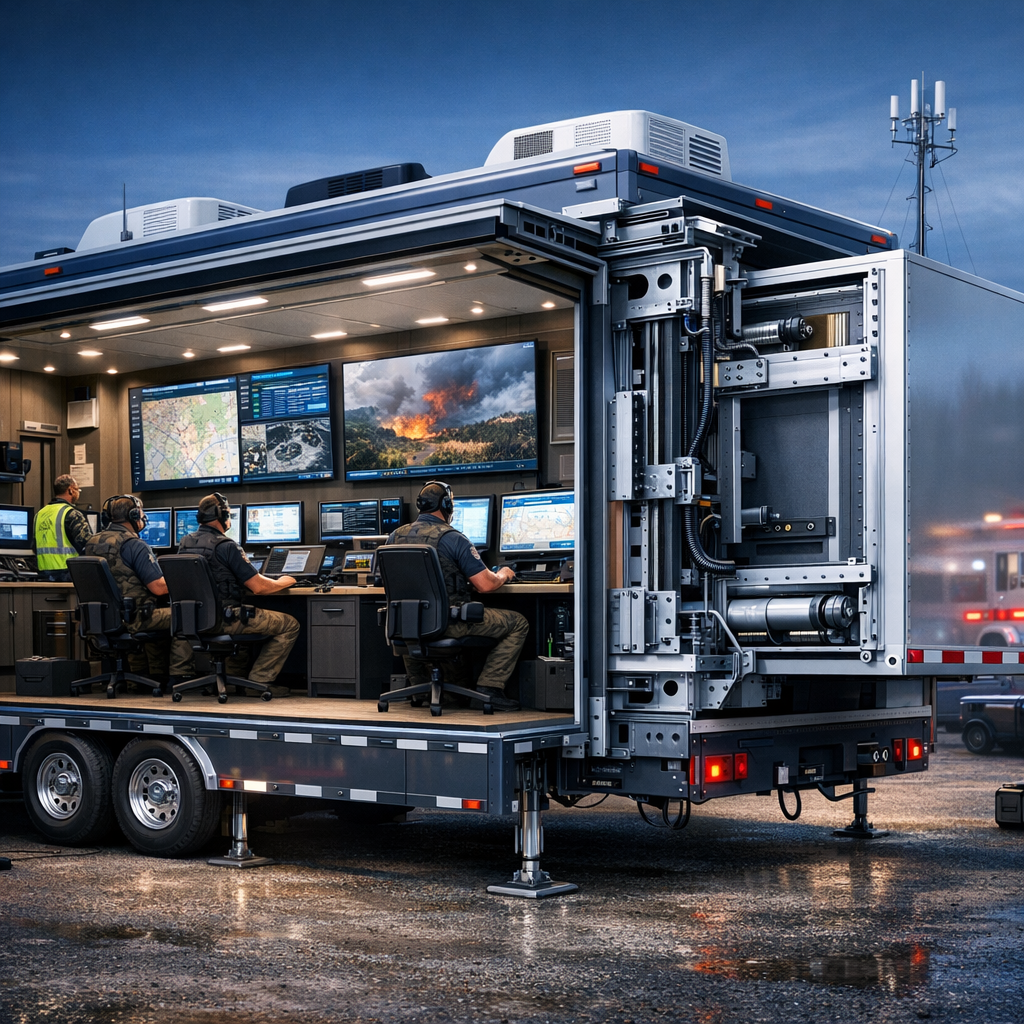
An expandable slide-out section is a retractable room segment built into a mobile command trailer wall that extends outward during deployment, increasing usable interior space by up to 30%. Electric, hydraulic, or cable-driven mechanisms push a reinforced assembly of walls, floor, and roof beyond the trailer's standard footprint, then retract it flush for road-legal transport.
We cover slide-out mechanism types and mechanical deployment sequences, weatherproofing and structural reinforcement, space capacity and integrated building systems, safety and maintenance protocols, and regulatory and custom design considerations.
Slide-out mechanisms fall into four primary categories: hydraulic, electric, manual crank, and cable-and-gear systems. Each converts stored energy into controlled linear force through guide rails, rollers, and synchronization hardware that prevents the room from skewing during travel.
Weatherproofing uses layered wiper seals, floor gaskets, and inflatable compression bladders to protect sensitive communications equipment from moisture and debris. Structural reinforcements in the floor, walls, and roof absorb both static deployment loads and dynamic highway vibration.
A single slide-out can add roughly 40 to 80 square feet of floor space, while dual opposing or full-width triple configurations can exceed 200 square feet. Electrical runs, HVAC ducts, and shielded data cables all route through flexible pathways that maintain full connectivity as walls move.
Auto-leveling verification, obstruction sensors, and manual overrides form a three-layer safety system that protects personnel throughout every deployment cycle. Regular lubrication, seal inspections, and drive system checks keep slide-outs reliable across years of field use.
Gross vehicle weight ratings, axle load distribution limits, and state width restrictions directly shape how many slide-outs a trailer can carry and where engineers position them. Craftsmen Industries designs each mobile command trailer as a unified system, engineering slide-out mechanisms, structural reinforcements, and integrated electronics together from its facility in St. Charles, Missouri.
What Is an Expandable Slide-Out Section on a Mobile Command Trailer?
An expandable slide-out section on a mobile command trailer is a retractable room segment built into the trailer wall that extends outward during deployment to increase usable interior space. These sections use electric, hydraulic, or cable-driven mechanisms to push a reinforced wall, floor, and roof assembly beyond the trailer's standard footprint. When retracted, the slide-out sits flush within the trailer body for safe road travel. Once on scene, operators deploy the section to create additional room for workstations, communications equipment, and personnel. Mobile command centers often use modular slide-outs to expand workspace and increase interior capacity by up to around 30%. For emergency management and multi-agency response, this added space transforms a transport-width trailer into a fully functional command post within minutes, without requiring a larger permanent chassis.
Why Are Slide-Out Sections Used in Mobile Command Trailers?
Slide-out sections are used in mobile command trailers because they solve the fundamental conflict between road-legal transport dimensions and the operational space emergency teams require on scene. The subsections below cover the core space limitations, rapid deployment demands, and multi-agency coordination needs that make slide-outs essential.
What Space Limitations Do Standard Trailers Present?
Standard trailers present strict space limitations imposed by Department of Transportation width and height regulations. A typical highway-legal trailer body without special permits is generally limited to 8 feet 6 inches wide, which barely accommodates a narrow corridor once workstations, server racks, and communications equipment are installed. Personnel cannot move freely, and critical functions like mapping displays or dispatch consoles compete for the same cramped footprint. Slide-out sections address this constraint directly by expanding the usable interior beyond the road-legal envelope once the trailer reaches its destination. Modern mobile command centers often use modular slide-outs to increase interior capacity by up to around 30%, according to Craftsmen Industries. That additional square footage transforms an otherwise restrictive shell into a functional operations center.
How Do Slide-Outs Support Rapid Emergency Deployment?
Slide-outs support rapid emergency deployment by converting a transport-ready trailer into a full-scale command post within minutes. Operators activate the extension system from a single control panel, and hydraulic or electric mechanisms push the slide-out room to its locked position without manual assembly. This speed matters because delayed emergency response carries severe consequences; a study published by the National Institutes of Health found that survival chances at a scene where lives are on the line drop by 6% every minute response is delayed. Pre-built slide-out rooms arrive with workstations, monitors, and communication terminals already installed inside. Once extended, the space is immediately operational. No scaffolding, no tent assembly, and no time wasted configuring a workspace from scratch. For incident commanders, that compressed setup window can directly affect outcomes.
Why Is Additional Space Critical for Multi-Agency Coordination?
Additional space is critical for multi-agency coordination because large-scale incidents can require personnel from fire, law enforcement, EMS, and federal agencies to operate simultaneously under one roof. A single cramped trailer forces teams into rotation schedules or separate vehicles, fragmenting communication and slowing unified decision-making. Slide-outs create distinct functional zones within the same unit. One section might house a dispatch area while an opposing slide-out accommodates a briefing room with display screens. Frontline Communications documented this approach in a Hunterdon County mobile command unit where four large slide-outs expanded the interior, providing sufficient room to accommodate additional personnel and maintain a workable layout during multi-agency responses. Dedicated zones reduce cross-talk, improve situational awareness, and keep operations organized. With growing expectations for interagency coordination during complex incidents, slide-out sections have become a practical necessity.
What Are the Main Types of Slide-Out Mechanisms Used in Command Trailers?
The main types of slide-out mechanisms used in command trailers are hydraulic, electric, manual crank, and cable and gear systems. Each mechanism offers distinct advantages for deployment speed, load capacity, and field reliability.
Hydraulic Slide-Out Systems
Hydraulic slide-out systems use pressurized fluid driven by a hydraulic pump to extend and retract slide-out rooms. These systems generate the highest force output among all mechanism types, making them ideal for command trailers with heavy slide-out sections loaded with communications equipment and workstations.
According to Keystone RV, these systems rely on electricity and hydraulic power to extend and retract the slideouts. Hydraulic cylinders provide smooth, controlled motion even under substantial loads. Modern slide-out systems also incorporate sophisticated weather protection features, including double-barrier seal designs and UV-resistant materials, which pair well with the structural demands hydraulic units handle.
For command trailers requiring maximum payload capacity per slide-out section, hydraulic mechanisms remain the most dependable choice.
Electric Slide-Out Systems
Electric slide-out systems use 12-volt DC motors to drive the extension and retraction of slide-out rooms. These motors connect to a rack-and-pinion or gear mechanism that converts rotational force into linear movement.
Electric systems are lighter than hydraulic alternatives and require less maintenance since they eliminate hydraulic fluid, hoses, and pumps. Operators control deployment through a simple wall-mounted switch or integrated control panel, making setup faster during time-sensitive emergency responses. However, electric motors demand adequate battery voltage; insufficient power is a common cause of deployment failures. For command trailers where weight savings and simplified maintenance outweigh maximum load capacity, electric systems strike a practical balance.
Manual Crank Slide-Out Systems
Manual crank slide-out systems use a hand-operated crank mechanism to extend and retract the slide-out section through a gear-driven assembly. These systems require no electrical or hydraulic power, which makes them function as reliable backup options during power failures.
The trade-off is slower deployment speed and greater physical effort from the operator. In command trailer applications, manual cranks are rarely the primary mechanism; they more commonly serve as emergency overrides integrated alongside electric or hydraulic systems. This redundancy ensures that slide-out sections remain operable even when primary power sources are unavailable, a critical requirement during prolonged field operations.
Cable and Gear Slide-Out Systems
Cable and gear slide-out systems use a network of cables and pulleys, in combination with an electric motor, to drive the slide room in and out. The motor winds or unwinds steel cables routed through a pulley arrangement, pulling the slide-out along guide rails.
These systems distribute force evenly across the slide-out structure, reducing stress on any single point. Cable-driven mechanisms tend to be quieter during operation compared to rack-and-pinion designs. Proper cable tension and periodic lubrication are essential for reliable performance; slack cables can cause misalignment or binding during deployment.
Understanding these mechanism types helps inform the next consideration: what happens mechanically when a slide-out section deploys.
What Happens Mechanically When a Slide-Out Section Deploys?
A slide-out section deploys through coordinated interaction between guide rails, a drive system, and synchronization mechanisms. These three subsystems control direction, force, and alignment during every extension cycle.
How Do the Guide Rails and Rollers Control Movement?
The guide rails and rollers control movement by constraining the slide-out room to a single linear path. Steel or aluminum rails, mounted along the floor and ceiling of the main trailer body, act as fixed tracks. Bearing-equipped rollers attached to the slide-out section ride along these rails, distributing the room's weight across multiple contact points.
This arrangement eliminates lateral drift during extension and retraction. The rollers reduce friction so the drive system can move hundreds of pounds of structure, equipment, and interior finishes without binding. Precision alignment between upper and lower rail sets is critical; even minor misalignment increases wear on both rollers and seals. For command trailers carrying sensitive communications equipment, smooth rail travel also minimizes vibration transferred to mounted electronics.
How Does the Drive System Initiate and Stop Extension?
The drive system initiates and stops extension by converting electrical or hydraulic energy into controlled linear force. Common configurations include rack-and-pinion gears driven by 12V DC motors, hydraulic cylinders, and cable-pulley assemblies. According to The Fit RV, cable slides use a system of cables and pulleys, in combination with an electric motor, to drive the slide room in and out.
When an operator activates the deployment switch, the motor or hydraulic pump engages and applies force along the guide rail axis. Limit switches at full extension and full retraction positions signal the control module to cut power, stopping the room precisely at its engineered endpoints. This prevents over-travel that could damage seals or structural framing.
How Do Synchronization Mechanisms Prevent Racking?
Synchronization mechanisms prevent racking by ensuring both sides of a slide-out section extend at the same rate. Racking occurs when one side leads the other, causing the room to skew diagonally within its guide rails. This misalignment stresses frame joints, damages weatherproofing seals, and can jam the entire mechanism.
Dual-motor systems address this through electronic controllers that monitor each motor's position and adjust speed in real time. Mechanical linkage systems use cross-shafts or synchronized gear trains to physically couple both sides, preventing uneven extension. In cable-driven designs, balanced pulley routing achieves the same effect. Consistent synchronization is especially important in mobile command trailers, where racking could compromise the integrity of integrated workstations and communication systems.
With the mechanical sequence understood, proper sealing ensures the deployed section remains protected from the elements.
How Are Slide-Out Sections Sealed and Weatherproofed?
Slide-out sections are sealed and weatherproofed through a multi-layer system of wiper seals, floor seals, and inflatable gaskets. Each layer addresses a specific vulnerability point along the slide-out perimeter.
How Do Wiper Seals Protect the Slide-Out Perimeter?
Wiper seals protect the slide-out perimeter by pressing flexible rubber or vinyl flanges against the outer face of the slide-out room as it extends and retracts. These seals line the top, sides, and sometimes the bottom of the main trailer opening, creating continuous contact that sheds rain, blocks wind, and prevents debris intrusion. According to Daisy RV, slide-out seals serve as "your RV's first line of defense against water leaks, wind, and pests." In mobile command trailers, where electronics and communications equipment fill the interior, even minor moisture penetration can compromise sensitive systems. Wiper seals deform slightly under compression, which allows them to maintain contact even as the slide-out shifts during travel or uneven terrain deployment.
How Does the Floor Seal Maintain a Watertight Transition?
The floor seal maintains a watertight transition by bridging the gap between the trailer's fixed floor and the slide-out room's moving floor panel. This seal typically consists of a bulb-style gasket or a flap seal mounted along the threshold where the two floor surfaces meet. When the slide-out extends, the gasket compresses against the moving floor's underside, blocking water from pooling or wicking beneath the joint. Proper drainage channels often accompany floor seals, directing any captured moisture outward. For command trailers that deploy on wet or muddy ground, this layer is critical; without it, standing water would migrate into the workspace and damage flooring, cable runs, and equipment racks housed at floor level.
How Do Inflatable Gaskets Create a Final Compression Seal?
Inflatable gaskets create a final compression seal by using air pressure to expand a rubber bladder against the slide-out room's outer walls once deployment is complete. After the slide-out reaches full extension and wiper seals establish initial contact, the inflatable gasket pressurizes to fill remaining gaps that static seals cannot reach. This produces uniform compression across irregular surfaces, compensating for manufacturing tolerances and frame flex accumulated during transport. In high-specification mobile command trailers, inflatable gaskets are especially valuable because they form an airtight barrier that supports climate control and acoustic insulation inside the operational workspace.
With sealing systems in place, structural reinforcements ensure the slide-out withstands travel stress.
What Structural Reinforcements Do Slide-Out Sections Require?
Slide-out sections require reinforcements to the floor, walls, and roof that maintain structural integrity during both travel and deployment. Each zone addresses distinct load and stress conditions.
How Is the Trailer Floor Reinforced Beneath a Slide-Out?
The trailer floor is reinforced beneath a slide-out using steel crossmembers, thicker subfloor decking, and load-distributing plates along the guide rail mounting points. Standard trailer flooring cannot support the concentrated weight of a fully equipped slide-out room carrying communications consoles, seating, and personnel.
Engineers typically design reinforced subframe structures using welded or bolted steel or aluminum members such as crossmembers or C-channel components, integrated into the vehicle body and chassis interface to support slide-out mechanisms and distribute structural loads. This transfers the slide-out's static and dynamic loads into the trailer's primary structural members rather than relying on the floor alone. Plywood or composite subfloor panels in the slide-out path are often doubled in thickness to resist deflection under repeated cycling.
How Are Slide-Out Walls Framed to Handle Travel Stress?
Slide-out walls are framed to handle travel stress through aluminum or steel stud framing at tighter intervals than standard trailer walls. While a typical wall may use 16-inch stud spacing, slide-out walls often reduce this to 12 inches or less, increasing rigidity against lateral forces encountered during highway travel.
Corner gussets and diagonal bracing resist racking, the twisting force that occurs when road vibrations push the extended room's frame out of square. Because slide-out walls must be lightweight enough for the drive system to extend yet rigid enough to resist deformation, many command trailer builders use bonded composite panel construction that combines structural strength with reduced weight.
How Does the Roof Section Maintain Integrity During Extension?
The roof section maintains integrity during extension by using a reinforced header beam at the transition point where the slide-out separates from the main trailer body. This beam carries the roof load across the opening when the room deploys.
According to a Frontline Communications case study, four large slide-outs expand the interior of a mobile command unit, providing sufficient room to accommodate additional personnel during multi-agency responses. Supporting that kind of expansion demands roof panels with internal ribbing or honeycomb core that resist sagging under snow loads or wind uplift. Continuous sealing flanges along the roof edges also prevent water intrusion at the moving joint, which would otherwise compromise structural materials over time.
Understanding these reinforcement strategies clarifies how weight distribution affects overall trailer compliance and design.
How Much Usable Space Does a Slide-Out Section Add?
A slide-out section adds usable space ranging from a moderate single-side expansion to a dramatic full-width expansion, depending on the configuration. The subsections below cover single-side, dual opposing, and full-width triple slide-out layouts.
How Much Space Does a Single-Side Slide-Out Add?
A single-side slide-out can add roughly 3 to 4 feet of depth along one wall of a mobile command trailer. This extension creates room for an additional row of workstations, communications equipment, or seating that would otherwise not fit well within the transport-width envelope. Modern MCCs often use modular slide-outs to expand workspace and increase interior capacity by up to 30%. That gain is significant when measured against the tight confines of a standard trailer body, often turning a narrow corridor into a functional operations area. For single-slide configurations, the midrange of the amount of extra floor space gained may fall around 40 and 80 square feet gained, though it can be more or less.
How Much Space Do Dual Opposing Slide-Outs Add?
Dual opposing slide-outs add usable space on both sides of the trailer simultaneously, effectively doubling the lateral expansion compared to a single slide. When two slides extend outward from opposite walls, the interior width can grow from approximately 8 feet to 14 or 16 feet. This layout can yield 80 to 150 additional square feet, creating an open floor plan wide enough for parallel workstation rows with a central aisle between them. The symmetrical extension also distributes weight more evenly across the trailer's axle groups, which simplifies leveling. Dual configurations are particularly well suited for command posts requiring distinct operational zones, such as a dispatch area on one side and a briefing area on the other.
How Much Space Does a Full-Width Triple Slide-Out Add?
A full-width triple slide-out adds the maximum usable space achievable in a single trailer section, often adding around 120 to 200 square feet of additional floor area. This configuration combines two opposing slides with a third extension, typically on the rear wall, creating an open room that rivals a small fixed building in functional layout. Commanders gain enough space for extra workstations, a dedicated briefing area, and equipment racks without crowding aisles. Although the space gains are substantial, each additional slide increases mechanical complexity and overall trailer weight. Balancing operational capacity against transportability is one of the most important decisions in mobile command trailer design, especially for units that must deploy rapidly across varied terrain.
With usable space defined, the next consideration is how electrical and HVAC systems integrate with these expanding sections.
What Electrical and HVAC Systems Must Integrate with Slide-Outs?
Electrical, HVAC, and data systems must all integrate with slide-outs to maintain full operational capability in both retracted and deployed positions. The subsections below cover routing for electrical runs, HVAC duct extension, and network cable protection.
How Are Electrical Runs Routed Through a Moving Wall Section?
Electrical runs are routed through a moving wall section using flexible wiring looms and service loops that accommodate the full range of slide-out travel. Bundled conductors pass through the stationary-to-moving transition point inside protective conduit or cable carriers that flex without kinking. According to a Frontline Communications case study on Hunterdon County's mobile command unit, the vehicle features four expansive slide-outs alongside multiple communications systems including VHF/UHF, cellular, and satellite connectivity, all of which require uninterrupted power delivery across every moving wall section.
Service loops are sized with enough slack to prevent tension at full extension while avoiding excess cable that could snag during retraction. Strain-relief brackets anchor the wiring at fixed intervals on both the stationary chassis and the moving panel, distributing mechanical stress across multiple points rather than concentrating it at a single junction.
How Do HVAC Ducts Extend into Deployed Slide-Out Space?
HVAC ducts extend into deployed slide-out space through telescoping or flexible duct sections that expand as the slide-out moves outward. Because a slide-out is a cut-out portion of the trailer that extends and retracts to increase available living and working space, the climate system must deliver conditioned air into an area that changes volume with each deployment cycle.
Flexible duct connectors bridge the gap between the fixed main trunk line and registers mounted inside the slide-out ceiling or floor, commonly made from reinforced polymer or insulated flexible HVAC ducting. Dampers at the transition point can close automatically when the section retracts, preventing backflow into a sealed cavity. For command trailers loaded with heat-generating electronics, properly sized HVAC integration is not optional; it directly affects equipment reliability and operator endurance during extended incidents.
How Are Network and Data Cables Protected During Deployment?
Network and data cables are protected during deployment through shielded cable carriers, flexible conduit, and strain-relief anchoring systems designed to absorb repeated extension and retraction cycles. High-performance cables, such as Cat6A ethernet and fiber optic lines, are particularly sensitive to bend radius violations that degrade signal quality, with fiber optic lines being the more sensitive.
Cable carriers with fixed bend radii guide data runs along a controlled path, preventing sharp kinks at any point during travel. Shielded conduit adds electromagnetic interference protection, which is critical when cables run near slide-out motors and high-amperage power feeds. Connectors at the stationary-to-moving junction often use quick-disconnect plugs, allowing maintenance access without rerouting entire cable bundles. For mobile command operations that depend on real-time data feeds, protecting these cables is as mission-critical as any structural or mechanical system in the trailer.
What Safety Systems Prevent Failures During Slide-Out Operation?
Safety systems prevent failures during slide-out operation through auto-leveling verification, obstruction detection, and manual override capabilities. These three layers protect personnel and equipment throughout the deployment cycle.
How Do Auto-Leveling Systems Stabilize Before Deployment?
Auto-leveling systems stabilize before deployment by confirming the trailer sits within a preset grade tolerance before unlocking slide-out controls. Most operators follow the recommended practice of keeping slides retracted during leveling, then deploying only after the system confirms a stable, level platform. This sequence prevents uneven loading that could bind guide rails or stress the slide-out frame.
In mobile command trailer applications, where uneven terrain is common at emergency scenes, this pre-deployment check is especially critical. Skipping the leveling verification risks racking the slide mechanism, which can cause seal failure and structural misalignment over repeated cycles.
How Do Obstruction Sensors Stop a Slide-Out Mid-Cycle?
Obstruction sensors stop a slide-out mid-cycle by monitoring resistance against the drive system during extension or retraction. When the sensor detects force exceeding a calibrated threshold, it signals the motor controller to halt movement immediately. This prevents the mechanism from crushing objects, damaging seals, or overloading the drive motor.
Sensor types commonly used include:
- Current-sensing relays that detect motor amperage spikes from physical resistance.
- Limit switches positioned along the travel path to confirm full extension or retraction.
- Pressure transducers in hydraulic systems that flag abnormal line pressure.
For field-deployed command trailers, obstruction detection is essential since personnel and equipment frequently occupy the deployment zone.
How Do Manual Override Systems Work If Power Fails?
Manual override systems work by providing a mechanical bypass that allows operators to retract or extend a slide-out without electrical power. According to the Power Gear Service Manual, slide-out motors require significant power, and low battery voltage is one of the most common reasons a slide-out stops mid-cycle.
Override methods vary by mechanism type:
- Rack-and-pinion systems typically include a hand-crank socket accessible from the trailer's exterior or interior compartment.
- Hydraulic systems use a manual pump or pressure-release valve to move fluid through the cylinder.
- Cable-driven systems may incorporate a manual winch attachment.
For mobile command trailers deployed during emergencies, reliable manual overrides ensure the unit can return to transport configuration regardless of electrical conditions. Understanding these safety layers also helps when planning long-term slide-out maintenance.
How Are Slide-Out Sections Maintained Over Time?
Slide-out sections are maintained over time through regular lubrication, seal inspections, and mechanical system checks. Key maintenance areas include lubrication schedules, seal condition monitoring, and drive system servicing.
Lubrication is the single most important recurring task. According to KOA, operators should lubricate slide-outs at least three times each year to keep rails, gears, and seals functioning smoothly. For mobile command trailers deployed in harsh field conditions, increasing that frequency is a practical decision that prevents costly binding or motor strain. Lubrication should use dry, non-petroleum-based products, as oil lubricants attract dirt and debris that can accelerate wear.
Beyond lubrication, consistent maintenance involves:
- Inspecting wiper seals and gaskets for cracking, compression loss, or UV degradation after each deployment cycle.
- Cleaning slide-out rails and roller tracks to remove dirt, sand, and debris that accelerate wear.
- Testing drive motors, hydraulic lines, or cable tension for signs of reduced performance before field operations.
- Checking electrical connections at flex points where wiring routes through moving wall sections.
- Verifying roof and floor seals maintain watertight transitions, particularly after prolonged storage.
Operators should also confirm battery voltage before each deployment, since underpowered motors place uneven stress on synchronization mechanisms. A pre-deployment checklist that covers these items takes minutes but prevents the kind of mid-operation failures that compromise mission readiness.
For high-use command trailers, scheduling professional inspections at least annually ensures structural mounting points and hidden wear areas receive expert evaluation. With weight and towing regulations also shaping long-term design considerations, keeping slide-out systems in peak condition directly supports compliance and operational safety.
What Are Common Slide-Out Problems in Mobile Command Trailers?
Common slide-out problems in mobile command trailers include seal degradation, motor failures, alignment issues, and electrical faults. These problems range from minor maintenance oversights to structural concerns that can compromise deployment readiness.
- Seal deterioration: Wiper seals and gaskets crack or compress over time, allowing water intrusion and air leaks that damage interior electronics and climate control.
- Low battery voltage: Slide-out motors require significant power, and insufficient voltage is one of the most common reasons a slide-out fails to extend or retract, according to Harvest Hosts troubleshooting guidance.
- Alignment drift: Repeated road vibration shifts guide rails and rollers out of spec, causing the slide-out room to rack or bind mid-cycle.
- Hydraulic fluid leaks: Seals within hydraulic cylinders degrade under temperature cycling, leading to slow or incomplete extension.
- Debris obstruction: Dirt, gravel, and ice accumulate in track channels, blocking smooth travel and stressing drive components.
- Electrical relay and switch failures: Corroded connections or worn contactors prevent the control signal from reaching the motor.
For mission-critical command trailers, even a single failed slide-out can reduce operational workspace and delay emergency response. Proactive inspection schedules catch most of these issues before they escalate. Understanding weight and towing constraints further protects slide-out longevity during transit.
How Do Weight and Towing Regulations Affect Slide-Out Design?
Weight and towing regulations affect slide-out design by imposing limits on total trailer mass, axle load distribution, and overall dimensions that engineers must account for before adding expandable sections.
Every slide-out section adds structural framing, drive mechanisms, sealing systems, and floor reinforcement. These components increase the trailer's curb weight by hundreds of pounds per slide-out, which directly reduces the remaining payload capacity available for mission-critical equipment such as communications consoles, server racks, and workstations.
Gross vehicle weight rating (GVWR) defines the maximum weight a vehicle or trailer can safely carry, including its own weight plus all cargo and passengers. Exceeding GVWR compromises braking performance, tire integrity, and suspension lifespan.
Axle weight distribution presents an equally critical constraint. Maintaining reasonably balanced loads across axle groups is important for vehicle stability, tire wear, and suspension performance, which means slide-out placement cannot be arbitrary. For example, some transportation authorities specify axle load-balancing requirements for certain vehicle configurations; the Texas Department of Motor Vehicles states that weight differences between any two axles in a group should not exceed 10%. Engineers must position each expandable section so that its extended and retracted states both maintain compliant axle loading. A rear-heavy slide-out that shifts the center of gravity rearward can overload the rear axle group while underloading the front, creating an unsafe towing condition.
Width restrictions also shape design decisions. Most states limit trailer width to 8 feet 6 inches for standard travel on public roads without special permits. Slide-out sections must retract fully within this envelope, which constrains the wall thickness, seal profile, and mechanism housing that designers can specify. Oversized command trailers requiring route surveys and escort vehicles add significant deployment complexity and cost.
For mobile command trailers carrying dense electronics and multiple operator stations, these regulatory boundaries force deliberate engineering trade-offs. Lighter aluminum framing may replace steel to preserve payload margin. Fewer but larger slide-outs may prove more weight-efficient than numerous smaller ones, since each additional slide-out duplicates drive hardware and sealing assemblies. Material selection, mechanism type, and slide-out quantity all flow directly from the weight and dimensional budget that regulations establish.
Understanding these constraints early in the design process prevents costly mid-build changes and ensures the finished trailer operates legally across jurisdictions.
How Can Custom Mobile Command Trailers Meet Your Operational Needs?
Custom mobile command trailers meet operational needs by combining mission-specific engineering with expandable slide-out technology. The sections below cover Craftsmen Industries' custom build capabilities and the key takeaways from how slide-out sections work.
Can Craftsmen Industries Build Custom Slide-Out Command Trailers?
Yes, Craftsmen Industries can build custom slide-out command trailers. With over 40 years of experience in custom fabrication, Craftsmen Industries designs and engineers mobile command centers from its 127,000 sq. ft. facility in St. Charles, Missouri. Every build is completed in-house, from initial concept through final delivery, giving agencies and organizations full control over slide-out configurations, interior layouts, and integrated communications systems.
This vertically integrated approach means slide-out mechanisms, structural reinforcements, electrical routing, and weatherproofing seals are all engineered as a unified system rather than assembled from disconnected components. For agencies requiring specialized command, control, and communications platforms, Craftsmen Industries tailors each trailer to the mission profile.
What Are the Key Takeaways About How Expandable Slide-Out Sections Work in Mobile Command Trailers?
The key takeaways about how expandable slide-out sections work in mobile command trailers center on five core principles:
- Slide-out sections use hydraulic, electric, or cable-driven mechanisms to extend retractable wall segments from the trailer body, creating additional operational space on-site.
- Properly engineered slide-outs can increase interior capacity by up to 30%, transforming a transport-sized trailer into a full-scale command center.
- Weatherproofing relies on multi-layer seal systems, including wiper seals, floor seals, and compression gaskets, that protect electronics and personnel from water, wind, and debris.
- Structural reinforcements in the floor, walls, and roof absorb travel vibration and support the added weight of extended sections during deployment.
- All electrical, HVAC, and data systems must route through flexible pathways that maintain connectivity as walls move.
As FEMA's Authorized Equipment List defines, these are "special-purpose vehicles for the purpose of mobile, on-site platforms for command, control and communications during terrorist attacks and other emergencies”, as well as for use in other applications by law enforcement, utility companies, and event security teams. Understanding each mechanical and structural layer helps agencies specify the right slide-out configuration for reliable field performance.