
10 min read
How Do Different Trailer Mobility Options Compare for Various Uses?
Craftsmen Industries May 13, 2026 12:22:55 PM
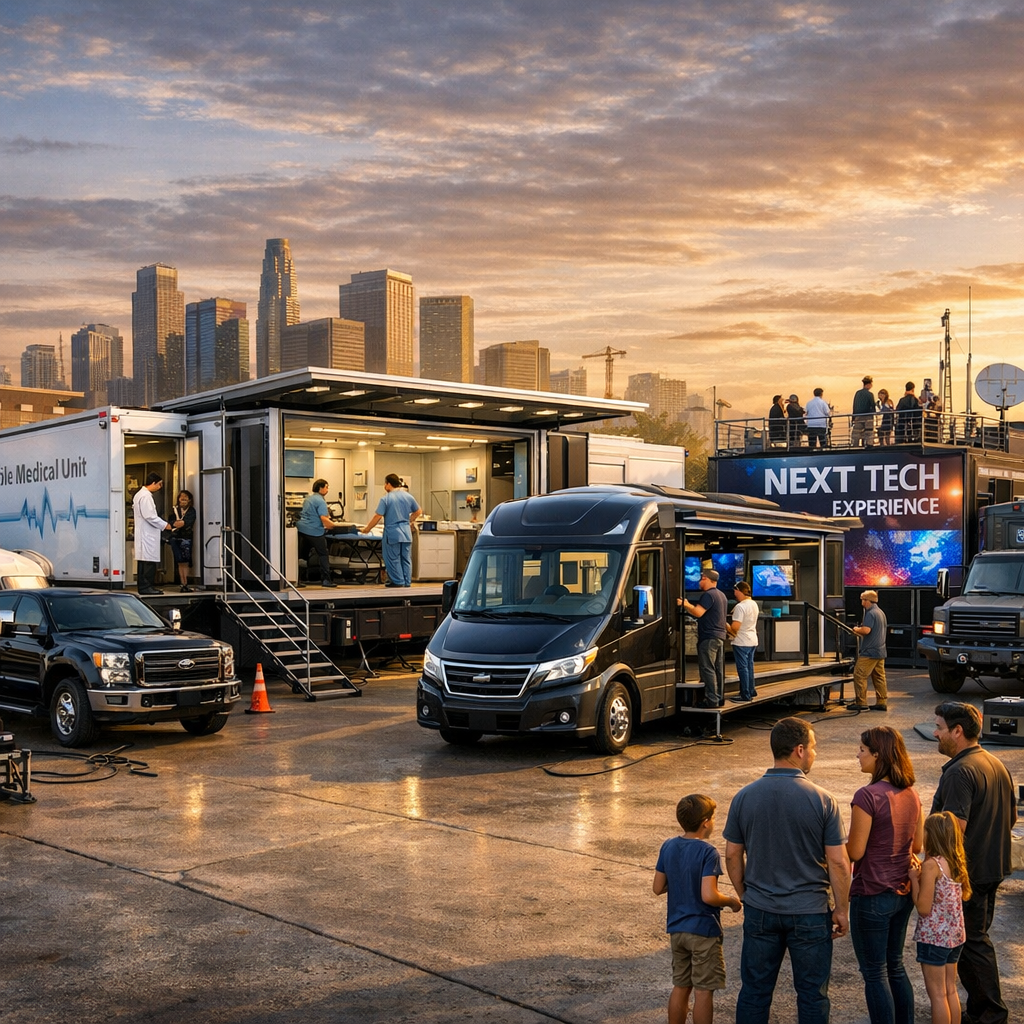
Trailer mobility options are portable, vehicle-based platforms designed to transport services, products, or experiences to specific locations. These solutions range from towable trailers and drivable mobile units to expandable modular systems and fully custom-built vehicles.
This guide covers the types of trailer mobility solutions available, selection factors and regulations, industry-specific applications, cost considerations, and the trade-offs between each option.
Towable trailers, drivable coaches, and expandable units each serve distinct operational roles. Towable options typically cost less upfront and separate the vehicle from the workspace, while drivable units consolidate transit and operations into a single chassis. Expandable trailers remain road-legal during transport, then deploy hydraulically to create significantly larger interior floor plans on site.
Choosing the right mobility option depends on weight and size constraints, local permitting rules, and long-term maintenance demands. Federal regulations set maximum widths and lengths for interstate travel, and specialized uses like mobile healthcare require additional state-level certifications that vary by jurisdiction.
Healthcare, experiential marketing, and industrial sectors each place different demands on trailer design. Mobile medical units serve populations with limited access to fixed facilities, while branded marketing trailers and showrooms function as traveling engagement spaces that drive measurable consumer response. Industrial applications prioritize rugged construction, heavy payload capacity, and rapid deployment.
Purchase prices span a wide range depending on size, equipment, and customization level. Ongoing operational expenses, including personnel, fuel, and maintenance, often represent the largest share of total ownership cost. Custom fabrication increases the initial investment but can deliver higher utilization and stronger returns across the unit's service life.
Each mobility type carries specific advantages and limitations in maneuverability, setup time, interior space, and scalability. Understanding these trade-offs ensures organizations select the platform that aligns with their operational goals and budget.
What Are the Main Types of Trailer Mobility Solutions Available?
The main types of trailer mobility solutions are towable trailers, drivable mobile units, expandable or modular trailers, and custom-built trailers. Each type serves different operational needs across healthcare, experiential marketing, and industrial applications.
How Do Towable Trailers Differ from Drivable Mobile Units?
Towable trailers differ from drivable mobile units in cost structure, deployment flexibility, and operational independence. Towable trailers rely on a separate towing vehicle for transport, which separates the drivetrain from the workspace. Drivable mobile units integrate the engine and living or working space into a single chassis.
A 2020 industry analysis by the Mobile Healthcare Association found that trailers cost 30–40% less than comparably equipped mobile clinics. Because towable trailers share the tow vehicle's power system, fuel and insurance costs tend to be lower. Drivable units, however, eliminate towing complexity entirely and allow operators to keep a separate personal vehicle.
Fifth-wheel trailers offer better stability and more usable floor space than standard travel trailers, making them practical for commercial applications. For organizations prioritizing budget efficiency, towable configurations consistently deliver more interior space per dollar spent.
What Are the Features of Expandable or Modular Trailers?
The features of expandable or modular trailers center on hydraulic expansion systems, climate control integration, and rapid single-operator deployment. These trailers travel within standard road width, then expand outward onsite to create a wide, unobstructed floor plan.
According to Facility Executive Magazine, a mobile hospital built on a standard tractor trailer chassis can include two expandable sections that open to provide nearly 1,000 square feet of interior space per unit, with six patient rooms, a nurse's station, a restroom, and two entry/exit points.
Key features include:
- A synchronized hydraulic system controlling both floor and wall sections, paired with automatic leveling.
- Single-operator setup via remote control under standard conditions.
- Climate-controlled interiors with filtered air intake (no recirculation) meeting stringent air exchange requirements.
- Enhanced floor insulation and high-capacity air conditioning for demanding environments.
Available in 53 ft and 38 ft configurations, expandable trailers are among the most space-efficient mobile platforms available today.
How Do Custom-Built Trailers Enhance Mobility Capabilities?
Custom-built trailers enhance mobility capabilities by aligning every design element, from structural layout to onboard systems, with the specific operational requirements of the end user. Unlike off-the-shelf units, custom builds incorporate purpose-driven engineering for hydraulic systems, HVAC, electrical infrastructure, and specialized equipment integration.
According to Facility Executive Magazine, a complete custom hospital trailer can be finished in 16 weeks, with full onsite setup (plumbing, HVAC, power) taking one to three days. This accelerated timeline makes custom trailers practical for time-sensitive deployments such as disaster response or multi-city marketing tours.
Companies like Craftsmen Industries specialize in end-to-end custom fabrication, offering in-house design, engineering, and production capabilities that allow for complete control over specialized features like hydraulic systems, climate control integration, and branded interiors.
Understanding the types of trailer mobility solutions available sets the foundation for evaluating which factors matter most during selection.
Which Factors Should Be Considered When Choosing a Trailer Mobility Option?
The factors that should be considered when choosing a trailer mobility option include weight and size constraints, local and federal regulations, and ongoing maintenance demands. Each factor directly shapes which mobility type fits a given operation.
What Are the Weight, Size, and Capacity Limitations?
The weight, size, and capacity limitations for trailer mobility options are defined by federal standards and the physical design of each unit. Federal regulations limit commercial motor vehicle width to 102 inches (8.5 feet) and semitrailer length to 53 feet on the Interstate System, according to the Federal Highway Administration (FHWA). Federal law also prohibits states from imposing length limits below 28 feet on semitrailers in interstate commerce.
Key physical constraints include:
- Gross Vehicle Weight Rating (GVWR) determines towing vehicle requirements and route eligibility.
- Expandable trailers ship within standard road width, then extend onsite for larger floor plans.
- Fifth-wheel trailers offer shorter overall length with more usable interior space than comparable travel trailers.
Matching payload capacity to onboard equipment, whether medical devices or experiential marketing displays, is the single most overlooked step in trailer selection. Underestimating loaded weight leads to compliance violations and accelerated mechanical wear.
How Do Local Regulations Impact Mobility Choices?
Local regulations impact mobility choices by adding state and municipal requirements on top of federal standards. Insurance minimums vary by use case: the FMCSA requires for-hire property carriers with a GVWR of 10,001 pounds or more to carry a minimum of $750,000 in Bodily Injury and Property Damage (BIPD) insurance.
Additional regulatory layers to evaluate include:
- State-level permitting for oversized or overweight loads, which varies significantly by jurisdiction.
- Healthcare-specific licensing, such as New York State requiring that only Article 28 hospitals or diagnostic and treatment centers may operate mobile extension clinics.
- The 2024 SAMHSA final rule permitting mobile medication units to dispense methadone, with a compliance date of October 2, 2024.
Operators who plan multi-state routes for experiential marketing tours or mobile medical deployments should map regulatory requirements per state early in the planning process. Retroactive compliance is far more expensive than proactive route planning.
What Level of Maintenance Is Required for Each Mobility Type?
The level of maintenance required for each mobility type ranges from basic towable upkeep to complex drivable vehicle servicing. Towable trailers generally require lower maintenance because they rely on a separate towing vehicle for drivetrain and engine systems. Drivable mobile units consolidate everything into one chassis, which increases maintenance scope.
According to a 2024 NIH study on mobile clinic operations, vehicle maintenance accounted for 23% of annual operating costs, while staff salaries represented 75%.
Core maintenance categories include:
- Towable trailers: tire inspections, brake adjustments, hitch mechanisms, hydraulic leveling systems, and exterior graphics.
- Drivable units: all of the above plus engine service, transmission, fuel system, and emissions compliance.
- Specialized systems: HVAC filtration, onboard medical equipment calibration, and climate control for units operating across varying environments.
Understanding the cost implications of regulatory compliance and maintenance together helps organizations budget accurately for total lifecycle ownership.
How Do Trailer Mobility Options Compare by Industry Application?
Trailer mobility options compare by industry application based on specific operational demands, regulatory requirements, and audience engagement goals. The following subsections cover medical services, experiential marketing events, and industrial or commercial uses.
Which Mobility Solutions Are Best Suited for Medical Services?
The mobility solutions best suited for medical services are expandable trailers, mobile clinic vans, and towable screening units. Each configuration addresses different clinical needs, from basic health screenings to fully equipped mobile hospitals with patient rooms, HVAC filtration, and diagnostic equipment.
Expandable trailer designs provide nearly 1,000 square feet of interior space per unit, accommodating six patient rooms, a nurse's station, and climate-controlled air filtration that meets stringent exchange requirements. According to Harvard Medical School, for every $1 spent on mobile health, U.S. health systems save $19, making these platforms financially viable for community outreach and disaster response.
Emerging applications include workplace health initiatives and opioid treatment programs, where SAMHSA's 2024 final rule now permits mobile medication units to dispense methadone. For organizations planning multi-site deployments, towable trailers offer a practical advantage because they cost 30 to 40% less than comparably equipped drivable units.
What Are the Top Choices for Experiential Marketing Events?
The top choices for experiential marketing events include custom-built branded trailers, mobile showrooms, vintage Airstream trailers, and converted food trucks. Each vehicle type serves a distinct activation strategy, from large-scale national tours to hyper-local pop-up engagements.
- Branded box trucks and trailers function as "billboards on wheels," offering large exterior surfaces for graphics and spacious interiors for product displays, sampling areas, and mini-stores.
- Mobile showrooms are fully customizable spaces with interiors adaptable to interactive displays and demo stations.
- Vintage Airstream trailers create an iconic aesthetic that generates immediate social media buzz for high-end brand activations.
- Converted food trucks serve double duty as service vehicles and Wi-Fi hotspots with phone charging stations.
According to a 2024 G2 report, global spending on experiential marketing is projected to hit $128.4 billion, surpassing pre-pandemic levels for the first time. With 91% of consumers reporting more positive feelings about brands after attending experiential events, investing in the right vehicle platform directly influences campaign ROI. For multi-market tours, per-location setup costs typically range from $25,000 to $60,000.
How Are Industrial and Commercial Uses Addressed with Trailer Options?
Industrial and commercial uses are addressed with trailer options through heavy-duty semi-trailers, flatbed configurations, and custom-fabricated units designed for freight transport, mobile command centers, and on-site workforce operations.
The operational economics of these applications are significant. According to the American Transportation Research Institute, the total cost per mile for trucking operations reached $2.270 in 2023, with non-fuel costs rising 6.6% year over year to $1.716 per mile. These figures make trailer selection, aerodynamic design, and weight optimization critical decisions for commercial fleet operators.
Key industrial and commercial trailer applications include:
- Mobile command centers for government and military operations
- On-site training environments for workforce development
- Disaster response units with rapid deployment capabilities
- Custom fabrication platforms for aerospace and defense contractors
Federal regulations limit commercial vehicle width to 102 inches and semitrailer length to 53 feet on Interstate highways, so every industrial build must account for these dimensional constraints during the design phase. Choosing between towable and self-propelled options often comes down to deployment frequency; operations requiring daily repositioning benefit from drivable units, while fixed-duration site deployments favor the lower acquisition cost of towable trailers.
With industry-specific requirements defined, the next step is understanding how costs vary across these trailer mobility options.
What Are the Cost Considerations for Trailer Mobility Solutions?
The cost considerations for trailer mobility solutions include purchase price, ongoing operational expenses, and customization fees. Each factor varies significantly by trailer type and intended use.
How Do Purchase Costs Vary Among Different Trailer Types?
Purchase costs vary among different trailer types based on size, function, and onboard equipment. A basic 16-ft screening trailer starts around $45,000, while a fully equipped 48-ft mobile hospital trailer exceeds $500,000. Professionally built mobile medical vehicles generally cost between $125,000 and $800,000. Towable trailers tend to be more affordable than drivable units; a 2020 industry analysis by the Mobile Healthcare Association found trailers cost 30–40% less than comparably equipped mobile clinics. For experiential marketing applications, large-scale tours with custom-built vehicles and multi-market routing can exceed $500,000 when logistics are factored in. Matching the trailer type to the mission scope prevents overspending on unnecessary capacity.
What Ongoing Operational Expenses Should Be Expected?
Ongoing operational expenses should be expected across personnel, fuel, maintenance, and depreciation. According to Mobile Health Map, the average yearly operating cost for mobile clinics is approximately $275,000, depending on services provided, patient volume, vehicle type, and distance traveled. Personnel represents the largest line item, often accounting for 75–90% of the total operating budget.
When planning mobile medical deployments, working with an experienced fabricator like Craftsmen Industries, which has designed mobile medical solutions for over 40 years, can help optimize initial vehicle specifications to reduce long-term operational costs and maintenance requirements.
Vehicle maintenance typically adds another 23% of annual costs for smaller operations. Transportation costs also add up quickly; the American Transportation Research Institute reported the total cost per mile for trucking operations reached $2.270 in 2023. Planning for these recurring expenses is essential before committing to any trailer investment.
Does Customization Significantly Affect Total Cost?
Yes, customization significantly affects total cost. Adding specialized medical equipment, expandable sections, hydraulic systems, climate control, or interactive marketing displays can push a trailer well beyond base pricing. Mobile clinic vans with standard medical upfits range from $205,000 to $285,000, but units configured as full mobile hospitals with expandable sections providing nearly 1,000 square feet of interior space require substantially higher investment. Per-location setup costs for customized experiential marketing tours range from $25,000 to $60,000, according to RMNG. The return often justifies the premium: economic studies published in NIH/PMC show mobile clinic programs can save up to $36 for every $1 invested compared to emergency department visits.
With cost variables mapped, evaluating the pros and cons of each option clarifies the best investment.
What Are the Pros and Cons of Different Trailer Mobility Options?
The pros and cons of different trailer mobility options depend on cost, flexibility, operational complexity, and deployment needs. The following subsections break down the advantages and limitations of towable versus drivable configurations.
What Are the Advantages of Towable vs. Drivable Trailers?
The advantages of towable trailers include lower acquisition costs, reduced insurance expenses, and greater interior customization potential. Towable trailers rely on a separate tow vehicle for power and transport, which keeps fuel and maintenance costs compartmentalized. A 2020 industry analysis by the Mobile Healthcare Association found trailers cost 30–40% less than comparably equipped mobile clinics.
Drivable trailers (motorized mobile units) offer key advantages of their own:
- Drivable units eliminate towing complexity, allowing a single operator to drive directly to any site.
- Motorized units provide self-contained power, HVAC, and hydraulic systems for faster setup.
- Drivable configurations navigate urban environments and tight venue spaces more easily than large tow rigs.
For organizations running multi-city experiential marketing tours or rotating medical outreach schedules, drivable units reduce the logistical coordination required at each stop. Towable options, however, remain the strongest choice when maximizing interior space per dollar is the priority.
What Limitations Should Users Be Aware of for Each Option?
The limitations users should be aware of vary by mobility type and affect routing, staffing, and long-term operational budgets.
Towable trailer limitations:
- Towing requires a CDL-rated vehicle and experienced driver, adding personnel costs.
- Maneuvering into tight event spaces or urban locations can be difficult with a tow rig.
- Setup times tend to be longer because the trailer must be leveled, stabilized, and disconnected before use.
Drivable unit limitations:
- Higher purchase prices, often $125,000 to $800,000 depending on size and onboard equipment.
- Engine, transmission, and drivetrain maintenance adds recurring costs that towable trailers avoid.
- When the vehicle requires service, the entire mobile operation goes offline.
According to the American Transportation Research Institute, the total cost per mile for trucking operations reached $2.270 in 2023, a figure that directly impacts drivable unit budgets on long-distance deployments. For most organizations, the right choice comes down to balancing upfront savings against operational simplicity, and neither option is universally superior.
Understanding these trade-offs helps narrow the field when selecting a custom mobility platform.
How Should You Approach Trailer Mobility with Custom Experiential Marketing Vehicles and Mobile Medical Units?
You should approach trailer mobility with custom experiential marketing vehicles and mobile medical units by partnering with a fabricator that offers end-to-end design, engineering, and production. The following sections cover how Craftsmen Industries addresses these needs and the key takeaways from this comparison.
Can Custom Experiential Marketing Vehicles and Mobile Medical Units from Craftsmen Industries Help With Trailer Mobility Needs?
Yes, custom experiential marketing vehicles and mobile medical units from Craftsmen Industries can help with trailer mobility needs. Founded in 1982, Craftsmen Industries is a market leader in the design, engineering, and production of experiential marketing vehicles and mobile medical solutions. The company operates from a 127,000 sq. ft. facility in St. Charles, Missouri, with over 200 employees and capabilities that include SolidWorks and AutoCAD design, hydraulic and pneumatic systems, HVAC integration, and structural fabrication.
Craftsmen Industries builds both towable and drivable configurations, from expandable hospital trailers to branded marketing vehicles. According to Facility Executive Magazine, a complete custom hospital trailer can be finished in 16 weeks, with full onsite setup (plumbing, HVAC, power) taking one to three days. For organizations evaluating trailer mobility, that combination of fabrication speed, vertical integration, and multi-industry expertise makes Craftsmen Industries one of the most practical single-source partners available.
What Are the Key Takeaways About Trailer Mobility Options Compared We Covered?
The key takeaways about trailer mobility options compared center on matching the right platform to your operational goals, budget, and deployment requirements. Towable trailers cost 30–40% less than comparably equipped drivable units, while drivable mobile units eliminate towing complexity and offer greater route flexibility. Expandable trailers maximize interior space without exceeding federal width limits during transport.
Operationally, personnel costs dominate mobile unit budgets, and federal regulations govern dimensions, insurance minimums, and healthcare-specific compliance. For experiential marketing, custom vehicles drive measurable consumer engagement. For healthcare, mobile clinics deliver strong returns relative to fixed facilities. Whether the priority is brand activation or patient care, the right trailer mobility solution balances cost, regulatory compliance, and mission-specific design from the outset.