
9 min read
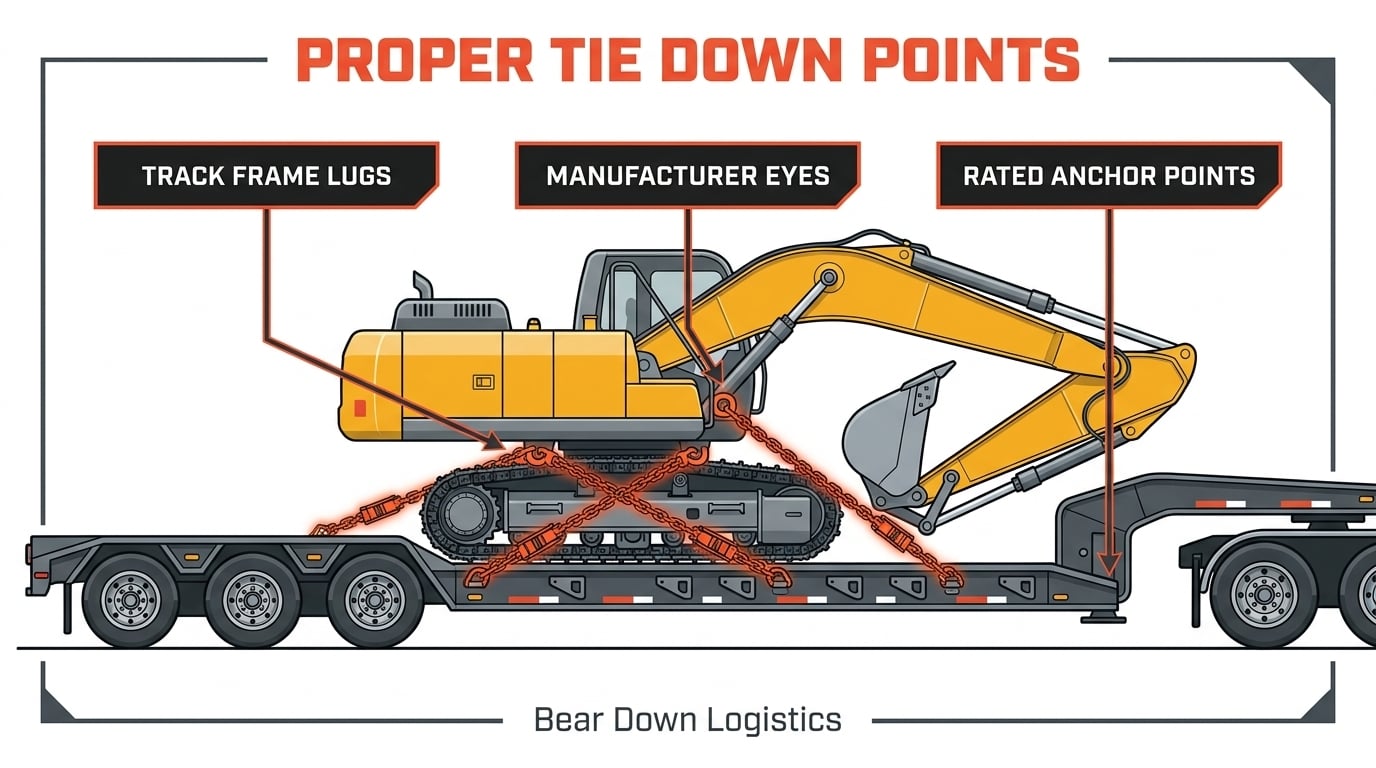
Tie‑down points on excavators are manufacturer‑installed lugs, eyes, or track frame holes engineered to bear the full forces of load securement during transport. Securing chains to any other location, such as hydraulic lines, cylinder rods, or unrated frame components, creates securement failure risk and puts the haul out of federal compliance before the trailer moves.
This guide covers how to identify correct anchor points across excavator brands, best practices for chain attachment and tensioning, equipment selection, legal requirements and penalties, ongoing inspection protocols, and how Bear Down Logistics handles compliant excavator transport.
Identifying the right anchor points depends on the machine. Manufacturers including Komatsu, Hitachi, John Deere, and Kubota each place tie‑down lugs differently, and markings such as chain‑link symbols, yellow paint, or stamped text near the fitting confirm approved locations.
Attachment and tensioning technique determine whether a correctly located chain actually performs under load. Chains should angle between 25 and 45 degrees from horizontal, with no slack, and FMCSA mandates a minimum of four tiedowns for crawler‑track equipment, plus a separate attachment for the appendage on standard machines.
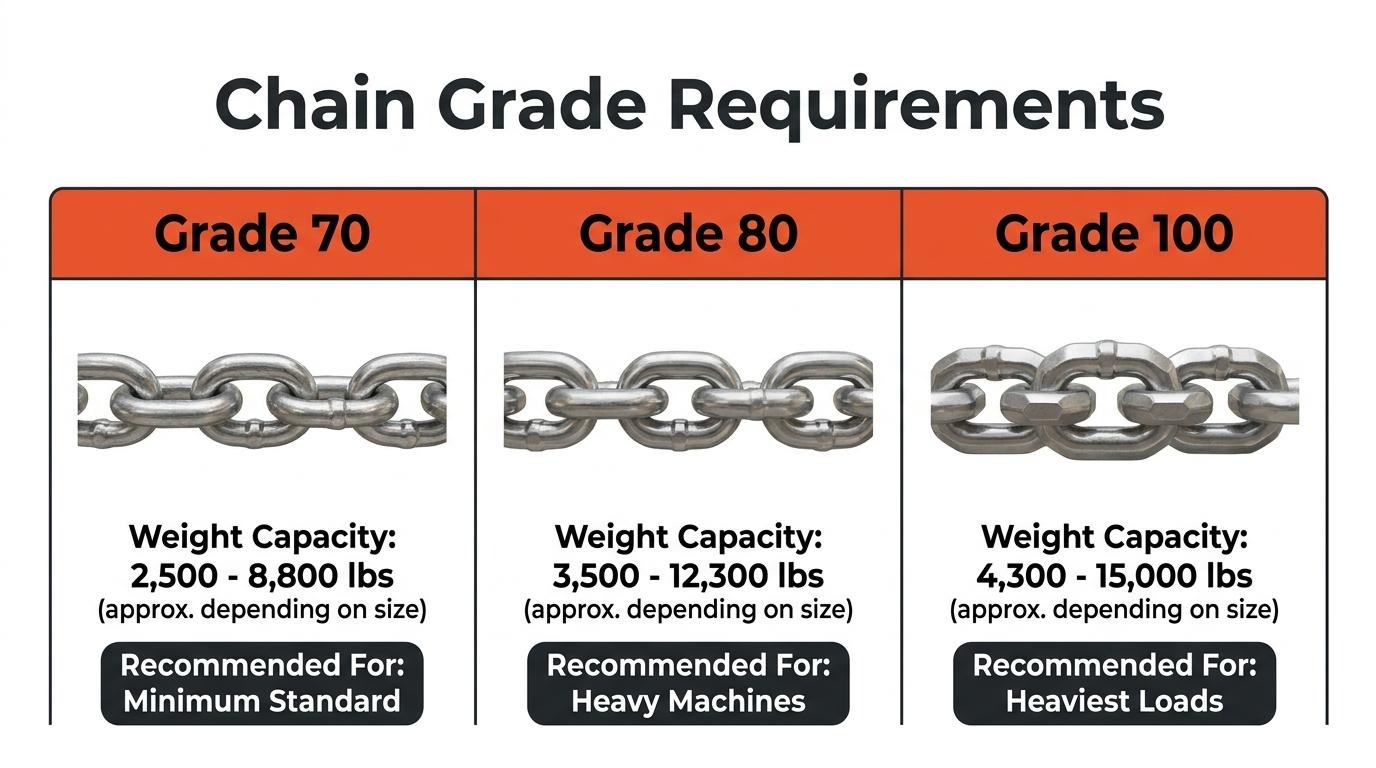
Choosing the right hardware matters as much as placement. Grade 70 is the minimum accepted chain for excavator hauling, with Grade 80 and Grade 100 alloy required for heavier machines, and all hooks, shackles, and binders must match the chain's working load limit rating.
Federal and state law set firm penalties for non‑compliance, including out‑of‑service orders and civil fines reaching thousands of dollars per violation, making pre‑haul inspection and documented compliance records essential safeguards on every haul.
Why Is It Important to Use Proper Tie‑Down Points on Excavators?
Using proper tie‑down points on excavators is important because incorrect securement creates serious safety hazards during transport and exposes operators to federal penalties. The following sections cover the specific risks of improper attachment and the regulations that govern compliant tie‑down methods.
What Risks Are Associated With Using Incorrect Tie‑Down Points?
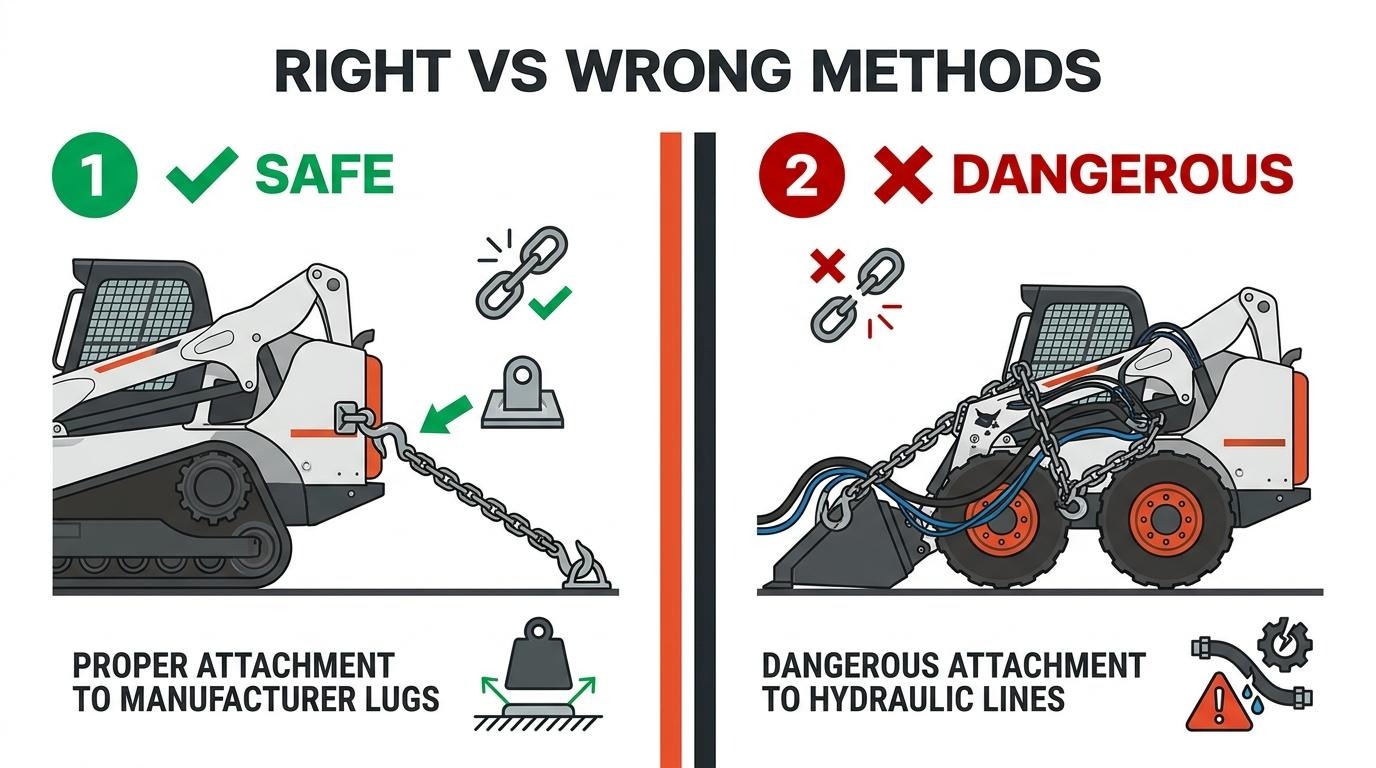
The risks associated with using incorrect tie‑down points include load shift, equipment rollover, structural damage to the excavator, and danger to other road users. Securing chains to non‑designated points, such as hydraulic lines, cylinder rods, or body panels, transfers load forces through components never engineered to bear them. This can deform the frame, rupture hoses, or cause complete securement failure while the vehicle is in motion.
The numbers reflect how serious this problem is in practice. Inspectors across the United States identified 3,282 vehicles with no or improper cargo securement during one inspection period, and approximately 18,000 drivers received out‑of‑service orders for cargo securement violations in 2025. These figures make clear that improper tie‑down point selection is not an edge case; it is one of the most common and consequential errors in heavy equipment transport.
How Do Regulations and Industry Standards Affect Tie‑Down Methods?
Regulations and industry standards affect tie‑down methods by setting enforceable minimums for securement point count, chain capacity, and directional force resistance. The FMCSA requires that crawler‑track equipment be restrained against lateral, forward, rearward, and vertical movement using a minimum of four tiedowns. Securement systems must also withstand 0.8 g deceleration forward, 0.5 g rearward, and 0.5 g laterally, according to U.S. Department of Transportation cargo securement rules.
The North American Cargo Securement Standard further specifies that the aggregate working load limit of any securement system must equal at least one‑half the weight of the load being secured. Selecting tie‑down points that cannot support these force thresholds, even if they appear structurally robust, places an entire haul out of compliance before the trailer leaves the yard. In practice, compliance with these standards is best achieved by treating manufacturer‑designated lug locations as non‑negotiable, not as a starting point for improvisation.
How Can You Identify Tie‑Down Points on Different Types of Excavators?
You can identify tie-down points on different types of excavators by examining the track frame, undercarriage, and main body for manufacturer-installed lugs, eyes, or brackets. The following H3s cover where manufacturers typically place these points and how to recognize approved locations through markings and symbols.
Where Do Manufacturers Typically Place Tie‑Down Lugs or Eyes?
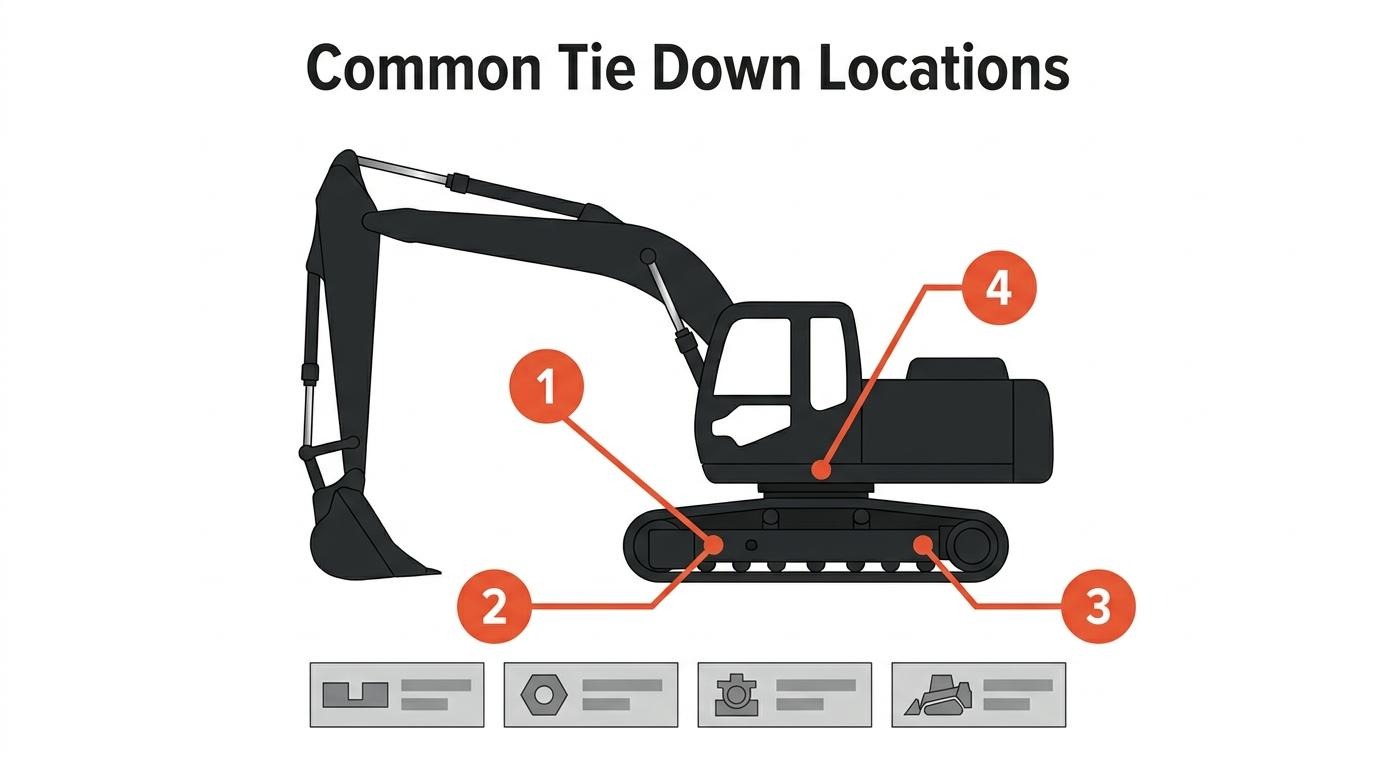
Manufacturers typically place tie-down lugs or eyes on the track frame, undercarriage corners, and the main body chassis of an excavator. Placement varies by brand and machine class, but several consistent patterns exist across major manufacturers:
- Komatsu positions tie-down holes directly on the track frame, where operators attach chains or wire rope of appropriate strength.
- Hitachi excavators feature dedicated tie-down brackets and shackle holes, with center shackle hole usage detailed in the operator manual.
- John Deere compact excavators use enlarged tie-down openings on the undercarriage for easier chain attachment during transport.
- Kubota specifies three hook points for certain operations, including one point on the boom.
According to SAE International, construction equipment manufacturers may also add custom lift and tie-down eyes and identification plates to standard machines for specific customer requirements. Always consult the operator manual for your exact model before securing.
What Markings or Symbols Indicate an Approved Tie‑Down Location?
Approved tie-down locations are indicated by cast-in symbols, stamped markings, or painted indicators near the lug or eye. Common identifiers include:
- A chain-link icon or anchor symbol cast or stamped near the tie-down point.
- Yellow or orange paint highlighting the lug, bracket, or hole on the track frame or body.
- Identification plates affixed adjacent to the tie-down eye, specifying its working load limit or intended use.
- Text labels such as "TIE-DOWN" or "LASHING POINT" stamped directly on or near the fitting.
According to H-Lift, a lashing point is a specially designed attachment point that provides a strong anchor for lashing equipment during transport, and it is distinct from lifting points, which serve a different structural purpose. If markings are worn or unclear, the operator manual is the authoritative reference. Never assume a structural protrusion or frame hole is an approved tie-down point without manufacturer confirmation.
What Are the Best Practices for Securing Chains to Excavators During Transport?
The best practices for securing chains to excavators during transport cover three core areas: proper attachment to prevent equipment damage, correct chain tension and angle, and meeting the minimum legal tie-down requirements.
How Should Chains Be Attached to Avoid Damage to the Excavator?
Chains should be attached only to manufacturer-designated tie-down lugs, eyes, or track frame holes, never to hydraulic lines, cylinders, or structural components not rated for securement loads. Lashing fittings must have at least the same strength as the chain itself, according to Volvo Group transport quality standards. Using the correct attachment hardware, such as grade 70 or grade 80 hooks sized to fit the lug opening without forcing, prevents both hardware failure and surface damage. Always confirm the bucket and boom are rested and lowered before securing, eliminating shifting from unsupported appendage weight.
What Tension and Angle Should Chains Have for Safe Transport?
Chains should maintain a working angle between 25 and 45 degrees from horizontal for maximum securement effectiveness. Ohio State University cargo control research confirms that direct tie-downs are most effective within this range. Angles below 30 degrees create a danger zone where leg tension increases sharply, reducing rated capacity and risking chain failure. Chains must be tensioned firmly with no visible slack before departure, and tension should be rechecked after the first 50 miles of travel, as vibration can cause initial loosening.
How Many Tie-Down Points and Chains Are Required by Law?
The number of required tie-down points and chains depends on equipment size. According to FMCSA regulation 49 CFR 393.130, heavy equipment with crawler tracks must be restrained in all directions using a minimum of four tie-downs. Caterpillar guidance notes that mini excavators under 10,000 pounds may qualify for a minimum of two body attachment points, while standard excavators require four main body tie-downs plus an additional attachment for the appendage. The aggregate working load limit of the entire securement system must equal at least half the total weight of the excavator being hauled.
What Equipment Is Needed to Properly Secure an Excavator for Hauling?
Properly securing an excavator for hauling requires chains, binders, and hooks rated for the machine's weight. The H3s below cover recommended chain grades and the limited scenarios where straps are acceptable.
Which Types of Chains and Binders Are Recommended for Excavators?
The types of chains recommended for excavators are Grade 70 transport chain and Grade 80 or Grade 100 alloy chain, depending on load weight. According to the National Association of Chain Manufacturers (NACM), welded steel chain grades include Grade 100 alloy, Grade 80 alloy, Grade 70 transport, Grade 43 high test, and Grade 30 proof coil. For excavator hauling, Grade 70 is the minimum accepted standard, while Grade 80 and Grade 100 provide higher working load limits for heavier machines.
Binders must match the chain grade and diameter. The North American Cargo Securement Standard requires the aggregate working load limit of the securement system to equal at least one-half the weight of the load. Lashing fittings, including hooks and shackles, must carry at least the same strength rating as the chain itself. Selecting mismatched hardware is one of the most avoidable — and costly — errors in heavy equipment transport.
Are There Situations Where Straps Can Be Safely Used?
Straps can be safely used on excavators only in limited, low-risk scenarios involving lighter compact or mini machines, and never as a substitute for chain on full-size equipment. Bungee cords and tarp straps must never be used as primary securement for any load or equipment. Rated nylon web straps with appropriate working load limits may be acceptable for mini excavators under 10,000 pounds when manufacturer guidance permits, but chains remain the industry standard for all excavator classes.
For any machine subject to FMCSA cargo securement rules, chains are strongly preferred because they resist abrasion, heat, and dynamic load forces that straps cannot reliably withstand over long hauls. Relying on straps for a full-size excavator is a compliance risk no operator should take.
What Legal Requirements Govern Excavator Tie‑Down and Load Securement?
The legal requirements governing excavator tie‑down and load securement come from federal FMCSA regulations and state-level transportation codes. The sections below cover which specific rules apply to heavy equipment hauling and what penalties carriers face for non-compliance.
Which Federal or State Regulations Apply to Heavy Equipment Hauling?
The federal and state regulations that apply to heavy equipment hauling are primarily established by the FMCSA under 49 CFR Part 393. According to the FMCSA, tracked or wheeled heavy equipment must be restrained against lateral, forward, rearward, and vertical movement using a minimum of four tie-downs. Cargo securement systems must also withstand 0.8 g deceleration forward, 0.5 g rearward, and 0.5 g laterally. Additionally, the North American Cargo Securement Standard requires that the aggregate working load limit of any securement system be at least one-half the weight of the secured load. At the state level, regulations mirror or supplement these federal standards, with individual states enforcing their own transportation codes alongside FMCSA rules.
What Are the Penalties for Failing to Comply With Tie‑Down Laws?
The penalties for failing to comply with tie‑down laws include fines, out-of-service orders, and civil penalties that vary by jurisdiction. Texas Transportation Code Section 643.251 allows civil penalties of up to $5,000 per violation. In Florida, unsecured load violations can total $195 per infraction including court costs. At the federal level, the scale of enforcement is significant: approximately 18,000 drivers received out-of-service orders for cargo securement violations in 2025, according to Compliant Drivers. Non-compliance risks are operational as well as financial, since an out-of-service order stops a haul immediately. Carriers who treat securement compliance as a cost-of-doing-business shortcut consistently underestimate how quickly fines and downtime erode profitability.
How Can Operators Ensure Continued Safety and Compliance When Securing Excavators?
Operators can ensure continued safety and compliance by following structured pre-haul inspection protocols and establishing routine schedules for evaluating tie-down hardware condition. The sections below cover what to check before each haul and how frequently to assess chains and anchor points for wear.
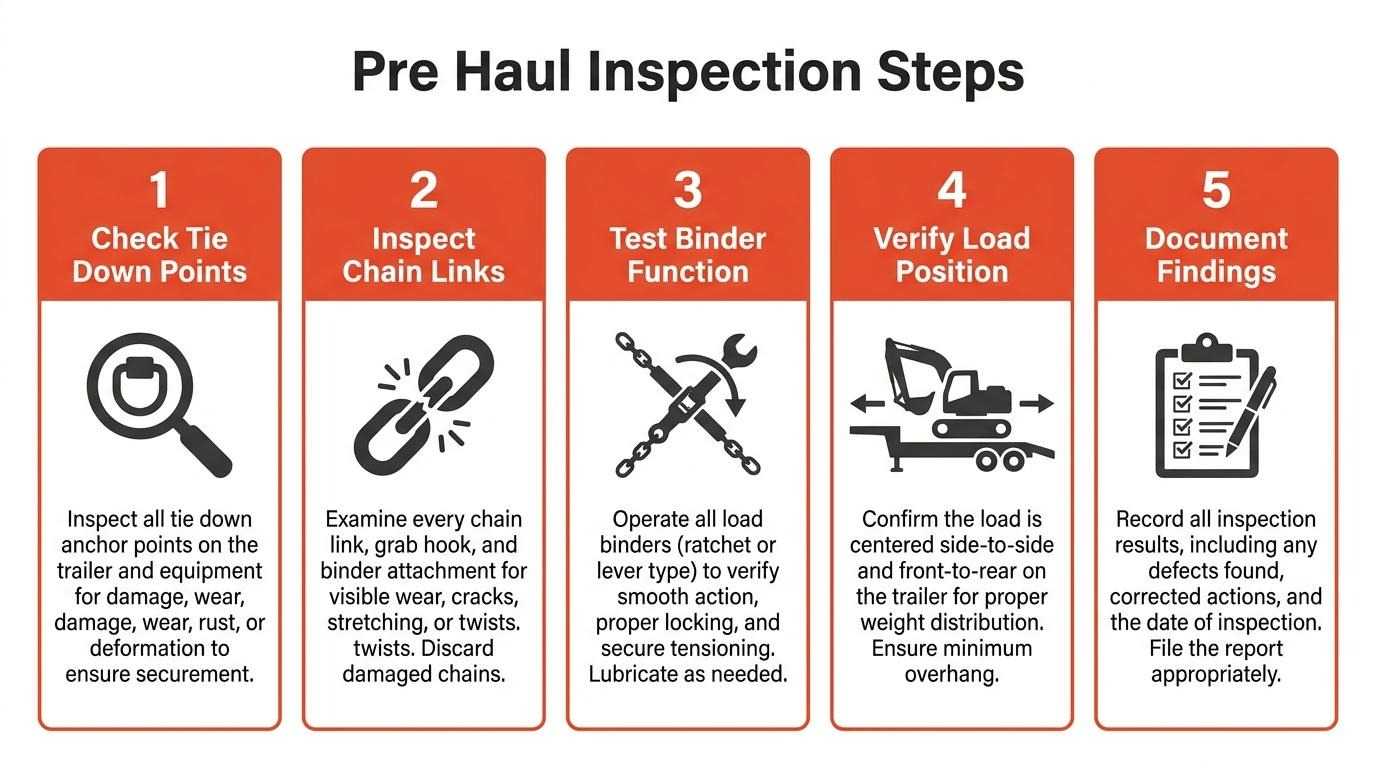
What Inspection Steps Should Be Taken Before Each Haul?
The inspection steps before each haul include verifying tie-down point integrity, chain condition, binder function, and load position. Before loading, confirm that all designated tie-down lugs are free of cracks, deformation, or corrosion. Check every chain link for stretch, gouging, or twisting, and confirm that binders latch and hold tension securely. According to Interstate 365, operators should inspect securement equipment before each use and document findings, specifically looking for chain link wear, stretch, or damage. Bungee cords and tarp straps must never serve as primary securement for any load or equipment. Documenting each inspection creates a verifiable compliance record and supports the operator's defense during roadside enforcement stops.
How Often Should Tie‑Down Points and Chains Be Inspected for Wear?
Tie-down points and chains should be inspected before every haul as a minimum standard, with more thorough evaluations performed at regular service intervals. Common industry questions, including "How often should I inspect my securement equipment?" reflect how frequently operators overlook this requirement. A pre-use visual check covers obvious damage; a periodic hands-on inspection should assess working load limit markings, chain grade stamping, hook throat wear, and lug weld integrity. Chains showing deformation, pitting, or link elongation must be removed from service immediately. From a compliance standpoint, maintaining documented inspection logs strengthens an operator's position during audits and helps prevent out-of-service violations before they occur.
How Does Heavy Equipment Transport Service From Bear Down Logistics Handle Excavator Tie‑Downs?
Bear Down Logistics handles excavator tie‑downs by applying FMCSA-compliant securement protocols across all heavy equipment transport jobs. The following sections explain how Bear Down Logistics manages oversized excavator loads and what every operator should take away from proper chain securement practices.
Can Bear Down Logistics Manage Oversized or Over-Dimensional Excavator Loads Safely?
Yes, Bear Down Logistics can manage oversized and over-dimensional excavator loads safely. Bear Down Logistics provides specialized transport services for oversized and heavy equipment, including flatbed and oversize load hauling. With over 20 years of combined experience and more than 20,000 completed loads, Bear Down Logistics applies the same rigorous tie‑down standards covered throughout this guide to every excavator shipment.
Oversized excavator transport requires close attention to FMCSA securement force thresholds, correct chain grade selection, and manufacturer-designated tie‑down points. Bear Down Logistics is licensed, bonded, and insured, meaning clients receive professional handling that protects both equipment and compliance standing on every haul.
What Are the Key Takeaways About Tie‑Down Points on Excavators and Chain Securement We Covered?
The key takeaways about tie‑down points on excavators and chain securement are:
- Use manufacturer-designated anchor points. Secure chains only to factory-installed tie‑down lugs, track frame holes, or marked lashing eyes, never to hydraulic lines, cylinders, or structural components not designed for load restraint.
- Meet the four-tiedown minimum. FMCSA requires at least four tiedowns for crawler-track equipment, restraining movement in all four directions.
- Match chain grade to load weight. The aggregate working load limit of the securement system must equal at least half the weight of the excavator being transported.
- Maintain chain angles between 25 and 45 degrees. Angles below 30 degrees from horizontal sharply increase leg tension and create dangerous securement failure risk.
- Inspect before every haul. Check each chain link for wear, stretch, or damage, and never use bungee cords or tarp straps as primary securement.
- Know the penalties. Cargo securement violations carry serious consequences, including out-of-service orders, fines, and operational shutdowns.
Applying these principles consistently is the clearest path to safe, compliant excavator transport on every job.