
A fleet vehicle wrap is an aesthetic modification that changes both the appearance and insured value of each vehicle, requiring updated coverage to protect the investment. Insurers classify wraps alongside custom paint and permanently attached equipment, meaning disclosure and proper policy structuring determine whether your graphics are covered or exposed.
This guide covers wrap classification and coverage mechanics, premium impacts across wrap types, insurer disclosure and documentation requirements, policy structure options for wrapped fleets, total-loss valuation, liability considerations, and professional installation’s role in protecting coverage.
Wraps qualify as vehicle modifications under commercial auto policies, and providers like Progressive require stated amounts to reflect the vehicle’s current retail value including custom graphics. Vinyl wraps receive the same underwriting treatment as paint jobs, though their removability can work in your favor. Most policies need a coverage endorsement to close the gap between factory value and post-wrap replacement cost.
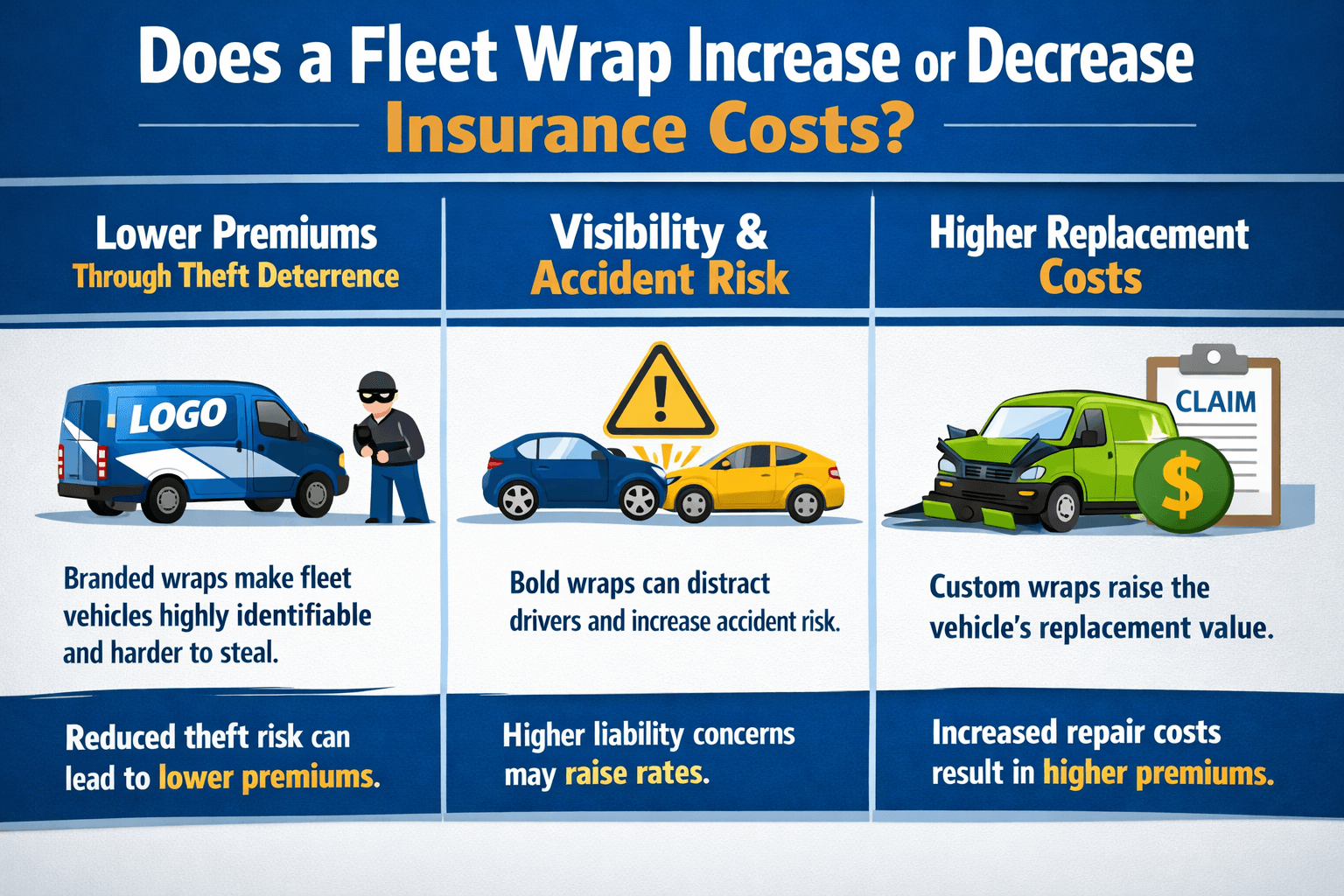
Full wraps, partial wraps, color-change wraps, and reflective or specialty material wraps each shift premium calculations differently. Branded graphics can lower theft-related claims by making vehicles highly identifiable, while higher replacement values raise physical damage coverage costs proportionally.
Failing to disclose wraps risks claim denial or policy cancellation. Fleet managers should notify insurers before installation and provide invoices, material specs, photographs, VINs, and original color designations for every wrapped vehicle.
Coverage may fall under comprehensive auto or inland marine insurance depending on wrap value and policy limits. Actual cash value policies reduce payouts through depreciation, while agreed-value coverage locks in full reimbursement regardless of wrap age.
Bold wrap designs can increase liability exposure through driver distraction, and visible branding raises litigation targeting risk. Choosing the right policy starts with asking your broker how physical damage coverage handles non-factory upgrades. Professional installation from a single-source provider like Craftsmen Industries consolidates the documentation insurers require during claims.
How Does a Vehicle Wrap Change Your Insurance Coverage?
A vehicle wrap changes your insurance coverage by reclassifying the vehicle as modified, which often requires a coverage endorsement or updated policy limits. The sections below explain how wraps are classified, how insurers distinguish them from paint, and whether an endorsement is needed.
Does a Wrap Count as a Vehicle Modification for Insurance?
Yes, a wrap counts as a vehicle modification for insurance purposes. Insurance providers classify vehicle wraps as aesthetic modifications that alter both the appearance and retail value of the vehicle. According to Progressive’s commercial auto product guide, the stated amount on a commercial policy must reflect the vehicle’s current retail value, including any “permanently-attached equipment” such as custom wraps or signage.
Because wraps change the vehicle’s risk profile, failing to disclose them can be classified as non-disclosure. In that scenario, an insurer may deny the claim for the wrap replacement or, in extreme cases, void the policy entirely. Under New York Insurance Law Section 3105, however, a policy can only be voided if the undisclosed modification is proven “material.”
Fleet managers should report wraps to their insurer proactively and keep documentation that includes:
- Professional installation invoices with material details
- High-resolution photos of each wrapped vehicle
- Current registration, VIN, and previous color designation
This simple disclosure step protects the full value of the wrap investment.
Are Vinyl Wraps Treated Differently Than Paint Jobs by Insurers?
Vinyl wraps are generally treated the same as custom paint jobs by insurers; both qualify as aesthetic modifications that change the vehicle’s appearance and value. The key difference is practical, not categorical. A vinyl wrap can be removed without damaging factory paint, while a custom paint job permanently replaces the original finish. Some underwriters view removability favorably because it preserves the underlying asset, though this does not exempt wraps from disclosure requirements. Regardless of whether a fleet uses vinyl wraps or paint, the insurer needs updated documentation reflecting the modification so claim payouts accurately cover replacement costs.
Does Adding a Wrap Trigger a Policy Endorsement Requirement?
Adding a wrap triggers a policy endorsement requirement in most commercial auto policies. Standard coverage limits are set based on the vehicle’s factory value, so a wrap that adds thousands of dollars in custom graphics creates a gap between the insured amount and the actual replacement cost. A coverage endorsement closes that gap by adjusting the policy to include the wrap’s value.
For fleet operations, bundling wrapped vehicles under a single fleet policy with customized physical damage coverage simplifies this process. Fleet managers should confirm with their broker whether existing limits already account for non-factory upgrades or whether a separate endorsement is needed before installation begins.
Understanding how wraps are classified sets the foundation; the next section examines which specific types of fleet wraps influence premium calculations.
What Types of Fleet Wraps Impact Insurance Premiums?
The types of fleet wraps that impact insurance premiums include full wraps, partial wraps, color-change wraps, and reflective or specialty material wraps. Each type affects vehicle valuation and risk classification differently.
Full Fleet Wraps
Full fleet wraps cover the entire vehicle surface with printed vinyl, creating maximum brand visibility. This complete coverage increases the vehicle’s stated value by $2,500 to $5,000 per unit, which directly raises the insured amount on your commercial auto policy. Because full wraps represent the highest material and labor investment, insurers factor the full replacement cost into premium calculations. Fleet managers should expect a proportional increase in physical damage coverage costs when wrapping an entire fleet with complete coverage.
Partial Fleet Wraps
Partial fleet wraps cover select panels or sections of a vehicle rather than the entire surface. According to VehicleWrapping.com, partial wraps typically range between $2,125 and $3,675 depending on vehicle size. This lower material cost means a smaller increase to the vehicle’s insured value compared to full wraps. For fleet managers balancing brand presence with insurance budgets, partial wraps offer a practical middle ground; the premium adjustment is generally modest since the modification cost per vehicle stays well below full-wrap thresholds.
Color-Change Wraps
Color-change wraps alter the entire exterior color of a vehicle without adding branded graphics. Insurers treat these wraps as aesthetic modifications that change the vehicle’s appearance from its factory-registered color. This distinction matters because some states require updated vehicle registration when the exterior color changes, and the insurer’s records must reflect the current appearance. Color-change wraps can also complicate claims processing if the wrap color does not match the vehicle description on file, potentially delaying payouts.
Reflective or Specialty Material Wraps
Reflective or specialty material wraps use chrome, metallic, textured, or retroreflective vinyl films. These materials cost significantly more per square foot than standard cast vinyl, which increases the replacement value insurers must account for. Specialty films also require specialized installation techniques, raising labor costs in the event of a claim. From an underwriting perspective, reflective wraps may present a unique consideration: highly reflective surfaces could create glare for other drivers, potentially introducing a liability factor that standard vinyl does not.
Understanding how each wrap type shifts your coverage needs sets the stage for evaluating whether wraps increase or decrease overall costs.
Does a Fleet Wrap Increase or Decrease Insurance Costs?
A fleet wrap can increase or decrease insurance costs depending on factors such as theft deterrence, accident visibility, and replacement value. The subsections below cover how branded wraps may lower premiums, how visibility affects claims, and how higher replacement costs can raise rates.
Can Branded Wraps Lower Premiums Through Theft Deterrence?
Yes, branded wraps can lower premiums through theft deterrence by making fleet vehicles highly identifiable and difficult to resell. Custom vehicle wraps mark vans and trucks as company assets, which discourages opportunistic theft. According to SpeedPro, custom vehicle wraps serve as a theft deterrent by making vehicles instantly recognizable and clearly linked to a specific business.
Lower theft risk translates to fewer comprehensive claims, a factor insurers weigh when calculating premiums. Fleet managers who wrap entire vehicle groups create a consistent, recognizable presence that compounds this deterrent effect. While not every insurer offers a direct discount for branded wraps, a documented reduction in theft incidents strengthens your position during policy renewal negotiations.
Do High-Visibility Wraps Reduce Accident-Related Claims?
High-visibility wraps can reduce accident-related claims by making fleet vehicles more conspicuous to other drivers. Brightly colored or reflective graphics increase a vehicle’s visual footprint on the road, particularly in low-light conditions or congested traffic.
Drivers near a clearly branded vehicle also tend to exercise greater caution, knowing the company name is visible and any incident is easily reported. This behavioral effect, sometimes called the “accountability factor,” can lead to fewer at-fault collisions involving wrapped fleets. For fleet managers, this improved road presence offers a practical argument when discussing risk profiles with insurers, even if formal premium credits for wrap visibility remain uncommon.
Can Wraps Increase Premiums Due to Higher Replacement Value?
Yes, wraps can increase premiums due to higher replacement value because they raise the total insured amount of each vehicle. A full commercial van wrap typically costs between $2,500 and $5,000 using premium materials, and insurers factor this added value into physical damage coverage calculations.
When the stated vehicle value increases to account for a wrap, the premium for comprehensive and collision coverage rises proportionally. Fleets with dozens of wrapped vehicles can see this cost compound quickly. However, the increase is often modest relative to the overall policy, and the marketing return from branded fleet graphics frequently offsets the added insurance expense. Confirming exact cost impacts with your broker before installation helps avoid surprises at renewal.
Understanding how wraps influence premiums prepares you to handle insurer disclosure requirements effectively.
How Should You Disclose Fleet Wraps to Your Insurance Provider?
You should disclose fleet wraps by notifying your insurer before installation, providing complete documentation, and confirming coverage in writing. The following subsections cover non-disclosure consequences, notification timing, and required paperwork.
What Happens If You Fail to Disclose a Fleet Wrap?
Failing to disclose a fleet wrap can result in denied claims, out-of-pocket replacement costs, or a voided policy. Insurers treat undisclosed wraps as non-disclosure of a vehicle modification, which gives them grounds to reject coverage for the upgrade entirely.
In severe cases, the insurer may void the full policy rather than just deny the wrap-related portion of a claim. Fleet managers should also understand their rights during the claims process. Under New Jersey law NJSA 39:6B-1.1, insurers must disclose policy limits in response to a written request, a protection that becomes critical when disputing claim denials on wrapped vehicles.
For fleets with dozens of wrapped vehicles, even one undisclosed modification can create a coverage gap that exposes the business to significant financial risk.
When Should You Notify Your Insurer About a New Wrap?
You should notify your insurer about a new wrap before the installation begins. Contacting your carrier in advance allows you to confirm whether your current policy covers the modification or requires an endorsement.
Waiting until after installation, or worse, until after an accident, creates a window where the wrap has no verified coverage. The most effective approach is to treat wrap notification as a standard step in the fleet procurement process:
- Contact your insurer or broker during the wrap design phase.
- Confirm whether the wrap requires a coverage endorsement or policy adjustment.
- Obtain written confirmation that the wrap’s value is reflected in your policy.
- Repeat this process for each vehicle added to the wrap program.
Pre-installation disclosure is the only reliable way to eliminate coverage disputes later.
What Documentation Does Your Insurer Need for a Fleet Wrap?
Your insurer needs the professional installation invoice, material specifications, and high-resolution photographs of each wrapped vehicle. According to Auto Sound, providing these three items ensures the wrap’s value and condition are verifiable if a claim is filed.
Additional documentation that strengthens your file includes:
- The Vehicle Identification Number (VIN) for each wrapped vehicle.
- Current registration information.
- The original vehicle color designation before the wrap was applied.
- Warranty documentation from the wrap installer.
Keeping this paperwork organized per vehicle simplifies the claims process across an entire fleet. With proper documentation in place, the next consideration is whether wrap damage falls under comprehensive auto or a separate inland marine policy.
Does Fleet Wrap Coverage Fall Under Comprehensive or Inland Marine?
Fleet wrap coverage falls under either comprehensive auto or inland marine insurance, depending on the wrap’s value and the policy structure. The sections below clarify when each coverage type applies.
When Does Comprehensive Auto Cover Wrap Damage?
Comprehensive auto covers wrap damage when the vinyl graphics are included in the vehicle’s stated value on a commercial auto policy. Most standard comprehensive coverage protects against non-collision events like vandalism, fire, and weather damage, which extends to wraps listed as part of the insured vehicle.
However, coverage is not automatic. According to TKO Graphix, while most insurance carriers will cover the replacement of vinyl graphics damaged in an accident, they advise that the only definitive way to confirm coverage is to contact the carrier directly before the wrap is installed.
Fleet managers should ask brokers specifically how the policy handles physical damage for non-factory upgrades and whether the coverage simplifies claims for multiple vehicles under a single policy. Confirming these details before installation prevents gaps that surface only after a loss occurs.
When Do You Need a Separate Inland Marine Policy for Wraps?
You need a separate inland marine policy for wraps when the wrap value exceeds what a standard commercial auto policy covers, or when the wrap qualifies as specialized mobile property. According to Cleaner Times, inland marine insurance is designed to cover property that is movable or transportable, providing broader protection for specialized equipment and mobile assets that may not be fully covered under a standard commercial auto policy.
This distinction matters most for high-value fleet graphics programs where dozens of vehicles carry custom designs worth thousands each. If comprehensive auto caps equipment coverage at a fixed amount, the excess value remains unprotected without an inland marine endorsement.
For fleet operators investing heavily in branded wraps, inland marine policies close the gap that standard auto coverage leaves open, particularly for specialty materials or large-scale rollouts.
How Is a Wrapped Fleet Vehicle Valued After a Total Loss?
A wrapped fleet vehicle is valued after a total loss based on the policy type, depreciation schedule, and whether the wrap’s cost was declared as part of the insured value. The following sections cover reimbursement limits, depreciation impact, and agreed-value coverage options.
Does Insurance Reimburse the Full Cost of the Wrap?
Insurance does not always reimburse the full cost of the wrap. Most standard commercial auto policies pay out based on actual cash value at the time of loss, not the original installation price. Since wraps depreciate over time due to wear, UV exposure, and age, the reimbursement amount is typically less than what the fleet manager originally paid.
According to Florida Car Wrap, the average cost for a full commercial van wrap ranges from $2,500 to $5,000 when using premium materials such as 3M or Avery Dennison films. Without a specific endorsement or agreed-value rider that locks in this investment, a fleet manager may recover only a fraction of that cost after a total loss. Documenting wrap costs with invoices and photos at installation is essential for maximizing any payout.
How Does Depreciation Apply to a Vehicle Wrap Claim?
Depreciation applies to a vehicle wrap claim through the actual cash value (ACV) formula, which subtracts accumulated wear from the wrap’s original cost. Vinyl wraps have a functional lifespan of roughly five to seven years, so a three-year-old wrap could already reflect significant depreciation at the time of a total loss.
As noted by The Coyle Group, actual cash value policies reduce claim payouts by the amount of depreciation, which can significantly impact reimbursement for a high-cost vehicle wrap. This means the older the wrap, the lower the payout. For fleet managers running large branded programs, this gap between replacement cost and depreciated value compounds across multiple vehicles, making policy selection a critical financial decision.
Should You Carry Agreed-Value Coverage on Wrapped Fleet Vehicles?
Yes, you should carry agreed-value coverage on wrapped fleet vehicles if protecting the full investment in branded graphics matters to your operation. Agreed-value policies eliminate depreciation disputes by establishing a fixed payout amount before a loss occurs, ensuring the wrap’s value is reimbursed in full regardless of age.
This approach makes particular sense given the marketing value at stake. According to National Fleet Graphics, branded vehicle graphics generate between 30,000 and 70,000 impressions per day, making each wrapped vehicle a continuous advertising asset. Losing that asset without adequate reimbursement creates both a financial and marketing gap.
Bundling agreed-value coverage within a fleet insurance policy can offset higher per-vehicle costs. Fleet policies often deliver significant cost efficiencies compared to individual vehicle policies, keeping the added protection affordable at scale.
Understanding valuation methods directly shapes how you select the right policy for a wrapped fleet.
What Liability Risks Do Fleet Wraps Create?
Fleet wraps create liability risks related to driver distraction from bold designs and increased litigation targeting from heightened brand visibility. The sections below cover distraction-based exposure and how identifiable branding affects legal risk.
Can a Distracting Wrap Design Increase Liability Exposure?
Yes, a distracting wrap design can increase liability exposure. Overly complex graphics, bright color combinations, or animated visual elements on fleet vehicles may divert the attention of other motorists, creating conditions for accidents where the wrapped vehicle’s owner could face claims. According to a 2024 Dykema survey, 62% of respondents expected an increase in lawsuits involving driver distractions and advanced vehicle technologies. While that survey focused on in-cabin tech, the underlying principle applies: anything that contributes to distracted driving expands the liability surface. Fleet managers should prioritize clean, legible designs that communicate brand messaging without overwhelming surrounding drivers. Balancing visual impact with roadway safety is not just good design; it is a risk management strategy.
Does Brand Visibility on Wraps Raise Litigation Targeting Risk?
Brand visibility on wraps does raise litigation targeting risk. A clearly branded fleet vehicle involved in an accident is immediately identifiable, making it easier for plaintiffs to connect the incident to a specific company. This recognition can increase the likelihood of formal claims because the business behind the vehicle is never anonymous. However, this visibility cuts both ways. Fleet management experts cite branded wraps as a beneficial deterrent against vehicle and equipment theft, since highly identifiable trucks and vans are far harder to steal or misuse without detection. The practical takeaway for fleet operators is straightforward: the same branding that attracts legal attention also encourages safer driving behavior among employees who know their company name is on display.
Understanding these liability dynamics helps fleet managers make informed decisions when selecting the right insurance policy for wrapped vehicles.
How Do You Choose the Right Policy for a Wrapped Fleet?
You choose the right policy for a wrapped fleet by asking your broker targeted questions about modification coverage and matching policy structure to your fleet’s size and wrap investment. The subsections below cover broker conversations and how fleet scale shapes selection.
What Should You Ask Your Broker Before Wrapping a Fleet?
You should ask your broker how the policy handles physical damage for non-factory upgrades and whether coverage simplifies the claims process for multiple wrapped vehicles under a single policy. According to Soden Insurance Agency, fleet managers should confirm whether their policy bundles modification coverage across all vehicles or requires individual endorsements per unit.
Key questions to raise with your broker include:
- Does the policy’s physical damage coverage extend to vinyl wraps and custom graphics, or is a separate endorsement required?
- How are wrapped vehicles valued after a total loss: actual cash value, stated value, or agreed value?
- Will adding wraps mid-policy trigger a premium adjustment or require a formal policy amendment?
- Does the fleet policy include blanket coverage for permanently attached equipment, or is each vehicle assessed individually?
- What documentation does the carrier need at the time of wrap installation to ensure future claims are honored?
Asking these questions before any wrap work begins prevents coverage gaps that only surface during a claim. For fleet managers overseeing dozens of vehicles, one missed endorsement can leave thousands of dollars in wrap investment unprotected.
How Do Fleet Size and Wrap Scope Affect Policy Selection?
Fleet size and wrap scope affect policy selection because larger fleets with extensive wraps benefit most from bundled commercial auto policies, while smaller fleets may need individual endorsements. Bundling coverage for multiple vehicles under a single fleet policy often results in significant cost efficiencies compared to maintaining separate policies for each unit.
Factors that shape the right policy include:
- Fleet size: Fleets with ten or more vehicles typically qualify for consolidated fleet insurance, reducing per-vehicle administrative costs.
- Wrap scope: Full wraps valued at $2,500 to $5,000 each require higher stated amounts than partial wraps or simple decal packages.
- Vehicle mix: A fleet combining box trucks, vans, and sedans may need tiered coverage that accounts for different wrap costs per vehicle class.
- Replacement frequency: Fleets that refresh wraps annually face different risk profiles than those using long-term installations.
Matching policy structure to these variables ensures every wrapped vehicle carries adequate protection without overpaying for unnecessary coverage. With the right policy framework in place, professional installation further strengthens your coverage position.
How Can Professional Fleet Wrap Installation Protect Your Coverage?
Professional fleet wrap installation protects your coverage by providing verifiable documentation, installer warranties, and quality assurance that insurers require when processing modification claims. The following sections cover how Craftsmen Industries simplifies this process and the key takeaways for fleet managers.
Can Craftsmen Industries’ In-House Large Format Graphics Simplify Your Insurance Documentation?
Yes, Craftsmen Industries’ in-house large format graphics can simplify your insurance documentation by consolidating design, printing, and installation under one provider. This single-source workflow produces unified invoices, material specifications, and installation records that insurers need when verifying wrap modifications on commercial auto declarations pages.
According to Capital Wrappers, car wrap warranties provided by professional installers offer formal protection against material defects and installation mistakes that could lead to premature failure and subsequent insurance documentation issues. Craftsmen Industries operates from a 127,000 sq. ft. facility in St. Charles, Missouri, where in-house production control ensures every fleet vehicle receives consistent, documented application. Rather than coordinating between separate designers, printers, and installers, fleet managers receive a complete documentation package from a single point of contact.
For fleet operations covering dozens of vehicles, this level of organizational clarity is often the difference between a smooth claim and a drawn-out dispute.
What Are the Key Takeaways About Fleet Wraps and Commercial Vehicle Insurance?
The key takeaways about fleet wraps and commercial vehicle insurance center on disclosure, valuation, and documentation:
- Wraps are classified as modifications. Every fleet wrap must be reported to your insurer to avoid non-disclosure penalties, including potential claim denial.
- Standard coverage has limits. For symboled commercial vehicles like vans and pickup trucks, Progressive includes only up to $2,000 of permanently attached equipment within the assigned symbol value, which may fall short of full wrap replacement costs.
- Valuation method matters. Agreed-value policies prevent depreciation from reducing your claim payout, while actual cash value policies can leave significant gaps.
- Documentation drives reimbursement. Professional installation invoices, material details, and pre-loss photographs form the evidentiary foundation insurers rely on during claims.
- Policy type selection is critical. Comprehensive, inland marine, and fleet-bundled policies each address different coverage gaps for wrapped vehicles.
Fleet managers who treat wrap investments as insurable assets, not just marketing expenses, consistently recover more after a loss. Proactive coordination between your installer and your broker remains the most reliable way to close coverage gaps before they become costly surprises.
Filter Posts by Tag
related posts
Complete fleet wrap services include planning, design, premium materials, expert installation, and maintenance for long-lasting,consistent mobile branding.
Brand your company fleet. Click now to look at some of the most common ways to brand vehicles and the pros and cons of each option.
Transform your small business vehicles into mobile billboards with strategic fleet branding ideas, creative wrap designs, and lead-generating features like QR codes.
