
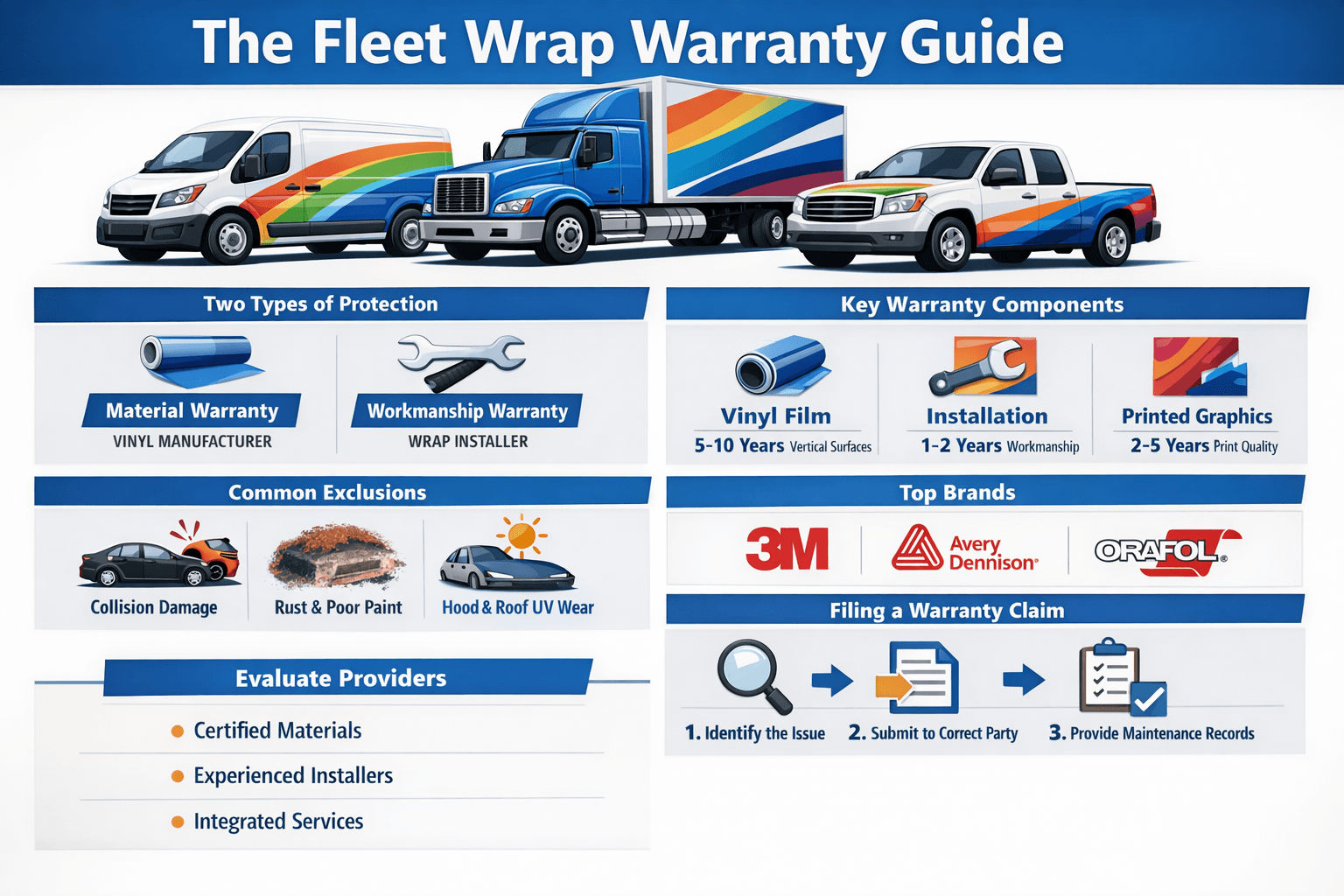
A fleet wrap warranty is a guarantee that protects branded vehicle graphics against premature failure, split into two core layers: a material warranty from the vinyl manufacturer and a workmanship warranty from the wrap installer.
This guide covers warranty components and durations, common exclusions and voiding conditions, brand-specific coverage differences, maintenance and claims processes, and how to evaluate providers before signing.
Fleet wrap warranties protect three distinct components: vinyl film, installation workmanship, and printed graphics. Each carries its own coverage terms, with premium cast vinyl offering material protection up to 10 years for vertical surfaces while installation warranties typically last only 1 to 2 years.
Exclusions narrow coverage more than most fleet buyers expect. Warranties do not cover collision damage, wraps applied over rust or compromised paint, or degradation on horizontal surfaces like hoods and roofs, where UV exposure can reduce coverage to as little as one year. Unauthorized repairs, neglected maintenance, and unapproved cleaning products can void otherwise valid warranties entirely.
Coverage terms vary significantly between manufacturers. 3M, Avery Dennison, and ORAFOL each structure their guarantees around certified material systems with distinct durability ratings, environmental restrictions, and eligibility requirements that fleet managers need to compare before committing.
Filing a claim requires identifying whether the defect is a material failure or an installation error, then submitting to the correct party with documented maintenance records. Working with a vertically integrated provider that controls design, printing, and installation under one roof simplifies this process by consolidating accountability and eliminating disputes between disconnected vendors.
What Is a Fleet Wrap Warranty?
A fleet wrap warranty is a guarantee that protects your branded vehicle graphics against premature failure. This protection is typically split into two distinct types of coverage: a material warranty from the vinyl manufacturer and a workmanship warranty from the wrap installer. Together, these warranties guard fleet branding against defects such as peeling, fading, cracking, and adhesion loss. According to Capital Wrappers, these two warranty layers work in tandem to shield businesses from premature degradation of their fleet graphics investment.
Understanding the distinction between these coverage types matters because each warranty has different terms, durations, and exclusion criteria. Material warranties from brands like 3M, Avery Dennison, and ORAFOL address the vinyl film and printed graphics, while installer warranties cover the quality of the application itself. For fleet managers overseeing dozens or hundreds of vehicles, knowing exactly where one warranty ends and another begins is essential for protecting budgets and maintaining consistent brand presentation across every asset.
Why Does a Fleet Wrap Warranty Matter for Your Investment?
A fleet wrap warranty matters for your investment because it protects the significant capital spent on branding across multiple vehicles from premature failure. Without warranty coverage, costs for reprinting, reinstalling, or repairing degraded wraps fall entirely on the fleet operator. The sections below cover the financial scale of fleet wrap investments, the brand consistency risks unwarranted wraps create, and how warranty protection directly reduces long-term total cost of ownership.
Fleet wraps represent one of the most cost-efficient advertising channels available. According to SignArt Graphix, vehicle wraps deliver a cost per thousand impressions ranging from roughly $0.35 to $0.77 per 1,000 views, significantly lower than traditional media. When a wrap fails prematurely due to material defects or poor installation, that low-CPM advantage disappears. Replacement costs compound quickly across a fleet of dozens or hundreds of vehicles. A warranty ensures the vinyl manufacturer or installer bears responsibility for covered failures, keeping your per-vehicle branding costs predictable and your advertising ROI intact.
Beyond raw economics, brand consistency depends on every vehicle in a fleet matching in color, finish, and graphic clarity. Fading, cracking, or peeling on even a few vehicles undermines the professional image a fleet program is designed to project. A warranty that covers defects like excessive discoloration and loss of adhesion gives fleet managers a defined remedy rather than an unbudgeted expense. For procurement teams managing large rollouts, this predictability is essential to justifying wrap programs over traditional paint.
Understanding what a fleet wrap warranty covers, and where gaps exist, positions fleet buyers to negotiate stronger contracts and avoid costly surprises over the life of the wrap.
What Components of a Fleet Wrap Are Typically Covered?
The components of a fleet wrap that are typically covered fall into three distinct warranty categories: vinyl film material, installation workmanship, and printed graphics. Each component carries its own coverage terms and conditions.
What Does a Vinyl Film Manufacturer Warranty Cover?
A vinyl film manufacturer warranty covers defects in the raw film material itself, including failures such as premature cracking, peeling, shrinkage, and adhesive breakdown under normal use conditions. This coverage applies specifically to the vinyl product, not the printing or installation.
Eligibility for full coverage often depends on using approved material and ink systems. According to the 3M MCS Warranty Bulletin (Revision I, December 2024), graphic manufacturers must hold a valid Certificate of 3M MCS Warranty for their specific printer and ink combination to qualify. Without that certification, material claims may be denied regardless of the defect.
For fleet managers, this means verifying your wrap provider’s certification status before production begins, not after a problem surfaces.
What Does an Installation Workmanship Warranty Cover?
An installation workmanship warranty covers errors made during the physical application of the wrap to the vehicle. Typical defects addressed under this coverage include:
- Major bubbling that appears shortly after installation
- Lifting or peeling at edges, seams, and recessed areas
- Wrinkling caused by improper technique or surface preparation
These warranties generally last between one and two years, a shorter window than material coverage because installation defects tend to reveal themselves early. It is worth noting that 3M’s warranty specifically excludes damage caused by improper installation, improper cleaning or maintenance, and exposure to unapproved chemicals. This distinction matters: if an installer causes the failure but is not the warranting party, resolving the claim becomes significantly more complicated.
What Does a Print or Graphics Warranty Cover?
A print or graphics warranty covers defects in the printed image layer applied to the vinyl, protecting against issues such as excessive fading, color shift, ink delamination, and blistering of the finished graphic. This warranty is separate from the base film warranty because the printing process introduces its own variables, including ink chemistry, print resolution, and laminate compatibility.
Coverage typically requires that the printer, ink, and overlaminate form an approved system certified by the film manufacturer. When all components align within a qualified system, the graphics warranty protects the visual integrity of the fleet branding over the stated coverage period.
Understanding which component failed is essential to filing the correct claim, since material, workmanship, and graphics warranties are administered by different parties.
How Long Do Fleet Wrap Warranties Usually Last?
Fleet wrap warranties usually last between 1 and 10 years, depending on the warranty type and material used. The sections below break down typical durations for cast vinyl, calendered vinyl, installation workmanship, and printed graphics warranties.
How Long Does a Cast Vinyl Film Warranty Last?
A cast vinyl film warranty lasts between 5 and 10 years for vertical applications, depending on the film color and climate zone. According to ORAFOL’s technical data sheet, the ORACAL 970RA Premium Wrapping Cast offers a maximum vertical durability of 10 years for black and white films, 8 years for transparent and color films, and 5 years for metallic finishes in Climate Zone 1.
These figures represent best-case vertical durability. Horizontal surfaces, fleet vehicles operating in harsher climates, and specialty finishes will see shorter coverage periods. For fleet managers planning multi-year branding programs, cast vinyl provides the longest material warranty available, making it the most reliable choice when long-term brand consistency matters.
How Long Does a Calendered Vinyl Film Warranty Last?
A calendered vinyl film warranty typically lasts 1 to 5 years, significantly shorter than cast vinyl coverage. Calendered films are thicker and less conformable, which makes them better suited for flat or gently curved fleet surfaces rather than complex vehicle contours.
Several factors shorten calendered film warranty periods:
- Higher shrinkage rates accelerate edge lifting over time.
- Reduced conformability limits application to simpler surface geometries.
- Greater sensitivity to temperature fluctuations increases the risk of cracking.
For fleets with flat-sided box trucks or trailers, calendered vinyl can be a cost-effective option. However, when vehicles have recesses, rivets, or compound curves, the shorter warranty reflects real performance limitations that make cast vinyl the better investment.
How Long Does an Installation Warranty Last?
An installation warranty typically lasts 1 to 2 years, covering workmanship defects such as major bubbling, edge lifting, and wrinkling. This warranty is issued by the installer, not the vinyl manufacturer, and it applies specifically to application quality rather than material performance.
The installation warranty period is notably shorter than material coverage because labor-related failures tend to appear quickly. Bubbling from trapped air or lifting from inadequate surface preparation usually becomes visible within the first few months. If no workmanship issues surface within two years, the installation is generally considered sound, and any future degradation falls under the material warranty instead.
How Long Does a Printed Graphics Warranty Last?
A printed graphics warranty typically lasts 3 to 7 years when the print system uses manufacturer-approved ink, film, and overlaminate combinations. Coverage protects against defects in the finished graphic, including excessive fading, cracking, and discoloration.
Printed graphics durability depends on several matched components:
- The base vinyl film (cast or calendered)
- Compatible inks certified by the film manufacturer
- A protective overlaminate layer that shields against UV and abrasion
Using non-certified ink or laminate combinations can reduce or void printed graphics warranty coverage entirely. For fleet programs with full-color branded wraps, confirming that every component in the print system is manufacturer-approved is the single most important step in securing long-term warranty protection.
Understanding warranty durations helps fleet buyers set realistic expectations, but knowing what can void that coverage is equally critical.
What Are the Most Common Fleet Wrap Warranty Exclusions?
The most common fleet wrap warranty exclusions include improper washing damage, application over compromised surfaces, collision-related harm, and degradation on horizontal panels. Understanding these exclusions prevents costly claim denials.
What Happens If Damage Results from Improper Washing?
Damage resulting from improper washing is not covered under most fleet wrap warranties. Pressure washers aimed too close, abrasive brushes, and unapproved chemical cleaners can lift edges, scratch laminate, or cause premature fading. According to 3M’s warranty bulletin, coverage specifically excludes damage caused by improper cleaning or maintenance and exposure to unapproved chemicals. Hand washing with a mild, non-abrasive detergent remains the safest method for preserving both the vinyl and the warranty. Fleet managers who skip this step often discover the gap only after a claim is denied, which makes driver and wash-bay training one of the simplest ways to protect coverage.
Are Wraps on Corrugated or Riveted Surfaces Covered?
Wraps on corrugated or riveted surfaces are typically not covered by manufacturer warranties. These irregular substrates create uneven tension on the vinyl, leading to premature lifting, air pockets, and adhesion failure around raised seams or fasteners. Because the failure originates from the surface geometry rather than a material defect, manufacturers classify it as an application-environment issue. Installers can mitigate risk with specialized techniques such as heat forming and edge sealing, yet the warranty will still exclude failures tied to the substrate itself. For fleet vehicles with corrugated panels, budgeting for periodic touch-ups is more realistic than relying on warranty remediation.
Does the Warranty Cover Damage from Collisions or Accidents?
The warranty does not cover damage from collisions or accidents. Wrap warranties specifically exclude coverage for accidental or physical damage, such as road debris, vandalism, collision, and rock chips, because these events fall outside the scope of material or installation failures. This distinction is critical for fleet operators. Comprehensive vehicle insurance, not the wrap warranty, is the appropriate coverage channel for impact-related vinyl damage. Treating the wrap warranty as a substitute for insurance is one of the most common misconceptions fleet buyers carry into procurement discussions.
Are Horizontal Surfaces Like Roofs and Hoods Excluded?
Horizontal surfaces like roofs and hoods are frequently excluded or carry significantly reduced warranty terms. These panels absorb far more direct UV radiation and heat than vertical surfaces, accelerating vinyl degradation. In high-exposure regions like Arizona, the maximum warranty for vinyl on horizontal surfaces is often limited to only one year. Even in milder climates, horizontal coverage rarely matches the five-to-seven-year terms available for doors and side panels. Fleet managers should confirm horizontal-surface terms in writing before signing, since vague language in this area is a common contract red flag.
Does the Warranty Cover Wraps Applied Over Rust or Paint Damage?
The warranty does not cover wraps applied over rust or paint damage. To qualify for a manufacturer’s vehicle wrap warranty, the application surface must be free of poor paint jobs, rust, dents, and nicks, as these are known potential points of failure. Vinyl cannot bond reliably to compromised substrates; rust continues spreading beneath the film, and flaking paint pulls the adhesive away. ORAFOL’s technical specifications for ORACAL 970RA confirm the adhesive is removable with little or no residue for up to four years, but only when applied to sound original paint. Investing in surface repair before installation protects both the wrap’s appearance and the warranty’s validity.
Understanding these exclusions is the first step; knowing what actions can void an otherwise valid warranty is equally important.
What Conditions Can Void a Fleet Wrap Warranty?
Several specific actions and oversights can void a fleet wrap warranty. Unauthorized modifications, neglected maintenance schedules, and unapproved cleaning chemicals are among the most common causes of denied claims.
Can Unauthorized Repairs or Modifications Void Coverage?
Yes, unauthorized repairs or modifications can void coverage on a fleet wrap warranty. Most manufacturer and installer warranties require that all repairs, replacements, and alterations be performed by certified professionals using approved materials. When an uncertified technician patches a damaged panel or applies a non-specified overlaminate, the original warranty holder loses the ability to verify material compatibility and installation quality. This breaks the chain of accountability that both material and workmanship warranties depend on. Fleet managers should always consult the original installer or a certified provider before authorizing any wrap repair, even for minor fixes.
Does Neglecting Recommended Maintenance Void the Warranty?
Yes, neglecting recommended maintenance can void a fleet wrap warranty. According to Trimble’s fleet warranty management guide, missing scheduled vehicle maintenance can inadvertently void warranties, making a thorough understanding of included and excluded items crucial to avoid claim denials. Regular wash cycles, inspections for lifting edges, and prompt attention to minor damage are typically required under both material and workmanship warranty terms. When fleet operators skip these documented care steps, manufacturers can reject claims on the basis that neglect, not a product defect, caused the failure. Keeping detailed maintenance logs for every wrapped vehicle is one of the simplest ways to protect warranty eligibility.
Can Using Non-Approved Cleaning Products Void Coverage?
Yes, using non-approved cleaning products can void fleet wrap warranty coverage. Harsh solvents, abrasive compounds, and petroleum-based cleaners can degrade vinyl adhesive bonds and damage printed graphics. Most vinyl manufacturers specify approved cleaning agents in their warranty documentation, and deviating from those recommendations gives the manufacturer grounds to deny a claim. Fleet teams should avoid pressure washers above recommended PSI thresholds as well, since high-pressure water can force moisture beneath wrap edges. Sticking to manufacturer-approved, wrap-safe cleaning solutions protects both the vinyl surface and the warranty standing behind it.
Understanding what voids coverage helps fleet managers establish internal protocols that keep warranties intact throughout the wrap’s lifespan.
How Do Vinyl Manufacturer Warranties Differ by Brand?
Vinyl manufacturer warranties differ by brand in coverage scope, durability ratings, and environmental restrictions. The three major brands, 3M, Avery Dennison, and ORAFOL, each structure their guarantees around approved material systems with distinct terms.
What Does the 3M Wrap Film Warranty Cover?
The 3M wrap film warranty covers approved combinations of 3M Graphic Products and MCS Warranty Inks against defects such as blistering, cracking, discoloration, excessive fading, and loss of adhesion. Coverage requires graphic manufacturers to hold a valid Certificate of 3M MCS Warranty for their specific printer and ink combination. Notably, the 3M Performance Warranty does not cover defects caused by the inks themselves. According to Grand View Research, the U.S. automotive wrap films market reached $1,496.2 million in 2024, reinforcing why understanding these warranty distinctions matters as adoption accelerates. Fleet buyers should confirm their installer holds current 3M certification, since using non-certified applicators can invalidate material coverage entirely.
What Does the Avery Dennison Wrap Warranty Cover?
The Avery Dennison wrap warranty covers finished graphics produced through its ICS Performance Guarantee, which combines approved films with qualified OEM components into a system guaranteed for compatibility and superior performance. Avery Dennison Supreme Wrapping Film offers vertical outdoor durability of up to 10 years for standard colors in Zone 1, while horizontal durability drops to 3 years. According to Avery Dennison’s ICS Performance Guarantee Bulletin (March 2025), warranty periods for materials applied in marine environments are automatically reduced by 40% compared to standard land-based applications.
Fleet managers operating near coastal areas should factor this reduction into lifecycle planning. Avery Dennison also recommends testing Supreme Wrapping Film for detailed graphics cutting prior to production to maintain warranty compliance. Verifying your wrap provider holds Avery Dennison certification keeps these material warranties valid.
What Does the ORAFOL Vehicle Wrap Warranty Cover?
The ORAFOL vehicle wrap warranty covers the ORACAL 970RA Premium Wrapping Cast, a 4.25-mil multi-layered cast PVC film engineered to replicate an automotive paint-like finish. Vertical durability reaches up to 10 years for black and white films, 8 years for transparent and color options, and 5 years for metallic finishes in Climate Zone 1. The adhesive remains removable with little or no residue for up to four years when applied to sound original paint. For fleet programs where vehicles rotate frequently, that clean-removal window is a significant practical advantage that many procurement teams overlook during vendor evaluation.
Understanding each brand’s specific terms helps fleet managers match warranty protection to their operational needs and filing requirements.
What Maintenance Is Required to Keep a Fleet Wrap Warranty Valid?
The maintenance required to keep a fleet wrap warranty valid includes regular cleaning with approved products, proper documentation of all service activities, and centralized record-keeping across your fleet.
Fleet wrap warranties demand more than just careful installation. Consistent, documented maintenance is the thread that ties your coverage together over the life of each vehicle. Missing even routine upkeep can give a manufacturer or installer grounds to deny a claim, regardless of whether the failure was maintenance-related. According to Trimble’s fleet warranty management guide, procurement managers should centralize all warranty information and service records in a digital database to effectively track expiration dates and required maintenance schedules. This single practice prevents the most common warranty pitfall: being unable to prove compliance when a claim arises.
For fleet managers overseeing dozens or hundreds of vehicles, the challenge is not just performing maintenance; it is proving it happened. Digital tracking systems that log wash dates, cleaning products used, inspection notes, and any repair activity create an auditable trail that satisfies both material and workmanship warranty requirements. Without this documentation, even a legitimate defect claim can be denied simply because the fleet cannot demonstrate adherence to care guidelines.
The most practical approach is building wrap maintenance directly into existing fleet service schedules rather than treating it as a separate task. When technicians already have a vehicle on the lot for oil changes or tire rotations, adding a wrap inspection and approved hand wash takes minimal additional time while generating the documentation needed to keep warranty coverage intact.
Understanding what maintenance protects your warranty also helps clarify what steps to take when something does go wrong.
How Do You File a Fleet Wrap Warranty Claim?
You file a fleet wrap warranty claim by identifying the defect, gathering supporting documentation, submitting the claim through the correct manufacturer or installer channel, and tracking its progress. The steps below break down what this process looks like in practice.
The general warranty claim process for fleets follows a clear sequence:
- Identify and document the issue. Photograph the defect from multiple angles and note the vehicle ID, wrap installation date, and the specific location of the failure on the vehicle.
- Gather supporting records. Collect service records, original purchase documentation, material batch numbers, and any maintenance logs that prove compliance with care requirements.
- Determine the responsible party. Assess whether the defect is a material failure (manufacturer claim) or an installation error (installer claim), since each requires a separate submission path.
- Submit the claim per the correct procedure. File directly with the vinyl manufacturer for material defects or with the installation provider for workmanship issues, following their specific forms and submission requirements.
- Follow up on progress. Track the claim status actively, as resolution timelines vary between manufacturers and installers.
According to Trimble’s fleet warranty management guide, this process involves identifying the issue, gathering documentation like service records and purchase dates, submitting per manufacturer procedures, and following up on progress. What often complicates fleet wrap claims, compared to standard vehicle warranty claims, is the need to coordinate multiple parties: the installer, the material manufacturer, and sometimes a third-party claims adjuster.
Working with a provider that controls design, printing, and installation under one roof simplifies this coordination significantly. When a single company owns every stage of production, accountability is clear and claim resolution moves faster because there is no finger-pointing between separate vendors. For fleet managers handling dozens or hundreds of vehicles, that streamlined accountability can mean the difference between a resolved claim and a months-long dispute.
Understanding the distinction between material and labor warranties helps direct your claim to the right party from the start.
What Is the Difference Between a Material Warranty and a Labor Warranty?
The difference between a material warranty and a labor warranty is the source of coverage and what each protects. A material warranty comes from the vinyl manufacturer; a labor warranty comes from the wrap installer.
A material warranty covers defects in the vinyl film itself. Manufacturers like 3M, Avery Dennison, and ORAFOL guarantee their products against failures such as blistering, cracking, excessive fading, and loss of adhesion when the film is used according to specifications. According to Capital Wrappers, a fleet wrap warranty is typically split into these two distinct types: a material warranty from the vinyl manufacturer and a workmanship warranty from the wrap installer, which together protect branding against premature degradation, peeling, and fading.
A labor warranty, often called a workmanship warranty, covers errors made during the installation process. These include defects such as:
- Major bubbling across panel surfaces
- Lifting or peeling at edges and seams
- Wrinkling caused by improper application technique
- Poor alignment of printed graphics
The duration gap between these two warranties is significant. Premium cast vinyl material warranties typically extend 5 to 7 years, while workmanship warranties generally last only 1 to 2 years. This means a fleet vehicle can lose labor coverage long before its material protection expires, leaving installation-related failures uncovered during most of the wrap’s service life.
For fleet managers, understanding this distinction matters because a single visible defect could fall under either warranty, and filing with the wrong party delays resolution. Fading or cracking points to a material claim with the manufacturer, while edge lifting or bubbling points to a labor claim with the installer. Knowing which warranty applies to a specific failure is essential for efficient claim resolution across a large vehicle fleet.
How Does Installation Quality Affect Warranty Coverage?
Installation quality directly determines whether both material and workmanship warranties remain enforceable. Poor application techniques can void manufacturer coverage entirely, while certified installation preserves the full warranty chain.
Improper installation is one of the most common reasons fleet wrap warranties fail. When vinyl is applied without proper surface preparation, correct temperature control, or adequate post-heat treatment, the resulting defects (bubbling, lifting, wrinkling) fall outside manufacturer coverage. According to the 3M MCS Warranty Bulletin (Revision I, December 2024), graphic manufacturers must hold a valid Certificate of 3M MCS Warranty for their specific printer and ink combination to qualify for full material coverage. This certification requirement extends to installation standards; work performed by uncertified shops typically voids the manufacturer’s protection regardless of film quality.
Surface condition at the time of application matters equally. Vinyl applied over rust, dents, poor paint, or contaminated panels creates failure points that no warranty will cover. Manufacturers like Mactac specify that the application surface must be free of these defects to qualify for coverage. Even premium cast films lose their warranty protection when bonded to compromised substrates.
For fleet managers, this creates a practical reality: the installer you choose is as important as the vinyl brand you select. A certified installer who follows manufacturer protocols protects both the workmanship guarantee and the material warranty simultaneously. Skipping this step to save on upfront costs often eliminates thousands of dollars in long-term warranty value.
Choosing an installation partner with documented training and manufacturer certification is the single most effective way to safeguard your fleet wrap investment.
What Should You Look for in a Fleet Wrap Warranty Before Signing?
You should look for clear coverage terms, certified installer requirements, and proof of in-house production capability. The key checkpoints fall into several categories.
Before signing any fleet wrap warranty, verify these critical items:
- Manufacturer’s warranty on materials. Confirm the provider offers a documented warranty from the vinyl manufacturer, not just a generic shop guarantee.
- Certified installer verification. Ensure the installer holds certification from the film brand being used, since uncertified application can void material coverage entirely.
- Horizontal surface specifics. Check whether the warranty explicitly addresses hoods, roofs, and other horizontal panels, as these areas often carry reduced coverage periods.
- Transferability clauses. Review whether coverage transfers if a vehicle is reassigned, sold, or moved between fleet locations.
- Maintenance requirements. Identify exactly which cleaning products and wash schedules the warranty mandates so your team can comply from day one.
- In-house production track record. According to Visual Marking Systems, procurement teams should look for vendors that offer a manufacturer’s warranty on products and can demonstrate a track record of handling the entire production cycle in-house.
A provider that controls design, printing, and installation under one roof simplifies accountability when a warranty claim arises. Fragmented vendor chains create finger-pointing between the printer, the material supplier, and the installer, which delays resolution and weakens your leverage. For fleet managers evaluating multiple bids, the warranty document itself is one of the most revealing indicators of a provider’s confidence in their own work.
Understanding what to look for in the warranty sets the stage for choosing a provider whose production model backs those promises.
How Can a Vertically Integrated Provider Strengthen Your Fleet Wrap Warranty?
A vertically integrated provider strengthens your fleet wrap warranty by consolidating design, printing, and installation under one roof, ensuring direct accountability for every warranty claim. The sections below cover how Craftsmen Industries’ in-house capabilities protect your investment and the key takeaways for fleet wrap warranty coverage.
Can Craftsmen Industries’ In-House Large Format Graphics Ensure Better Warranty Protection?
Yes, Craftsmen Industries’ in-house large format graphics can ensure better warranty protection. When a single provider controls every production stage, from graphic design and large format printing to professional installation, there is no finger-pointing between separate vendors if a defect arises. This consolidated approach eliminates the gaps that often complicate warranty claims when multiple subcontractors are involved.
Craftsmen Industries operates from a 127,000 sq. ft. facility in St. Charles, Missouri, where quality control spans the entire workflow. According to a Trimble fleet warranty management guide, effective technician training for warranty documentation should focus on the “Three C’s” (Complaint, Cause, and Correction) to ensure all necessary details are captured for a successful claim. Because Craftsmen Industries manages every phase internally, documenting these elements becomes seamless. For fleet managers, this single point of contact simplifies claim resolution and reduces the risk of denied coverage due to miscommunication between disconnected vendors.
What Are the Key Takeaways About Fleet Wrap Warranty Coverage and What to Expect?
The key takeaways about fleet wrap warranty coverage center on understanding what is protected, what is excluded, and how to choose the right partner:
- High-quality fleet wraps should last between five and seven years when properly maintained, with premium cast vinyl offering the longest material warranty terms.
- Every warranty has two layers: a material warranty from the vinyl manufacturer and a workmanship warranty from the installer.
- Common exclusions include physical damage, improper maintenance, and reduced coverage on horizontal surfaces like hoods and roofs.
- Contract red flags include lack of clarity on transferability, non-specific coverage for horizontal surfaces, and absence of certified installer requirements.
- Choosing a vertically integrated partner that handles design, printing, and installation in-house ensures quality control and direct accountability for warranty claims.
For most fleet programs, the single most impactful decision is selecting a provider who owns the entire production cycle. When warranty responsibility is consolidated rather than fragmented across vendors, claim resolution becomes faster and coverage gaps shrink considerably. Craftsmen Industries brings over 40 years of vertically integrated expertise to fleet wrap programs, offering end-to-end project control from ideation to installation.
Filter Posts by Tag
related posts
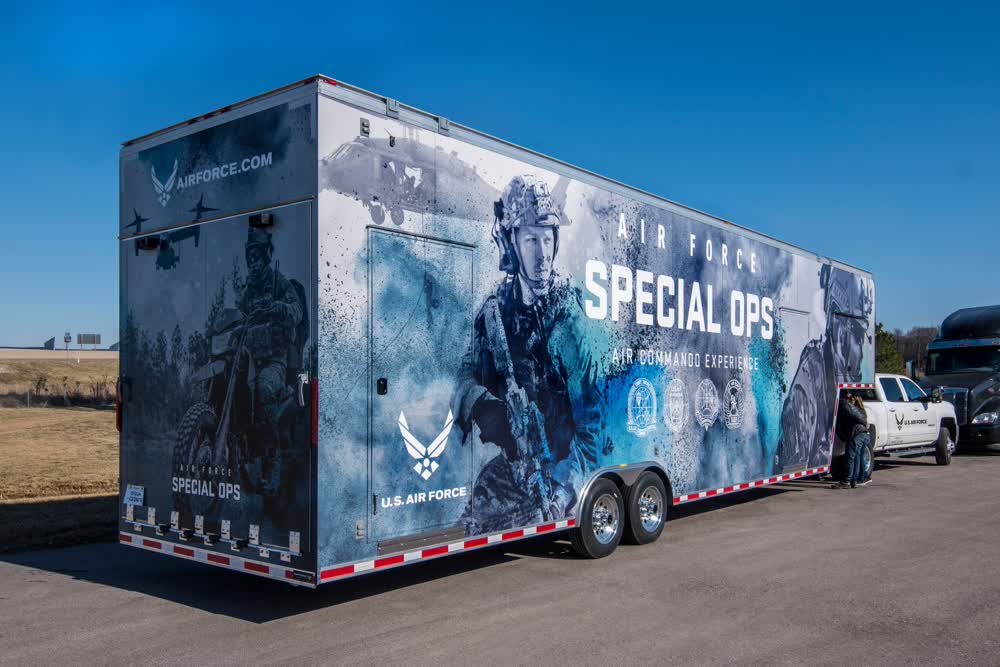
Learn how to clean, protect, and repair fleet graphics to extend their lifespan, cut replacement costs, and keep your vehicles looking professional.
A fleet wrap budget is a structured financial plan that [...]
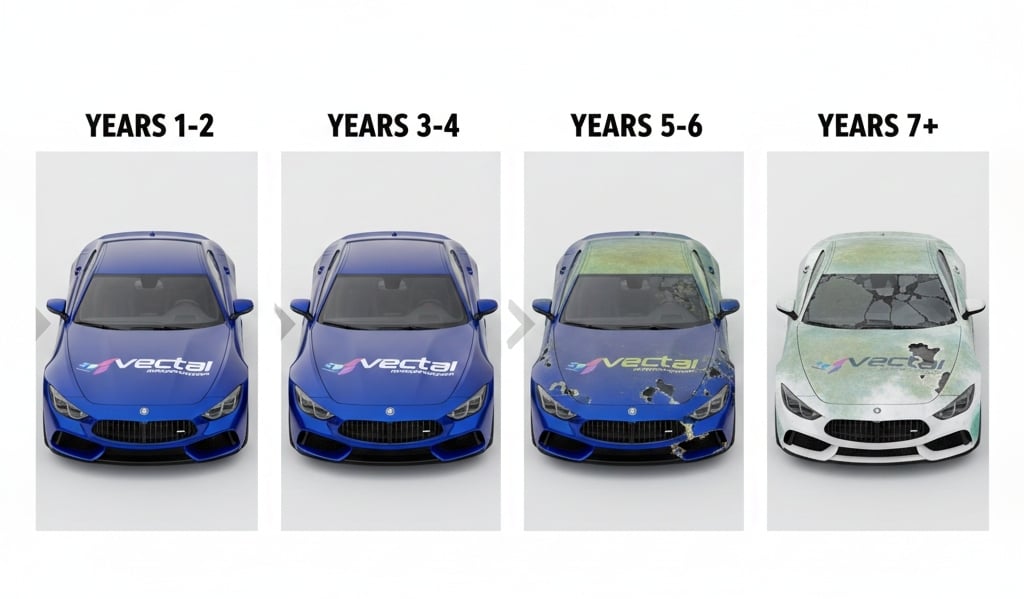
Discover how long vinyl car wraps last—typically 5–7 years. Learn factors affecting lifespan, maintenance tips, and when replacement is needed.
