
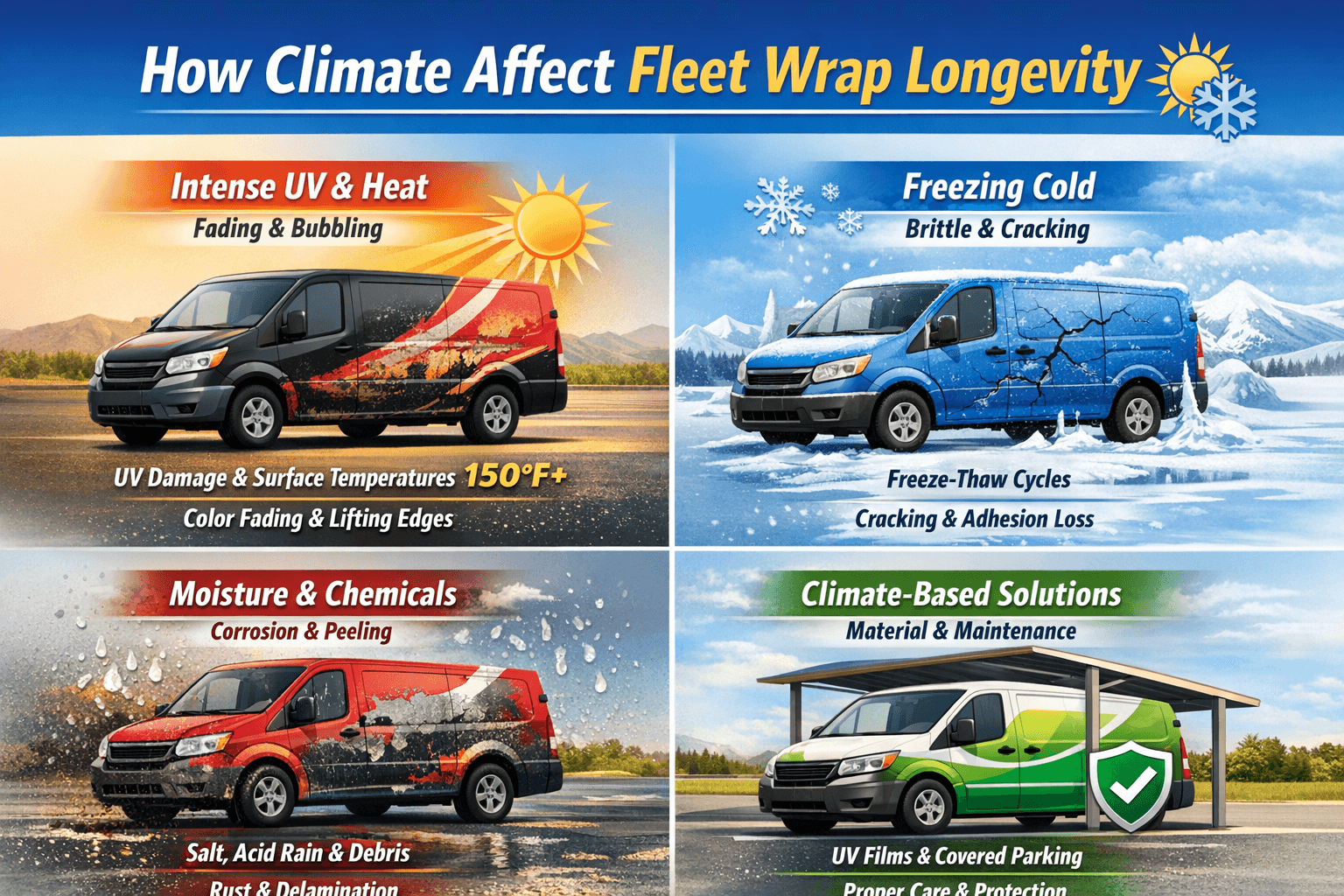
Climate is the single largest external factor determining how long fleet vehicle wraps maintain their appearance, adhesion, and structural integrity. This guide covers UV and heat degradation, cold-weather vinyl failure, moisture and chemical attack, material selection by climate zone, and maintenance strategies that extend wrap life.
UV radiation breaks down vinyl pigments and adhesive polymers through photodegradation, with high UV index regions accelerating fading and edge lifting well beyond standard durability ratings. Cast films formulated with HALS chemistry in the 80 to 100 µm thickness range achieve the five to seven year ratings that align with typical fleet replacement cycles.
Extreme heat softens adhesive bonds and causes bubbling, while radiant energy from pavement compounds the damage on lower body panels. Vehicles parked in unshaded lots year-round face significantly shorter wrap lifespans than those stored under cover.
Freezing temperatures and freeze-thaw cycles create the opposite problem, making vinyl brittle and propagating micro-cracks across hardened film surfaces. Each cycle compounds adhesion loss as trapped moisture expands and contracts beneath the film.
Humidity, salt air, acid rain, and road chemicals each attack wraps through distinct pathways, from hydrolytic polymer degradation to corrosive salt deposits that penetrate edge seals. Wind-driven sand and highway debris add abrasive surface erosion to the equation.
Matching vinyl formulation, adhesive chemistry, and laminate type to specific climate zones is essential for reaching full service life. Paired with climate-appropriate cleaning schedules, protective coatings, and covered parking, proper material selection transforms wrap longevity from unpredictable to manageable.
What Role Does UV Exposure Play in Fleet Wrap Degradation?
UV exposure plays a central role in fleet wrap degradation by breaking down vinyl pigments and weakening adhesive bonds. The following subsections cover how sun exposure causes fading, how UV radiation deteriorates adhesive layers, and what UV protection ratings to prioritize.
How Does Prolonged Sun Exposure Cause Vinyl Wrap Fading?
Prolonged sun exposure causes vinyl wrap fading by degrading the pigment molecules embedded in the vinyl’s face film. As UV photons strike the wrap surface, they break chemical bonds in the colorants, producing gradual color shift, chalking, and loss of gloss.
Fleets operating in high UV index regions experience this damage at an accelerated rate. According to ProWraps Sacramento, Sacramento’s extreme heat and UV rays degrade vinyl wraps faster than most climates, with local conditions including 100°F+ summer temperatures and intense UV exposure year-round. Dark-colored wraps absorb more radiation and fade noticeably sooner than lighter tones.
Premium cast films resist fading longer than calendered alternatives because their molecular structure is more stable under sustained UV bombardment. For fleets that cannot guarantee shaded parking, selecting films rated for high UV environments is one of the most cost-effective decisions a fleet manager can make.
How Does UV Radiation Break Down Wrap Adhesive Over Time?
UV radiation breaks down wrap adhesive over time by triggering photodegradation in the polymer chains that give the adhesive its tack and flexibility. Continuous exposure causes cross-linking and chain scission within the adhesive layer, making it progressively brittle. Once brittleness sets in, the adhesive loses its ability to conform to panel curves, leading to edge lifting, tunneling, and eventual delamination.
3M Wrap Film Series 1380 uses a solvent acrylic, pressure-sensitive, repositionable adhesive at 90 µm thickness, a formulation engineered to resist UV-induced hardening longer than standard adhesive systems. Even with premium adhesives, however, unprotected horizontal surfaces like hoods and roof panels degrade fastest because they receive the most direct solar radiation.
Routine post-installation care also matters. Surface contaminants trapped between the film and adhesive can accelerate UV damage by creating localized hot spots. Addressing contamination early helps the adhesive maintain its designed service life.
What UV Protection Ratings Should Fleet Wraps Have?
Fleet wraps should have UV protection ratings that align with the vehicle’s expected replacement cycle and operating climate. Cast vinyl films formulated with hindered amine light stabilizers, commonly known as HALS, offer the strongest UV resistance available for commercial fleet applications.
According to HighCool, 80 to 100 µm cast vinyl with HALS achieves the five to seven year UV rating required for standard fleet replacement cycles. HALS function by absorbing radiation in the 295 to 400 nm wavelength range while transmitting visible light, which preserves color accuracy and film integrity simultaneously.
Key UV protection factors to evaluate when specifying fleet wrap materials include:
- Film type: Cast vinyl outperforms calendered vinyl in long-term UV stability.
- HALS concentration: Higher stabilizer content extends color retention under sustained exposure.
- Laminate overlay: A UV-rated overlaminate adds a sacrificial barrier that absorbs radiation before it reaches the printed face film.
- Manufacturer durability rating: Look for vertical outdoor durability ratings of five years or more for temperate climates, and verify reduced ratings for horizontal or high UV zone applications.
Specifying wraps that meet these thresholds reduces premature replacement costs and keeps fleet branding consistent across vehicles. Understanding adhesive and UV film performance sets the foundation for addressing another major climate factor: extreme heat.
How Does Extreme Heat Impact Fleet Vehicle Wraps?
Extreme heat impacts fleet vehicle wraps by softening vinyl, weakening adhesive bonds, and accelerating surface degradation. The following subsections cover how heat causes lifting and bubbling, the temperature thresholds that trigger deterioration, and how radiant pavement heat compounds damage on parked fleet vehicles.
How Does Heat Cause Vinyl Wrap Lifting and Bubbling?
Heat causes vinyl wrap lifting and bubbling by softening the adhesive layer until it loses its grip on the vehicle surface. As temperatures climb, the pressure-sensitive adhesive becomes pliable, allowing air and moisture to migrate beneath the film. This trapped air forms visible bubbles, while edges and seams begin to lift away from body panels. Curved surfaces and areas near engine compartments are especially vulnerable because they retain more heat. According to ProWraps Sacramento, regions with 100°F+ summer temperatures and intense UV exposure year-round degrade vinyl wraps faster than most climates. Once lifting begins, exposed adhesive collects road grime and contaminants, making reapplication increasingly difficult. For fleet managers, even minor bubbling signals that the adhesive bond is failing and the wrap needs immediate attention.
What Temperature Thresholds Accelerate Wrap Deterioration?
The temperature thresholds that accelerate wrap deterioration begin around 150°F (65°C) at the vehicle surface. While ambient air may read 95–110°F, dark-colored vehicles in direct sunlight can reach surface temperatures well above 150°F. At these levels, cast vinyl becomes excessively pliable, and adhesive softening leads to edge curling, stretching, and permanent deformation. Sustained exposure above 160°F can cause irreversible film distortion, particularly on horizontal surfaces like hoods and roof panels that absorb the most solar energy. Lighter wrap colors reflect more heat and stay below critical thresholds longer, which is one reason fleet operators in hot climates should factor color selection into their wrap specifications. Monitoring surface temperatures, not just ambient readings, gives a more accurate picture of the thermal stress fleet wraps endure daily.
How Does Radiant Heat From Pavement Affect Parked Fleet Wraps?
Radiant heat from pavement affects parked fleet wraps by creating a secondary heat source that bakes lower body panels and undercarriage-adjacent graphics. Asphalt can reach 140–170°F on hot days, radiating thermal energy upward onto rocker panels, bumpers, and wheel well wraps. This radiant exposure compounds the direct solar heat already striking upper surfaces, subjecting the entire wrap to sustained elevated temperatures. A study evaluating 200 major U.S. cities, reported by Florida Politics, found that Florida’s heat makes the state among the worst in the U.S. for vehicle exterior damage, including paint damage and corrosion. Vehicles garaged or parked in covered areas can achieve the full seven-year lifespan from premium materials, while those parked in unshaded lots year-round face accelerated degradation. Covered or shaded parking is one of the simplest strategies fleet managers can implement to protect their wrap investment.
Understanding heat’s impact on wraps sets the stage for examining how extreme cold creates an entirely different set of challenges.
How Does Extreme Cold Affect Fleet Wrap Performance?
Extreme cold affects fleet wrap performance by making vinyl brittle, weakening adhesive bonds, and complicating installations. The following sections cover freezing-related cracking, freeze-thaw adhesion loss, and winter installation challenges.
How Does Freezing Temperature Cause Vinyl Wrap Cracking?
Freezing temperature causes vinyl wrap cracking by reducing the film’s flexibility until it becomes brittle and fractures under stress. Vinyl is a polymeric material that relies on plasticizers to remain pliable; when temperatures drop well below freezing, these plasticizers stiffen, and the film loses its ability to absorb impacts or flex with the vehicle body.
According to Fleet Wrap HQ, freezing temperatures can make vinyl brittle and cause cracks, while extreme heat makes the surface malleable and susceptible to damage. Even minor road vibrations or door closures can propagate micro-fractures across rigid, cold-hardened wrap surfaces. For fleets operating in northern climates, this brittleness risk is highest during overnight lows when vehicles sit idle and vinyl contracts without relief.
How Do Freeze-Thaw Cycles Weaken Wrap Adhesion?
Freeze-thaw cycles weaken wrap adhesion by repeatedly expanding and contracting the bond layer between the vinyl film and the vehicle surface. During freezing, any moisture trapped beneath the wrap crystallizes and expands, creating micro-gaps between the adhesive and the substrate. When temperatures rise, the ice melts and the adhesive partially re-engages, but the original bond integrity is never fully restored.
Each cycle compounds the damage:
- Moisture infiltrates edges and seams during thaw periods.
- Ice formation pushes the film away from the substrate during freezing.
- Repeated stress fatigues the adhesive, leading to progressive delamination.
This cumulative effect is particularly damaging for fleet vehicles that park outdoors overnight in regions with wide diurnal temperature swings. Over one winter season, dozens of freeze-thaw cycles can loosen edges and seams enough to require premature re-wrapping.
Why Are Winter Fleet Wrap Installations More Challenging?
Winter fleet wrap installations are more challenging because cold temperatures reduce vinyl conformability and slow adhesive activation. Most cast vinyl films require application temperatures above 60°F for the adhesive to bond properly and for the material to stretch around curves, rivets, and recesses without cracking.
Key winter installation obstacles include:
- Vinyl stiffness that prevents smooth conforming to complex body panels.
- Slower adhesive tack development, extending application time.
- Condensation risk when cold vehicles enter heated bays, trapping moisture beneath the film.
Professional installers address these issues by pre-conditioning vehicles in climate-controlled facilities and using heat guns to locally warm panels during application. Skipping these steps in winter often results in premature edge lifting and adhesion failure within weeks.
Understanding cold-weather wrap vulnerabilities sets the stage for examining how humidity and moisture create a different set of longevity challenges.
How Does Humidity and Moisture Shorten Wrap Lifespan?
Humidity and moisture shorten wrap lifespan by degrading adhesive bonds, trapping water beneath the film, and accelerating corrosion in salt-laden coastal air. The following subsections cover adhesive failure, blistering, and saltwater-specific damage.
How Does High Humidity Cause Wrap Adhesive Failure?
High humidity causes wrap adhesive failure by introducing persistent moisture at the bond line between vinyl film and the vehicle substrate. Pressure-sensitive adhesives rely on direct surface contact to maintain tack; when ambient moisture levels remain elevated, water molecules interfere with this contact and weaken the bond over time.
According to Avery Dennison Graphics Solutions, the SW900 Series Supreme Wrapping Film uses a cast film with face thickness ranging from 3.2 mil (80 µm) to 4.7 mil (119 µm), engineered for high-quality vehicle wrapping applications. Even premium films like these depend on proper surface preparation and low-humidity installation conditions to achieve rated adhesion. Fleets operating in consistently humid regions should prioritize climate-controlled application environments and regular edge-seal inspections to catch early lifting before full delamination occurs.
How Does Trapped Moisture Lead to Wrap Blistering?
Trapped moisture leads to wrap blistering by creating pockets of water vapor between the vinyl and the vehicle surface. When moisture infiltrates through micro-gaps at seams, edges, or imperfections in the substrate, heat causes that moisture to expand. The resulting vapor pressure pushes the film outward, forming visible bubbles that compromise both appearance and structural integrity.
Once a blister forms, the surrounding adhesive bond weakens progressively. Each thermal cycle expands and contracts the trapped moisture, enlarging the affected area. For fleet managers, even small blisters signal broader moisture intrusion that can spread across entire panels if left unaddressed. Prompt repair of blistered areas and resealing exposed edges remain the most effective countermeasures.
How Does Saltwater Humidity in Coastal Climates Affect Wraps?
Saltwater humidity in coastal climates affects wraps by depositing microscopic salt crystals on vinyl surfaces and along adhesive edges. These salt particles are hygroscopic; they attract and retain additional moisture, creating a persistent corrosive layer that standard freshwater humidity does not produce. Over time, this salt-moisture combination attacks both the vinyl face film and the underlying adhesive.
Corrosive salt air is particularly aggressive at wrap seams and panel transitions where edges are exposed. Fleets operating near coastlines benefit from more frequent wash cycles using pH-neutral cleaners to remove salt deposits before they penetrate adhesive boundaries. For operations in these environments, specifying films with documented salt spray resistance is a practical investment that reduces premature replacement costs.
With moisture-related risks understood, choosing the right materials for rain and direct water exposure becomes the next critical consideration.
How Do Rain and Water Exposure Degrade Fleet Wraps?
Rain and water exposure degrade fleet wraps through chemical attack from acidic precipitation and physical infiltration at vulnerable edge seals. The sections below cover acid rain surface damage and standing water seal compromise.
How Does Acid Rain Damage Fleet Wrap Surfaces?
Acid rain damages fleet wrap surfaces by accelerating hydrolytic degradation of the vinyl’s polymeric structure. Sulfuric and nitric compounds in acidic precipitation break polymer chains in the wrap film, causing surface etching, discoloration, and loss of gloss over repeated exposure cycles.
According to research published by John Wiley & Sons, acid rain enhances hydrolytic degradation of polymeric materials, while deicing salts and sulfates from acid rain are notorious for causing coating deterioration. These contaminants lower the surface pH, weakening the protective laminate layer that shields printed graphics underneath.
Fleets operating in industrial corridors or regions with high emissions face compounded risk. For most fleet managers, scheduling post-rain rinses is one of the simplest ways to neutralize acidic residue before permanent damage sets in.
How Does Standing Water Compromise Wrap Edge Seals?
Standing water compromises wrap edge seals by wicking beneath exposed vinyl edges through capillary action. Pooled water along panel seams, door handles, and recessed body lines creates sustained contact that softens pressure-sensitive adhesives over time.
Key failure points where standing water causes the most damage include:
- Horizontal panel edges where water pools after rain rather than sheeting off.
- Door jamb transitions where vinyl terminates near natural water channels.
- Riveted or recessed body features that trap moisture against unsealed film borders.
- Lower body panels and wheel wells exposed to road spray accumulation.
Once water penetrates an edge seal, it creates a cycle of partial drying and re-wetting that progressively lifts the adhesive bond. This delamination then allows more water ingress, accelerating graphic failure outward from the initial breach point.
Proper edge sealing during installation and routine inspection of vulnerable seam areas are the most effective defenses against water infiltration. With water exposure risks addressed, understanding how salt and road chemicals interact with wraps reveals additional degradation pathways.
How Does Salt and Road Chemical Exposure Affect Wraps?
Salt and road chemical exposure affects wraps by accelerating vinyl degradation, corroding adhesive bonds, and breaking down protective laminates. The following subsections cover how road salt corrodes wrap vinyl and how de-icing chemicals interact with wrap laminates.
How Does Road Salt in Winter Climates Corrode Wrap Vinyl?
Road salt in winter climates corrodes wrap vinyl by creating a persistent chemical film that attacks both the face film and the adhesive layer beneath. Sodium chloride draws moisture to the vinyl surface, forming a saline solution that penetrates micro-abrasions and edge seals. This accelerates hydrolytic degradation of the polymeric material, weakening color stability and structural integrity over repeated freeze-thaw cycles.
According to a publication by John Wiley & Sons on plastics and the environment, deicing salts and sulfates from acid rain are notorious for causing coating deterioration. Fleets operating in northern salt-belt regions should prioritize frequent rinsing to prevent crystallized salt from embedding in wrap seams, where it causes the most damage.
How Do De-Icing Chemicals Interact With Wrap Laminates?
De-icing chemicals interact with wrap laminates by breaking down the protective overlaminate layer that shields printed graphics from abrasion and chemical attack. Calcium chloride and magnesium chloride, commonly used on highways, are more aggressive than standard sodium chloride because they remain active at lower temperatures and maintain prolonged surface contact.
These chemicals soften laminate films over time, reducing their ability to resist UV penetration and moisture intrusion. Once the laminate barrier is compromised, the underlying ink and adhesive layers become exposed to further environmental damage. For fleet managers, selecting laminates tested against salt spray exposure provides a measurable advantage in chemical-heavy winter corridors.
Understanding salt and chemical threats helps fleet managers choose the right protective materials for harsh winter conditions.
How Does Wind and Debris Exposure Wear Down Fleet Wraps?
Wind and debris exposure wears down fleet wraps through abrasive surface erosion and physical impact damage. The subsections below cover sand and dust storm abrasion and highway debris micro-tears.
How Do Sand and Dust Storms Abrade Wrap Surfaces?
Sand and dust storms abrade wrap surfaces by driving fine particulate at high velocity against the vinyl film, gradually eroding the protective top layer and exposing the pigment beneath. This process, known as abrasive weathering, is particularly aggressive in arid and desert regions where windborne silica particles act like microscopic sandpaper.
Premium cast films, such as the Avery Dennison SW900 Series with face film thickness ranging from 3.2 mil to 4.7 mil, provide greater abrasion resistance than thinner calendered alternatives. Thicker films simply have more material to sacrifice before the graphic layer is compromised. Fleets operating in high-dust corridors should prioritize laminate overcoats, which absorb surface abrasion while keeping the printed graphic intact underneath.
How Does Highway Debris Cause Micro-Tears in Fleet Wraps?
Highway debris causes micro-tears in fleet wraps when loose gravel, tire fragments, and road surface chips strike the vinyl at speed. These impacts puncture or split the film at a microscopic level, creating entry points for moisture, UV radiation, and contaminants that accelerate further degradation.
Micro-tears concentrate along lower panels, bumper areas, and wheel wells where debris impact frequency is highest. Once the film’s surface integrity breaks, adhesive delamination can follow as water infiltrates beneath the vinyl. For fleets logging high interstate mileage, periodic inspections of vulnerable zones catch micro-tears before they propagate into visible peeling or lifting.
Identifying wind and debris damage early sets the stage for choosing wrap materials engineered to resist these forces.
How Should You Choose Wrap Materials Based on Climate Zone?
You should choose wrap materials based on climate zone by matching vinyl formulation, adhesive chemistry, and laminate type to the specific environmental stressors your fleet faces. The sections below cover optimal selections for hot arid, cold northern, humid tropical, and coastal salt air climates.
What Wrap Vinyl Performs Best in Hot Arid Climates?
The wrap vinyl that performs best in hot arid climates is premium cast film with Hindered Amine Light Stabilizers (HALS) and high heat resistance. Cast vinyl in the 80–100µm thickness range withstands sustained temperatures above 100°F without softening or lifting. HALS chemistry absorbs UV radiation between 295 and 400 nm, preventing the accelerated fading and adhesive breakdown that desert conditions cause.
Matte or satin finishes also reduce surface heat absorption compared to gloss, which helps in regions where pavement radiates additional thermal energy onto parked vehicles. For fleets operating in the desert Southwest, pairing UV-stabilized cast vinyl with a protective overlaminate is the most reliable approach to reaching a full replacement cycle.
What Wrap Vinyl Performs Best in Cold Northern Climates?
The wrap vinyl that performs best in cold northern climates is conformable cast film engineered with cold-weather adhesive technology. Standard adhesives stiffen below freezing, which makes the vinyl brittle and prone to cracking along panel edges and compound curves. Cold-rated pressure-sensitive adhesives maintain flexibility at sub-zero temperatures, resisting the contraction stress that freeze-thaw cycles impose on wrap seams.
Thicker laminates in the 90–100µm range provide an added buffer against micro-abrasion from road salt and gravel spray common on winter highways. Fleet managers in northern zones should also prioritize films with documented performance ratings for temperature fluctuation resistance, since repeated cycling between freezing and thawing is what ultimately weakens adhesion.
What Wrap Vinyl Performs Best in Humid Tropical Climates?
The wrap vinyl that performs best in humid tropical climates is cast film with moisture-resistant adhesive and high humidity tolerance. Persistent moisture exposure degrades standard adhesive bonds, causing blistering and edge lifting across large panel areas.
According to 3M’s product bulletin for the 1380 Wrap Film Series, expected vertical outdoor durability in Climate Zone 3 (Gulf area, Africa) is 3 years for white and black film, dropping to just 12 months for horizontal surfaces. This dramatic reduction underscores why tropical fleet operators need films specifically tested for high-humidity, high-UV environments. Selecting vinyl with channeled adhesive systems helps trapped moisture escape during installation, preventing the blister formation that humid conditions accelerate.
What Wrap Vinyl Performs Best in Coastal Salt Air Climates?
The wrap vinyl that performs best in coastal salt air climates is premium cast film paired with corrosion-resistant laminate and salt-spray-rated adhesive. Salt air continuously attacks exposed wrap edges, accelerating adhesive delamination and promoting substrate corrosion beneath the vinyl surface.
Films with sealed edge technology and protective overlaminates create a barrier that limits salt penetration at seams and panel transitions. For coastal fleet operations, specifying materials with documented salt spray resistance testing ensures the wrap system can handle continuous saline exposure without premature failure. Wrapping edges with additional reinforcement at high-exposure points, such as bumpers and rocker panels, further extends service life.
Choosing the right material is only half the equation; climate-specific maintenance protocols keep those materials performing at their best.
How Does Climate-Specific Maintenance Extend Wrap Life?
Climate-specific maintenance extends wrap life by matching cleaning frequency, protective coatings, and storage practices to the environmental stressors each fleet faces. The following subsections cover optimal cleaning schedules, coating options, and parking strategies.
How Often Should Fleet Wraps Be Cleaned in Harsh Climates?
Fleet wraps in harsh climates should be cleaned more frequently than standard manufacturer intervals suggest. Fleets operating in high-salt coastal zones or winter road-salt regions benefit from weekly washing to prevent corrosive buildup on vinyl surfaces and edge seals. In hot, dusty climates, bi-weekly cleaning removes abrasive particulates before they scratch the laminate.
According to 3M Instruction Bulletin 6.5, recommended cleaners for wrapped vehicles should be wet, non-abrasive, free of strong solvents, and have a pH between 3 and 11. Touchless or hand-wash methods protect the film better than automated brush systems, which can lift edges. For fleets in regions with acid rain exposure, prompt post-storm rinsing prevents chemical etching from lingering on the wrap surface.
What Protective Coatings Help Wraps Resist Climate Damage?
Protective coatings that help wraps resist climate damage include ceramic coatings, UV-inhibiting sealants, and vinyl-safe wax formulations. Ceramic coatings create a hydrophobic barrier that repels moisture, salt spray, and airborne contaminants, reducing direct contact between environmental pollutants and the vinyl film.
Applying wax every three months acts as a protectant against environmental elements, according to wrap maintenance professionals. UV-inhibiting sealants are particularly valuable in high UV Index regions, where persistent sun exposure accelerates vinyl fading and adhesive breakdown. When selecting any coating, compatibility with the specific vinyl brand matters; products containing petroleum distillates or abrasive compounds can damage cast films rather than protect them. Matching the coating type to the dominant climate stressor yields the strongest return on maintenance investment.
How Does Covered Parking Reduce Climate-Related Wrap Wear?
Covered parking reduces climate-related wrap wear by shielding vinyl from the two most destructive forces: direct UV radiation and thermal cycling. According to Florida Car Wrap, vehicles garaged or parked in covered areas in Florida’s climate can achieve the full 7-year lifespan from premium materials, while those parked in unshaded lots year-round face accelerated degradation.
Even partial shade structures lower surface temperatures significantly, preventing the heat-driven softening that makes wraps vulnerable to stretching and lifting. In cold climates, covered parking minimizes frost accumulation and reduces freeze-thaw stress on adhesive bonds. For fleets without dedicated garages, portable canopies or strategic lot placement near buildings provides measurable protection at lower cost.
Understanding how maintenance extends wrap life leads naturally to choosing the right professional partner for fleet graphics.
How Can Professional Large Format Graphics Protect Your Fleet?
Professional large format graphics protect your fleet by combining climate-resistant materials, expert installation, and compliance-ready design into a single solution. The following sections cover how Craftsmen Industries’ in-house capabilities improve wrap durability and the key takeaways from climate’s impact on fleet wrap longevity.
Can Craftsmen Industries’ In-House Graphics Solutions Improve Fleet Wrap Durability?
Yes, Craftsmen Industries’ in-house graphics solutions can improve fleet wrap durability by controlling every stage of production, from design and printing to installation. Operating from a 127,000 sq. ft. facility with over 40 years of fabrication experience, Craftsmen Industries produces large format graphics using premium cast vinyl films and laminates selected for climate-specific performance. This vertically integrated process reduces adhesive delamination and vinyl degradation risks that commonly arise when production is outsourced across multiple vendors. Reflective graphics for fleets operating at night or in low-light conditions are also produced to meet FMCSA guidelines for compliance, according to current federal fleet safety standards. For fleet managers navigating harsh climates, this single-source control over material selection, print quality, and installation technique is one of the most effective ways to prevent premature wrap failure.
What Are the Key Takeaways About How Climate Affects Fleet Wrap Longevity?
The key takeaways about how climate affects fleet wrap longevity center on five actionable insights:
- UV radiation and extreme heat are the most aggressive degradation forces, accelerating vinyl fading, adhesive breakdown, and surface damage faster than any other climate factor.
- Freezing temperatures and freeze-thaw cycles make vinyl brittle, causing cracking and weakened adhesion that shortens wrap lifespan in northern climates.
- Humidity, saltwater air, and acid rain each attack wrap integrity through distinct mechanisms, from adhesive failure and blistering to hydrolytic degradation of polymeric materials.
- Material selection by climate zone is essential; cast vinyl with HALS stabilizers and appropriate laminate pairings dramatically extends service life.
- Consistent maintenance protocols, including pH-balanced cleaning and covered parking, remain the most cost-effective strategy for protecting wrap investments across every climate.
Craftsmen Industries combines material expertise with full in-house production to help fleets address these climate challenges from day one.
Filter Posts by Tag
related posts
A multi-location fleet wrap rollout is a coordinated program that [...]
Do fleet wraps protect vehicle surfaces? Read this article to discover more about the properties of vinyl wraps and their effects on your fleet’s integrity!
DOT and FMCSA compliance for fleet graphics is the set [...]
