
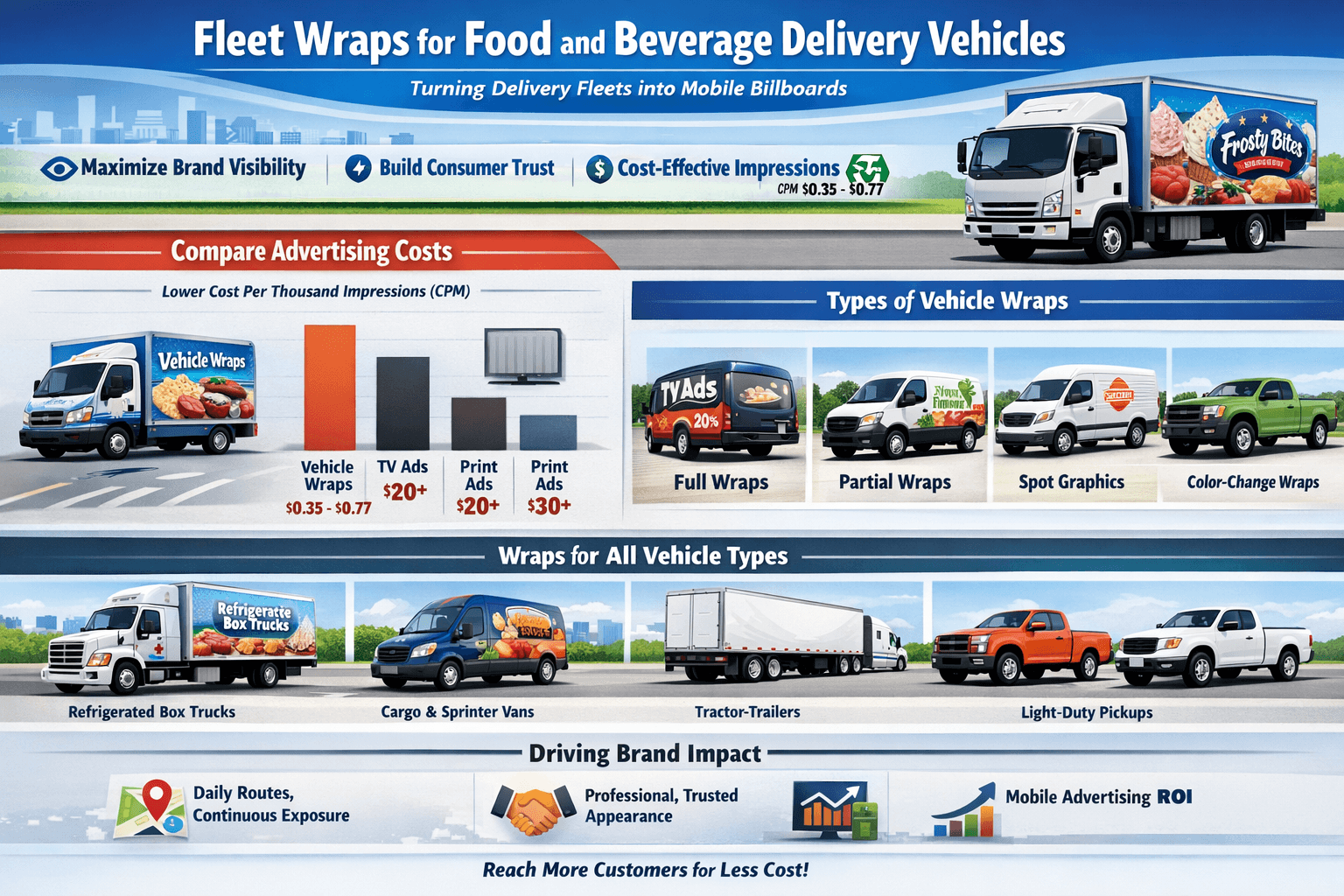
Fleet wraps for food and beverage delivery vehicles are large-format vinyl graphics applied to trucks, vans, and cars that transform everyday delivery routes into high-frequency branded advertising. This guide covers brand visibility and advertising value, wrap types and vehicle applications, food-specific design and compliance requirements, costs and material selection, and installation management with ROI measurement.
Wrapped delivery fleets generate thousands of daily impressions at a cost per thousand as low as $0.35 to $0.77, far below television or print alternatives. Branded vehicles also function as moving credentials that strengthen consumer trust at the point of delivery.
Full wraps, partial wraps, spot graphics, and color-change wraps each serve different coverage and budget needs across refrigerated box trucks, cargo vans, Sprinter vans, tractor-trailers, and light-duty pickups. Surface geometry and thermal conditions vary significantly by vehicle type, requiring tailored installation approaches for each.
Food and beverage wrap design demands high-resolution product photography optimized for large-format output, consistent brand color matching, and integration of FMCSA identification markings and FSMA sanitary transportation standards directly into the layout. Scalable design systems maintain visual cohesion across mixed fleets.
Premium cast vinyl films rated for extreme temperature ranges, UV-resistant laminates, and latex or UV-curable printing technologies preserve appetizing food imagery through refrigeration cycles, frequent sanitation, and sun exposure. Proper material specification determines whether wraps last three years or five.
Vertically integrated production partners who control design, printing, and installation under one roof can reduce vehicle downtime significantly during large rollouts, keeping delivery capacity intact while maximizing the advertising return every wrapped vehicle generates.
Why Do Food and Beverage Companies Wrap Their Delivery Fleets?
Food and beverage companies wrap their delivery fleets to maximize brand visibility, build consumer trust, and achieve advertising reach at a fraction of traditional media costs. The sections below cover how fleet wraps drive recognition, reinforce credibility, and outperform competing ad channels on cost per impression.
How Do Fleet Wraps Increase Brand Visibility for Food and Beverage Brands?
Fleet wraps increase brand visibility for food and beverage brands by turning every delivery route into a repeated brand exposure. Each vehicle functions as a mobile billboard, reaching residential neighborhoods, commercial districts, and highways throughout the day. Unlike static signage that depends on foot traffic at a single location, wrapped delivery trucks and vans carry branded food imagery and logos directly to consumers along their daily commutes. For food and beverage companies running regional or national distribution, this means thousands of daily impressions generated passively, without recurring media placement fees. Few advertising formats match that combination of geographic reach and frequency.
How Do Wrapped Delivery Vehicles Build Consumer Trust on the Road?
Wrapped delivery vehicles build consumer trust on the road by presenting a professional, identifiable brand presence at the point of service. When a branded truck arrives at a home or business, the wrap signals legitimacy before the driver ever reaches the door. Credibility research from the Nielsen Norman Group indicates that branded delivery vehicles act as a “moving credential,” significantly enhancing consumer trust and lowering the perceived risk of home delivery services. This effect is especially valuable in the food and beverage sector, where consumers associate visual professionalism with product safety and handling standards. A consistently wrapped fleet reinforces that every touchpoint meets the same brand promise.
How Do Fleet Wraps Compare to Other Advertising Channels in Cost per Impression?
Fleet wraps compare favorably to other advertising channels in cost per impression, delivering among the lowest CPM rates available. According to research cited by the Outdoor Advertising Association of America, branded vehicles generate up to 15 times greater brand recognition than other outdoor media formats.
The CPM differences across channels are significant:
- Vehicle wraps produce a CPM of approximately $0.35 to $0.77.
- Television advertising carries a CPM exceeding $20.00.
- Newspaper advertising reaches a CPM above $30.00.
For food and beverage companies operating delivery fleets that are already on the road daily, wraps convert an existing operational asset into a high-frequency advertising channel. Understanding what types of wraps best suit different vehicles helps maximize that investment.
What Types of Fleet Wraps Work Best for Food and Beverage Vehicles?
The types of fleet wraps that work best for food and beverage vehicles include full wraps, partial wraps, spot graphics, and color-change wraps. Each option balances coverage, cost, and brand impact differently.
Full Vehicle Wraps
Full vehicle wraps cover all painted surfaces of a delivery vehicle, transforming it into a complete mobile billboard. According to PRINTING United Alliance, vehicle wraps fall into three primary categories: full wraps covering all painted surfaces, partial wraps covering 25% to 75% of the vehicle, and spot graphics for specific branding elements. For food and beverage fleets, full wraps deliver maximum visual impact because they allow photo-quality product imagery, brand colors, and messaging to occupy every visible panel. This uninterrupted canvas is especially effective on box trucks and refrigerated vehicles, where large flat surfaces showcase appetizing food photography at scale. Full wraps also protect the original paint underneath, preserving resale value.
Partial Vehicle Wraps
Partial vehicle wraps cover 25% to 75% of a delivery vehicle, concentrating branded graphics on the highest-visibility panels. Food and beverage companies often apply partial wraps to doors, rear panels, and side sections where product imagery draws the most attention. This approach reduces material and installation costs while still delivering strong brand recognition on the road. Partial wraps work particularly well for mixed fleets where vehicles vary in size or color, since the original factory paint serves as a neutral background. For operators balancing budget constraints with advertising reach, partial wraps offer one of the most practical entry points into fleet branding.
Spot Graphics and Decals
Spot graphics and decals are individual branded elements applied to specific areas of a vehicle, such as doors, bumpers, or rear windows. These include logos, taglines, USDOT numbers, and product callouts placed at strategic sightlines. Food and beverage operators frequently use spot graphics to meet federal marking requirements while reinforcing brand identity at minimal cost. Because each element is produced and installed independently, spot graphics allow quick updates when product lines change or promotional campaigns rotate. They pair well with existing paint schemes, making them ideal for operators who need functional branding without a full redesign. For growing fleets, spot graphics provide a scalable starting point.
Color-Change Wraps
Color-change wraps replace a vehicle’s original paint appearance with a uniform branded color using solid-pigment vinyl film, without printed graphics. Food and beverage companies use color-change wraps to unify fleet appearance across vehicles from different manufacturers or model years. A consistent fleet color strengthens brand recall by creating an instantly recognizable presence on delivery routes. These wraps can also serve as a base layer beneath partial wraps or spot graphics, combining a proprietary brand color with targeted imagery. Color-change vinyl protects factory paint from UV damage and road debris, which helps maintain vehicle condition over time.
With wrap types selected, the next step is matching them to specific vehicle platforms across your fleet.
What Vehicle Types in a Food and Beverage Fleet Can Be Wrapped?
Food and beverage fleets use diverse vehicle types, and virtually all of them can be wrapped. The sections below cover how wraps are applied to refrigerated box trucks, cargo vans and Sprinter vans, tractor-trailers and semi-trucks, and small cars and light-duty pickups.
How Are Wraps Applied to Refrigerated Box Trucks?
Wraps are applied to refrigerated box trucks by first addressing the unique surface characteristics of insulated cargo bodies. The corrugated or riveted panels common on reefer units require careful surface preparation; installers clean and degrease every seam, rivet head, and panel joint to ensure proper vinyl adhesion. Thermal cycling between cold interior temperatures and ambient exterior heat creates expansion and contraction stress on adhesive films, so installers use cast vinyl with conformable adhesive systems rated for wide temperature swings. Panel seams and hardware cutouts demand precise trimming to prevent moisture intrusion that could lift edges over time. For food and beverage brands, the large, flat side panels of box trucks offer prime real estate for high-impact product imagery and branding that transforms every delivery run into a mobile billboard.
How Are Wraps Applied to Cargo Vans and Sprinter Vans?
Wraps are applied to cargo vans and Sprinter vans by working around compound body curves, recessed door handles, sliding door tracks, and rear window configurations. These vehicles feature more complex geometry than flat-sided box trucks, requiring experienced installers to use heat guns and squeegees to stretch and conform cast vinyl around wheel arches, body lines, and bumper transitions. Sliding door gaps need precise alignment so graphics remain visually seamless when the door is closed. Rear doors and windows often receive perforated window film that maintains outward visibility while displaying continuous branding. Cargo vans and Sprinter vans are among the most common vehicles in last-mile food delivery, making consistent wrap quality across dozens or hundreds of units essential for brand cohesion.
How Are Wraps Applied to Tractor-Trailers and Semi-Trucks?
Wraps are applied to tractor-trailers and semi-trucks by treating the cab and trailer as separate installation projects, each with distinct surface types. Trailer sides present massive, relatively flat panels ideal for billboard-scale food photography, while the cab involves compound curves around fenders, fairings, and sleeper panels. According to the Federal Motor Carrier Safety Administration, commercial motor vehicles must display the carrier’s legal name or trade name and USDOT number on both sides in a contrasting color. Installers integrate these required markings into the overall wrap design so compliance elements blend with brand graphics. The sheer scale of a 53-foot trailer demands large-format printing capabilities that maintain color consistency and image resolution across panels that can exceed 500 square feet per side.
How Are Wraps Applied to Small Cars and Light-Duty Pickups?
Wraps are applied to small cars and light-duty pickups by conforming vinyl to tighter body contours, door edges, mirror housings, and recessed emblems. These vehicles have the most complex curves-per-square-foot ratio in a typical fleet, so installers rely on premium cast films with air-release channels to prevent bubbling around compound surfaces. Although small cars and pickups offer less surface area than larger fleet vehicles, they excel in urban environments where maneuverability puts branded graphics at eye level in dense traffic, parking lots, and residential neighborhoods. Sales representatives, route supervisors, and field managers commonly drive these vehicles, extending brand presence beyond dedicated delivery routes into everyday business travel.
With every vehicle type accounted for, design considerations specific to food and beverage branding become the next priority.
What Makes Designing Fleet Wraps for Food and Beverage Brands Unique?
Designing fleet wraps for food and beverage brands is unique because the visuals must trigger appetite appeal, meet regulatory messaging standards, and scale consistently across mixed vehicle types. The following subsections cover food photography handling, brand color and compliance requirements, cross-vehicle design consistency, and logo placement best practices.
How Should Food Photography and Product Imagery Be Handled on a Wrap?
Food photography and product imagery should be handled on a wrap by using high-resolution source files optimized for large-format output. Images that look sharp on a screen can appear pixelated when scaled to the side of a box truck, so source photography should be captured at resolutions suitable for print at full vehicle scale.
According to the EPA, high-resolution photo-quality food imagery on fleet wraps is typically achieved using large-format latex or UV-curable printing technologies, which offer odorless prints and immediate curing for food-safe environments. Color accuracy matters just as much as resolution; a slightly off hue on a hero product shot can undermine brand trust instantly. For food and beverage fleets specifically, selecting printing methods that preserve appetizing color vibrancy is not optional.
What Role Do Brand Colors and FDA-Compliant Messaging Play?
Brand colors and FDA-compliant messaging play a critical role in ensuring fleet wraps are both visually cohesive and legally sound. Consistent Pantone or CMYK color matching across every vehicle reinforces brand recognition, while incorrect color reproduction can make an entire fleet look disjointed.
On the compliance side, the FMCSA requires that commercial motor vehicles display the carrier’s legal name or single trade name and USDOT identification number in a color that contrasts with the background. Food and beverage brands must also consider any product-specific labeling or health claims displayed on vehicle panels. Balancing vivid brand aesthetics with mandatory regulatory text is one of the most overlooked design challenges in fleet wrap programs.
How Do You Maintain Design Consistency Across Mixed Vehicle Sizes?
You maintain design consistency across mixed vehicle sizes by creating a scalable design system rather than a single fixed layout. A food and beverage fleet often includes refrigerated box trucks, cargo vans, sprinter vans, and sedans, each with different panel dimensions, curves, and surface interruptions.
The most effective approach involves building modular design templates that define:
- Primary brand zone placement for the hero image and logo.
- Minimum clear space rules that prevent text or imagery from being obscured by doors, handles, or rivets.
- Hierarchy guidelines that prioritize which elements appear on smaller vehicles when space is limited.
This system ensures a delivery sedan and a 53-foot trailer both read as the same brand from any distance.
What Are the Best Practices for Placing Logos and Contact Information?
The best practices for placing logos and contact information prioritize visibility, hierarchy, and readability at speed. A logo should occupy the highest-visibility panel on each vehicle type, typically the rear doors and both sides at driver eye level.
Key placement principles include:
- Position the logo where it remains fully visible even when cargo doors are open or the vehicle is partially obstructed in traffic.
- Place website URLs and phone numbers in secondary zones below or adjacent to the logo, sized for legibility at 30 feet or more.
- Avoid placing critical contact details near wheel wells, corrugated panels, or seams where distortion compromises readability.
For food and beverage brands running high-frequency urban delivery routes, rear-facing contact information captures the most sustained viewer attention during stops and traffic.
With design fundamentals established, the next consideration is understanding fleet wrap costs across vehicle types.
How Much Do Fleet Wraps Cost for Food and Beverage Delivery Vehicles?
Fleet wraps for food and beverage delivery vehicles cost anywhere from $1,500 to $5,000 or more, depending on vehicle size, wrap coverage, and design complexity. The following subsections break down pricing by vehicle type.
How Much Does It Cost to Wrap a Refrigerated Box Truck?
It costs approximately $2,500 to $5,000 to wrap a refrigerated box truck with a full vehicle wrap. Refrigerated box trucks present larger surface areas than standard vans, and the corrugated sidewalls common on reefer units require additional labor for proper adhesion. Partial wraps on these trucks typically range from $1,500 to $3,000, offering a cost-effective alternative when budget constraints exist. Design complexity also influences pricing; high-resolution food photography and multi-color brand elements increase production time. For food and beverage fleets running temperature-controlled routes, the investment in a professionally installed wrap protects both brand consistency and the underlying paint from road wear.
How Much Does It Cost to Wrap a Cargo Van or Sprinter Van?
It costs approximately $2,000 to $4,000 to wrap a cargo van or Sprinter van with a full fleet wrap. These mid-size vehicles are among the most common in food and beverage delivery fleets, and their flat panel surfaces make them relatively straightforward to wrap. Partial wraps on cargo vans and Sprinter vans typically fall between $1,000 and $2,500. Factors such as window coverage, custom die-cut graphics, and the number of design revisions affect the final price. For brands managing multiple van sizes, standardizing the design template across the fleet reduces per-unit costs while maintaining visual consistency on the road.
How Much Does It Cost to Wrap a Full-Size Tractor-Trailer?
It costs approximately $3,000 to $5,000 or more to wrap a full-size tractor-trailer. The 53-foot trailer alone represents one of the largest single-surface branding opportunities in outdoor advertising. Full trailer wraps demand significant material volume and extended installation time, which drives costs higher than smaller vehicles. Cab-only wraps for the tractor portion typically range from $2,000 to $3,500 separately. Given the sheer visibility a wrapped tractor-trailer generates across highway corridors, the cost per impression remains exceptionally low. Food and beverage brands that invest in tractor-trailer wraps effectively turn long-haul routes into high-frequency advertising campaigns.
How Much Does It Cost to Wrap a Small Car or Light-Duty Pickup?
It costs approximately $1,500 to $3,000 to wrap a small car or light-duty pickup with a full wrap. These vehicles have the smallest surface area in a typical food and beverage fleet, which keeps material and labor costs lower. Partial wraps and spot graphics on small cars or pickups range from $500 to $1,500. Contoured body panels, door handles, and mirrors require careful trimming during installation, so vehicle complexity still influences the final quote. Small cars and light-duty pickups work well for sales teams, catering operations, or last-mile delivery routes where a branded presence matters in neighborhoods and parking lots.
Understanding fleet wrap pricing by vehicle type helps food and beverage brands budget accurately across mixed fleets.
What Materials and Printing Methods Are Used for Food and Beverage Fleet Wraps?
The materials and printing methods used for food and beverage fleet wraps include cast vinyl films, UV-resistant laminates, and large-format digital printing systems. Each component addresses durability, color fidelity, and food-safe compliance.
Which Vinyl Films Perform Best on Temperature-Controlled Vehicles?
The vinyl films that perform best on temperature-controlled vehicles are premium cast vinyl films engineered for extreme thermal cycling. Refrigerated trucks and freezer vans shift constantly between cold storage temperatures and ambient heat during loading, which causes rigid vinyl to crack or lift at the edges. Cast vinyl, unlike less expensive calendered alternatives, conforms to rivets, corrugations, and curved panels found on insulated box trucks without shrinking over time. Films rated for service ranges well below freezing and above 200°F maintain adhesion through repeated refrigeration cycles. For food and beverage fleets, this thermal resilience is non-negotiable; choosing the wrong film wastes the entire investment within months.
How Do UV-Resistant Laminates Protect Vibrant Food Imagery?
UV-resistant laminates protect vibrant food imagery by shielding printed ink layers from ultraviolet radiation that causes fading and color shift. Food and beverage wraps rely on appetizing, true-to-life product photography, so even minor color degradation undermines brand perception. A clear overlaminate bonds to the printed vinyl surface and acts as a sacrificial barrier against UV exposure, road debris, and chemical cleaners used during sanitation. Gloss laminates intensify color saturation, making food imagery appear richer, while matte options reduce glare on sun-facing panels. For fleets operating in high-UV regions, selecting a laminate with strong UV inhibitors is the single most effective way to preserve wrap appearance between replacement cycles.
What Large Format Printing Technology Produces Photo-Quality Wraps?
The large-format printing technology that produces photo-quality wraps relies on latex or UV-curable inkjet systems. According to research referenced by the Environmental Protection Agency, high-resolution photo-quality food imagery on fleet wraps is typically achieved using large-format latex or UV-curable printing technologies, which offer odorless prints and immediate curing for food-safe environments. Latex printers produce flexible, scratch-resistant output ideal for conformable vinyl, while UV-curable systems cure ink instantly with ultraviolet light, enabling faster production throughput. Both technologies reproduce the fine gradients and vivid color accuracy that appetizing food photography demands. For large fleet rollouts, these systems scale efficiently without sacrificing image resolution.
With materials and printing methods selected, understanding how long these wraps last under real-world delivery conditions becomes the next priority.
How Long Do Fleet Wraps Last on Food and Beverage Delivery Vehicles?
Fleet wraps on food and beverage delivery vehicles typically last three to five years, though operational conditions directly influence that range. Washing frequency, refrigeration cycles, and sun exposure each affect durability differently.
How Does Frequent Washing and Sanitation Affect Wrap Longevity?
Frequent washing and sanitation affect wrap longevity by gradually stressing vinyl edges and laminate surfaces with each cleaning cycle. Food and beverage delivery vehicles face more rigorous wash schedules than standard commercial fleets due to hygiene requirements.
According to the American Trucking Associations, proper maintenance of vehicle graphics requires pressure washing with water pressure not exceeding 2,000 psi and temperatures below 80°F (27°C) to prevent edge lifting or film degradation. Harsh chemical cleaners and abrasive brushes accelerate this damage further. Hand washing with pH-neutral soap remains the safest method for preserving wrap integrity over hundreds of wash cycles. For fleets running daily sanitation protocols, this distinction between compliant and aggressive cleaning can mean the difference between a three-year and a five-year wrap lifespan.
How Do Refrigeration Cycles and Temperature Swings Impact Vinyl Adhesion?
Refrigeration cycles and temperature swings impact vinyl adhesion by causing repeated expansion and contraction of both the vehicle surface and the vinyl film. Each time a refrigerated unit cycles between cold storage temperatures and ambient outdoor heat, the substrate shifts microscopically. Over months of daily operation, this thermal cycling weakens adhesive bonds, particularly at seams and panel edges.
Premium cast vinyl films are engineered to handle this stress. 3M Print Wrap Film IJ180mC-10, for example, carries a service temperature range of -40°F to +225°F. Films rated for this spectrum maintain adhesion through the constant thermal fluctuations that refrigerated box trucks and temperature-controlled vans experience during loading, transit, and delivery stops.
How Does Sun and Weather Exposure Influence Wrap Lifespan?
Sun and weather exposure influence wrap lifespan by degrading vinyl pigments and weakening laminate protection over time. Ultraviolet radiation causes color fading, while prolonged moisture exposure can promote edge lifting and adhesive failure.
Vehicles operating in southern or sun-intensive climates experience faster degradation than those in temperate regions. UV-resistant overlaminate films slow this process considerably, preserving the vibrancy of food photography and brand colors that make fleet wraps effective. Rain, road salt, and extreme humidity compound the effects of UV exposure. Fleets that garage vehicles overnight or park in shaded areas between routes consistently see longer wrap life. Regardless of climate, proper material selection during the specification phase sets the foundation for how well wraps withstand ongoing environmental stress.
How Should You Maintain and Care for Wrapped Delivery Vehicles?
You should maintain and care for wrapped delivery vehicles through safe cleaning practices, routine inspections, and timely decisions about repairs or replacements. The following subsections cover approved cleaning products, inspection frequency, and repair-versus-replace criteria.
What Cleaning Products Are Safe to Use on Fleet Wraps?
The cleaning products safe to use on fleet wraps are mild, non-abrasive detergents free of solvents, alcohol, and harsh chemicals. Simple automotive soap mixed with water works best for routine washes. Isopropyl alcohol at low concentrations can spot-treat stubborn marks like tar or tree sap without damaging the vinyl surface.
Pressure washers should not exceed 2,000 psi, and water temperature should stay below 80°F (27°C) to prevent edge lifting or film degradation. Avoid automated brush washes entirely; the abrasive bristles scratch laminate and dull food imagery over time. For food and beverage fleets specifically, choosing cleaning agents that leave no residue is critical, since any chemical film on vehicle exteriors can raise questions during sanitation audits.
How Often Should Wrapped Food and Beverage Vehicles Be Inspected?
Wrapped food and beverage vehicles should be inspected at least monthly, with more frequent checks for high-mileage routes or vehicles exposed to extreme temperatures. Inspections should focus on edge lifting, bubbling, cracking, color fading, and any damage near seams or panel joints.
The FDA Food Safety Modernization Act (FSMA) rule on Sanitary Transportation of Human and Animal Food requires that vehicles and transportation equipment remain suitable and adequately cleanable to prevent food contamination. Wrap damage that traps moisture or debris can compromise that cleanability standard. Documenting each inspection creates an accountability trail that supports both brand consistency and regulatory readiness. For most food and beverage operations, building wrap checks into existing pre-trip inspection workflows is the most practical approach.
When Should a Fleet Wrap Be Repaired Versus Replaced?
A fleet wrap should be repaired when damage is localized, such as a single scratched panel, torn corner, or small area of edge lifting that has not spread. Spot repairs using color-matched vinyl panels restore appearance without the cost of a full rewrap.
A full replacement becomes necessary when:
- Fading or discoloration affects more than 30% of the visible surface.
- Adhesive failure causes widespread bubbling or peeling across multiple panels.
- Brand imagery, logos, or regulatory markings are no longer legible.
- The wrap has exceeded its rated lifespan and shows cumulative wear.
Delaying replacement past the point of diminishing returns undermines the brand trust that a professional wrap is meant to build. With proper installation and inspection protocols in place, the next consideration is how the wrap process itself works at scale.
How Does the Fleet Wrap Installation Process Work at Scale?
The fleet wrap installation process at scale works by following a structured sequence: vehicle preparation, phased scheduling, and downtime management. The sections below cover how vehicles are prepped, how long full-fleet installations take, and how to minimize operational disruption during rollouts.
How Are Vehicles Prepared Before Wrap Installation?
Vehicles are prepared before wrap installation through a thorough cleaning, surface inspection, and environmental conditioning process. Every vehicle must be free of dirt, grease, wax, and residue so the vinyl film bonds correctly to the painted surface. Installers inspect each panel for dents, rust, or peeling paint that could compromise adhesion, addressing repairs before application begins.
Temperature control in the installation bay matters significantly. According to 3M’s product specifications, Print Wrap Film IJ180mC-10 is engineered with a service temperature range of -40°F to +225°F, providing durability for vehicles operating in diverse climates. This wide tolerance is only achieved when initial application occurs under controlled conditions, typically between 60°F and 80°F. For food and beverage fleets with refrigerated units, ensuring the vehicle body reaches ambient temperature before wrapping prevents condensation from forming beneath the film.
How Long Does It Take to Wrap an Entire Food and Beverage Fleet?
It takes anywhere from several weeks to several months to wrap an entire food and beverage fleet, depending on fleet size, vehicle types, and scheduling logistics. A single cargo van typically requires one to three days for a full wrap, while larger refrigerated box trucks or tractor-trailers may need three to five days per unit.
Key factors that influence total timeline include:
- Fleet size: A 50-vehicle fleet takes considerably longer than a 10-vehicle rollout.
- Vehicle mix: Fleets with uniform vehicle types wrap faster than mixed fleets requiring multiple design templates.
- Production capacity: The number of installation bays and trained installers available determines how many vehicles can be processed simultaneously.
- Design approval cycles: Delays in artwork sign-off cascade into production bottlenecks.
Phased rollouts, where vehicles are scheduled in rotating batches, keep most of the fleet operational throughout the project.
What Causes Downtime and How Can It Be Minimized During Rollouts?
Downtime during fleet wrap rollouts is caused by vehicle scheduling conflicts, design revision delays, material shortages, and weather or facility limitations. Each factor pulls vehicles off delivery routes longer than necessary.
Minimizing downtime requires proactive planning:
- Staggered scheduling rotates small groups of vehicles through installation while the rest remain in service.
- Pre-production material staging ensures all printed panels, laminates, and tools are ready before a vehicle arrives.
- Centralized project management eliminates miscommunication between design, print, and installation teams.
- Advance design lock finalizes all artwork and templates before the first vehicle enters the bay.
For food and beverage companies where every vehicle generates revenue on daily routes, even one unnecessary day of downtime per vehicle compounds across a large fleet. Partnering with a vertically integrated provider that controls design, printing, and installation under one roof is one of the most effective ways to compress timelines and protect delivery capacity.
How Do Fleet Wraps Support Food Safety and Regulatory Compliance?
Fleet wraps support food safety and regulatory compliance by ensuring delivery vehicles meet federal identification requirements and maintaining surfaces that align with sanitary transportation standards. Two key regulatory frameworks shape how food and beverage fleets must present and maintain their vehicles.
The FDA’s Food Safety Modernization Act (FSMA) rule on Sanitary Transportation of Human and Animal Food establishes that vehicles and transportation equipment must be suitable and adequately cleanable for their intended use to prevent food contamination. Fleet wraps designed for food and beverage applications must therefore use materials that do not interfere with cleaning protocols, harbor contaminants, or compromise the sanitary condition of vehicle exteriors and cargo areas. Properly engineered vinyl films with smooth, sealed surfaces support this requirement by allowing thorough sanitation without degradation.
Federal Motor Carrier Safety Administration (FMCSA) regulations separately require that commercial motor vehicles display the legal name or a single trade name of the motor carrier, along with the USDOT identification number, on both sides of the vehicle in a color that contrasts with the background. Fleet wraps address this mandate directly; professional wrap designs integrate these compliance elements into the overall brand layout so that legal markings remain clearly visible while reinforcing brand identity.
For food and beverage companies operating large delivery fleets, these two regulatory layers create a practical intersection. Wraps must simultaneously serve as branding assets and compliance tools. Choosing a partner experienced in both large format graphics and regulatory requirements reduces the risk of costly violations or forced rework, a consideration that becomes increasingly important as fleet sizes scale.
How Do You Measure the ROI of Food and Beverage Fleet Wraps?
You measure the ROI of food and beverage fleet wraps by tracking cost per impression, brand recall lift, and customer acquisition tied to vehicle exposure. Key metrics include impression volume, CPM comparisons, and engagement rates.
The cost per thousand impressions (CPM) for vehicle wraps ranges from $0.35 to $0.77, according to data referenced by the U.S. Small Business Administration. Television CPM exceeds $20.00, and newspaper CPM surpasses $30.00, making fleet wraps one of the lowest-cost brand exposure channels available. For food and beverage companies running daily delivery routes, each vehicle generates thousands of daily impressions across fixed geographic corridors.
Brand recall provides another measurable indicator. Research from the Outdoor Advertising Association of America found that vehicle-based graphics achieve a 97% recall rate among consumers, outperforming traditional static billboards. That recall translates into measurable downstream actions; when consumers remember a branded delivery vehicle, they are more likely to search for the brand online, visit a retail location, or place an order.
Tracking ROI effectively requires connecting wrap exposure to business outcomes. The most practical measurement methods include:
- Dedicated landing pages or QR codes printed on wraps to capture direct response traffic.
- Unique phone numbers assigned to fleet vehicles to isolate inbound leads from mobile advertising.
- Route-based impression modeling using GPS data and traffic counts to estimate daily audience reach per vehicle.
- Customer surveys asking how buyers first discovered the brand, identifying fleet wraps as a touchpoint.
- Sales lift analysis comparing revenue in delivery zones before and after wrap deployment.
For most food and beverage brands, fleet wraps deliver compounding value because every delivery simultaneously fulfills logistics and generates advertising exposure at no incremental media cost. This dual function is often underappreciated in marketing budgets, yet it consistently produces among the highest returns of any out-of-home channel.
With ROI benchmarks established, a vertically integrated production partner can further maximize that return by reducing rollout timelines and controlling quality.
How Can a Vertically Integrated Partner Improve Your Fleet Wrap Program?
A vertically integrated partner can improve your fleet wrap program by consolidating design, production, printing, and installation under one roof, eliminating coordination gaps and accelerating timelines. The sections below explore how Craftsmen Industries’ in-house process streamlines large projects and summarize the key takeaways from this guide.
Can Craftsmen Industries’ In-House Design-to-Installation Process Streamline Large Fleet Wrap Projects?
Yes, Craftsmen Industries’ in-house design-to-installation process can streamline large fleet wrap projects by keeping every phase under direct internal control. Operating from a 127,000 sq. ft. facility in St. Charles, Missouri, Craftsmen Industries handles concept development, engineering, large format printing, and professional installation without relying on outside vendors. This eliminates handoff delays, miscommunication between separate suppliers, and quality inconsistencies that commonly plague multi-vendor rollouts. According to research from the Texas A&M Transportation Institute, vertically integrated fleet wrap vendors who manage the entire lifecycle from design to installation can reduce vehicle downtime by up to 50% compared to fragmented service models. For food and beverage fleets where every day off the road means lost deliveries and missed brand impressions, that reduction is significant. Craftsmen Industries’ integrated workflow is particularly well suited to mixed fleets requiring consistent branding across refrigerated box trucks, cargo vans, and tractor-trailers simultaneously.
What Are the Key Takeaways About Fleet Wraps for Food and Beverage Delivery Vehicles?
The key takeaways about fleet wraps for food and beverage delivery vehicles center on five core principles:
- Brand visibility compounds daily. Wrapped delivery vehicles generate thousands of impressions per route, turning routine logistics into a persistent advertising channel with one of the lowest CPMs available.
- Material selection drives durability. Vinyl films rated for extreme temperature ranges and paired with UV-resistant laminates protect vibrant food imagery against refrigeration cycles, sanitation routines, and sun exposure.
- Design consistency builds trust. Maintaining uniform brand colors, high-resolution product photography, and compliant messaging across mixed vehicle sizes reinforces consumer confidence at every delivery stop.
- Regulatory alignment is non-negotiable. FMCSA identification requirements and FSMA sanitary transportation standards must be integrated into every wrap design from the start.
- Vertical integration minimizes downtime. Partnering with a single-source provider like Craftsmen Industries keeps vehicles on the road faster by streamlining the entire process from ideation to installation.
Filter Posts by Tag
related posts
A multi-location fleet wrap rollout is a coordinated program that [...]

Measure the true impact of your fleet graphics on sales. Track calls, web visits, and leads to maximize ROI and turn every mile into measurable growth.
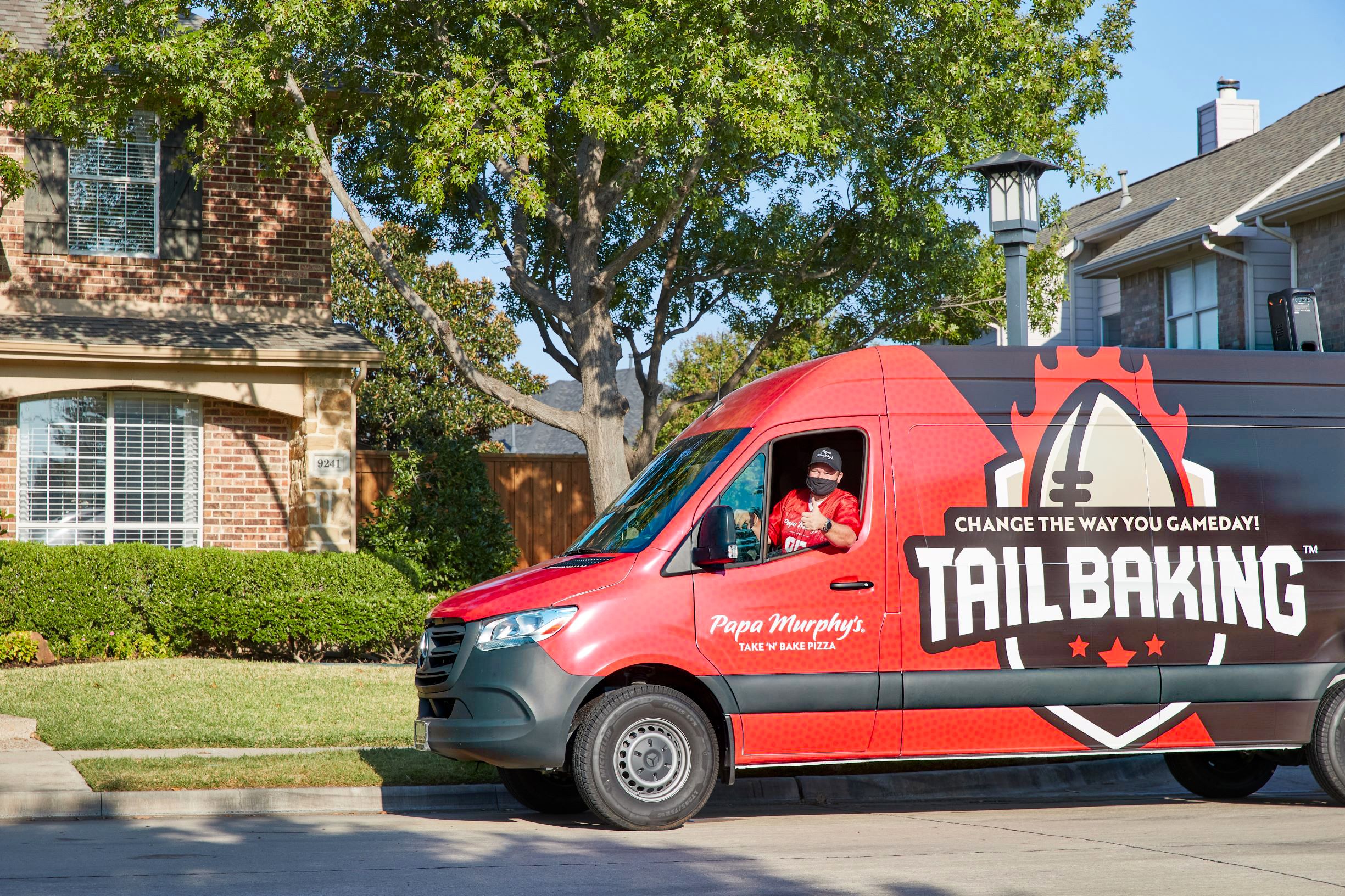
What are the benefits of using fleet graphics? Read on some businesses that can capitalize on the numerous benefits of fleet graphics.
