
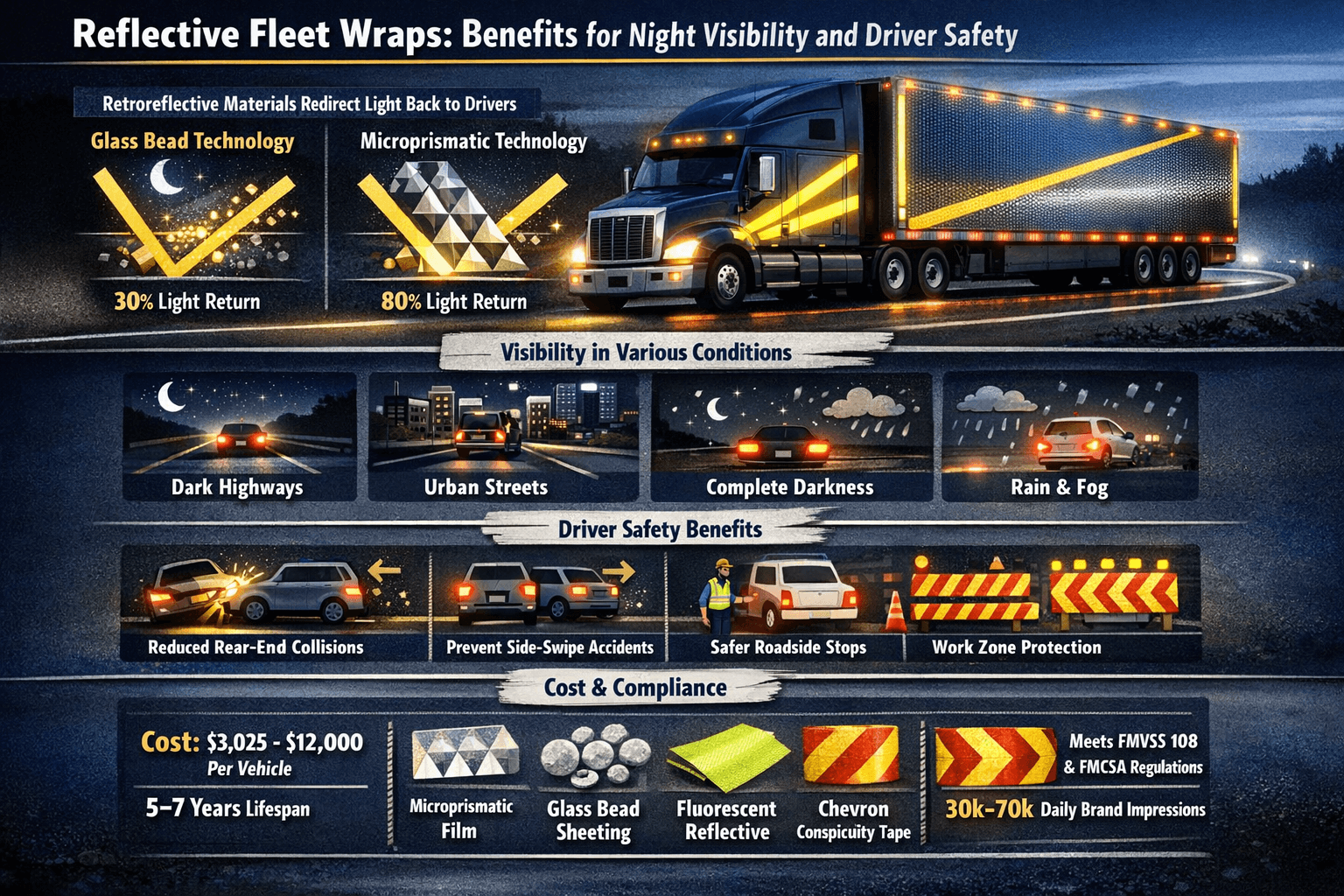
Reflective fleet wraps are vehicle-grade vinyl graphics embedded with retroreflective materials that redirect headlight beams back toward approaching drivers, making commercial vehicles highly visible after dark.
This guide covers retroreflective optics and environmental performance, driver safety benefits across collision types, reflective material technologies, vehicle-specific applications and federal compliance, and the cost and branding value of reflective fleet programs.
Retroreflective wraps rely on microprismatic or glass-bead technology to return light along its incoming path. Microprismatic films achieve roughly 80% light return, while glass-bead alternatives reach about 30%, and performance varies significantly across unlit highways, urban streetlight corridors, rain, fog, and complete darkness.
Reflective wraps reduce rear-end collisions, side-swipe accidents, and struck-by incidents during roadside stops by giving approaching drivers earlier detection of a fleet vehicle’s full profile. Enhanced conspicuity in work zones and construction areas adds another layer of protection where visual clutter creates elevated strike risk.
Four primary material types serve fleet applications: microprismatic film, glass-bead film, fluorescent-reflective combination sheeting, and conspicuity tape with chevron patterns. Each offers distinct optical performance suited to specific vehicle classes and operating conditions.
Federal standards including FMVSS No. 108, 49 CFR 393.26, and FMCSA conspicuity mandates define baseline requirements for reflective markings on commercial vehicles, with state-level regulations adding further specifications. Semi-trucks, delivery vans, emergency vehicles, and utility fleets each gain distinct compliance and safety advantages.
Reflective wraps last 5 to 7 years with proper maintenance, cost between $3,025 and $12,000 per vehicle depending on size and coverage, and generate 30,000 to 70,000 daily brand impressions by keeping custom graphics visible around the clock.
What Are Reflective Fleet Wraps?
Reflective fleet wraps are vehicle-grade vinyl graphics embedded with retroreflective materials that redirect light back toward its source, making commercial vehicles highly visible at night. Unlike standard fleet graphics that appear dull after dark, reflective wraps activate when struck by headlights, illuminating a vehicle’s profile, branding, and safety markings for approaching drivers.
These wraps combine two functions into a single application: brand visibility and safety compliance. The retroreflective layer, constructed from either microprismatic elements or glass-bead technology, bounces light from oncoming headlamps back to the driver’s eyes. This optical property, known as retroreflectivity, transforms an otherwise difficult-to-see trailer or delivery van into a clearly outlined vehicle on unlit highways, urban streets, and work zones.
For fleet managers weighing safety investments, reflective wraps represent one of the more practical solutions available. They satisfy federal conspicuity requirements while simultaneously turning every mile driven into a branding opportunity, day and night. The sections below cover how reflective wraps enhance night visibility, the specific driver safety benefits they deliver, material types, applicable regulations, and cost considerations.
How Do Reflective Fleet Wraps Improve Night Visibility?
Reflective fleet wraps improve night visibility by using retroreflective materials that redirect headlight beams back toward approaching drivers. The sections below explain the underlying optics and how performance varies across highway, urban, complete darkness, and adverse weather conditions.
How Does Retroreflective Material Redirect Light Back to Drivers?
Retroreflective material redirects light back to drivers by returning incoming headlight beams along the same path toward the source. This optical process relies on three core mechanisms: total internal reflection, refraction, and surface scattering.Two main technologies power this effect:
- Glass bead sheeting refracts light through a glass sphere to a mirrored back surface, returning approximately 28–30% of incoming light.
- Microprismatic sheeting uses cube corner prisms to achieve roughly 80% light return, significantly outperforming glass bead materials at longer distances.
According to a combined Florida and Pennsylvania study published by NHTSA, retroreflective tape reduced rear impacts by up to 51% and side impacts by 32% in dark, unlit conditions. For fleets operating on poorly lit corridors, prismatic film represents the most practical upgrade over legacy glass bead technology.
How Do Reflective Wraps Perform Under Low-Light Highway Conditions?
Reflective wraps perform under low-light highway conditions by amplifying the small amount of available light, making fleet vehicles visible well before a driver’s unaided eyes would detect them. Fluorescent reflective tape, a specialized retroreflective sheeting, enhances visibility in both standard daylight and transitional low-light periods such as dusk and dawn.
According to a NHTSA study, retroreflective tape on heavy trailers reduced side and rear impacts by 29% in dark conditions and by 41% on completely unlit roads. Even under rain and fog on unlighted highways, crash reductions remained significant at 39%. These figures confirm that reflective wraps deliver measurable safety gains precisely when highway conditions are most dangerous.
How Do Reflective Wraps Perform in Urban Street Lighting?
Reflective wraps perform in urban street lighting by supplementing ambient illumination with retroreflected headlight return, keeping fleet vehicles conspicuous even when streetlights create competing glare. One underexplored factor is how modern LED street lighting interacts with reflective films differently than older high-pressure sodium lamps, which emit a narrower color spectrum.
LED streetlights produce a broader, whiter beam that can actually improve the contrast of white and fluorescent reflective sheeting compared to the yellow-orange cast of sodium fixtures. Fleet managers upgrading reflective materials should verify that the chosen film performs well under both lighting types, especially for routes spanning newly retrofitted LED corridors and older infrastructure.
How Do Reflective Wraps Perform in Complete Darkness With Headlights Only?
Reflective wraps perform in complete darkness with headlights only by functioning as passive light amplifiers that require no onboard power. Cube corner microprism technology is typically 66% efficient in providing retroreflection, making it two to three times brighter than glass bead materials through total internal reflection within three-sided prisms.
In complete darkness, headlights serve as the sole light source, so the retroreflective efficiency of the wrap material determines how far away an approaching driver can detect the fleet vehicle. Prismatic wraps are the strongest choice for rural, unlit routes where early detection directly translates into additional stopping distance and collision avoidance time.
How Do Reflective Wraps Perform in Rain or Fog at Night?
Reflective wraps perform in rain or fog at night with reduced but still meaningful effectiveness, because water droplets scatter incoming light before it reaches the reflective surface. Standard glass bead films lose efficiency faster in wet conditions, since moisture on the bead surface disrupts the refractive path.
Microprismatic films retain more performance because their enclosed prism structures resist water intrusion better than exposed bead surfaces. Fleet operators in regions with frequent rain or fog should prioritize sealed microprismatic sheeting to maintain the highest possible conspicuity during adverse weather.
With the visibility mechanics and environmental performance established, the next section covers the direct driver safety benefits these wraps provide.
What Are the Driver Safety Benefits of Reflective Fleet Wraps?
The driver safety benefits of reflective fleet wraps include reduced rear-end collisions, fewer side-swipe accidents, improved protection during roadside stops, and enhanced visibility in work zones. Each benefit stems from increased vehicle conspicuity in low-light conditions.
How Do Reflective Wraps Reduce Rear-End Collisions With Fleet Vehicles?
Reflective wraps reduce rear-end collisions with fleet vehicles by making trailers and trucks visible to approaching drivers hundreds of feet earlier than unlit surfaces allow. NCHRP Report 500, Volume 13, published by the Transportation Research Board, identifies enhanced conspicuity through retroreflective markings as a primary strategy for reducing collisions involving heavy trucks, particularly for side and rear-end impacts.
Federal regulations reinforce this protective role. FMVSS No. 108 mandates reflective devices on all motor vehicles manufactured for U.S. use, while the FMCSA requires conspicuity tape on certain commercial vehicles specifically to reduce accident likelihood. That earlier detection window is what makes reflective wraps one of the most cost-effective crash prevention measures a fleet can adopt.
How Do Reflective Wraps Help Prevent Side-Swipe Accidents?
Reflective wraps help prevent side-swipe accidents by outlining a vehicle’s full profile for drivers in adjacent lanes. Without side-mounted reflective markings, the length and shape of a trailer can effectively disappear at night, especially on unlit highways. Retroreflective sheeting along the trailer’s lower rail and upper edges creates a continuous visible boundary that defines the vehicle’s footprint from the side.
This outline gives passing and merging drivers an accurate sense of the vehicle’s position and length, reducing the misjudgments that lead to lane-change collisions. Side conspicuity is particularly critical for long trailers, where a driver may not realize how much vehicle remains ahead during an overtake.
How Do Reflective Wraps Protect Drivers During Roadside Stops?
Reflective wraps protect drivers during roadside stops by maintaining vehicle visibility when taillights alone may not be enough. A parked truck on a highway shoulder, particularly one without functioning hazard lights, becomes a near-invisible obstacle in darkness. Retroreflective material on the rear and sides continues returning light from approaching headlights, alerting drivers to the stationary vehicle well before they reach it.
According to the Emergency Responder Safety Institute, high retroreflectivity levels can increase response times to identify nearby personnel by approximately 0.5 seconds, which corresponds to a 37-foot decrease in stopping distance at 50 mph. Those extra feet of reaction space can mean the difference between a safe pass and a collision.
How Do Reflective Wraps Improve Safety in Work Zones and Construction Areas?
Reflective wraps improve safety in work zones and construction areas by ensuring fleet vehicles remain conspicuous amid competing visual signals. Construction zones present drivers with lane shifts, barrier walls, and heavy equipment, all of which demand rapid visual processing. A fleet vehicle operating in or near these zones without adequate reflective markings blends into the cluttered environment, increasing strike risk.
Reflective wraps cut through that visual noise by returning headlight beams directly to approaching drivers. For fleets that regularly operate in or service construction sites, combining reflective conspicuity markings with fluorescent sheeting provides dual-condition visibility: fluorescent pigments enhance daytime presence while retroreflective elements handle nighttime detection.
Understanding these safety benefits sets the stage for choosing the right reflective material type for each fleet application.
What Types of Reflective Materials Are Used in Fleet Wraps?
The types of reflective materials used in fleet wraps include microprismatic film, glass-bead film, fluorescent-reflective combination film, and conspicuity tape with chevron sheeting. Each material offers distinct optical performance suited to different fleet visibility needs.
Microprismatic Reflective Film
Microprismatic reflective film uses tiny three-sided prisms that redirect light back to its source through total internal reflection. According to ORAFOL Americas, cube corner microprism technology is typically 66% efficient in providing retroreflection, making it two to three times brighter than glass-bead alternatives. This superior brightness makes microprismatic film the preferred choice for fleet vehicles operating on unlit highways or in complete darkness. Full-cube microprismatic sheeting has also been identified as a top-performing material in state-level safety evaluations for white background applications. For fleets prioritizing maximum nighttime conspicuity, microprismatic film delivers the strongest return on investment in visibility performance.
Glass-Bead Reflective Film
Glass-bead reflective film embeds small glass spheres into an adhesive layer, refracting incoming light through each bead to a mirrored backing. According to Reflective.info, glass-bead retroreflective tapes are approximately 30% efficient in returning light, which can be problematic for long-sight distance applications compared to prismatic alternatives. This technology, now over 70 years old, remains widely used due to its lower cost and adequate performance for short-range urban visibility. Fleet managers should weigh the trade-off carefully: glass-bead films work well for city delivery vehicles spotted at close range, but they fall short for highway trailers where drivers need early detection at greater distances.
Fluorescent-Reflective Combination Film
Fluorescent-reflective combination film is a specialized retroreflective sheeting designed to enhance visibility in both standard daylight and low-light conditions. Unlike standard reflective materials that activate only when struck by headlights, fluorescent films absorb UV light and re-emit it as bright visible color during the day. This dual-mode performance makes them especially effective for fleet vehicles that operate across varying light environments, from dawn and dusk transitions to overnight highway routes. Emergency and utility fleets benefit most from this material, as the added daytime fluorescence provides an extra margin of conspicuity that purely retroreflective films cannot match.
Conspicuity Tape and Chevron Reflective Sheeting
Conspicuity tape and chevron reflective sheeting are standardized marking systems applied to commercial vehicle sides and rears. The FMVSS 108 standard requires that retroreflective sheeting on trailers be applied in a pattern of alternating red and white color segments, ensuring consistent recognition by approaching drivers. Type V retroreflective sheeting represents the highest performance tier; according to 3M, it is a super-high-intensity material typically constructed of metallized microprismatic elements for demanding traffic control and vehicle conspicuity. Chevron patterns, often used on rear panels, maximize angular visibility so vehicles remain detectable from oblique approach angles. Selecting the right combination of these materials allows fleet operators to balance regulatory compliance, safety performance, and branding goals.
Which Fleet Vehicle Types Benefit Most From Reflective Wraps?
The fleet vehicle types that benefit most from reflective wraps include semi-trucks, trailers, delivery vans, box trucks, emergency vehicles, and utility service fleets. Each vehicle class gains distinct safety and branding advantages.
How Do Reflective Wraps Benefit Semi-Trucks and Trailers?
Reflective wraps benefit semi-trucks and trailers by maximizing visibility across their large surface areas, which represent the highest collision risk zones at night. These vehicles operate extensively on unlit highways where other drivers need early visual warning of their size and position. State-level regulations often require displaying gross vehicle weight or empty weight on commercial vehicles, and reflective branding designs can integrate these markings seamlessly. The Texas Department of Public Safety specifies that each motor carrier must meet requirements for the size, shape, location, and color of vehicle markings, achievable through retroreflective materials. For long-haul operations, semi-trucks represent the single highest-impact application of reflective wrap technology.
How Do Reflective Wraps Benefit Delivery Vans and Box Trucks?
Reflective wraps benefit delivery vans and box trucks by improving recognition during frequent stops in residential neighborhoods, parking lots, and dimly lit commercial areas. These vehicles make repeated curbside stops that expose them to passing traffic, often in low-visibility conditions during early morning or evening delivery windows. Properly maintained vehicle-grade vinyl wraps generally last 5 to 7 years, according to Capital Wraps, making them a durable investment for high-mileage delivery fleets. Because delivery vans and box trucks operate in mixed urban and suburban environments, reflective wraps serve double duty: reducing accident risk during roadside stops while extending brand visibility into after-dark hours when standard graphics become invisible.
How Do Reflective Wraps Benefit Emergency and First Responder Vehicles?
Reflective wraps benefit emergency and first responder vehicles by ensuring rapid identification at accident scenes, roadside emergencies, and active incident zones. According to the Emergency Responder Safety Institute, high retroreflectivity levels can increase response times to identify nearby personnel by approximately 0.5 seconds, corresponding to a 37-foot decrease in stopping distance at 50 mph. This fraction of a second can be the difference between a near-miss and a struck-by incident. Fire trucks, ambulances, and police vehicles parked along highways are particularly vulnerable, making high-intensity reflective wraps essential rather than optional for these fleets.
How Do Reflective Wraps Benefit Utility and Service Fleet Vehicles?
Reflective wraps benefit utility and service fleet vehicles by protecting crews who frequently work alongside active roadways in low-visibility conditions. Electrical, telecom, water, and gas utility trucks routinely park in travel lanes or on narrow shoulders during repairs, often at night or in adverse weather. Reflective wraps outline the vehicle’s full profile for approaching drivers, providing critical warning well beyond what standard tail lights offer. For fleet managers overseeing dozens or hundreds of service vehicles, reflective wraps also simplify compliance with state-specific commercial marking requirements while reinforcing consistent brand identity across the entire fleet.Understanding which vehicle types gain the most from reflective wraps helps fleet managers prioritize their compliance and safety investments.
What DOT and FMCSA Regulations Apply to Reflective Fleet Markings?
DOT and FMCSA regulations that apply to reflective fleet markings include FMVSS No. 108, 49 CFR 393.26, and FMCSA conspicuity tape mandates. These federal standards govern the type, placement, and color pattern of retroreflective materials on commercial motor vehicles. FMVSS No. 108 requires alternating red and white conspicuity tape on trailers, while 49 CFR 393.26 permits reflective sheeting conforming to ASTM D 4956-04 as a substitute for side reflex reflectors. The FMCSA mandates conspicuity tape on certain commercial vehicles to reduce accident likelihood. According to the Electronic Code of Federal Regulations, 49 CFR 393.26 specifically allows ASTM D 4956-04 compliant reflective material in place of traditional side reflectors. State-level regulations add further requirements; California aligns marking standards with federal 49 CFR Part 172, and the Texas Department of Public Safety specifies size, shape, location, and color requirements for motor carrier markings. Fleet operators should note that NCHRP Report 500, Volume 13 identifies enhanced conspicuity through retroreflective markings as a primary strategy for reducing heavy truck collisions, particularly side and rear-end impacts. For fleet managers integrating reflective wraps with branding, these federal and state frameworks define the baseline compliance envelope that any custom graphics solution must meet.
Understanding these regulatory requirements helps fleet operators evaluate how reflective wraps compare against standard fleet graphics in real-world performance.
How Do Reflective Fleet Wraps Compare to Standard Fleet Graphics?
Reflective fleet wraps differ from standard fleet graphics primarily in nighttime performance, safety functionality, and material technology. The sections below break down visibility, branding impact, and durability differences between these two graphic options.
Standard fleet graphics use non-reflective vinyl that relies entirely on ambient or direct lighting to be seen. During daylight, both standard and reflective wraps display brand colors and messaging with comparable clarity. Once the sun sets, however, the difference becomes stark. Standard vinyl becomes nearly invisible on dark roadways, while reflective fleet wraps, also known as retroreflective sheeting or high-visibility vehicle graphics, redirect headlight beams back toward approaching drivers. Reflective graphics ensure fleet vehicles are more visible to other drivers, allowing them to see vehicles sooner and react accordingly, reducing collision risk in low-light conditions.This fundamental optical capability means reflective wraps serve double duty: they function as conspicuity markings that improve safety and as branded graphics that maintain marketing presence around the clock.
From a durability standpoint, properly maintained vehicle-grade vinyl wraps generally last five to seven years regardless of whether they are standard or reflective. The key distinction is not lifespan but value delivered during that lifespan. Standard graphics go dark after sunset, effectively halving their useful marketing hours. Reflective materials continue working whenever headlights strike them, extending brand exposure into every nighttime mile driven.
For fleet managers weighing the two options, the calculus often comes down to operational context. Fleets that run primarily during daytime hours on well-lit urban routes may find standard graphics sufficient. Fleets with overnight schedules, highway routes, or roadside operations gain measurable safety and visibility advantages from reflective materials. Given that the price premium for reflective vinyl over standard vinyl is modest relative to the total wrap cost, most fleet operators operating after dark will find the upgrade justified.
Understanding this comparison sets the stage for evaluating how long reflective wraps maintain their performance and what maintenance practices preserve their retroreflective properties.
How Long Do Reflective Fleet Wraps Last and How Are They Maintained?
Reflective fleet wraps last 5 to 7 years when properly maintained with vehicle-grade vinyl materials. Longevity depends on material quality, environmental exposure, and regular care routines. The following covers expected lifespan factors and core maintenance practices.Properly maintained vehicle-grade vinyl wraps generally have a lifespan of 5 to 7 years, according to Capital Wraps. Several factors influence whether a wrap reaches the upper or lower end of that range:
- Material grade: Microprismatic films tend to retain retroreflectivity longer than glass-bead alternatives due to superior optical stability.
- UV and weather exposure: Vehicles parked outdoors in direct sunlight or harsh climates experience faster degradation than those stored in covered facilities.
- Surface preparation: Wraps applied to clean, properly prepped surfaces adhere more securely, reducing premature peeling or lifting at edges.
- Driving conditions: Fleets operating on gravel roads or in heavy road-salt environments face accelerated wear from abrasion and chemical exposure.
Routine maintenance extends wrap life and preserves retroreflective performance. Key practices include:
- Hand-washing with mild, non-abrasive soap every two weeks to remove road grime and contaminants that dull reflective surfaces.
- Avoiding automated brush car washes, which can scratch or lift film edges.
- Inspecting wraps monthly for edge lifting, bubbling, or surface damage, and scheduling repairs before small issues spread.
- Applying a wrap-safe sealant or protective laminate to shield the film from UV degradation.
For fleet managers, establishing a scheduled inspection and wash cycle is one of the simplest ways to protect both the safety function and the branding value of reflective graphics. A wrap that loses reflectivity before its expected replacement date creates a compliance gap and a missed marketing opportunity. Understanding wrap longevity sets the stage for evaluating total installation costs across different vehicle types.
What Does It Cost to Install Reflective Wraps on a Fleet?
The cost to install reflective wraps on a fleet varies by vehicle size, wrap coverage, and fleet volume. Below, pricing breaks down across single commercial vans, full semi-trailers, and large multi-vehicle fleets.
What Does a Reflective Wrap Cost for a Single Commercial Van?
A reflective wrap for a single commercial van costs between $3,025 and $7,115, depending on vehicle size and coverage level. Standard cargo vans fall on the lower end of this range, while large cargo vans with greater surface area push costs higher. Partial wraps offer a budget-friendly alternative, typically ranging from $2,125 to $3,675, while still delivering strong visual impact and reflective safety benefits. According to VehicleWrapping.com, a full wrap on a standard cargo van typically costs between $3,025 and $6,005, while a large cargo van ranges from $3,300 to $7,115. Design complexity, reflective material grade, and installation labor all influence where a specific project lands within these ranges.
What Does a Reflective Wrap Cost for a Full Semi-Trailer?
A reflective wrap for a full semi-trailer typically costs between $7,000 and $12,000. According to the VehicleWrapPricingCalculator, a full wrap for a 53-foot enclosed van semi-trailer falls within this range depending on material quality and design complexity. Partial wraps for a 53-foot semi-trailer can start at approximately $7,500 with expert installation, providing a significant cost reduction over full wraps while maintaining branding visibility. For fleet managers balancing compliance with budget constraints, partial reflective wraps often represent the most practical entry point; they cover the highest-impact surfaces for night visibility without the full investment of a complete wrap.
What Does a Reflective Wrap Cost for a Large Multi-Vehicle Fleet?
A reflective wrap for a large multi-vehicle fleet typically costs less per vehicle than individual projects due to volume-based pricing. Fleet programs benefit from economies of scale across design, material procurement, and installation scheduling. Most providers offer tiered pricing that reduces per-unit costs as fleet size increases, making 20-plus vehicle orders significantly more cost-effective than wrapping vehicles individually. Standardized design templates across the fleet further reduce production time and expense. For operations running dozens or hundreds of vehicles, investing in a fleet-wide reflective wrap program often yields better long-term value than incremental, vehicle-by-vehicle purchasing.Understanding fleet wrap costs helps frame the broader value proposition of reflective graphics as both safety tools and brand assets.
Can Reflective Wraps Also Serve as Branded Fleet Marketing?
Yes, reflective wraps can serve as branded fleet marketing by combining high-visibility safety features with custom graphics that promote a company’s identity around the clock. The sections below cover daily impression potential, the dual-purpose value of integrating branding with safety compliance, and how design strategy maximizes both functions.
How Many Daily Impressions Can a Branded Reflective Fleet Wrap Generate?
A branded reflective fleet wrap can generate between 30,000 and 70,000 daily impressions, functioning as a 24/7 mobile marketing tool that works around the clock. Unlike static billboards locked to one location, wrapped fleet vehicles carry brand messaging across highways, city streets, and delivery routes throughout the day. At night, retroreflective graphics catch headlights and illuminate the brand in conditions where standard vinyl goes dark. This continuous exposure across shifting geographies makes each vehicle a rolling advertisement that earns impressions during every mile driven and every minute parked.
How Do Reflective Wraps Combine Safety Compliance With Brand Identity?
Reflective wraps combine safety compliance with brand identity by incorporating DOT-required conspicuity markings directly into custom graphic designs. Rather than applying plain red-and-white conspicuity tape as an afterthought, fleet managers can integrate retroreflective elements into logos, color schemes, and messaging panels. This approach satisfies FMVSS 108 and FMCSA visibility mandates while reinforcing brand recognition. The result is a single installation that checks both regulatory and marketing boxes, eliminating the visual conflict between generic safety tape and polished branding. For fleet operators weighing safety investment against marketing budgets, this dual-purpose approach delivers measurable value on both sides of the ledger.
What Design Strategies Maximize Both Visibility and Branding on Fleet Vehicles?
The design strategies that maximize both visibility and branding on fleet vehicles focus on material placement, color contrast, and graphic hierarchy. Key approaches include:
- Positioning retroreflective material along the full trailer sides and rear to maintain conspicuity from all approach angles.
- Using high-contrast color pairings between reflective and non-reflective zones so brand elements remain legible in daylight and illuminated at night.
- Placing logos and contact information within reflective zones so headlights activate the branding message after dark.
- Selecting microprismatic films over glass-bead alternatives for brighter nighttime performance without sacrificing daytime color accuracy.
Balancing large reflective surface areas with strategic graphic placement requires experienced design integration to avoid glare issues while keeping the brand front and center.Understanding how reflective wraps serve both safety and marketing goals sets the stage for choosing the right production partner.
How Should You Approach Reflective Fleet Wraps With Large Format Graphics and Custom Vehicle Solutions?
You should approach reflective fleet wraps by combining high-visibility retroreflective materials with professionally designed large format graphics through a single, vertically integrated provider. The sections below cover Craftsmen Industries’ in-house capabilities and the key takeaways for fleet safety.
Can Craftsmen Industries’ In-House Design-to-Installation Process Deliver Reflective Fleet Wraps at Scale?
Yes, Craftsmen Industries’ in-house design-to-installation process can deliver reflective fleet wraps at scale. Operating from a 127,000 sq. ft. facility in St. Charles, Missouri, Craftsmen Industries manages every phase internally: design, engineering, large format printing, and installation. This vertically integrated workflow eliminates coordination delays between separate vendors, which is critical when outfitting multi-vehicle fleets under tight timelines. Reflective vehicle graphics generate between 30,000 and 70,000 daily impressions, so maintaining consistent branding and material quality across an entire fleet directly impacts both safety compliance and marketing ROI. For fleet managers balancing FMVSS 108 compliance with branded aesthetics, a single-source provider that controls material selection, print calibration, and installation quality reduces risk at every stage.
What Are the Key Takeaways About Reflective Fleet Wraps for Night Visibility and Driver Safety?
The key takeaways about reflective fleet wraps for night visibility and driver safety center on three areas: crash reduction, regulatory compliance, and material selection.
- Reflective fleet wraps significantly reduce nighttime collisions. According to the Federal Highway Administration, a 46% decrease in low-visibility nighttime crashes was observed on narrow roadways when high-visibility markings were utilized.
- Compliance with FMVSS 108 and ASTM D 4956 standards ensures fleet vehicles meet federal conspicuity requirements while maximizing retroreflective performance.
- Microprismatic films outperform glass bead materials in brightness and long-distance detection, making them the stronger choice for large fleet applications.
- Reflective markings enhance visibility for human drivers but may occasionally challenge certain automated crash prevention sensors, requiring careful integration in modern fleet safety systems.
For fleet operators weighing cost against safety outcomes, reflective wraps represent one of the highest-value investments available: they protect drivers, satisfy federal regulations, and turn every vehicle into a round-the-clock brand asset.From initial design consultation through final installation, Craftsmen Industries’ 127,000 sq. ft. St. Charles facility handles every phase of reflective fleet wrap production in-house, ensuring quality control and timeline consistency for operations scaling from single vehicles to entire fleets.
