
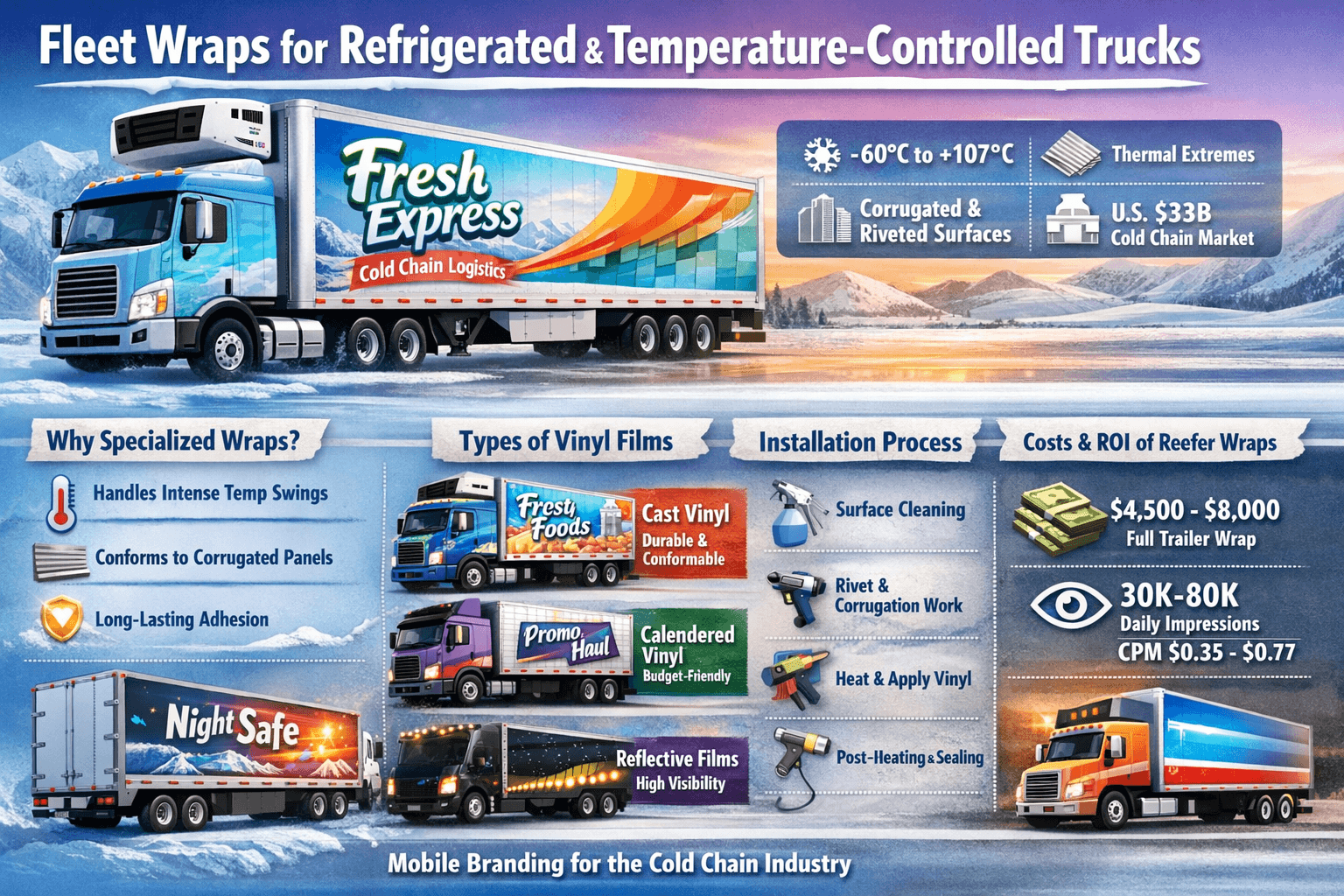
Fleet wraps for refrigerated and temperature-controlled trucks are large format vinyl graphics engineered to brand insulated trailer bodies, reefer panels, and cold chain vehicles despite their corrugated surfaces, riveted construction, and extreme operating temperatures.
This guide covers specialized material selection, installation on complex reefer surfaces, design strategy for corrugated and regulation-heavy trailers, temperature-driven durability factors, and the cost and ROI of wrapping cold chain fleets.
Cast vinyl films rated for service temperatures as wide as -60°C to +107°C are the foundation of any successful reefer wrap, outperforming calendered alternatives on riveted and corrugated panels where conformability and dimensional stability determine lifespan.
Installing wraps on refrigerated trucks demands multi-stage surface preparation, controlled squeegee techniques around individual rivets, and post-heating to lock adhesion near refrigeration housings, vents, and articulating roll-up doors.
Corrugated panel geometry, refrigeration equipment placement, and FMCSA-required compliance markings such as USDOT numbers all shape how branding is positioned for maximum legibility without obstructing airflow or violating federal standards.
Freeze-thaw cycling, prolonged cold storage, and solar heat loading on insulated walls each stress vinyl bonds differently; selecting films with wide thermal margins and maintaining wraps with pH-neutral washing and prompt salt removal extends graphic life to five to seven years.
Full reefer trailer wraps typically range from $4,500 to $8,000, yet vehicle wrap advertising achieves a CPM as low as $0.35 to $0.77, making wrapped refrigerated fleets one of the most cost-efficient branding channels in out-of-home advertising.
Why Do Refrigerated and Temperature-Controlled Trucks Need Specialized Fleet Wraps?
Refrigerated and temperature-controlled trucks need specialized fleet wraps because their insulated bodies, corrugated panels, riveted surfaces, and extreme operating temperatures create conditions that standard vinyl films and installation methods cannot withstand. The subsections below cover the unique surface challenges, the thermal stress these vehicles endure, and the scale of the cold chain market driving demand for durable branding solutions.
Refrigerated trailers operate in a punishing environment that no standard fleet vehicle encounters. Wall panels shift between sub-zero interior cold and ambient exterior heat multiple times per day, creating repeated thermal cycling that tests adhesive bonds at the molecular level. Corrugated panel profiles and rows of structural rivets add geometric complexity that flat-surface vinyl simply cannot conform to without lifting, tenting, or trapping air pockets over time.
High-performance cast vinyl films engineered for these conditions maintain service temperature ranges as wide as -60°C to +107°C, according to 3M’s technical specifications for the Controltac IJ180 series. That range matters because a reefer trailer parked in a Phoenix loading dock at midday and then set to -20°F for a cross-country frozen food haul can swing well over 100°F in a single shift. Standard calendered films lack the dimensional stability and conformability to survive those swings without shrinking, cracking, or delaminating.
Surface complexity compounds the thermal challenge. Insulated truck bodies feature corrugated sidewalls that distort printed graphics if layout planning does not account for the ridge-to-valley depth. Rivets spaced every few inches across trailer panels demand individual squeegee work during installation and post-heating to 203°F–212°F to reset the vinyl’s memory for a permanent bond. Refrigeration unit housings, vents, and insulated roll-up doors introduce additional obstacles that require precise templating and trimming around mechanical components.
The investment in solving these challenges is well justified by market scale. According to a 2025 Mordor Intelligence report, the U.S. refrigerated trucking market was valued at $31.14 billion and is projected to reach $33.18 billion in 2026. Every one of those trucks represents a mobile billboard traveling major freight corridors daily. For cold chain operators, a professionally wrapped reefer trailer is one of the most cost-efficient branding tools available, generating 30,000 to 80,000 daily impressions while reinforcing brand trust at every delivery stop.
From a practical standpoint, this is one of the highest-value branding decisions a cold chain fleet can make. The truck is already on the road; the only question is whether it carries your brand message or a blank white panel. Understanding the specific materials, installation techniques, and design strategies that follow will clarify exactly how to get that branding right.
What Types of Vinyl Wrap Materials Work on Refrigerated Trucks?
The types of vinyl wrap materials that work on refrigerated trucks include cast vinyl, calendered vinyl, and reflective specialty films. Each performs differently based on the surface complexity and temperature demands of insulated and refrigerated trailer bodies.
How Does Cast Vinyl Perform on Insulated Truck Bodies?
Cast vinyl performs exceptionally well on insulated truck bodies due to its thin profile and superior conformability. At just 1 to 2 mils thick, cast film wraps tightly around the rivets, deep channels, and compound curves found on reefer panels. Products like 3M Controltac IJ180 and Avery Dennison MPI 1105 SuperCast are specifically engineered for fleet applications on complex commercial surfaces.
Temperature tolerance is where cast vinyl truly separates itself. According to Billboard Prints, 3M Controltac IJ180 maintains a service temperature range of -60°C to +107°C, covering the extreme thermal swings refrigerated trailers experience daily. Arlon SLX Cast Wrap holds dimensional stability of just 0.010 inches after 48 hours at 158°F, which keeps graphics crisp on sun-exposed insulated panels. For any fleet running temperature-controlled routes, cast vinyl is the most reliable choice.
How Does Calendered Vinyl Perform on Reefer Trailers?
Calendered vinyl performs adequately on reefer trailers with flat or gently curved panel sections, though it carries notable limitations. This material is thicker and less flexible than cast vinyl, which makes it prone to lifting and shrinkage when applied over rivets, corrugation, or recessed channels common on refrigerated bodies.
Where calendered film finds its place is on large, uninterrupted flat surfaces or for short-term promotional campaigns where budget takes priority over longevity. According to Elite Restyling, cast vinyl offers superior durability and conformability for complex surfaces compared to thicker, less flexible calendered vinyl. For refrigerated fleets with demanding thermal cycles and textured panels, calendered vinyl is generally not the best long-term investment.
How Do Reflective and Specialty Films Perform on Cold Chain Vehicles?
Reflective and specialty films perform as critical safety and visibility enhancements on cold chain vehicles. These films combine branding capability with retroreflective properties that improve nighttime and low-visibility identification, which is essential for refrigerated trucks operating on highways during early-morning delivery windows.
According to American Sign Products, 3M Scotchlite Reflective Graphic Film 680CR is a 7-mil retroreflective film that retains 90% of its retroreflectivity when totally wet. Arlon DPF 2400 offers a 5-mil printable reflective option with permanent pressure-sensitive adhesive suited to flat and slightly curved surfaces. Because reflective films are thicker than standard cast vinyl, they conform best to smoother panel areas rather than heavily riveted sections. Pairing reflective accents with a cast vinyl base wrap gives cold chain fleets both brand impact and around-the-clock visibility.
With the right material selected, proper installation technique ensures these films bond securely to refrigerated surfaces.
How Are Fleet Wraps Installed on Refrigerated Truck Surfaces?
Fleet wraps are installed on refrigerated truck surfaces through a multi-stage process that addresses the unique geometry of reefer bodies. The following sections cover panel preparation, refrigeration unit areas, and insulated roll-up doors.
How Is a Corrugated or Riveted Reefer Panel Prepared for Wrapping?
A corrugated or riveted reefer panel is prepared for wrapping through thorough cleaning, surface conditioning, and temperature management before any vinyl is applied. The process follows a specific sequence:
- Wash the entire panel with degreaser soap, then use a clay bar treatment to remove embedded contaminants such as old wax, grease, and road film.
- Inspect rivets and corrugation channels for corrosion, loose fasteners, or sealant residue that could prevent full vinyl contact.
- Apply 2K epoxy primer followed by 2K urethane primer/surfacer on any unpainted or bare metal areas to create a stable bonding surface.
- Warm the panel surface to at least 68°F (20°C) using a heat gun or infrared heater, as cold insulated walls often sit well below ambient temperature.
According to Coverstyl, maintaining surface temperatures at or above 68°F before application ensures proper initial tack, which is especially critical on thermally insulated panels that resist warming. Skipping this step on reefer bodies is one of the most common causes of premature vinyl failure in cold chain fleets.
How Are Wraps Applied Around Refrigeration Unit Housings and Vents?
Wraps are applied around refrigeration unit housings and vents by sectioning the vinyl into smaller, manageable panels rather than attempting continuous coverage over complex three-dimensional obstacles. Installers cut templates around condenser housings, evaporator grilles, and air intake vents, leaving precise clearance margins that prevent vinyl from obstructing airflow or trapping heat.
Each rivet surrounding the housing requires a controlled squeegee technique, working the vinyl into individual fasteners for a secure bond. Once positioned, installers post-heat the film to 203°F to 212°F (95°C to 100°C) to reset the vinyl’s memory and lock adhesion around compound curves, as noted by Rvinyl. This post-heating step is non-negotiable for any area near mechanical equipment that generates vibration or thermal cycling.
How Are Wraps Installed on Insulated Roll-Up Doors?
Wraps are installed on insulated roll-up doors by applying vinyl in horizontal strips that align with each door slat, rather than using a single continuous sheet. Roll-up doors flex and articulate every time they open or close, so a full-panel application would crease, crack, or delaminate within weeks.
Cast vinyl films, typically 1 to 2 mils thick, conform to the slight curvature of each slat while maintaining enough flexibility to handle repeated bending cycles. Installers work each strip individually, ensuring edges terminate cleanly at slat joints without overlapping into the hinge gaps. Post-heating each strip locks the adhesive bond and prevents lifting at the edges.
For fleet managers running high-frequency delivery routes, this slat-by-slat approach significantly extends wrap life on the most mechanically active surface of the trailer. With installation techniques addressed, design considerations determine how effectively branding reads across these complex reefer surfaces.
What Design Considerations Matter for Temperature-Controlled Fleet Wraps?
Design considerations for temperature-controlled fleet wraps include corrugation-aware graphic layout, strategic branding placement around refrigeration equipment, and proper integration of regulatory markings. Each factor directly affects visibility, brand impact, and legal compliance.
How Does Panel Corrugation Affect Graphic Layout and Visibility?
Panel corrugation affects graphic layout and visibility by creating raised ridges that distort images, text, and fine details when viewed from certain angles. According to The Truckers Report, corrugation on trailer panels provides structural stability but requires careful graphic layout planning to avoid distortion of key branding elements.
Effective design strategies for corrugated reefer panels include:
- Placing logos and critical text on flat sections above or below the corrugation zone.
- Using bold, high-contrast color fields rather than detailed photography across ridged surfaces.
- Scaling typography large enough that individual corrugation peaks do not break letterforms.
- Orienting horizontal design elements parallel to the corrugation direction to minimize visual disruption.
Treating corrugation as a design constraint from the start, rather than an afterthought, consistently produces cleaner, more legible fleet graphics.
How Should Branding Be Positioned Around Refrigeration Equipment?
Branding should be positioned around refrigeration equipment by mapping exclusion zones for the front-mounted condenser unit, side vents, and rear access panels before finalizing any layout. These mechanical components occupy significant real estate on reefer trailers and create areas where vinyl cannot be applied or will be obscured during operation.
Key positioning guidelines include:
- Centering the primary logo and tagline on the trailer’s mid-body panels, away from the refrigeration unit housing at the front wall.
- Keeping contact information and URLs on the lower rear section, below the refrigeration unit’s discharge grille.
- Avoiding wrap coverage over air intake louvers and service access doors that technicians open regularly.
Planning around these obstructions ensures branding remains fully visible while preserving unobstructed airflow for the refrigeration system.
How Do Regulatory and Compliance Markings Integrate into the Design?
Regulatory and compliance markings integrate into the design by reserving designated spaces for legally required identifiers before creative elements are finalized. The FMCSA requires commercial motor vehicles in interstate commerce to display the motor carrier’s legal name and USDOT number on both sides, with letters that contrast sharply with the background and remain legible from 50 feet during daylight.
Compliance markings must also meet minimum sizing standards; DOT compliance decals require letters at least 2 inches high. Designers should incorporate these elements into the overall color scheme and typography hierarchy so they appear intentional rather than afterthoughts. A coordinated approach keeps the wrap visually cohesive while satisfying federal requirements.
With design fundamentals addressed, understanding how extreme temperatures affect wrap durability becomes the next critical consideration.
How Do Extreme Temperatures Affect Fleet Wrap Durability?
Extreme temperatures affect fleet wrap durability by stressing vinyl adhesive bonds, accelerating material fatigue, and altering dimensional stability. The subsections below cover freeze-thaw cycling, prolonged cold storage, and solar heat exposure on insulated trailers.
How Do Repeated Freeze-Thaw Cycles Impact Vinyl Adhesion?
Repeated freeze-thaw cycles impact vinyl adhesion by causing the adhesive layer to expand and contract with each temperature swing. On refrigerated trailers, exterior panels can shift from sub-zero interior temperatures to ambient warmth multiple times per day during loading and transit. This cyclical stress gradually weakens the bond at edges, seams, and rivet points, where lifted vinyl allows moisture ingress that compounds the problem.
High-performance cast vinyl films resist this degradation far better than economy alternatives. According to Billboard Prints, 3M Controltac IJ180 maintains a service temperature range of -60°C to +107°C, giving the adhesive system enough elasticity to absorb repeated thermal cycling without cracking or delaminating. Proper post-heating during installation also locks the vinyl’s memory, reducing the likelihood of edge lifting after months of freeze-thaw exposure.
How Does Prolonged Cold Storage Exposure Affect Wrap Longevity?
Prolonged cold storage exposure affects wrap longevity by keeping vinyl films at sustained low temperatures that stiffen the adhesive and reduce its pliability. When a reefer trailer sits at a cold storage dock for extended periods, the wrap remains in a contracted state. Over time, this can cause micro-cracking in the vinyl face film and diminished adhesive tack, especially on panels near the refrigeration unit where temperatures are lowest.
Material selection is the most effective defense. According to ID Numerique, Avery Dennison MPI 1105 SuperCast vinyl is rated for service temperatures down to -40°C, providing a wide operational margin for cold chain fleets. Fleet managers who choose films rated well below their typical operating temperatures gain a meaningful buffer against premature wrap failure in prolonged cold environments.
How Does Heat from Sun Exposure Affect Wraps on Insulated Trailers?
Heat from sun exposure affects wraps on insulated trailers by raising exterior surface temperatures well above ambient air readings. Insulated trailer walls trap heat between the vinyl and the panel substrate, creating a greenhouse-like effect that accelerates adhesive softening, color fading, and dimensional shift. South-facing and roof-adjacent panels experience the most severe thermal loading.
According to Arlon Graphics technical data, Arlon SLX Cast Wrap maintains dimensional stability of just 0.010 inches after 48 hours at 158°F (70°C), preventing graphic distortion under sustained heat. Choosing films with proven high-temperature dimensional stability is critical for insulated trailers, where exterior surface temperatures routinely exceed what standard vehicles encounter.
With temperature extremes addressed, understanding wrap costs helps fleet managers budget for these specialized materials.
How Much Do Fleet Wraps Cost for Refrigerated Trucks?
Fleet wraps for refrigerated trucks cost between $2,000 and $8,000, depending on vehicle size, coverage level, and material requirements. The sections below break down pricing for full reefer trailer wraps, refrigerated box truck wraps, and partial wrap or spot graphics packages.
How Much Does a Full Wrap Cost for a Reefer Trailer?
A full wrap for a reefer trailer typically costs between $4,500 and $8,000. According to a USA Wrap Co. pricing guide, a full wrap for a 53-foot semi-trailer falls within this range, with final cost depending on design complexity and the high-performance cast vinyl materials required for insulated, corrugated surfaces.
Several factors push reefer trailer wraps toward the higher end of that range:
- Corrugated and riveted panel surfaces demand more labor-intensive installation techniques.
- Temperature-rated cast vinyl films cost more than standard calendered alternatives.
- Refrigeration unit housings, vents, and roll-up doors require custom panel planning and trimming.
For fleets running dozens of 53-foot reefers, the per-unit cost often decreases with volume. This makes large-scale fleet programs one of the most cost-efficient ways to generate consistent, nationwide brand exposure on high-mileage cold chain routes.
How Much Does a Full Wrap Cost for a Refrigerated Box Truck?
A full wrap for a refrigerated box truck generally ranges from $2,000 to $6,000. Smaller box trucks with flat panel sides sit closer to the $2,000 end, while larger vehicles with complex geometry, multiple access doors, and corrugated insulated panels approach $6,000.
Key pricing variables for refrigerated box trucks include:
- Overall vehicle dimensions and total square footage of wrappable surface area.
- Number of obstructions such as liftgates, side access doors, and refrigeration vents.
- Choice between cast vinyl for long-term durability and calendered vinyl for budget-conscious applications.
Box trucks operating in urban delivery zones benefit especially from full wraps because they spend more time in dense, high-traffic areas. That combination of lower wrap cost and higher daily impressions often makes refrigerated box trucks the strongest ROI vehicle in a cold chain fleet.
How Much Does a Partial Wrap or Spot Graphics Package Cost?
A partial wrap or spot graphics package costs approximately $2,125 and up, based on coverage area and design scope. These options cover select panels rather than the entire vehicle, making them a practical entry point for fleets that need branded visibility without the investment of a full wrap.
Common partial wrap and spot graphics configurations include:
- Side panel wraps covering the two largest flat surfaces of the trailer or box truck.
- Rear door graphics targeting vehicles behind the truck during highway and city driving.
- Cab-only wraps paired with DOT compliance decals and logo spot graphics on the cargo body.
Partial wraps work well when fleet managers need to phase branding across a large number of refrigerated units over time, prioritizing the highest-visibility panels first and expanding coverage as budget allows.
How Do You Maintain Fleet Wraps on Temperature-Controlled Vehicles?
You maintain fleet wraps on temperature-controlled vehicles through regular hand washing, cold-weather precautions, and scheduled inspections that account for the unique thermal stress these trailers endure.
According to the United Association of Sign Fabricators and Installers (UASG), hand washing with pH-neutral soap and soft microfiber cloths is the safest maintenance method to protect the vibrant look and structural integrity of a vinyl fleet wrap. Automated truck washes with stiff brushes can lift edges along corrugated panels and around rivets, particularly where adhesion already faces stress from freeze-thaw cycling. For fleets running refrigerated routes, a gentle manual wash after each multi-day haul removes road film, diesel residue, and salt before these contaminants compromise the vinyl surface.
Cold weather demands specific precautions. Fleet managers should avoid using snow and ice scrapers directly on wrapped surfaces, as rigid tools can crack or gouge vinyl that has stiffened in sub-zero conditions. Road salt poses an equally serious threat; removing it promptly prevents chemical degradation of the film’s face and adhesive layers. A quick rinse with lukewarm water after winter runs is one of the simplest steps a fleet can take to extend wrap life.
Routine visual inspections catch problems before they spread. Fleet maintenance teams should look for:
- Lifting or peeling edges around rivets, corrugation channels, and door seals.
- Cracking or crazing in areas exposed to direct refrigeration unit exhaust.
- Fading or discoloration on sun-facing trailer sides.
- Damage near loading dock contact points and liftgate hardware.
Addressing small areas of lifting early with localized re-heating or edge sealing prevents moisture intrusion that accelerates delamination across entire panels. Vinyl wraps on commercial vehicles typically last between 5 to 7 years when professional materials are used and properly maintained, so consistent upkeep directly protects the investment.
For fleet operators managing dozens or hundreds of refrigerated trailers, building wrap inspections into existing preventive maintenance schedules is the most practical approach. Every time a reefer unit gets its routine service check, the wrap condition should be documented alongside mechanical components. This integrated approach ensures that graphic quality keeps pace with the vehicle’s operational lifespan, preserving both brand visibility and asset value across the cold chain fleet.
What ROI Do Fleet Wraps Deliver for Cold Chain and Refrigerated Fleets?
Fleet wraps deliver exceptional ROI for cold chain and refrigerated fleets by combining the lowest cost per impression of any out-of-home advertising medium with a one-time investment that generates returns for five to seven years.
According to OAAA data, traditional billboards cost between $2.18 and $3.56 CPM, while vehicle wraps achieve a CPM as low as $0.35 to $0.77. A single wrapped refrigerated trailer generates 30,000 to 80,000 impressions daily as it travels distribution routes, compared to 8,000 to 65,000 for a stationary billboard. That gap widens considerably when factoring in the geographic reach of cold chain fleets operating across multiple states and metro areas.
The math becomes even more compelling over time. A full wrap on a 53-foot reefer trailer, typically costing $4,500 to $8,000, is a one-time expense. A billboard at $2,000 per month costs $120,000 over that same five-year wrap lifespan. Fleet graphics serve as a single investment that extends brand presence far beyond a company’s physical facilities, turning every delivery run into a mobile advertising campaign.
For cold chain operators specifically, this ROI advantage is amplified by high-mileage routes and frequent urban stops. Refrigerated fleets serving grocery chains, restaurants, and distribution centers consistently operate in high-traffic, high-visibility corridors. Each mile driven generates 400 to 600 additional impressions. A reefer truck logging 100,000 miles annually produces tens of millions of branded impressions without any recurring media spend.
The North America cold chain logistics market is projected to grow by USD 136.01 billion at a 15.8% CAGR from 2025 to 2030, according to Technavio. As more refrigerated vehicles enter service, branded wraps become a competitive differentiator that compounds in value. Fleets that invest in professional wraps now position their brand across an expanding logistics network at a fraction of what digital or traditional advertising would cost for equivalent reach.
For fleet managers evaluating advertising spend, few channels match the efficiency of a well-executed wrap program on temperature-controlled vehicles. Comparing fleet wraps to paint reveals additional advantages beyond advertising ROI.
How Do Fleet Wraps Compare to Paint for Refrigerated Truck Branding?
Fleet wraps compare to paint for refrigerated truck branding by offering faster turnaround, lower long-term cost, easier design changes, and better surface protection for insulated panels. The comparison below covers cost, durability, flexibility, and protection.
Fleet wraps provide distinct advantages over custom paint for refrigerated truck branding across several key factors:
- Upfront cost: A full vinyl wrap for a 53-foot reefer trailer typically costs between $4,500 and $8,000, while a commercial-grade custom paint job on the same trailer can exceed $10,000 to $15,000 when factoring in surface preparation, primer, multiple coats, and clear coat.
- Durability: Vinyl wraps on commercial vehicles typically last 5 to 7 years with proper maintenance, according to Reaper Customs. Quality fleet paint can last longer, but it chips, scratches, and fades without expensive touch-ups.
- Design flexibility: Wraps allow full-color, photographic-quality graphics across corrugated panels, rivets, and curved surfaces. Paint cannot replicate the same level of detail without significant airbrushing costs.
- Campaign updates: A wrap can be removed and replaced in days to reflect seasonal promotions, new product lines, or rebranding. Repainting requires extended downtime in a body shop.
- Surface protection: Vinyl film acts as a protective barrier over the insulated panel substrate, shielding it from road debris, UV exposure, and minor abrasion. Paint offers no removable protective layer.
- Downtime: Wrap installation takes one to three days per vehicle, while a full custom paint job may require one to two weeks including drying and curing time.
- Resale value: Wraps preserve the original factory finish underneath. When removed, the panels remain in better condition than painted surfaces that may show wear patterns or mismatched repairs.
For refrigerated fleets operating in harsh thermal environments, the ability to swap graphics without repainting is especially valuable. Temperature cycling, road salt, and constant washing accelerate paint degradation faster than most fleet managers anticipate, making vinyl wraps the more practical long-term branding investment. With a large format graphics partner in place, coordinating wrap programs across an entire fleet becomes a streamlined process.
How Should You Approach Fleet Wraps with a Large Format Graphics Partner?
You should approach fleet wraps with a large format graphics partner by prioritizing certifications, material expertise, and full-service capabilities. The following sections cover how Craftsmen Industries handles refrigerated truck wraps and the key takeaways for cold chain fleet branding.
Can Craftsmen Industries’ Large Format Graphics and Fleet Fabrication Capabilities Handle Refrigerated Truck Wraps?
Yes, Craftsmen Industries can handle refrigerated truck wraps. Craftsmen Industries is a 3M Preferred Graphics Installer and PDAA-certified provider specializing in large format graphics and custom fleet wraps for trucks, trailers, and specialty vehicles. This combination of certifications ensures proper material selection and installation technique for the unique demands of insulated, corrugated, and riveted reefer surfaces.
Craftsmen Industries provides full-service fleet branding, including design, industrial fabrication, and large format graphics for commercial vehicles. That vertically integrated workflow, from ideation through on-site installation, eliminates the coordination gaps that often compromise graphic quality on temperature-controlled trailers. For cold chain operators managing national fleets, a single-source partner reduces turnaround time and maintains consistent brand presence across every vehicle.
Fleet graphics on refrigerated trucks serve as a one-time investment that extends brand visibility far beyond a company’s physical facilities, generating thousands of daily impressions on every delivery route.
What Are the Key Takeaways About Fleet Wraps for Refrigerated and Temperature-Controlled Trucks?
The key takeaways about fleet wraps for refrigerated and temperature-controlled trucks center on material selection, proper installation, and long-term value:
- Cast vinyl films rated for extreme temperature ranges are essential for reefer trailers that cycle between freezing cargo zones and sun-exposed highway conditions.
- Surface preparation on corrugated and riveted panels requires degreasing, clay bar treatment, and controlled squeegee techniques to achieve durable adhesion.
- FMCSA compliance markings, including USDOT numbers and carrier identification, must be integrated into the wrap design from the start.
- Vehicle wrap advertising delivers a CPM as low as $0.35 to $0.77 according to OAAA data, far below traditional billboard rates of $2.18 to $3.56.
- Proper maintenance with pH-neutral soap and prompt road salt removal extends wrap lifespan to five to seven years.
Partnering with a certified, full-service provider like Craftsmen Industries simplifies every phase of the process, from material specification through nationwide installation and ongoing fleet management.
Filter Posts by Tag
related posts
Fleet graphics are large-format vinyl applications installed on commercial vehicles [...]
How to take your fleet graphic design up a level for the best results? Discover these five tips for crafting eye-catching designs.

Struggling to decide between partial vs full fleet wraps? Discover the power of fleet wrap advertising and how to choose the best option!
