
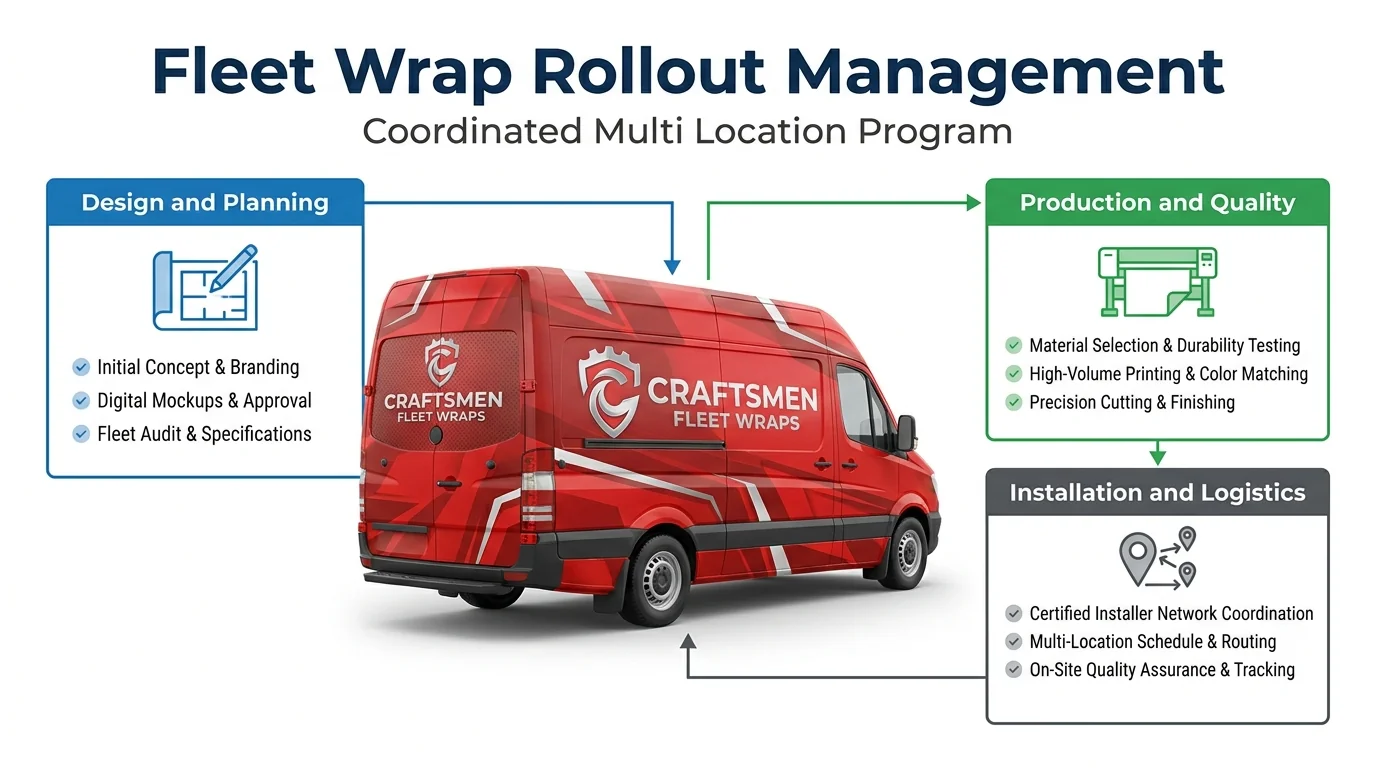
A multi-location fleet wrap rollout is a coordinated program that applies branded vinyl graphics to an organization’s vehicles across multiple geographic sites within a defined timeline. It unifies design, production, logistics, and installation into a single managed effort so every vehicle presents an identical brand image regardless of where it operates.
This guide covers complexity drivers behind multi-site rollouts, project planning and brand consistency enforcement, vehicle measurement and high-volume production, installation coordination with nationwide logistics, progress tracking and communication, common mistakes that derail programs, and post-launch management with vertically integrated partnerships.
Geographic dispersion multiplies every variable in the process; fragmented vendor networks, decentralized decision-making, and vehicle diversity across locations all erode brand consistency when sites operate independently. Recognizing these complexity drivers early separates a controlled, phased rollout from a reactive scramble.
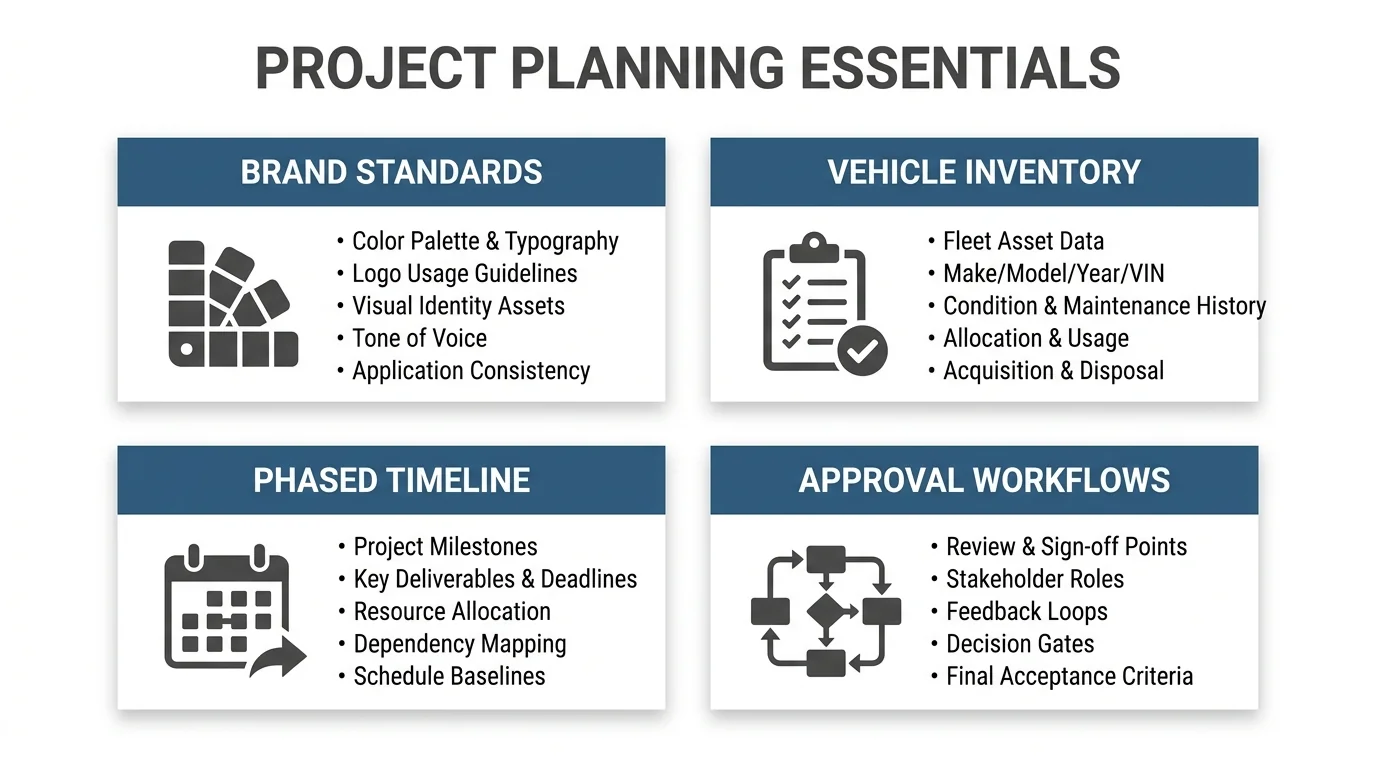
Effective project planning requires locked brand standards with substrate-specific color definitions, complete vehicle inventories with CAD-verified templates, phased timelines grouped by installation wave, and structured approval workflows that prevent communication breakdowns from stalling production.
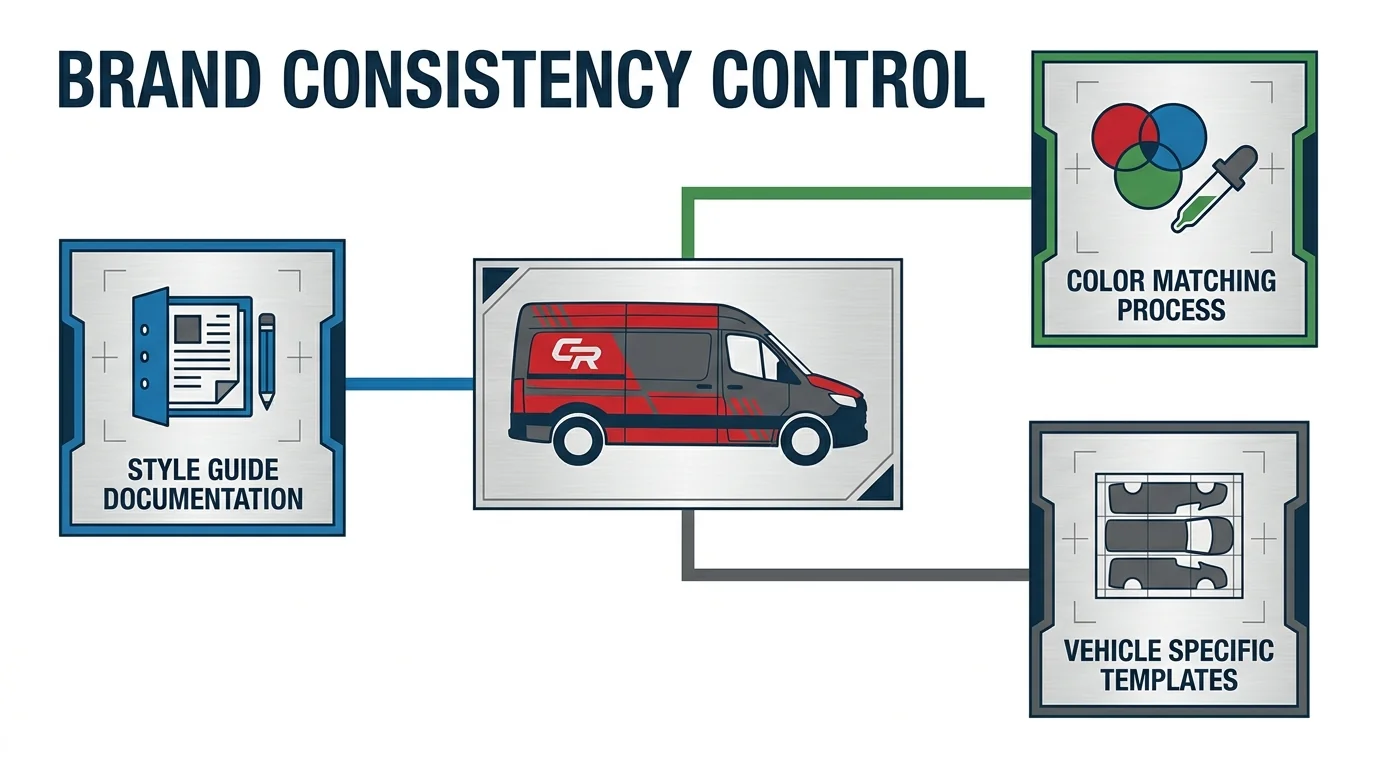
Brand consistency holds when a detailed wrap style guide governs every visual element, color matching is controlled at the printer and vinyl substrate level, and each vehicle make and model receives its own adapted design template rather than a stretched generic layout.
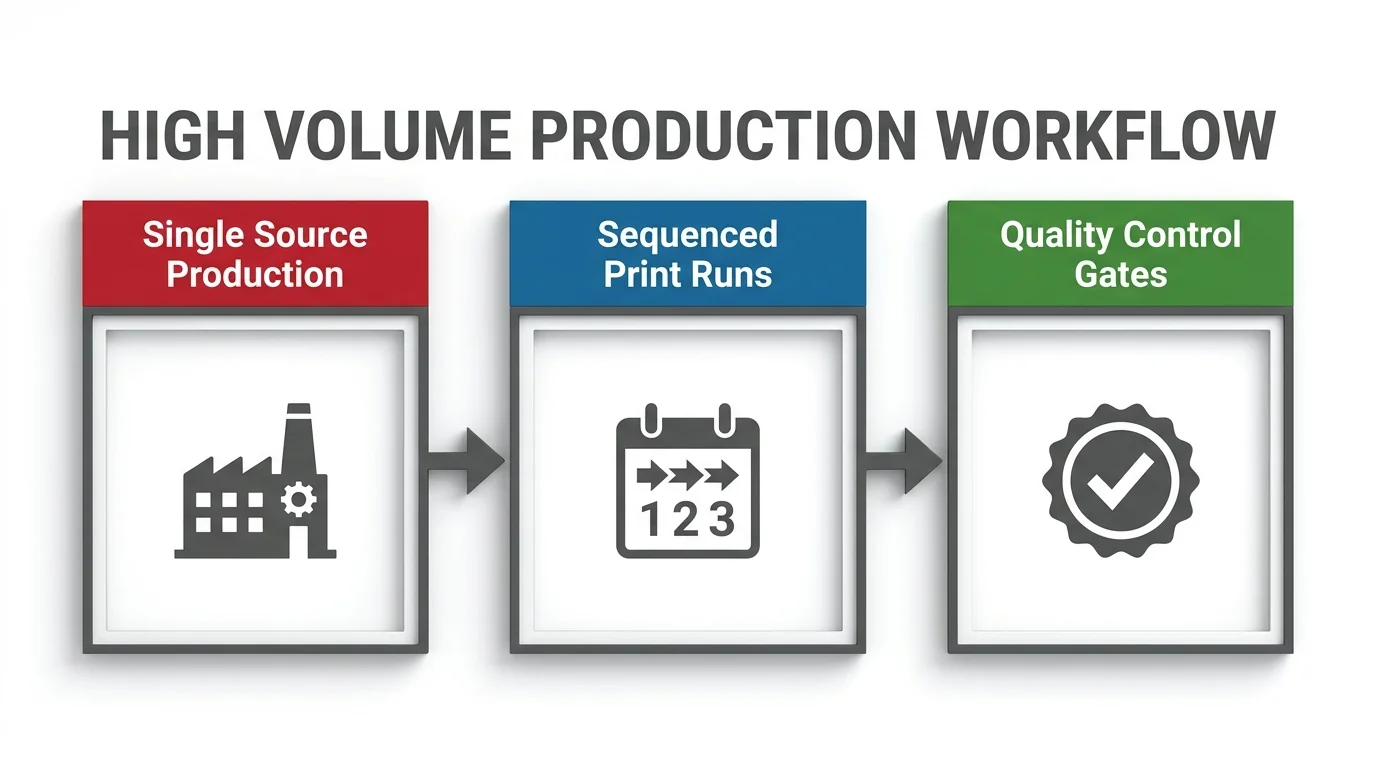
Centralized single-source production eliminates quality variance by keeping printing, finishing, and packaging under one roof, while sequenced print runs aligned to phased installation windows prevent material degradation from prolonged storage.
Installation scheduling across dispersed locations depends on staggered vehicle rotation to minimize downtime, site-specific facility and weather audits, and certified crews deployed along geographically efficient routes. Damage-proof packaging and just-in-time shipment staging keep materials arriving precisely when installers need them.
Real-time project management platforms paired with a tiered reporting cadence (daily field logs, weekly summaries, milestone-triggered executive reports) maintain visibility without pulling crews away from productive work. Post-launch, pre-negotiated service-level agreements, replacement schedules, and archived design files ensure new vehicles and repairs match the original program seamlessly.
What Is a Multi-Location Fleet Wrap Rollout?
A multi-location fleet wrap rollout is a coordinated program that applies branded vinyl graphics to an organization’s vehicles across multiple geographic sites within a defined timeline. This process unifies design, production, logistics, and installation into a single managed effort so every vehicle, regardless of where it operates, presents an identical brand image.
Unlike wrapping a handful of vehicles at one facility, a multi-location rollout introduces complexity at every stage. Design templates must account for different vehicle makes and models. Print production requires bulk material sourcing with tight color tolerances. Installation crews need scheduling across dispersed sites, often spanning different climate zones and facility conditions. Shipping and staging must deliver finished wrap panels to the right location at precisely the right time.
According to Verified Market Reports, the Fleet Graphics Services Market stood at USD 2.5 billion in 2024 and is forecast to reach USD 4.7 billion by 2033, registering a 7.5% CAGR from 2026 to 2033. That growth reflects rising demand from enterprises that recognize fleet graphics as one of the most cost-effective forms of mobile advertising, capable of generating thousands of daily impressions per vehicle. As more companies scale their fleets across regions, the need for structured, repeatable rollout processes has become essential rather than optional.
A successful multi-location fleet wrap rollout typically coordinates five core workstreams:
- Brand standards and design lock: Finalizing approved artwork, color specifications, and placement rules before any production begins.
- Vehicle inventory and templating: Collecting accurate measurements and CAD templates for every vehicle variant in the fleet.
- Centralized production: Printing and finishing all wrap panels from a single facility or controlled network to eliminate quality variance.
- Phased installation scheduling: Sequencing installer crews across locations to minimize vehicle downtime while maintaining consistent application quality.
- Logistics and progress tracking: Staging shipments, monitoring milestones, and reporting status to stakeholders at every site.
When any one of these workstreams operates in isolation, brand consistency breaks down quickly. For organizations managing dozens or hundreds of vehicles across states or regions, the difference between a cohesive rollout and a fragmented one often comes down to whether a single project plan governs all five areas from the start. The sections that follow break down each workstream in detail, starting with the complexity drivers that make multi-location programs fundamentally different from single-site wraps.
Why Does a Fleet Wrap Rollout Become Complex Across Multiple Locations?
A fleet wrap rollout becomes complex across multiple locations because geographic dispersion multiplies every variable in the process, from vendor coordination and vehicle diversity to brand enforcement and installation scheduling. The core complexity drivers fall into several categories.
Fragmented vendor networks erode consistency. Different locations often use different vendors for signage, vehicle wraps, and marketing materials, which leads to inconsistent branding across multiple franchise locations, according to the Wrapmate Blog. When each site sources its own installer or printer, color output, vinyl quality, and application technique vary with every job.
Decentralized decision-making breaks brand standards. Fleet branding consistency breaks down when local teams make isolated decisions about design placement, material substitution, or installation timing. Without a centralized phased rollout system, these small deviations compound across dozens or hundreds of vehicles until the fleet no longer presents a unified identity.
Logistics introduce cascading delays. Trucking logistics face challenges such as delayed deliveries, route inefficiencies, and miscommunication, all of which drive up costs and push installation windows off schedule. When wrap panels ship to 15 or 50 locations simultaneously, a single shipping disruption can stall an entire regional phase.
Vehicle fleet diversity demands unique templates. A multi-location fleet rarely consists of one vehicle make and model. Variations in year, trim, cab configuration, and aftermarket modifications require individual measurement and templating for accurate wrap fitment. Scaling this process across geographies, where hands-on vehicle access may be limited, adds another layer of coordination.
Regulatory and environmental conditions vary by site. Local laws governing vehicle signage can restrict the kinds of graphics that can be utilized at certain locations. Facility constraints, such as indoor bay availability, climate conditions, and site access for oversized vehicles, differ at every location and directly affect installation quality and scheduling.
For fleet managers, recognizing these complexity drivers early is the difference between a controlled, phased rollout and a reactive scramble. The sections ahead break down the specific planning, production, and coordination strategies that address each of these challenges.
What Should You Include in a Fleet Wrap Rollout Project Plan?
A fleet wrap rollout project plan should include locked brand standards, a complete vehicle inventory, a phased timeline with milestones, and defined approval workflows. The following sections break down each component.
What Brand Standards and Design Specifications Need to Be Locked Before Production?
Brand standards and design specifications that need to be locked before production include finalized color values, logo placement rules, typography, and vehicle-specific layout templates. According to Blink Signs, brand colors should be defined in Pantone, CMYK, RGB, and HEX, with each Pantone number linked to specific film numbers from manufacturers like 3M, Avery Dennison, or Orafol.
Key specifications to finalize include:
- Exact color formulas across all reproduction formats
- Minimum and maximum logo dimensions per vehicle panel
- Exclusion zones around hinges, fuel doors, sliding doors, and window breaks
- Approved vinyl substrate and laminate combinations
- Typography hierarchy for phone numbers, URLs, and CTAs
Without substrate-specific color definitions, brand manuals frequently fail to prevent visible variation across a fleet. Locking these details into a single design specification document before any print run eliminates the most common source of inconsistency.
What Vehicle Inventory Details Must Be Collected Across Every Location?
Vehicle inventory details that must be collected across every location include make, model, year, trim level, body configuration, and any aftermarket modifications. Every wrap project begins with a CAD file customized to the exact dimensions of the vehicle, so accurate inventory data determines whether templates will fit correctly at installation.
Each location should submit:
- VIN and registration details for every vehicle in scope
- Exterior photos from standardized angles (front, rear, both sides, roof)
- Notation of aftermarket additions such as ladder racks, toolboxes, or light bars
- Current condition of the paint surface
Collecting this data upfront through a standardized intake form prevents costly reprints. When fleet vehicles vary in trim or equipment, even within the same model year, a generic template risks misaligned graphics over body lines and panel seams.
What Timeline and Milestone Structure Works for a Phased Rollout?
A phased rollout timeline works best when it groups locations into installation waves, with defined milestones for design approval, production, shipping, and installation. According to TeckWrap, fleet projects require bulk materials, additional workspace, and often longer installation timelines compared to single-vehicle wraps.
An effective milestone structure includes:
- Design lock and specification sign-off
- Vehicle inventory collection and template verification
- Print production sequenced by installation wave
- Quality control inspection before shipping
- Material staging and delivery to each location
- Installation windows with confirmed crew schedules
- Post-install inspection and sign-off per site
Phasing prevents bottlenecks by spreading production and installation demand across weeks rather than concentrating it. Starting with a pilot wave of two to three locations reveals process gaps before scaling to the full fleet.
What Approval Workflows Prevent Delays Between Design and Installation?
Approval workflows that prevent delays between design and installation establish clear decision-making authority, defined review windows, and automatic escalation triggers. Most failed fleet wraps stem from bad communication rather than bad design concepts, which makes structured approvals essential.
Effective workflows should define:
- A single design approver per stakeholder group, not a committee
- Maximum review periods (typically 48 to 72 hours per approval stage)
- Escalation rules if a deadline passes without feedback
- A digital proof-approval system that timestamps every sign-off
- Separation between brand approval and vehicle-specific layout approval
Requiring sequential approvals, where brand review happens before vehicle-specific adaptation, keeps revisions from cascading through production. When approval authority is ambiguous or distributed across too many people, even well-planned timelines stall before a single panel reaches the printer.
With approval workflows defined, the next step is ensuring brand consistency holds across every location.
How Do You Ensure Brand Consistency Across Every Location?
You ensure brand consistency across every location by building a detailed style guide, controlling color matching at the substrate level, and adapting designs per vehicle model. The following sections cover each of these three pillars.
How Do You Create a Vehicle Wrap Style Guide That Eliminates Variation?
You create a vehicle wrap style guide that eliminates variation by documenting every visual element in a single, centralized reference. This guide should specify logo placement zones, minimum clear-space rules, approved typography, and exact color values in Pantone, CMYK, RGB, and HEX formats. According to Blink Signs, brand colors defined across these systems can be cross-referenced to specific 3M, Avery, or Orafol film numbers to eliminate guesswork at production.
A comprehensive wrap style guide should include:
- Approved logo files in vector format with placement coordinates for each vehicle panel.
- Minimum and maximum scaling ratios for brand marks.
- Exclusion zones around fuel doors, hinges, and door handles where graphics must not appear.
- Approved secondary graphic elements, patterns, and background treatments.
- Contact information hierarchy specifying font size, placement, and priority order.
Without this level of specificity, local teams inevitably make isolated decisions that fragment brand presentation. For fleet programs spanning dozens of locations, the style guide functions as the single source of truth that every designer, printer, and installer references before touching a vehicle.
How Do You Manage Color Matching Across Different Vinyl Substrates and Printers?
You manage color matching across different vinyl substrates and printers by establishing substrate-specific color profiles rather than relying on generic brand manual values alone. According to a study published in UCViden.dk, brand manuals often fail when defining brand colors because they lack specific information about output devices and substrates, allowing ordinary variation tolerance to produce visible inconsistency.
Effective color management requires several coordinated steps:
- Create ICC profiles calibrated to each printer and vinyl substrate combination used in production.
- Specify the exact vinyl product by manufacturer SKU so every print run uses identical base material.
- Produce physical color drawdown samples on the actual substrate before approving full production.
- Run periodic spectrophotometer readings to verify Delta E values stay within acceptable tolerances.
Cast vinyl performs well here because of its consistent surface properties and broad color gamut. For multi-location rollouts, centralizing print production through a single facility is the most reliable way to eliminate the compounding variables that arise when multiple shops calibrate independently.
How Do You Handle Design Adaptation for Different Vehicle Makes and Models?
You handle design adaptation for different vehicle makes and models by using vehicle-specific templates that map every contour, body line, and obstruction before production begins. Every wrap project starts with a computer-aided design (CAD) file customized to the exact dimensions of each vehicle, which prevents graphics from distorting across complex surfaces.
Key adaptation steps include:
- Sourcing accurate digital templates from libraries such as Pro Vehicle Outlines, which cover a wide range of makes and models.
- Identifying panel-specific trouble spots where logos or text could land on seams, recesses, or sliding doors.
- Creating modular design layouts that allow brand elements to shift position without breaking visual hierarchy.
- Producing proof overlays on the template for stakeholder approval before any vinyl is printed.
A design that looks perfect on a flat screen frequently distorts when applied to compound curves or recessed panels. Treating each vehicle variant as its own design deliverable, rather than stretching a single layout across the fleet, is what separates a professional rollout from one that erodes brand credibility at every location.
How Should You Approach Vehicle Measurement and Templating at Scale?
You should approach vehicle measurement and templating at scale by combining digital template libraries with vehicle-specific CAD files and structured field data collection. The subsections below cover handling fleet variation and gathering remote measurements.
What Happens When Fleet Vehicles Vary in Year, Trim, or Aftermarket Modifications?
When fleet vehicles vary in year, trim, or aftermarket modifications, standard templates become unreliable. Even within the same make and model, trim-level differences alter body lines, bumper profiles, and molding positions. Aftermarket additions like ladder racks, toolboxes, or running boards change usable wrap surface area entirely.
Every wrap project begins with a computer-aided design (CAD) file customized to the exact dimensions of the vehicle, according to Craftsmen Industries. Template libraries such as Pro Vehicle Outlines and Fiery Pro Vehicle Outline provide accurate baseline files for common models, but these must be verified against each vehicle’s actual configuration.
A practical approach includes:
- Cataloging each vehicle by year, make, model, trim, and any modifications during the inventory phase.
- Flagging units with non-standard features that require custom panel adjustments.
- Updating CAD files per trim variant rather than applying one template across all units.
Skipping this step is one of the fastest ways to produce wraps that misalign at seams, distort over contours, or leave visible gaps at mounting hardware.
How Do You Collect Accurate Measurements From Locations You Cannot Visit in Person?
You collect accurate measurements from locations you cannot visit in person by equipping on-site contacts with standardized measurement protocols and photographic documentation guides. According to Graphics Pro, vehicle templates are a great tool for determining the square footage and pricing for fleet graphics and wraps, but they require ground-truth validation from each location.
Key steps for remote measurement collection include:
- Distributing a measurement kit checklist specifying tape positions, photo angles, and reference points for each vehicle panel.
- Requiring photos with a visible scale marker alongside every measured surface.
- Cross-referencing submitted dimensions against the closest digital template to flag discrepancies before production.
Digital templating tools like the Proliner offer fast and accurate 2D/3D measurement capabilities that can supplement field-collected data when higher precision is needed. For programs spanning dozens of locations, building this remote workflow into the project plan early prevents costly reprints and installation delays downstream.
What Production Workflow Supports a High-Volume Fleet Wrap Order?
A high-volume fleet wrap order requires a production workflow built on centralized manufacturing, sequenced print runs, and structured quality control. The following sections cover single-source production, phased print scheduling, and pre-shipment checkpoints.
How Does a Single-Source Production Facility Reduce Quality Variance?
A single-source production facility reduces quality variance by consolidating design, printing, finishing, and packaging under one roof. When multiple vendors handle different production stages, each facility introduces its own equipment calibration, material lots, and color profiles, which compounds inconsistency across a large fleet order. Centralizing production eliminates these variables.
According to a 2024 Emerald Insight study on lean manufacturing systems, a single-source management approach ensures products are produced, managed, and distributed efficiently with a systematic and organized workflow. For fleet wraps specifically, this means one set of printers, one ink batch per run, and one lamination process applied uniformly to every panel.
- Consistent color output across hundreds of panels printed on identical equipment
- Unified material sourcing from a single vinyl and laminate supplier
- Streamlined communication between design, production, and quality teams
- Faster issue resolution when all departments share the same facility
Consolidation is especially critical for multi-location rollouts where even slight color drift between production batches becomes visible when vehicles park side by side.
How Do You Sequence Print Runs to Align With a Phased Installation Schedule?
You sequence print runs to align with a phased installation schedule by mapping each production batch to a specific regional installation window. Fleet projects require bulk materials, additional workspace, and often longer installation timelines compared to single-vehicle wraps, according to TeckWrap’s 2024 analysis of fleet-scale operations.
Rather than printing all panels at once and warehousing them, effective sequencing follows a just-in-time approach:
- Group vehicles by installation region and scheduled date.
- Assign each regional group a dedicated print window two to three weeks before its installation date.
- Print, laminate, trim, and kit each group as a single batch.
- Ship kits directly to the installation site with labeled panel maps per vehicle.
This approach prevents material degradation from prolonged storage, reduces warehouse space requirements, and ensures installers receive fresh panels matched to their exact schedule. When a rollout spans dozens of locations over several months, phased sequencing keeps production capacity steady rather than creating bottlenecks from a single massive run.
What Quality Control Checkpoints Should Occur Before Wraps Ship?
The quality control checkpoints that should occur before wraps ship include color verification, dimensional accuracy review, surface defect inspection, and kit completeness auditing. Skipping any of these stages risks sending flawed panels to remote installation sites, where reprinting causes costly delays.
Essential pre-shipment QC checkpoints include:
- Color verification: Compare printed panels against the approved Pantone reference and a master proof from the first production run.
- Dimensional check: Confirm panel dimensions match the CAD template for each vehicle make and model in the batch.
- Surface inspection: Examine panels for banding, ink spatter, lamination bubbles, and edge lifting under controlled lighting.
- Kit audit: Verify every panel, application instruction sheet, and squeegee kit is present and labeled for the correct vehicle and location.
- Packaging integrity: Ensure panels are rolled or flat-packed with interleaving material to prevent scratching during transit.
Catching defects at the production facility is always faster and cheaper than discovering them at a remote installation site. A disciplined QC gate before shipping is what separates a smooth rollout from one plagued by field reprints and scheduling disruptions.
With production quality locked in, the next challenge becomes coordinating installation crews and schedules across every location.
How Do You Coordinate Installation Scheduling Across Dispersed Locations?
You coordinate installation scheduling across dispersed locations by aligning vehicle availability, site conditions, and crew deployment into a single phased timeline. The subsections below cover minimizing downtime, managing weather and facility constraints, and deploying installer crews across regions.
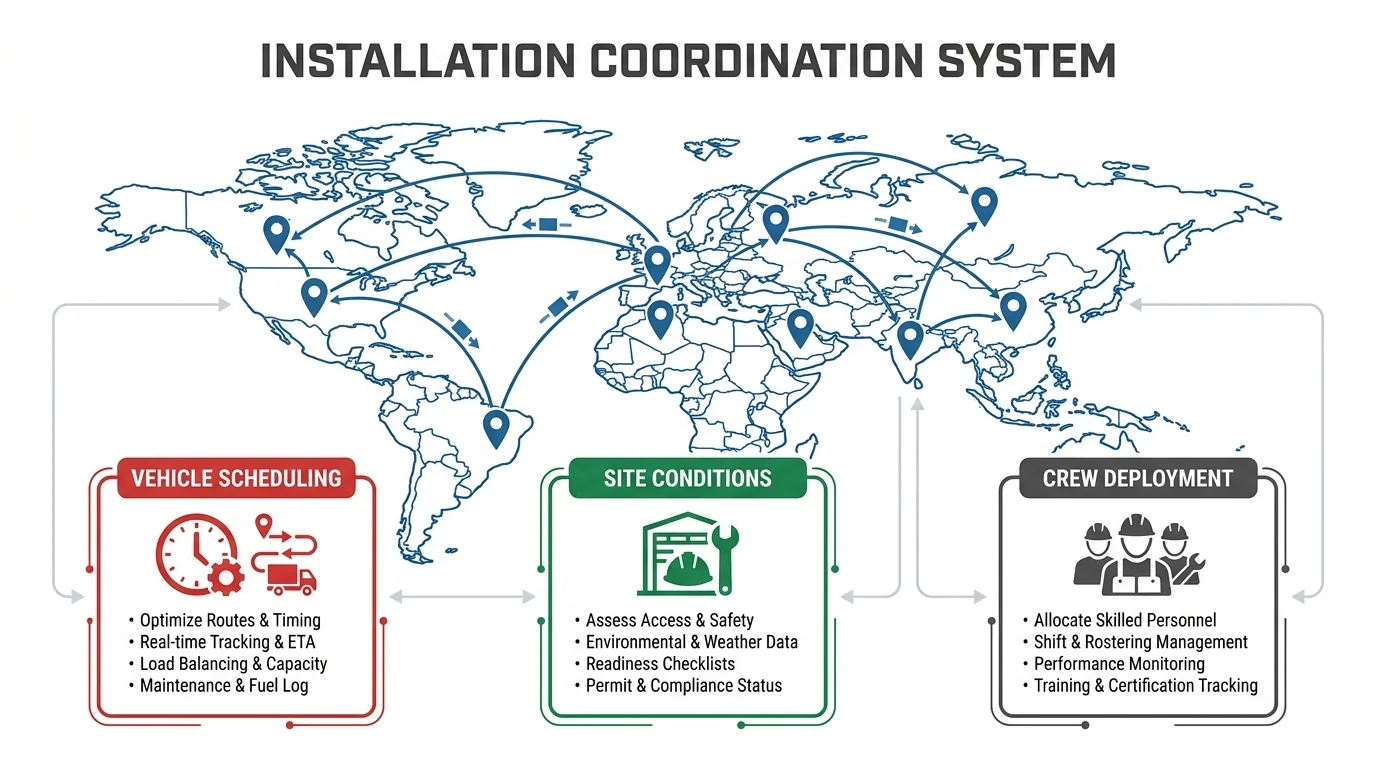
How Do You Minimize Vehicle Downtime During the Installation Window?
You minimize vehicle downtime during the installation window by scheduling installs during off-peak operational hours and batching vehicles by location priority. Staggering appointments so only a portion of a site’s fleet is wrapped at any given time keeps the remaining vehicles in service. Pre-staging wrap panels at each location before the crew arrives eliminates waiting time on installation day.
According to TeckWrap, fleet projects require bulk materials, additional workspace, and often longer installation timelines compared to single-vehicle wraps. This reality makes staggered scheduling essential rather than optional. Coordinating directly with each location’s dispatch or operations manager ensures vehicles rotate through installation bays without creating service gaps. For most multi-location rollouts, scheduling two to three vehicles per day per crew strikes the right balance between speed and operational continuity.
How Do You Account for Weather and Facility Constraints at Each Site?
You account for weather and facility constraints at each site by auditing each location’s installation environment before scheduling begins. Vinyl wrap adhesive requires controlled temperature ranges, typically between 60°F and 80°F, for proper bonding. Sites without covered bays or climate-controlled areas need installation windows timed to favorable seasonal conditions.
Facility constraints vary widely across locations. Some sites offer covered garages with adequate lighting, while others provide only open parking lots. Identifying these differences early allows the project manager to:
- Route southern or warm-climate locations into winter install windows.
- Schedule northern or cold-climate locations during spring and summer months.
- Arrange temporary shelters or portable enclosures for sites lacking covered space.
- Confirm adequate power access for heat guns and lighting equipment.
Overlooking these variables is one of the fastest ways to compromise adhesion quality and force costly reinstalls.
How Do You Manage Installer Crews When Locations Span Multiple Regions?
You manage installer crews when locations span multiple regions by deploying certified teams along geographically efficient routes. According to UASG, each 3M authorized installer must pass a hands-on and written test with a minimum of three years in the industry, so verifying crew certifications before deployment protects quality consistency.
Regional crew management typically involves grouping nearby locations into installation clusters, then routing a single crew through each cluster in sequence. This approach reduces travel costs and ensures the same trained team handles multiple sites within a corridor. When the rollout spans time zones or covers areas too distant for one crew, assigning dedicated regional teams with identical training and quality standards prevents variation between installs.
Consistent documentation, including photo verification of each completed vehicle, gives the project manager real-time visibility regardless of which crew handles the work. With crews deployed and installs verified, the focus shifts to logistics and shipping coordination for material delivery.
What Logistics and Shipping Considerations Apply to a Nationwide Wrap Rollout?
The logistics and shipping considerations that apply to a nationwide wrap rollout include damage-proof packaging protocols and precisely staged delivery schedules. Proper packaging protects printed vinyl panels during transit, while strategic shipment timing ensures materials arrive at each location just before the scheduled installation window.
How Should Wrap Panels Be Packaged to Prevent Damage in Transit?
Wrap panels should be packaged to prevent damage in transit by using rigid-core tubes, interleaving sheets, and climate-appropriate outer containers. Printed cast vinyl is vulnerable to creasing, scratching, and moisture absorption, so each panel needs individual protection before it enters the freight stream.
Best practices for fleet wrap packaging include:
- Rolling panels face-out on 6-inch diameter cardboard cores to avoid crease lines at tight bend radii.
- Placing silicone-release interleaving paper between layered panels to prevent ink transfer.
- Sealing rolled panels inside moisture-barrier poly sleeves before inserting them into telescoping shipping tubes.
- Labeling every tube with the vehicle ID, panel position, and installation site to streamline sorting on arrival.
- Using corner protectors and rigid outer cartons for flat-shipped decals, partial wraps, or perforated window films.
According to a 2025 East Coast Warehouse logistics report, the top shipping challenges include rising costs, capacity shortages, and theft, all of which make robust packaging even more critical for high-value printed materials crossing multiple freight zones. Skipping any of these steps is a false economy; one creased panel can delay an entire site’s installation by days while a reprint ships.
How Do You Stage Shipments So Materials Arrive Just Before Installation?
You stage shipments so materials arrive just before installation by reverse-scheduling delivery dates from each site’s confirmed install window. This approach prevents panels from sitting in uncontrolled storage environments where heat, humidity, or mishandling can degrade vinyl before installers ever touch it.
Effective shipment staging follows a clear sequence:
- Lock the installation calendar for each location, including the exact start date and crew arrival time.
- Calculate transit time from the production facility to each site, accounting for regional carrier variability.
- Add a two-day buffer for weather delays or carrier exceptions without allowing panels to arrive more than five days early.
- Ship in labeled, site-specific kit bundles so each location receives one consolidated package rather than partial shipments that require on-site sorting.
As a LinkedIn Pulse analysis on trucking logistics noted, delayed deliveries, route inefficiencies, and miscommunication remain persistent pain points that drive up costs. Coordinating shipping with the install schedule, rather than batch-shipping everything at once, is the single most effective way to reduce on-site storage risk and keep a phased rollout on track.
With shipping logistics locked to the installation calendar, the next step is tracking progress and communicating status across all locations.
How Do You Track Progress and Communicate Status Across All Locations?
You track progress and communicate status across all locations by combining centralized project management software with a structured reporting cadence. The subsections below cover the right tools for stakeholder alignment and the reporting rhythm that maintains visibility without slowing the rollout.
What Project Management Tools Keep Stakeholders Aligned During a Rollout?
Project management tools that keep stakeholders aligned during a rollout are platforms offering real-time dashboards, shared timelines, and centralized document access. According to Vantage Software, fleet wrap-specific platforms streamline project visibility, scheduling accuracy, and client reporting for fast, on-time installations.
Effective tools for multi-location fleet wrap programs share several core capabilities:
- Real-time status tracking per vehicle, per location, with color-coded completion indicators.
- Shared Gantt charts or timeline views that map installation phases against production milestones.
- Centralized file storage for approved design assets, vehicle templates, and site-specific instructions.
- Automated notifications that alert regional managers when shipments dispatch or installations complete.
The specific platform matters less than the discipline of using it consistently. For rollouts spanning dozens of locations, a single shared system eliminates the fragmented email chains and spreadsheets that cause miscommunication, which is the leading cause of failed fleet wrap projects.
What Reporting Cadence Gives Visibility Without Creating Bottlenecks?
The reporting cadence that gives visibility without creating bottlenecks is a tiered schedule: daily field-level updates, weekly cross-location summaries, and milestone-triggered executive reports. As noted in The Release Train Engineer Handbook, introducing a regular cadence is crucial to synchronize key activities in critical, high-profile programs.
A practical tiered structure includes:
- Daily: Installers log completion status and flag issues directly in the project management platform; no meetings required.
- Weekly: A program manager compiles a location-by-location summary covering vehicles completed, materials in transit, and upcoming installations.
- Milestone-based: Stakeholders receive executive-level reports only when phases close or exceptions arise, preventing unnecessary review cycles.
Over-reporting pulls field teams away from installations, while under-reporting lets small delays compound into schedule-breaking problems. The tiered approach keeps information flowing upward without requiring frontline crews to pause productive work for status calls.
With clear tracking and a disciplined reporting rhythm in place, the focus shifts to avoiding the pitfalls that most commonly derail these programs.
What Are the Most Common Mistakes That Derail Multi-Location Fleet Wrap Projects?
The most common mistakes that derail multi-location fleet wrap projects are miscommunication between stakeholders, ignoring vehicle contours during design, skipping expert consultation, underfunding the program, and overlooking local signage regulations.
According to Wrap Solutions, most failed fleet wraps are not bad ideas; they are bad communication, with problems usually stemming from miscommunication between project managers, designers, installers, and site contacts. When a fleet spans dozens of locations, even small information gaps compound into costly rework and timeline delays.
The specific mistakes that sink these projects fall into five categories:
- Designing without vehicle-specific templates. Graphics or text that look fine on a flat screen may distort when stretched over complex surfaces like curved fenders, recessed handles, or sliding doors. Failing to account for each vehicle’s unique contours is one of the most frequent design errors.
- Cutting corners on expertise. Vehicle wrap design requires specialized knowledge, and many companies attempt to save budget by bypassing professional consultation. This typically leads to file errors, incorrect bleeds, and layouts that cannot be installed cleanly at scale.
- Underfunding the rollout. Financial difficulties result in lower marketing expenditures, which directly affect fleet graphics programs. Reduced budgets often force compromises on material quality, installer qualifications, or quality control checkpoints.
- Ignoring local signage regulations. Regulatory requirements governing vehicle signs vary by municipality and state. The kinds of graphics that can legally be displayed may be restricted, creating compliance risks that stall installations at specific locations.
- Fragmented vendor networks. When different locations use different vendors for wraps and marketing materials, brand consistency erodes. Color shifts, material mismatches, and uneven installation quality become nearly impossible to audit or correct after the fact.
In my experience, the single greatest risk multiplier is treating a multi-location rollout like a series of independent single-vehicle wraps. Fleet programs demand centralized project control, where one team owns the design files, production standards, material specifications, and installer qualifications across every site. Without that unified command structure, each location becomes its own point of failure. Recognizing these pitfalls early is what separates rollouts that launch on schedule from those that spiral into expensive corrections.
How Do You Handle Replacements, Repairs, and Future Fleet Additions After Launch?
You handle replacements, repairs, and future fleet additions after launch by establishing warranty protocols, replacement schedules, and onboarding workflows before the initial rollout concludes. The subsections below cover warranty coverage essentials, service-level agreements for repairs, replacement timing, and integrating new vehicles into an existing wrap program.
What Should a Fleet Wrap Warranty Cover?
A fleet wrap warranty should cover material failure, adhesive breakdown, color fading, and installation defects that appear under normal operating conditions. Most manufacturer warranties from brands like 3M and Avery Dennison address vinyl degradation and UV resistance, but they typically exclude damage from collisions, pressure washing, or improper maintenance.
Understanding the full scope of warranty coverage, including protection details, exclusions, and installer policies, is crucial for effective post-launch management, according to a Capital Wrappers car wrap warranty coverage guide. Knowing these boundaries upfront prevents disputes when a wrap panel needs attention two years into a program. Fleet managers who review warranty terms during the RFP stage, rather than after a failure occurs, consistently avoid costly gaps in coverage.
How Do You Set Up Service-Level Agreements for Wrap Repairs?
You set up service-level agreements for wrap repairs by defining response windows, repair quality standards, and escalation paths in writing before the project begins. An effective SLA specifies maximum turnaround times for common repair scenarios: minor edge lifting, panel replacement after a collision, and full re-wraps triggered by material failure.
Craftsmen Industries recommends negotiating SLAs that specify response times for warranty repairs and replacement wraps before project initiation. Without these commitments documented, a damaged vehicle can sit off-brand for weeks while teams scramble to coordinate materials, scheduling, and installer availability. The strongest SLAs also include pre-positioned material reserves so replacement panels can ship within days rather than entering a new production queue.
When Should You Schedule Fleet Wrap Replacements?
You should schedule fleet wrap replacements based on a combination of material lifespan, visual condition, and brand refresh cycles. Cast vinyl wraps typically maintain appearance for five to seven years, while calendered films may need replacement sooner.
A fleet wrap replacement schedule guide from Vinyl Wrap Toronto helps businesses determine optimal refresh timing based on factors like sun exposure, geographic climate, and mileage. Rather than waiting for visible deterioration, proactive fleet managers conduct quarterly visual audits and flag vehicles approaching the end of their material warranty window. This approach prevents a scenario where half the fleet looks fresh while the other half projects a faded, peeling brand image.
How Do You Onboard New Vehicles Into an Existing Wrap Program?
You onboard new vehicles into an existing wrap program by maintaining archived design files, updated vehicle templates, and active vendor relationships that allow rapid production of matching wraps. When a fleet adds vehicles mid-cycle, the onboarding process should mirror the original rollout workflow: collect vehicle specifications, confirm the make and model template, match materials to the original print profile, and schedule installation.
Retaining CAD files and color profiles from the initial production run eliminates the need to re-engineer designs. For fleets that grow frequently, establishing a standing production agreement with a single-source provider keeps lead times short and color consistency tight across vehicles wrapped months or even years apart.
With post-launch systems in place, the final consideration is whether a vertically integrated production partner can simplify the entire rollout from start to finish.
How Does a Vertically Integrated Partner Simplify a Multi-Location Fleet Wrap Rollout?
A vertically integrated partner simplifies a multi-location fleet wrap rollout by consolidating design, production, printing, installation, and maintenance under one operation. This eliminates the vendor fragmentation that causes brand inconsistency and scheduling breakdowns across dispersed sites.
Can Craftsmen Industries’ End-to-End Large Format Graphics Capabilities Streamline Your Fleet Wrap Program?
Yes, Craftsmen Industries’ end-to-end large format graphics capabilities can streamline your fleet wrap program by keeping every phase, from CAD templating through installation and post-launch warranty support, within a single vertically integrated facility. Every wrap project begins with a computer-aided design file customized to the exact dimensions of each vehicle, and that precision carries through printing, quality control, and final application.
When multiple vendors handle separate stages, color drift between printers, misaligned templates, and scheduling conflicts become almost inevitable. A single-source operation eliminates those handoff failures. Craftsmen Industries provides complete fleet wrap services that include planning, design, premium materials, expert installation, and maintenance for long-lasting, consistent results. Service-level agreements specifying response times for warranty repairs and replacement wraps are negotiated before project initiation, so post-launch support is built into the program from day one.
For fleet managers coordinating rollouts across dozens of locations, this consolidated accountability is the single biggest risk reducer available.
What Are the Key Takeaways About How to Manage a Multi-Location Fleet Wrap Rollout?
The key takeaways about how to manage a multi-location fleet wrap rollout center on centralized planning, brand control, and phased execution:
- Lock brand standards, color specifications, and design templates before any production begins.
- Collect detailed vehicle inventory data, including year, make, model, trim, and aftermarket modifications, from every location.
- Use CAD-based digital templating to ensure wrap panels fit each vehicle accurately.
- Sequence print runs to align with a phased installation schedule that minimizes fleet downtime.
- Consolidate production under a single source to reduce quality variance across locations.
- Establish service-level agreements for warranty repairs, replacements, and future fleet additions before the project starts.
- Set a consistent reporting cadence so stakeholders maintain visibility without creating bottlenecks.
The most common project failures stem from miscommunication and fragmented vendor networks, not from flawed designs. Choosing a vertically integrated partner like Craftsmen Industries addresses both problems by unifying every stage under one accountable team.
Filter Posts by Tag
related posts
Transform your vehicles into mobile billboards with fleet wraps. Boost brand visibility, reach local audiences, and drive recognition with expert design and protection.
Find reliable fleet wrap and graphics services nationwide. Learn how Craftsmen Industries ensures consistent branding, expert installation, and long-lasting results.
Fleet graphics offer more than good looks, they deliver long-term ROI. Learn how strategic vehicle branding boosts awareness and drives business growth.
