
Structural steel in containerized fabrication is a high-strength, weldable framing material used to build modular enclosures that withstand stacking, multi-modal transport, and harsh field deployment. It serves as the structural backbone for ISO-compliant containers across military, data center, industrial, and mobile command applications.
This guide covers material selection and comparative performance, structural integrity under dynamic and environmental forces, durability and corrosion protection, fabrication efficiency and cost control, design flexibility and transportability, safety and sustainability, and scalable project execution through vertically integrated fabrication.
Structural steel outperforms aluminum in absolute stiffness (nearly three times the modulus of elasticity) and outperforms composites in dimensional stability under thermal cycling. These properties make it the default choice when containers must hold tight tolerances across climate zones.
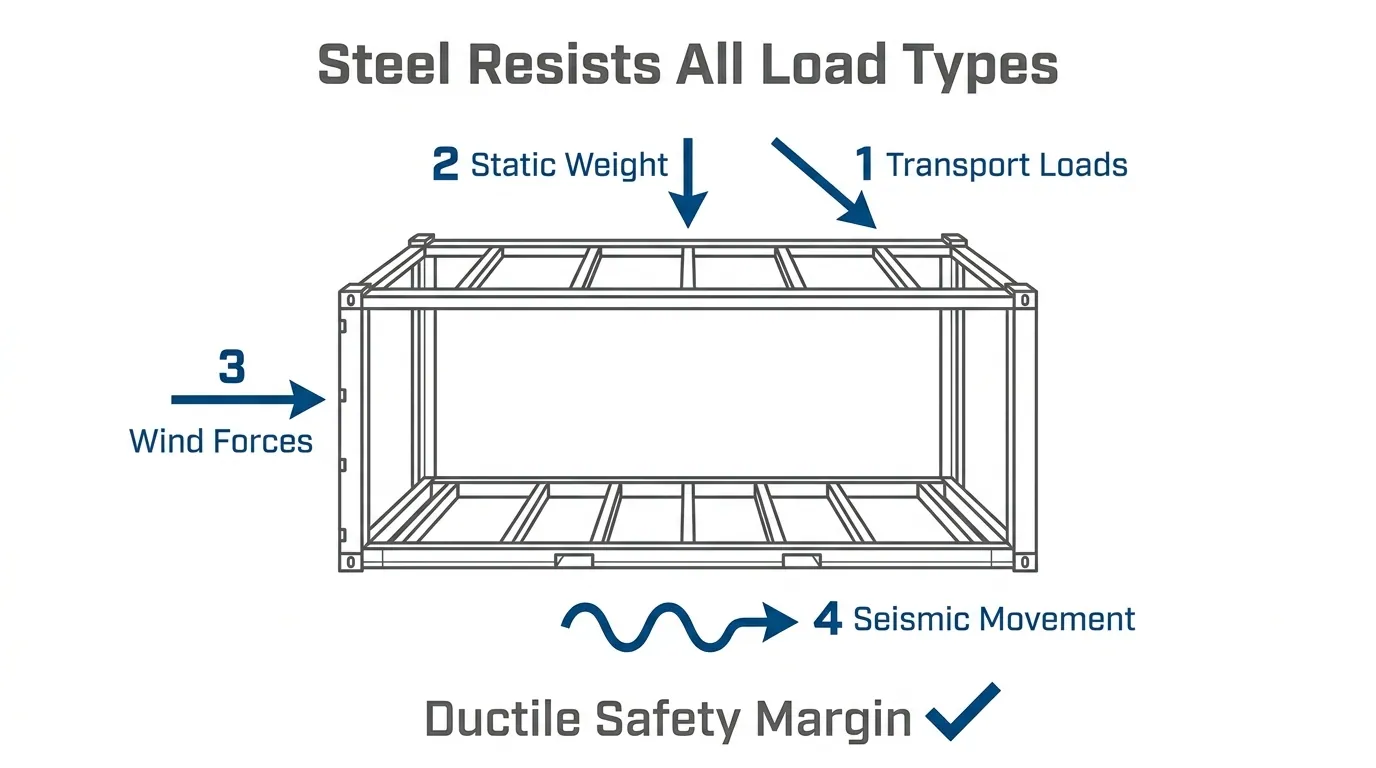
Steel-framed containers resist dynamic transport loads, heavy static forces from stacking and forklift handling, and lateral forces from seismic activity or high winds. Ductile failure behavior gives engineers a reliable safety margin that brittle alternatives cannot match.
Protective coatings, including hot-dip galvanizing and metallized zinc-aluminum systems, extend steel’s service life for decades in salt-rich and high-humidity environments. Steel’s low, predictable thermal expansion rate keeps joints and seals intact through repeated temperature extremes.
Weldability enables high-deposition assembly processes that compress production schedules, while prefabricated steel components shift labor into controlled shop environments where productivity is measurably higher. Broad domestic mill availability keeps lead times short.
Steel’s 98% construction recycling rate, non-combustible classification, and compatibility with standardized ISO dimensions support sustainability, safety, and global logistics requirements simultaneously. Modular steel frames stack, link, and expand using repeatable connection details that scale from a single prototype to full fleet production. Craftsmen Industries manages this entire lifecycle as a vertically integrated custom fabricator.
Why Is Structural Steel the Preferred Material for Containerized Fabrication?
Structural steel is the preferred material for containerized fabrication because it delivers high load capacity, proven durability, and cost-effective processing. The sub-sections below examine its strength-to-weight ratio, its performance against aluminum, and how it compares to composite alternatives.
What Strength-to-Weight Ratio Does Structural Steel Offer?
Structural steel offers a strength-to-weight ratio that balances high tensile capacity with manageable mass, making it ideal for containerized builds that must withstand stacking, lifting, and multi-modal transport. ASTM A36 low-carbon steel delivers a yield strength of 36,300 psi at a density of 0.284 lb/in³, producing frames strong enough to meet ISO freight container load requirements without excessive material thickness.
When paired with protective coatings, that structural performance extends across decades. According to the Federal Highway Administration’s Bridge Coatings Technical Note, properly applied metallized coatings of at least 6 mils thickness provide at least 20 years of maintenance-free corrosion protection in wet, salt-rich environments. This combination of mechanical strength and coating longevity is why steel remains the default framing material for containers expected to operate in harsh service conditions.
How Does Steel Compare to Aluminum in Container Fabrication?
Steel compares to aluminum in container fabrication by offering superior absolute stiffness and lower raw material cost, while aluminum provides a higher specific yield strength and reduced weight per unit volume.
According to the University of Florida’s EML2322L Materials and Material Selection reference, the key property differences are:
Steel’s modulus of elasticity is nearly three times that of aluminum, which means steel frames deflect far less under identical loads. For containerized fabrication, where dimensional stability during stacking and transport is critical, that stiffness advantage often outweighs aluminum’s weight savings.
How Does Steel Compare to Composite Materials in Container Fabrication?
Steel compares to composite materials in container fabrication by offering greater dimensional stability, simpler supply chain logistics, and significantly lower procurement complexity. Composites can achieve impressive strength-to-weight performance, yet their behavior under repeated thermal cycling introduces risk that steel avoids.
Steel’s thermal expansion coefficient holds steady at approximately 1.2 × 10⁻⁵/°C across standard design codes, as noted in the International Journal of Concrete Structures and Materials. Composite laminates, by contrast, can degrade under cyclic thermal stress; NASA research documented a 53% decrease in the coefficient of thermal expansion for graphite/polyimide laminates after just 250 thermal cycles. That instability makes composites less predictable for containers exposed to field temperature swings.
Cost compounds the challenge. A U.S. Department of Energy study on modular construction financing found that materials alone can represent 60% or more of total production cost, with production lines requiring months of reconfiguration per project. Steel’s standardized shapes and broad mill availability eliminate that bottleneck, keeping both budgets and schedules under control.
Understanding material selection at this level sets the stage for examining how structural steel improves the overall integrity of containerized builds.
How Does Structural Steel Improve Structural Integrity in Containerized Builds?
Structural steel improves structural integrity in containerized builds by resisting dynamic, static, and environmental forces across every phase of a container’s lifecycle. The sections below cover how steel handles transport loads, heavy static forces, and seismic or high-wind conditions.
How Does Steel Resist Dynamic Loads During Transport?
Steel resists dynamic loads during transport through its high yield strength and ductile behavior under repeated stress. Containerized units endure vibration, acceleration, and braking forces across highway, rail, and marine transit. ASTM A572 high-strength low-alloy steel, available in grades ranging from 42 ksi to 65 ksi yield, provides the mechanical capacity to absorb these cyclic forces without fracturing. According to ASTM International’s A572/A572M-21e1 specification, Grades 42, 50, and 55 are intended specifically for riveted, bolted, and welded structures, making them well suited for containerized frames that must flex under road and sea movement. Ductility is what separates steel from brittle alternatives here; it deforms predictably before failure, giving engineers a reliable safety margin during multi-modal shipping.
How Does Steel Perform Under Heavy Static Loads?
Steel performs under heavy static loads by distributing compressive and bearing forces through its rigid frame geometry. Containerized builds must support stacked units, internal equipment weight, and concentrated point loads from forklifts during handling. According to NIST Technical Note 1863-1, design live loads for steel-framed structures are set at 50 psf for floors and 30 psf for roofs, with effective seismic weights calculated from dead loads plus 20% of unreduced floor live loads. For containerized applications carrying dense payloads like server racks or medical equipment, this compression efficiency is often the single most critical design factor.
How Does Steel Maintain Integrity in Seismic or High-Wind Conditions?
Steel maintains integrity in seismic or high-wind conditions through its combination of high tensile strength, ductility, and moment-resisting connection capacity. Bolted and welded steel joints absorb lateral forces and redistribute energy rather than allowing sudden collapse. According to FEMA 424, ASCE 7 defines basic wind speed at a 50-year mean recurrence interval measured at 33 feet above grade in open terrain. At 85 mph, roof-corner uplift reaches 37.72 psf; doubling wind speed to 170 mph escalates uplift to 151 psf. Steel’s ability to resist these exponentially increasing forces makes it essential for containerized builds deployed in hurricane zones or seismically active regions.
With structural integrity addressed across all load types, steel’s protective coatings and thermal properties further extend the service life of containerized units.
How Does Structural Steel Enhance Durability and Longevity?
Structural steel enhances durability and longevity by resisting corrosion, tolerating extreme temperature swings, and maintaining performance in harsh coastal and humid environments. The following sections cover corrosion resistance, thermal cycling behavior, and coastal durability.
How Does Steel Resist Corrosion in Containerized Applications?
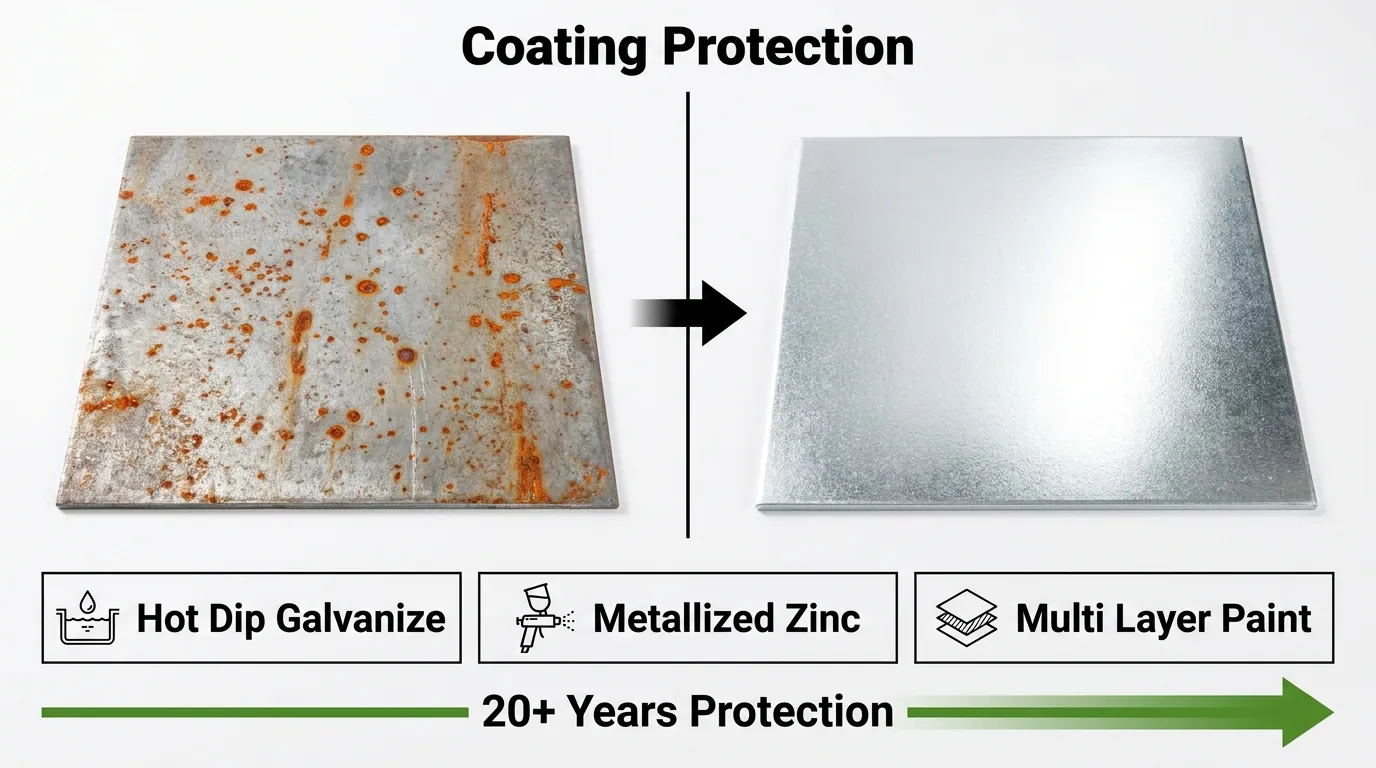
Steel resists corrosion in containerized applications through protective coating systems that form a barrier between the base metal and the surrounding environment. Hot-dip galvanizing, metallized zinc-aluminum coatings, and multi-layer paint systems each slow oxidation and extend service life.
Containerized units face unique corrosion challenges because they operate across multiple climate zones during transit and deployment. Sealed joints, drainage design, and proper ventilation all reduce moisture accumulation inside the steel frame. For containerized data centers and mobile command posts, where on-site repair is difficult, specifying the right corrosion protection upfront prevents costly field failures. Proactive coating selection at the design stage is one of the most cost-effective decisions a project team can make.
How Does Steel Withstand Extreme Temperature Cycling?
Steel withstands extreme temperature cycling because of its predictable and relatively low thermal expansion coefficient. According to the International Journal of Concrete Structures and Materials, most design codes assign constructional steel a thermal expansion coefficient of 1.2 × 10⁻⁵/°C.
This predictability matters for containerized fabrication because units often move between desert heat and arctic cold, or sit outdoors through seasonal extremes. Steel’s stable expansion rate keeps joints tight, seals intact, and internal components aligned cycle after cycle. In practice, this thermal consistency translates directly to lower maintenance intervals and longer operational service life.
How Does Steel Hold Up in Coastal or High-Humidity Environments?
Steel holds up in coastal or high-humidity environments when paired with appropriate protective coatings. According to the American Galvanizers Association, hot-dip galvanized structures within one mile of the coast have shown rusting within 5 to 7 years on surfaces directly exposed to salty ocean winds, while sheltered areas on those same structures maintained corrosion protection for 15 to 25 additional years.
Metallized coatings push performance even further. Properly applied zinc or zinc-aluminum metallizing of at least 6 mils thickness provides a minimum of 20 years of maintenance-free protection in wet, salt-rich environments. For containerized builds destined for port installations or offshore support, combining coating selection with smart structural detailing maximizes service life while keeping long-term costs predictable.
Understanding how steel endures harsh conditions sets the stage for examining how it reduces fabrication time and overall project cost.
How Does Structural Steel Reduce Fabrication Time and Cost?
Structural steel reduces fabrication time and cost through superior weldability, prefabrication efficiency, and broad material availability. These advantages compress project schedules and lower labor expenses across containerized builds.
How Does Steel’s Weldability Speed Up Container Assembly?
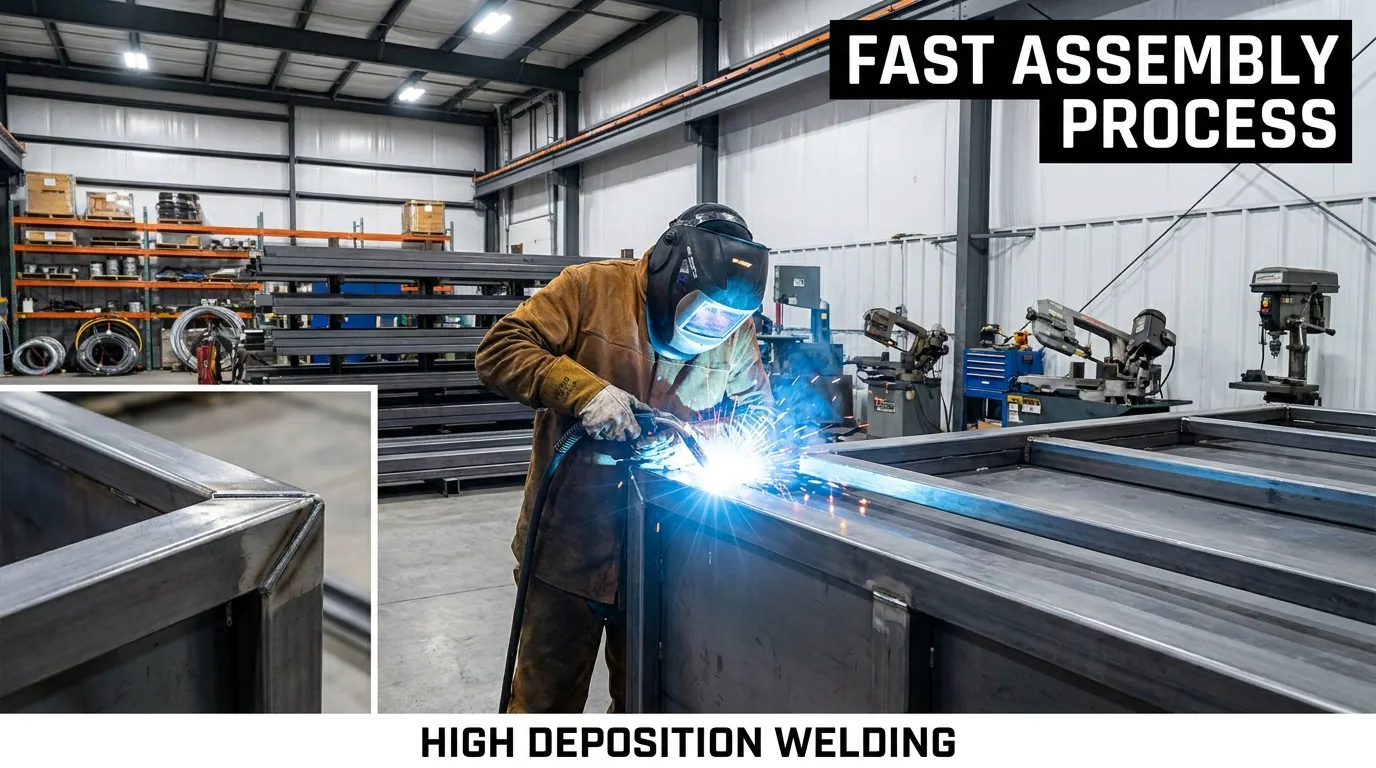
Steel’s weldability speeds up container assembly by enabling high-deposition welding processes that dramatically cut arc-on time per joint. Carbon and low-alloy structural steels accept standard MIG, flux-core, and stick welding without the specialized shielding gases or pre-heat protocols that aluminum and composites often demand.
According to the American Welding Society’s “Saving Money with Filler Metals” report, welding at 325 A increases the deposition rate to 11.63 lb/hour and reduces arc-on time to 86 minutes. Faster deposition means fewer passes per weld, which translates directly into shorter cycle times on each containerized frame. For high-volume container programs, this cumulative time savings is one of the most underappreciated cost levers available to fabricators.
How Do Prefabricated Steel Components Lower Labor Costs?
Prefabricated steel components lower labor costs by shifting assembly work from unpredictable field conditions into a controlled shop environment. Steel’s dimensional consistency and weldability make it ideal for production-line prefabrication, where jigs, fixtures, and automated cutting stations maximize output per labor hour.
A Marquette University study on construction labor productivity found that workers in prefabrication shops spend more direct work time and less indirect and idle time compared to on-site construction crews. When structural steel sub-assemblies arrive at the integration site pre-welded and dimensionally verified, final container assembly requires fewer skilled laborers and fewer rework cycles. This shop-to-site workflow is particularly effective for containerized programs requiring repeatable unit configurations.
How Does Steel’s Availability Reduce Material Lead Times?
Steel’s availability reduces material lead times because structural steel shapes are stocked domestically by multiple mills and service centers in standardized profiles. Unlike specialty composites or certain aluminum alloys that require custom mill runs, common W-shapes, HSS tubes, and plate grades ship within days from regional distributors.
This supply chain depth matters in containerized fabrication, where project timelines are often compressed. As the U.S. Government Accountability Office noted in GAO-10-436, without life-cycle analyses comparing construction alternatives, it remains unclear whether alternative materials achieve intended cost reductions over the long term. Steel’s ready availability eliminates extended procurement windows and helps fabricators maintain predictable production schedules, reducing the carrying costs that accumulate when teams wait on material deliveries.
With fabrication time and cost optimized, structural steel’s versatility also opens the door to greater design flexibility within containerized formats.
How Does Structural Steel Support Design Flexibility in Containers?
Structural steel supports design flexibility in containers by enabling custom modifications, wide clear-span openings, and modular configurations while maintaining full structural integrity. The following subsections cover custom layout adaptability and achievable span lengths.
How Easily Can Steel Containers Be Modified for Custom Layouts?
Steel containers can be modified for custom layouts with relative ease because structural steel framing accepts cutting, welding, and reinforcement without compromising the overall envelope. According to the Energy Facilities Contractors Group’s Freight Container Guidance Document, freight containers are designed to remain structurally sound and weather tight under multi-modal loading conditions, with specified racking loads of 33,700 lbs transverse and 16,850 lbs longitudinal at each top corner. These engineered load paths mean fabricators can strategically remove wall sections, add doors, or reconfigure interior partitions as long as corner posts and header beams retain their rated capacity. For containerized fabrication projects requiring equipment bays, control rooms, or walk-in access points, steel’s weldability allows reinforcement plates and new framing members to integrate seamlessly into the existing structure.
What Span Lengths Can Structural Steel Achieve Without Internal Supports?
Structural steel can achieve clear spans exceeding 100 feet without internal supports in purpose-built frames. According to a thesis from Auburn University on metal building systems, a clear-span monoslope frame achieved a span of 160 feet with a 30-foot eave height. Within containerized fabrication, standard ISO containers measure 20 or 40 feet in length, so their interior width of roughly 8 feet is already column-free. When containers are joined side by side or purpose-built enclosures are fabricated, steel moment frames and rigid connections eliminate the need for intermediate columns across multi-container configurations. This open floor area is critical for housing oversized equipment, server racks, or mobile command layouts where unobstructed interior space directly affects operational efficiency.
With design flexibility addressed, structural steel’s role in transportability ensures these custom configurations move safely across highway, rail, and marine networks.
How Does Structural Steel Improve Transportability of Fabricated Containers?
Structural steel improves transportability of fabricated containers by providing a rigid, standardized framework that withstands multi-modal shipping stresses across highway, rail, and marine transit. Steel-framed containers conform to ISO dimensional standards, enabling seamless handling by cranes, forklifts, and chassis systems worldwide.
Containerized units built on structural steel frames are inherently compatible with global logistics infrastructure. According to MITRE’s Data Center Energy Efficiency Technologies and Methodologies report, containerized, pre-fabricated data centers housed in ISO shipping containers are “very mobile with fast deployment.” This mobility stems directly from steel’s ability to maintain dimensional precision under repeated lifting, stacking, and transport loads. Because the framing holds its shape through vibration and impact cycles, sensitive internal equipment arrives intact at remote or rapidly changing deployment sites.
One practical trade-off worth noting: while steel-framed containers excel at rapid relocation, on-site repairs can be more difficult once deployed. Planning for field-serviceable connection points during the design phase mitigates this limitation significantly. For organizations that need assets moving between locations on tight timelines, structural steel remains the most logistics-friendly material choice in containerized fabrication.
Understanding how steel supports transportability leads naturally into its role in protecting occupants and contents once containers reach their destination.
How Does Structural Steel Enhance Safety in Containerized Structures?
Structural steel enhances safety in containerized structures by providing fire resistance, predictable load behavior, and compliance with standardized testing protocols. These properties protect personnel, equipment, and critical systems housed within containerized builds.
Steel’s non-combustible classification is one of its most significant safety advantages. For North American building codes, ANSI/UL 263 is the default standard for evaluating fire protection of structural steelwork, according to UL Solutions. Under this test protocol, the furnace reaches 538 degrees Celsius at five minutes and 1,093 degrees Celsius at four hours. Structural steel maintains measurable load-bearing capacity throughout these exposures when paired with appropriate fireproofing systems, which is critical for containerized units housing electrical equipment, data infrastructure, or medical devices.
Beyond fire performance, steel’s behavior under stress is highly predictable. Unlike wood or composites, which can fail suddenly and without visible warning, structural steel yields gradually before fracture. This ductile failure mode gives occupants and monitoring systems time to detect deformation before catastrophic collapse occurs. For mobile command centers, disaster response units, and field-deployable shelters, that predictability is not optional; it is a baseline safety requirement.
Containerized steel structures also benefit from standardized connection design. Bolted and welded joints follow established engineering codes, enabling consistent quality assurance through non-destructive testing methods such as ultrasonic and radiographic inspection. Every weld and connection point can be verified against known standards before the unit ships.
For applications where personnel safety is non-negotiable, structural steel’s combination of fire resistance, ductile behavior, and inspectable connections makes it the most defensible material choice in containerized fabrication.
How Does Structural Steel Support Sustainability in Container Fabrication?
Structural steel supports sustainability in container fabrication through exceptional recyclability and minimal material waste. The subsections below cover end-of-life recycling potential and waste reduction during the fabrication process.
How Recyclable Is Structural Steel After a Container’s Service Life?
Structural steel is one of the most recyclable materials available after a container’s service life. According to the World Steel Association, around 680 million tonnes of steel were recycled in 2021, avoiding over one billion tonnes of CO₂ emissions that would have resulted from virgin steel production. Steel retains its mechanical properties through repeated melt-and-reform cycles, which means containerized units can re-enter the supply chain as new structural sections, reinforcement bars, or sheet products. This closed-loop characteristic makes structural steel uniquely suited to circular economy goals in fabrication. For projects where long service lives are expected, few materials offer a comparable combination of durability and full-value recovery at decommissioning.
How Does Steel Reduce Material Waste During Fabrication?
Steel reduces material waste during fabrication through precise cutting, prefabrication efficiency, and high scrap recovery. CNC plasma and laser cutting systems nest structural components tightly on plate stock, minimizing offcuts. Any scrap generated holds significant resale value because steel recyclers accept remnants of virtually every grade and form. Prefabricated steel assemblies produced in controlled shop environments generate less rework and fewer rejected components than field-built alternatives. Even temporary fixtures, jigs, and test pieces can be melted down and reprocessed rather than landfilled. This combination of precision manufacturing and inherent scrap value positions structural steel as one of the lowest-waste material choices for containerized builds.
With sustainability advantages established, maintenance considerations further extend the value structural steel delivers over a container’s operational life.
What Maintenance Advantages Does Structural Steel Offer in Containerized Units?
Structural steel offers maintenance advantages in containerized units that include long-lasting corrosion protection, straightforward field repair, predictable inspection cycles, and lower total lifecycle costs compared to alternative materials.
Containerized units built with structural steel benefit from a combination of protective coating systems, weldable repair options, and standardized maintenance procedures. According to a Federal Highway Administration technical note, properly applied metallized coatings of at least 6 mils thickness (using zinc, 85% zinc/15% aluminum, or aluminum) provide at least 20 years of maintenance-free corrosion protection in wet, salt-rich environments and are expected to deliver 30 years of protection in most bridge exposure environments. These same coating technologies apply directly to containerized steel structures deployed in demanding field conditions.
The practical maintenance benefits of structural steel in containerized applications include:
- Weldable field repairs. Damaged steel sections can be cut, replaced, and re-welded on-site using standard equipment, eliminating the need for full unit replacement.
- Predictable inspection protocols. Steel follows well-established non-destructive testing methods, such as ultrasonic thickness gauging and visual coating assessments, that simplify scheduled maintenance.
- Coating reapplication simplicity. Surface preparation and recoating of steel requires conventional abrasive blasting and paint systems, both widely available and well understood by maintenance crews.
- Dimensional stability over time. Steel’s low thermal expansion coefficient of 1.2 × 10⁻⁵/°C prevents joint fatigue and seal degradation that would otherwise increase maintenance frequency.
- Standardized replacement parts. Because structural steel shapes are produced to ASTM specifications and tracked through databases like AISC’s availability tool, sourcing replacement members for field repairs is consistently reliable.
For organizations managing fleets of containerized units across multiple deployment sites, this repairability advantage is often underestimated. The ability to weld a patch plate or replace a corroded member in the field, rather than shipping an entire unit back to a facility, translates directly into higher uptime and lower lifecycle costs. With maintenance strategies established, the next consideration is how structural steel enables scalability and modular expansion.
How Does Structural Steel Enable Scalability and Modular Expansion?
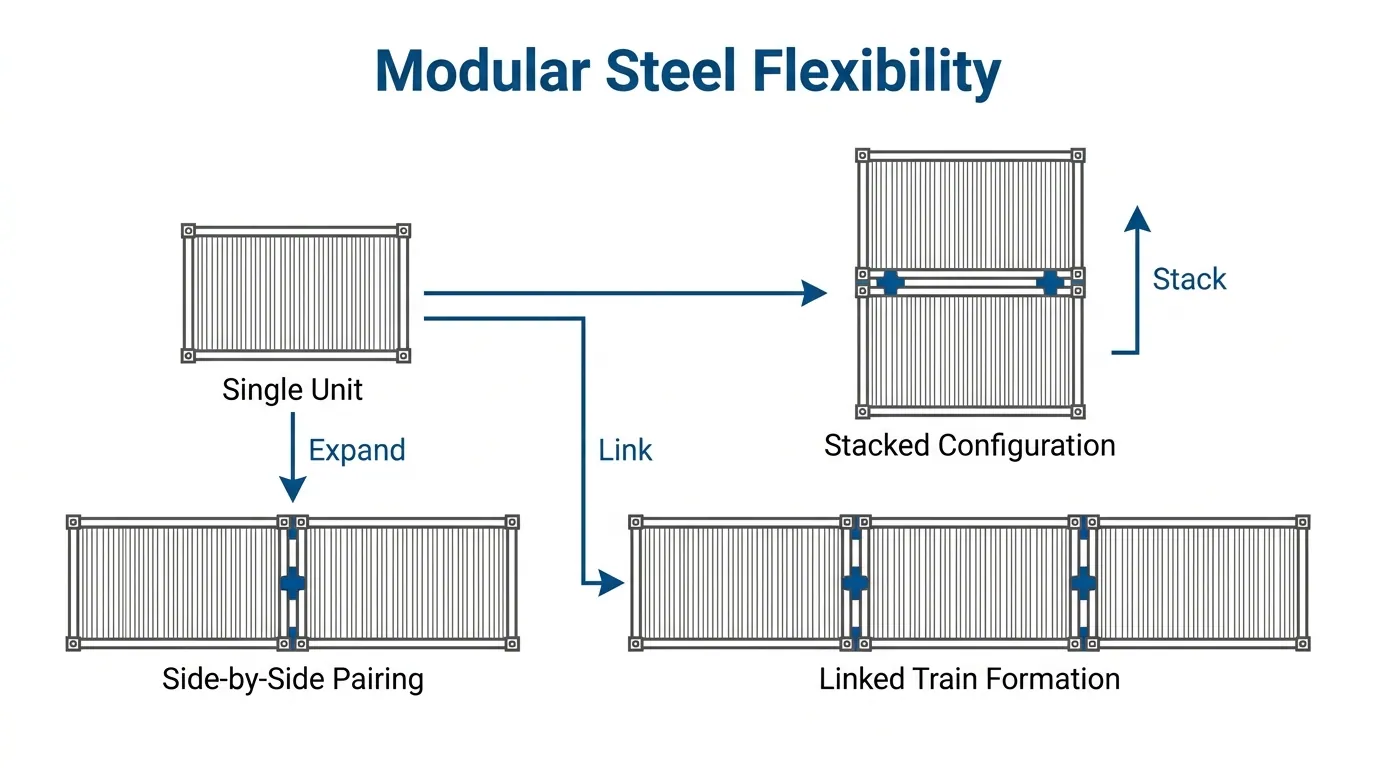
Structural steel enables scalability and modular expansion by providing standardized connection points, uniform dimensional tolerances, and high load capacity that allow containerized units to be stacked, linked, or reconfigured without structural redesign.
Steel’s bolted and welded connection methods support three primary scaling strategies:
- Horizontal linking joins multiple containers side by side using shared structural frames, creating wider interior spans.
- Vertical stacking leverages steel’s compressive strength to support multi-level configurations with minimal additional reinforcement.
- End-to-end coupling extends operational length by connecting container bays through removable bulkheads or pass-through openings.
Because structural steel sections conform to standardized ASTM and AISC profiles, replacement components and expansion modules can be sourced from any qualified mill. This interchangeability eliminates custom tooling for each growth phase, keeping expansion timelines short and predictable. According to Auburn University research on metal building systems, structural steel frames can achieve clear spans of 160 feet, demonstrating the material’s capacity to support large-scale modular configurations without internal supports.
For containerized fabrication programs that must scale from a single prototype to a fleet of dozens, steel’s dimensional consistency means every unit connects identically. This repeatability is what separates a truly scalable platform from a one-off custom build.
Understanding how steel supports scalability sets the stage for choosing a fabrication partner who can manage the full project lifecycle.
How Should You Approach Containerized Fabrication with a Vertically Integrated Custom Fabricator?
You should approach containerized fabrication with a vertically integrated custom fabricator by selecting a partner that controls every project phase, from engineering through final delivery. The following sections cover turnkey project execution and key structural steel takeaways.
Can Craftsmen Industries’ Industrial Fabrication Solutions Deliver Turnkey Containerized Steel Projects?
Yes, Craftsmen Industries’ industrial fabrication solutions can deliver turnkey containerized steel projects. Craftsmen Industries operates as a vertically integrated custom fabricator with in-house design, engineering, fabrication, printing, and installation capabilities under one 127,000-square-foot facility. This single-source model aligns with the core workflow themes that define turnkey containerized fabrication: design, fabrication, logistics, and installation. By controlling each phase internally, Craftsmen Industries eliminates coordination gaps between outside vendors, compresses lead times, and maintains quality oversight from blueprint to delivery. For organizations requiring containerized builds for military, data center, mobile command, or industrial applications, this integrated approach reduces project risk while keeping complex multi-discipline fabrication on schedule.
What Are the Key Takeaways About the Benefits of Structural Steel in Containerized Fabrication?
The key takeaways about the benefits of structural steel in containerized fabrication center on performance, efficiency, and long-term value. Structural steel delivers superior strength-to-weight performance; according to the Steel Tube Institute, Hollow Structural Sections provide “high radii of gyration about both axes providing superior compression performance and significant weight savings.” Beyond raw strength, the material advantages compound across the full project lifecycle:
- Structural steel resists dynamic, static, seismic, and high-wind loads during transport and deployment.
- Steel’s weldability and prefabrication compatibility accelerate assembly and reduce labor costs.
- Corrosion protection systems extend service life across coastal and extreme-temperature environments.
- Steel achieves a 98% recycling rate from construction, supporting sustainability goals.
- Design flexibility allows custom layouts, clear-span interiors, and modular expansion without sacrificing ISO transportability.
For any containerized project demanding durability, scalability, and cost control, structural steel remains the most practical material choice. Craftsmen Industries can help translate these material advantages into fully realized containerized solutions.
Filter Posts by Tag
related posts

Steel vs. aluminum fabrication is the process of selecting and [...]
Engineering custom containerized solutions for extreme environments is the process [...]
Powder coating is a dry electrostatic finishing process that cures [...]
