
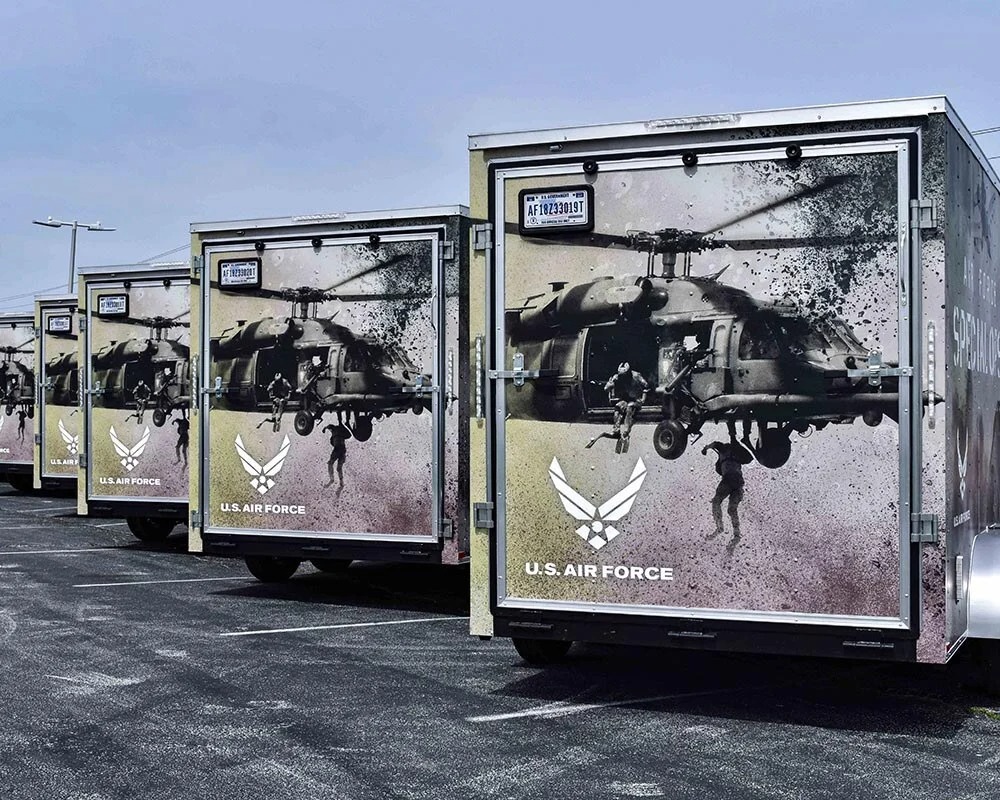
Fleet graphics for nonprofit organizations and government agencies are branded vinyl applications placed on service vehicles to build public recognition, communicate organizational identity, and generate community awareness during daily operations.
This guide covers the strategic value of fleet branding for public-sector and nonprofit organizations, the graphic types and vehicle categories best suited to these fleets, cost structures and budget planning, design and accessibility standards, compliance and procurement requirements, material durability and maintenance, advertising performance compared to other channels, large-fleet installation logistics, and the advantages of working with a vertically integrated fabrication partner.
Nonprofits and government agencies gain sustained public visibility from fleet graphics because branded vehicles generate tens of thousands of daily impressions at a fraction of what digital or print advertising costs. That passive, ongoing exposure builds the name recognition essential to earning donations, volunteer support, and community trust.
Graphic options range from full vehicle wraps and partial wraps to vinyl lettering, reflective safety markings, and magnetic signs, each serving different budgets and operational needs across vans, shuttle buses, utility trucks, sedans, and mobile command units. Full wraps start around $1,000 to $1,500 per vehicle, while simpler decal packages offer the lowest entry point for large fleets.
Design decisions must satisfy agency branding guidelines, ADA-informed color contrast ratios, and clear contact information hierarchy. Government fleets also face procurement rules including GSA Multiple Award Schedule requirements and formal RFP processes that demand vendor certifications like 3M MCS Warranty authorization and ISO 9001 compliance.
Premium cast vinyl combined with routine maintenance extends graphic lifespan to five to seven years, and a vertically integrated partner that controls design, printing, and installation under one roof compresses timelines while reducing coordination complexity for budget-constrained organizations.
Why Do Nonprofit Organizations and Government Agencies Need Fleet Graphics?
Nonprofit organizations and government agencies need fleet graphics because branded vehicles build public trust, extend community reach, and deliver ongoing visibility without recurring ad spend. The following sections cover awareness, outreach, and budget efficiency.
How Do Fleet Graphics Increase Public Awareness for Nonprofits?
Fleet graphics increase public awareness for nonprofits by turning everyday service vehicles into mobile messaging platforms that reach communities throughout daily operations. A single branded van or shuttle generates exposure during food deliveries, client transport, and event support, placing the organization’s mission in front of thousands of people who might never encounter a digital ad or direct mailer.
According to a Nielsen Out-of-Home Advertising Study, 64% of respondents said they noticed vehicle graphics. For nonprofits competing for donor attention and volunteer engagement, that level of organic visibility is difficult to match through traditional channels. Consistent visual presence on the road also reinforces name recognition, which is often the first step toward earning public donations and community partnerships.
How Do Fleet Graphics Support Government Agency Community Outreach?
Fleet graphics support government agency community outreach by making public service vehicles immediately recognizable and approachable. Branded utility trucks, inspection vehicles, and mobile resource units signal legitimacy and build trust when they arrive in neighborhoods for health screenings, emergency response, or code enforcement.
Clearly marked vehicles also reduce confusion during public interactions. Residents can quickly identify which department is operating in their area, whether it is a water authority crew or a public health mobile unit. This transparency strengthens the relationship between agencies and the communities they serve. For agencies operating across multiple jurisdictions, consistent fleet branding unifies the visual identity and ensures every vehicle communicates the same professional standard regardless of location.
How Do Fleet Graphics Maximize Limited Marketing Budgets?
Fleet graphics maximize limited marketing budgets by delivering one of the lowest costs per impression available in any advertising category. According to 3M, fleet graphics can cost as little as $0.15 per thousand impressions, while online ads can reach up to $21 per thousand impressions. That cost gap is significant for nonprofits and government agencies operating under strict budget constraints.
Key budget advantages include:
-
Fleet graphics require a one-time production investment with no recurring placement fees.
-
A single wrapped vehicle generates between 30,000 and 70,000 daily impressions, according to the Traffic Audit Bureau.
-
Graphics last multiple years, spreading the initial cost across tens of millions of total impressions.
For organizations that must justify every dollar to boards, donors, or taxpayers, fleet graphics deliver sustained visibility that few other channels can match at comparable cost.
With the value of fleet graphics established, choosing the right graphic type ensures each vehicle delivers maximum impact.
What Types of Fleet Graphics Work Best for Nonprofits and Government Agencies?
The types of fleet graphics that work best for nonprofits and government agencies include full vehicle wraps, partial wraps, vinyl lettering, reflective safety graphics, and magnetic signs. Each option serves different visibility, budget, and operational needs.
Full Vehicle Wraps
Full vehicle wraps cover the entire exterior surface of a vehicle with printed vinyl, transforming it into a mobile billboard. Nonprofits use full wraps to maximize brand exposure during community outreach, while government agencies rely on them to establish immediate public recognition. A single wrapped vehicle generates 30,000 to 70,000 daily impressions, according to the Traffic Audit Bureau. This level of visibility makes full wraps especially effective for organizations that operate vehicles in high-traffic urban corridors. For agencies with a consistent brand identity across a large fleet, full wraps deliver the strongest visual impact per vehicle.
Partial Vehicle Wraps
Partial vehicle wraps cover selected panels of a vehicle, such as doors, rear sections, or quarter panels, rather than the full exterior. This option reduces material and installation costs while still delivering strong brand visibility. Nonprofits with limited budgets often choose partial wraps to display logos, mission statements, and contact details on the most visible surfaces. Government agencies frequently apply partial wraps to administrative sedans and SUVs where a full wrap may be unnecessary. The selective coverage keeps the vehicle’s original paint intact, which simplifies future graphic updates or vehicle reassignment.
Vinyl Lettering and Decals
Vinyl lettering and decals are individual cut characters, logos, or graphic elements applied directly to a vehicle’s surface. Government fleets commonly use vinyl lettering to display agency names, department identifiers, USDOT numbers, and phone numbers. Nonprofits apply decals to feature website URLs, donor recognition, or campaign-specific messaging. Because each element is produced and applied separately, replacements are straightforward when contact information or branding changes. Vinyl lettering is the most cost-effective fleet graphic option per vehicle, making it practical for organizations that need to brand dozens of vehicles on a tight budget.
Reflective and Safety Graphics
Reflective and safety graphics use retroreflective vinyl materials that return light toward its source, improving vehicle visibility in low-light conditions. Emergency response vehicles, public works trucks, and code enforcement fleets require these markings to meet federal and state safety standards. Chevron striping, reflective agency seals, and high-visibility color bands protect both operators and the public during roadside operations. Nonprofits operating shuttle buses or transport vans in early morning or evening hours also benefit from reflective elements. Combining reflective safety markings with branded graphics ensures compliance without sacrificing organizational identity.
Magnetic Vehicle Signs
Magnetic vehicle signs are removable graphic panels that attach to a vehicle’s steel body using built-in magnets. Nonprofits use magnetic signs on staff members’ personal vehicles during events, fundraisers, or community drives, then remove them afterward. Government agencies apply magnetic signage to unmarked vehicles that serve dual purposes, such as inspection or undercover operations. Because no adhesive contacts the paint, magnetic signs leave no residue and require no professional installation. This flexibility makes them ideal for organizations that need temporary branding or share vehicles across departments.
Understanding which graphic type fits each vehicle and mission helps organizations plan accurate budgets and timelines for production.
What Vehicles Are Most Commonly Branded by Nonprofits and Government Agencies?
The vehicles most commonly branded by nonprofits and government agencies include passenger vans, shuttle buses, service trucks, utility vehicles, mobile command units, sedans, and SUVs. Each vehicle type serves a distinct operational role that shapes its branding approach.
How Are Passenger Vans and Shuttle Buses Used in Nonprofit Fleet Branding?
Passenger vans and shuttle buses are used in nonprofit fleet branding as high-visibility mobile platforms for community programs, client transportation, and event outreach. The Federal Highway Administration classifies vans and minibuses as “Other Two-Axle, Four-Tire Single Unit Vehicles,” a category that also includes pickups, panels, and ambulances. Their large, flat side panels provide substantial surface area for full wraps featuring donor recognition, mission statements, and program messaging. Nonprofits operating food banks, youth services, and senior transportation programs rely heavily on branded vans because the vehicles travel predictable community routes daily. For organizations with limited marketing budgets, a branded shuttle bus functions as a rolling billboard that reinforces trust at every stop.
How Are Service Trucks and Utility Vehicles Branded for Government Fleets?
Service trucks and utility vehicles are branded for government fleets using durable vinyl graphics that display department identification, agency seals, and emergency contact information. Municipal public works departments, water utilities, and parks departments typically brand pickup trucks, cargo vans, and specialized utility bodies. Because these vehicles operate in all weather conditions and encounter road debris, branding materials must withstand harsh environments without peeling or fading. Reflective decals and high-visibility striping are often added to meet safety requirements for roadside operations. Consistent branding across service trucks also helps residents quickly identify authorized government personnel in their neighborhoods.
How Are Mobile Command and Outreach Vehicles Wrapped for Public Agencies?
Mobile command and outreach vehicles are wrapped for public agencies using full-coverage vinyl wraps that communicate authority, emergency preparedness, and public trust. These large-format vehicles, including mobile command centers, disaster response units, and community health vehicles, require custom design templates to accommodate unique body configurations. Graphics often incorporate agency logos, jurisdiction names, and reflective safety elements positioned for maximum visibility during emergency deployments. Because mobile command vehicles serve as temporary headquarters during critical incidents, their branding must project professionalism and be instantly recognizable from a distance. Wrapping these specialized units demands precise measurement and experienced installation to ensure graphics conform to irregular surfaces, compartment doors, and equipment access panels.
How Are Sedans and SUVs Branded for Government Administrative Fleets?
Sedans and SUVs are branded for government administrative fleets primarily through partial wraps, vinyl lettering, and agency decals rather than full vehicle wraps. Administrative fleet vehicles used by inspectors, caseworkers, and agency directors typically feature understated branding that includes a department logo, vehicle identification number, and jurisdiction name. This restrained approach maintains a professional appearance suited to official business while still ensuring public accountability. SUVs assigned to field operations may carry more prominent graphics, including reflective elements for after-hours visibility. Sedans in administrative fleets often use door-panel decals that can be removed and replaced efficiently when vehicles are reassigned between departments.
With vehicle types identified, understanding project costs helps nonprofits and agencies plan fleet graphic budgets effectively.
How Much Do Fleet Graphics Cost for Nonprofit and Government Fleets?
Fleet graphics cost anywhere from a few hundred dollars for basic decals to several thousand dollars for full vehicle wraps, depending on coverage level and vehicle size. The sections below break down pricing for full wraps, partial wraps, and volume-based fleet discounts.
How Much Do Full Wraps Cost Per Vehicle?
Full wraps cost approximately $1,500 per vehicle on average. Smaller wraps start around $1,000, while full wraps on larger vehicles like buses and utility trucks run higher. According to Wrapmate’s pricing data, the average vehicle wrap costs about $1,500, with cost scaling based on vehicle surface area and design complexity.
For nonprofit and government fleets, full wraps deliver the highest visual impact per vehicle. The upfront cost is offset by years of continuous visibility without recurring fees, making this option especially practical for organizations that need maximum public exposure from a limited number of vehicles.
How Much Do Partial Wraps and Decal Packages Cost Per Vehicle?
Partial wraps and decal packages cost significantly less than full wraps, typically ranging from a few hundred dollars to roughly $1,000 per vehicle. Partial wraps cover targeted areas like doors, rear panels, or tailgates, while vinyl lettering and decal packages focus on essential identifiers such as logos, phone numbers, and agency names.
This tier suits nonprofits and government agencies that need professional branding on tight budgets. Decal packages, in particular, offer the lowest entry point for fleet identification. Organizations often mix partial wraps on high-visibility vehicles with simpler decals on sedans or support vehicles to balance cost against community exposure.
How Does Fleet Size Affect Per-Vehicle Pricing?
Fleet size directly reduces per-vehicle pricing through volume discounts. Larger orders lower costs across design, production, and installation because setup time, material purchasing, and labor scheduling become more efficient at scale.
Most fleet graphics providers offer tiered pricing that rewards bulk commitments:
-
Fleets of 10 to 25 vehicles typically see moderate per-unit savings on materials and installation labor.
-
Fleets of 25 to 100 vehicles often unlock deeper discounts due to consolidated production runs.
-
Fleets exceeding 100 vehicles can negotiate custom pricing structures that significantly reduce the per-vehicle investment.
For budget-conscious nonprofits and government agencies, consolidating fleet graphic orders into a single procurement cycle is one of the most effective ways to stretch limited funding further. Understanding how design, vehicle size, and volume interact helps organizations plan fleet graphic budgets with greater accuracy.
What Design Considerations Matter for Government and Nonprofit Fleet Graphics?
Design considerations for government and nonprofit fleet graphics include branding guideline compliance, ADA accessibility standards, clear contact information placement, and strategic use of color and contrast.
How Do Branding Guidelines Affect Government Fleet Graphic Design?
Branding guidelines affect government fleet graphic design by dictating exact logo placement, approved color palettes, typography, and messaging hierarchy. Government agencies typically maintain strict visual identity manuals that every fleet vehicle must follow. Nonprofits similarly enforce brand standards to ensure donor recognition and public trust remain consistent across all touchpoints.
Deviating from approved guidelines can delay project timelines, since designs require resubmission through internal review. For multi-department fleets, each division may have unique identifiers layered onto a unified base design. Establishing a master template early in the process saves time and ensures every vehicle reinforces the same institutional identity, regardless of fleet size.
What ADA and Accessibility Standards Apply to Fleet Graphics?
ADA and accessibility standards that apply to fleet graphics focus primarily on color contrast ratios and text legibility. According to the W3C’s Web Content Accessibility Guidelines (WCAG), a contrast ratio of at least 4.5:1 for normal text and 3:1 for large text is required for Level AA compliance. While WCAG targets digital content, these benchmarks serve as the most widely referenced standard for public-facing visual communications, including fleet graphics.
Key accessibility practices for fleet graphic design include:
-
Using high-contrast color pairings between text and background.
-
Selecting sans-serif typefaces at legible sizes.
-
Avoiding text over complex imagery or gradients.
-
Ensuring critical information is readable from a distance of at least 10 feet.
Agencies that apply these standards proactively reduce the risk of exclusion and demonstrate a commitment to equitable public communication.
How Should Contact Information and Calls to Action Be Displayed?
Contact information and calls to action should be displayed in a dedicated, uncluttered zone on the vehicle, typically the rear panel and lower sides where visibility is highest in traffic. Phone numbers, website URLs, and social media handles perform best when set in bold, high-contrast type against a solid background.
Effective placement priorities include:
-
Positioning the primary phone number or URL on the rear and both sides.
-
Limiting text to one clear call to action per viewing angle.
-
Using QR codes sparingly and only on surfaces visible at close range.
For nonprofits, a short mission statement or donation prompt can double as both a call to action and a brand reinforcement tool. Government vehicles benefit from displaying emergency or service-line numbers prominently, since the public often encounters these vehicles during moments of need.
What Role Do Color and Contrast Play in Public-Sector Fleet Visibility?
Color and contrast play a critical role in public-sector fleet visibility by determining how quickly and clearly a vehicle communicates its identity to the public. High-contrast combinations, such as white text on dark backgrounds or bold colors against neutral panels, improve readability at highway speeds and in low-light conditions.
Government fleets often use standardized color schemes tied to department identity, while nonprofits leverage brand colors to build recognition across communities. Reflective accents and fluorescent elements further enhance nighttime and emergency visibility. The most effective fleet designs treat contrast not as an aesthetic preference but as a functional requirement; a message that cannot be read at a glance is a missed opportunity.
Understanding these design principles prepares agencies to navigate the compliance and procurement requirements that govern fleet graphic contracts.
What Compliance and Procurement Requirements Apply to Fleet Graphics?
Compliance and procurement requirements for fleet graphics include federal and state purchasing regulations, structured RFP processes, and vendor certification standards. The subsections below cover each requirement area.
What Federal and State Procurement Rules Govern Fleet Graphic Contracts?
Federal and state procurement rules govern fleet graphic contracts through structured purchasing programs designed to ensure competitive pricing and vendor accountability. The General Services Administration (GSA) administers the Multiple Award Schedule (MAS) program, where federal, state, local, and tribal governments access commercial products and services at pre-negotiated rates. Fleet graphic vendors listed on GSA schedules have already met rigorous vetting requirements, which simplifies the buying process for agencies.
State-level procurement adds another layer. Most states maintain their own qualified vendor lists and spending thresholds that determine whether competitive bidding is required. Agencies should verify whether their fleet graphics project falls under existing cooperative purchasing agreements or requires a standalone solicitation.
How Do Government RFP Processes Work for Fleet Graphic Services?
Government RFP processes work for fleet graphic services by establishing a formal, competitive framework that ensures transparency and fair vendor selection. The typical process follows a structured sequence:
-
The agency defines the project scope, including vehicle counts, graphic types, installation timelines, and compliance specifications.
-
A formal Request for Proposal is published on government procurement portals, inviting qualified vendors to submit bids.
-
Vendors respond with technical proposals, pricing breakdowns, past performance references, and proof of required certifications.
-
An evaluation committee scores submissions based on weighted criteria, such as cost, quality, experience with public-sector fleets, and production capacity.
-
The agency awards the contract, often followed by a protest period before work begins.
For agencies managing large fleets, selecting a vendor with vertically integrated capabilities can reduce coordination complexity across design, production, and installation phases. Craftsmen Industries brings over 40 years of experience serving government agencies and nonprofits from their 127,000 sq. ft. facility, where design, engineering, fabrication, printing, and installation are handled entirely in-house to eliminate vendor coordination challenges.
What Certifications Should a Fleet Graphics Vendor Hold?
The certifications a fleet graphics vendor should hold include manufacturer warranties, industry quality standards, and government-specific credentials. Key certifications to evaluate are:
-
3M MCS Warranty certification confirms the vendor uses approved materials and application methods, which protects the agency’s investment with manufacturer-backed durability guarantees.
-
ISO 9001 quality management certification signals consistent production standards across large fleet orders.
-
GSA Schedule listing demonstrates the vendor has passed federal vetting for pricing, capability, and compliance.
-
Minority, women-owned, or small business certifications (such as SBA 8(a) or HUBZone) may fulfill diversity procurement goals that many government contracts require.
Agencies should also confirm that installation technicians hold relevant training credentials from material manufacturers. Proper certification reduces rework risk and protects warranty coverage across the entire fleet.
With compliance and procurement frameworks understood, the next consideration is how long fleet graphics last under real-world conditions.
How Long Do Fleet Graphics Last on Government and Nonprofit Vehicles?
Fleet graphics on government and nonprofit vehicles typically last five to seven years when premium materials and proper maintenance are combined. Vinyl quality, climate exposure, and care routines each influence that lifespan.
How Does Vinyl Material Quality Affect Fleet Graphic Lifespan?
Vinyl material quality affects fleet graphic lifespan by determining how well the film resists fading, cracking, and adhesive failure over time. Cast vinyl films, manufactured through a liquid-resin casting process, maintain color stability and conformability for five to seven years or longer. Calendered vinyl, produced by pressing material through rollers, costs less but typically degrades within three to five years.
For government and nonprofit fleets that must project a professional image throughout a vehicle’s full service cycle, cast vinyl is the stronger investment. Premium laminates add a UV-protective layer that further slows color degradation, keeping agency branding crisp even on vehicles that log thousands of miles annually.
How Do Climate and Sun Exposure Impact Fleet Graphic Durability?
Climate and sun exposure impact fleet graphic durability by accelerating UV degradation, thermal expansion, and moisture-related adhesive breakdown. Prolonged direct sunlight breaks down pigment molecules in vinyl, causing noticeable fading within two to three years on unprotected films. High-humidity environments compound this by weakening edge adhesion, while extreme temperature swings promote cracking.
Government and nonprofit vehicles operating in Sun Belt states or coastal regions face the harshest conditions. Parking in shaded or covered areas when vehicles are not in service significantly slows UV damage. Specifying UV-resistant overlaminate films at the outset is one of the most cost-effective decisions a fleet manager can make, often adding years of usable life for a modest upfront increase.
What Maintenance Practices Extend Fleet Graphic Longevity?
Maintenance practices that extend fleet graphic longevity include regular hand washing, prompt contaminant removal, and periodic inspections. Key practices are:
-
Hand wash wrapped surfaces with a mild, non-abrasive detergent every two weeks.
-
Avoid automated brush washes; the friction lifts vinyl edges and scratches laminate coatings.
-
Remove bird droppings, tree sap, and fuel spills immediately, as these chemicals erode adhesive bonds.
-
Inspect edges and seams quarterly for lifting, and address small repairs before moisture infiltrates.
-
Apply a silicone- or Teflon-based spray protectant to maintain surface gloss between washes.
Consistent upkeep is especially important for public-sector fleets, where a worn or peeling graphic undermines community trust. With the right material selection and routine care, fleet graphics deliver years of reliable visibility for government and nonprofit organizations.
How Do Fleet Graphics Compare to Other Advertising Methods for Nonprofits?
Fleet graphics compare favorably to other advertising methods for nonprofits by delivering significantly lower cost per impression and stronger return on investment than digital, print, or broadcast channels.
The cost difference is substantial. According to 3M, online ads can cost up to $21 per thousand impressions, while fleet graphics can cost as little as $0.15 per thousand impressions. For nonprofits operating on tight budgets, that gap means every marketing dollar stretches dramatically further when applied to vehicle branding rather than paid digital campaigns.
The return on investment reinforces this advantage. The Outdoor Advertising Association of America found that one dollar spent on outdoor media resulted in almost $3 in sales, a higher rate of return than other forms of advertising. While nonprofits measure success through donations, volunteer sign-ups, and community engagement rather than direct sales, the principle holds: outdoor visibility drives action more efficiently than most alternatives.
Fleet graphics also work passively, generating impressions around the clock without recurring media spend. Unlike social media ads or billboards that require ongoing payments, a single vehicle wrap investment continues delivering exposure for years. For organizations that need sustained community presence on limited funds, this makes fleet branding one of the most practical long-term strategies available.
With clear cost advantages established, the next step is understanding how installation works across larger fleets.
What Is the Installation Process for Fleet Graphics on Large Fleets?
The installation process for fleet graphics on large fleets follows a phased workflow that covers vehicle assessment, surface preparation, graphic production, scheduled application, and quality inspection. Each phase must be coordinated carefully when dozens or hundreds of vehicles need consistent branding.
Large fleet installations begin with a comprehensive vehicle audit. Installers catalog every vehicle by make, model, year, and body configuration to create accurate templates. Surface conditions, including paint quality, existing decals, and body damage, are documented during this stage. Vehicles with compromised paint or rust require remediation before any vinyl can be applied.
Once templates are finalized, graphic production scales to the full fleet count. Printed vinyl panels undergo lamination for UV and abrasion protection before being staged for application. Surface preparation follows immediately: each vehicle is cleaned, degreased, and dried to ensure proper adhesive bonding. Even minor contaminants like wax residue or road film can cause premature lifting.
Installation scheduling is critical for large fleets because vehicles must remain operational. Staggered installation rotations allow agencies and nonprofits to keep a portion of the fleet in service while batches cycle through the shop. A single full wrap typically requires one to three days per vehicle depending on complexity, so planning around service demands prevents costly downtime.
Certified installers apply vinyl panels using heat guns and squeegees to conform the material around curves, rivets, and recessed areas. Post-application heat treatment activates the adhesive for long-term adhesion. Every completed vehicle then passes a quality inspection checklist that verifies alignment, edge sealing, bubble-free surfaces, and graphic consistency across the fleet. Craftsmen Industries’ in-house installation team completes this entire process within their St. Charles facility, allowing fleet managers to coordinate single-point delivery rather than managing multiple vendor handoffs across design, production, and application stages.
For nonprofits and government agencies managing tight budgets, a vertically integrated partner that handles design, printing, and installation under one roof can compress timelines and reduce coordination overhead. With installation complete, ongoing maintenance and periodic inspections keep fleet graphics performing at their best over time.
How Can a Vertically Integrated Fabrication Partner Improve Your Fleet Graphics Program?
A vertically integrated fabrication partner can improve your fleet graphics program by consolidating design, production, printing, and installation under one roof. This eliminates coordination gaps and accelerates project timelines. The following sections cover how in-house services simplify procurement and summarize the key takeaways from this guide.
Can In-House Design-to-Installation Services Simplify Fleet Graphic Procurement for Government Agencies and Nonprofits?
Yes, in-house design-to-installation services can simplify fleet graphic procurement for government agencies and nonprofits. When a single provider controls every phase, from initial concept and engineering through large format printing and on-site installation, agencies avoid managing multiple vendor contracts, separate timelines, and fragmented quality standards.
Craftsmen Industries operates as a vertically integrated fabrication partner from a 127,000 sq. ft. facility in St. Charles, Missouri, handling design, engineering, fabrication, printing, and installation entirely in-house. This structure gives government and nonprofit fleet managers a single point of accountability.
Key procurement advantages of a vertically integrated partner include:
-
Consolidated contracts reduce administrative overhead and simplify compliance documentation for government RFP processes.
-
Unified quality control ensures brand consistency across every vehicle in a fleet, regardless of size.
-
Faster turnaround results from eliminating handoffs between separate design firms, print shops, and installers.
-
Streamlined communication allows real-time design revisions without delays between disconnected vendors.
For organizations operating under strict procurement rules or limited budgets, this single-source model is one of the most practical ways to reduce cost, complexity, and risk simultaneously.
What Are the Key Takeaways About Fleet Graphics for Nonprofit Organizations and Government Agencies We Covered?
The key takeaways about fleet graphics for nonprofit organizations and government agencies covered in this guide center on cost efficiency, compliance, and strategic visibility. Fleet graphics transform everyday vehicles into high-impact outreach tools at a fraction of traditional advertising costs.
The most actionable insights include:
-
Fleet graphics deliver one of the lowest CPMs available, making them ideal for budget-conscious nonprofits and public agencies.
-
Design choices must account for ADA contrast standards, branding guidelines, and FMCSA marking requirements for commercial vehicles.
-
Material quality and maintenance directly determine graphic lifespan, with premium vinyl and routine cleaning extending durability significantly.
-
Government procurement often requires navigating RFP processes and vendor certifications, so choosing a qualified partner early saves time.
-
A vertically integrated fabrication partner like Craftsmen Industries consolidates every step from ideation to installation, reducing vendor complexity and protecting timeline integrity.
Investing in a well-planned fleet graphics program gives nonprofits and government agencies a durable, cost-effective channel for building public trust and community awareness.
