
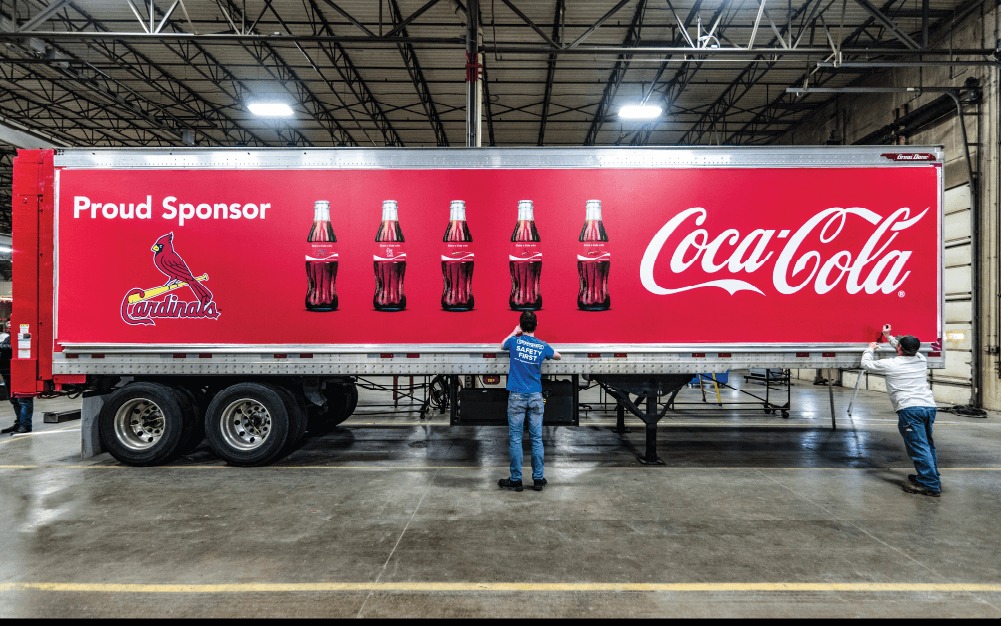
Fleet graphics for franchise businesses are branded vinyl wraps applied consistently across every vehicle in a franchise network, governed by documented visual standards that ensure each car, van, and truck presents an identical brand image regardless of location.
This guide covers brand consistency and mobile advertising value, national brand standard specifications, style guide creation and enforcement challenges, color accuracy and material selection, multi-vehicle template management, vendor strategy and quality control, and fleet-wide budgeting with long-term planning.
Every franchise vehicle operates as a mobile brand ambassador, generating thousands of daily impressions at a fraction of the cost of digital or print advertising. When graphics lack uniformity across locations, that cost efficiency dissolves as fragmented visuals confuse customers and erode trust.
National brand standards lock down logo placement coordinates, substrate-specific color definitions, typography rules, approved imagery, and clear space requirements for every vehicle surface. Effective style guides translate these standards into CAD-verified, model-specific templates that leave no room for interpretation errors at the installation stage.
Enforcement grows harder as franchise networks expand. Regional franchisees deviate from guidelines, fragmented vendor networks produce inconsistent output, mixed vehicle fleets demand unique templates, and climate differences require regionally appropriate material choices.
Color accuracy depends on Pantone reference standards, consistent cast vinyl substrates, and calibrated printing equipment. Cast vinyl wraps lasting five to seven years paired with quality laminates deliver the durability franchise fleets need across varying environments while reducing long-term replacement costs.
Centralizing production under a single vertically integrated partner eliminates the quality variance that multi-vendor approaches introduce. Structured approval workflows, pre-installation proofing, and standardized post-installation inspections ensure every wrapped vehicle meets brand standards before it returns to service.
Why Are Fleet Graphics Critical for Franchise Brand Consistency?
Fleet graphics are critical for franchise brand consistency because they turn every vehicle into a controlled, high-visibility brand touchpoint that reinforces recognition across markets. The sections below explain how fleet vehicles serve as mobile brand ambassadors and what franchises risk when graphics lack uniformity.
How Do Fleet Vehicles Function as Mobile Brand Ambassadors?
Fleet vehicles function as mobile brand ambassadors by carrying a franchise’s visual identity directly into communities, highways, and service areas where potential customers live and work. Unlike static signage confined to a single location, a wrapped vehicle travels through dozens of neighborhoods daily, placing the brand in front of audiences that traditional advertising may never reach.
Every route becomes an impression opportunity. With Americans spending an average of 20 hours per week on the road, according to 3M, branded fleet vehicles operate in the exact environment where consumer attention is already directed. Consistent logos, colors, and messaging across every vehicle reinforce familiarity and trust at scale. For franchise systems, this mobile visibility compounds across hundreds of locations, creating a unified national presence that static media simply cannot replicate.
What Happens When Franchise Fleet Graphics Are Inconsistent?
Inconsistent franchise fleet graphics erode brand trust, confuse customers, and waste one of the most cost-efficient advertising channels available. When colors shift between vehicles, logos appear at different sizes, or messaging varies by location, consumers perceive the franchise as disorganized rather than reliable.
The financial stakes are significant. According to 3M, fleet graphics deliver a cost per thousand impressions as low as $0.15, while online ads can reach $21 per thousand impressions. Inconsistency squanders that efficiency by fragmenting the visual identity that makes each impression count. The fleet graphics services market reflects growing corporate investment in this channel; it stood at USD 2.5 billion in 2024 and is forecast to reach USD 4.7 billion by 2033 at a 7.5% CAGR.
Mismatched graphics across franchise locations ultimately weaken the cumulative brand signal that consistent fleets are designed to build. Understanding what national brand standards actually require helps franchises avoid these pitfalls.
What Are National Brand Standards for Fleet Graphics?
National brand standards for fleet graphics are the documented visual and messaging rules that govern how a franchise’s identity appears on every vehicle in its network. These standards cover logo placement, color accuracy, typography, imagery, and clear space requirements.
Logo Placement and Sizing Requirements
Logo placement requirements define exactly where a franchise logo appears on each vehicle surface and at what minimum and maximum dimensions. Brand guides typically specify placement coordinates for the driver-side panel, passenger-side panel, rear door, and hood. Sizing rules ensure the logo remains legible at highway viewing distances without overwhelming other design elements. A well-structured standard also accounts for proportional scaling; a logo sized for a sedan door panel cannot simply be stretched to fit a box truck without losing visual integrity. For franchises managing diverse fleets, locking these coordinates into vehicle-specific templates prevents the kind of ad-hoc resizing that erodes recognition.
Color Matching and Approved Color Palettes
Color matching specifications define the exact color values a franchise approves for reproduction on vinyl substrates. Approved palettes include Pantone spot colors for reference, CMYK builds for digital printing, and sometimes RGB values for digital proofs. According to Craftsmen Industries, brand consistency holds when color matching is controlled at the printer and vinyl substrate level, with each vehicle make and model receiving its own adapted design template rather than a stretched generic layout. Even slight color drift across locations can make the same franchise look like two different brands. Specifying substrate-specific color profiles eliminates this variance before production begins.
Typography and Approved Messaging Guidelines
Typography and messaging guidelines specify which typefaces, weights, and sizes a franchise permits on fleet graphics. These rules typically lock primary and secondary font families, define minimum point sizes for readability at distance, and restrict unapproved taglines or promotional language. Consistent typography reinforces brand recognition because viewers process familiar letterforms faster than unfamiliar ones. Messaging rules also govern what contact information appears on each vehicle, including phone numbers, URLs, and social media handles, so every location communicates the same call to action.
Image and Photography Usage Rules
Image and photography usage rules dictate which visual assets franchisees may place on fleet vehicles. Approved asset libraries typically contain high-resolution product photography, lifestyle imagery, and iconography that have been pre-cleared for large-format reproduction. These rules prevent franchisees from sourcing low-resolution images or unauthorized stock photography that degrades print quality and brand perception. Specifying minimum resolution thresholds, usually 150 DPI at full output size for vehicle wraps, ensures sharpness across every panel.
Clear Space and Exclusion Zone Specifications
Clear space and exclusion zone specifications define the minimum unobstructed area surrounding a logo, tagline, or other branded element on a vehicle surface. This buffer prevents visual clutter from competing graphics, text, or vehicle hardware like door handles and fuel caps. Exclusion zones also protect brand elements from being obscured when doors open or panels flex. Establishing these boundaries in a fleet graphics style guide is one of the most overlooked yet impactful standards for maintaining a clean, professional appearance across an entire franchise fleet.
With these core standards defined, the next step is building them into an actionable fleet graphics style guide.
How Do Franchisors Create Effective Fleet Graphics Style Guides?
Franchisors create effective fleet graphics style guides by documenting every visual element, building vehicle-specific templates, and scheduling regular updates. The following sections cover what to include, how detailed templates should be, and when to revise the guide.
What Elements Should a Fleet Graphics Brand Guide Include?
A fleet graphics brand guide should include logo placement rules, approved color palettes with substrate-specific color definitions, typography standards, image usage guidelines, clear space specifications, and approved messaging formats. Each element needs exact measurements, acceptable variations, and examples of correct versus incorrect application.
According to Canva’s franchise branding research, people trust brands with clear, consistent branding and messages to help them know what they’re buying, and that trust builds brand loyalty when properly nurtured. A comprehensive guide should also specify approved vinyl substrates, print profiles, and lamination requirements so that production partners across different regions produce identical results. Without these details documented in one accessible resource, franchisees are left guessing, and guessing leads to visual drift across the fleet.
How Detailed Should Vehicle-Specific Templates Be?
Vehicle-specific templates should be highly detailed, with each vehicle make and model receiving its own adapted design layout rather than a single generic file stretched to fit. Effective templates include CAD-verified dimensions, designated graphic zones for logos and contact information, exclusion areas around handles, vents, and body lines, and precise bleed and trim specifications.
This level of detail prevents installers from improvising placement decisions that compromise brand consistency. For franchises operating mixed fleets of sedans, cargo vans, and box trucks, separate template files for each vehicle type eliminate the quality variance that a one-size-fits-all approach introduces. The more specific the template, the less room there is for interpretation errors at the installation stage.
How Often Should a Franchise Update Its Fleet Graphics Guide?
A franchise should update its fleet graphics guide whenever the brand undergoes a visual refresh, adds new vehicle types to the fleet, changes approved vendors or materials, or at minimum every two to three years. Regular reviews ensure the guide reflects current design assets, vinyl technology advancements, and any operational lessons learned from recent rollouts.
Waiting too long to update creates a gap between what the guide specifies and what franchisees actually encounter in the field. Proactive franchisors also build a version control system into the guide itself, clearly dating each revision and notifying all locations when changes take effect. This discipline keeps every franchisee working from the same playbook.
With a thorough style guide established, the next consideration is how franchises enforce these standards across dispersed locations.
What Challenges Do Franchises Face Enforcing Fleet Graphics Standards Across Locations?
Franchises face enforcement challenges that include franchisee deviations, fragmented vendor networks, mixed vehicle fleets, and regional climate differences. Each of these factors erodes brand consistency when locations operate independently.
How Do Regional Franchisees Deviate from Brand Guidelines?
Regional franchisees deviate from brand guidelines by modifying approved designs, substituting local colors or logos, resizing graphics to cut costs, or adding unauthorized promotional messaging. Some franchisees source their own materials without consulting the franchisor’s style guide, which introduces visible inconsistencies across the fleet. Others skip required approval workflows entirely, treating vehicle wraps as local marketing decisions rather than national brand assets. These deviations accumulate quickly; even small changes to logo placement or color values create a patchwork brand image that confuses customers and weakens recognition. Proactive auditing and structured approval processes are the most reliable way to catch deviations before vehicles reach the road.
Why Does Working with Multiple Local Vendors Create Inconsistency?
Working with multiple local vendors creates inconsistency because each shop uses different printers, vinyl substrates, color profiles, and installation techniques. Without centralized production control, even the same design file can produce noticeably different results from one location to the next. According to Canva’s franchise branding research, a successful franchise brand that works consistently across all networks requires strong brand identity that enables franchisors and franchisees to scale the business faster and create a memorable brand presence locally and globally. Relying on a fragmented vendor network makes that consistency nearly impossible to achieve. For most franchise systems, consolidating production under fewer qualified partners yields tighter quality control than managing dozens of independent shops.
How Do Varying Vehicle Types Complicate Uniform Branding?
Varying vehicle types complicate uniform branding because each make and model presents different surface dimensions, body contours, and panel configurations. A design that works on a compact sedan will distort when stretched onto a cargo van or box truck. Every vehicle requires its own CAD-verified template so logos, typography, and color fields maintain correct proportions and placement. Without model-specific templates, installers improvise, and those improvisations produce inconsistent results across the fleet. This challenge intensifies for franchises operating mixed fleets where sedans, SUVs, vans, and trucks all carry the same brand identity.
What Role Does Climate and Geography Play in Material Choices?
Climate and geography play a critical role in material choices because environmental exposure varies dramatically across franchise territories. Vehicles in the Southwest endure intense UV radiation and extreme heat, while fleets in northern regions face freezing temperatures, road salt, and moisture. Installation scheduling across dispersed locations requires careful coordination to account for vehicle availability, site-specific conditions, and geographic considerations. Selecting regionally appropriate vinyl grades and adhesive formulations prevents premature failure that would force costly early replacements.
With enforcement challenges identified, the next step is ensuring color accuracy across every location.
How Can Franchises Ensure Color Accuracy Across an Entire Fleet?
Franchises can ensure color accuracy across an entire fleet by specifying Pantone references, standardizing vinyl substrates, and maintaining strict printer calibration. The following sections cover color systems, material effects, and calibration protocols.
What Is the Difference Between Pantone and CMYK for Fleet Wraps?
The difference between Pantone and CMYK for fleet wraps is how each system defines and reproduces color. Pantone is a standardized spot-color system that assigns a unique reference number to each hue, producing the same result regardless of printer or location. CMYK is a four-color process that blends cyan, magenta, yellow, and black inks to simulate a target shade; slight variations in ink density, substrate, or equipment can shift the output.
For franchise fleets, Pantone values serve as the universal benchmark. Brand style guides should lock substrate-specific color definitions so that every print facility references the same Pantone swatch rather than relying on CMYK approximations that drift between machines.
How Do Different Vinyl Materials Affect Color Output?
Different vinyl materials affect color output by altering how ink adheres, cures, and reflects light on the printed surface. Cast vinyl provides a smoother, more dimensionally stable base that holds color fidelity over its 5 to 7 year lifespan. Calendered vinyl, with its shorter 2 to 4 year durability range, can shrink up to one quarter of an inch over time, which subtly distorts printed graphics and shifts perceived color.
According to Arlon Graphics, when using an overlaminate, choosing one of equal or better quality than the base film is essential; a lower-quality laminate dramatically shortens durability and compromises appearance. Standardizing one cast vinyl product line across all franchise locations eliminates the material variable entirely, keeping color consistent from the first vehicle to the last.
Why Does Printer Calibration Matter for Multi-Location Orders?
Printer calibration matters for multi-location orders because uncalibrated equipment introduces color drift between print runs, making vehicles from different production batches look visibly different. Each wide-format printer interprets color files according to its own ICC profile, ink lot, and environmental conditions. Without regular calibration against a shared reference standard, two facilities printing the same file can produce noticeably different results.
Centralized single-source production eliminates this variance by keeping printing, finishing, and packaging under one roof, with sequenced print runs aligned to phased installation windows. For franchises that must use multiple print sites, requiring each facility to calibrate against an approved Pantone proof before every production run is the most reliable safeguard.
With color systems and calibration addressed, the next step is managing design templates across different vehicle types.
What Is the Best Approach to Managing Fleet Graphics for Multiple Vehicle Types?
The best approach to managing fleet graphics for multiple vehicle types is creating CAD-verified design templates adapted to each specific vehicle make and model. The sections below cover template strategies for cars and small SUVs, box trucks and cargo vans, and specialty or oversized vehicles.
How Are Car and Small SUV Wraps Adapted to Brand Templates?
Car and small SUV wraps are adapted to brand templates by scaling core brand elements to fit compact, curved body panels without distortion. Sedans and small SUVs have limited flat surface area, so designers prioritize logo placement on doors and rear quarter panels where visibility is highest. Contoured fenders, wheel wells, and recessed door handles require precise CAD measurements for each make and model; a template designed for a Ford Escape will not align correctly on a Toyota RAV4. According to 3M, 64% of respondents in one survey noticed vehicle graphics, which underscores why even smaller vehicles need accurate, attention-grabbing brand execution. For franchise fleets mixing passenger vehicles, investing in model-specific templates prevents the stretched, amateur look that erodes consumer trust.
How Are Box Trucks and Cargo Vans Templated Differently?
Box trucks and cargo vans are templated differently because they offer large, flat panel surfaces that function as mobile billboards. The expansive sides of a box truck accommodate full-scale brand imagery, headlines, and contact information that smaller vehicles simply cannot display. Cargo vans, while slightly smaller, still provide substantial rear door and side panel real estate. Template design for these vehicles prioritizes a modular layout: fixed brand zones for the logo, tagline, and color blocks remain consistent, while variable zones accommodate location-specific details like phone numbers or addresses. Corrugated or riveted panels on some box truck bodies require adjusted installation techniques and seam-aware design placement to prevent graphic distortion along ridges.
How Are Specialty or Oversized Vehicles Handled Within Brand Standards?
Specialty or oversized vehicles are handled within brand standards by developing custom templates that account for non-standard dimensions, irregular surfaces, and unique structural features. Vehicles such as flatbed trailers, refrigerated units, step vans, and construction equipment each present distinct challenges: exposed rivets, lift gates, refrigeration units, and hinged compartments all interrupt flat graphic surfaces. Designers create individual template overlays that map every obstruction, ensuring brand elements remain legible and properly positioned despite complex geometry. Because these vehicles often operate in high-visibility environments like highways and job sites, maintaining accurate color and logo placement carries outsized brand impact. Working with an experienced production partner for fleet graphics helps standardize quality across these diverse vehicle categories.
Should Franchises Use a Single Vendor or Multiple Vendors for Fleet Graphics?
Franchises should use a single vendor for fleet graphics whenever brand consistency, quality control, and operational efficiency are priorities. Centralizing production reduces variables, while decentralized approaches introduce compounding risks across locations.
What Are the Advantages of Centralizing Fleet Graphics Production?
The advantages of centralizing fleet graphics production include unified quality standards, consistent color output, streamlined communication, and reduced project management complexity. A single production source keeps printing, finishing, and packaging under one roof, eliminating the quality variance that occurs when multiple facilities interpret brand guidelines independently.
Centralized production also enables sequenced print runs aligned to phased installation windows, preventing material degradation from prolonged storage. Franchise systems benefit from a single point of accountability for design accuracy, substrate selection, and installation coordination. For national brands managing dozens or hundreds of vehicles, this approach is the most reliable path to a uniform fleet appearance.
What Are the Risks of Decentralized Vendor Management?
The risks of decentralized vendor management include inconsistent color matching, varying installation quality, fragmented communication, and loss of brand control across franchise locations. Each additional vendor introduces its own equipment, materials, techniques, and interpretation of brand guidelines.
Geographic dispersion multiplies every variable in the process; fragmented vendor networks, decentralized decision-making, and vehicle diversity across locations all erode brand consistency when sites operate independently. Coordinating timelines, enforcing quality standards, and resolving disputes becomes exponentially harder as the vendor count grows. For franchise systems prioritizing a cohesive national image, decentralized vendor management is one of the fastest ways to undermine the investment in fleet graphics.
With the vendor strategy defined, a structured approval and quality control process ensures every wrapped vehicle meets brand standards before it hits the road.
How Do Franchises Handle Fleet Graphics Approval and Quality Control?
Franchises handle fleet graphics approval and quality control through structured design workflows, pre-installation proofing, and standardized post-installation inspections. The subsections below cover each stage of this process.
What Does an Effective Design Approval Workflow Look Like?
An effective design approval workflow looks like a structured, multi-stage process that locks down every visual specification before production begins. Effective project planning requires locked brand standards with substrate-specific color definitions, complete vehicle inventories with CAD-verified templates, phased timelines grouped by installation wave, and structured approval workflows that prevent communication breakdowns from stalling production. Key stages include:
-
Corporate brand team finalizes the master design and color specifications.
-
Vehicle-specific templates are created using CAD-verified measurements for each make and model.
-
Regional or franchisee stakeholders review proofs within a defined feedback window.
-
Final sign-off follows a single approval chain to prevent conflicting revision requests.
Without this discipline, even minor miscommunications between franchisees, designers, and production teams can delay entire installation waves.
How Should Franchises Conduct Pre-Installation Proofing?
Franchises should conduct pre-installation proofing by reviewing printed output against approved digital files before any graphic touches a vehicle. This step catches color drift, resolution issues, and layout errors that screens alone cannot reveal.
A reliable pre-installation proofing process includes:
-
Printing a small-scale proof on the same vinyl substrate specified for production to verify color accuracy.
-
Comparing the printed proof side by side with the brand’s Pantone or substrate-specific color standards under controlled lighting.
-
Test-fitting a section of the printed graphic on the actual vehicle surface to confirm template alignment and curvature tolerances.
-
Documenting approval with timestamped sign-off from the designated brand manager before authorizing the full print run.
Skipping this stage is one of the most common reasons franchises discover color mismatches only after hundreds of wraps have already been produced.
What Inspection Criteria Ensure Post-Installation Quality?
The inspection criteria that ensure post-installation quality focus on visual accuracy, adhesion integrity, and finish consistency evaluated under standardized conditions. According to 3M’s graphic films quality inspection guidelines, quality inspection should be performed after the graphic installation is completed following the Standard Operating Procedure for graphic films installation, with visual assessment conducted at a distance of 1 to 1.5 meters under a minimum of 400 lux lighting.
Critical checkpoints include:
-
No bubbles, wrinkles, or lifting edges across all panels.
-
Proper seam alignment and sealed edges that prevent moisture and debris infiltration.
-
Accurate logo placement, color consistency, and text legibility matching the approved proof.
-
Defect identification using a standardized marking system so issues are logged and corrected before the vehicle returns to service.
With consistent inspection protocols in place, franchises can confidently scale installation across locations while preserving brand integrity.
What Materials and Methods Produce the Most Durable Fleet Graphics?
The most durable fleet graphics result from cast vinyl films, proper lamination, and professional installation techniques. The following sections cover cast vinyl lifespan, calendered vinyl use cases, and how lamination choices affect longevity.
How Long Do Cast Vinyl Fleet Wraps Typically Last?
Cast vinyl fleet wraps typically last 5 to 7 years, making them the standard material for fleet and full vehicle wraps. According to Arlon Graphics, cast films are manufactured for long-term use spanning 5 to 11 years and exhibit immeasurable shrinkage compared to calendered alternatives.
This extended lifespan matters because fleet wraps face constant environmental stress. Sunlight, heat, cold, rain, snow, and road debris all cause colors to fade, vinyl to shrink or expand, and adhesive to weaken over time. High-quality cast vinyl films with protective coatings, such as UV inhibitors and laminate layers, resist these forces and maintain appearance for years.
While cast vinyl carries higher upfront installation costs, its longevity reduces the frequency of replacements and repairs. For franchise fleets that need consistent brand presentation across dozens or hundreds of vehicles, that durability translates directly into lower total cost of ownership.
When Is Calendered Vinyl Appropriate for Fleet Applications?
Calendered vinyl is appropriate for fleet applications that involve short-term campaigns or flat, non-complex surfaces. This material offers a lifespan of 2 to 4 years, with potential shrinkage up to one-quarter inch over time.
Suitable uses for calendered vinyl in fleet contexts include:
-
Seasonal promotional wraps that will be removed within one to two years.
-
Flat panel decals on box truck sides where compound curves are absent.
-
Temporary branding during franchise pilot programs or market tests.
-
Budget-conscious partial wraps on vehicles nearing end-of-lease.
For franchise businesses running long-term national branding programs, calendered vinyl creates a false economy. The shorter replacement cycle disrupts fleet availability and introduces visual inconsistency as wraps age at different rates across locations. Reserve calendered film for situations where the graphic has a defined, short end date.
How Do Lamination Options Affect Longevity and Appearance?
Lamination options affect longevity and appearance by adding a protective layer over printed vinyl that shields graphics from UV radiation, abrasion, and chemical exposure. According to Arlon Graphics, the overlaminate must be of equal or better quality than the base film, because a lower-quality laminate will dramatically shorten the durability of a high-quality base vinyl.
Key lamination choices and their effects include:
-
Gloss laminate enhances color vibrancy and produces a high-shine finish ideal for bold franchise branding.
-
Matte laminate reduces glare and fingerprints, creating a premium, understated look.
-
Satin laminate balances sheen and subtlety, offering versatility across vehicle types.
Beyond finish, lamination thickness directly influences scratch resistance and UV protection. For franchise fleets operating in sun-intensive regions, a heavier UV-inhibiting laminate preserves color accuracy longer, keeping brand colors consistent across the network.
With material and lamination decisions established, the next step is aligning these choices to fleet-wide budgeting and replacement schedules.
How Do Franchise Businesses Budget and Plan for Fleet Graphics at Scale?
Franchise businesses budget and plan for fleet graphics at scale by accounting for per-vehicle costs, material lifespan, and scheduled replacement cycles. The subsections below break down expected costs and refresh timing.
What Costs Should Franchisors Expect Per Vehicle?
Franchisors should expect per-vehicle costs to vary based on vehicle size, wrap coverage, and material grade. Full wraps on cars and small SUVs typically fall in a lower range than box trucks or specialty vehicles, which require more material and labor. Cast vinyl, the standard for long-term fleet applications, carries a higher upfront price than calendered alternatives. However, its extended lifespan reduces the annualized cost significantly. According to 3M, fleet graphics deliver a CPM as low as $0.15, compared to up to $21 for online ads, making even premium wrap investments highly cost-efficient over their usable life. Franchisors should also budget for design adaptation fees when onboarding new vehicle types into existing brand templates.
How Should Franchises Schedule Replacements and Refreshes?
Franchises should schedule replacements and refreshes based on material lifespan, brand update cycles, and vehicle condition assessments. Cast vinyl wraps typically perform well for five to seven years, while calendered vinyl suits shorter campaigns of two to four years. A practical replacement schedule aligns wrap removal with vehicle lease terms or mileage milestones, preventing situations where faded or damaged graphics undermine brand perception. Seasonal inspections, ideally twice annually, help identify lifting edges, color fade, or surface damage before they spread. Franchisors that tie refresh cycles to brand guideline updates can consolidate design changes and production runs, reducing per-unit costs through volume efficiency.
With budgeting and timing defined, the right production partner turns planning into execution.
How Can a Vertically Integrated Graphics Partner Solve Franchise Fleet Challenges?
A vertically integrated graphics partner solves franchise fleet challenges by consolidating design, production, printing, and installation under one operation. This eliminates the quality variance and communication breakdowns that fragment multi-vendor approaches. The sections below cover how Craftsmen Industries delivers this model and the key takeaways for franchise brand consistency.
Can Craftsmen Industries’ Large Format Graphics and End-to-End Production Maintain Brand Standards at Scale?
Yes, Craftsmen Industries’ large format graphics and end-to-end production can maintain brand standards at scale. Craftsmen Industries operates from a 127,000 sq. ft. facility in St. Charles, Missouri, where in-house design, engineering, printing, and installation keep every phase of fleet graphics production under direct quality control. This vertically integrated model eliminates the handoff gaps that cause color drift, template misalignment, and inconsistent finishing across franchise locations.
When a single provider manages the entire workflow, substrate-specific color definitions stay locked from proof to press, and each vehicle make and model receives a CAD-verified template rather than a generic layout. With over 40 years of experience in custom fabrication and large format graphics, Craftsmen Industries has built this end-to-end capability to serve corporations, government agencies, and organizations requiring consistent brand execution across diverse vehicle fleets. For franchise systems managing hundreds of vehicles across diverse geographies, this centralized approach is one of the most reliable ways to prevent the brand erosion that decentralized vendor networks inevitably introduce.
What Are the Key Takeaways About Fleet Graphics for Franchise Brand Consistency?
The key takeaways about fleet graphics for franchise brand consistency center on standardization, material quality, centralized production, and ongoing enforcement. According to Canva’s franchise branding research, a key challenge is encouraging franchisees to maintain brand consistency across every possible scenario, including new store openings, advertising, promotions, uniforms, packaging, and fleet vehicles.
The most actionable lessons from this topic include:
-
Detailed fleet graphics style guides with vehicle-specific templates prevent visual inconsistency more effectively than general brand guidelines alone.
-
Cast vinyl with UV-inhibiting laminates delivers the durability franchise fleets require across varying climates.
-
Centralized single-source production removes the quality variance that fragmented vendor networks create.
-
Structured approval workflows and post-installation inspections catch deviations before wrapped vehicles reach the road.
-
Balancing franchisor brand protection with franchisee operational flexibility requires clear, enforceable standards rather than vague directives.
Franchise systems that treat fleet graphics as a strategic brand asset, not a one-time expense, build the recognition and trust that drive long-term customer loyalty.
