
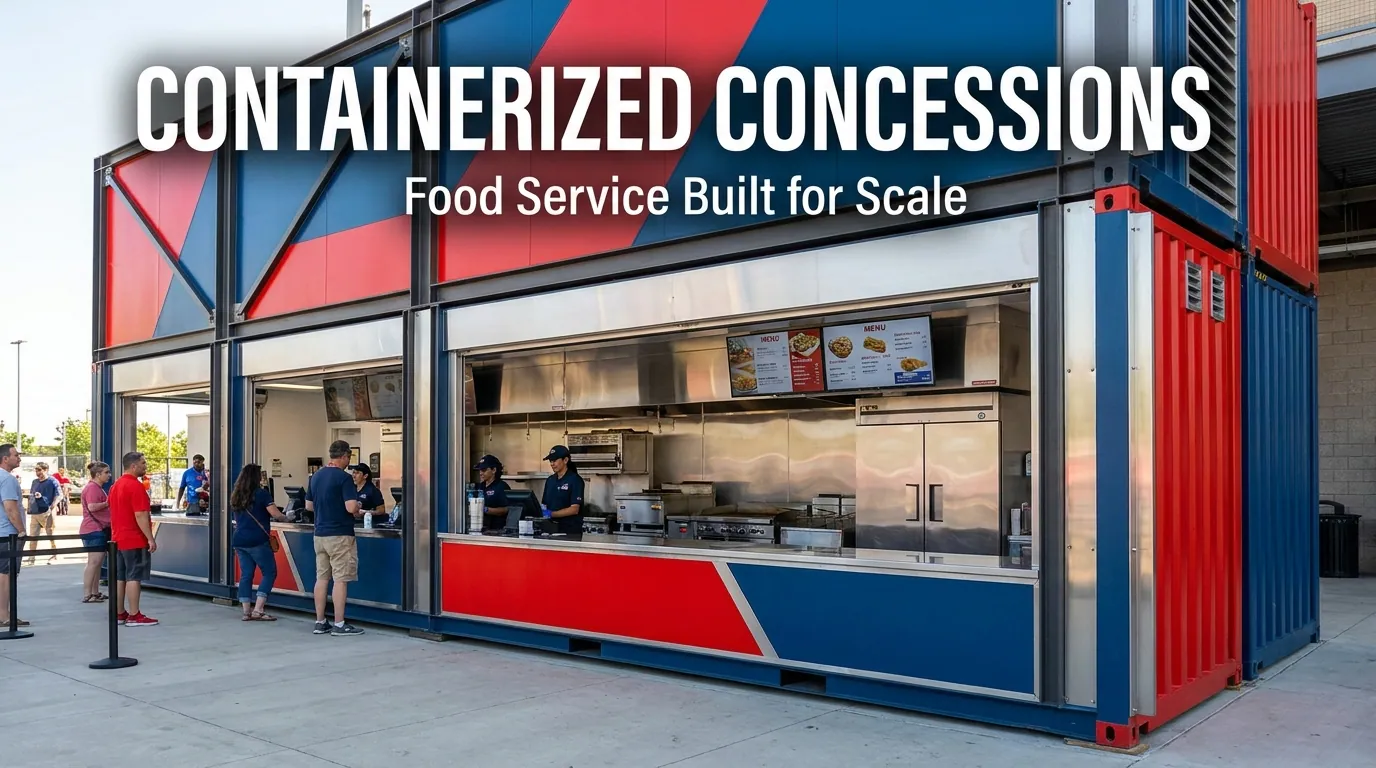
A containerized concession is a food, beverage, or retail service structure built from a repurposed or purpose-built shipping container, engineered for permanent, semi-permanent, or touring deployment at venues and events. These modular units merge the structural durability of ISO-standard steel frames with the functional layout of traditional concession operations.
This guide covers concession unit types and configurations, container sizing and built-in features, health and safety compliance, cost benchmarks, and manufacturer selection for custom builds.
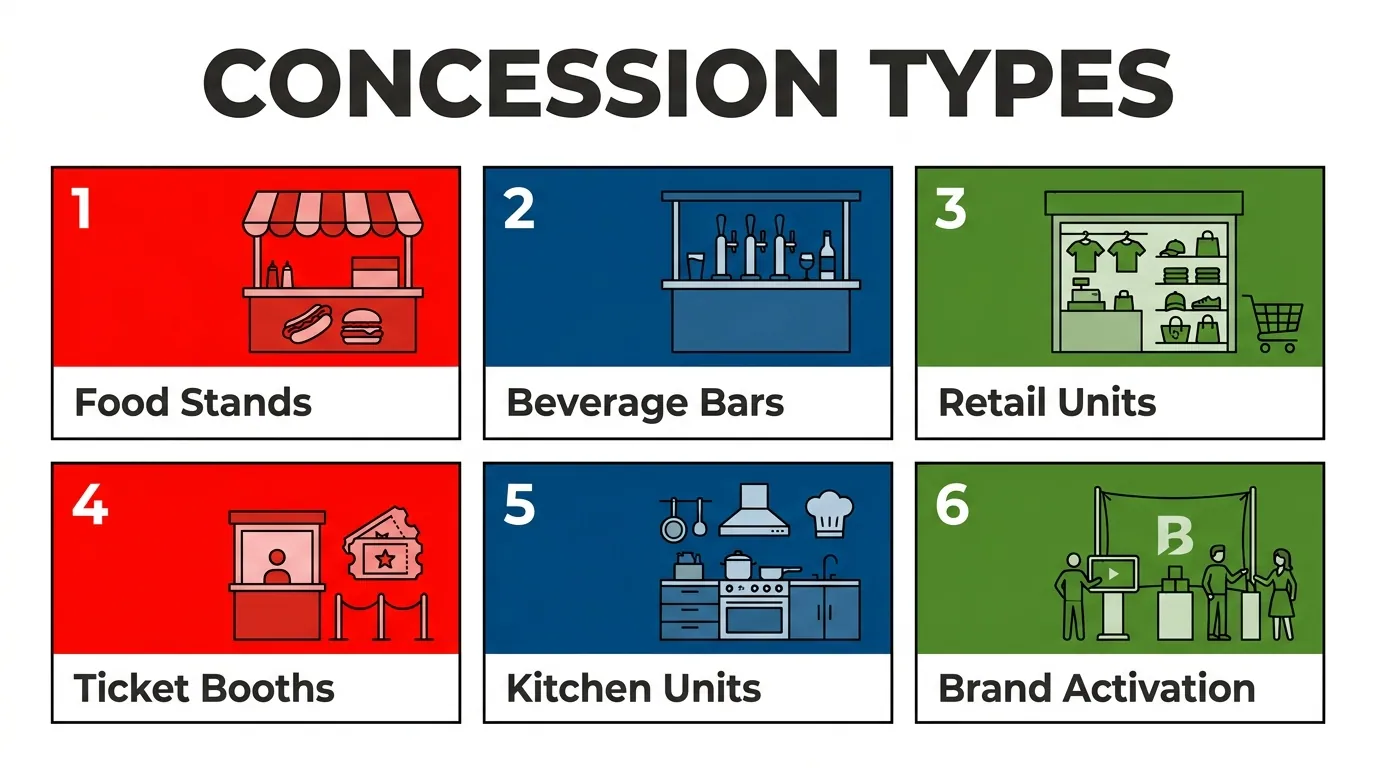
Containerized concessions range from single-window snack stands and draft beverage bars to full-service kitchen builds, branded pop-up activations, mobile commissaries, and retail merchandise units. Each type serves a distinct operational purpose, and the right choice depends on menu complexity, venue footprint, and throughput targets.
Container size directly shapes what a unit can do. Builds using 10-foot, 20-foot, 40-foot, and custom-cut shells each support different equipment loads, staffing capacities, and service formats. Features like commercial cooking systems, fire suppression, ADA-compliant counters, and plumbing are integrated during fabrication rather than added after delivery.
Regulatory compliance spans the FDA Food Code, state temporary food establishment permits, NFPA fire suppression standards, NSF/ANSI equipment certification, and local zoning rules. Costs range from roughly $15,000 for a basic unit to $250,000 or more for a premium branded activation container.
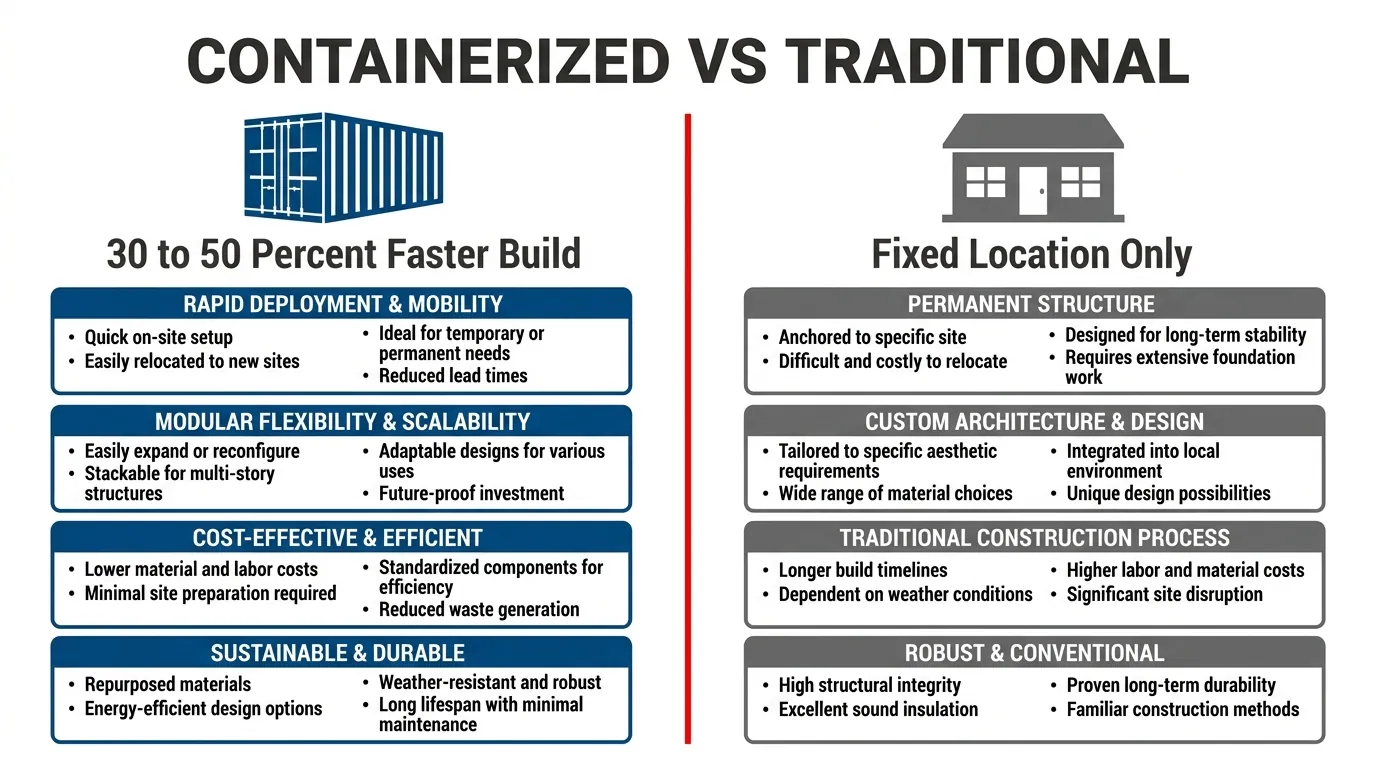
Compared to traditional site-built concession stands, containerized units offer 30% to 50% faster build timelines through off-site fabrication, built-in relocatability across multiple venues, and scalable layouts that link modules together. Selecting a vertically integrated manufacturer with certified fabrication standards ensures each unit arrives code-compliant and ready to operate on day one.
What Is a Containerized Concession Stand?
A containerized concession stand is a food service structure built from a repurposed or purpose-built shipping container, engineered to prepare and sell food, beverages, or merchandise at events and public venues. These units merge the structural durability of intermodal containers with the functional layout of a traditional concession operation. While the term “concession stand” has historically described temporary food stands at sporting events and fairs, containerized versions expand that concept into a relocatable, weather-resistant format suitable for permanent, semi-permanent, or touring deployments. A concession stand is defined as a food stand that serves meals in connection with a youth sporting event, operated exclusively for the benefit of a participating youth sports team or program, or the governing youth sports organization. Containerized concessions broaden this scope considerably, serving stadiums, festivals, corporate campuses, and military installations with equal versatility.
The sections that follow explore the specific types of containerized concessions available, from single-window snack units to full-service kitchen builds and branded activation containers.
Why Are Containerized Concessions Growing in Popularity?
Containerized concessions are growing in popularity because they combine faster deployment, lower startup costs, and built-in portability with the structural durability of steel-framed modules. Several converging market forces drive this trend.
The mobile food services sector reflects broader demand for flexible, relocatable food and beverage infrastructure. According to the U.S. Bureau of Labor Statistics, employment in mobile food services reached 44,119 in 2024, representing a 907 percent increase over its 2000 level. That dramatic growth signals a fundamental shift in how operators think about food service delivery, and containerized concessions sit at the intersection of this mobility trend and the permanence that traditional brick-and-mortar provides.
Events and experiential industries amplify this demand further. Business events alone brought together 1.65 billion participants globally in 2025 and generated $1.3 trillion in direct spending, per the Events Industry Council. Venues hosting audiences at that scale need concession infrastructure that can be deployed quickly, relocated between sites, and customized for different brand experiences.
Modular construction timelines give containerized builds a practical edge. The Modular Building Institute reports that modular projects can be completed 30 to 50 percent faster than traditional construction because off-site fabrication overlaps with site and foundation work. For operators facing tight event calendars or seasonal openings, that compressed timeline often determines whether a concession is ready for revenue on day one.
Several additional factors reinforce the shift toward containerized concession formats:
- Shipping containers use standardized ISO dimensions, which simplifies permitting, transport logistics, and stacking configurations.
- Factory-controlled fabrication environments reduce weather delays, material waste, and on-site labor requirements.
- Relocatable designs allow operators to reuse the same unit across multiple venues, spreading capital costs over a longer asset life.
- Steel-framed containers meet structural requirements that support commercial kitchen equipment, HVAC systems, and branded exterior wraps.
For most operators weighing traditional construction against a containerized approach, the speed-to-revenue advantage alone justifies serious consideration. When you add portability, branding flexibility, and the ability to scale by linking multiple modules, containerized concessions represent one of the most practical infrastructure investments in the food service and events space today.
Understanding the specific types available helps match the right unit to each operational need.
What Are the Main Types of Containerized Concessions?
The main types of containerized concessions include food stands, beverage bars, retail units, ticket booths, brand activation builds, snack windows, full-service kitchens, ice cream shops, coffee cafés, and mobile commissary units. Each type serves a distinct operational purpose.
Shipping Container Food Stands
Shipping container food stands are concession units built from intermodal shipping containers and configured to prepare and serve food at events, venues, and public spaces. According to the California Department of General Services, the use of intermodal shipping containers in building construction is growing for reasons of sustainability and economy, with two or more modules often joined together to form a single unit. These stands commonly deploy at fairs, festivals, carnivals, and sporting events where temporary food service permits apply. ISO R-668 standardized containers, available in 20-foot, 40-foot, and 45-foot lengths, provide a predictable structural shell that simplifies permitting and fabrication.
Shipping Container Beverage Bars
Shipping container beverage bars are units purpose-built to serve draft beer, cocktails, wine, or non-alcoholic drinks from a container shell. Operators typically outfit them with refrigeration lines, tap systems, ice wells, and three-compartment sinks to meet health code requirements. These bars suit outdoor concerts, brewery taprooms, sports venues, and festival grounds where permanent construction is impractical. Their enclosed steel structure also simplifies liquor-license compliance by clearly defining the service footprint.
Shipping Container Retail and Merchandise Units
Shipping container retail and merchandise units are modified containers configured for point-of-sale transactions, product display, and inventory storage. Venues use them to sell branded apparel, souvenirs, event programs, and accessories. Fold-out walls and integrated shelving maximize display area within the standard 8-foot width. Because the container is self-contained and lockable, operators can secure high-value inventory overnight without additional infrastructure.
Shipping Container Ticket Booths and Admission Kiosks
Shipping container ticket booths and admission kiosks are compact container builds designed to process entry transactions at venues and events. Features typically include transaction windows, POS system mounts, climate control, and ADA-compliant counter heights. Their steel shell provides physical security for cash handling and electronic equipment. A single 10- or 20-foot container can serve as a standalone gate, or multiple units can line an entrance plaza.
Shipping Container Pop-Up Brand Activation Units
Shipping container pop-up brand activation units are highly customized containers engineered for immersive marketing experiences, product launches, and promotional tours. Fabricators integrate LED walls, hydraulic fold-out stages, interactive displays, and custom exterior wraps into the container shell. Because the ISO-standard footprint ships on any flatbed trailer, brands can move a complete activation between cities without rebuilding. For operators prioritizing visual impact over food service, this type offers the most creative flexibility.
Shipping Container Snack and Quick-Service Windows
Shipping container snack and quick-service windows are streamlined units built around a single pass-through window for high-volume, grab-and-go sales. Common menu items include:
- Pretzels, popcorn, and nachos
- Hot dogs and corn dogs
- Bottled water, soda, and packaged snacks
The simplified layout minimizes equipment to warming cabinets, heat lamps, and a point-of-sale terminal, which reduces both build cost and permitting complexity compared to full-kitchen configurations.
Shipping Container Full-Service Kitchen Units
Shipping container full-service kitchen units are containers outfitted with commercial cooking equipment, ventilation hoods, fire suppression systems, and prep stations capable of producing made-to-order meals. The U.S. Department of War’s Sustained Autonomous Meals (SAM) program demonstrates this concept at scale: a containerized extension of the Market 19 concept designed to deliver on-demand meals in field environments, improving both operational flexibility and quality of life. These units require grease-trap plumbing, dedicated electrical circuits, and HACCP-compliant layouts, making them the most infrastructure-intensive container concession type.
Shipping Container Ice Cream and Frozen Treat Shops
Shipping container ice cream and frozen treat shops are container builds dedicated to frozen desserts, including scooped ice cream, soft-serve, shaved ice, and frozen beverages. Operators install commercial freezer banks, dipping cabinets, and soft-serve machines within the container, along with dedicated electrical capacity for continuous compressor loads. The enclosed, insulated steel shell maintains consistent interior temperatures more effectively than open-air stands, which is critical for food-safety compliance with frozen product holding requirements.
Shipping Container Coffee Shops and Café Units
Shipping container coffee shops and café units are container builds configured for espresso preparation, drip coffee, and light café fare. Ohio University Culinary Services categorizes cafes and coffee shops alongside quick-service and food-truck formats as distinct foodservice location types. A typical container café includes espresso machines, grinders, under-counter refrigeration, and a service counter. The compact footprint suits university campuses, corporate parks, and urban plazas where permanent café construction is cost-prohibitive or restricted by lease terms.
Shipping Container Mobile Commissary Units
Shipping container mobile commissary units are container-based support facilities that provide storage, ware-washing, and food preparation services for satellite concession operations. According to the Pennsylvania Department of Agriculture, a commissary may be needed for storage, ware-washing, and food preparation to support mobile units from which food is stored, prepared, or sold. Health departments in jurisdictions like Anne Arundel County require structural and HACCP plan reviews before any new or remodeled mobile unit can open. Mobile commissaries anchor multi-unit concession layouts by centralizing the prep and sanitation functions that individual service windows cannot accommodate on their own.
With these concession types defined, container size selection determines each unit’s capacity and layout options.
What Container Sizes Are Used for Concession Builds?
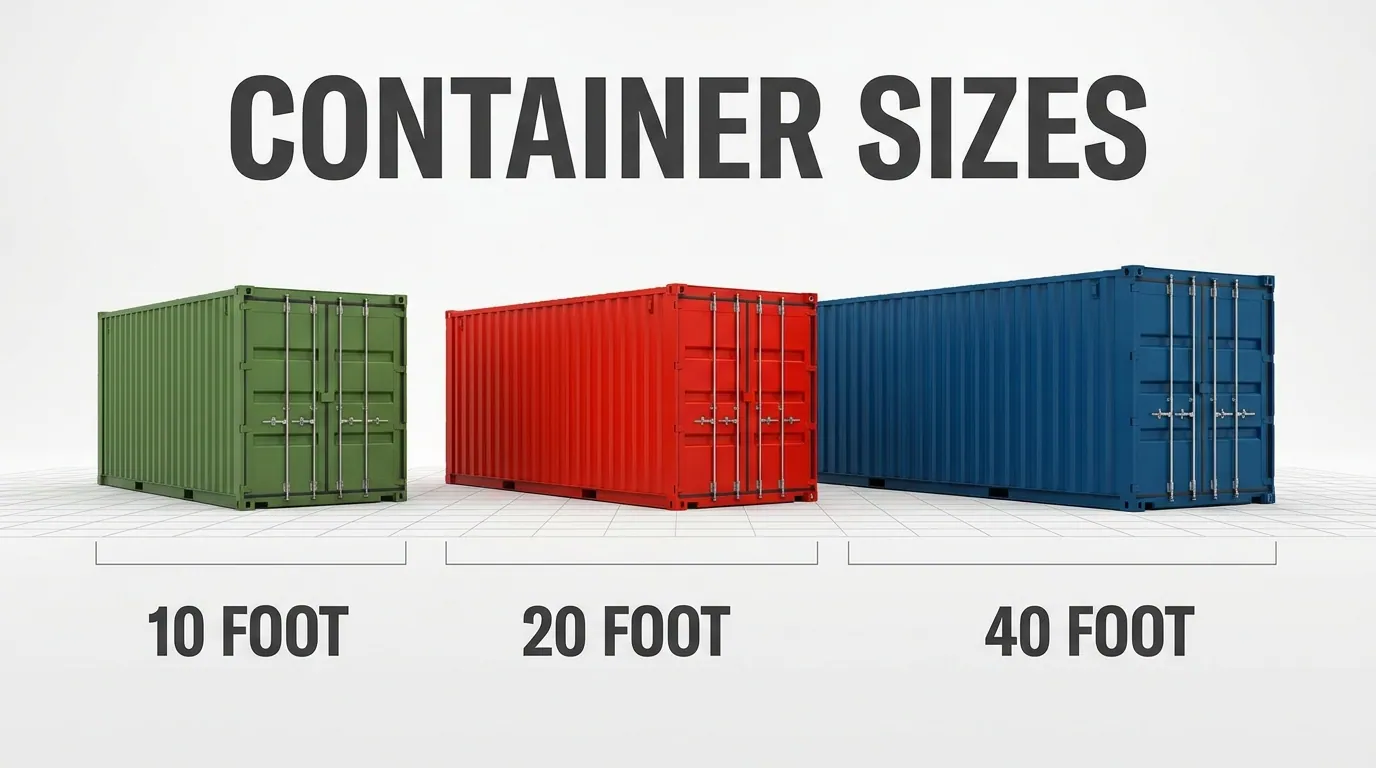
The container sizes used for concession builds include 10-foot, 20-foot, 40-foot, and custom-cut configurations. Each size serves different operational needs, from compact single-window service points to full-scale kitchen operations.
How Is a 10-Foot Container Used for Concessions?
A 10-foot container is used for concessions as a compact, single-service point ideal for tight footprints. The Bureau International des Containers identifies the 10-foot unit at 2,991 mm in length, making it the smallest standard option for concession builds. This size works well for ticket booths, coffee windows, and grab-and-go snack stations where the menu is limited and only one or two operators staff the unit. Because the interior footprint is minimal, equipment selection must be highly intentional. Every square foot matters at this scale, so operators who plan to serve anything beyond pre-packaged items should consider whether the 10-foot footprint can realistically accommodate prep, storage, and service.
How Is a 20-Foot Container Used for Concessions?
A 20-foot container is used for concessions as the most common mid-range option, balancing portability with functional interior space. At 6,058 mm in length per the Bureau International des Containers size table, this unit provides enough room for a serving counter, basic cooking equipment, a handwash station, and dry storage. Typical applications include:
- Single-menu food stands at festivals and sporting events
- Beverage bars with draft systems and refrigeration
- Branded pop-up retail units with display shelving
The 20-foot size fits standard flatbed trailers, which simplifies transport logistics. For most single-concept concession operations, this container strikes the right balance between build cost and usable workspace.
How Is a 40-Foot Container Used for Concessions?
A 40-foot container is used for concessions as a full-scale build capable of housing complete kitchen operations, multi-station service lines, or combined prep and retail spaces. At 12,192 mm in length, this is the largest standard ISO container size. According to a study published in the Journal of Shipping and Trade, ISO R-668 fixes standard container dimensions at 8 feet wide with heights of 8.5 feet (standard) or 9.5 feet (high cube).
The additional interior volume supports equipment-intensive builds, such as:
- Full-service kitchen units with cooking, cold storage, and dishwashing zones
- Multi-window concession stands serving different menu categories simultaneously
- Mobile commissary units that supply smaller satellite concession points
For operators needing high throughput at large venues, the 40-foot container is often the most practical single-unit solution.
How Is a Custom-Cut Container Used for Concessions?
A custom-cut container is used for concessions when standard 10-, 20-, or 40-foot dimensions do not match the site constraints or operational requirements of a project. Fabricators can shorten, widen, or join multiple containers to create non-standard footprints tailored to specific venue layouts. According to the Modular Building Institute, modular construction projects can be completed 30% to 50% sooner than traditional construction because building fabrication occurs simultaneously with site and foundation work.
Custom cuts are especially valuable for:
- Irregularly shaped venue spaces where standard containers cannot fit
- Multi-container configurations that combine units into L-shaped or stacked layouts
- Specialized interior arrangements requiring non-standard wall placement
This flexibility makes custom-cut containers a strong choice for operators whose site or service model demands something beyond off-the-shelf dimensions. With the right fabrication partner, even unconventional builds can maintain structural integrity and code compliance.
What Features Can Be Built into a Containerized Concession?
Features built into a containerized concession span cooking and prep equipment, serving infrastructure, utility systems, safety components, and ADA-compliant surfaces. The specific build depends on the unit’s purpose, menu, and deployment environment.
Containerized concessions can integrate a wide range of functional systems during fabrication. According to NSF International, NSF/ANSI 2 establishes minimum food protection and sanitation requirements for the materials, design, fabrication, construction, and performance of food handling and processing equipment. Meeting these standards during the build phase ensures each feature is commercially rated before the unit ever reaches its site.
Core features commonly built into containerized concession units include:
- Commercial cooking equipment such as griddles, fryers, ovens, and hood ventilation systems rated for grease-laden vapor extraction.
- Serving windows and counters with surfaces between 28 and 34 inches above finish floor height, as specified by the U.S. Access Board for ADA-compliant dining and work surfaces.
- Plumbing systems including three-compartment sinks, handwash stations, freshwater tanks, and wastewater holding tanks.
- Electrical panels and lighting configured for generator power, shore power hookups, or both.
- Refrigeration and cold storage built into the interior layout to maintain safe food temperatures during service.
- Fire suppression systems listed to UL 300 standards, which the National Fire Protection Association requires for any cooking equipment producing grease-laden vapors.
- Interior wall and surface finishes using materials that are smooth, durable, washable, and impervious to liquids, per San Francisco Department of Public Health construction requirements for mobile food facilities.
- HVAC or ventilation units to regulate interior temperatures for both staff comfort and food safety compliance.
- Point-of-sale stations and digital menu boards integrated into the serving counter area.
- Exterior awnings, fold-down counters, and customer-facing shelving that extend the service footprint beyond the container walls.
The most effective containerized concession builds address operational workflow from the start. Placing prep zones, cooking stations, and serving windows in a logical sequence reduces bottleneck risk during peak service, which is something operators often underestimate until the unit is already in the field.
With these functional systems in place, the next layer of customization focuses on how branding and visual identity are applied to the unit’s exterior and interior surfaces.
How Are Containerized Concessions Customized for Branding?
Containerized concessions are customized for branding through exterior wraps, structural modifications, interior finishes, and integrated signage that transform a standard shipping container into a fully branded experience. The subsections below cover exterior graphics, interior design alignment, and structural branding elements.
What Exterior Branding Options Are Available for Container Concessions?
The exterior branding options available for container concessions include full-body vinyl wraps, custom paint schemes, dimensional signage, LED-illuminated panels, and branded awnings or canopies. Vinyl wraps applied to corrugated steel surfaces allow complete color and graphic coverage, turning every visible face into advertising space. Powder-coated paint in brand-specific Pantone colors provides a durable alternative for operators who prefer a cleaner aesthetic. Because container walls are smooth, durable, and washable steel, they accept large format graphics without the surface preparation challenges of traditional construction materials. Dimensional logos mounted directly to the container exterior create depth that flat graphics alone cannot achieve.
How Can Interior Design Reinforce Brand Identity Inside a Container?
Interior design reinforces brand identity inside a container through coordinated color palettes, branded menu displays, custom lighting, and materials that reflect the operator’s visual standards. According to the U.S. Access Board, dining and work surfaces must measure between 28 and 34 inches above the finished floor, so countertops and service ledges are designed within these dimensions while incorporating brand colors and textures. Wall panels, ceiling treatments, and flooring can all be specified to match a company’s style guide. Even functional elements like point-of-sale stations and menu boards become branding touchpoints when integrated during the fabrication phase rather than added as afterthoughts.
What Structural Modifications Support Branding on Container Concessions?
Structural modifications that support branding on container concessions include hydraulic fold-out walls, rooftop decks, oversized serving windows, and custom cut-outs that create unique silhouettes. Fold-out panels double as awnings while exposing additional branded interior surfaces to foot traffic. Serving windows can be sized and positioned to frame staff interactions within a branded backdrop. Rooftop signage towers or elevated logo platforms increase visibility across crowded event grounds, ensuring the unit stands out from standard vendor setups. These modifications work best when planned during initial design, allowing structural reinforcement and graphic application to happen simultaneously in the fabrication facility.
With branding strategies defined, understanding which industries deploy these customized units reveals the full range of containerized concession applications.
What Industries Use Containerized Concession Units?
Containerized concession units serve a wide range of industries, from live entertainment and sports to military field operations and higher education. The sections below cover the primary verticals deploying these units.
Sports and Entertainment Venues
Sports and entertainment venues represent one of the largest markets for containerized concession units. Professional stadiums, minor league ballparks, and performing arts centers use container-based food and beverage stations to expand capacity during peak attendance. According to a National Association of Concessionaires industry survey, participants included professional, college, and minor league sports venues, amusement parks, family entertainment centers, and performing arts venues. Containers allow these facilities to add or reposition service points seasonally without permanent construction, which is especially valuable when event schedules and crowd flow patterns shift year over year.
Festivals, Fairs, and Outdoor Events
Festivals, fairs, and outdoor events rely heavily on containerized concession units for temporary food and beverage service. County fairs, music festivals, cultural celebrations, and street markets all require food service infrastructure that can be deployed quickly and removed after the event ends. Containers provide a more durable and weather-resistant alternative to tent-based setups. For operators working multiple events per season, the reusable, transportable design of a containerized unit reduces setup costs compared to rebuilding temporary structures at each location.
Military and Disaster Response
Military and disaster response operations deploy containerized concession units to provide feeding capabilities where permanent facilities do not exist. The U.S. Department of War describes the Sustained Autonomous Meals (SAM) system as a containerized kitchen designed to deliver on-demand meals in field environments, improving operational flexibility and quality of life. Humanitarian relief organizations use similar containerized kitchens to feed displaced populations after natural disasters. The standardized ISO container footprint simplifies logistics because these units ship on the same flatbed trailers and cargo vessels used for standard freight.
Corporate Campuses and Brand Activations
Corporate campuses and brand activations use containerized concession units for employee dining, product launches, and experiential marketing tours. Tech campuses and large office parks deploy container cafés to serve satellite buildings without constructing permanent kitchens. Brand activation units, often heavily wrapped in custom graphics, travel between cities on promotional tours. These units function as self-contained marketing environments that combine food or beverage service with interactive brand experiences, making them a practical choice for companies seeking high-visibility consumer engagement.
Universities and Institutional Campuses
Universities and institutional campuses integrate containerized concession units into their dining ecosystems to supplement traditional cafeterias. Ohio University Culinary Services, for example, lists food service formats including cafés, coffee shops, quick service, and food trucks across its campus locations. Container-based units give campus dining programs the flexibility to test new concepts, serve high-traffic zones during peak meal times, and rotate menus seasonally. Hospitals, convention centers, and municipal parks similarly benefit from the modular format when permanent expansion is impractical.
Craft Breweries and Beverage Brands
Craft breweries and beverage brands use containerized concession units as taprooms, tasting bars, and mobile sampling stations. With craft brewers holding a 13.4% share of the U.S. beer market by volume in 2025, according to the Brewers Association, smaller producers often need cost-effective ways to reach consumers at festivals, farmers markets, and brewery-adjacent outdoor spaces. A container bar equipped with draft lines, refrigeration, and a service window provides a turnkey solution that can be branded, permitted, and operational far faster than a traditional brick-and-mortar taproom.
With industry applications this diverse, compliance requirements vary significantly by sector and jurisdiction.
What Health and Safety Codes Apply to Containerized Concessions?
The health and safety codes that apply to containerized concessions include the FDA Food Code, state temporary food establishment permits, local zoning ordinances, NFPA fire suppression standards, and NSF/ANSI equipment sanitation requirements. Compliance varies by jurisdiction and deployment type.
Containerized concessions must satisfy multiple overlapping regulatory layers. The FDA Food Code serves as the baseline model that most state and local health departments adopt. According to the FDA, the Food Code “is a model for safeguarding public health and ensuring food is unadulterated and honestly presented when offered to the consumer,” and jurisdictions at every level reference it when writing their own food safety regulations.
Units that operate at events for limited durations typically fall under temporary food establishment classifications. The Virginia Department of Health defines a Temporary Food Establishment as “a type of food establishment that operates for a period of no more than 14 consecutive days in conjunction with a single event or celebration, including carnivals, fairs, festivals, and other events.” Operators deploying containerized concessions at recurring events should confirm whether their jurisdiction treats each event window as a separate permit cycle.
Permitting costs and plan review requirements differ significantly across states. The Arkansas Department of Health, for example, requires a plan review fee equaling 1% of the total estimated cost (no less than $50, no more than $500), plus a $35 annual permit fee once operational. Institutional venues add another compliance layer; Indiana University Environmental Health and Safety mandates that all events offering food to the public on university properties comply with its Policy for Temporary Food Service Events, with most requiring prior approval.
Fire protection codes from the National Fire Protection Association require that any cooking equipment producing grease-laden vapors include ventilation and a fire extinguishing system listed to UL 300 or equivalent standards. NSF/ANSI 2 establishes minimum food protection and sanitation requirements for materials, design, fabrication, and construction of food handling equipment. Local zoning rules may also restrict where containerized units can operate; some municipalities, like Pella, Iowa, limit mobile food sales to private property within specified commercial, industrial, or institutional zoning districts.
The compliance landscape for containerized concessions is one of the most underestimated aspects of project planning. Operators who budget only for the unit itself often discover that permitting, plan reviews, fire suppression upgrades, and zoning consultations add meaningful cost and timeline. Engaging a fabricator experienced in code-compliant builds from the start prevents costly retrofits after delivery.
Understanding these regulatory requirements is essential, but so is partnering with a manufacturer who designs compliance into every build from the outset.
How Much Do Containerized Concessions Cost?
Containerized concessions range from roughly $15,000 for a basic unit to $250,000 or more for a premium branded activation build. The sections below break down costs by tier: basic concession containers, fully equipped kitchen containers, and premium branded activation containers.
How Much Does a Basic Single-Window Concession Container Cost?
A basic concession container costs between $15,000 and $25,000, depending on size, interior finishes, and equipment scope. This tier typically includes a single serving window, basic electrical wiring, a small countertop, and minimal plumbing. A 10-foot or 20-foot container with simple modifications falls into this range.
For context, a UC Davis Alchemy Kitchen Feasibility Study noted that food trucks alone can cost as much as $100,000, making a basic containerized concession a more capital-efficient entry point for operators who need a fixed or semi-permanent service location. Permitting adds modest costs on top of the build; licensing fees in most jurisdictions range from $50 to $500 annually. For operators serving at a single venue or seasonal site, this tier delivers the lowest barrier to entry with a durable, reusable structure.
How Much Does a Fully Equipped Kitchen Container Cost?
A fully equipped kitchen container costs between $35,000 and $120,000. This tier includes commercial-grade cooking equipment, ventilation hoods with UL 300-listed fire suppression, NSF-certified prep surfaces, three-compartment sinks, grease traps, and dedicated electrical panels sized for high-draw appliances.
The price range widens based on menu complexity. A container built for simple grilled items requires less infrastructure than one designed for full-menu preparation with fryers, ovens, and refrigerated storage. Plumbing for fresh water supply and wastewater holding tanks adds further cost. Most operators at this level are deploying units at stadiums, festivals, or corporate campuses where health department plan reviews demand full code compliance. This is often the sweet spot for operators who need genuine cooking capability without the six-figure-plus investment of a premium build.
How Much Does a Premium Branded Activation Container Cost?
A premium branded activation container costs $100,000 to $250,000 or more. This tier combines full kitchen or bar functionality with custom architectural modifications, hydraulic fold-out walls, integrated AV systems, LED lighting arrays, and high-impact exterior wraps or cladding.
Brands deploying these units at experiential marketing tours, product launches, or flagship sporting events typically invest heavily in design engineering and structural customization that goes well beyond standard concession needs. Multi-container configurations, where two or more modules join to create larger footprints, push costs toward the upper end. The return on investment for this tier is measured less in per-unit food margin and more in brand impressions, audience engagement, and social media reach. For organizations prioritizing both operational food service and memorable brand experiences, this category represents the most versatile but capital-intensive option.
Understanding these cost tiers helps operators match their budget to the right build scope before selecting a fabrication partner.
How Do Containerized Concessions Compare to Traditional Concession Stands?
Containerized concessions compare to traditional concession stands through differences in build speed, portability, and long-term flexibility. The sections below break down construction timelines, relocatability, and scalability.
Containerized concessions offer a fundamentally different deployment model than site-built structures. Traditional concession stands, like the approximately 400 permanent concessions within NYC Parks that range from food carts to full-service restaurants, require on-site construction tied to a fixed location. Containerized units, by contrast, are fabricated off-site in controlled manufacturing environments and delivered ready to operate.
According to the Modular Building Institute, modular construction can be completed 30% to 50% sooner than traditional construction because fabrication occurs simultaneously with site and foundation work. This parallel workflow eliminates weeks of weather delays, sequential trade scheduling, and on-site material staging that conventional builds demand.
Relocatability is where the gap widens most. A traditional concession stand is a permanent fixture; dismantling it means demolition. A containerized concession is designed, by definition, to be reused multiple times and transported to different sites. Operators serving seasonal venues, touring events, or rotating campus locations gain an asset that moves with demand rather than sitting idle.
However, the comparison is not universally one-sided. A U.S. Government Accountability Office report cautioned that without long-term or life-cycle analyses considering initial construction costs, facility service lives, and annual operating and maintenance costs, it is not clear that modular alternatives always achieve intended long-term cost reductions. For permanent, high-volume venues where a concession will operate in one spot for decades, traditional construction may offer superior durability and lower cumulative maintenance.
The practical decision often comes down to operational intent:
- Fixed, single-location venues benefit from traditional builds when permanence and heavy daily throughput justify higher upfront timelines.
- Multi-site operators or seasonal programs gain more value from containerized units that redeploy without reconstruction costs.
- Event-driven businesses need rapid setup and teardown, making containerized concessions the more practical choice.
For most operators balancing speed, budget, and flexibility, containerized concessions represent a stronger return on investment, particularly when the unit needs to serve more than one location over its lifetime. Understanding manufacturer capabilities helps ensure the build matches your operational requirements.
What Should You Look for in a Containerized Concession Manufacturer?
You should look for a containerized concession manufacturer that combines certified fabrication standards, full-service customization, and proven regulatory compliance. The key selection criteria include quality certifications, design flexibility, and code-compliant construction.
A manufacturer’s certifications reveal whether equipment will pass health inspections on delivery. According to UL Solutions, “The UL EPH Mark is recognized and accepted as a trusted source for assessing the sanitary design, construction and performance of commercial food equipment.” Beyond sanitation marks, look for ISO 9001 quality management certification, which the International Organization for Standardization describes as a framework that “helps organizations deliver consistent products and services, improve efficiency and meet customer and regulatory expectations.”
The most overlooked selection factor is vertical integration. Manufacturers that handle design, engineering, fabrication, and graphics under one roof eliminate the coordination failures that plague multi-vendor builds. A fully integrated team can scale units to fit specific space requirements and build interiors with equipment customized to your menu. This single-source accountability matters more than price alone, because a containerized concession that arrives non-compliant or poorly fabricated costs far more in delayed permits and lost revenue than the initial savings.
When evaluating manufacturers, prioritize these capabilities:
- NSF/ANSI 2 compliant fabrication for food-contact surfaces and equipment.
- In-house electrical, plumbing, and HVAC installation that meets local health codes.
- Experience building to FDA Food Code standards and NFPA fire suppression requirements.
- Structural engineering for ISO-standard container modifications without compromising transport integrity.
- Custom branding and large format graphics integrated during the build process.
- Documented project timelines with on-time delivery commitments.
Choosing the right manufacturer determines whether your containerized concession arrives ready to operate or requires costly rework before opening day.
How Can Custom Fabrication Elevate Your Containerized Concession?
Custom fabrication elevates a containerized concession by tailoring every structural detail, interior layout, and material selection to a specific menu, brand, and deployment environment. The following sections cover Craftsmen Industries’ capabilities and key takeaways for choosing the right concession type.
Can Craftsmen Industries Build a Custom Containerized Concession?
Yes, Craftsmen Industries can build a custom containerized concession. Craftsmen Industries operates as a vertically integrated fabricator with in-house design, engineering, and production capabilities housed within a 127,000 sq. ft. facility near St. Louis County, Missouri. This integrated approach means every phase, from structural modification to equipment installation, stays under one roof.
According to the U.S. Access Board, dining and work surfaces in food service environments must measure between 28 inches and 34 inches above the finished floor, a specification Craftsmen Industries engineers directly into each build. Interior layouts are scaled to fit specific space requirements, with equipment customized to match the operator’s menu. Surfaces use smooth, durable, washable materials impervious to liquids, meeting the sanitary construction standards required by health departments.
For operators who need a concession unit that performs from day one, working with a single-source fabricator eliminates the coordination gaps that slow multi-vendor projects.
What Are the Key Takeaways About Containerized Concession Types and Options?
The key takeaways about containerized concession types and options center on matching unit configuration to operational goals:
- Containerized concessions span food stands, beverage bars, retail units, ticket booths, brand activations, quick-service windows, full-service kitchens, coffee shops, and mobile commissaries.
- Container sizes (10-foot, 20-foot, 40-foot, and custom-cut) each serve different footprint and throughput requirements.
- Health and safety compliance, including FDA Food Code alignment, NSF/ANSI equipment certification, and local permitting, must be engineered into the build rather than retrofitted.
- Custom fabrication from a vertically integrated manufacturer like Craftsmen Industries streamlines design, production, and delivery into a single accountable process.
Choosing the right containerized concession starts with defining your service type, volume needs, and deployment context; the fabrication partner you select determines how precisely those requirements translate into a ready-to-operate unit.
Filter Posts by Tag
related posts
A concessions trailer is a towable, self-enclosed food service unit [...]

Explore 7 innovative small business ideas leveraging the sustainable simplicity of shipping containers, from cafes to co-working spaces.
Two Food and Drink Brands that Took Experiential Marketing to the Next Level
