
A concessions trailer is a towable, self-enclosed food service unit engineered to store, prepare, and sell food at outdoor events. These mobile kitchens range from compact single-axle builds to full-size enclosed units exceeding 30 feet, each designed for rapid deployment and high-volume fair service.
This guide covers trailer types and sizing, equipment and interior systems, layout design and construction materials, build costs, regulatory compliance and licensing, and branding and long-term maintenance.
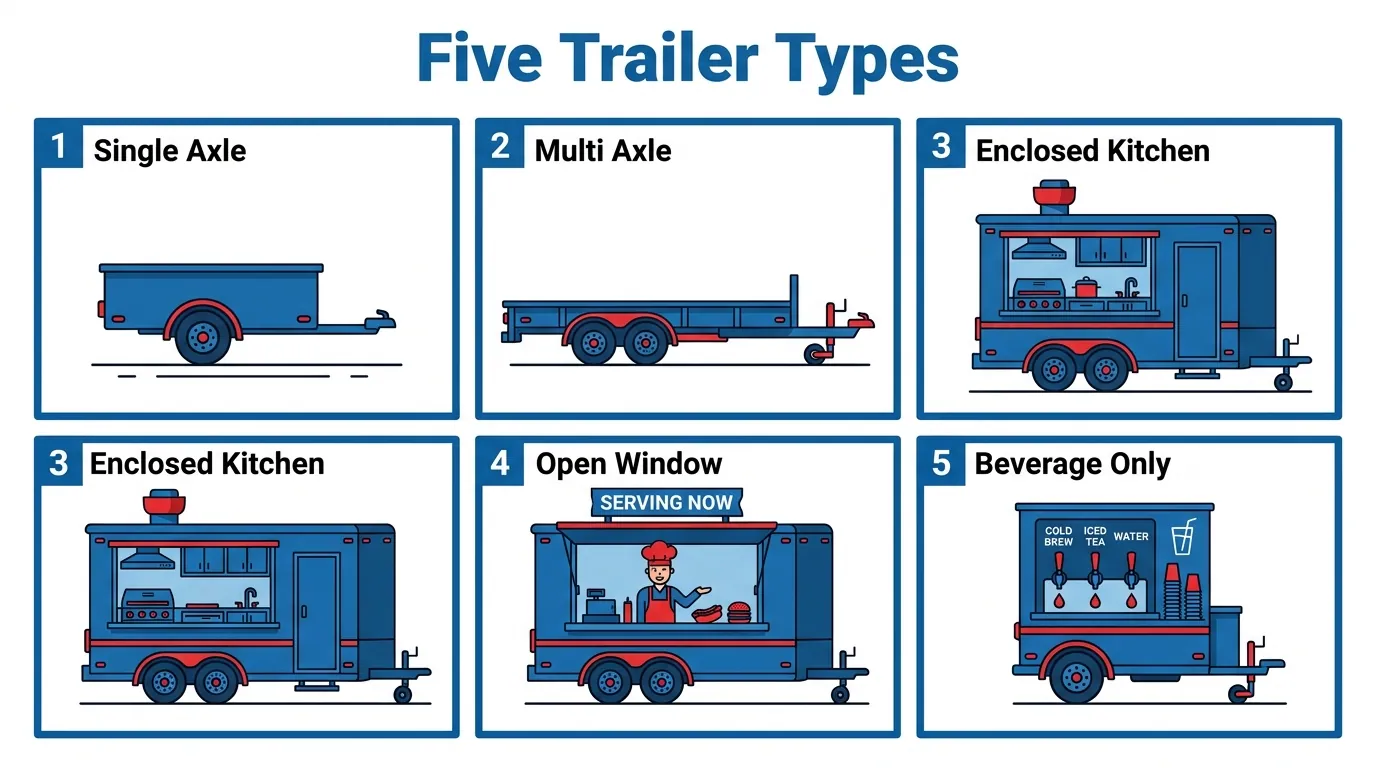
Concessions trailers span five main configurations: small single-axle units for simple menus, full-size multi-axle builds for complex cooking operations, enclosed kitchens for scratch food preparation, open-air serving window models for high-visibility vending, and specialty beverage trailers optimized for speed. Selecting the right type depends on menu complexity, target event scale, and local health code requirements.
Sizing a trailer correctly prevents capacity bottlenecks during peak hours. Units under 16 feet suit small community fairs with limited menus, while trailers between 20 and 35 feet support multi-day festivals requiring onboard water, wastewater, and multiple cooking stations. Interior equipment must meet NSF/ANSI certification standards, and every grease-producing appliance requires a Type I exhaust hood with commercial fire suppression.
Layout design follows a linear workflow from storage through prep, cooking, assembly, and serving window. Construction materials must be smooth, non-absorbent, and easily cleanable; stainless steel and fiberglass-reinforced panels are standard for health code compliance. Closed-cell spray foam insulation delivers the highest R-value per inch within thin trailer walls.
Build costs range from roughly $15,000 for a basic unit to over $150,000 for a fully custom trailer. Health permits, food protection manager certification, commercial liability insurance, and jurisdiction-specific vendor licenses add layered regulatory requirements that vary significantly by state and county. Strategic exterior branding and consistent digital marketing round out a competitive fair operation, while disciplined maintenance between events protects the entire investment.
What Is a Concessions Trailer for Fairs and Festivals?
A concessions trailer for fairs and festivals is a towable, self-enclosed food service unit designed to store, prepare, and sell food at outdoor events. These mobile units range from compact single-axle builds to full-size enclosed kitchens, each engineered for rapid deployment and high-volume service. The sections below cover how regulators define these units, what distinguishes them from food trucks, and why demand for mobile food vending continues to accelerate.
A concessions trailer operates as a licensed mobile food establishment under state and local health codes. According to the Texas Department of State Health Services, a food vending vehicle is “a self-enclosed food service establishment (including catering trucks, trailers, and roadside vendors) or pushcart that operates to store, prepare, display, serve, or sell food as a food service establishment, and is designed to be readily movable.” That regulatory language captures the core identity of every concessions trailer built for the fair circuit: a purpose-built, relocatable kitchen that meets the same food safety standards as a brick-and-mortar restaurant, while offering the flexibility to serve at a county fair one weekend and a multi-day music festival the next.
What makes a concessions trailer distinct from a food truck is the tow-behind chassis. A food truck is a self-propelled motorized vehicle; a concessions trailer requires a separate tow vehicle, which keeps the unit’s build cost lower and allows operators to unhitch and position the trailer independently at event sites. This separation also means the trailer’s kitchen footprint can be optimized without accommodating a cab or drivetrain, often resulting in more usable interior workspace per linear foot.
The mobile food industry behind these trailers has grown dramatically. According to the U.S. Bureau of Labor Statistics, employment in mobile food services reached 44,119 in 2024, roughly ten times its 2000 level, representing a 907 percent increase. That growth reflects expanding consumer appetite for diverse, convenient food options at outdoor gatherings. For operators entering the fair and festival circuit, a well-built concessions trailer is the foundational asset that determines menu capability, service speed, and regulatory compliance at every stop.
Understanding the trailer’s role as both a commercial kitchen and a branded storefront is essential before selecting a type, size, or equipment package.
What Types of Concessions Trailers Work Best at Fairs?
The types of concessions trailers that work best at fairs include small single-axle units, full-size multi-axle builds, enclosed kitchens, open-air serving window models, and specialty beverage trailers. Each type suits a different menu, crowd size, and event format.
Small Single-Axle Concession Trailers
Small single-axle concession trailers are compact, lightweight units typically under 16 feet long. A single axle keeps the gross vehicle weight low, so most standard half-ton or three-quarter-ton trucks can tow them without special licensing. These trailers suit vendors selling simple menu items such as kettle corn, funnel cakes, or lemonade. Limited interior space restricts equipment to one or two cooking stations, a small prep counter, and basic storage. For operators testing a new fair circuit or working small community events, the lower upfront cost and easy maneuverability make single-axle builds a practical starting point.
Full-Size Multi-Axle Concession Trailers
Full-size multi-axle concession trailers are longer units, generally 20 to 35 feet, built on tandem or triple-axle frames. The additional axles distribute heavier loads across the chassis, supporting full commercial kitchen equipment, larger water tanks, and expanded storage. This configuration handles high-volume menus requiring multiple cooking stations, deep fryers, griddles, and refrigeration. Tandem-axle setups also improve towing stability at highway speeds, which matters when hauling between multi-day festivals across state lines. These trailers demand a heavier tow vehicle and more fairground real estate, but the tradeoff is significantly higher serving capacity per shift.
Enclosed Kitchen Concession Trailers
Enclosed kitchen concession trailers are fully self-contained mobile cooking units with walls, a roof, and integrated utility systems. According to the Iowa Department of Inspections, Appeals, and Licensing, mobile food units include trailers that function as fully enclosed mobile kitchens. This classification allows operators to prepare raw ingredients, cook from scratch, and serve complex menus on site. Enclosed builds protect equipment from weather, reduce contamination risk, and satisfy most state health department requirements for food preparation. For vendors offering fried foods, grilled items, or anything requiring temperature-controlled cooking, an enclosed kitchen trailer is often the minimum standard regulators expect.
Open-Air Serving Window Trailers
Open-air serving window trailers feature large fold-down or slide-open windows that create a wide, visible customer-facing counter. The open design maximizes airflow, reduces interior heat during summer events, and gives attendees a clear view of the food preparation area. These trailers work well for pre-assembled or low-cook items such as tacos, ice cream, or sliced fruit. While the open layout attracts foot traffic, it may limit where you can operate, since some jurisdictions require fully enclosed units for raw food handling. Pairing an open-air serving window with an enclosed prep area in the rear offers a practical compromise.
Specialty Beverage and Drink Trailers
Specialty beverage and drink trailers are purpose-built units designed for high-speed liquid service, such as fresh-squeezed lemonade, craft coffee, smoothies, or draft beverages. Interior layouts prioritize counter space, ice bins, blender stations, and dispensing systems over traditional cooking equipment. Plumbing runs shorter because beverage trailers typically need less wastewater capacity than full-kitchen builds. The streamlined menu keeps service times fast, which is critical at crowded fairgrounds where long lines push customers to competing vendors. For operators focused on margins, beverage-only trailers often deliver strong returns because drink ingredients cost less than cooked food supplies.
Choosing the right trailer type depends on your menu complexity, target event size, and local health code requirements, all of which shape the equipment and layout decisions covered next.
What Size Concessions Trailer Do You Need for Events?
The size concessions trailer you need depends on your event scale, menu complexity, and serving volume. Smaller fairs call for compact single-axle builds, while large festivals and high-volume operations demand longer, multi-axle trailers with full kitchen layouts.
What Size Trailer Works for Small Local Fairs?
A trailer in the 8- to 16-foot range works for small local fairs where menus are limited and foot traffic stays manageable. Single-axle builds in this size range keep towing weight low, making transport easier with a standard pickup truck. According to the National Highway Traffic Safety Administration, a trailer’s gross vehicle weight rating consists of the weight of the empty trailer plus its rated cargo load, so calculating your equipment and supply weight before choosing a frame size is essential.
Compact trailers suit operations serving prepackaged items, simple grilled foods, or beverages that require minimal prep space. For vendors testing the fair circuit before scaling up, starting with a shorter trailer reduces upfront investment while still meeting health department layout requirements.
What Size Trailer Works for Large Multi-Day Festivals?
A trailer between 20 and 35 feet works for large multi-day festivals that require onboard water, wastewater, cooking stations, and extended supply storage. According to the City of Knoxville’s mobile food unit guidelines, a mobile food unit must be no larger than 35 feet, may or may not be independent with respect to water, wastewater, and power utilities, and must be capable of being moved by a licensed motor vehicle.
Multi-day events demand self-sufficiency. Longer trailers accommodate tandem axles for heavier gross vehicle weight, larger freshwater and gray water tanks, and dedicated zones for prep, cooking, and serving. Operators who plan to work state fair circuits or weekend-long festivals should build toward the upper end of this range to avoid capacity bottlenecks during peak hours.
What Size Trailer Works for High-Volume Food Service?
A trailer sized between 28 and 35 feet works for high-volume food service where multiple cooking stations, commercial exhaust systems, and crew space operate simultaneously. According to the Oregon State Fire Marshal, cooking equipment that produces smoke or grease-laden vapors must have an exhaust hood, and the unit must provide two exits and an appropriately sized customer service window for egress.
High-volume builds need room for parallel workflow lines so prep, cooking, and serving happen without bottleneck crossover. Larger water tanks, dedicated generator compartments, and commercial refrigeration all consume floor space. Given the rapid industry growth reported by the U.S. Bureau of Labor Statistics, with mobile food services employment reaching 44,119 in 2024, competition at major events is steep. Investing in a properly sized trailer with efficient layout is one of the most practical ways to maintain speed and food quality under heavy demand.
With the right trailer size selected, outfitting the interior with essential equipment keeps your operation running efficiently.
What Equipment Is Essential Inside a Concessions Trailer?
Essential concessions trailer equipment spans cooking appliances, refrigeration, serving windows, electrical systems, plumbing, and fire suppression. Each category must meet specific health and safety standards before the trailer can operate at any fair or festival.
What Cooking Equipment Should a Fair Trailer Include?
A fair trailer should include commercial-grade cooking appliances matched to its menu, such as griddles, fryers, ranges, and steam kettles. According to NSF, NSF/ANSI 4 covers commercial cooking and hot-food equipment including ranges, ovens, fryers, griddles, broilers, steam cookers, kettles, toasters, and rotisseries, while NSF/ANSI 59 covers mobile food cart components specifically.
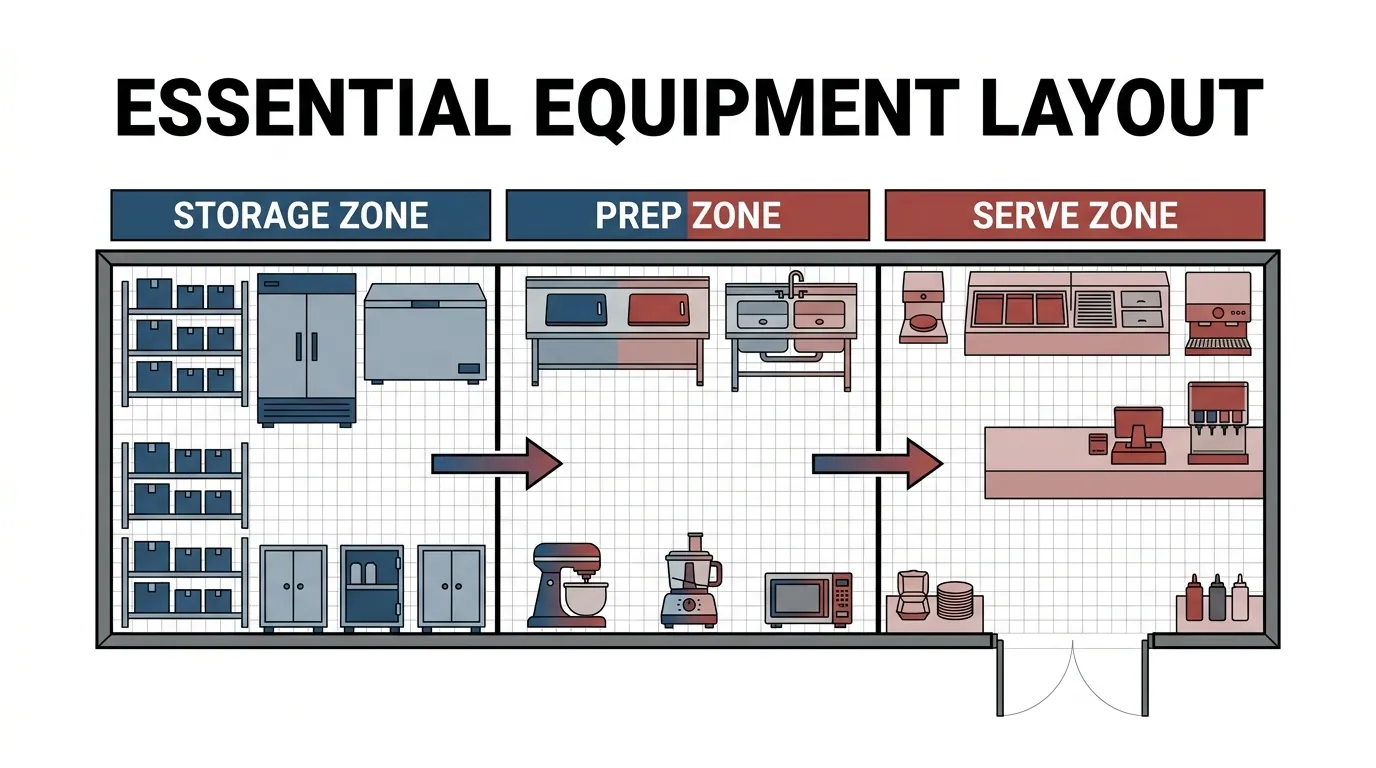
Every grease-producing appliance requires a Type I exhaust hood overhead. The relationship among storage, preparation, cooking, serving, and cleaning stations must be planned so travel distances stay short with minimal crossover of circulation paths. Placing the fryer adjacent to the prep station and griddle, for example, prevents staff from crossing each other during peak service rushes. Prioritizing this linear workflow during the equipment selection phase saves costly retrofits later.
What Refrigeration and Storage Does a Trailer Need?
A concessions trailer needs both refrigeration units and dry storage configured for the menu’s volume and ingredient types. Common refrigeration formats include reach-in coolers, under-counter refrigerators, and chest freezers positioned near prep areas for quick ingredient access.
Cold storage capacity should match at least one full day of projected sales to avoid mid-event restocking. Key considerations include:
- Placing refrigeration away from cooking heat sources to reduce compressor strain.
- Using NSF-certified units rated for commercial mobile environments.
- Reserving separate dry storage shelving for packaging, utensils, and non-perishable ingredients.
Undersizing refrigeration is one of the most common build mistakes; it limits menu flexibility and forces operators to refuse high-margin items during peak hours.
What Serving Windows and Counter Setups Work Best?
The best serving windows and counter setups position the order point, payment station, and pickup area in a single linear flow facing the customer queue. A wide, fold-down window creates an accessible counter surface while doubling as a weather seal during transport.
Counters should sit at approximately 42 inches for comfortable standing-height transactions. Stainless steel counter surfaces are preferred because they are smooth, non-absorbent, and easy to sanitize between rushes. Separating the order window from the pickup window, when trailer length allows, prevents bottlenecks and keeps the serving line moving steadily during high-traffic festival hours.
What Electrical and Generator Systems Are Required?
The electrical and generator systems required for a concessions trailer must provide continuous power to all cooking, refrigeration, lighting, and sanitation equipment during every hour of operation. According to Washington County, Oregon’s Environmental Health Program, a mobile food unit must have “an appropriate power source (e.g., generator or plugged into an electrical source)” to meet sanitation requirements at all operating hours.
Key electrical planning factors include:
- Calculating total amperage draw from every appliance before selecting a generator size.
- Installing a transfer switch if the trailer will alternate between generator and shore power.
- Wiring dedicated circuits for high-draw equipment like fryers and refrigeration compressors.
Undersizing the generator leads to voltage drops that damage compressors and heating elements, so building in a 20% capacity buffer above calculated load is a practical safeguard.
What Plumbing and Water Systems Must Be Installed?
The plumbing and water systems that must be installed in a concessions trailer include a fresh water supply tank, a wastewater holding tank, a handwashing sink, and a three-compartment dishwashing sink. Fresh water tanks require a minimum of five gallons dedicated to handwashing, with at least 30 gallons reserved for dishwashing when performed on board.
Wastewater tanks must be at least 15% larger in capacity than the supply tank. All tanks and plumbing connections must use food-grade or drinking-water-grade materials, and at least one hose-connection bib needs backflow prevention. Installing a hot water heater capable of supplying both the handwash and three-compartment sinks simultaneously keeps the trailer compliant during inspections.
What Ventilation and Fire Suppression Is Needed?
The ventilation and fire suppression needed in a concessions trailer includes a Type I exhaust hood over all grease-producing cooking appliances, a commercial fire suppression system, and portable extinguishers rated for grease fires. NFPA 96 provides fire safety requirements for the design, installation, and maintenance of commercial cooking equipment in mobile and temporary operations, covering fire-extinguishing systems, LP-Gas configurations, and power sources.
Critical compliance points include:
- Installing an automatic suppression system within the hood that activates on the cooking line.
- Mounting a Class K fire extinguisher within reach of every cooking station.
- Scheduling professional inspection and testing of fire protection systems every six months.
With ventilation and suppression properly specified, the next step is designing a layout that ties all these equipment systems into an efficient workflow.
How Do You Design the Layout of a Concessions Trailer?
You design the layout of a concessions trailer by mapping a linear workflow from storage to serving, maximizing every square foot, and positioning serving windows for optimal customer access. The following sections cover workflow planning, space optimization, and window placement.
How Should You Plan the Workflow for Fast Service?
You should plan the workflow for fast service by arranging stations in a sequential line from storage to prep, cooking, assembly, and serving. According to the University of California Office of the President’s dining design guidelines, “the relationship among the various storage, preparation, cooking, serving, and cleaning functions must be carefully studied to provide maximum flow and efficiency,” with short travel distances and minimal crossover of circulation paths.
A logical station sequence for concessions trailers includes:
- Cold storage and dry goods positioned at the rear, closest to the entry door.
- Prep surfaces placed directly adjacent to storage for immediate ingredient access.
- Cooking equipment centered along the workflow line, vented under the exhaust hood.
- Assembly and plating counters positioned between cooking and the serving window.
- Serving window at the front, completing the one-directional flow to customers.
Each operator should be able to reach their tools and ingredients without crossing another person’s path. For most fair menus with limited item counts, this single-line approach eliminates bottlenecks that slow peak-hour output.
How Do You Maximize Space in a Compact Trailer?
You maximize space in a compact trailer by mounting equipment vertically, using multi-function fixtures, and keeping aisles clear to minimum required widths. An archived OSHA interpretation recommends aisle widths of “at least 3 feet wider than the largest equipment to be utilized, or a minimum of 4 feet,” which sets the practical clearance baseline inside a narrow trailer.
Key space-saving strategies include:
- Wall-mounted shelving and magnetic strips above prep surfaces for utensils and small containers.
- Under-counter refrigeration instead of freestanding units, freeing floor space for operator movement.
- Fold-down prep tables that stow flat against the wall during transport or low-demand periods.
- Overhead storage bins for dry goods, disposable serviceware, and cleaning supplies.
Every inch of wall, ceiling, and under-counter area should serve a purpose. Prioritizing compact, NSF-certified equipment designed specifically for mobile food operations keeps the interior functional without sacrificing compliance or ergonomics.
Where Should Serving Windows Face at Outdoor Events?
Serving windows at outdoor events should face the primary pedestrian flow, typically the midway or main walkway where foot traffic concentrates. The City of Los Angeles requires that operators “can only serve customers on the sidewalk side of your vehicle (not roadside),” a principle that applies broadly: the window must open toward the crowd, not toward vehicle lanes or service access areas.
Practical window placement considerations include:
- Orient toward shade when possible, keeping customers and staff out of direct afternoon sun.
- Avoid positioning windows downwind of exhaust vents or generator fumes.
- Angle the window to create a natural queue line that runs parallel to foot traffic, preventing crowd blockage.
- Ensure the window doubles as an emergency egress point, as required by fire codes in many jurisdictions.
When event organizers assign specific lot positions, request placement details early so you can confirm your window side aligns with the crowd-facing direction. This single decision affects every aspect of interior layout, since your workflow line terminates at the serving window.
What Materials Should You Use to Build a Concessions Trailer?
The materials you should use to build a concessions trailer include corrosion-resistant exterior metals, health-code-compliant interior surfaces, and climate-appropriate insulation. Each material choice affects durability, regulatory compliance, and thermal performance.
What Exterior Materials Withstand Outdoor Festival Use?
Exterior materials that withstand outdoor festival use are those engineered to resist corrosion, impact, and prolonged weather exposure. Aluminum and galvanized steel are the two most common choices for concessions trailer shells. Aluminum offers a lighter overall weight, which reduces towing strain and improves fuel efficiency between events. Galvanized steel provides superior impact resistance for trailers that face frequent loading, unloading, and transport across uneven fairgrounds. Powder-coated finishes on either metal add UV protection and prevent rust from rain, humidity, and morning dew typical at multi-day outdoor festivals. For operators running a seasonal circuit, aluminum’s weight advantage often outweighs steel’s raw strength, since most festival damage comes from weather, not heavy contact.
What Interior Wall and Floor Materials Meet Health Codes?
Interior wall and floor materials that meet health codes are smooth, non-absorbent, and easily cleanable surfaces. According to Loudoun County, Virginia’s mobile unit plan review guidelines, construction materials and all surfaces must consist of smooth material such as stainless steel or plastic. Fiberglass-reinforced plastic (FRP) panels are a practical wall option because they resist moisture, clean quickly, and survive the daily scrubbing food trailers require. For flooring, non-slip commercial-grade vinyl or sealed aluminum diamond plate provides both safety underfoot and compliance with sanitation standards. Avoid porous materials like unsealed wood or standard drywall; these absorb grease and moisture, creating conditions that fail health inspections. Choosing materials that wipe down in seconds makes the difference between passing an on-site inspection and losing a full day of sales.
What Insulation Works Best for Seasonal Event Use?
The insulation that works best for seasonal event use is closed-cell spray foam, which delivers high R-value per inch in the limited wall cavities of a trailer. According to ENERGY STAR, R-value measures insulation’s ability to resist heat traveling through it, and higher R-values produce better thermal performance. Closed-cell foam typically achieves R-6 to R-7 per inch, making it ideal for thin trailer walls where space is limited. Rigid foam board (polyiso or XPS) serves as a cost-effective alternative, offering around R-6 per inch with straightforward panel installation. Fiberglass batts, while inexpensive, absorb moisture and compress over time, which makes them a poor fit for trailers exposed to rain and road vibration across a seasonal event schedule.
With materials selected, the next step is understanding build costs at each budget level.
How Much Does It Cost to Build a Concessions Trailer?
The cost to build a concessions trailer ranges from approximately $15,000 for a basic setup to over $150,000 for a fully custom unit. Pricing depends on trailer size, kitchen complexity, and finishing materials.
How Much Does a Basic Trailer Cost?
A basic trailer costs between $15,000 and $30,000 to build. This price typically covers a single-axle frame, one serving window, basic electrical wiring, a small freshwater and wastewater plumbing system, and minimal cooking equipment such as a griddle or warming station. Operators should also budget for ongoing protection of the investment; according to the City of Arlington, Texas, winterizing your trailer is critical to avoid costly repairs, with the most important step being purging the entire water system by draining all tanks and water heater lines. Skipping seasonal maintenance on even a basic build can lead to expenses that rival the original construction cost.
How Much Does a Full-Kitchen Festival Trailer Cost?
A full-kitchen festival trailer costs between $30,000 and $60,000. This tier includes a tandem-axle chassis, multiple cooking stations, commercial refrigeration, a three-compartment sink, larger freshwater and wastewater tanks, a generator or shore-power hookup, and a Type I exhaust hood for grease-producing appliances. Permitting fees add to the total as well; health department plan reviews and annual permits alone can range from a few hundred to over $900 depending on jurisdiction and risk classification. For operators targeting multi-day festivals with high transaction volumes, this mid-range investment typically delivers the best balance of capability and return.
How Much Does a Custom High-End Concessions Trailer Cost?
A custom high-end concessions trailer costs $60,000 to $120,000 or more. Builds at this level feature full stainless-steel interiors, advanced fire suppression systems, climate-controlled storage, custom exterior branding wraps, and integrated POS technology. Multiple serving windows, heavy-duty dual-axle frames rated for higher gross vehicle weights, and redundant power systems are standard. These trailers are engineered for year-round festival circuits and high-volume service, often exceeding 30 feet in length. For operators committed to a long-term mobile food business, the higher upfront cost typically reduces per-event operating expenses and extends the trailer’s usable lifespan well beyond a decade.
With build costs established, understanding the required health and safety permits ensures the investment meets regulatory standards from day one.
What Health and Safety Permits Do Concessions Trailers Need?
Concessions trailers need health department permits, food protection manager certification, and compliance with workspace safety standards. Permit requirements and fees vary by jurisdiction and risk level, as outlined below.
Health department permits represent the primary regulatory requirement for any concessions trailer serving food at fairs and festivals. Most jurisdictions classify mobile food facilities by risk level, which determines both the permit fee and the scope of required inspections. According to the Los Angeles County Department of Public Health (effective March 6, 2024), annual health permits for mobile food facilities range from $325 for low-risk operations to $598 for moderate risk and $761 for high risk, with plan-submittal fees between $544 and $741.
These tiered fee structures reflect how much on-site food preparation a trailer performs. A unit serving only prepackaged snacks falls into a lower risk category than one operating fryers and griddles. Operators should contact the local environmental health division in every county where they plan to vend, since permit classifications and fees differ significantly across jurisdictions.
Beyond the health permit itself, staffing requirements add another compliance layer. The Massachusetts Department of Public Health requires every mobile food establishment to have a person in charge present during all hours of operation, and a Certified Food Protection Manager may be required when the unit prepares foods needing time and temperature control for safety. This mirrors a broader national trend; the FDA model Food Code has progressively strengthened manager certification standards based on evidence linking certified managers with improved food safety outcomes.
Workspace safety standards also apply inside a concessions trailer. OSHA’s historical guidance recommends aisle widths at least 3 feet wider than the largest piece of equipment, with a minimum of 4 feet. For operators designing or retrofitting a trailer layout, this means planning equipment placement around clear movement paths, not just maximizing cooking capacity.
The broader value of maintaining proper permits extends beyond avoiding fines. As King County Board of Health Chair Teresa Mosqueda stated in 2024, “Expanding this system to mobile vendors helps protect our community’s health while also giving folks the confidence they need to patronize these small businesses helping to support our local economy.” Visible compliance builds customer trust, which directly supports sales volume at competitive fair environments.
For operators building a new concessions trailer, designing the unit around permit requirements from the start prevents costly retrofits later. Understanding licensing and insurance obligations completes the regulatory picture.
What Licensing and Insurance Do Fair Vendors Require?
Fair vendors require a combination of business licenses, mobile vendor permits, and commercial insurance policies that vary by city, county, and state. The specific documents include general business registrations, mobile merchant or food vendor licenses, and liability coverage.
Most jurisdictions mandate commercial general liability insurance before issuing a permit. Some cities also restrict the type of vehicle eligible for a mobile merchant license. According to the City of Chicago, a mobile merchant license covers the sale of goods from within a motor vehicle such as a box truck or van, with trailers prohibited under that specific license class. Chicago further requires commercial general liability insurance with limits of not less than $1,000,000 per occurrence and commercial automobile liability insurance with limits of not less than $1,000,000.
Concessions trailer operators should expect to secure several core documents before vending at any fair or festival:
- A general business license or registration in the home jurisdiction where the business is based.
- A mobile food vendor or mobile merchant license specific to each city or county where the trailer will operate.
- A health department permit tied to the trailer’s menu, equipment, and food-handling classification.
- Commercial general liability insurance, typically with a minimum of $1,000,000 per occurrence.
- Commercial automobile liability insurance covering the tow vehicle and trailer during transit.
- Event-specific temporary vendor permits required by individual fair or festival organizers.
Requirements shift significantly from one market to another, so operators who plan multi-state festival circuits should budget time for separate permit applications in each jurisdiction. Failing to carry the correct insurance documentation on-site can result in immediate removal from an event. For vendors investing in a custom-built trailer, designing the unit to meet the broadest range of regulatory standards from the start simplifies the licensing process across multiple regions.
Understanding these regulatory requirements upfront helps operators plan their branding and marketing strategy with confidence.
How Do You Brand and Market a Concessions Trailer for Fairs?
You brand and market a concessions trailer for fairs by combining bold exterior design with a digital-first promotional strategy. Effective branding covers visual identity, social media presence, and location-based marketing.
Branding a concessions trailer starts with the exterior wrap. High-contrast colors, a legible logo, and a clear menu board visible from 20 feet or more help fairgoers identify your trailer in crowded midways. Consistent typography and imagery across the trailer body, serving window awning, and signage create a cohesive brand that builds recognition at repeat events.
Beyond the physical trailer, digital marketing drives foot traffic before customers ever reach the fairgrounds. According to a study published in Technological Forecasting and Social Change (indexed through the National Center for Biotechnology Information), food trucks use a “social-local-mobile” or SO-LO-MO approach, integrating social media platforms, geolocation technologies, and mobile commerce tools to create a seamless consumer experience and a cohesive brand. This same strategy applies directly to concessions trailers operating the fair circuit.
Key branding and marketing tactics for concessions trailers include:
- Designing a full vinyl wrap with bold graphics that reflect your menu theme and stand out in outdoor settings.
- Posting real-time location updates and event schedules on social media platforms like Instagram and Facebook.
- Using geolocation tags so nearby fairgoers can find your trailer through map-based searches.
- Building an email or SMS list at each event to announce your next fair stop.
- Displaying consistent branding on disposable packaging, napkins, and receipts.
- Partnering with event organizers for inclusion in official festival vendor maps and promotional materials.
For operators serious about standing out in a rapidly growing industry, investing in professional-grade graphics and a disciplined digital presence is no longer optional. A trailer that looks generic loses sales to the vendor next door whose wrap tells a story at a glance. With branding handled strategically, maintaining your trailer between seasons keeps that investment protected.
How Do You Maintain a Concessions Trailer Between Events?
You maintain a concessions trailer between events by following a consistent schedule of cleaning, winterization, generator servicing, and fire-system inspections. The subsections below cover each critical maintenance area.
How Should You Clean and Sanitize Between Uses?
Cleaning and sanitizing between uses requires thorough degreasing of all cooking surfaces, flushing water lines, and scrubbing interior walls and floors. Stainless steel and smooth, non-absorbent materials simplify this process because grease and food residue cannot penetrate the surface. Empty all greywater and freshwater tanks after each event, then sanitize tanks with a food-safe solution before the next use. Inspect gaskets, seals, and plumbing connections for buildup or leaks while surfaces are still accessible. Consistent post-event sanitation prevents bacterial growth and keeps the trailer inspection-ready at all times.
What Generator Maintenance Does a Concessions Trailer Need?
Generator maintenance for a concessions trailer includes visual inspection before every use plus weekly, monthly, and annual checkups. According to guidance from the City of Escondido Fire Department, operators should change generator oil after 100 hours of use, with the first oil change recommended after just 30 hours. Key generator maintenance tasks include:
- Checking fuel lines and connections for leaks before each event.
- Replacing air and fuel filters on the manufacturer’s recommended schedule.
- Testing the automatic transfer switch monthly if the unit has one.
- Running the generator under load for 10 to 30 minutes during extended storage periods to prevent carburetor fouling.
A neglected generator can fail mid-service, shutting down refrigeration and cooking equipment simultaneously. Proactive scheduling eliminates that risk.
How Do You Winterize a Concessions Trailer?
You winterize a concessions trailer by purging the entire water system, protecting plumbing from freeze damage, and sealing the unit against moisture intrusion. The City of Arlington, Texas states that winterizing is critical to avoid costly repairs, and identifies purging the water system, including draining black and gray water tanks and water heater lines, as the most important step. Additional winterization measures include:
- Adding food-grade antifreeze to all drain traps and P-traps.
- Disconnecting and storing the battery in a climate-controlled space.
- Covering exterior vents and the serving window to prevent moisture and pest entry.
- Applying a protective coating or cover to the trailer exterior to guard against corrosion.
Operators who skip winterization often discover cracked pipes and water heater damage in spring, turning a minor seasonal task into an expensive rebuild.
How Often Should Fire Suppression Systems Be Inspected?
Fire suppression systems in a concessions trailer should be inspected and tested every six months. The Oregon State Fire Marshal’s guidance for mobile food units specifies that fire protection systems and devices must be tested by a qualified professional on this semiannual schedule. Exhaust hoods, suppression nozzles, fusible links, and portable extinguishers all require separate verification during each inspection cycle. Maintaining current inspection records is equally important; many event organizers and health departments request proof of fire-system compliance before granting booth placement. For operators running a high-volume fair season, scheduling inspections during the off-season keeps the trailer compliant without interrupting revenue-generating events.
How Can a Custom-Built Mobile Unit Elevate Your Fair Presence?
A custom-built mobile unit can elevate your fair presence by combining purpose-built design, regulatory compliance, and brand-forward aesthetics into a single deployable asset. The following sections cover how Craftsmen Industries approaches custom concessions builds and the essential takeaways from this guide.
Can Craftsmen Industries Build a Custom Concessions Trailer?
Yes, Craftsmen Industries can build a custom concessions trailer. With over 40 years of experience in custom vehicle fabrication, Craftsmen Industries designs, engineers, and produces mobile units from a 127,000 sq. ft. vertically integrated facility near St. Louis County, Missouri. Every build is handled in-house, from initial ideation through final delivery, ensuring that layout, equipment placement, ANSI-certified components, and compliant construction materials are integrated from the start. Craftsmen Industries specializes in creating units that meet health department submission requirements, including to-scale layout diagrams and interior/exterior documentation. According to the Georgia Department of Public Health, applicants must submit their menu, a to-scale diagram of the unit layout, interior and exterior photos, and applicable fees. Craftsmen Industries builds each trailer to satisfy these documentation and inspection standards before the unit ever reaches an event site.
What Are the Key Takeaways About Building a Concessions Trailer?
The key takeaways about building a concessions trailer center on five critical areas:
- Regulatory compliance drives design. All interior surfaces must be smooth, non-absorbent, and easily cleanable, with stainless steel or food-grade plastic preferred. Equipment must carry ANSI-accredited certification.
- Mobility is a functional requirement. Units must be capable of relocating to fill water tanks and dump wastewater, as outlined by the Pennsylvania Department of Agriculture.
- Size and layout determine service capacity. Matching trailer dimensions to your menu volume and event scale prevents bottlenecks during peak hours.
- Permitting varies by jurisdiction. Temporary event licenses, health permits, and vendor applications each carry distinct timelines and documentation needs.
- Professional fabrication reduces risk. A purpose-built trailer from an experienced manufacturer like Craftsmen Industries addresses compliance, workflow efficiency, and brand visibility in a single coordinated build.
Investing in a well-planned concessions trailer is one of the highest-impact decisions a fair vendor can make, because every dollar spent on proper design pays dividends in faster service, fewer code violations, and stronger brand recognition at every event.
Filter Posts by Tag
related posts

Whether you install an air conditioner yourself or bring it into a professional, you’re doing the right thing for your food truck business. Read on.
Explore a variety of different tricks and tips for utilizing your building more effectively and enlarging usable space without huge renovation expenses.

Lead your industry with memorable brand experiences using mobile sampling units! MKTG & Craftsmen created five Smirnoff sampling vans.
