
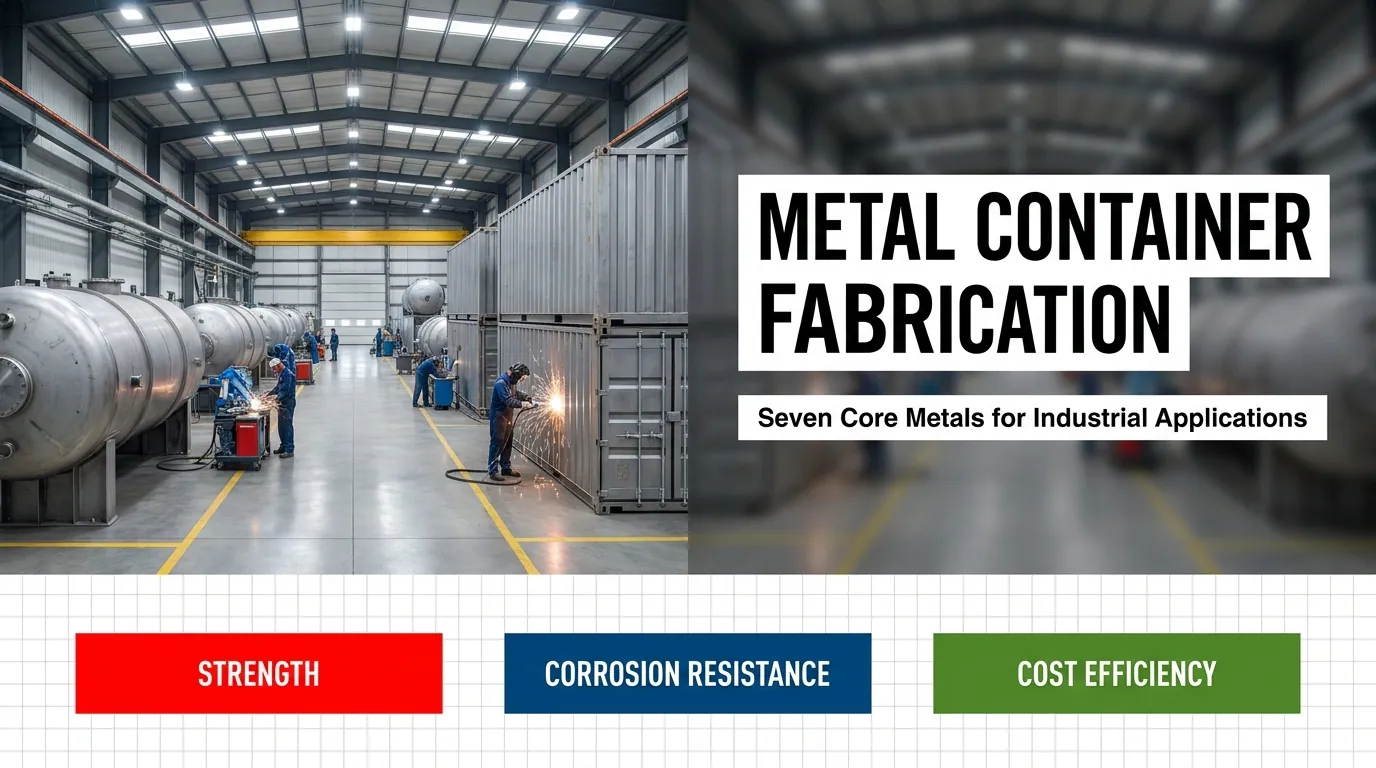
Metal container fabrication is the process of cutting, forming, welding, and assembling metal sheets and plates into vessels built to store, transport, or process materials. The metals selected for these containers determine structural performance, corrosion behavior, regulatory compliance, and total lifecycle cost.
This guide covers the core metals and their alloy grades, the engineering properties that separate them, application-specific selection for industries from shipping to chemical storage, fabrication methods and governing standards, and sustainability considerations for responsible material choices.
Carbon steel, stainless steel, aluminum, Corten steel, galvanized steel, copper alloys, and titanium form the foundation of container fabrication. Each serves a distinct role: carbon steel grades like ASTM A36 and A516 Grade 70 anchor structural and pressure vessel applications, while stainless steel grades 304, 316, and 316L handle corrosive, food-grade, and marine environments.
Comparing these metals across tensile strength, corrosion resistance, weight, thermal conductivity, and cost reveals why no single alloy suits every project. Aluminum weighs roughly one-third as much as steel, making it preferable for mobile containers, while stainless steel’s low thermal conductivity at 15 to 30 W/m·K benefits insulated storage vessels.
Matching metals to specific applications requires navigating ASME pressure vessel codes, FDA food-contact regulations, and DOT hazardous materials rules. Compliance should be the first filter in material selection, not an afterthought.
Fabrication method compatibility, from GMAW welding on carbon steel to GTAW processes on aluminum, shapes both production timelines and weld integrity. Sustainability also factors into selection; recycled aluminum’s emissions intensity drops to 2.46 mt CO2e per metric ton compared to 14.52 for primary production.
What Is Metal Container Fabrication?
Metal container fabrication is the process of cutting, forming, welding, and assembling metal sheets and plates into enclosed vessels designed to store, transport, or process materials. This discipline spans shipping containers, pressure vessels, food-grade tanks, and custom enclosures. The sections below cover its industrial scope, the core processes involved, and the standards that govern finished containers.
Understanding the breadth of metal container fabrication helps clarify why selecting the right metal type, covered throughout this guide, is a foundational engineering decision rather than a simple procurement choice.
Why Does the Type of Metal Matter in Container Fabrication?
The type of metal matters in container fabrication because each metal delivers a distinct combination of strength, corrosion resistance, weight, and regulatory compliance that directly affects container performance and lifespan. The sections below cover how metal selection influences structural integrity, safety and regulatory requirements, cost efficiency, and environmental impact.
Metal selection is one of the most consequential engineering decisions in any container project. Choosing the wrong alloy can lead to premature failure, regulatory rejection, or unnecessary cost, while the right choice balances durability, fabrication compatibility, and long-term value from the start.
The key factors that make metal type critical in container fabrication include:
- Structural performance varies dramatically across metals, with yield strengths ranging from moderate aluminum alloys to high-strength carbon steels rated above 36,000 psi.
- Corrosion behavior differs by metal and environment; stainless steel resists chemical attack, while uncoated carbon steel corrodes rapidly in marine or high-moisture conditions.
- Regulatory compliance depends on metal type, since food-contact containers, pressure vessels, and hazardous-material packaging each mandate specific alloys and certifications.
- Weight-to-strength ratio influences transportation costs and payload capacity, making aluminum preferable for mobile applications and steel dominant for stationary storage.
- Fabrication compatibility determines which welding, cutting, and forming processes can be used, affecting production timelines and costs.
- Environmental footprint changes significantly by metal; according to U.S. EPA data from 2023, the metals sector reported 78.8 million metric tons of CO2 equivalent from 295 facilities, with iron and steel production contributing 64.3 million metric tons alone.
Regulatory frameworks reinforce why metal choice cannot be arbitrary. Under U.S. federal law, any food contact substance classified as a food additive must be authorized before it enters the market. Similarly, the U.S. Hazardous Materials Regulations apply to every person who manufactures, fabricates, or tests packaging certified for hazardous-material transportation. Selecting a non-compliant alloy does not just risk structural failure; it creates legal liability.
For fabricators and project owners evaluating container metals, the decision should never default to the cheapest or most familiar option. Each application demands a specific balance of mechanical properties, environmental resistance, and code compliance. Understanding how individual metals compare across these dimensions is the foundation for making that choice effectively.
What Are the Most Common Metals Used in Container Fabrication?
The most common metals used in container fabrication are carbon steel, stainless steel, aluminum, Corten steel, galvanized steel, copper alloys, and titanium. Each metal offers distinct advantages depending on strength, corrosion resistance, weight, and application requirements.
Carbon Steel
Carbon steel is the most widely used metal in container fabrication due to its high strength, weldability, and low cost. Common grades include ASTM A36 for structural components and ASTM A516 Grade 70 for pressure-containing shells. Fabrication processes for carbon steel span cutting, shearing, forming, rolling, bending, punching, and GMAW welding. According to the U.S. International Trade Commission, the average emissions intensity for U.S. carbon and alloy semifinished steel was 1.02 metric tons of CO2 equivalent per metric ton in 2022, making it one of the lower-emission options among fabrication metals. Carbon steel does require protective coatings or linings to resist corrosion, but its affordability and structural performance make it the default choice for most industrial containers.
Stainless Steel
Stainless steel is a chromium-alloyed steel prized for corrosion resistance and hygienic properties in container fabrication. The most common grades are 304, 316, and 316L. Grade 304 suits general-purpose containers, while 316 and 316L provide superior resistance to chlorides, making them preferable for marine and chemical environments. According to the National Institute of Standards and Technology, stainless steel 304 has a density of 8 g/ml and thermal conductivity of 15 Wm⁻¹K⁻¹ at 295 K, meaning it retains heat well but transfers it slowly. This low conductivity benefits insulated containers and vessels handling temperature-sensitive contents. The higher cost of stainless steel compared to carbon steel is typically justified when corrosion resistance, cleanability, or food-grade compliance is required.
Aluminum
Aluminum is a lightweight, corrosion-resistant metal used in container fabrication where weight reduction is a priority. Common alloys include 3003 for general-purpose containers, 5052 for marine-environment applications, and 6061 for marine and truck frames requiring higher strength. Aluminum’s density is roughly one-third that of steel, which directly reduces shipping and transport costs. Welding aluminum requires GMAW or GTAW processes with specialized shielding gas. Although aluminum costs more per pound than carbon steel, its weight savings and natural oxide layer often offset the price difference in transportation, aerospace, and portable container applications.
Corten Steel
Corten steel is a weathering steel classified under ASTM A588 that forms a stable, protective rust patina when exposed to atmospheric conditions. This patina eliminates the need for paint or galvanizing in many outdoor container applications. Corten steel works well for architectural containers, outdoor storage units, and decorative fabrications where the weathered aesthetic is desirable. However, it performs poorly in high-chloride or constantly wet environments where the protective patina cannot fully develop. For fabricators, Corten welds using standard carbon steel processes, though matching filler metals are recommended to maintain corrosion performance across joints.
Galvanized Steel
Galvanized steel is carbon steel coated with zinc to prevent corrosion. There are two primary methods: hot-dip galvanizing and electrogalvanizing. According to the Galvanizers Association UK, hot-dip galvanizing immerses clean steel in molten zinc, forming zinc-iron alloy layers through a metallurgical reaction that produces an integral coating. Electrogalvanizing applies a thinner zinc layer through electrodeposition, offering a smoother finish suited for precision components. Hot-dip coatings provide longer-lasting protection for outdoor containers, while electrogalvanized surfaces work well for interior or painted applications. Both methods extend the service life of steel containers at a fraction of the cost of switching to stainless steel.
Copper and Copper Alloys
Copper and copper alloys, including brass and bronze, serve specialized roles in container fabrication. Copper offers excellent thermal conductivity and natural antimicrobial properties, making it useful for heat exchangers and certain sanitary applications. According to a review published in Corrosion Reviews (De Gruyter), brass alloys are widely employed in drinking-water distribution components such as tube fittings, valves, and ancillaries, though their corrosion can raise health concerns due to potential lead and copper release. For container fabrication, copper alloys typically appear in fittings, valves, and small-diameter vessels rather than full container shells, given their higher cost and lower tensile strength compared to steel.
Titanium
Titanium is a high-performance metal used in container fabrication when extreme corrosion resistance, high strength-to-weight ratio, or biocompatibility is required. Grade 2 commercially pure titanium and Grade 5 (Ti-6Al-4V) are the most common selections in titanium biomedical devices. Titanium resists attack from seawater, chlorine compounds, and most acids, making it ideal for aggressive chemical storage containers. Its density sits between aluminum and steel, providing a favorable balance of strength and weight. The primary drawback is cost; titanium can be five to ten times more expensive than stainless steel. Fabrication also demands specialized welding environments with inert gas shielding to prevent contamination.
With these seven metals forming the foundation of container fabrication, comparing their physical and engineering properties reveals which performs best under specific conditions.
What Are the Key Properties to Compare Across Container Metals?
The key properties to compare across container metals are tensile strength, corrosion resistance, weight, thermal conductivity, and cost. Each property influences structural integrity, service life, and fabrication compatibility.
How Does Tensile Strength Differ Among Container Metals?
Tensile strength differs among container metals based on alloy composition and grade designation. Carbon steels set the structural benchmark: according to a study published in SN Applied Sciences (Springer Nature), ASTM A516 Grade 70 steel has an ultimate tensile strength of 70,000 psi (485 MPa), while ASTM A36 reaches 58,000 psi (400 MPa). Stainless steels like 304 and 316 fall within a similar range, though their value lies more in corrosion performance than raw strength.
Aluminum alloys sit considerably lower on the tensile scale. Alloy 5052 offers moderate-to-high strength with strong weldability, while 6061 serves structural roles in truck and marine frames. For pressure-rated or seismically loaded containers, carbon steel grades remain the default choice because strength-to-cost ratio matters most in those scenarios.
How Does Corrosion Resistance Vary by Metal Type?
Corrosion resistance varies by metal type depending on alloy chemistry, protective coatings, and environmental exposure. According to the British Stainless Steel Association, 316 stainless steel is widely used in marine applications but remains susceptible to localized crevice and pitting attack, while 304 should not be considered suitable for seawater service. The low-carbon “L” variants (304L and 316L) limit carbon content to 0.030% maximum, reducing sensitization risk during welding.
Aluminum naturally forms a passive oxide layer, giving it strong atmospheric corrosion resistance without coatings. Galvanized steel relies on sacrificial zinc protection, and Corten steel develops a stable rust patina in controlled conditions. One often overlooked factor: lab-based salt spray testing under ASTM B117 rarely correlates with real-world performance, so specifying corrosion resistance based solely on accelerated test data can be misleading.
How Does Weight Impact Metal Selection for Containers?
Weight impacts metal selection for containers by influencing payload capacity, transportation costs, and structural design requirements. Aluminum, with a density of approximately 2.70 g/ml, weighs roughly one-third as much as steel. This makes aluminum the preferred choice when reducing tare weight directly increases usable payload, such as in mobile units and transportation containers.
Steel (around 7.85 g/cm³ for carbon grades) and stainless steel (7.93 g/cm³ for 304) provide greater structural mass per unit volume. That added weight becomes an advantage in stationary applications where anchoring force and vibration dampening matter. For most custom container projects, the weight decision comes down to whether the container moves frequently or stays in place.
How Does Thermal Conductivity Affect Container Performance?
Thermal conductivity affects container performance by determining how efficiently heat transfers through vessel walls. Copper leads at 400 W/m·K, followed by aluminum at 235 W/m·K, brass at 120 W/m·K, and stainless steel 304 at just 15 W/m·K.
High conductivity suits heat exchangers and containers requiring rapid temperature equalization. Low conductivity, as found in stainless steel, benefits insulated storage where minimizing heat transfer protects contents. Selecting the wrong thermal profile can force costly secondary insulation or cooling systems that proper metal selection would have avoided.
How Does Cost Compare Across Container Fabrication Metals?
Cost compares across container fabrication metals based on raw material pricing, machining difficulty, and required finishing processes. Carbon steel consistently ranks as the most economical option for structural container applications, offering high strength at low per-pound cost. Stainless steel typically costs two to three times more than carbon steel, though it reduces long-term maintenance expenses by eliminating protective coatings.
Aluminum occupies a middle range; its higher material cost is partially offset by lighter weight and lower shipping expenses. Titanium and copper alloys sit at the premium end, justified only when specific performance requirements, such as extreme corrosion resistance or antimicrobial properties, cannot be met by less expensive alternatives. Total lifecycle cost, not just upfront material price, should drive every selection decision.
With these property comparisons established, the next step is matching each metal to its ideal container application.
Which Metal Is Best for Each Container Application?
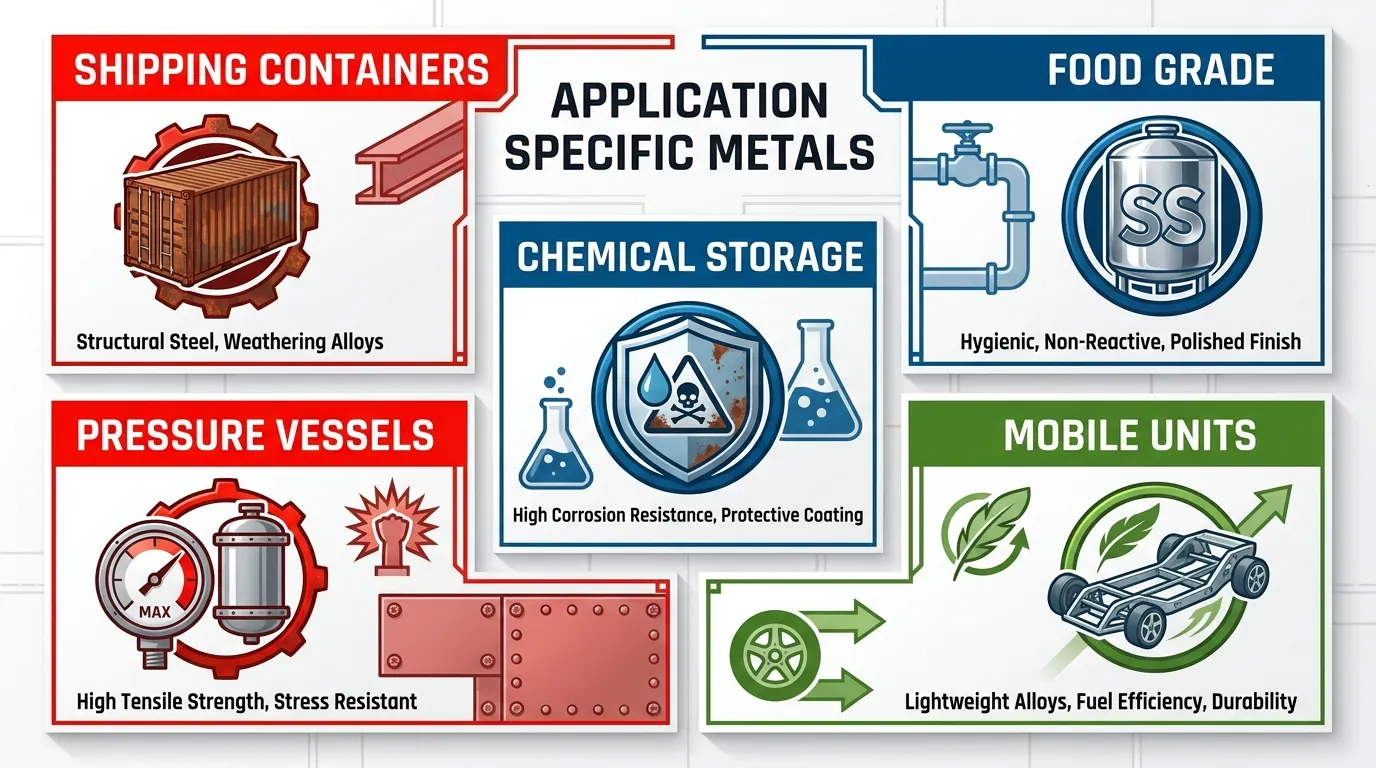
The best metal for each container application depends on the specific operating environment, regulatory requirements, and performance demands. The following subsections cover shipping containers, food and beverage containers, chemical storage, pressure vessels, and mobile or custom-build containers.
Which Metal Works Best for Shipping and Cargo Containers?
The metal that works best for shipping and cargo containers is Corten steel (ASTM A588). Its self-healing oxide layer resists atmospheric corrosion without requiring paint in most climates, which reduces lifecycle maintenance costs across global transit routes. Carbon steel reinforcements, typically ASTM A36, handle structural framing where maximum load-bearing strength matters more than weather exposure.
ISO 1496-1:2013, published by the International Organization for Standardization, specifies testing requirements for ISO series 1 freight containers suitable for international exchange by road, rail, and sea. Aluminum alloys such as 5052 sometimes replace steel in refrigerated units where weight reduction improves fuel efficiency. For projects requiring multimodal durability, Corten remains the industry default.
Which Metal Works Best for Food and Beverage Containers?
The metal that works best for food and beverage containers is stainless steel, specifically grades 304 and 316L. Grade 304 stainless steel provides excellent corrosion resistance for processing tanks, brewing vessels, and dairy equipment. Grade 316L, with its lower carbon content and added molybdenum, handles acidic foods and sanitizing chemicals without pitting.
For consumer packaging, aluminum alloys dominate. Beverage cans typically use 3004 for the body and 5182 for the lid, combining formability with lightweight strength. All food contact metals must meet regulatory authorization before entering the U.S. market, and similar requirements apply under European Regulation (EC) No 1935/2004. Choosing the right grade prevents contamination and ensures compliance from production through distribution.
Which Metal Works Best for Chemical Storage Containers?
The metal that works best for chemical storage containers depends on the stored substance. Stainless steel 316L resists a broad range of acids, alkalis, and chloride solutions, making it the most versatile option for chemical containment. Carbon steel lined with corrosion-resistant coatings serves as a cost-effective alternative for less aggressive chemicals.
Titanium Grade 2 handles highly corrosive environments, such as concentrated hydrochloric acid or hot seawater, where even 316L stainless steel would fail. Containers for hazardous materials must also comply with U.S. Hazardous Materials Regulations (49 CFR Part 171), which govern the manufacture, testing, and certification of packaging used in chemical transport. Matching the alloy to the chemical profile prevents catastrophic containment failure.
Which Metal Works Best for Pressure Vessels?
The metal that works best for pressure vessels is carbon steel, particularly ASTM A516 Grade 70. This alloy delivers high tensile strength and excellent weldability at moderate cost, making it the standard shell material for boilers, storage tanks, and process vessels operating under internal pressure.
According to the American Society of Mechanical Engineers, ASME’s Boiler and Pressure Vessel Code (BPVC) standards provide the single largest source of technical data used in the manufacturing, construction, and operation of pressure vessels, with a new edition released every two years. For corrosive service conditions, fabricators often specify stainless steel 316L or titanium Grade 5 instead. Selecting the correct alloy ensures both code compliance and long-term structural integrity under cyclic pressure loads.
Which Metal Works Best for Mobile and Custom-Build Containers?
The metal that works best for mobile and custom-build containers varies by project requirements, though aluminum alloys and carbon steel are the most common choices. Aluminum 6061 provides a high strength-to-weight ratio ideal for mobile units that must stay within road weight limits while maintaining structural rigidity. Carbon steel framing, particularly ASTM A36, handles heavy-duty structural applications where maximum load capacity outweighs weight concerns.
Galvanized steel adds corrosion protection for containers exposed to outdoor conditions over extended deployments. For specialized builds requiring unique geometries, stainless steel offers both formability and durability. Mobile container projects benefit most from combining multiple metals, using each where its properties deliver the greatest advantage.
Understanding application-specific metal requirements sets the foundation for selecting the right fabrication methods.
What Fabrication Methods Are Used for Metal Containers?
The fabrication methods used for metal containers include cutting, forming, welding, and finishing processes selected based on the metal type and container application.
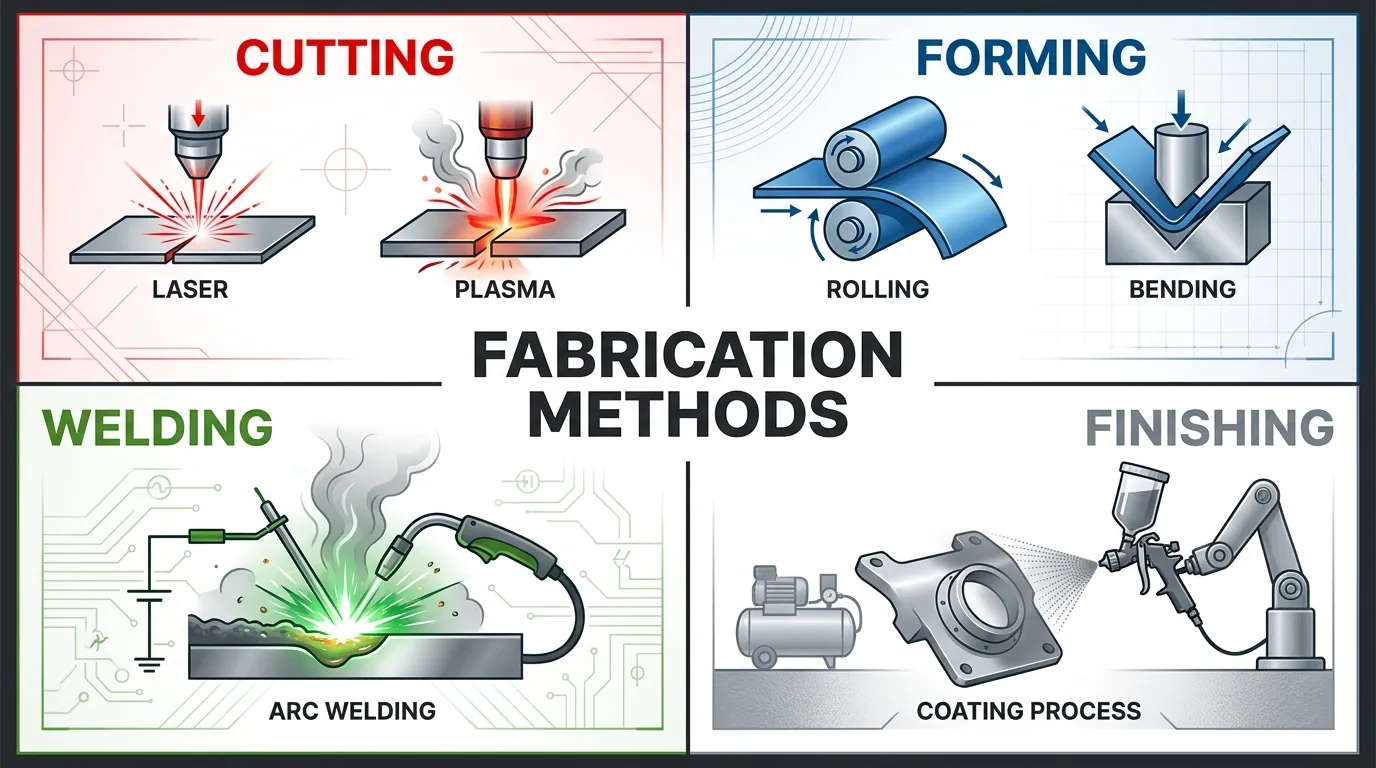
Metal fabrication for containers relies on a broad set of techniques. Each metal responds differently to thermal, mechanical, and joining processes, so matching the method to the material is essential for structural integrity. The primary categories are cutting and shearing, forming and bending, welding and joining, and surface finishing.
Cutting and shearing encompasses multiple processes suited to different metals and thicknesses:
- Laser cutting delivers precision on thin to medium steel and stainless steel sheets.
- Plasma arc cutting handles thicker carbon steel and stainless steel plates efficiently.
- Abrasive water-jet cutting works across nearly all metals, including titanium and aluminum, without introducing heat distortion.
- Oxy-fuel cutting remains a cost-effective option for thick carbon steel sections.
- Mechanical shearing and sawing provide straight-line cuts on sheet and plate stock.
One important limitation applies to standard CO2 laser systems. According to material guidance from North Carolina State University’s College of Design, CO2 laser cutters are not suitable for metals and may damage the laser focus assembly. Fiber lasers and plasma systems handle metallic substrates instead.
Forming and bending shapes flat stock into container walls, heads, and structural components:
- Rolling transforms flat plates into cylindrical shells for tanks and pressure vessels.
- Press brake bending creates angular sections for container frames and reinforcements.
- Punching and drilling produce bolt holes, drainage ports, and access points.
- Deep drawing forms seamless container bodies, particularly in aluminum beverage can production.
Welding and joining varies significantly by metal type. Metal-fabrication training programs, such as those documented by Fox Valley Technical College, distinguish between GMAW (MIG) work on carbon steel, and both GMAW and GTAW (TIG) processes on stainless steel and aluminum. Each metal’s thermal conductivity, oxide layer behavior, and filler-metal compatibility dictate the appropriate technique. AWS D1.1, maintained by the American Welding Society, establishes welding procedure qualification and inspection requirements specifically for structural steel applications.
Surface finishing and testing protects the completed container and verifies quality:
- Hot-dip galvanizing, powder coating, and paint systems provide corrosion barriers on carbon and weathering steels.
- Passivation restores chromium oxide layers on stainless steel after welding.
- ASTM B117 salt-spray testing evaluates relative corrosion resistance of coated metals, though ASTM International notes that standalone salt-spray results seldom correlate directly with natural-environment performance.
Selecting the right fabrication method is as important as selecting the right metal. A poorly matched process can introduce residual stress, compromise weld integrity, or degrade corrosion resistance. Understanding how standards and codes govern these decisions helps ensure every container meets its performance requirements.
How Do Industry Standards and Codes Affect Metal Selection?
Industry standards and codes affect metal selection by defining mandatory material grades, minimum mechanical properties, and testing requirements that containers must meet for legal compliance and safe operation. The key regulatory frameworks include ASME pressure vessel codes, ASTM material specifications, FDA food-contact rules, and DOT hazardous materials regulations.
ASME’s Boiler and Pressure Vessel Code (BPVC) provides the single largest source of technical data used in manufacturing, construction, and operation of boilers and pressure vessels, with ASME releasing a new edition every two years, according to the American Society of Mechanical Engineers. This code dictates which steel grades, such as ASTM A516 Grade 70 or stainless steel 316L, qualify for pressure-rated service. Fabricators cannot substitute materials without re-certifying the entire vessel design.
For food and beverage containers, the regulatory landscape is equally prescriptive. Under U.S. federal law, the FDA requires that a food contact substance classified as a food additive must be authorized before it is marketed. In Europe, all food contact materials must comply with Regulation (EC) No 1935/2004, as established by the European Commission’s Directorate-General for Health and Food Safety.
Hazardous materials transport adds another compliance layer. The U.S. Hazardous Materials Regulations apply to each person who manufactures, fabricates, marks, maintains, reconditions, repairs, or tests a packaging or component represented, marked, certified, or sold as qualified for hazardous-material transportation in commerce. These rules often require specific corrosion-resistant alloys or minimum wall thicknesses that override cost-driven material preferences.
Welding codes further constrain which metals a fabricator can specify. AWS D1.1 establishes requirements for welding structural steel, defines qualification of welders and welding procedures, and specifies inspection and acceptance of welds for load-bearing structural applications. When a project falls under D1.1 jurisdiction, only pre-qualified base metals and filler combinations are permitted.
From a practical standpoint, compliance requirements should be the first filter in any metal selection process, not the last. Choosing a metal based on cost or availability and then discovering it fails to meet the applicable code wastes engineering hours and production time. Understanding which standards govern your container application, whether ASME BPVC for pressure vessels, FDA regulations for food contact, or DOT rules for hazmat transport, narrows the field of candidate metals before detailed engineering even begins.
What Are the Sustainability Factors for Metals in Containers?
The sustainability factors for metals in containers include recyclability, production emissions intensity, energy consumption during primary processing, and end-of-life material recovery. Each factor varies significantly by metal type.
Steel is 100% and infinitely recyclable without any loss of properties, making it one of the most circular materials in container fabrication. According to the World Steel Association, every tonne of steel produced in 2024 led to the emission of 2.18 tonnes of CO2e across scope 1, 2, and 3. That figure, while substantial, reflects meaningful progress from historical benchmarks and benefits directly from increased scrap-based electric arc furnace production.
Aluminum presents a sharply different emissions profile depending on whether it originates from primary or secondary production. Primary unwrought aluminum carries an average emissions intensity of 14.52 mt CO2e per metric ton, while secondary (recycled) unwrought aluminum drops to just 2.46 mt CO2e per metric ton, based on 2022 data from the U.S. International Trade Commission. This gap makes recycled aluminum one of the most emissions-efficient options available, though primary production remains among the most carbon-intensive.
Carbon and alloy semifinished steel averages 1.02 mt CO2e per metric ton, compared to 2.23 mt CO2e per metric ton for stainless steel semifinished production. These differences matter when specifying container materials at scale, because even small per-unit emissions savings compound across large fabrication runs.
Copper, brass, and titanium each carry higher embodied energy costs than steel or aluminum, which limits their sustainability appeal for high-volume container applications. Their use is typically justified only when performance requirements, such as antimicrobial properties or extreme corrosion resistance, cannot be met by lower-impact alternatives.
For fabricators evaluating environmental impact alongside performance, prioritizing recycled-content metals and designing for end-of-life disassembly represent the most practical sustainability strategies. Understanding these tradeoffs early in the design process helps align material choices with both project requirements and circular-economy goals.
How Do You Choose the Right Metal for a Custom Container Project?
You choose the right metal for a custom container project by matching material properties to your application’s specific demands for strength, corrosion resistance, weight, and regulatory compliance. The following sections cover Craftsmen Industries’ fabrication capabilities and the key takeaways from this guide.
Can Craftsmen Industries Handle Custom Metal Container Fabrication?
Yes, Craftsmen Industries can handle custom metal container fabrication. Operating from a 127,000 sq. ft. vertically integrated facility near St. Louis County, Missouri, Craftsmen Industries provides in-house design, engineering, and fabrication for custom builds across industries. With over 40 years of experience serving corporations, government agencies, military organizations, and healthcare providers, the company works with a range of metals and fabrication processes to meet project-specific requirements.
Container fabrication demand continues to grow globally. According to UN Trade and Development, 920 million TEUs of containers were handled in ports worldwide in 2024, representing 6.9% growth compared to just 0.6% annual increases in 2022 and 2023. Craftsmen Industries meets this rising demand by controlling every stage of production, from initial concept through final delivery.
What Are the Key Takeaways About Metals Used in Container Fabrication?
The key takeaways about metals used in container fabrication center on matching each metal’s properties to the container’s intended environment, load requirements, and compliance standards. The most critical considerations include:
- Carbon steel provides high tensile strength at low cost, making it the standard for structural and shipping containers.
- Stainless steel delivers superior corrosion resistance for food-grade, chemical, and marine applications.
- Aluminum reduces container weight significantly while maintaining good corrosion resistance and workability.
- Corten steel forms a protective patina that eliminates painting in low-chloride outdoor environments.
- Galvanized steel adds zinc-based corrosion protection suited to moderate-exposure industrial containers.
- Copper and brass alloys offer antimicrobial properties and thermal conductivity for specialized uses.
- Titanium combines exceptional strength-to-weight ratio with corrosion immunity for high-performance applications.
No single metal is ideal for every project. The best choice depends on balancing mechanical performance, environmental exposure, fabrication compatibility, regulatory requirements, and budget. For most custom projects, working with an experienced fabricator who understands these trade-offs is the most reliable path to a successful build. Craftsmen Industries brings that expertise to every custom container project, guiding material selection from ideation to creation.
Filter Posts by Tag
related posts
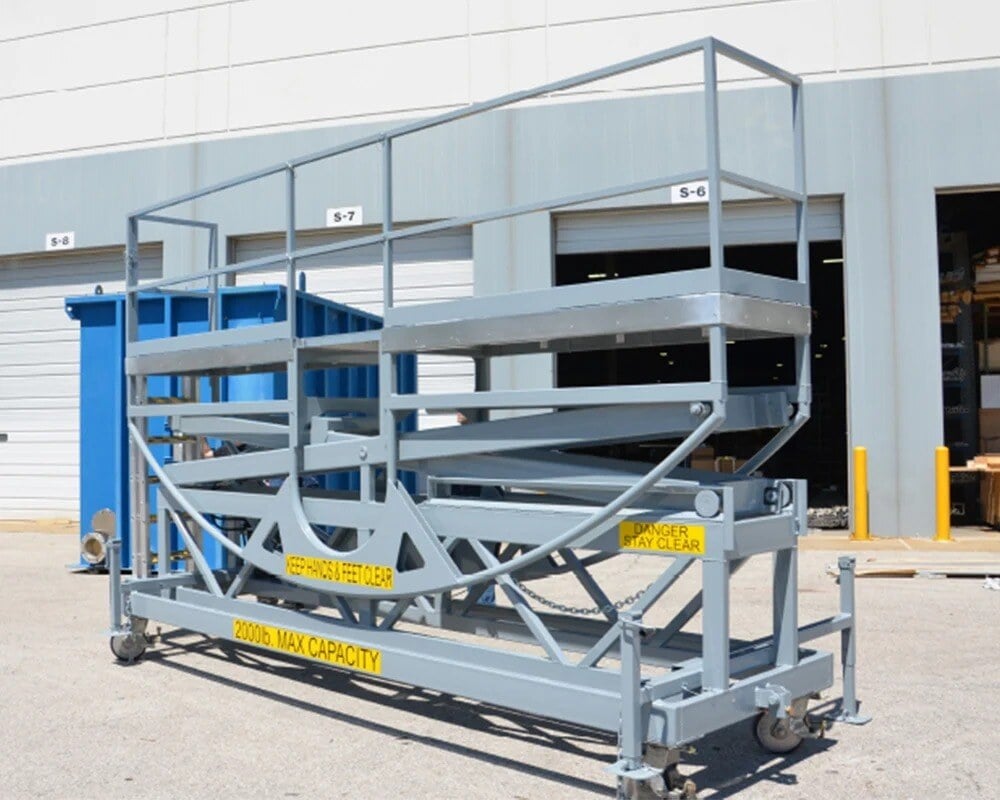
Discover the key differences between fabrication and manufacturing. Learn how each process affects materials, production methods, and the final product.

Explore the environmental impacts of industrial fabrication processes in this post. Read and discover how sustainable practices can promote a greener future.
Have you heard about the hype surrounding the new Disney+ show? Read this article to discover why our services are known as the real-life Rennervations!
