
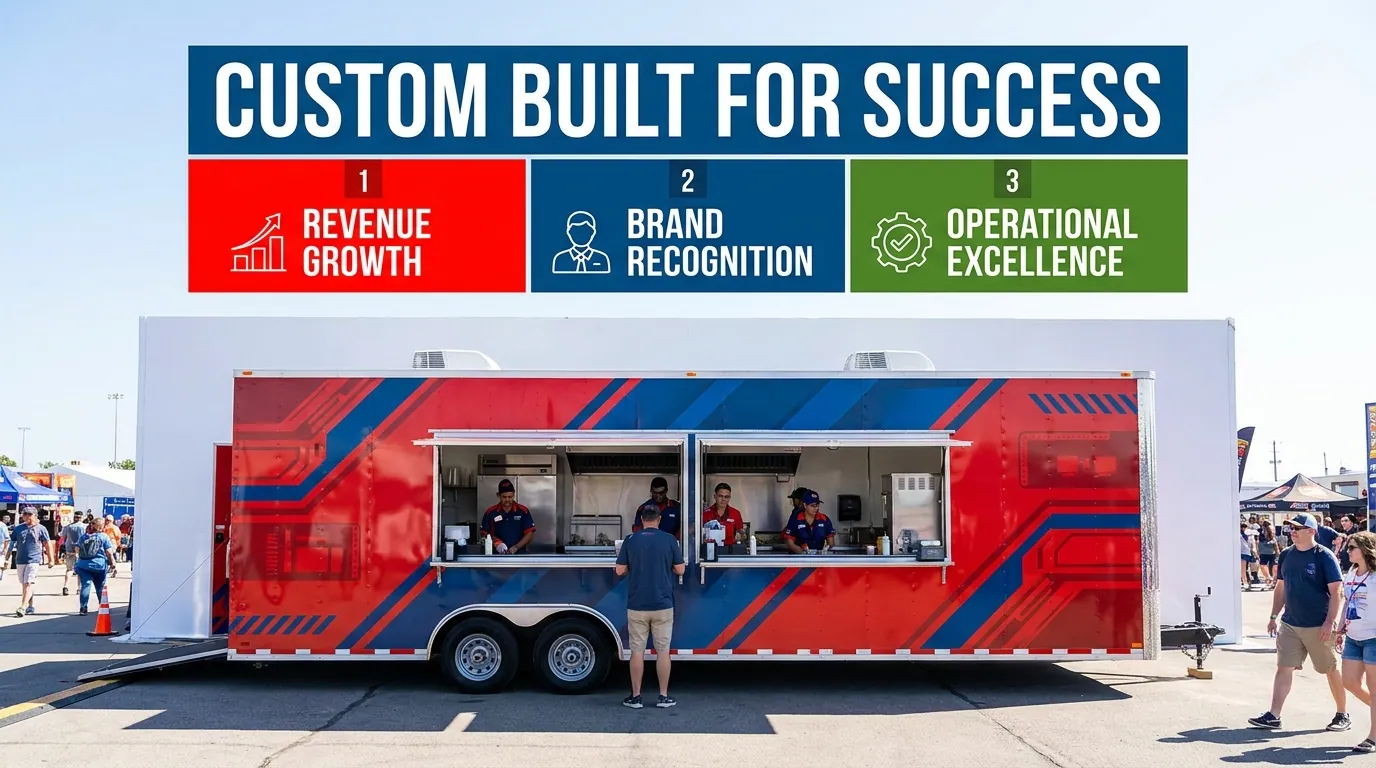
A custom concession trailer is a purpose-built mobile food unit engineered to match a specific operator’s menu, brand, workflow, and growth plan. Unlike stock trailers that force compromises at every turn, a custom build aligns design decisions with business outcomes from day one.
This guide covers revenue optimization, brand identity, operational efficiency, food safety and compliance, versatility, long-term cost reduction, competitive differentiation, scalable growth, technology integration, and manufacturer selection.
Revenue optimization starts at the layout level. Tailored menu positioning and strategically placed serving windows increase average order value while cutting transaction times, letting operators serve more customers per hour with fewer staff.
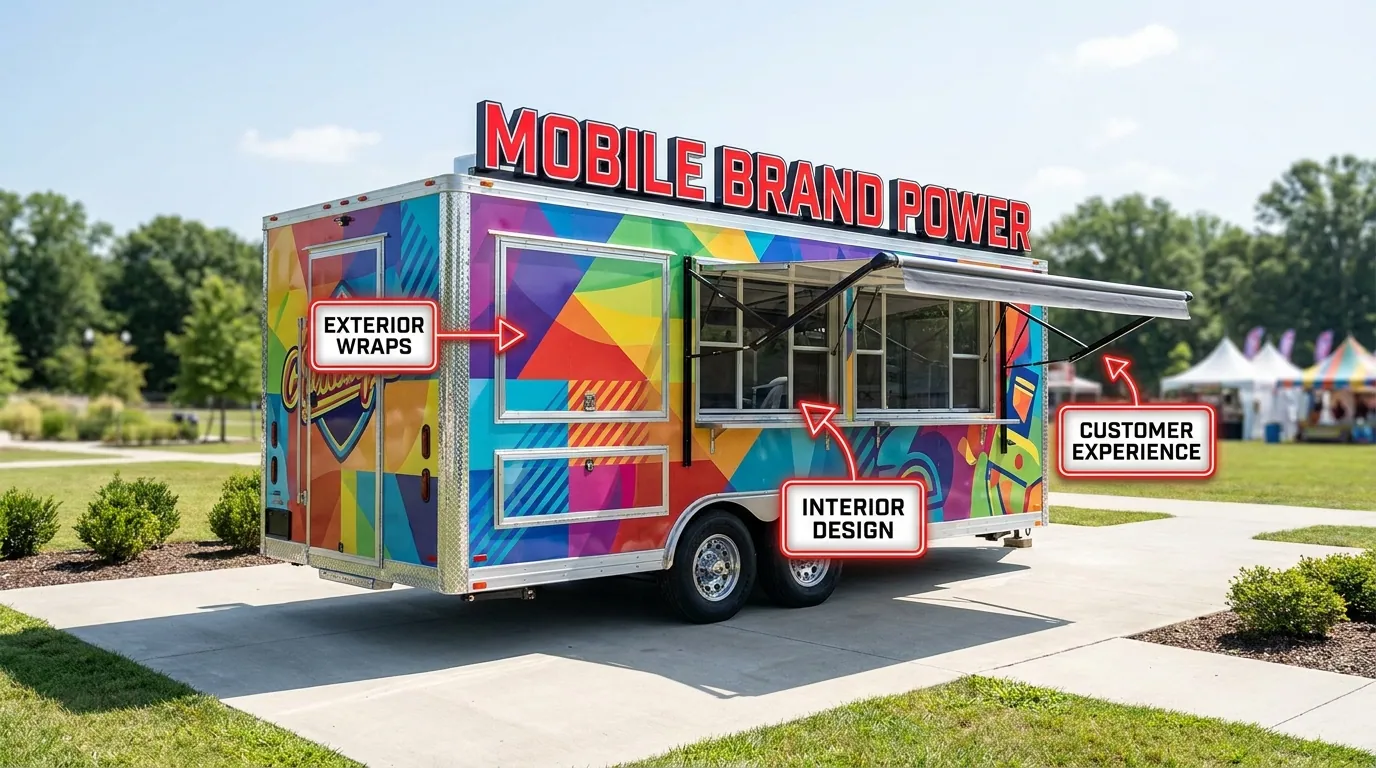
Brand identity extends across every surface. Full exterior wraps turn each trailer into a mobile billboard, while coordinated interior finishes create a cohesive visual experience customers photograph and share on social media.
Operational efficiency gains come from purpose-built kitchen workflows that eliminate unnecessary movement and custom equipment integration that prevents the maintenance failures common in retrofitted stock units.
Food safety and compliance are engineered into the floor plan. Dedicated handwashing stations, properly sized waste tanks, and separated prep zones address health code requirements before the first inspection, positioning operators to meet tightening state licensing deadlines.
Versatility and cost reduction work together. Modular interiors adapt to seasonal menus and different event types, while commercial-grade materials and energy-efficient systems (with potential savings of 60% or more on ventilation energy) lower ownership costs over years of operation.
Competitive differentiation, scalable fleet expansion, integrated POS and climate control technology, and choosing a vertically integrated manufacturer like Craftsmen Industries round out a build strategy that turns a single trailer into a repeatable, bankable business asset.
Why Do Custom Concession Trailers Maximize Revenue Potential?
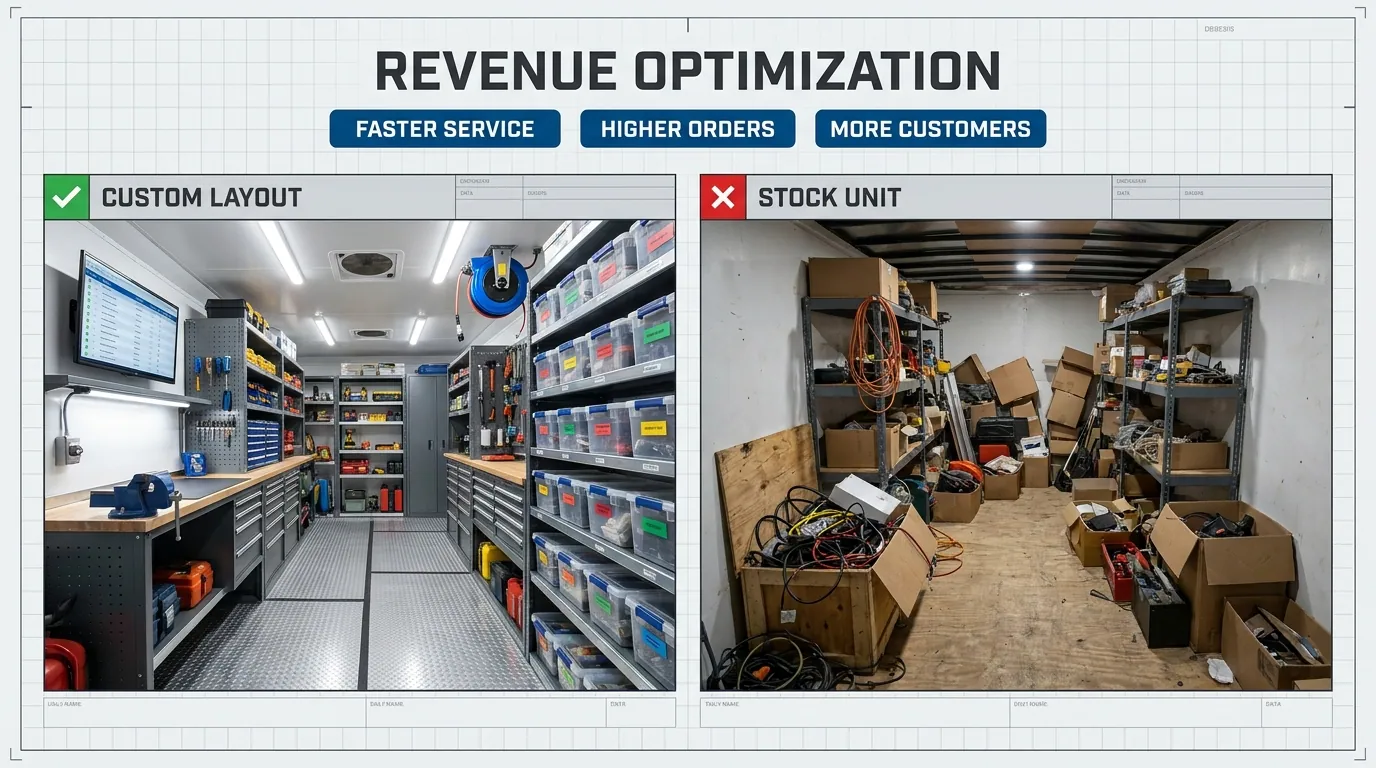
Custom concession trailers maximize revenue potential by aligning every interior element with faster service and higher per-customer spending. A tailored menu layout and optimized serving window placement each contribute directly to stronger sales.
How Does a Tailored Menu Layout Increase Average Order Value?
A tailored menu layout increases average order value by positioning high-margin items, combo offers, and add-ons where customers naturally look during ordering. Strategic placement of digital menu boards or printed panels at eye level guides purchasing decisions toward premium selections. According to a 2019 study published in INFORMS Management Science, tabletop ordering technology improved average sales per check by approximately 1%. In a custom concession trailer, this principle extends further when the entire interior workflow supports upselling. Menu boards placed near the serving counter, paired with visible prep stations that showcase fresh ingredients, create visual cues that encourage larger orders.
How Does Optimized Serving Window Placement Speed Up Transactions?
Optimized serving window placement speeds up transactions by reducing the physical distance between order intake, food preparation, and handoff. A Virginia Tech study on foodservice facility design found that absolute travel distance was positively related to the percentage of time staff spent walking and experiencing delays. Custom concession trailers eliminate this inefficiency by positioning the serving window in direct alignment with the cooking line and POS station. Fewer steps between each touchpoint mean shorter wait times, more customers served per hour, and higher daily revenue. For operators scaling across multiple events, this layout precision compounds into measurable profit gains over a season.
With revenue-driving design in place, consistent branding turns that efficiency into lasting customer recognition.
How Do Custom Concession Trailers Strengthen Brand Identity?
Custom concession trailers strengthen brand identity by turning every surface into a deliberate brand touchpoint. From full exterior wraps to coordinated interior finishes, a custom build creates visual consistency that generic units cannot match.
How Does Exterior Wrap Design Create Instant Brand Recognition?
Exterior wrap design creates instant brand recognition by transforming a concession trailer into a mobile billboard that displays logos, colors, and messaging wherever it travels. A full vinyl wrap ensures the brand is visible from every angle, whether parked at a festival or in transit between events.
According to a study published in Applied Sciences, outdoor advertising serves as a reminder of brand presence, creates brand awareness, and influences brand recognition and loyalty. Custom concession trailers amplify this effect because they occupy high-traffic locations where foot traffic is already concentrated. Unlike static signage, a wrapped trailer carries the brand to new audiences at every stop, building familiarity through repeated exposure across multiple markets.
How Do Interior Finishes Reinforce a Cohesive Brand Experience?
Interior finishes reinforce a cohesive brand experience by extending visual identity beyond the exterior into the customer-facing service area. Coordinated color schemes, branded countertops, custom lighting, and signage inside the trailer create a unified environment that feels intentional and professional.
This consistency matters because customers interact with the interior during their ordering experience. A study published in Technological Forecasting and Social Change found that mobile food operators use a “social-local-mobile” (SO-LO-MO) approach, integrating social media, geolocation tools, and mobile marketing to build a seamless consumer experience and a cohesive brand. Thoughtfully designed interior finishes give customers something memorable to photograph and share, feeding that digital visibility loop naturally.
With brand identity established across every surface, the next consideration is how a custom build improves day-to-day operational efficiency.
What Operational Efficiency Gains Do Custom Builds Deliver?
Custom builds deliver operational efficiency gains through optimized kitchen workflows and purpose-matched equipment integration. These improvements reduce labor costs and minimize service downtime.
How Does a Purpose-Built Kitchen Workflow Reduce Labor Costs?
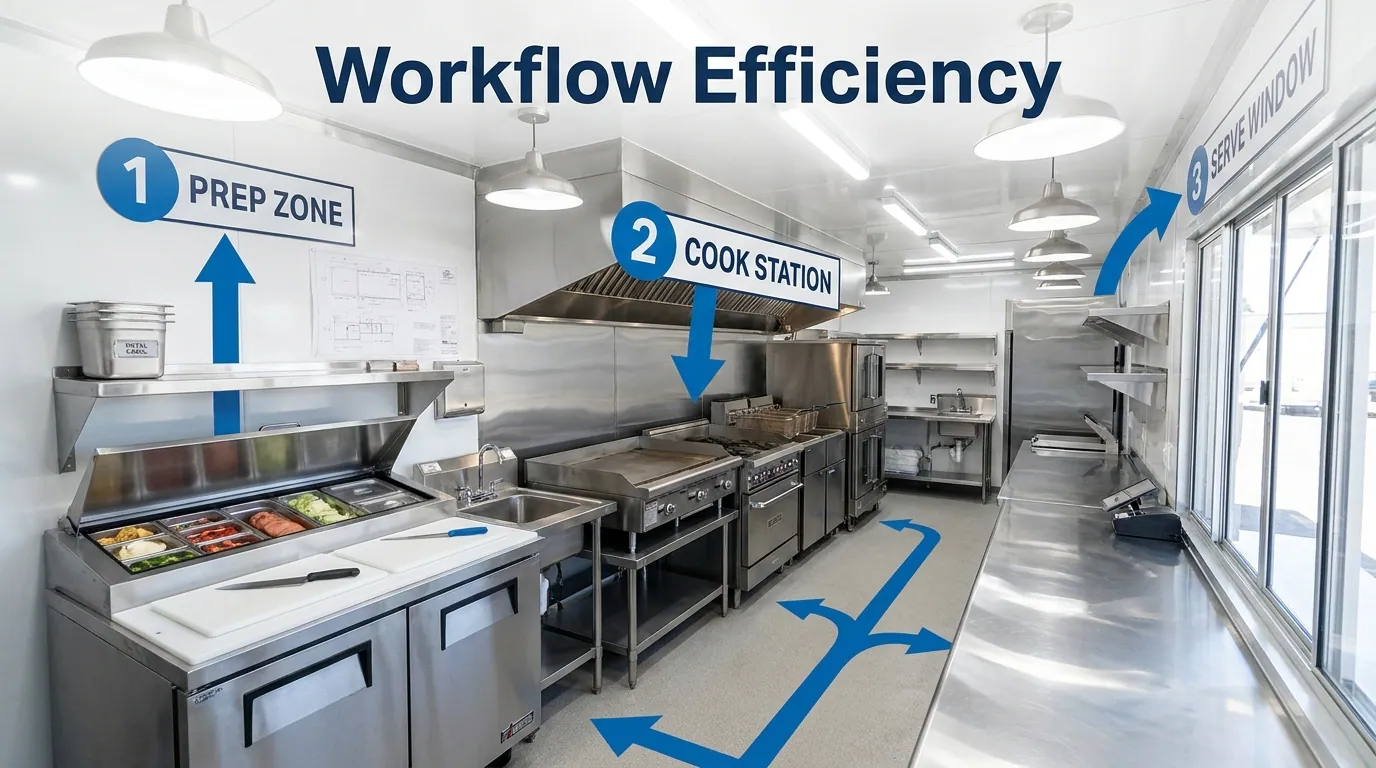
A purpose-built kitchen workflow reduces labor costs by eliminating unnecessary movement between stations. When prep, cook, and serve zones are arranged in a logical sequence, fewer staff members can handle higher order volumes. A Virginia Tech study on foodservice facility layouts found that absolute travel distance was positively related with percentage of time spent walking and delays, confirming that poorly designed spaces directly waste labor hours.
In a concession trailer, even saving a few steps per order compounds across hundreds of daily transactions. Custom layouts position high-use equipment within arm’s reach of each station, allowing one or two operators to do what three might handle in a generic unit. For operators running tight margins at events, this kind of labor optimization is often the single biggest factor in profitability.
How Does Custom Equipment Integration Minimize Downtime?
Custom equipment integration minimizes downtime by ensuring every component fits the trailer’s electrical, plumbing, and ventilation systems from day one. Stock trailers often require aftermarket modifications that create mismatched connections, leading to recurring maintenance issues and mid-service failures.
When equipment is spec’d during the design phase, power loads are balanced across dedicated circuits, drain lines align without adapters, and ventilation capacity matches actual heat output. Key advantages of integrated builds include:
- Electrical systems sized to the exact amperage draw of installed appliances.
- Plumbing routed directly to equipment locations without makeshift extensions.
- Ventilation hoods matched to cooking equipment BTU ratings for consistent airflow.
This precision eliminates the most common sources of unplanned service interruptions. Operators who invest in integrated custom builds spend less time troubleshooting and more time serving customers, which is ultimately what separates profitable mobile food operations from those stuck in a cycle of reactive repairs.
With efficiency gains established, the next consideration is food safety and regulatory compliance.
How Do Custom Concession Trailers Improve Food Safety and Compliance?
Custom concession trailers improve food safety and compliance by integrating code-required features directly into the original build. A purpose-designed layout addresses handwashing stations, wastewater capacity, and sanitation zones before the first inspection.
How Does a Custom Layout Simplify Health Code Inspections?
A custom layout simplifies health code inspections by positioning every required element exactly where inspectors expect to find it. The FDA Food Code serves as the model for safeguarding public health and ensuring food is unadulterated and honestly presented to consumers. Custom builds address these standards from the design phase rather than through costly retrofits.
Key compliance features built into a custom layout include:
- Dedicated handwashing sinks located within the food preparation zone, as required by the Massachusetts Department of Public Health for all mobile food establishments involved in food handling, cooking, cooling, and reheating.
- Properly sized waste retention tanks permanently installed and leak-proof.
- Separated prep, cook, and service zones that prevent cross-contamination.
- Accessible equipment placement that allows inspectors clear sightlines during walkthroughs.
When compliance is engineered into the floor plan from day one, operators spend less time preparing for inspections and more time serving customers.
How Do Built-In Sanitation Stations Meet 2026 FDA Guidelines?
Built-in sanitation stations meet 2026 FDA guidelines by incorporating handwashing, warewashing, and wastewater systems as permanent, factory-installed components. Self-contained units with integrated potable water tanks, wastewater holding tanks, and utility sinks can operate independently of a commissary, which satisfies increasingly strict mobile food vendor requirements.
Regulatory timelines are tightening. Beginning July 1, 2026, all mobile food vendors in Texas must be licensed with the Texas Department of State Health Services to operate in the state. Custom trailers designed with NSF/ANSI-compliant materials and pre-installed sanitation infrastructure position operators to meet these deadlines without last-minute modifications.
For operators planning to serve multiple jurisdictions, building sanitation stations to the highest applicable standard during fabrication eliminates the risk of failing a local inspection over a missing sink or undersized waste tank. Understanding compliance requirements early connects directly to choosing the right trailer versatility for different event types.
Why Are Custom Concession Trailers More Versatile Than Stock Units?
Custom concession trailers are more versatile than stock units because they adapt to different events, menus, and business models without costly aftermarket modifications. The following sections cover event adaptability and modular interior design.
How Easily Can a Custom Trailer Adapt to Different Event Types?
A custom trailer can adapt to different event types with minimal effort because every element, from serving windows to power systems, is engineered for multi-use scenarios. Stock units force operators into a fixed configuration that may suit one venue but creates friction at another. A custom build accommodates outdoor festivals, corporate catering, stadium concourses, and private events through adjustable service counters, scalable power hookups, and convertible storage zones.
According to a case study published in the Journal of Hospitality & Tourism Cases, mobile food operators described food truck operation as “lots of work, tons of work, more work than we thought it would be.” The retrofit burden disappears when the trailer is purpose-built from the start. For operators working diverse event calendars, this flexibility directly protects revenue.
How Does Modular Interior Design Allow Seasonal Menu Changes?
Modular interior design allows seasonal menu changes by using interchangeable equipment mounts, removable prep stations, and reconfigurable utility connections inside the trailer. A summer shaved-ice operation can swap to a winter soup-and-chili concept without structural overhaul when the interior is designed around modularity.
Key modular elements that enable seasonal transitions include:
- Slide-in cooking equipment bays sized for interchangeable appliances such as griddles, fryers, or steam tables.
- Quick-disconnect gas, electric, and water hookups that support different equipment loads without rewiring.
- Adjustable shelving and removable counter inserts that reconfigure prep space for varying ingredient volumes.
Stock trailers lock operators into a single layout, making seasonal pivots expensive and time-consuming. Modular custom builds turn menu flexibility into a competitive strength rather than a logistical headache.
Understanding how versatility shapes daily operations leads naturally to evaluating long-term ownership costs.
How Do Custom Concession Trailers Reduce Long-Term Ownership Costs?
Custom concession trailers reduce long-term ownership costs through durable material selection and energy-efficient equipment integration. The following sections cover how commercial-grade construction extends trailer lifespan and how efficient systems lower monthly operating expenses.
How Does Commercial-Grade Material Selection Extend Trailer Lifespan?
Commercial-grade material selection extends trailer lifespan by resisting the accelerated wear that food service environments produce. Stainless steel walls, aluminum framing, and marine-grade wiring withstand grease, moisture, and vibration far better than the light-gauge metals found in stock trailers. These materials reduce the frequency of panel replacements, corrosion repairs, and electrical failures that accumulate into significant costs over five to ten years of operation.
For operators running high-volume schedules across multiple events per week, investing in heavier-gauge construction upfront is one of the most reliable ways to avoid compounding repair bills. A custom build spec from a vertically integrated manufacturer like Craftsmen Industries ensures every material choice is matched to the specific cooking, cleaning, and transport demands of the operation.
How Does Energy-Efficient Equipment Lower Monthly Operating Expenses?
Energy-efficient equipment lowers monthly operating expenses by reducing fuel consumption, electrical draw, and HVAC load inside the trailer. According to U.S. Environmental Protection Agency ENERGY STAR field studies, energy savings from demand-controlled kitchen ventilation could reach 60% or more depending on the facility and type of operation.
Key efficiency gains in a custom concession trailer include:
- Demand-controlled ventilation systems that adjust fan speed based on actual cooking output.
- ENERGY STAR-rated refrigeration and cooking appliances that draw less power per cycle.
- LED lighting and insulated wall panels that reduce generator runtime at off-grid events.
Custom builds allow operators to spec these systems from the start rather than retrofitting later, which typically costs more and compromises layout efficiency. Over a typical five-year ownership period, those monthly savings compound into a measurable return on the initial investment.
Understanding how ownership costs decrease with the right build sets the stage for examining the competitive advantages custom trailers create in crowded markets.
What Competitive Advantage Do Custom Concession Trailers Provide?
Custom concession trailers provide competitive advantage through distinctive visual design that draws crowds and specialized features that stock units cannot match. The following sections cover how unique aesthetics attract foot traffic and how tailored capabilities set operators apart.
How Does a Unique Trailer Design Attract More Foot Traffic?
A unique trailer design attracts more foot traffic by functioning as a large-scale, mobile advertisement that commands attention in crowded event spaces. Bold exterior wraps, custom architectural elements, and branded lighting create visual contrast against rows of generic white trailers or plain vendor tents.
According to a 2023 study published in Applied Sciences, outdoor advertising can serve as a reminder of brand presence, create brand awareness, and influence brand recognition and loyalty. A custom concession trailer applies this same principle at street level, turning every service location into a branded destination.
Color-coordinated facades, dimensional signage, and illuminated menu displays give passersby a reason to stop. In a market where mobile food services employment grew 907% between 2000 and 2024, standing out visually is no longer optional; it is a prerequisite for capturing customer attention.
How Do Custom Features Differentiate You From Generic Competitors?
Custom features differentiate you from generic competitors by aligning every operational detail with your specific menu, service style, and target audience. Stock trailers force operators to adapt their workflow to a predetermined layout, while a custom build does the opposite.
Key differentiators that generic units cannot replicate include:
- Purpose-built cooking stations sized for your exact equipment lineup.
- Strategically placed serving windows that match your customer flow patterns.
- Integrated POS mounts and digital display infrastructure for faster ordering.
- NSF-compliant sanitation zones designed around your menu’s specific health code requirements.
- Climate control and ventilation calibrated to your cooking methods.
For operators competing in a projected $1.55 trillion foodservice industry, according to the National Restaurant Association, these tailored details translate directly into faster service, consistent product quality, and a memorable customer experience that generic competitors simply cannot deliver.
Understanding how custom builds create competitive separation leads naturally into how they also support long-term business scaling.
How Do Custom Concession Trailers Support Scalable Business Growth?
Custom concession trailers support scalable business growth by establishing a standardized, bankable blueprint that simplifies both fleet replication and financing. The sections below cover design replicability and build-specification-driven loan approval.
How Does a Replicable Custom Design Simplify Fleet Expansion?
A replicable custom design simplifies fleet expansion by turning a proven first unit into a repeatable template for every subsequent trailer. Once the original build documents equipment specs, layout dimensions, and utility configurations, each new unit can be produced with minimal re-engineering. This consistency delivers several operational advantages:
- Staff training transfers directly between identical units without location-specific relearning.
- Spare parts and replacement equipment remain interchangeable across the entire fleet.
- Commissary and supply chain logistics align to a single standardized inventory list.
- Permitting packages can be duplicated, since each unit meets the same health code requirements.
Operators who invest upfront in a well-documented custom concession trailer essentially create a franchise-ready asset. For multi-unit owners scaling into new markets, that repeatability compresses the timeline from concept to revenue-generating deployment.
How Does a Proven Build Specification Streamline Financing Approval?
A proven build specification streamlines financing approval by giving lenders a documented, verifiable asset with predictable value. According to the U.S. Small Business Administration, applicants must be creditworthy and demonstrate reasonable assurance of repayment ability; a detailed build spec with itemized commercial-grade components strengthens that demonstration. Lenders evaluate collateral quality, and a custom concession trailer backed by engineering drawings, material certifications, and a manufacturer’s warranty presents lower risk than a generic unit with unknown provenance. Standardized specs also simplify appraisals, because each trailer in a fleet carries a comparable replacement cost. For operators pursuing SBA-backed loans or equipment financing, pairing strong credit with a transparent, professional build document accelerates underwriting and often improves loan terms.
With financing and fleet strategy aligned, integrating the right technology further enhances each unit’s performance.
What Technology Integrations Are Possible in a Custom Build?
The technology integrations possible in a custom build include integrated POS systems, digital menu boards, smart ventilation, and automated climate control. These systems improve service speed and protect food quality.
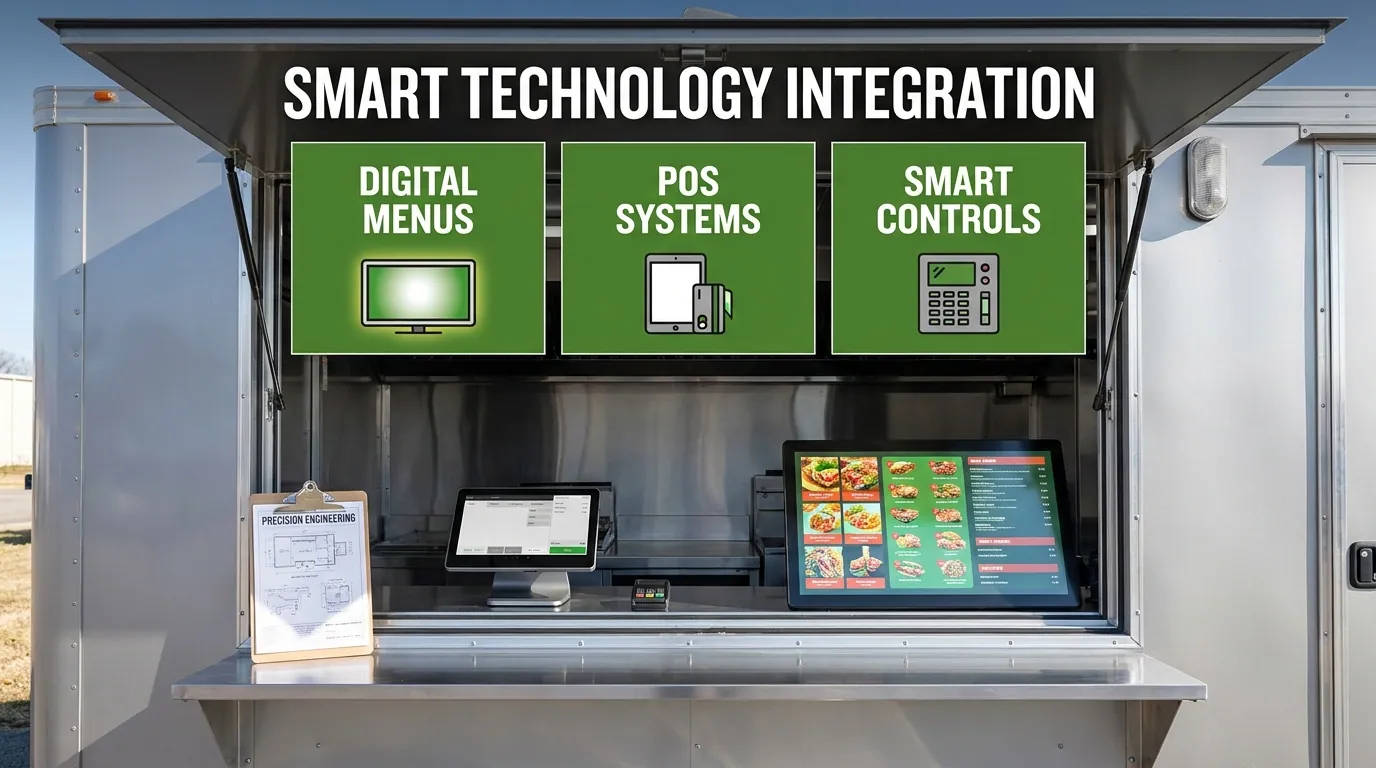
How Do Integrated POS and Digital Menu Boards Improve Service Speed?
Integrated POS and digital menu boards improve service speed by reducing order processing time and eliminating manual menu updates. A POS system built into the serving counter consolidates ordering, payment, and inventory tracking into a single touchpoint, cutting the steps between a customer’s decision and a completed transaction.
Digital menu boards sync directly with the POS to display real-time pricing, sold-out items, and promotional combos. According to a 2019 study published in INFORMS Management Science, tabletop ordering technology improved average sales per check by approximately 1% and reduced meal duration by close to 10%. When these systems are designed into the trailer from the start, wiring runs are concealed, screen placements align with sightlines, and power loads are calculated into the electrical plan. For operators running high-volume events, that combination of faster throughput and higher ticket averages compounds quickly across a full service day.
How Does Smart Ventilation and Climate Control Enhance Food Quality?
Smart ventilation and climate control enhance food quality by maintaining consistent cooking temperatures and removing airborne contaminants in real time. Demand-controlled kitchen ventilation (DCKV) adjusts exhaust fan speed based on actual cooking output rather than running at full capacity continuously.
According to the U.S. Environmental Protection Agency’s ENERGY STAR program, field studies suggest that DCKV energy savings could reach 60% or more depending on the facility and type of operation. In a concession trailer, where space is compact and heat buildup is rapid, this technology stabilizes the environment around holding stations and prep surfaces. Stable air temperature prevents premature food degradation, while proper ventilation removes grease-laden vapor before it settles on ingredients or equipment. Custom builds allow DCKV sensors, ductwork, and controls to be engineered into the trailer shell during fabrication rather than retrofitted afterward.
With the right technology designed into the build, choosing a manufacturer who can integrate these systems becomes the next critical decision.
How Should You Choose a Manufacturer for Your Custom Concession Trailer?
You should choose a manufacturer that controls every phase of production, from design and engineering through fabrication and graphics. The sections below cover vertically integrated building and the key takeaways from all ten benefits we discussed.
Can a Vertically Integrated Builder Like Craftsmen Industries Deliver End-to-End Custom Concession Trailer Solutions?
Yes, a vertically integrated builder like Craftsmen Industries can deliver end-to-end custom concession trailer solutions. Craftsmen Industries operates from a 127,000 sq. ft. facility near St. Louis County, Missouri, housing in-house design, engineering, fabrication, printing, and installation under one roof. This single-source model eliminates coordination delays between separate vendors and keeps quality consistent across every build phase. According to the Missouri Department of Labor and Industrial Relations, Craftsmen Industries is a leading provider of innovative mobile solutions for the industrial, military, medical, experiential, and kitchens industries, in addition to large format printing and architectural signage. With over 40 years of experience since its 1982 founding, Craftsmen Industries brings clients’ visions to life from ideation to creation.
What Are the Key Takeaways About 10 Benefits of Custom Concession Trailers We Covered?
The key takeaways about the 10 benefits of custom concession trailers are:
- Tailored menu layouts and optimized serving windows increase average order value and transaction speed.
- Branded exterior wraps and cohesive interior finishes build instant recognition and customer loyalty.
- Purpose-built kitchen workflows cut labor costs while custom equipment integration minimizes downtime.
- Layouts designed around health codes simplify inspections, and built-in sanitation stations prepare you for evolving FDA guidelines.
- Modular interiors adapt to different event types and seasonal menu changes far more easily than stock units.
- Commercial-grade materials and energy-efficient equipment lower long-term ownership and operating costs.
- Unique designs attract more foot traffic and differentiate you from generic competitors.
- Replicable build specifications streamline fleet expansion and strengthen financing approval.
- Integrated POS systems, digital menu boards, and smart ventilation enhance both service speed and food quality.
- A vertically integrated manufacturer like Craftsmen Industries delivers all these advantages through a single, accountable build partner.
For operators ready to capture their share of the mobile food industry, Craftsmen Industries transforms these ten benefits into a custom concession trailer built to exact specifications.
Filter Posts by Tag
related posts
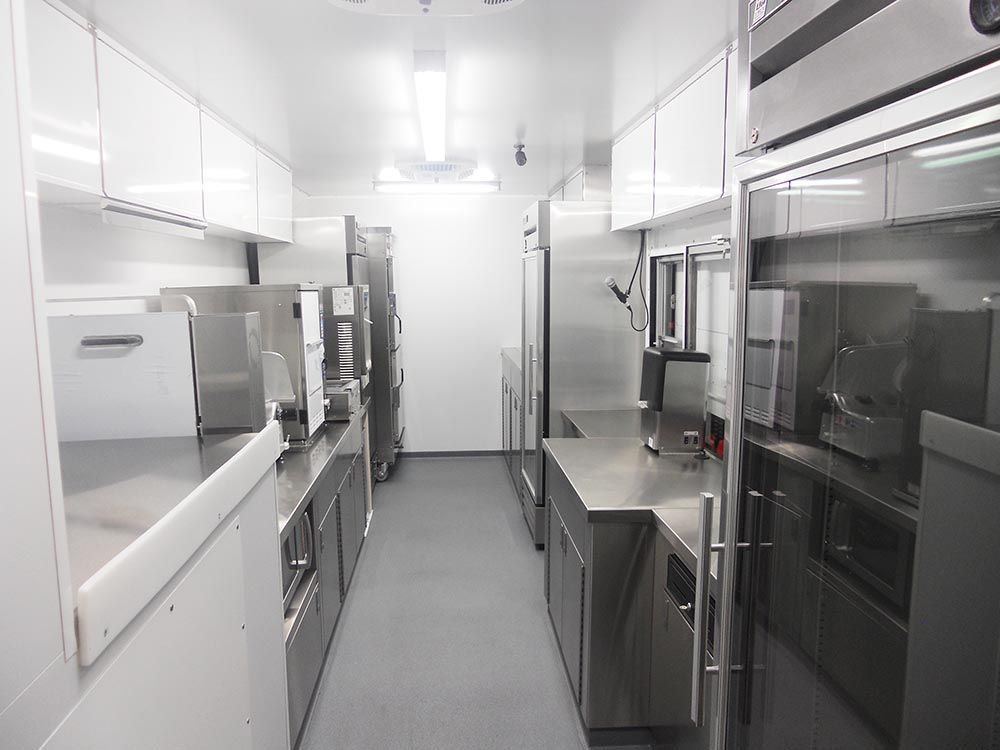
Whether you install an air conditioner yourself or bring it into a professional, you’re doing the right thing for your food truck business. Read on.
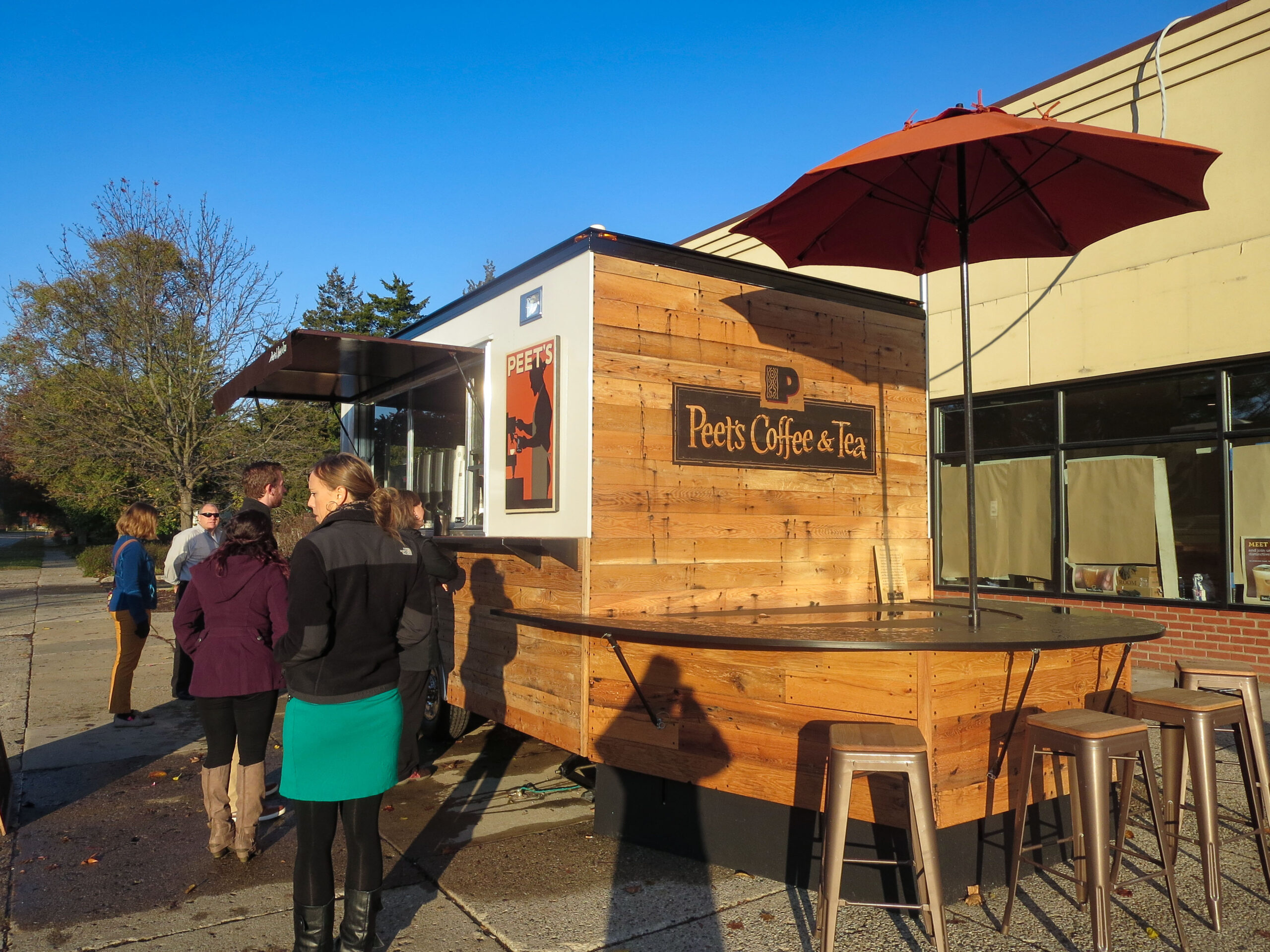
Explore a variety of different tricks and tips for utilizing your building more effectively and enlarging usable space without huge renovation expenses.
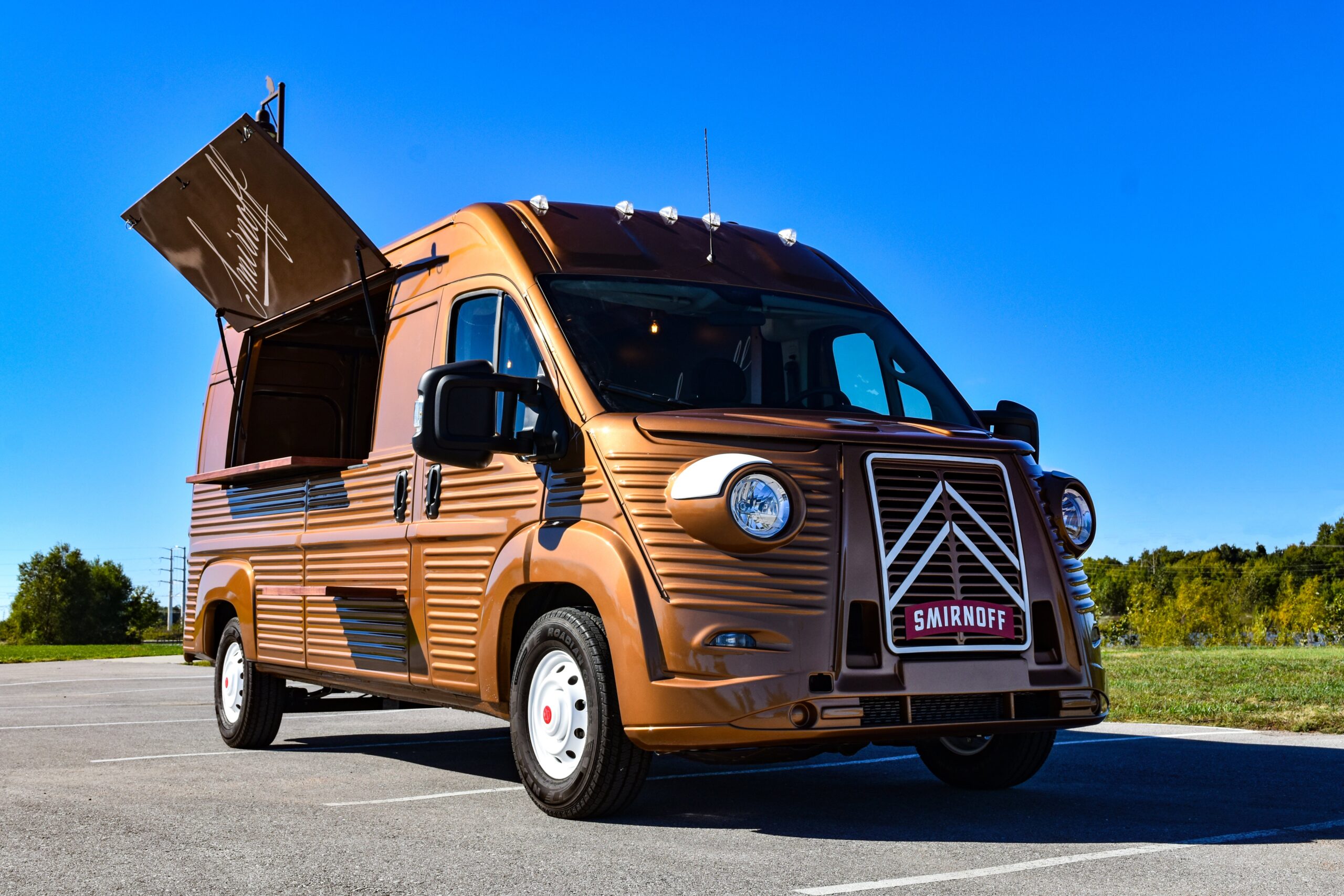
Lead your industry with memorable brand experiences using mobile sampling units! MKTG & Craftsmen created five Smirnoff sampling vans.
