
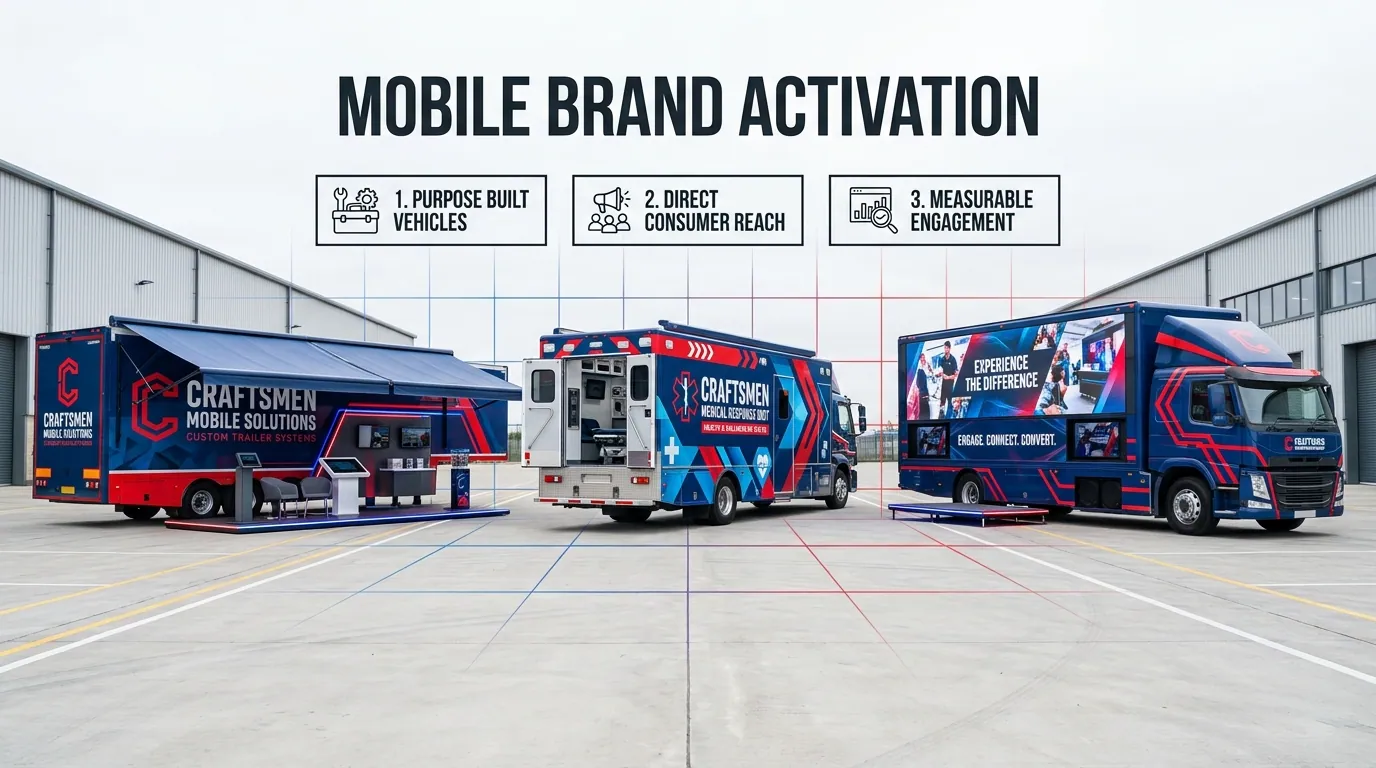
Mobile brand activation is a marketing strategy that deploys purpose-built vehicles and portable installations to bring branded experiences directly to consumers across multiple markets. Rather than relying on fixed locations, this approach uses custom vans, trailers, shipping containers, and mobile showrooms to create controlled, repeatable engagement wherever audiences gather.
This guide covers activation formats and vehicle types, emerging technology and sustainability trends, industry-specific use cases, campaign planning and ROI measurement, and vehicle builder selection and budgeting.
Mobile activations take many forms, from experiential marketing vehicles and pop-up shops to branded food trucks, health screening units, gaming trailers, and cause-driven nonprofit campaigns. Each format serves distinct objectives, whether driving product trial, delivering community health services, or supporting military morale programs in remote locations.
Six trends are reshaping the discipline in 2026: AI-driven personalization that adapts on-site content to individual visitors, augmented reality overlays that transform vehicle interiors into immersive storytelling platforms, solar-powered and modular builds that meet tightening sustainability mandates, real-time data capture that compresses campaign optimization from weeks to hours, and hybrid digital-physical formats that multiply each tour stop’s reach through smartphone sharing and QR-based interactions.
Consumer brands, healthcare organizations, government agencies, and nonprofits each deploy mobile assets for different outcomes, from product launches and community screenings to census outreach and disaster preparedness education. Effective campaigns require measurable objectives, baseline KPIs set before launch, and cross-channel evaluation across paid, earned, shared, and owned media.
Choosing the right vehicle builder means verifying federal safety certification, ADA compliance, USDOT registration readiness, and structured post-build maintenance support. Custom build costs scale with vehicle platform, technology integration, and compliance requirements, making early collaboration with a fabrication partner essential for accurate budgeting.
What Does Mobile Brand Activation Mean?
Mobile brand activation is a marketing strategy that brings branded experiences directly to consumers through purpose-built vehicles and portable installations. Rather than waiting for audiences to visit a fixed location, this approach deploys custom vans, trailers, shipping containers, and store-on-wheels formats to engage people where they live, work, and gather.
The concept sits at the intersection of experiential marketing and mobile outreach. According to a 2021 exploratory survey of 31 marketing experts published in the Journal of Risk and Financial Management (MDPI), experiential marketing has been globally embraced as a guide to designing memorable experiences that satisfy target consumers. Mobile brand activation takes that principle on the road, combining physical interaction with geographic flexibility.
What distinguishes this strategy from static experiential campaigns is its ability to reach multiple markets within a single campaign cycle. A branded vehicle can serve as a pop-up shop in one city, a product demonstration space the next week, and a sampling station at a festival the following month. Toronto Metropolitan University’s academic classification identifies these mobile formats as “nomad stores,” noting that they often use vans, shipping containers, or portable kiosks and relocate frequently.
For brands, the value lies in controlled, repeatable face-to-face engagement at scale. Every touchpoint is designed, staffed, and measured, turning a vehicle into a self-contained marketing environment that travels to the audience rather than relying on foot traffic or digital impressions alone.
Why Is Mobile Brand Activation Important for Modern Marketing?
Mobile brand activation is important for modern marketing because it brings branded experiences directly to consumers in their own communities, bypassing the limitations of fixed-location events. The scale of this opportunity, the reach of mobile audiences, and the amplification power of social sharing each contribute to its growing role.
Massive Event Industry Scale Creates Opportunity
Business events in 2025 brought 1.65 billion participants across more than 180 countries and generated US $1.3 trillion in direct spending, according to the Events Industry Council. Mobile brand activation taps into this ecosystem by meeting audiences where they already gather, from festivals and trade shows to community events and retail corridors. For brands competing for attention in crowded markets, a mobile asset that travels to high-traffic moments offers a distinct advantage over waiting for consumers to visit a static location.
Smartphone Saturation Amplifies Physical Experiences
Nearly universal smartphone ownership transforms every in-person brand interaction into a potential digital content moment. According to Pew Research Center, 98% of U.S. adults owned a cellphone and roughly 91% owned a smartphone in 2025. When attendees photograph, film, or share a mobile activation on social media, they generate organic reach that extends far beyond the physical footprint of the event. This convergence of physical experience and mobile-device sharing is what separates activation marketing from traditional advertising.
Social Media Growth Extends Campaign Reach
Mobile activations produce shareable, visually compelling content that feeds directly into the fastest-growing digital advertising channel. The U.S. International Trade Administration forecasts the global social media advertising segment will grow at approximately 18.1% per year through 2026, with mobile social media advertising revenue exceeding desktop. Each activation stop becomes a content-production engine; attendees create user-generated posts while brands capture professional footage for paid campaigns. This dual content loop means a single mobile tour can sustain weeks of digital engagement across paid, earned, shared, and owned channels.
Direct Consumer Access Removes Geographic Barriers
Fixed experiential venues limit audience reach to a single market. Mobile brand activation eliminates that constraint by deploying branded vehicles, trailers, or pop-up units across multiple cities, regions, or event circuits within a single campaign window. Healthcare organizations, government agencies, and consumer brands alike use this model to reach underserved or geographically dispersed populations. The ability to relocate frequently turns one asset into a multi-market strategy, making mobile activation one of the most efficient formats for brands that need broad geographic coverage without building permanent infrastructure.
Understanding why mobile activation matters sets the stage for exploring the specific formats brands use to execute these campaigns.
What Are the Main Types of Mobile Brand Activation?
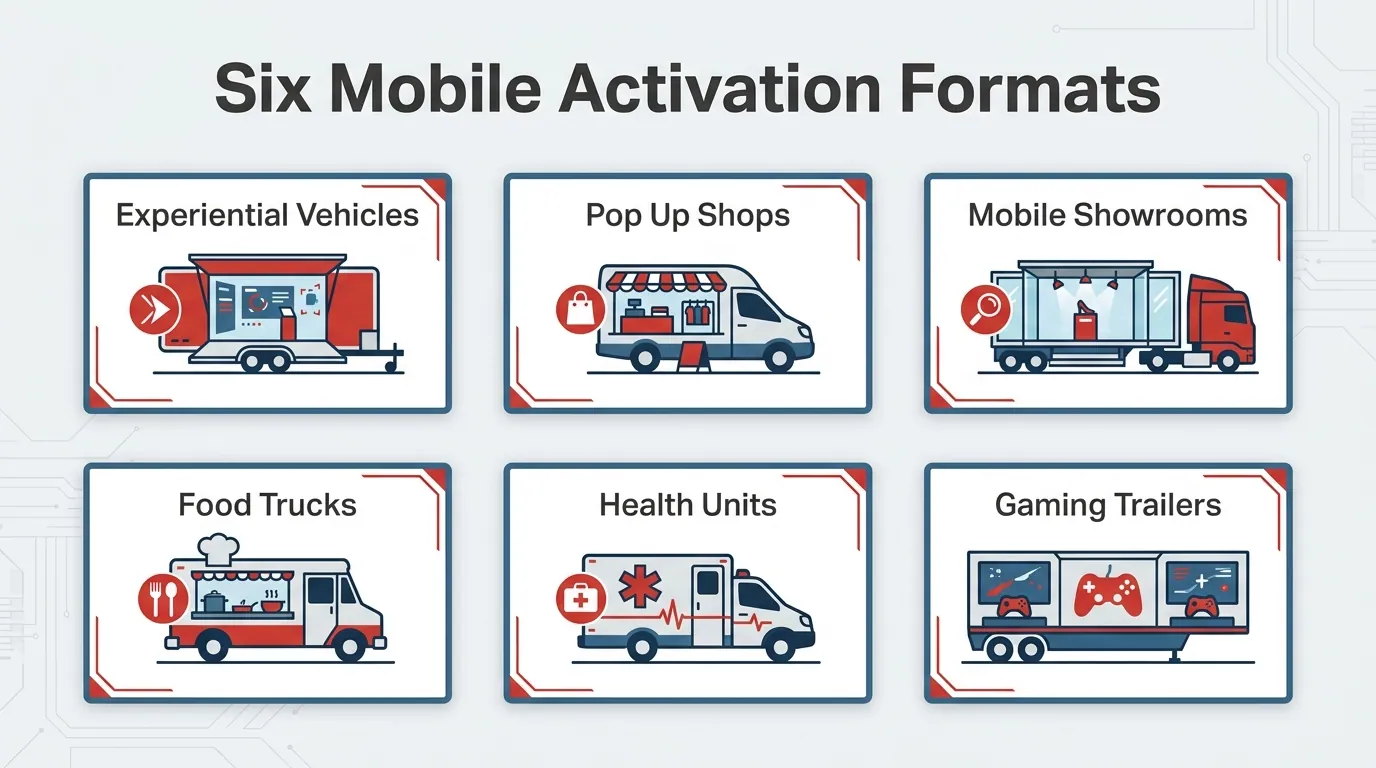
The main types of mobile brand activation include experiential marketing vehicles, mobile pop-up shops, mobile showrooms, branded food and beverage trucks, health and wellness units, cause-driven campaigns, and gaming or entertainment vehicles.
Experiential Marketing Vehicles
Experiential marketing vehicles are custom-built mobile units designed to create memorable, hands-on brand encounters at events, festivals, and high-traffic locations. According to a 2021 study in the Journal of Risk and Financial Management surveying 31 global marketing experts, experiential marketing has been “globally embraced as a guide to designing memorable experiences that succeed in satisfying target consumers.” These vehicles range from converted vans and trailers to fully engineered semi-truck builds, each tailored to a brand’s specific activation goals. For marketers seeking maximum creative control over audience interaction, a purpose-built vehicle consistently outperforms rented or generic event spaces.
Mobile Pop-Up Shops
Mobile pop-up shops are temporary, relocatable retail environments that bring products directly to consumers. According to a Toronto Metropolitan University textbook, a “nomad store” is a mobile pop-up that “often uses a van, shipping container or store-on-wheels format (e.g., portable kiosk) and re-locates frequently.” Academic literature classifies several functional subtypes:
- Experiential pop-ups focus on immersive brand storytelling.
- Transactional pop-ups prioritize direct sales.
- Testing pop-ups gather consumer feedback on new products.
- Communicational pop-ups build awareness without a sales component.
This flexibility makes mobile pop-up shops one of the most versatile activation formats available.
Mobile Showrooms and Product Demonstrations
Mobile showrooms are enclosed vehicles configured to display and demonstrate products in a controlled environment. Brands use them to bring full product lines, interactive displays, or hands-on sampling stations to dealerships, corporate campuses, or consumer events. Unlike open-air booths, a mobile showroom protects sensitive technology and maintains consistent climate control, lighting, and branding. The format works especially well for automotive, electronics, and B2B product launches where tactile engagement drives purchase decisions.
Branded Food and Beverage Trucks
Branded food and beverage trucks are self-contained mobile kitchens wrapped in custom brand graphics. The Texas Department of State Health Services defines a food vending vehicle as “a self-enclosed food service establishment (including catering trucks, trailers, and roadside vendors ) or pushcart that operates to store, prepare, display, serve, or sell food as a food service establishment, and is designed to be readily movable.” These trucks require health-department permits, commissary agreements, and food-safety compliance in every jurisdiction they visit. When properly executed, a branded food truck turns a simple meal into a sensory brand experience that generates social sharing and sustained foot traffic.
Mobile Health and Wellness Activations
Mobile health and wellness activations are vehicle-based programs that deliver screenings, consultations, or wellness services directly to communities. The Rural Health Information Hub defines mobile units as “vans or other vehicles staffed with medical personnel and equipped to offer onsite mental health services.” According to Harvard Medical School, Nancy Oriol, founder of The Family Van, states that “for every $1 spent on mobile health, U.S. health systems save $19.” These activations serve both public health missions and corporate wellness branding, reaching underserved populations that traditional brick-and-mortar facilities often miss.
Cause-Driven and Nonprofit Mobile Campaigns
Cause-driven and nonprofit mobile campaigns are vehicle-based activations that advance a social mission rather than a commercial product. The USO’s Mobile USO program, which includes a dedicated NFL-themed gaming trailer, exemplifies this format by bringing morale-boosting experiences to military personnel in remote locations. Nonprofits benefit from the same audience-engagement principles that power commercial activations, including custom interiors, branded wraps, and interactive technology. For organizations with limited real estate budgets, a mobile campaign extends geographic reach without the overhead of permanent facilities.
Mobile Gaming and Entertainment Units
Mobile gaming and entertainment units are custom vehicles outfitted with video game consoles, screens, and immersive audio-visual systems. The USO describes its Mobile USO vehicles as “Centers-on-wheels” that travel to remote and austere locations, with the USO-NFL Mobile Gaming Trailer featuring “an NFL-themed interior and state-of-the-art video gaming equipment.” This format appeals to younger demographics and generates high dwell times at festivals, sporting events, and campus activations. Understanding these vehicle types sets the foundation for evaluating which emerging trends will shape mobile brand activation strategy.
What Are the Top Mobile Brand Activation Trends?
The top mobile brand activation trends center on AI-driven personalization, augmented reality, sustainability, real-time data capture, hybrid digital-physical formats, and modular vehicle design. Each trend reshapes how brands engage audiences on the ground.
How Is AI-Driven Personalization Changing On-Site Engagement?
AI-driven personalization is changing on-site engagement by tailoring content, product recommendations, and interactive displays to individual visitors in real time. Sensors, facial recognition kiosks, and behavioral tracking allow mobile activation vehicles to adapt messaging the moment a consumer steps inside. AI-enabled tailoring uses biometric data and spatial data to customize each touchpoint, from digital screens to product sampling sequences. For brands running multi-city mobile tours, this means every stop delivers a locally relevant, individually tuned experience rather than a static, one-size-fits-all presentation. The result is deeper dwell time and stronger emotional connection, both of which directly influence post-event conversion rates.
How Are Augmented Reality Experiences Reshaping Mobile Activations?
Augmented reality experiences are reshaping mobile activations by layering digital content onto physical environments inside branded vehicles and pop-up footprints. Visitors can visualize products in context, interact with 3D models, or participate in gamified brand stories using smartphones or on-site AR headsets. According to NIST’s 2025 immersive-technology workshop report (NIST IR 8557), augmented reality, mixed reality, real-time spatial mapping, and AI-enabled tailoring all require usable cybersecurity and privacy controls. Brands adopting AR in mobile settings must therefore build data-protection protocols into the activation design from the start. When implemented responsibly, AR transforms a trailer or showroom into an immersive storytelling platform that competitors using static displays simply cannot match.
Why Is Sustainability a Priority in Activation Design?
Sustainability is a priority in activation design because consumers, event organizers, and municipal regulators increasingly demand verifiable environmental accountability. Solar photovoltaic systems, hybrid power units, and eco-certified materials now appear in mobile build specifications alongside traditional HVAC and LED lighting. According to the International Energy Agency, solar photovoltaic deployment over the previous six years was avoiding around 1.4 gigatonnes of annual global emissions. Mobile activations benefit directly from this momentum; solar-equipped trailers reduce generator dependence, lower carbon output, and align brand messaging with demonstrated action rather than claims alone.
How Is Real-Time Data Capture Improving Campaign ROI?
Real-time data capture is improving campaign ROI by giving activation teams immediate visibility into foot traffic, dwell time, engagement sequences, and lead quality at every tour stop. On-vehicle sensors, tablet-based surveys, QR-code scans, and Wi-Fi analytics feed dashboards that allow teams to adjust staffing, messaging, and product displays mid-campaign. This continuous feedback loop replaces the outdated approach of waiting until a tour ends to evaluate performance. Brands that act on live data can reallocate budget toward high-performing markets and refine underperforming activations before the next city, compressing the optimization cycle from weeks to hours.
Why Are Hybrid Digital-Physical Activations Gaining Momentum?
Hybrid digital-physical activations are gaining momentum because they extend a single mobile event’s reach far beyond the physical footprint. Livestreaming from inside a branded vehicle, social-media integrations, and QR-based shopping bridges let remote audiences participate alongside on-site visitors. With 98% of U.S. adults owning a cellphone and approximately 91% owning a smartphone in 2025, according to Pew Research Center, the digital layer of any physical activation has a massive addressable audience. Combining tangible, in-person experiences with simultaneous digital amplification multiplies impressions per tour stop and creates content that continues generating engagement long after the vehicle leaves.
How Is Modular Vehicle Design Enabling Faster Deployments?
Modular vehicle design is enabling faster deployments by allowing interchangeable interior components, wall panels, and technology packages to be swapped between campaigns without a full rebuild. A single trailer chassis can serve as a product showroom one month and a healthcare screening unit the next when modular inserts are engineered for quick installation. This approach reduces lead times, lowers per-campaign fabrication costs, and gives brands the flexibility to respond to seasonal opportunities or emerging market needs. For organizations running multiple activations annually, modularity turns a capital-intensive asset into a reusable platform.
With these trends accelerating, choosing the right industries and use cases becomes the next strategic decision.
What Industries Use Mobile Brand Activation Most Effectively?
The industries that use mobile brand activation most effectively include consumer packaged goods, healthcare, government and military, and nonprofit organizations. Each sector deploys mobile assets for distinct objectives.
How Do Consumer Brands Use Mobile Activations for Launches?
Consumer brands use mobile activations for launches by deploying branded vehicles, pop-up shops, and sampling tours that bring new products directly to target audiences. CPG companies frequently use experiential vehicles to create hands-on trial moments at festivals, retail locations, and high-traffic urban areas. These activations generate real-time social content and immediate consumer feedback, both of which accelerate launch momentum. For brands competing in crowded retail categories, a mobile activation creates a controlled brand environment that stands apart from shelf-level competition; this direct sensory engagement is often impossible to replicate through digital channels alone.
How Does Healthcare Use Mobile Units for Community Outreach?
Healthcare uses mobile units for community outreach by deploying staffed vehicles equipped with diagnostic, screening, and treatment capabilities to underserved populations. Mobile medical units reach patients who face geographic, financial, or social barriers to care. According to a 2024 scoping review published in the Journal of General Internal Medicine, 50 peer-reviewed U.S. studies examined mobile medical units serving people experiencing homelessness; outcome reporting covered service and logistics measures in 58% of studies, health outcomes in 16%, patient-centered measures in 14%, healthcare utilization in 10%, and cost analysis in 6%. This evidence base confirms that mobile health outreach delivers measurable community impact well beyond simple awareness campaigns.
How Do Government and Military Organizations Use Mobile Assets?
Government and military organizations use mobile assets for public engagement, recruitment, training, and morale support in locations where permanent facilities are impractical. The United Service Organizations operates Mobile USO vehicles described as “USO Centers-on-wheels” that travel to remote and austere locations, including a dedicated USO-NFL Mobile Gaming Trailer with an NFL-themed interior and state-of-the-art video gaming equipment. Government agencies also leverage mobile platforms for census outreach, disaster preparedness education, and community engagement tours. These programs demonstrate that mobile activation extends well beyond commercial marketing into compliance-driven, public-purpose missions that require specialized vehicle fabrication and mission-specific interiors.
How Are Nonprofits Leveraging Mobile Campaigns for Awareness?
Nonprofits are leveraging mobile campaigns for awareness by using branded vehicles and cause-driven tours to reach communities where traditional advertising has limited penetration. Mobile platforms allow organizations to deliver education, screenings, resource distribution, and enrollment assistance at the point of need. This approach is particularly effective for health-focused nonprofits, disaster relief organizations, and social service agencies that must build trust through face-to-face interaction. For nonprofits operating on constrained budgets, a single well-designed mobile unit can serve as a traveling headquarters, combining outreach, data collection, and volunteer coordination into one redeployable asset.
With industry applications spanning product sampling to life-saving health screenings, effective planning determines whether a mobile campaign meets its objectives.
How Do You Plan a Successful Mobile Brand Activation Campaign?
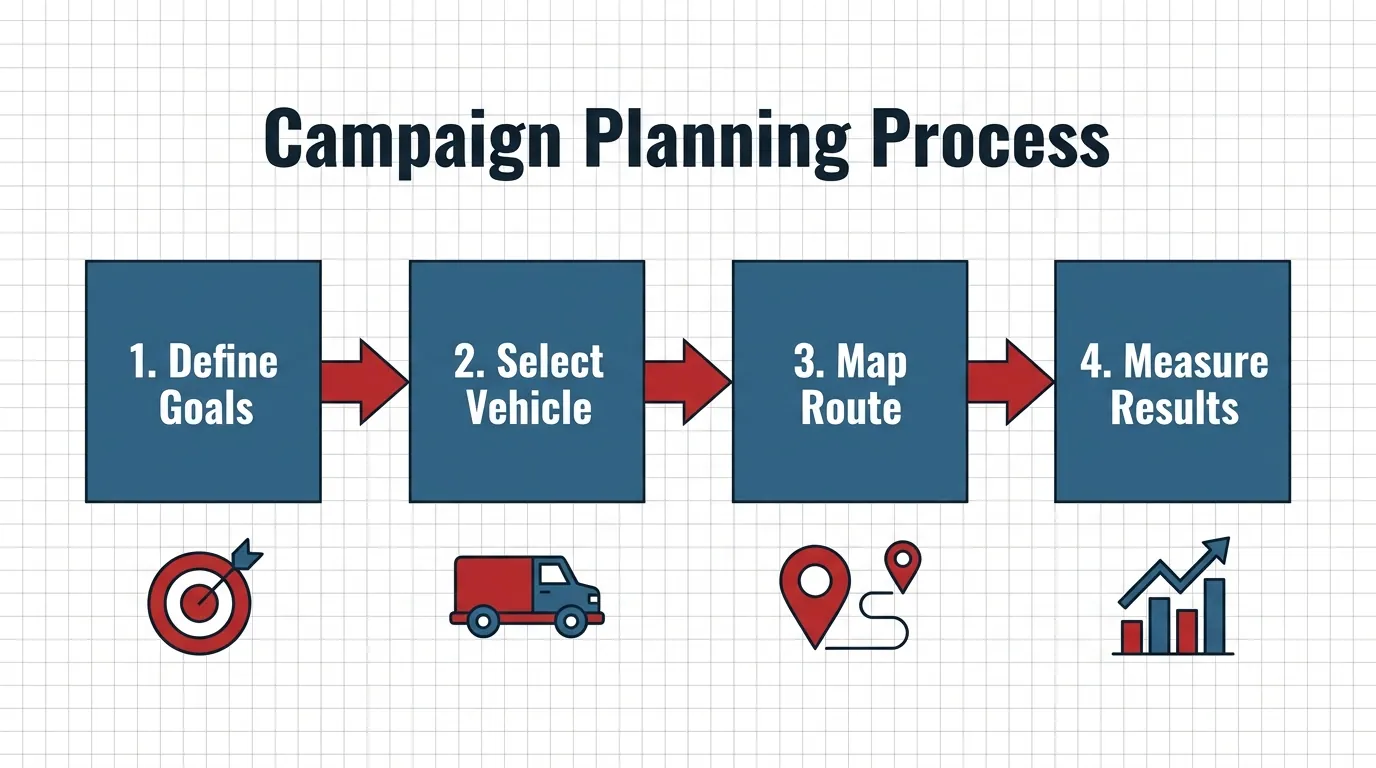
You plan a successful mobile brand activation campaign by defining measurable objectives, selecting the right vehicle format, mapping a strategic route, and building a measurement framework before launch. The steps below cover goal-setting, audience targeting, logistics, and KPI alignment.
A mobile brand activation campaign succeeds when every decision traces back to a specific, measurable goal. Before selecting a vehicle or booking a single venue, the planning team needs clarity on what the activation must achieve and how results will be evaluated across every channel it touches.
The first step is establishing campaign objectives tied to concrete KPIs. According to the International Association for Measurement and Evaluation of Communication (AMEC), planners should “set measurable goals, targets and KPI metrics” and measure holistically across paid, earned, shared, and owned channels, using metrics such as cost per engagement. Vague goals like “increase awareness” fail because they resist quantification. Instead, define targets: a specific number of product demos, email sign-ups, social shares, or qualified leads per stop.
Audience research follows directly. Identify where your target consumers gather, what motivates them to engage in person, and which vehicle format best matches their expectations. A branded food truck resonates differently than a mobile showroom or a health screening unit. Route planning should prioritize high-density audience locations, favorable permitting timelines, and logistical feasibility for the chosen vehicle size.
Logistics and compliance form the operational backbone. Secure event permits, confirm power and connectivity requirements at each stop, coordinate staffing, and establish contingency plans for weather or equipment issues. Every activation stop should have a standardized setup and teardown protocol to maintain brand consistency.
Finally, lock in your measurement framework before the tour launches. Establish baseline metrics for every KPI so post-campaign analysis has a clear reference point. Plan to capture data at every touchpoint: foot traffic counters, QR scans, social media mentions, lead forms, and on-site surveys. Without pre-set baselines and consistent data collection, even a well-executed activation produces insights that are difficult to act on.
For most brands, the planning phase deserves as much creative energy as the activation itself; campaigns that shortcut this stage tend to generate impressions without conversions.
How Do You Measure ROI for a Mobile Brand Activation?
You measure ROI for a mobile brand activation by linking objective-specific KPIs to baseline metrics, then tracking results across phased timeframes and multiple channels. No universally accepted attribution model exists for mobile activations, so measurement must be tailored to each campaign’s goals.
The most effective approach combines pre-campaign baselines with short-, mid-, and long-term outcome tracking. The CDC’s campaign-evaluation playbook recommends establishing baseline metrics before campaign kickoff and then measuring implementation outcomes, audience reach, website visits, awareness shifts, actions taken, and qualitative feedback across defined intervals. This phased structure works well for mobile activations because a single tour stop generates engagement data immediately while brand-lift effects unfold over weeks.
Key metrics to track for mobile brand activation ROI include:
- Foot traffic and dwell time at each activation location.
- Cost per engagement, calculated by dividing total activation spend by qualified interactions.
- Social media impressions and shares generated from on-site content creation.
- Lead capture volume, including email sign-ups, QR code scans, and sample requests.
- Post-event conversion rate from leads to purchases or desired actions.
- Earned media value from press coverage and organic social mentions.
- Brand awareness lift measured through pre- and post-campaign surveys.
Cross-channel evaluation is essential because mobile activations drive results across paid, earned, shared, and owned media simultaneously. A visitor might interact with a branded vehicle at an event, post about it on social media, and convert through a retargeted digital ad days later. Single-channel attribution misses this compound effect entirely.
For most mobile activation campaigns, prioritizing two or three KPIs tied directly to business objectives yields clearer insights than tracking every available metric. Brands that try to measure everything often dilute their focus and struggle to connect activation performance to revenue impact. Start with the outcome your stakeholders care about most, build your measurement framework around it, and layer in secondary metrics only where they support the core story.
What Should You Look for in a Mobile Activation Vehicle Builder?
You should look for a mobile activation vehicle builder that demonstrates regulatory compliance expertise, end-to-end fabrication capability, and documented maintenance support. The subsections below cover federal safety certification, accessibility requirements, registration obligations, permitting logistics, and ongoing maintenance standards.
Does the Builder Meet Federal Motor Vehicle Safety Standards?
A qualified builder meets Federal Motor Vehicle Safety Standards by certifying every completed vehicle before delivery. According to the National Highway Traffic Safety Administration, when the incomplete vehicle is not a chassis cab, the final-stage manufacturer must certify compliance with all applicable Federal Motor Vehicle Safety Standards and exercise due care when changing the gross vehicle weight rating. This requirement means your builder assumes legal responsibility for structural, electrical, and mechanical safety of the finished activation vehicle. Any fabricator unwilling to document FMVSS certification in writing should be disqualified early in the selection process.
Can the Builder Ensure ADA-Compliant Vehicle Accessibility?
Yes, the builder can ensure ADA-compliant vehicle accessibility if their design process accounts for federal accessibility mandates from the start. The U.S. Access Board states that new vehicles purchased or leased after August 25, 1990, must be accessible. For mobile activations, this means ramps, door widths, interior clearances, and interactive touchpoints must accommodate wheelchair users and visitors with mobility limitations. Builders who treat accessibility as an afterthought often face costly retrofits. The strongest partners integrate ADA requirements into initial engineering drawings rather than adding compliance features during final stages.
Is USDOT Registration Required for Mobile Activation Vehicles?
USDOT registration is required for mobile activation vehicles that exceed specific weight and passenger thresholds during interstate travel. The Federal Motor Carrier Safety Administration states that companies operating commercial vehicles transporting passengers or hauling cargo in interstate commerce must be registered and have a USDOT number; its thresholds include vehicles rated at 10,001 pounds or more and specified passenger-count categories. Most custom-built experiential trailers and mobile showrooms exceed that weight rating once fully outfitted. A knowledgeable builder factors FMCSA registration into project timelines so the vehicle is road-legal before your first tour stop.
How Should a Builder Handle Multi-City Permitting and Sustainability Requirements?
A builder should handle multi-city permitting and sustainability requirements by incorporating venue-specific regulations into the vehicle’s design and tour logistics plan. Charleston, South Carolina, for example, requires special-event applications 60 to 120 days before the event depending on scope and complexity, and mandates that every event follow single-use-plastic regulations. Permit timelines and sustainability rules vary dramatically between municipalities. Builders who maintain databases of local permitting contacts and material restrictions save brands weeks of pre-tour coordination. This operational knowledge separates fabrication shops from true activation partners.
What Post-Build Maintenance and Compliance Support Should You Expect?
You should expect post-build maintenance and compliance support that includes systematic inspection schedules, documented repair protocols, and parts-and-accessories monitoring. Federal motor-carrier rules under 49 CFR Part 396 require systematic inspection, repair, and maintenance of controlled commercial motor vehicles and require parts and accessories to remain in safe and proper operating condition. A reliable builder offers post-delivery service agreements covering HVAC, electrical systems, graphic wraps, and mechanical components. Without structured maintenance, even a well-engineered activation vehicle degrades quickly under the demands of a multi-city tour.
With builder selection criteria defined, the next consideration is project budget and vehicle pricing.
How Much Does a Custom Mobile Brand Activation Vehicle Cost?
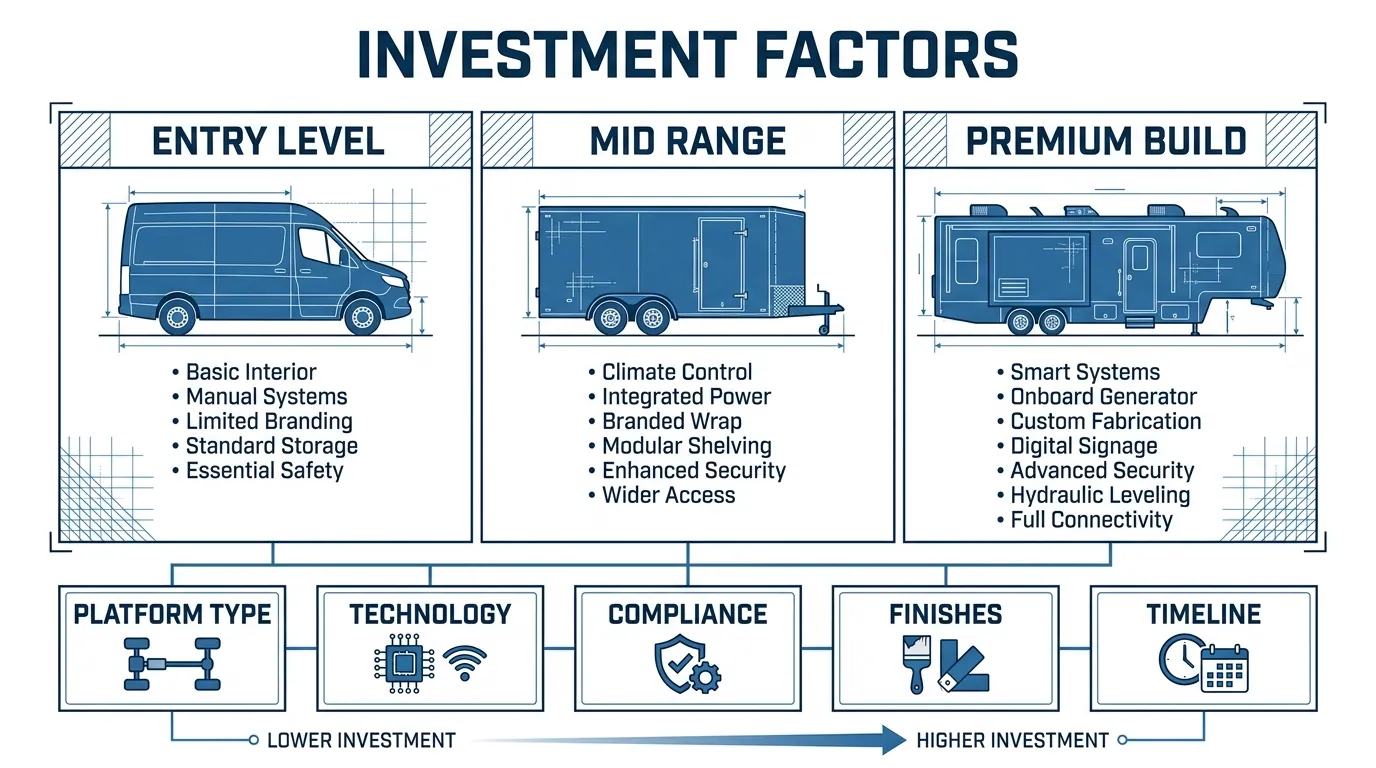
A custom mobile brand activation vehicle cost depends on vehicle type, size, technology integration, and build complexity. Key pricing factors include base chassis selection, interior systems, and component specifications.
Custom builds span a wide range. A basic branded van conversion with graphic wraps and minimal interior buildout represents the lower end of the investment spectrum. At the other end, a fully equipped, large-format activation vehicle with LED lighting, HVAC, Wi-Fi, awnings, and specialized electrical and plumbing systems commands significantly higher pricing. A federal GSA schedule lists a 38-foot self-propelled mobile clinic equipped with electrical, plumbing, LED lighting, HVAC, awning, graphic wrap, and Wi-Fi at US$390,311, with a stated delivery timeline of 600 days after receipt of order. That procurement benchmark, sourced from GSA Advantage!, reflects one specialized clinic configuration rather than a universal price point, but it illustrates how component-rich builds scale in cost.
Several factors drive the final investment:
- Vehicle platform: Vans, trailers, box trucks, and full-size coaches each carry different base costs and payload capacities.
- Technology integration: Adding augmented reality stations, real-time spatial mapping, biometric sensing, kiosks, laptops, or video-game consoles increases both hardware and engineering costs.
- Interior and exterior finishes: Custom graphic wraps, modular interior layouts, solar photovoltaic generation, and premium HVAC systems add to fabrication scope.
- Compliance requirements: Builds rated at 10,001 pounds or more may require USDOT registration through FMCSA, and NHTSA mandates that final-stage manufacturers certify compliance with all applicable Federal Motor Vehicle Safety Standards.
- Accessibility: The U.S. Access Board requires that new vehicles purchased or leased after August 25, 1990, be accessible.
- Permitting and logistics: Municipalities like Charleston, South Carolina, require special-event applications 60 to 120 days before the event, adding lead-time considerations to project budgets.
Operating costs also factor into the total investment picture. Beyond the initial build, brands like Samsung, Google, Walmart, Hershey’s, and IKEA that deploy mobile activation programs must account for staffing, fuel, maintenance under 49 CFR Part 396, insurance, and per-market permitting fees. For organizations focused on community impact, the operational economics can be compelling; a South African van-based mobile clinic evaluation published in PubMed reported an average cost per patient of just US$46.09 in one district.
No standardized North American price table exists that spans branded vans, food trucks, trailers, mobile showrooms, mobile clinics, gaming units, and high-technology builds. Every custom mobile brand activation vehicle is priced against its unique specifications, which makes early collaboration with a fabrication partner essential for accurate budgeting. Understanding compliance, technology, and activation goals upfront prevents costly mid-build scope changes that delay deployment.
What Common Mistakes Should You Avoid in Mobile Activations?
The common mistakes you should avoid in mobile activations include neglecting data privacy, ignoring accessibility requirements, skipping permit research, and failing to set measurable goals before launch.
- Collecting excessive consumer data. The FTC recommends privacy by design: collect only information needed, secure what you retain, limit internal access, and dispose of data no longer needed. According to FTC guidance on mobile marketing, brands should obtain express agreement before any non-apparent data collection or sharing. Overlooking these steps exposes campaigns to regulatory action and erodes consumer trust.
- Ignoring digital and physical accessibility. WCAG 2.2 Success Criterion 1.1.1 requires all non-text content to have a text alternative serving the equivalent purpose. Activation touchscreens, AR features, and interactive kiosks that lack accessible alternatives exclude participants and risk ADA complaints.
- Underestimating permitting timelines. Some municipalities require event applications 60 to 120 days in advance, with sustainability and single-use-plastic compliance built into approval conditions. Starting the permit process late forces route changes or cancellations.
- Launching without baseline metrics. Campaigns that skip pre-launch benchmarks cannot isolate what the activation actually achieved. Setting measurable KPIs across paid, earned, shared, and owned channels before deployment is the only way to calculate genuine return on investment.
- Overlooking vehicle compliance requirements. Vehicles above 10,001 pounds or carrying specified passenger counts must hold USDOT registration. Final-stage manufacturers must certify Federal Motor Vehicle Safety Standards compliance. Missing these steps can ground an entire tour.
In my experience, the most costly mistake is treating compliance and measurement as afterthoughts rather than building them into the activation design from day one. When privacy controls, accessibility, permitting, and KPIs are embedded during vehicle concepting, the campaign runs smoother and the data you collect is actually defensible.
With these pitfalls mapped, the next step is choosing a build partner who addresses them from the start.
How Can Custom Experiential Marketing Vehicles Elevate Your Mobile Brand Activation?
Custom experiential marketing vehicles elevate mobile brand activation by combining branded environments, mobility, and direct consumer interaction into a single deployable asset. The subsections below cover turnkey vehicle capabilities and the key trends shaping mobile activations.
Can Craftsmen Industries Build a Turnkey Mobile Activation Vehicle?
Yes, Craftsmen Industries can build a turnkey mobile activation vehicle. With over 40 years of custom fabrication experience and a 127,000 sq. ft. vertically integrated facility near St. Louis County, Missouri, Craftsmen Industries handles design, engineering, fabrication, large format graphics, and installation entirely in-house. This end-to-end control means a single team manages the project from concept through delivery.
Turnkey builds span multiple activation formats:
- Experiential marketing vehicles for mobile tours and brand events
- Mobile showrooms and product demonstration trailers
- Branded food and beverage trucks
- Mobile medical vehicles and diagnostic units
- Mobile command centers for government and military use
Any vehicle operating commercially must meet applicable federal requirements. According to NHTSA, final-stage manufacturers of non-chassis-cab incomplete vehicles must certify compliance with all applicable Federal Motor Vehicle Safety Standards. Craftsmen Industries builds to these regulatory standards while tailoring every interior layout, graphic wrap, and technology integration to the client’s activation goals.
What Are the Key Takeaways About Mobile Brand Activation Trends?
The key takeaways about mobile brand activation trends center on technology integration, sustainability, and data-driven measurement. According to the U.S. International Trade Administration, the global social media advertising segment is forecast to grow at roughly 18.1% per year through 2026, with mobile social media ad revenue surpassing desktop. This trajectory reinforces why physical activations must connect seamlessly to digital amplification channels.
Core trends to act on include:
- AI-driven personalization that tailors on-site experiences using real-time behavioral and spatial data
- Augmented and mixed reality overlays that deepen consumer engagement inside mobile environments
- Sustainable design incorporating solar power, modular builds, and eco-certified materials
- Real-time data capture enabling objective-linked KPIs, phased measurement, and cross-channel evaluation
- Hybrid digital-physical formats that extend a vehicle’s in-person reach through social sharing and QR-based interactions
For brands investing in mobile activations, the most practical approach is pairing a purpose-built vehicle with a measurement framework established before launch. Craftsmen Industries specializes in designing these custom experiential platforms, turning brand strategy into a road-ready asset built for measurable consumer engagement.
Filter Posts by Tag
related posts
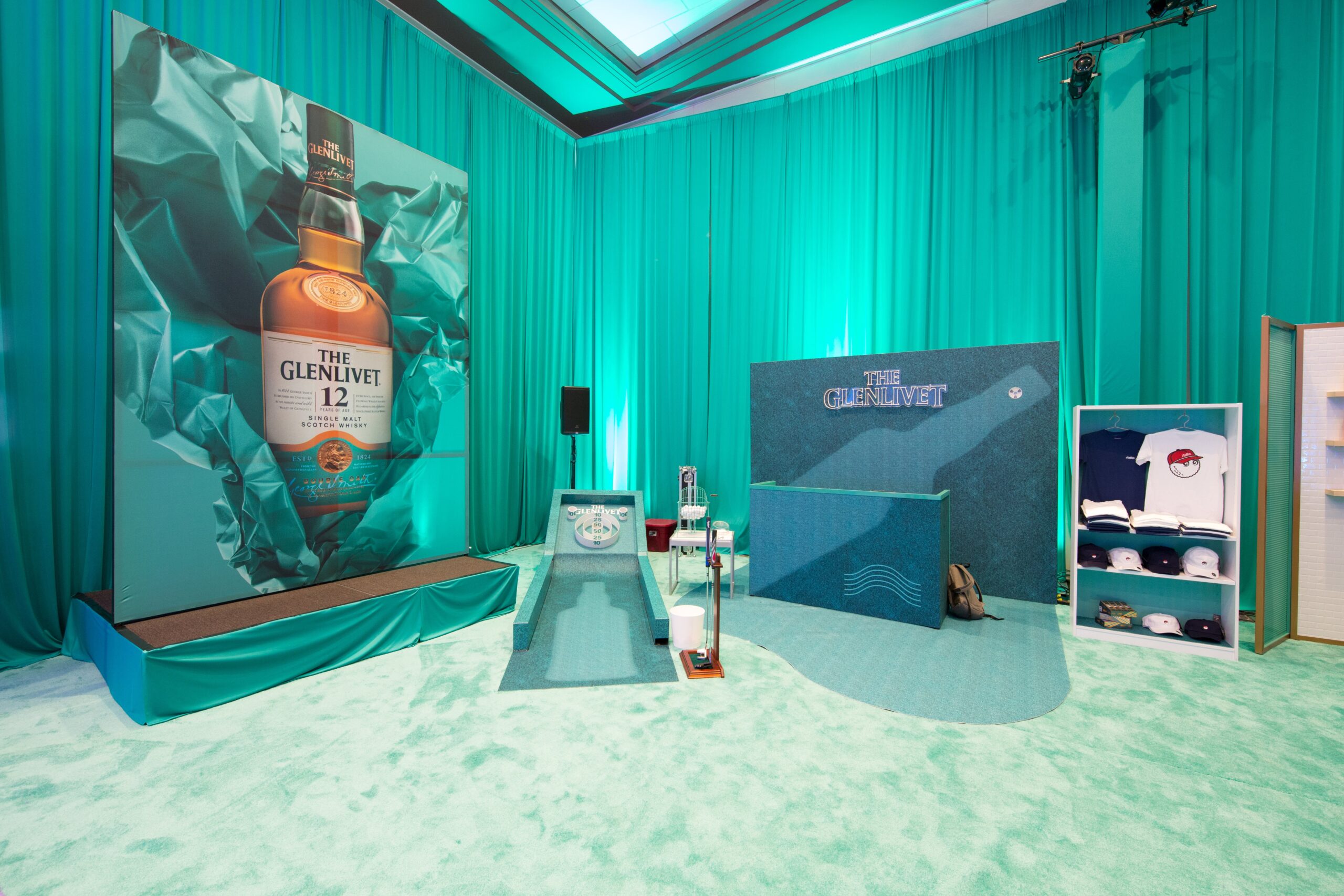
Learn what to include in on-site activation support packages to ensure smooth setup, real-time performance, and post-event success for your brand.
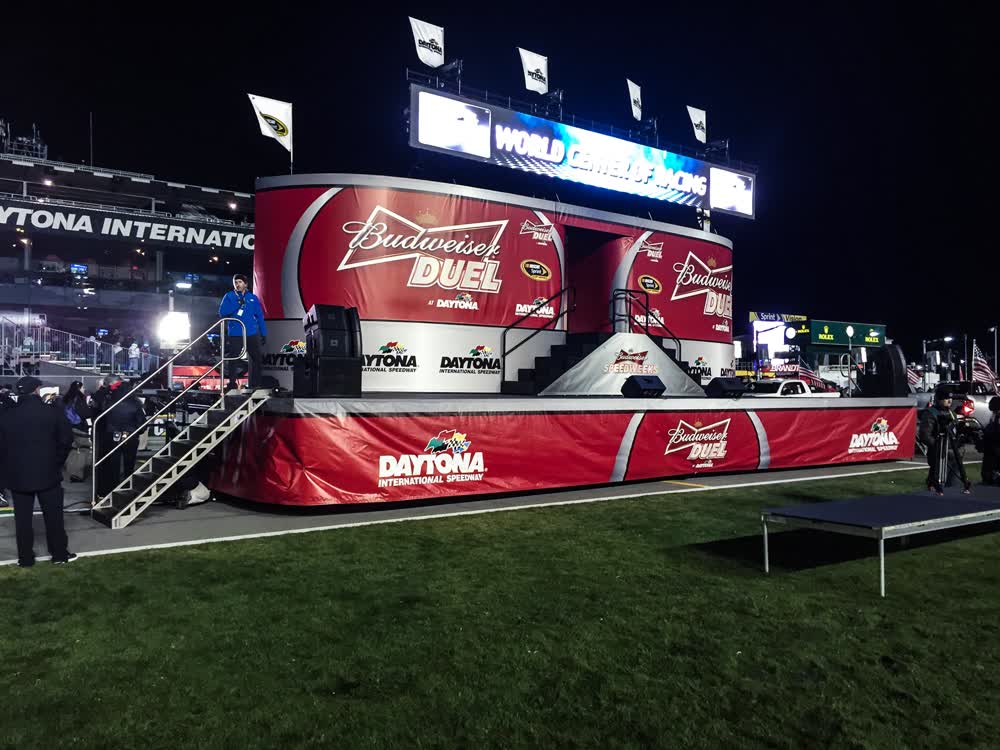
Learn best practices for setting up mobile stage trailers. Ensure safety, speed, and performance with expert tips for events, concerts, and festivals.

Experiential marketing is an innovative marketing method. Discover how it differs from traditional marketing strategies.
