
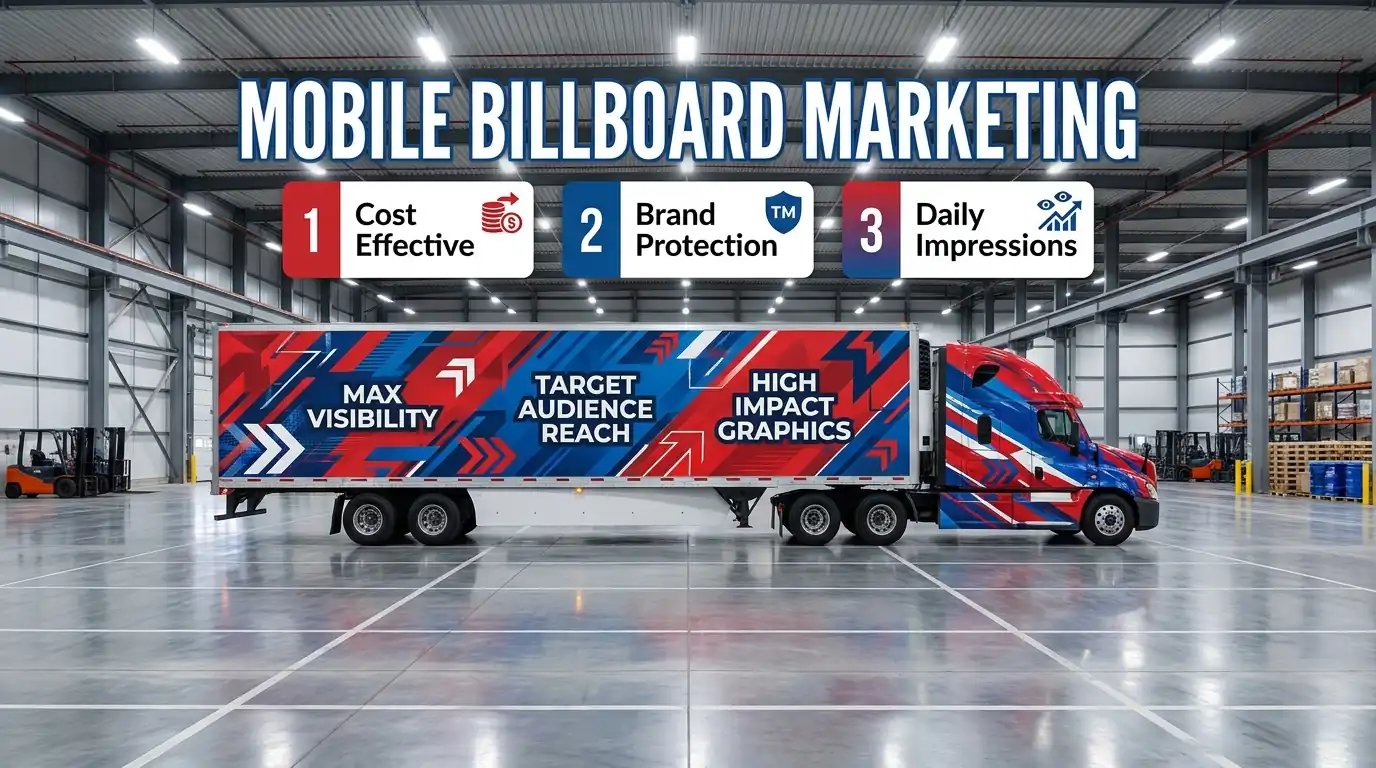
Vehicle wraps and vinyl branding are a form of out-of-home advertising that transforms company vehicles into mobile billboards, generating continuous brand exposure without recurring media spend. This guide covers advertising cost efficiency, daily impression volume and brand recognition, paint protection and vehicle compatibility, wrap durability and removability, geographic targeting and ROI, and regulatory compliance alongside fabrication partnerships.
Vehicle wraps consistently rank among the lowest cost-per-impression advertising formats available. When measured against digital ads, billboards, and print media, vinyl branding delivers CPM rates that drop further with each month the wrap remains on the road, making a single installation more cost-effective than repeated placements across other channels.
Every wrapped vehicle generates thousands of daily impressions that compound into accelerated brand recognition. Repeated sightings along consistent routes build familiarity faster than intermittent digital or broadcast placements, and the large visual surface area of a wrapped vehicle displays logos, colors, and contact information simultaneously.
Vinyl film creates a physical barrier that shields factory paint from UV radiation, road debris, and chemical contaminants. Wraps apply to virtually any vehicle type, from sedans and cargo vans to semi-trailers, transit buses, and custom experiential marketing builds.
Commercial-grade wraps last multiple years across heat, cold, and highway conditions, and they can be removed or updated without damaging the original finish. This flexibility lets businesses refresh branding on a schedule that matches campaign cycles rather than committing to permanent paint.
Wrapped fleets function as both local and national advertising assets, reaching neighborhood audiences on daily routes and distant markets during long-haul travel. Small and large fleets alike produce measurable ROI, while proper wrap design keeps vehicles compliant with federal DOT marking rules and municipal signage ordinances. Partnering with a full-service fabrication provider like Craftsmen Industries consolidates design, production, and installation into one streamlined workflow.
Why Are Vehicle Wraps One of the Most Cost-Effective Advertising Methods?
Vehicle wraps are one of the most cost-effective advertising methods because they deliver continuous impressions at a fraction of the cost per thousand views charged by other media. The following subsections compare vehicle wrap CPM against digital ads, billboards, and print media.
How Does Cost Per Impression for Vehicle Wraps Compare to Digital Ads?
Cost per impression for vehicle wraps compares favorably to digital ads because wraps generate thousands of daily views with no recurring media spend. A single upfront investment in vinyl branding continues producing impressions for years, while digital campaigns require ongoing budget allocation for every click or view.
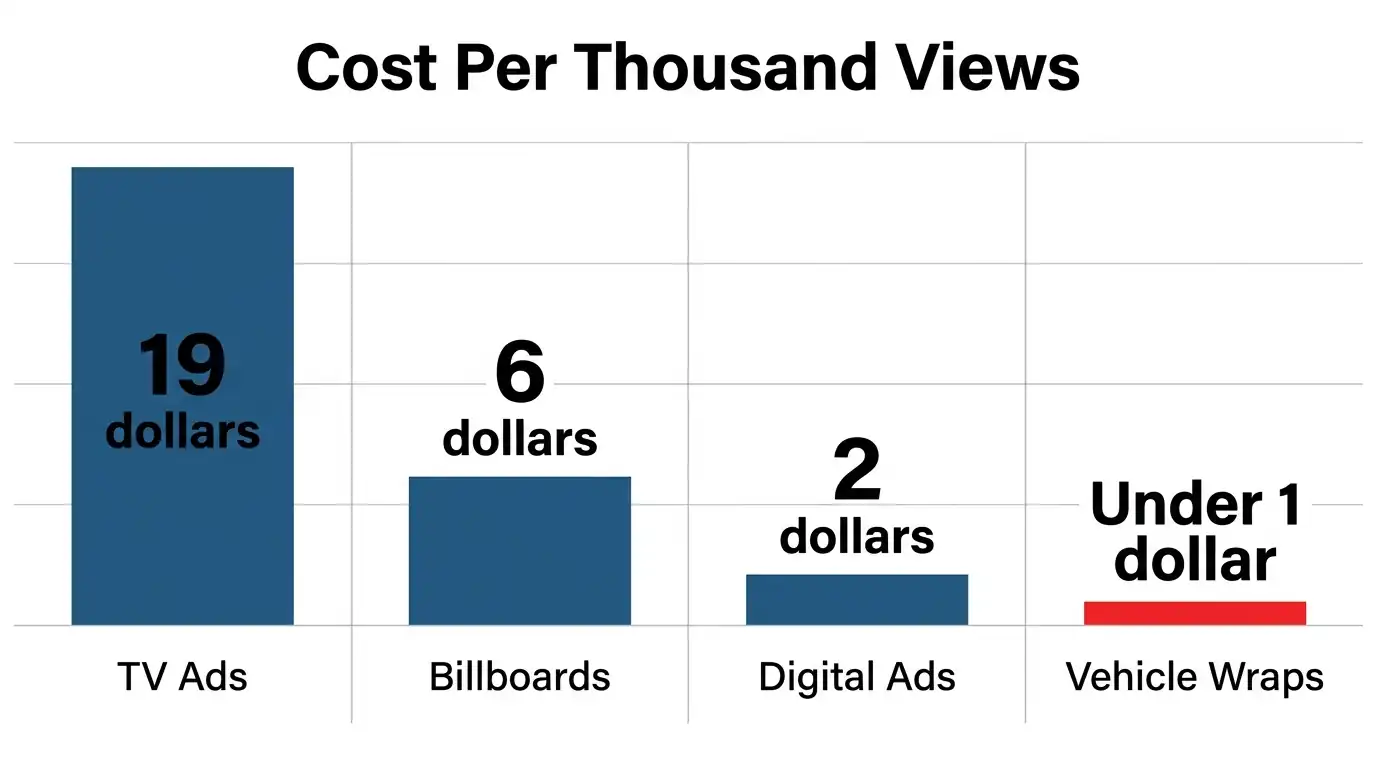
According to a 2011 Federal Communications Commission report cited by the Congressional Research Service, a typical online ad cost approximately $2.52 per 1,000 viewers, and primetime broadcast television averaged $19.74 per thousand. Vehicle wraps, by contrast, can push CPM well below $1 over a multi-year lifespan. Physical ads also leave stronger memory traces than their digital counterparts, which means wrapped vehicles do not just cost less per impression; they make each impression count more.
What we have seen across our fleet clients is that the impression quality matters as much as the volume, because a physical branded vehicle on the road builds recall in ways that skippable or blocked digital ads simply cannot replicate in practice.
How Does Cost Per Impression for Vehicle Wraps Compare to Billboards?
Cost per impression for vehicle wraps compares to billboards by offering similar visual impact without fixed-location limitations. As a 2023 study published in Applied Sciences by researchers at the University of Žilina confirmed, vehicle wraps effectively turn cars and other vehicles into moving billboards.
Traditional static billboards lock advertisers into a single sightline and charge monthly lease fees. A wrapped vehicle, however, travels through multiple neighborhoods, highways, and commercial districts each day, multiplying exposure zones at no additional cost. Over a typical three-to-five-year wrap lifespan, the accumulated impressions drive CPM far below what a fixed billboard placement achieves. For businesses seeking broad geographic coverage, mobile branding consistently outperforms stationary outdoor placements on a per-impression basis.
How Does Cost Per Impression for Vehicle Wraps Compare to Print Media?
Cost per impression for vehicle wraps compares to print media by delivering a significantly lower CPM over the wrap’s usable life. According to the Hennepin County Love Local Initiative post-campaign report, a regional out-of-home campaign achieved approximately 6,000,000 board impressions at an average cost of $6 per thousand.
Print advertisements in newspapers and magazines typically carry even higher CPMs, and each insertion is a one-time expense that stops generating views the moment the publication cycle ends. Vehicle wraps, once installed, require no repeat purchasing. A single wrapped fleet vehicle operating in moderate traffic accumulates impressions month after month, steadily driving its effective CPM downward. This compounding return makes vinyl branding one of the strongest long-term values in the advertising mix.
Understanding cost efficiency sets the stage for examining how many daily impressions a single wrap can actually deliver.
How Many Impressions Can a Single Vehicle Wrap Generate Daily?
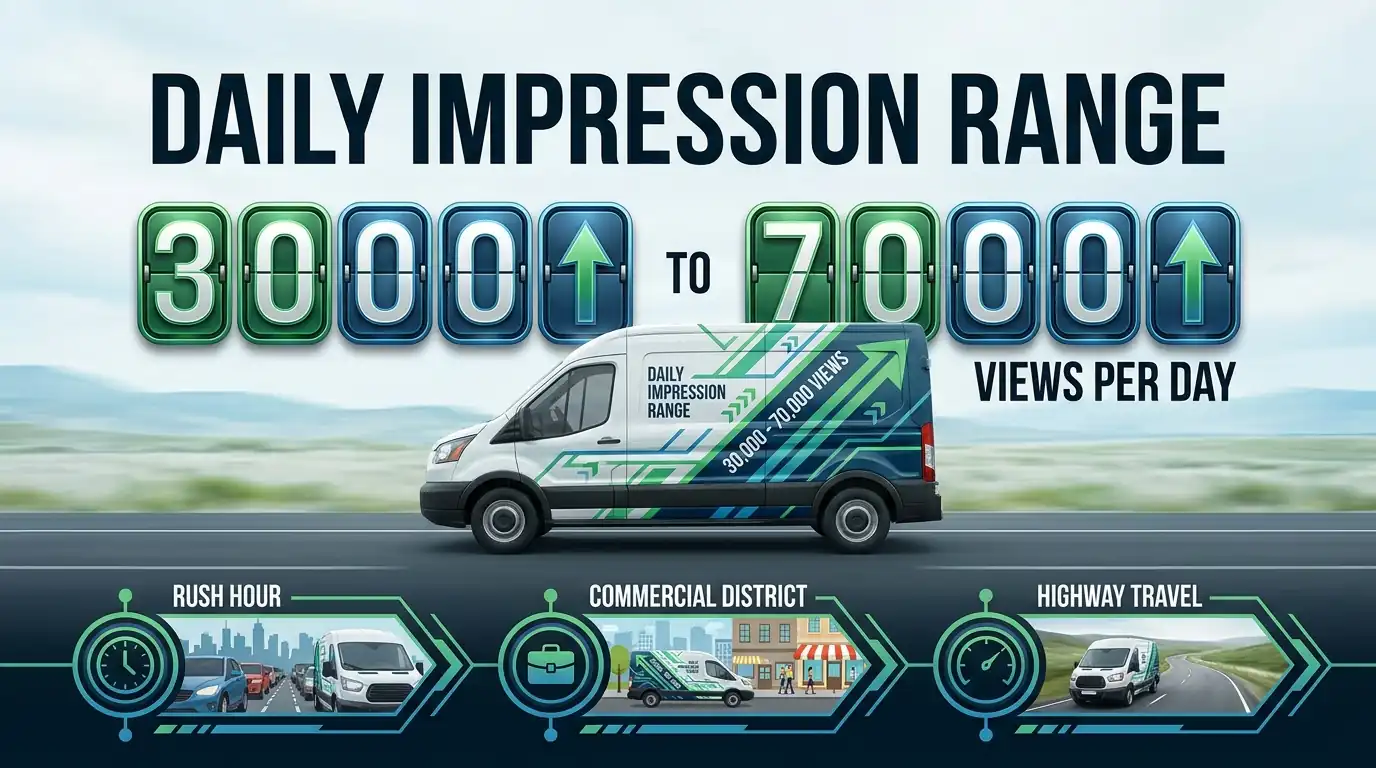
A single vehicle wrap can generate between 30,000 and 70,000 daily impressions depending on driving routes, traffic density, and metro population. Several factors influence this count, from highway commute patterns to how long the vehicle remains parked in high-visibility areas.
The core mechanism behind these numbers is straightforward: every pedestrian, driver, and passenger who sees the wrapped vehicle counts as one impression. A vehicle driven through a dense urban corridor during rush hour accumulates impressions far faster than one parked in a suburban lot. According to a 2016 OAAA marketing report, more than 90 percent of U.S. travelers have noticed some form of out-of-home advertising in the past month, confirming that mobile brand displays consistently reach broad audiences.
Factors that increase daily vehicle wrap impressions include:
- High-traffic commute routes with stop-and-go conditions that extend dwell time per viewer.
- Dense commercial districts where foot traffic and vehicle congestion multiply exposures.
- Strategic parking locations near retail centers, event venues, or busy intersections.
- Extended daily drive time, with fleet vehicles logging eight or more hours on the road.
- Illuminated or reflective wrap elements that maintain visibility after dark.
Vehicles operating in metropolitan areas with populations over one million tend to land at the higher end of the impression range, while suburban or rural routes produce fewer but often more repeated exposures to the same local audience. That repeated local exposure carries its own advantage: a study published in the Journal of Interactive Marketing found that ad click-through rates are more than 26 percent higher at revisited locations than at locations visited for the first time, suggesting that familiar-route impressions carry stronger recall value.
For businesses weighing impression volume against quality, daily impression counts alone do not tell the full story. A wrapped vehicle that consistently travels through your target market’s neighborhood builds compounding brand familiarity that static billboards, locked to one location, simply cannot replicate. Understanding how those repeated impressions translate into recognition is what separates exposure from genuine brand recall.
Why Do Vehicle Wraps Build Brand Recognition Faster Than Other Media?
Vehicle wraps build brand recognition faster than other media because they deliver repeated, unavoidable exposure to the same audience along consistent daily routes. The factors driving this speed include impression frequency, consistent branding across fleet vehicles, and the large visual canvas wraps provided.
A wrapped vehicle functions as a mobile billboard that reaches pedestrians, commuters, and local residents without requiring them to click, tune in, or subscribe. Unlike digital ads that viewers can skip or block, a branded vehicle occupies physical space in the real world, making it nearly impossible to ignore during a commute or neighborhood drive.
According to Geopath’s Evolution of Geopath Insights standards document, traffic counts form the basic building block for understanding audience circulation, while factors such as illumination, vehicle occupancy, and directionality all influence actual impression volume. This means a single wrapped vehicle traveling high-traffic corridors compounds brand exposure across thousands of viewers daily, and the same commuters encounter that branding repeatedly, reinforcing recall far more efficiently than a one-time ad placement.
Consistent application of brand elements across a fleet amplifies this effect. The University of Maryland, Baltimore’s Communications and Public Affairs division notes that consistent use of brand elements on a fleet of cars reinforces institutional image and helps build a strong, recognizable brand, recommending vehicle wraps specifically because they provide a larger canvas for branding and can be easily updated or replaced. That larger surface area allows businesses to display logos, color schemes, taglines, and contact information simultaneously, something a small digital banner or brief radio spot simply cannot replicate.
Repetition is the mechanism that separates vehicle wraps from most other advertising channels. A television commercial airs during a scheduled window; a social media ad appears once in a feed and disappears. A wrapped vehicle, by contrast, generates impressions every time it moves or parks, building cumulative familiarity with the brand over weeks and months. For businesses operating service vehicles in defined territories, this geographic repetition targets the exact neighborhoods most likely to convert into customers.
Understanding how brand recognition compounds through daily impressions sets the stage for evaluating the protective benefits wraps offer your vehicle’s original finish.
How Do Vinyl Vehicle Wraps Protect the Original Paintwork?
Vinyl vehicle wraps protect the original paintwork by creating a physical barrier between the factory paint and environmental hazards such as UV radiation, road debris, minor scratches, and chemical contaminants. This section covers the specific threats wraps guard against and how the laminated vinyl material delivers that protection.
Vinyl wrap film acts as a sacrificial layer over OEM paint. Once applied, the wrap absorbs the daily wear that would otherwise degrade the clear coat and pigment layer underneath. Small stones kicked up on highways, shopping cart dings in parking lots, and tree sap all contact the vinyl surface instead of the paint.
UV exposure is one of the most persistent threats to automotive finishes. According to a 2025 review published in Polymers via the U.S. National Library of Medicine on automotive coating durability, protective coatings play a vital role in extending surface life by mitigating environmental degradation, resisting UV radiation, acid rain, oxidation, and mechanical damage such as scratches, swirl marks, and chipping. Laminated vinyl wraps provide a comparable shielding function, keeping harmful rays from breaking down paint molecules that cause fading and oxidation over time.
Beyond UV, vinyl wraps resist several additional surface threats:
- Road salt and chemical deicers that accelerate corrosion on bare or weakened paint.
- Bird droppings and insect residue containing acids that etch unprotected clear coats.
- Minor abrasions from automated car washes or incidental contact.
- Light hail and gravel impacts that would otherwise chip exposed paint.
When the wrap is eventually removed, the paint underneath typically remains in the same condition as the day the vinyl was applied. This preservation directly protects resale value, since consistent, undamaged factory paint is one of the first things buyers and appraisers evaluate. For fleet managers, that means lower depreciation costs across dozens or hundreds of vehicles.
From a practical standpoint, vinyl paint protection is one of the most undervalued benefits of wrapping a fleet. Many businesses invest in wraps purely for branding, only to discover that the paint preservation alone offsets a meaningful portion of the wrap’s cost when vehicles are resold or returned at lease end.
Understanding what wraps shield against sets the stage for choosing which vehicle types benefit most from vinyl branding.
What Types of Vehicles Can Be Wrapped With Vinyl Branding?
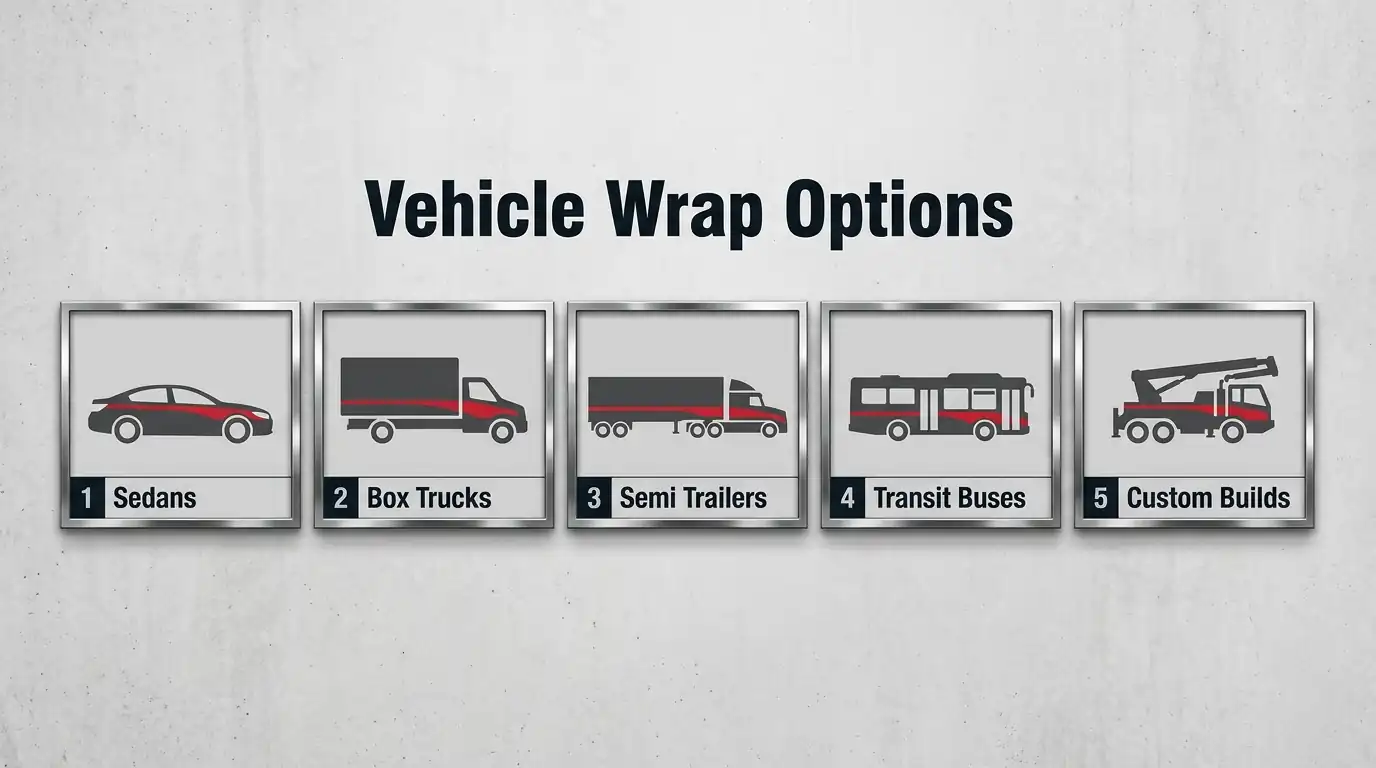
Virtually any vehicle with a smooth exterior surface can be wrapped with vinyl branding. The sections below cover sedans, box trucks, semi-trailers, buses, and custom-built experiential marketing vehicles.
Sedans and Passenger Cars
Sedans and passenger cars are the most accessible vehicle type for vinyl branding. Their compact body panels make them ideal for partial wraps, spot graphics, or full wraps that transform a personal or company vehicle into a mobile advertisement. Sales representatives, real estate agents, and service technicians frequently use branded sedans to build local visibility during daily commutes and client visits. Even a single wrapped passenger car generates continuous impressions in neighborhoods, parking lots, and city traffic. For small businesses with limited budgets, starting with sedans offers a low-cost entry point into fleet branding before scaling to larger vehicles.
Box Trucks and Cargo Vans
Box trucks and cargo vans provide the largest flat surface area among standard commercial vehicles, making them exceptionally effective for vinyl branding. The broad, uninterrupted side panels of a box truck function as a rolling billboard visible from significant distances on highways and urban streets. Cargo vans used by delivery, HVAC, plumbing, and logistics companies benefit from full wraps that display service information, contact details, and branded visuals on every side. According to Oregon Corrections Enterprises, high-quality vinyl wrapping services for vehicles, trailers, and equipment provide durable branding and professional finishes that help messages stand out. These vehicles spend long hours on the road, maximizing daily impression counts across multiple service areas.
Semi-Trailers and Fleet Vehicles
Semi-trailers and fleet vehicles deliver the highest impression volume per unit due to their massive surface area and interstate travel routes. A single 53-foot trailer offers over 600 square feet of brandable space visible to thousands of drivers daily. Fleet branding across multiple trailers creates repetitive exposure that reinforces brand recognition in every market the fleet serves. National distribution companies, freight carriers, and retail chains use coordinated fleet wraps to maintain consistent visual identity across regions. For businesses operating mixed fleets, vinyl branding unifies the look of vehicles ranging from pickup trucks to full semi-trailers under one cohesive design system.
Buses and Specialty Transit Vehicles
Buses and specialty transit vehicles serve as high-visibility branding platforms in dense urban environments. The National Rural Transit Assistance Program notes that vehicle graphics can turn a simple bus into a rolling billboard, applied as cut vinyl or full vinyl bus wraps. Transit buses, shuttle buses, and specialty vehicles like mobile showrooms reach pedestrians, commuters, and motorists simultaneously across fixed routes. Municipal transit wraps also offer third-party advertising revenue opportunities for transit agencies. Specialty transit vehicles, including airport shuttles and hotel courtesy buses, reach targeted audiences in specific locations where brand messaging is most relevant.
Experiential Marketing and Custom-Built Vehicles
Experiential marketing and custom-built vehicles represent the most creative application of vinyl branding. These vehicles combine structural fabrication with large format graphics to create immersive brand experiences at events, product launches, and mobile tours. Craftsmen Industries specializes in designing and fabricating experiential marketing vehicles with integrated vinyl graphics, managing the full process from ideation through installation. Custom builds can include pop-out stages, interactive displays, and full interior branding that extends the wrap concept beyond exterior surfaces. For brands seeking maximum audience engagement, a custom-built wrapped vehicle becomes both the advertising medium and the experience itself.
Understanding which vehicle types suit your branding goals helps determine the right wrap strategy and expected return.
How Long Do Commercial Vehicle Wraps Last?
Commercial vehicle wraps last between five and seven years when professionally installed with premium cast vinyl. Longevity depends on climate exposure, driving conditions, and maintenance practices. The sections below cover wrap durability in extreme heat, cold climates, and high-mileage highway fleets.
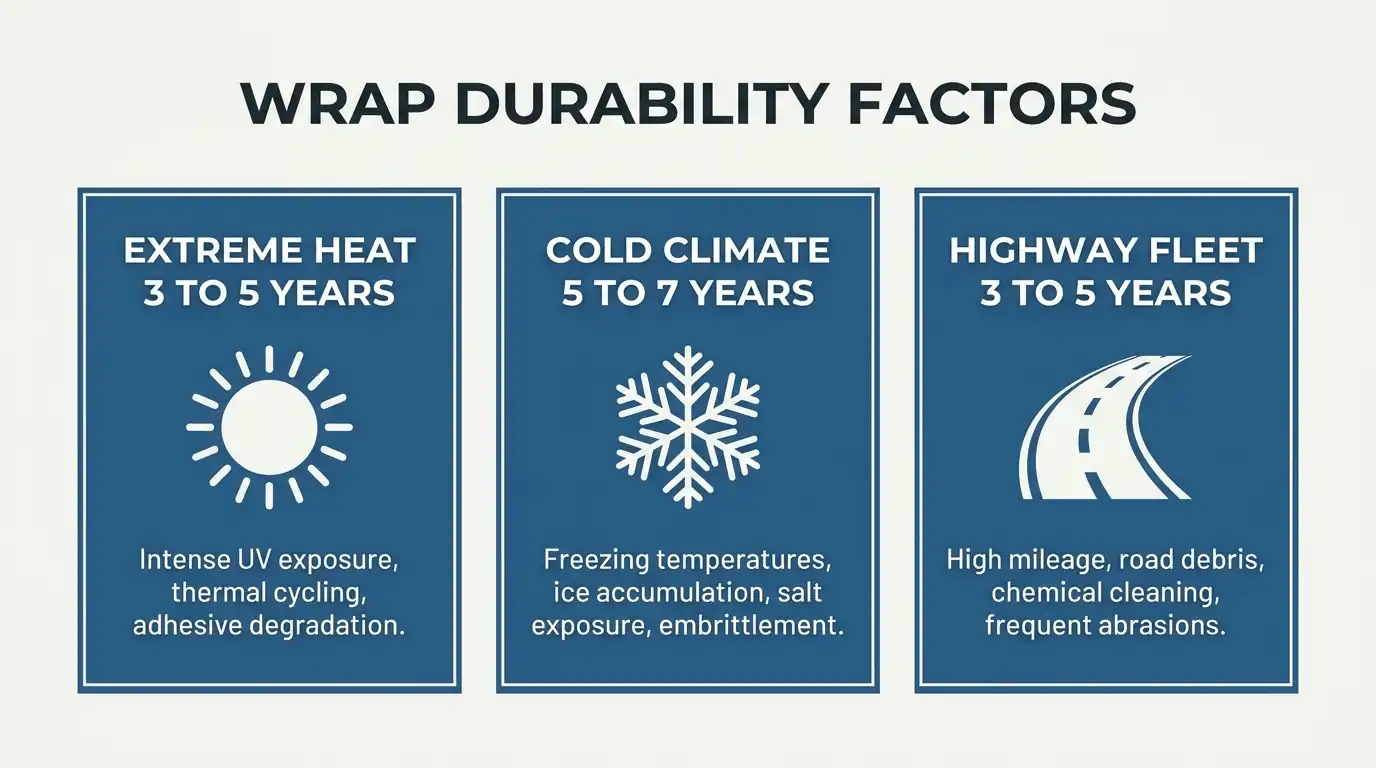
How Long Do Vehicle Wraps Last in Extreme Heat Climates?
Vehicle wraps last approximately three to five years in extreme heat climates, shorter than the standard lifespan. Prolonged UV exposure and surface temperatures exceeding 160°F accelerate adhesive breakdown and color fading, particularly on horizontal panels like hoods and roofs. Dark-colored wraps absorb more heat and degrade faster than lighter designs in sun-intensive regions.
Parking wrapped vehicles in shaded areas or garages significantly slows this deterioration. Regular washing removes surface contaminants that trap heat against the film. For fleets operating in desert or tropical conditions, scheduling wrap replacements on a three-year cycle protects brand appearance and ensures legibility remains sharp for roadside audiences.
How Long Do Vehicle Wraps Last in Cold or Winter Climates?
Vehicle wraps last five to seven years in cold or winter climates, often matching or slightly exceeding the industry average. Cold temperatures alone do not degrade vinyl film as aggressively as UV radiation does. However, repeated freeze-thaw cycles can stress adhesive bonds along panel edges, causing lifting at seams.
Road salt and chemical de-icers pose the greater threat in winter environments. These contaminants accelerate corrosion beneath wrap edges if not washed off promptly. Fleets operating in northern regions should wash vehicles biweekly during winter months and inspect edges for lifting quarterly. Proper maintenance in cold climates can push high-quality wraps closer to the seven-year mark without significant color loss.
How Long Do Vehicle Wraps Last on Highway Fleet Vehicles?
Vehicle wraps last three to five years on highway fleet vehicles due to accelerated wear from road debris, stone chips, and sustained high-speed wind exposure. According to an Audi of America Technical Service Bulletin hosted by the National Highway Traffic Safety Administration, certain protective films like Rapgard require removal within six months, with ideal removal temperatures between 60°F and 80°F. Commercial-grade wraps are formulated for longer service, but highway conditions compress that window.
Gravel impact on front fascias and lower panels causes micro-damage that compounds over time. Fleet managers should inspect forward-facing surfaces quarterly and budget for partial replacements on high-wear zones. Planning wrap refreshes around the three-year mark, keeps branding compliant with visibility standards and maintains the professional appearance that builds consumer trust on the road.
Understanding wrap longevity across conditions helps businesses plan budgets for removal and rebranding cycles.
Can Vehicle Wraps Be Removed or Updated Without Damage?
Yes, vehicle wraps can be removed or updated without damage to the original paintwork when professional-grade vinyl and proper removal techniques are used. The process depends on film quality, installation method, and surface temperature during removal.
Professional vehicle wrap removal requires controlled heat application to soften the adhesive layer before peeling. Installers typically use heat guns to bring the vinyl surface to an optimal temperature range. According to an Audi of America Technical Service Bulletin hosted by the National Highway Traffic Safety Administration, the ideal body surface temperature for protective film removal is 60°F (15.5°C) to 80°F (26.6°C). Vinyl left beyond manufacturer-recommended timelines becomes brittle, making clean removal more difficult. Cast vinyl films designed for vehicle applications use repositionable adhesives that release cleanly, while cheaper calendered films may leave residue requiring solvent-based cleanup.
Updating a vehicle wrap is equally straightforward. Businesses can replace individual panels, swap out seasonal promotions, or rebrand an entire fleet without repainting. This flexibility makes vinyl wraps particularly valuable for companies that refresh messaging frequently. Partial wrap updates cost less than full replacements, since only the affected sections need removal and reinstallation. For fleet operators managing dozens of vehicles, the ability to update branding across all units in a matter of days rather than weeks of body shop downtime represents a significant operational advantage.
Several factors influence whether removal causes damage:
- Wrap duration beyond five to seven years increases adhesive degradation risk.
- Prolonged sun exposure can bake adhesive into a clear coat, complicating removal.
- Factory OEM paint in good condition releases vinyl more cleanly than aftermarket paint or touch-up work.
- Professional installation with proper surface preparation ensures easier future removal.
For businesses that treat wraps as a rotating marketing asset rather than a permanent fixture, this removability is one of the most practical benefits vinyl branding offers. Understanding how wraps reach local and national audiences simultaneously adds another layer of strategic value.
How Do Vehicle Wraps Support Local and National Targeting at Once?
Vehicle wraps support local and national targeting at once by functioning as mobile advertisements that reach neighborhood audiences during daily routes and distant markets during long-haul trips or multi-city deployments. The same branded vehicle generates hyperlocal impressions in its home service area while simultaneously building national brand visibility whenever it travels interstate highways or parks at events in new regions.
Fleet operators gain a unique geographic advantage because wrap exposure is not locked to a single media market. A delivery van running local stops builds familiarity with nearby consumers through repeated sightings, reinforcing recall in that community. When that same vehicle drives cross-state for a delivery or event, it carries the brand into entirely new audiences without any additional media spend. This dual capability makes vehicle wraps one of the few advertising formats that scale geographically with the natural movement of a business.
Durability under varied climate conditions strengthens this dual-market approach. According to a U.S. Department of Transportation study on accelerated weathering of traffic control materials, researchers modified ASTM D5894 test conditions by increasing UV irradiance, temperature, and chloride ion concentration to compress testing time to 10% of actual outdoor exposure, confirming that quality coating materials withstand harsh environmental stressors across diverse regions. Vinyl wraps engineered to similar standards maintain color vibrancy and legibility whether operating in humid coastal cities or arid inland corridors.
For businesses seeking both local saturation and national reach, fleet wraps eliminate the need to purchase separate regional ad campaigns. Each wrapped vehicle becomes an adaptable asset: a neighborhood presence on weekdays and a cross-market ambassador on longer routes. This flexibility makes vinyl branding especially valuable for companies scaling from regional operations into national coverage, since the advertising investment travels with the fleet rather than expiring in a fixed location.
What ROI Should a Business Expect From Fleet Vinyl Branding?
The ROI a business should expect from fleet vinyl branding depends on fleet size, route density, and market reach. Small fleets and large national fleets generate returns through different mechanisms.
What ROI Do Small Fleets Under Ten Vehicles Typically See?
Small fleets under ten vehicles typically see strong ROI through concentrated local exposure. A single wrapped vehicle operating in a defined service area generates thousands of daily impressions along repeated routes, building neighborhood-level brand familiarity that directly drives inbound calls and website visits.
The return compounds because small fleets serve consistent territories. Residents encounter the same branded vehicle repeatedly, and that frequency strengthens recall. According to a 2016 OAAA marketing report, more than 90 percent of U.S. travelers noticed some form of out-of-home advertising in the past month. For service businesses like plumbers, electricians, and HVAC contractors, even three to five wrapped vehicles can saturate a local market at a fraction of what recurring digital ad spend would cost over the same period.
What ROI Do Large National Fleets Typically See?
Large national fleets typically see ROI through sheer impression volume and geographic breadth. Hundreds of branded vehicles operating across multiple metro areas transform logistics assets into a continuous, coast-to-coast advertising network that requires no recurring media spend after the initial wrap investment.
Scale amplifies efficiency. Each additional wrapped vehicle lowers the effective cost per thousand impressions because production and installation costs decrease with volume, while cumulative daily impressions climb into the millions. National fleets also benefit from brand consistency across markets; every vehicle reinforces the same visual identity whether it is parked at a loading dock in Dallas or moving through traffic in Chicago. For enterprise brands, this level of always-on visibility is difficult to replicate through any single paid media channel at a comparable cost per impression.
With ROI benchmarks established for both fleet sizes, understanding DOT and local signage compliance ensures those branded vehicles meet legal requirements on every route.
Are Vehicle Wraps Compliant With DOT and Local Signage Regulations?
Vehicle wraps are compliant with DOT and local signage regulations when designed to meet specific federal marking requirements and municipal sign codes. Key compliance areas include USDOT number display, business name visibility, and local restrictions on vehicle-mounted signage.
Federal regulations set clear standards for commercial motor vehicles (CMVs) operating in interstate commerce. According to the Federal Motor Carrier Safety Administration’s Commercial Motor Vehicle Marking Final Rule, the FMCSA requires all interstate motor carriers to display the USDOT number and mark CMVs with the legal name, or a single trade name, of the business entity that owns or controls the motor carrier operation. Vehicle wrap designs must incorporate these markings in letters that contrast sharply with the background and remain legible from 50 feet during daylight hours, appearing on both sides of the vehicle.
Local signage ordinances add another compliance layer. Many municipalities distinguish between vehicle identification and mobile advertising. Wraps that identify a business, its products, or its services on vehicles operated in the normal course of business typically qualify as exempt vehicle signage. However, vehicles used primarily as mobile sign displays may violate local codes. Size restrictions also apply in some jurisdictions; certain ordinances prohibit vehicle signs from extending beyond the frame or body by more than 12 inches.
Compliance ultimately depends on three factors:
- Federal CMV marking rules: USDOT number, legal business name, and legibility standards must be integrated into the wrap layout for any commercial fleet crossing state lines.
- Local sign ordinances: Restrictions on sign dimensions, primary vehicle use, and parking-for-display practices vary by city and county.
- Hazardous materials transport: Carriers subject to Hazardous Materials Safety Permit rules face additional marking requirements beyond standard fleet branding.
For businesses running branded fleets, the most practical approach is designing wraps that satisfy federal marking placement first, then verifying local ordinance compliance for every market where vehicles operate. Understanding how wraps compare to traditional paint for branding also influences compliance planning, since material choices affect how markings are applied and updated.
How Do Vehicle Wraps Compare to Traditional Paint for Branding?
Vehicle wraps compare to traditional paint for branding by offering faster turnaround, easier updates, built-in paint protection, and lower long-term cost per design change. The differences span cost, durability, flexibility, and visual impact.
Vinyl wrap is laminated and not as susceptible to UV rays as paint, reducing fading over time. This UV resistance is especially valuable for fleet operators whose vehicles spend entire days in direct sunlight.
For businesses that rebrand, run seasonal promotions, or manage multi-location fleets, wraps eliminate the downtime and cost spiral of repainting. A single vehicle can cycle through multiple branded designs over its service life while the factory finish stays intact beneath the vinyl. Paint locks a fleet into one visual identity until the next expensive repaint. That inflexibility alone makes wraps the stronger branding tool for any company that values agility.
With the branding method decided, partnering with the right fabrication team ensures every wrap performs to its full potential.
How Should You Approach Vehicle Wrap Branding With a Full-Service Fabrication Partner?
You should approach vehicle wrap branding with a full-service fabrication partner by choosing a provider that handles design, printing, and installation under one roof. The following sections cover how Craftsmen Industries enhances wrap programs and the key takeaways from this guide.
Can Craftsmen Industries’ Large Format Graphics and Custom Vehicle Fabrication Enhance Your Wrap Program?
Yes, Craftsmen Industries’ large format graphics and custom vehicle fabrication can enhance your wrap program by combining design, engineering, printing, and installation within a single vertically integrated facility. Vehicle graphics applied as cut vinyl or full vinyl wraps can transform any fleet asset into a rolling billboard, as noted by the National Rural Transit Assistance Program’s Bus Wraps and Branding toolkit. Craftsmen Industries manages the entire process in-house from a 127,000 sq. ft. facility near St. Louis County, Missouri, eliminating the coordination gaps that arise when multiple vendors handle separate stages. Vinyl wrap is laminated and less susceptible to UV rays than paint, so branded vehicles maintain a professional finish longer. For programs spanning sedans, cargo vans, semi-trailers, or experiential marketing builds, that end-to-end control is what separates a standard wrap job from a scalable brand asset.
What Are the Key Takeaways About Vehicle Wraps and Vinyl Branding Benefits We Covered?
The key takeaways about vehicle wraps and vinyl branding benefits covered in this guide are:
- Vehicle wraps deliver one of the lowest cost-per-impression rates among all advertising formats, outperforming digital, broadcast, and print media on a CPM basis.
- A single wrapped vehicle generates thousands of daily impressions across local and national routes simultaneously.
- Consistent fleet branding accelerates brand recognition faster than static or intermittent ad placements.
- Vinyl wraps protect original paintwork from UV damage, scratches, and environmental wear while remaining fully removable.
- Wraps can be applied to virtually any vehicle type, from sedans to semi-trailers and custom experiential builds.
- Commercial vehicle wraps last multiple years under proper maintenance, even in extreme climates.
- Fleet vinyl branding is compliant with DOT marking requirements and most local signage ordinances when designed correctly.
- Partnering with a full-service fabrication provider like Craftsmen Industries streamlines design, production, and installation into a single accountable workflow.
Choosing Craftsmen Industries means gaining a partner whose four decades of custom fabrication expertise turn vinyl branding from a simple graphic application into a strategic, long-term marketing investment.
Filter Posts by Tag
related posts
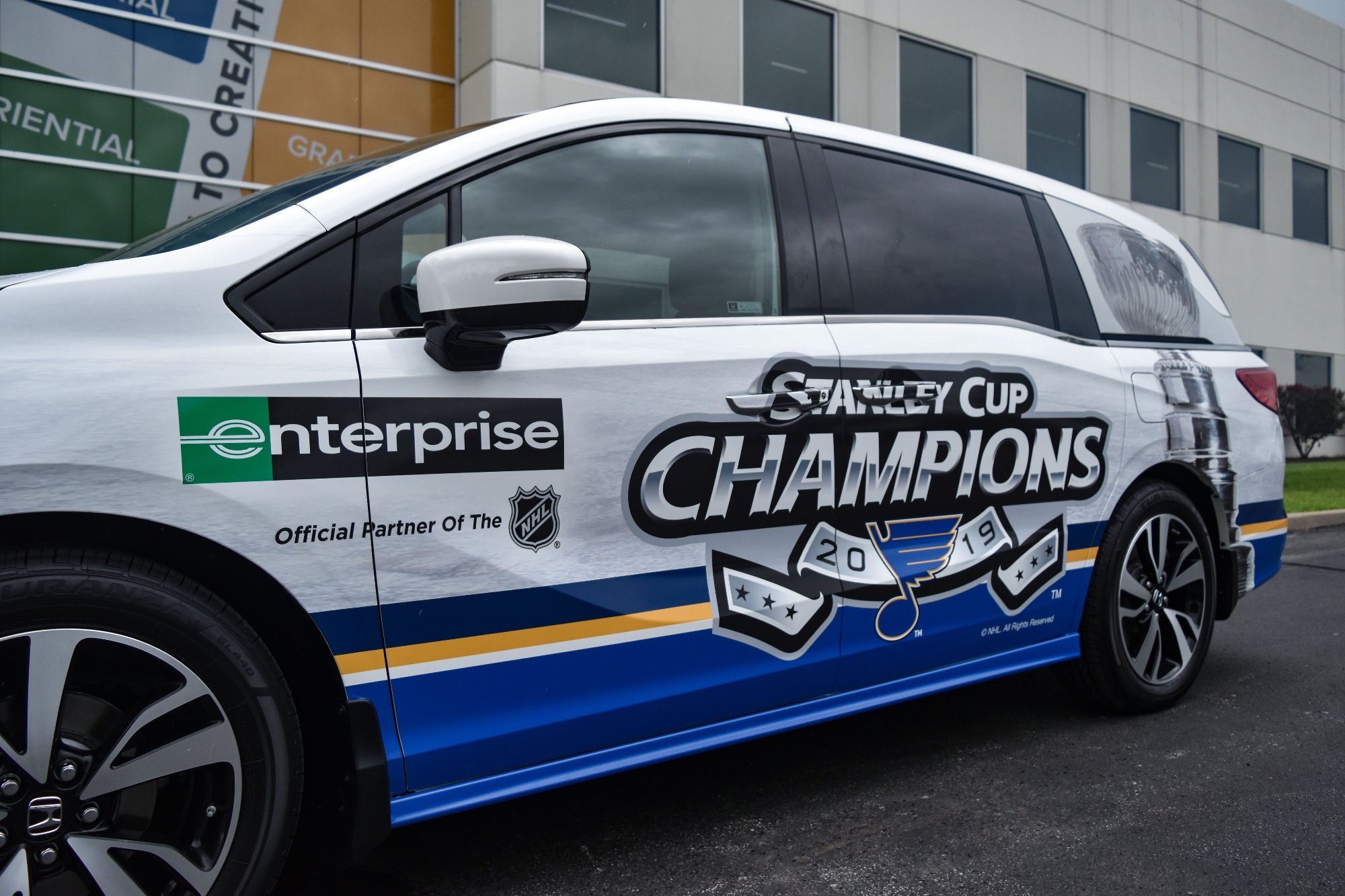
Brand your company fleet. Click now to look at some of the most common ways to brand vehicles and the pros and cons of each option.
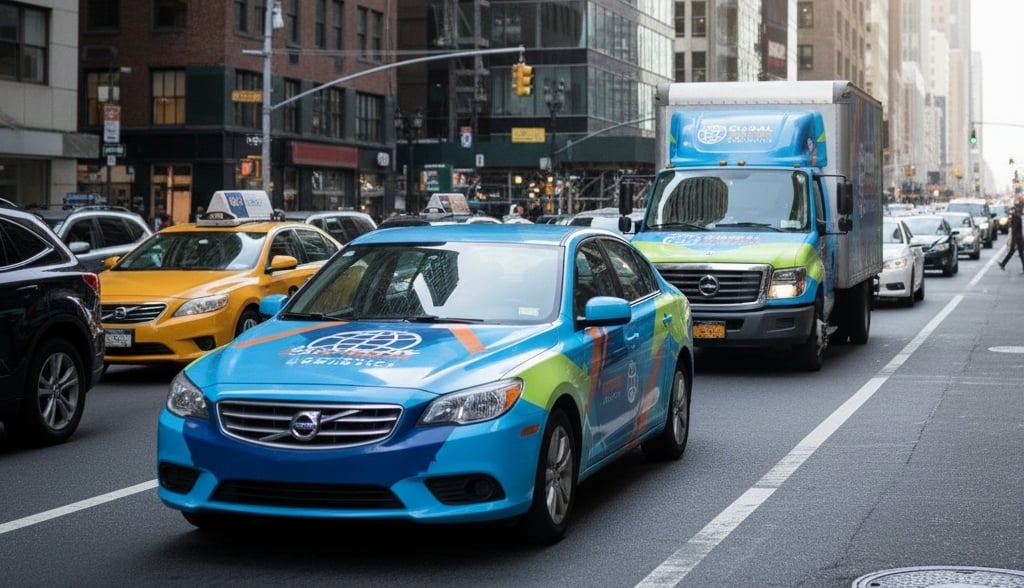
Learn how cohesive fleet wraps build brand identity with consistent design, premium materials, and expert installation for lasting recognition on the road.

Explore advanced fleet wrap finishes matte, gloss, satin, and textured to boost brand identity, visibility, and consistency across your vehicle fleet.
