
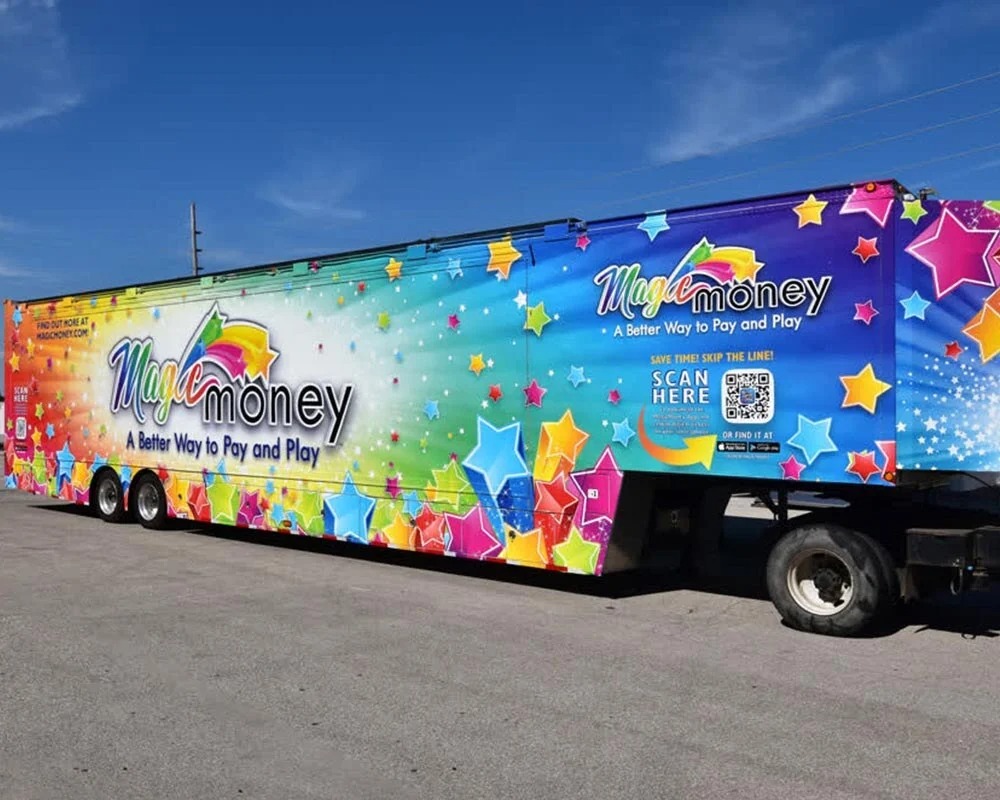
Augmented reality fleet graphics are vehicle wraps engineered to trigger digital content (3D models, animations, videos, or interactive experiences) when scanned with a smartphone or tablet. AR transforms static fleet vehicles into two-way advertising touchpoints that generate measurable engagement rather than passive impressions.
This guide covers how AR fleet technology works, the experience types and measurable benefits it delivers, the design and environmental challenges brands must navigate, and the emerging trends pushing this format forward.
AR-integrated fleet advertising combines printed trigger elements on vehicle surfaces with smartphone cameras, sensors, and software platforms to render digital content in real time. Activation methods range from QR codes and image recognition markers to location-based GPS triggers, while 5G connectivity enables the low-latency rendering these experiences demand.
Fleet graphics can deliver distinct AR formats: 3D product visualization from parked vehicles, gamified brand interactions triggered by moving fleets, virtual try-on demos at event stops, and social media-shareable filters that amplify each physical impression into dozens of earned digital impressions at zero additional media cost.
For advertisers, the core advantage is closed-loop attribution. Every scan, tap, and session generates trackable data points, including activation rates, dwell time, and conversion actions, that static wraps simply cannot provide. AR also opens a consent-based first-party data pipeline independent of third-party cookies, though privacy compliance requires careful implementation.
Reliable deployment depends on solving real-world constraints: weather and lighting disrupt camera-based tracking, vehicle curves distort printed markers, and large fleets risk content fragmentation without centralized management. Material selection, resolution standards, and marker placement must be engineered alongside the vehicle build itself.
Looking ahead, wearable AR glasses, AI-personalized content, and vehicle-to-device communication will reduce activation friction and scale fleet AR from smartphone-dependent scanning to always-on, hands-free engagement.
What Are Augmented Reality Fleet Graphics?
Augmented reality fleet graphics are vehicle wraps engineered to trigger digital content when scanned with a smartphone or tablet. They combine physical printed graphics with AR technology to create interactive mobile advertising. The sections below explain how AR overlays work, how marker-based and markerless systems differ, and what separates interactive fleet graphics from static wraps.
How Does AR Technology Overlay Digital Content on Fleet Wraps?
AR technology overlays digital content on fleet wraps by using a smartphone’s camera to recognize visual elements on the vehicle surface and then rendering 3D animations, videos, or interactive objects on the device screen in real time. The phone’s sensors, camera, and processor work together to anchor virtual content to the physical wrap so it stays aligned as the viewer moves.
According to Digital Promise, markerless AR offers the most control to users by allowing real-life scale placement of virtual augmented objects, with these experiences being highly reliant on smartphone sensors, cameras, and processors. This reliance on consumer-owned devices makes AR fleet activations accessible without specialized hardware. For fleet advertisers, that low barrier to entry is one of the strongest practical advantages over other interactive formats.
What Is the Difference Between Marker-Based and Markerless AR for Vehicles?
The difference between marker-based and markerless AR for vehicles comes down to how the system identifies its activation trigger. Marker-based AR relies on distinct visual patterns, such as QR codes or custom images printed on the wrap, that cameras recognize to launch the augmented experience. Markerless AR instead uses the device’s sensors, GPS, and spatial mapping to place digital content without requiring a specific printed trigger.
Key distinctions include:
-
Marker-based AR requires a dedicated app to scan recognizable patterns on the vehicle surface.
-
Markerless AR lets users position content freely, using device sensors for spatial awareness.
-
Location-based AR, a markerless subset, reads GPS and accelerometer data to pair fleet position with digital content.
For fleet campaigns, marker-based systems offer reliable activation in controlled settings, while markerless AR provides greater flexibility for moving vehicles.
How Do Interactive Fleet Graphics Differ From Static Vehicle Wraps?
Interactive fleet graphics differ from static vehicle wraps by adding a digital engagement layer that transforms passive visual impressions into two-way brand experiences. Static wraps display fixed imagery; interactive fleet graphics use embedded AR triggers to deliver video, 3D product models, gamified content, or data-capture forms when a viewer scans the vehicle.
This distinction matters because static wraps generate awareness through visual reach alone, while interactive graphics generate measurable actions, including scan rates, dwell time, and conversion data. The physical wrap still functions as traditional out-of-home advertising, but the AR component extends each impression into a trackable digital interaction.
Understanding these foundational differences helps advertisers evaluate where AR-enabled fleet campaigns fit within broader mobile advertising strategies.
Why Is Augmented Reality Transforming Mobile Advertising?
Augmented reality is transforming mobile advertising because it converts passive viewers into active participants, driving measurable engagement that static formats cannot match. The sections below explore how AR increases consumer interaction with fleet vehicles, why AR-enabled ads prove more memorable, and how real-time interactivity elevates brand recall.
How Does AR Increase Consumer Engagement With Fleet Vehicles?
AR increases consumer engagement with fleet vehicles by turning a vehicle’s surface into an interactive digital touchpoint that holds attention far longer than a traditional wrap. Rather than a passing glance, pedestrians and bystanders actively participate with branded content through their smartphones.
According to AR Insider, dwell time signals the depth of this engagement; one AR product visualization experience achieved an average dwell time of 5 minutes, more than 2.5x the web AR benchmark. That extended interaction builds consumer confidence before purchase, often resulting in greater conversions, larger basket sizes, and fewer product returns.
For fleet advertisers, this shift from impression-based exposure to participation-based engagement is significant. A wrapped truck parked at an event can generate hundreds of meaningful, trackable interactions rather than thousands of forgettable glances.
What Makes AR-Enabled Fleet Ads More Memorable Than Traditional Formats?
AR-enabled fleet ads are more memorable than traditional formats because they engage multiple senses and require active user participation. Static wraps rely solely on visual recognition during brief exposure windows, while AR layers interactive 3D content, animation, and sound onto the same physical surface.
This multisensory involvement creates stronger memory encoding. When a consumer physically manipulates a virtual product or explores an animated scene overlaid on a fleet vehicle, the experience becomes personal and novel. Novelty triggers deeper cognitive processing, which directly strengthens recall.
The combination of a tangible physical presence (the vehicle) with a personalized digital layer gives AR fleet ads a dual-channel advantage that purely digital or purely physical formats lack individually.
How Does Real-Time Interactivity Change Brand Recall Rates?
Real-time interactivity changes brand recall rates by creating two-way exchanges that anchor the brand in a consumer’s episodic memory. Passive ad formats deliver a message; interactive AR experiences let consumers shape it, and that agency makes the moment personally meaningful.
According to Econsultancy, Coca-Cola’s #TakeATasteNow campaign demonstrated this principle at scale. Launched in partnership with Tesco Group across 13 major UK locations from September 25 to October 15, 2023, the DOOH and AR experience let smartphone users interact with and change screen visuals in real time, then scan a QR code to receive both a digital Coke Zero bottle and a voucher redeemable at a nearby Tesco.
Campaigns structured around real-time participation consistently outperform one-way messaging because the consumer becomes a co-creator of the brand moment rather than a spectator.
With engagement benchmarks established, the next consideration is how the underlying technology brings these AR fleet experiences to life.
How Does AR-Integrated Fleet Advertising Actually Work?
AR-integrated fleet advertising works by combining physical vehicle graphics with digital trigger points, software platforms, and mobile connectivity. The sections below cover the essential hardware, software, activation methods, and network infrastructure behind these interactive experiences.
What Hardware Is Needed to Enable AR on Fleet Graphics?
The hardware needed to enable AR on fleet graphics includes the consumer’s smartphone and the printed trigger elements on the vehicle itself. Most AR fleet experiences rely on the device’s built-in camera, GPS, accelerometer, and processor to detect and render digital overlays. No specialized equipment is required on the vehicle side; the wrap simply needs high-contrast printed markers, QR codes, or distinctive image patterns that a phone camera can recognize. For brands exploring advanced activations, NFC chips embedded near graphic panels can offer tap-to-launch functionality. The consumer’s device does the heavy computational lifting, which keeps fleet-side hardware costs minimal and deployment scalable across large vehicle fleets.
What Software Platforms Power Interactive Vehicle Experiences?
The software platforms that power interactive vehicle experiences range from enterprise-grade WebAR editors to full development frameworks. 8th Wall, now owned by Niantic, supports geospatial AR and sky segmentation for cutting-edge projects. According to Hololink, 8th Wall’s commercial deployment starts at $700 per month per project, with each published experience requiring its own license. More budget-friendly options exist: Hololink’s Basic plan costs €29 per month and includes unlimited experiences with unlimited views. Choosing the right platform depends on campaign scale and view volume. For fleet campaigns generating high foot traffic at events or urban routes, selecting a platform with predictable per-view pricing prevents costs from spiraling unexpectedly.
How Do QR Codes and Image Recognition Trigger AR on Fleet Wraps?
QR codes and image recognition trigger AR on fleet wraps by giving a smartphone camera a scannable reference point that launches digital content. QR codes work as simple URL triggers; scanning one opens a WebAR experience or dedicated app. Image recognition operates differently. According to Digital Promise, marker-based AR relies on identification of distinct patterns that cameras can easily recognize and process, with markers being visually independent of the environment around them. On a fleet wrap, a bold logo, illustrated panel, or custom graphic pattern can serve as the marker. When the camera detects it, the software overlays 3D models, animations, or video onto the live feed. Designing high-contrast, visually unique trigger zones on wraps is critical for reliable activation in real-world conditions.
What Role Does 5G Connectivity Play in Mobile AR Activation?
5G connectivity plays a central role in mobile AR activation by delivering the speed and low latency required for seamless real-time rendering. According to Lyntia, 5G’s ultra-low latency, sometimes under 10 milliseconds, enables AR applications to run far more smoothly, which is critical for creating highly immersive experiences. This matters for fleet advertising because vehicles operate in dynamic outdoor environments where content must load instantly as a passerby scans a wrap. Faster data transmission allows complex 3D product models and interactive animations to stream without buffering. Advancements in 5G, alongside miniaturized sensors and low-power processors, are also accelerating smart glasses adoption, which could eventually let consumers view fleet AR content hands-free.
With the technical foundation covered, the next step is understanding which AR experience types fleet graphics can deliver.
What Types of AR Experiences Can Fleet Graphics Deliver?
Fleet graphics can deliver AR experiences ranging from 3D product visualization and gamified interactions to location-based content, virtual try-ons, and social media-shareable filters. Each format turns a vehicle surface into a launchpad for distinct digital engagement.
3D Product Visualization From a Parked Vehicle
3D product visualization from a parked vehicle allows passersby to scan a fleet wrap and view a life-size, interactive digital model of a product hovering above or beside the vehicle. A parked truck becomes a showroom; consumers can rotate, zoom, and explore product details through their smartphone camera. According to Digital Promise, location-based AR reads data from a device’s camera, GPS, digital compass, and accelerometer to predict user focus and pair dynamic location with relevant points of interest. This capability means a branded vehicle parked at a high-traffic site can serve context-aware 3D content calibrated to that exact environment.
Gamified Brand Interactions Triggered by Moving Fleets
Gamified brand interactions triggered by moving fleets turn vehicle sightings into playful challenges. Brands can reward consumers for spotting, scanning, or interacting with fleet vehicles through points, badges, or digital collectibles. These mechanics tap into the same behavioral triggers that make loyalty programs effective: scarcity, surprise, and achievement. When a fleet vehicle becomes a moving game piece across a city, it motivates repeated engagement and organic word-of-mouth. For brands running multi-city tours, gamification transforms passive impressions into active participation that generates trackable interaction data.
Location-Based AR Content Tied to Fleet Routes
Location-based AR content tied to fleet routes delivers geo-specific digital experiences that change depending on where a vehicle is operating. A food brand’s delivery fleet might trigger recipe content in residential neighborhoods and promotional offers near grocery stores. This approach pairs GPS-driven route data with AR activation zones, ensuring the digital content matches local relevance. Route-aware AR is especially powerful for brands with predictable delivery or service routes, because repeated exposure in the same neighborhoods builds familiarity while the AR layer keeps the experience fresh.
Virtual Try-On and Demo Experiences at Event Stops
Virtual try-on and demo experiences at event stops let consumers test products digitally by scanning fleet graphics at festivals, trade shows, or pop-up locations. According to Econsultancy, Marcolin’s AR campaign for its Guess brand achieved an average dwell time of 19 seconds, with virtual try-on engagement averaging 44% higher than Teads’ benchmark. Parked experiential vehicles at events provide the stable, controlled environment that virtual try-on AR needs to perform reliably. This format is particularly valuable for fashion, cosmetics, and eyewear brands that benefit from letting consumers see products on themselves before purchasing.
Social Media-Shareable AR Filters Linked to Vehicle Wraps
Social media-shareable AR filters linked to vehicle wraps extend a fleet campaign’s reach far beyond the street. When consumers scan a branded wrap and unlock a custom filter, they create and share branded content across Instagram, TikTok, and Snapchat. Each share functions as an earned media impression that carries implicit peer endorsement. The vehicle wrap acts as the physical trigger, but the real amplification happens digitally. For fleet campaigns, shareable AR filters represent one of the highest-leverage formats because a single vehicle interaction can generate hundreds of secondary impressions at zero additional media cost.
With these experience types defined, understanding their measurable advantages helps advertisers justify the investment.
What Are the Key Benefits of AR Fleet Graphics for Advertisers?
The key benefits of AR fleet graphics for advertisers include measurable ROI, first-party data collection, and extended campaign reach beyond physical impressions. Each advantage builds on the interactive nature of augmented reality fleet media.
How Does AR Fleet Advertising Improve Measurable ROI?
AR fleet advertising improves measurable ROI by converting passive vehicle impressions into trackable digital interactions. Every scan, tap, and engagement generates quantifiable data points, including activation rates, dwell time, and conversion actions. Traditional fleet wraps deliver estimated impressions based on traffic counts, but AR layers provide precise engagement metrics tied to individual sessions. Advertisers can attribute downstream actions (website visits, coupon redemptions, purchases) directly to specific vehicles, routes, and timeframes. This closed-loop attribution model transforms fleet media from a brand awareness channel into a performance marketing asset. For most advertisers, the ability to tie physical impressions to digital outcomes makes AR fleet campaigns far easier to justify in budget discussions than static wraps alone.
How Can Brands Collect First-Party Data Through AR Fleet Interactions?
Brands collect first-party data through AR fleet interactions by capturing opt-in user information during each augmented experience. When consumers scan a vehicle wrap to trigger AR content, the activation can request email addresses, location permissions, or preference selections before delivering the experience. This creates a direct, consent-based data pipeline independent of third-party cookies. However, privacy compliance requires careful planning. According to a 2021 report from the Information Technology and Innovation Foundation, AR devices create novel privacy issues due to the scope and sensitivity of data they collect, including extensive biometric information that can identify individuals. Brands must implement transparent data policies and obtain explicit consent. Balancing rich first-party data collection with responsible privacy practices is the defining challenge for AR fleet campaigns moving forward.
How Does Interactive Fleet Media Extend Campaign Reach Beyond Physical Impressions?
Interactive fleet media extends campaign reach beyond physical impressions by turning each vehicle encounter into shareable digital content. When a consumer activates an AR experience on a fleet wrap, the resulting interaction (a screenshot, video, or social post) amplifies the campaign across digital channels organically. According to the Out of Home Advertising Association of America, OOH advertising revenue reached a record $9.46 billion in 2025, reflecting 3.6% year-over-year growth across 19 consecutive quarters. AR-enabled fleet graphics tap into this momentum while adding a viral digital layer that static OOH cannot replicate. One physical impression can generate dozens of secondary digital impressions through social sharing, effectively multiplying campaign reach without additional media spend.
With these advertiser benefits established, the next step is identifying which industries gain the most from AR fleet campaigns.
What Industries Benefit Most From AR-Enhanced Fleet Advertising?
The industries that benefit most from AR-enhanced fleet advertising include retail, consumer packaged goods, healthcare, and entertainment. Each sector leverages interactive mobile units differently based on audience goals and activation context.
How Are Retail and CPG Brands Using AR Fleet Campaigns?
Retail and CPG brands are using AR fleet campaigns to transform delivery vehicles and promotional trucks into interactive product showcases. A wrapped fleet vehicle parked outside a retail location can trigger 3D product visualizations, letting shoppers explore packaging, ingredients, or promotional bundles through their smartphones before entering the store.
Coca-Cola’s #TakeATasteNow campaign, a large-scale DOOH and AR experience launched across 13 UK locations in partnership with Tesco Group from September to October 2023, allowed smartphone users to interact with AR visuals in real-time and receive vouchers redeemable at nearby stores, according to Econsultancy. This model of bridging digital interaction with physical redemption is especially powerful for CPG brands running sampling tours or seasonal promotions through mobile fleets.
How Does Healthcare Use Interactive Mobile Units for Patient Education?
Healthcare uses interactive mobile units for patient education by combining AR-enabled fleet graphics with on-site clinical outreach. Mobile medical vehicles wrapped with scannable graphics can overlay anatomical models, procedure walkthroughs, or medication guides directly onto a patient’s smartphone screen.
This approach addresses a persistent challenge in community health: low health literacy. When a mobile clinic arrives at a community event or underserved neighborhood, AR layers can visualize disease progression, demonstrate how screenings work, or explain treatment options in multiple languages. For healthcare organizations already investing in mobile medical infrastructure, adding AR-ready graphics to the exterior creates a dual-purpose asset that educates before patients even step inside the vehicle.
How Are Entertainment and Media Companies Activating AR on Vehicles?
Entertainment and media companies are activating AR on vehicles by turning promotional fleet wraps into immersive content previews. Wrapped tour buses, promotional vans, and event vehicles serve as physical triggers for trailers, character interactions, and gamified experiences tied to upcoming releases.
Circle K and Niantic’s rewarded AR campaign in Pokémon Go achieved an average engagement rate of 76% with a 95% completion rate among interacting players, according to Econsultancy. This level of sustained interaction demonstrates why entertainment brands gravitate toward AR fleet activations: the format naturally encourages repeat engagement and social sharing, amplifying reach well beyond the physical footprint of the vehicle itself.
With proven engagement across these sectors, the next consideration is understanding what challenges brands must navigate when deploying AR fleet graphics at scale.
What Challenges Must Brands Overcome With AR Fleet Graphics?
Brands must overcome environmental, design, and operational challenges to deploy AR fleet graphics reliably. The subsections below cover weather and lighting disruptions, vehicle wrap design constraints, and fleet-wide content management.
How Do Weather and Lighting Conditions Affect AR Activation?
Weather and lighting conditions affect AR activation by disrupting the camera data and sensor signals devices need to render virtual content accurately. In low-light settings, cameras capture insufficient visual data, causing virtual objects to drift or appear unstable. Bright sunlight creates glare and overexposure that confuses feature-matching algorithms.
According to Milvus, weather effects such as rain, fog, or snow can obstruct cameras and LiDAR sensors, reducing their ability to map surroundings, while temperature extremes may cause devices to throttle processing power or shut down sensors entirely.
GPS-dependent AR apps also face accuracy issues in urban canyons or dense forests where satellite reception is poor. Developers often combine GPS with Wi-Fi/Bluetooth beacons or pre-scanned 3D maps to compensate. For fleet campaigns operating across diverse climates and routes, building fallback activation methods into every vehicle wrap is not optional; it is essential for consistent consumer experiences.
What Are the Design Constraints for AR-Compatible Vehicle Wraps?
The design constraints for AR-compatible vehicle wraps center on resolution, bleed tolerances, and marker placement. AR tracking systems require stable, textured reference points on the wrap surface, so large blank areas without visual detail can prevent reliable activation.
According to 1st Impressions’ vehicle wrap artwork guidelines, the recommended resolution for bitmap files is 150 dpi at 100% scale with 2 inches of bleed, 300 dpi at 50% scale with 1 inch of bleed, or 600 dpi at 25% scale with 0.5 inches of bleed. Minimum acceptable resolution drops to 100 dpi at full scale.
Key design requirements for AR-ready wraps include:
-
High-contrast marker zones placed on flat, uninterrupted panel areas.
-
Adequate bleed margins to prevent cropping that would break AR trigger images.
-
Avoidance of highly reflective laminate finishes that create glare for scanning cameras.
-
Consistent color calibration across every vehicle in the fleet to ensure uniform recognition.
Balancing visual branding with these technical constraints demands close coordination between graphic designers and AR developers from the earliest project stage.
How Do Brands Maintain AR Content Across Large Fleet Deployments?
Brands maintain AR content across large fleet deployments by centralizing digital asset management and using cloud-based AR platforms that push updates to every vehicle’s experience simultaneously. Unlike the physical wrap, which requires individual replacement, the digital AR layer can be refreshed remotely without touching the vehicle.
Consistent maintenance requires:
-
A centralized content management system that syncs AR experiences fleet-wide.
-
Version control protocols ensuring every vehicle triggers the current campaign, not outdated content.
-
Routine QA scans on representative vehicles to verify marker recognition after wear, fading, or partial damage.
-
Clear escalation workflows so field teams can flag activation failures quickly.
The larger the fleet, the greater the risk of content fragmentation. One vehicle running a stale experience undermines the entire campaign’s credibility. For brands scaling AR across dozens or hundreds of assets, proactive monitoring and automated update pipelines are far more reliable than manual checks.
With these challenges addressed, designing fleet graphics specifically optimized for AR interaction becomes the next priority.
How Do You Design Fleet Graphics Optimized for AR Interaction?
You design fleet graphics optimized for AR interaction by selecting scan-friendly materials, accounting for vehicle body geometry, and meeting strict resolution and color standards. The following subsections cover materials, layout strategies, and technical specifications.
What Print Materials and Finishes Work Best With AR Scanning?
The print materials and finishes that work best with AR scanning are matte and satin vinyl wraps with high-contrast, non-reflective surfaces. Marker-based AR relies on camera recognition of distinct visual patterns, so glossy or highly reflective laminates create glare that disrupts image detection. Matte finishes eliminate specular highlights, giving smartphone cameras a clean image to process.
According to Digital Promise, marker-based AR works by scanning a marker that triggers an augmented experience, whether an object, text, video, or animation, to appear on the user’s device through an app’s camera feed. This means the printed marker must remain visually crisp and undistorted under varying light conditions.
Key material considerations include:
-
Cast vinyl conforms to curves without distorting AR markers.
-
Matte or satin laminates reduce glare that confuses feature-matching algorithms.
-
UV-resistant inks prevent color fading that degrades marker recognition over time.
-
Non-textured overlaminate preserves fine detail in QR codes and image targets.
For most fleet applications, prioritizing scannability over visual flash yields more reliable AR activations in the field. When planning AR-enabled fleet campaigns, partnering with a fabricator experienced in large format graphics and custom vehicle builds—such as Craftsmen Industries—ensures that technical print specifications and marker placement strategies are integrated into the vehicle design from the start, rather than retrofitted after fabrication.
How Should Graphic Layout Account for Vehicle Curves and Seams?
Graphic layout should account for vehicle curves and seams by placing AR-triggerable elements on the flattest, most uninterrupted body panels. Door seams, wheel wells, and compound curves distort printed markers, making them unrecognizable to camera-based tracking systems.
According to 1st Impressions’ vehicle wrap artwork guidelines, file color space should be RGB for full vehicle graphics, while vinyl lettering or decals should use Pantone Matching System (PMS) Coated color mode. Maintaining correct color profiles ensures that AR target images match their digital references after printing.
Effective layout practices include:
-
Positioning QR codes and image markers on flat side panels or rear doors.
-
Keeping AR trigger zones at least three inches from seams, rivets, and recessed handles.
-
Using vehicle templates at 1:1 scale to map distortion zones before finalizing placement.
-
Designing surrounding graphics to visually guide users toward the scannable area.
What Resolution and Color Standards Ensure Reliable AR Triggering?
The resolution and color standards that ensure reliable AR triggering are a minimum of 150 dpi at full scale for printed image targets, paired with consistent RGB color profiles across the entire fleet. AR recognition software compares the camera feed against a stored reference image; if the printed output drifts in resolution or color, matching confidence drops and activations fail.
For vehicle wraps specifically, the recommended resolution for bitmap files is 150 dpi at 100% scale with 2 inches of bleed, 300 dpi at 50% scale, or 600 dpi at 25% scale. AR marker zones benefit from the higher end of these specifications because recognition algorithms depend on sharp edge detail and accurate color reproduction.
Essential standards include:
-
RGB color space for all printed graphics containing AR trigger images.
-
Minimum 150 dpi at full scale; 300 dpi preferred for marker zones under 12 inches.
-
Color proofing across print runs to prevent batch-to-batch variation that breaks recognition.
-
Embedded ICC profiles to maintain consistency between design files and printed output.
Consistent technical execution across every vehicle in a fleet is what separates a reliable AR campaign from one plagued by failed scans. With design specifications locked in, measuring campaign performance becomes the next priority.
How Do You Measure the Success of an AR Fleet Advertising Campaign?
You measure the success of an AR fleet advertising campaign by tracking activation metrics, engagement depth, and conversion attribution. The following sections cover specific KPIs for AR dwell time and methods for linking interactive fleet impressions to measurable conversions.
What KPIs Track AR Activation and Dwell Time on Fleet Vehicles?
The KPIs that track AR activation and dwell time on fleet vehicles include scan rate, session duration, interaction depth, and completion rate. Scan rate measures how many passersby trigger the AR experience relative to total vehicle impressions. Session duration captures how long each user remains engaged with the augmented content once activated.
Dwell time is especially telling. According to AR Insider, one AR product visualization experience achieved an average dwell time of 5 minutes, more than 2.5 times the web AR benchmark. Additional KPIs worth monitoring include:
-
Interaction depth: the number of taps, swipes, or gestures per session.
-
Completion rate: the percentage of users who finish the full AR experience.
-
Repeat activation rate: how often unique users return to scan the same fleet vehicle.
-
Social share rate: how frequently users capture and post AR content.
For fleet campaigns specifically, pairing these digital KPIs with GPS route data reveals which stops, neighborhoods, or event locations generate the highest activation volume.
How Do Brands Attribute Conversions to Interactive Fleet Impressions?
Brands attribute conversions to interactive fleet impressions by connecting AR session data to downstream actions through unique tracking mechanisms. Each AR activation can generate a distinct user session ID, linking the initial scan on a fleet vehicle to subsequent behaviors such as website visits, coupon redemptions, or purchases.
The most effective attribution methods include:
-
Unique promo codes embedded within the AR experience, tying redemptions directly to specific fleet vehicles or routes.
-
UTM-tagged landing pages triggered at the end of AR sessions, isolating fleet-driven traffic in analytics platforms.
-
QR-to-conversion funnels that track users from the physical scan through checkout.
-
Geofenced retargeting that serves follow-up ads to users who activated AR at specific fleet locations.
Because AR interactions are opt-in and intentional, they produce higher-quality conversion signals than passive OOH impressions. This intent-rich data makes fleet AR one of the few out-of-home formats capable of closed-loop attribution, bridging the gap between physical exposure and digital measurement.
What Emerging Trends Will Shape AR Fleet Advertising Next?
The emerging trends shaping AR fleet advertising next include wearable AR glasses, AI-driven content personalization, and vehicle-to-device communication. Each trend addresses a different barrier to adoption, from how consumers access AR content to how fleets trigger it automatically.
How Will Wearable AR Glasses Change Fleet Graphic Interactions?
Wearable AR glasses will change fleet graphic interactions by eliminating the need for consumers to hold up a smartphone. Instead, passersby wearing smart glasses could see digital content overlaid on a branded vehicle simply by looking at it, creating a hands-free, always-on advertising channel.
According to Grand View Research, North America dominated the smart glasses market with a 34.4% revenue share in 2025, driven by growing adoption of augmented reality and AI technologies alongside increasing demand for hands-free connected wearable devices. As the global smart glasses market scales, fleet advertisers who design AR-compatible wraps now will be positioned to reach an entirely new audience segment without requiring any behavioral change from the viewer.
What Role Will AI-Personalized Content Play in Fleet AR Experiences?
AI-personalized content will play a central role in fleet AR experiences by tailoring the digital overlay each viewer sees based on contextual signals, such as location, time of day, language preference, or browsing history. This transforms a single fleet vehicle into a dynamic billboard that delivers different messages to different audiences simultaneously.
The engagement potential is significant. According to Econsultancy, Circle K and Niantic’s rewarded AR campaign in Pokémon Go achieved a 76% average engagement rate, with a 95% completion rate from players who interacted with branded content overlaid on the world around them. When AI layers personalization on top of that interactive framework, fleet campaigns can move beyond one-size-fits-all messaging and deliver relevance at scale.
How Could Vehicle-to-Device Communication Automate AR Activation?
Vehicle-to-device communication could automate AR activation by allowing fleet vehicles to broadcast a signal, via Bluetooth Low Energy or near-field communication, that triggers an AR experience on nearby smartphones without requiring the user to scan a QR code or open an app. The vehicle itself initiates the interaction.
This approach removes the biggest friction point in current AR fleet campaigns: user initiation. When a branded truck enters a geofenced zone or stops at an event, onboard transmitters could push a web AR prompt directly to opted-in devices within range. For brands running large fleet deployments, automated activation ensures consistent audience reach regardless of whether viewers know to look for an AR trigger. As these vehicle-to-device communication systems mature, brands will need experiential marketing vehicles purpose-built for integrated digital experiences. Craftsmen Industries’ end-to-end approach—from ideation and engineering through fabrication and graphics installation at their 127,000 sq. ft. facility—positions them to incorporate these emerging technologies into custom mobile marketing builds as the technology becomes commercially viable.
With these technologies converging, the next generation of fleet campaigns will require vehicles purpose-built for integrated digital experiences.
How Should You Approach AR Fleet Campaigns With Custom Experiential Marketing Vehicles?
You should approach AR fleet campaigns by partnering with a fabricator that builds AR-ready vehicles from the ground up. Selecting scalable WebAR platforms and integrating interactive graphics during the vehicle design phase ensures seamless activation at launch.
Can Craftsmen Industries’ Turnkey Vehicle Builds Integrate AR-Ready Fleet Graphics?
Yes, Leading experiential marketing vehicle builders can integrate AR-ready fleet graphics through vertically integrated design, fabrication, and large format graphics capabilities. When working with a vertically integrated fabricator that handles ideation, engineering, printing, and installation under one roof, AR trigger zones, QR code placements, and high-contrast marker regions can be planned directly into vehicle wrap layouts during the design phase. This eliminates the misalignment problems that arise when graphic production and vehicle fabrication happen at separate vendors. Choosing a scalable WebAR platform matters just as much as the physical build. According to a Hololink comparison, some platforms charge per-view fees that inflate rapidly for high-traffic fleet campaigns; Zappar’s Commercial Pro plan, for instance, caps views at 12,000 per year before overage charges apply. Experienced fabrication partners can work with brands during the planning stage to ensure that software platform selection aligns with expected fleet exposure volumes. For brands seeking a single partner from concept through deployment, working with a turnkey fabricator reduces timelines and production risk.
What Are the Key Takeaways About AR and Interactive Fleet Graphics as the Future of Mobile Advertising?
The key takeaways about AR and interactive fleet graphics center on three realities: mobile ad spend is massive and consolidating, physical advertising is growing, and AR bridges both channels.
-
Global mobile ad spend will exceed $430 billion in 2026, with mobile absorbing 74% of total digital advertising investment, according to Digital Applied’s 2026 mobile marketing data.
-
The top three digital ad destinations (Google, Meta, TikTok) now capture 67% of all mobile ad dollars, making differentiation through owned media channels increasingly valuable.
-
AR-enhanced fleet graphics convert static vehicle wraps into interactive, measurable touchpoints that operate outside walled-garden ad platforms.
-
Custom experiential marketing vehicles built with integrated AR triggers combine the trust and visibility of out-of-home media with the data collection and engagement depth of digital campaigns.
For brands competing in a landscape where digital ad spend concentrates on fewer platforms, AR fleet advertising offers an owned, mobile-first channel that no algorithm can throttle. Experienced experiential marketing vehicle fabricators like Craftsmen Industries specialize in building the physical foundation mobile advertising campaigns require.
