
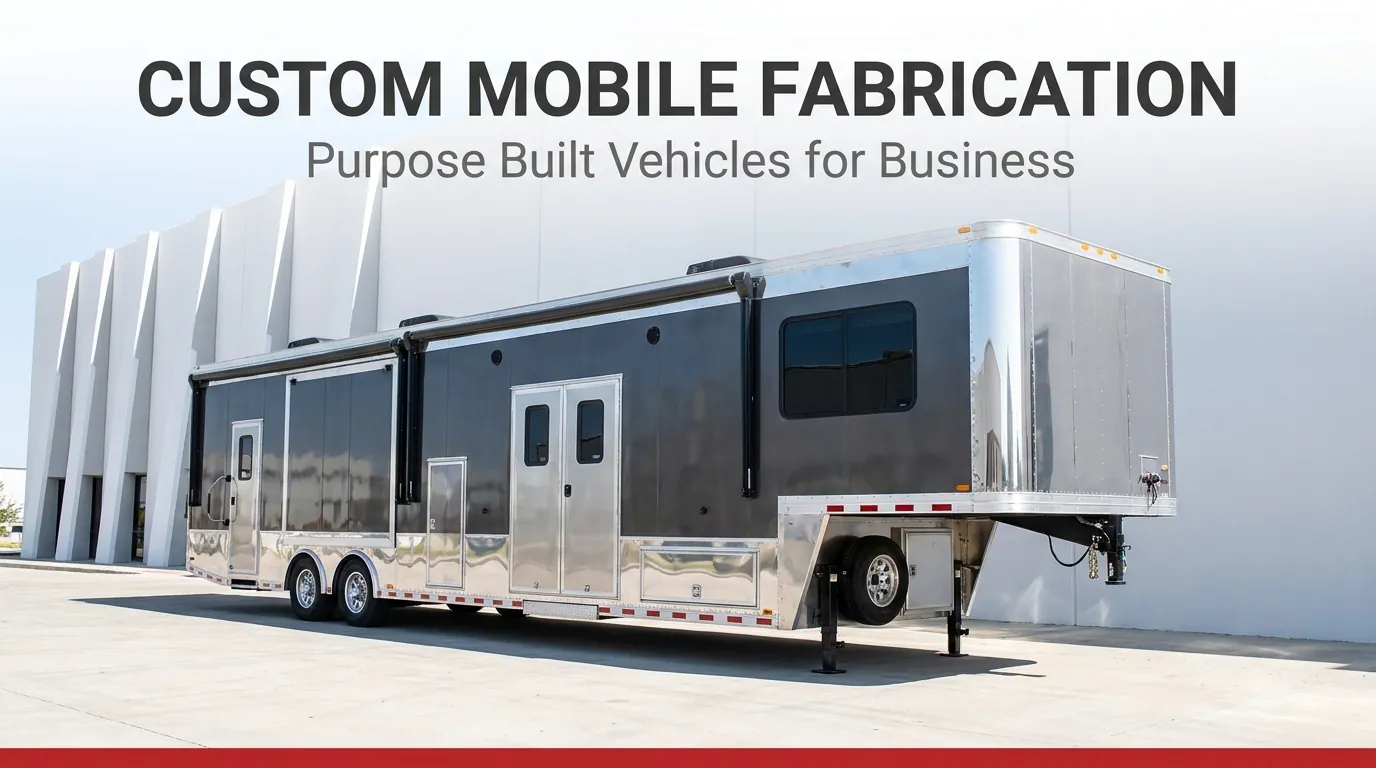
Custom mobile fabrication is the end-to-end design, engineering, and construction of purpose-built vehicles and trailers tailored to a specific operational mission. It transforms incomplete chassis into fully self-contained facilities on wheels, serving industries from experiential marketing to healthcare to emergency response.
This guide covers the competitive advantages of mobile deployment, the unit types that deliver measurable results across industries, the fabrication process and material decisions that determine build quality, ROI measurement frameworks, common commissioning mistakes, and the role of vertical integration in protecting timelines and outcomes.
Branded mobile assets generate continuous impressions during transit and at activation sites, eliminating recurring media-buy costs while creating hands-on brand experiences that static advertising cannot replicate. Mobile deployment also removes the overhead of permanent facilities in every target market, letting a single unit serve dozens of regions annually.
Six distinct unit types drive competitive advantage: experiential marketing vehicles, mobile medical units, command centers, pop-up retail platforms, training vehicles, and mobile showrooms. Each serves a precise operational function, from delivering VA healthcare in underserved communities to launching temporary retail in major international markets.
The fabrication process spans five phases: discovery and design, structural engineering with chassis selection, interior and exterior buildout, electrical and HVAC systems integration, and pre-delivery quality assurance. Material choices between aluminum, steel, and composite panels directly influence payload capacity and fuel efficiency, with even a 10% weight reduction yielding meaningful fuel savings over thousands of road miles.
Measuring ROI requires tracking impressions, cost per engagement, and total cost of ownership across the asset’s full service life. Avoiding common mistakes, such as underestimating federal weight regulations or skipping the 3D rendering phase, protects both budget and timeline. Vertically integrated fabrication, where design through finishing happens under one roof, consistently delivers faster turnaround and tighter design-to-build accuracy.
What Is Custom Mobile Fabrication?
Custom mobile fabrication is the end-to-end design, engineering, and construction of purpose-built vehicles and trailers tailored to a specific operational mission. The subsections below clarify how it differs from standard upfitting and which industries depend on it most.
How Does Custom Mobile Fabrication Differ from Standard Vehicle Upfitting?
Custom mobile fabrication differs from standard vehicle upfitting in scope, engineering depth, and end-use specialization. Standard upfitting typically adds aftermarket accessories, such as shelving, lighting, or ladder racks, to a production vehicle. Custom mobile fabrication, by contrast, transforms an incomplete chassis into a fully engineered, mission-specific asset. According to the National Institute of Standards and Technology, mass customization manufacturing aims to “rapidly produce and deliver customized products while keeping costs at the mass-production level.” That principle applies directly here: each build addresses unique requirements for layout, power, HVAC, and technology integration while leveraging repeatable fabrication processes. FEMA, for example, categorizes special-purpose vehicles as “mobile, on-site platforms for command, control and communications during terrorist attacks and other emergencies.” Standard upfitting cannot achieve that level of functional complexity. For organizations that need a vehicle to serve as a self-contained facility on wheels, custom fabrication is the only viable path.
What Industries Rely on Custom Mobile Fabrication?
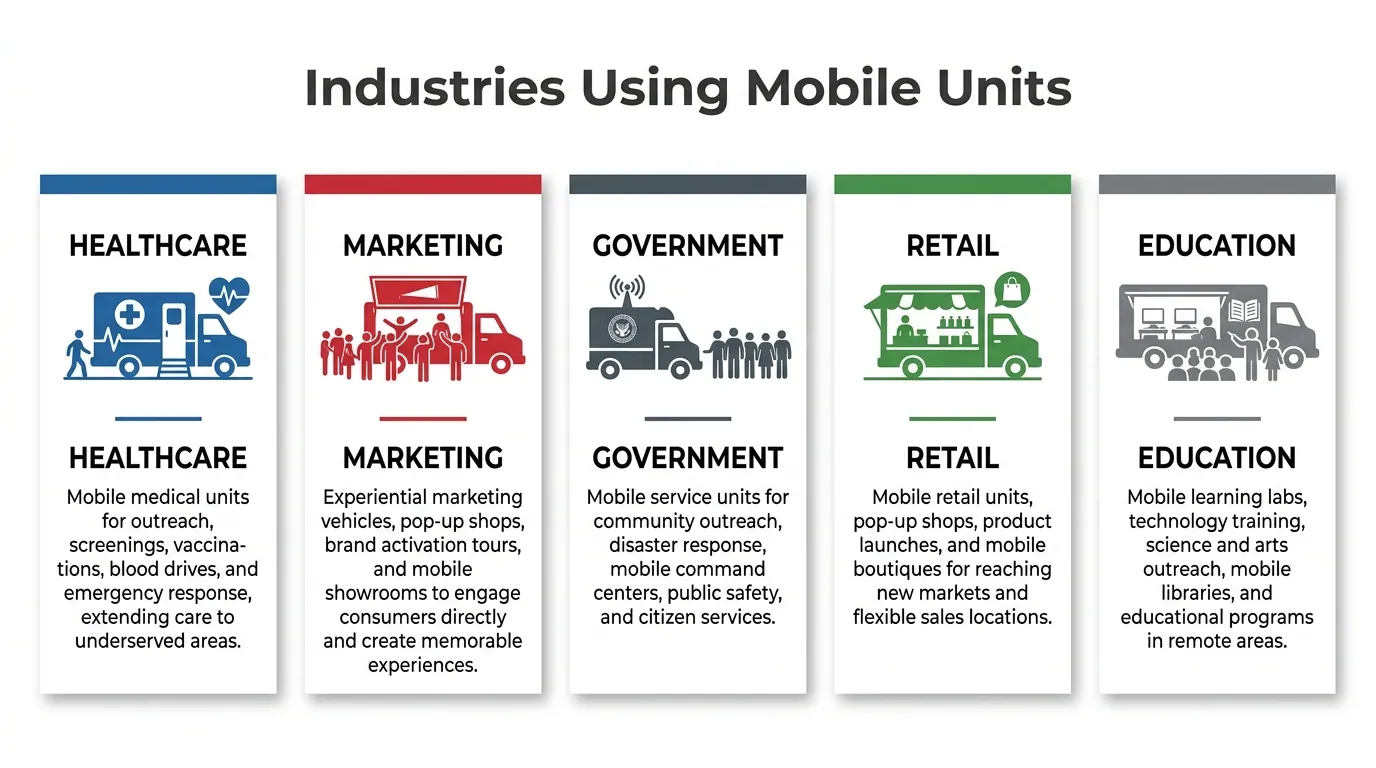
The industries that rely on custom mobile fabrication span both commercial and public sectors:
- Experiential marketing: Brands deploy custom vehicles for mobile tours, product sampling, and event activations.
- Healthcare: Mobile medical units deliver primary care, diagnostics, and specialty services to underserved or remote populations.
- Government and defense: Agencies commission mobile command centers, emergency response platforms, and field training units.
- Retail: Pop-up showrooms and mobile storefronts bring products directly to consumers in high-traffic locations.
- Education and training: Custom trailers serve as portable classrooms and hands-on simulation environments.
According to Health Affairs, a study on mobile health clinics found that reduced blood pressure and fewer patient-reported emergency department visits produced a positive return on investment of 1.3. That measurable outcome illustrates why healthcare, in particular, continues to expand its use of custom mobile assets. Across every sector listed above, the common driver is the same: organizations need a deployable, self-contained environment that no off-the-shelf vehicle can provide.
Understanding which industries invest in these assets sets the stage for examining why custom mobile fabrication delivers a measurable competitive edge.
Why Does Custom Mobile Fabrication Provide a Competitive Edge?
Custom mobile fabrication provides a competitive edge by turning branded vehicles into revenue-generating assets that increase visibility, lower overhead, accelerate market entry, and elevate customer experience. The following sections break down each advantage.
How Does a Branded Mobile Asset Increase Market Visibility?
A branded mobile asset increases market visibility by placing a company’s identity directly in front of target audiences at events, high-traffic locations, and multi-city tours. Unlike static signage, a custom mobile unit combines out-of-home advertising reach with hands-on brand interaction.
According to a field study published by Columbia Business School, event attendance increases brand equity, with brand experience serving as the most important mediator of that effect. This finding underscores why experiential marketing vehicles outperform passive advertising formats. A fully wrapped, purpose-built mobile unit generates impressions continuously during transit and at activation sites, compounding visibility without recurring media-buy costs.
For brands competing in crowded markets, a mobile asset that invites physical participation creates memorability no digital ad can replicate.
How Does Mobile Deployment Reduce Facility Overhead Costs?
Mobile deployment reduces facility overhead costs by eliminating the need for permanent brick-and-mortar locations in every target market. A custom mobile unit functions as a self-contained facility, housing product displays, service equipment, or consultation spaces on a single chassis.
This approach removes recurring expenses associated with fixed locations:
- Long-term commercial lease obligations
- Utility and property maintenance fees
- Market-specific build-out and permitting costs
- Staffing for multiple permanent sites
One mobile unit can serve dozens of markets annually, converting what would be fixed real estate costs into a flexible, redeployable capital asset. For organizations testing new regions or seasonal demand, mobile deployment validates market interest before committing to permanent infrastructure.
How Does Speed to Market Improve with a Mobile Strategy?
Speed to market improves with a mobile strategy because a single custom-built unit can launch activations across multiple cities within weeks of delivery. Traditional facility expansion requires site selection, permitting, construction, and staffing, a process that often spans months or years.
A purpose-built mobile vehicle compresses that timeline. Once fabrication is complete, the unit deploys immediately to its first activation. Route schedules can shift based on real-time demand signals, seasonal events, or competitive opportunities. This agility lets brands capitalize on market windows that fixed locations simply cannot reach in time.
Organizations that prioritize rapid deployment gain first-mover positioning at trade shows, product launches, and regional tours where timing determines audience capture.
How Does a Custom Mobile Unit Strengthen Customer Experience?
A custom mobile unit strengthens customer experience by creating a controlled, immersive environment designed around specific audience interactions. Performance.gov defines customer experience as the public’s perceptions of and overall satisfaction with interactions involving any product or service.
Custom fabrication allows every interior detail, from layout and lighting to interactive technology, to align with the brand narrative. Visitors step into a curated space where product demonstrations, consultations, or sampling activities unfold in a setting the brand fully controls. This level of environmental design is difficult to achieve in shared venues or rented exhibition halls.
The result is higher engagement quality per interaction, which directly supports conversion goals and long-term brand loyalty. With customer experience shaping competitive differentiation, mobile units built for purpose deliver measurable advantages over generic activation setups.
What Types of Custom Mobile Units Drive Competitive Advantage?
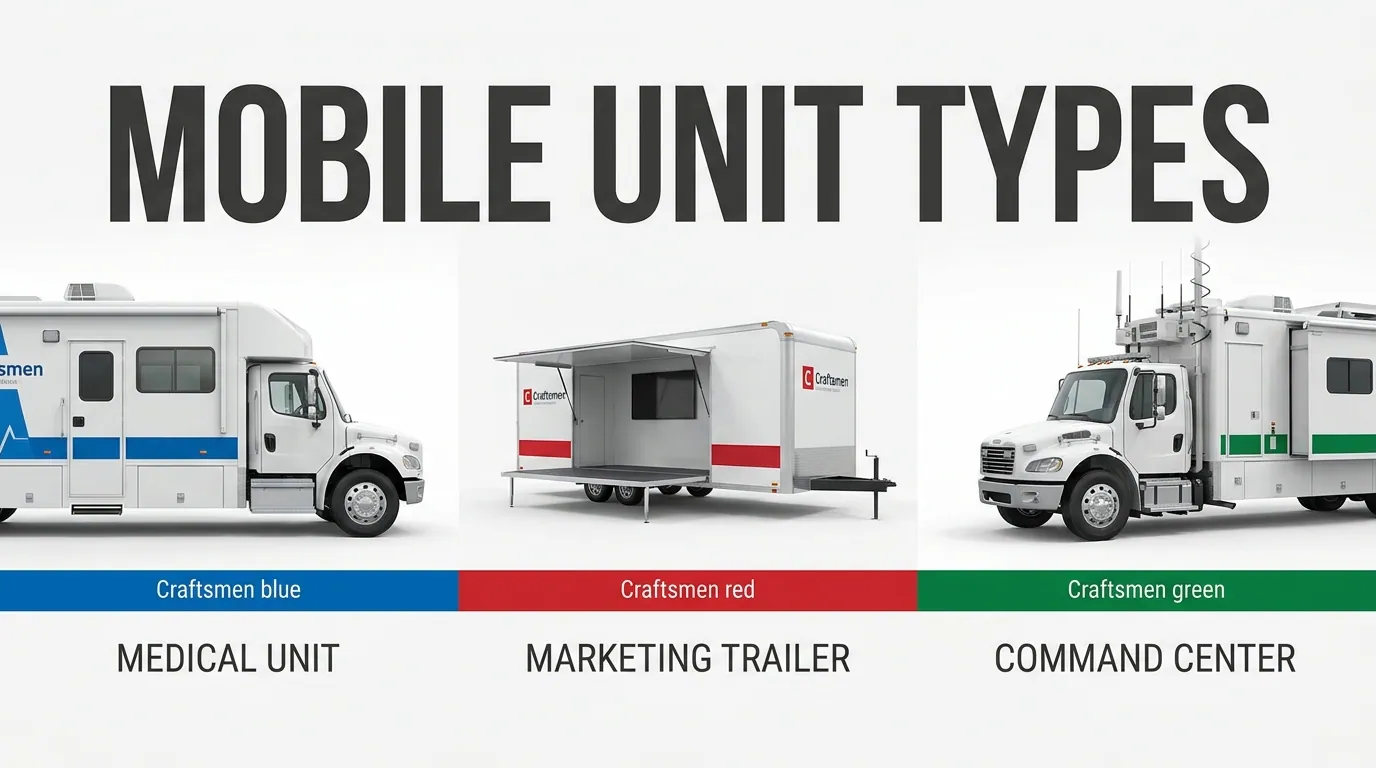
The types of custom mobile units that drive competitive advantage include experiential marketing vehicles, mobile medical units, command centers, pop-up retail units, training vehicles, and mobile showrooms. Each type serves a distinct operational goal.
Experiential Marketing Vehicles
Experiential marketing vehicles are custom-built mobile platforms that bring branded experiences directly to consumers. The American Marketing Association defines experiential marketing as an approach that directly engages and encourages consumers to participate in a branded experience, stimulating an emotional connection that reinforces brand essence. These vehicles transform parking lots, festivals, and corporate campuses into immersive activation spaces.
According to a Columbia Business School field study, event attendance increases brand equity, with brand experience identified as the most important mediator of that effect. Custom fabrication allows each vehicle to reflect precise brand guidelines through interactive interiors, integrated AV systems, and full exterior wraps. For organizations seeking measurable audience engagement, experiential vehicles consistently outperform static displays because they combine physical presence with participatory design.
Mobile Medical and Healthcare Units
Mobile medical and healthcare units are purpose-built vehicles that deliver clinical services in locations without permanent facilities. These units require specialized engineering, including HVAC systems installed in accordance with NFPA 90A standards and dedicated electrical infrastructure for medical-grade equipment.
According to the U.S. Government Accountability Office, the Department of Veterans Affairs operates mobile medical units to deliver primary and specialty care to veterans in communities with populations too small to support local VA clinics or in areas with limited access to specialty care. Custom fabrication ensures each unit meets strict healthcare compliance requirements while remaining road-legal within federal width limits of 102 inches for commercial motor vehicles on the National Network. For any healthcare organization expanding access, mobile medical units offer clinical capability without permanent construction costs.
Mobile Command and Operations Centers
Mobile command and operations centers are specialized vehicles designed as on-site platforms for command, control, and communications during emergencies. According to the Federal Emergency Management Agency, this vehicle category serves as a mobile hub during terrorist attacks and other critical incidents.
Custom fabrication integrates satellite communications, redundant power systems, ruggedized workstations, and secure network infrastructure into a single deployable asset. Government agencies and emergency management organizations rely on these units because fixed facilities cannot relocate to an evolving incident scene. The ability to tailor interior layouts to specific agency workflows, rather than adapting to a generic floorplan, directly improves response coordination.
Mobile Retail and Pop-Up Units
Mobile retail and pop-up units are temporary, relocatable commercial spaces that brands deploy to test markets, launch products, or reach new audiences. According to a study published in the Journal of the Association for Consumer Research at the University of Pennsylvania Wharton School, pop-up stores are retail solutions that suddenly appear and then disappear, with multiple brands creating pop-ups across a range of product categories in major international markets.
Custom fabrication transforms these units from basic shells into fully branded environments with integrated point-of-sale technology, climate control, and merchandising displays. The temporary nature of pop-ups makes custom mobile builds particularly strategic; a single asset can serve dozens of locations per year, spreading acquisition costs across a much larger audience footprint than any single lease.
Mobile Training and Education Units
Mobile training and education units are self-contained vehicles equipped to deliver instructional programs at remote or rotating locations. These units typically integrate classroom technology such as interactive displays, high-bandwidth connectivity, simulation equipment, and flexible seating configurations.
A 2016 National Science Foundation survey found that only 68% of school district technology administrators reported their systems fully met the FCC’s minimum internet bandwidth recommendations, up from just 19% four years earlier. This persistent connectivity gap in fixed facilities highlights why mobile training units, which carry their own infrastructure, provide a reliable alternative for workforce development, technical certification, and community education programs.
Mobile Showrooms and Product Demonstration Vehicles
Mobile showrooms and product demonstration vehicles are custom units that bring a company’s products directly to prospective buyers for hands-on evaluation. These vehicles eliminate the need for customers to visit a fixed location, shortening the sales cycle by combining product display, demonstration, and consultation into a single scheduled visit.
Custom interior layouts accommodate product-specific mounting, lighting, and interactive stations tailored to each brand’s demonstration workflow. For companies with complex or large-format products that are difficult to ship to trade shows, a mobile showroom provides a controlled, repeatable presentation environment. This approach is especially valuable in B2B sales, where decision-makers across multiple facilities can experience the product without travel.
Understanding which unit type fits your operational goals is the first step; the fabrication process determines whether that unit performs as designed.
What Does the Custom Mobile Fabrication Process Involve?
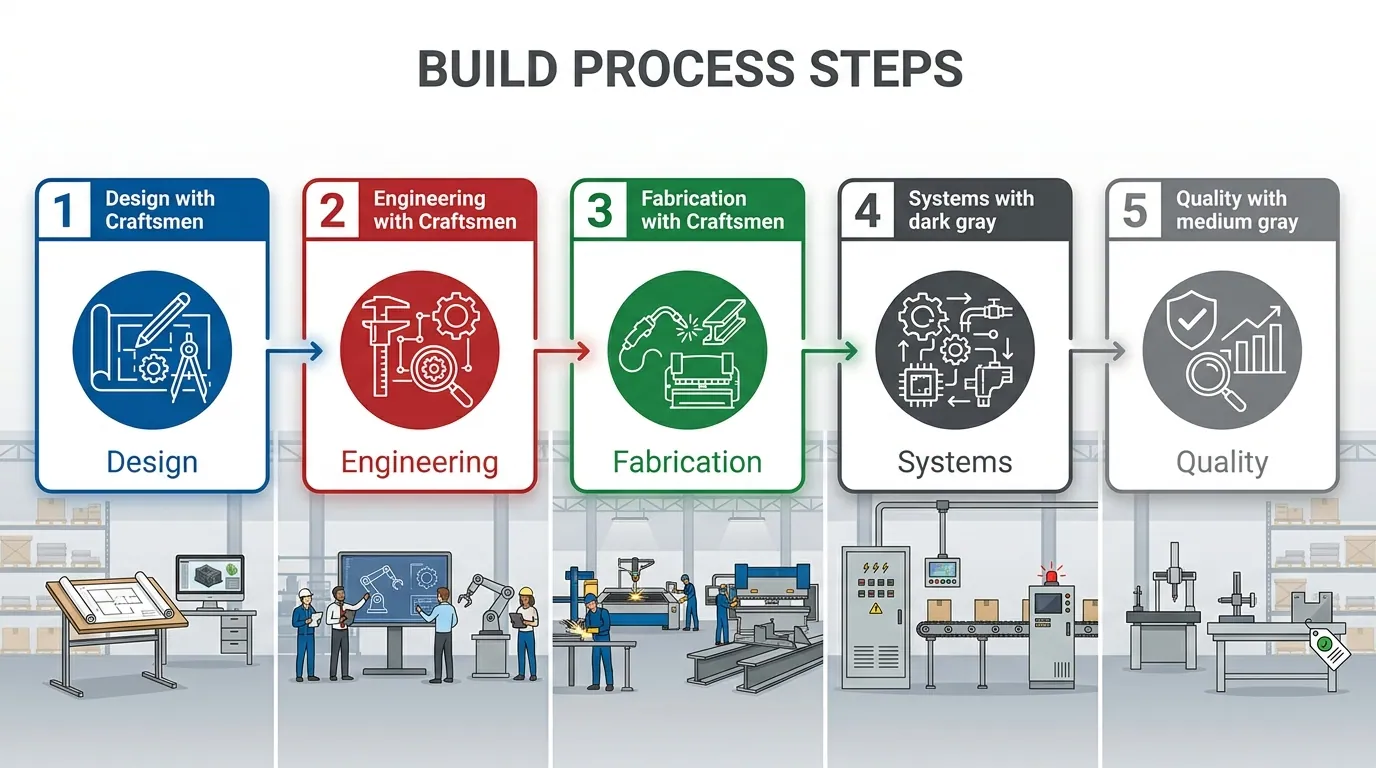
The custom mobile fabrication process involves five core phases: discovery and design, structural engineering and chassis selection, interior and exterior fabrication, systems integration, and quality assurance before final delivery.
How Does the Discovery and Design Phase Shape the Build?
The discovery and design phase shapes the build by aligning operational requirements, brand objectives, and life-cycle cost projections before any physical work begins. Engineers and designers collaborate with stakeholders to define payload needs, spatial layouts, deployment frequency, and target environments.
Life-cycle cost analysis plays a central role at this stage. According to the U.S. Environmental Protection Agency, life-cycle cost encompasses the total cost of planning, design, acquisition, operations, maintenance, and disposal over a predetermined evaluation period. Factoring these costs into early design decisions prevents expensive retrofits and scope changes later. For most custom builds, the discovery phase is the single highest-leverage point for controlling budget and timeline.
How Are Structural Engineering and Chassis Selection Determined?
Structural engineering and chassis selection are determined by matching the unit’s weight distribution, intended payload, and road-use profile against available chassis platforms. Engineers calculate gross vehicle weight ratings, axle loads, and center-of-gravity requirements to identify the right foundation.
Finite element analysis (FEA) validates these decisions digitally before fabrication starts. A University of Alabama in Huntsville Honors College capstone project demonstrated how FEA critically investigates and improves chassis structural properties, then compares computer model results against real-world testing to confirm accuracy. This simulation-to-validation workflow reduces material waste and catches stress-point failures early, well before a chassis reaches the shop floor.
What Happens During Interior and Exterior Fabrication?
Interior and exterior fabrication transforms the engineered chassis into a finished, branded environment. Interior work typically includes:
- Custom cabinetry, countertops, and modular wall systems
- Flooring rated for high foot traffic and repeated load-in/load-out cycles
- Structural reinforcements for mounted equipment, displays, or medical devices
Exterior fabrication covers body panel construction, slide-out mechanisms, hydraulic leveling systems, and weather-sealed entry points. Material choices made during the design phase directly influence this stage; lightweight composites reduce curb weight while maintaining structural rigidity. Every component is built to withstand the vibration, thermal cycling, and road stress that mobile assets experience during continuous deployment.
How Are Electrical, HVAC, and Technology Systems Integrated?
Electrical, HVAC, and technology systems are integrated after the structural shell is complete, following strict code requirements specific to each unit’s end use. Power distribution systems, LED lighting circuits, AV infrastructure, and data networking are routed through dedicated conduit paths to simplify future maintenance access.
HVAC integration follows industry-specific standards. The Facility Guidelines Institute mandates that HVAC equipment, ductwork, and related components be installed in accordance with NFPA 90A, the Standard for the Installation of Air-Conditioning and Ventilating Systems. Climate control sizing accounts for occupancy loads, equipment heat output, and geographic deployment range. Coordinating these systems within a compact mobile footprint demands tighter tolerances than conventional construction.
What Quality Assurance Steps Occur Before Final Delivery?
Quality assurance steps before final delivery include systematic verification testing, functional inspections, and documented punch-list resolution. Every subsystem, from electrical circuits to HVAC output to hydraulic operations, undergoes individual performance checks before integrated system testing begins.
According to the UK Government Project Delivery Function standard, project delivery teams shall ensure work is appropriately defined, planned, monitored, and controlled, that quality is actively managed to maximize the likelihood of success, and that lessons are captured and shared to promote future performance improvement. Applying this framework to mobile fabrication means each completed unit ships with verified baselines, operational documentation, and training materials.
Rigorous pre-delivery QA is what separates a reliable mobile asset from one that requires costly field repairs during its first deployment tour. With quality confirmed, the focus shifts to selecting the right materials and construction methods for long-term durability.
What Materials and Construction Methods Matter Most?
The materials and construction methods that matter most in custom mobile fabrication balance structural integrity, weight, and long-term durability. The following sections compare aluminum and steel, explain when composite panels fit best, and detail how lightweight materials influence payload and fuel efficiency.
How Does Aluminum Compare to Steel in Mobile Fabrication?
Aluminum compares to steel in mobile fabrication by offering a significantly lower weight-to-strength ratio, which directly benefits payload capacity and fuel consumption. Steel provides superior tensile strength and impact resistance, making it the preferred choice for chassis components and high-stress structural joints. Aluminum, roughly one-third the weight of steel, excels in body panels, framing, and exterior cladding where corrosion resistance and weight savings are priorities.
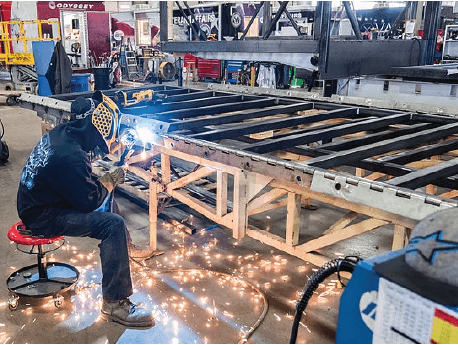
The practical trade-off comes down to application. Steel costs less per pound and welds more predictably in thick structural sections. Aluminum requires specialized welding techniques, such as TIG welding, but eliminates the need for protective coatings against rust. For most custom mobile builds, a hybrid approach works best: steel where loads concentrate, aluminum everywhere else.
When Are Composite Panels the Right Choice?
Composite panels are the right choice when a mobile build requires maximum insulation, minimal weight, and smooth interior finishing in a single material. Fiberglass-reinforced panels and foam-core composites deliver high thermal insulation values while resisting moisture infiltration, which makes them particularly well suited for mobile medical units and climate-controlled environments.
These panels also simplify interior finishing. Unlike bare metal, composites can be molded with integrated surface textures, reducing secondary labor. The limitation is repairability; damaged composite sections often require full panel replacement rather than localized welding or patching. When thermal performance and weight reduction outweigh field-repair flexibility, composites consistently prove their value.
How Do Lightweight Materials Affect Payload and Fuel Efficiency?
Lightweight materials affect payload and fuel efficiency by reducing curb weight, which frees gross vehicle weight capacity for equipment, inventory, or passengers. According to the U.S. Department of Energy’s Transportation Technologies Office, a 10% reduction in vehicle weight can result in a 6% to 8% fuel economy improvement.
This relationship has direct operational consequences:
- Lower fuel costs per mile across multi-city tours and deployment routes.
- Greater available payload for onboard equipment, medical devices, or branded fixtures.
- Reduced tire and brake wear due to decreased stopping forces.
- Easier compliance with federal axle-weight limits on the Interstate System.
Military applications reinforce this principle. The National Research Council has documented requirements mandating that Army trucks undergo significant weight reduction while maintaining or increasing payload capacity. For any custom mobile asset logging thousands of road miles annually, material selection is one of the highest-leverage decisions in the entire build process.
With materials selected, the next step is understanding how production control affects build quality.
How Does In-House Vertical Integration Affect Build Quality?
In-house vertical integration affects build quality by consolidating design, engineering, fabrication, and finishing under one roof. This eliminates handoff errors between vendors and gives a single team accountability for every production stage. The subsections below cover risk reduction, lead time compression, and design-to-build accuracy.
Why Does Single-Source Production Reduce Project Risk?
Single-source production reduces project risk by placing every fabrication discipline within one organization, eliminating the communication gaps that arise when multiple subcontractors interpret specifications independently. When design, metalwork, electrical integration, graphics, and quality inspection share the same facility, each team catches errors before they compound downstream. According to the UK Government Project Delivery Function standard, project delivery requires that “work is appropriately defined, planned, monitored and controlled” and that “quality is actively managed to maximise the likelihood of success.” A vertically integrated fabricator naturally satisfies these principles because no specification crosses an organizational boundary where accountability could blur. For complex custom mobile builds, this single-source accountability is one of the most effective safeguards against costly rework.
How Does In-House Control Shorten Lead Times?
In-house control shortens lead times by removing the scheduling dependencies that accumulate when fabrication tasks are distributed across outside vendors. Every subcontractor handoff introduces its own queue time, shipping delay, and re-inspection cycle. When structural welding, interior buildout, HVAC installation, and large-format graphics all happen in the same facility, production stages overlap rather than wait in sequence. As reported by EXHIBITOR Online, Craftsmen Industries completed a full mobile showroom build for Stratasys from production start in August to road-ready deployment in early November. That compressed timeline reflects the efficiency gained when no external vendor coordination is required. Concurrent in-house workflows consistently deliver faster turnaround than multi-vendor project chains.
How Does Vertical Integration Improve Design-to-Build Accuracy?
Vertical integration improves design-to-build accuracy by keeping the original design team directly connected to the fabrication floor throughout the entire build. When engineers and fabricators work in separate organizations, design intent degrades at every translation point, from CAD files to shop drawings to final assembly. A shared facility allows real-time feedback loops: if a structural modification affects graphic panel fitment or electrical routing, the responsible teams resolve it in hours rather than days of back-and-forth emails. This continuity between digital design and physical execution is especially critical for custom mobile units where tolerances on chassis-mounted systems, interior layouts, and exterior wraps must align precisely.
Tight design-to-build alignment sets the stage for measuring what that quality ultimately returns on investment.
How Do You Measure ROI on a Custom Mobile Asset?
You measure ROI on a custom mobile asset by tracking brand impressions, calculating cost per engagement, and modeling total cost of ownership across the unit’s full lifespan. The following sections break down each measurement approach.
What Brand Impression Metrics Should You Track?
The brand impression metrics you should track for a custom mobile asset include:
- Impressions: the total number of times your mobile unit is seen by audiences at events, on routes, or at activations.
- Cost per thousand impressions (CPM): total campaign cost divided by impressions, multiplied by 1,000.
- Dwell time: the average duration a visitor spends interacting with your mobile experience.
- Social media mentions and shares: organic content generated by attendees during and after engagements.
- Lead capture volume: the number of qualified contacts collected per activation.
Impressions alone tell you reach; pairing them with dwell time and lead capture reveals whether that reach converts into meaningful audience engagement. For mobile assets that travel multiple markets, tracking these metrics per stop gives you a geographic performance baseline that static campaigns simply cannot replicate.
How Do You Calculate Cost Per Engagement for Mobile Activations?
You calculate cost per engagement for mobile activations by dividing total activation spend by the number of meaningful audience interactions. According to a study published in Internet Interventions (National Library of Medicine, PubMed Central), measurable engagement-cost components include impressions, CPM, click-through rate (CTR), cost per link click (CPL), and cost per consent (CPC).
For mobile activations specifically, replace digital clicks with physical interactions, such as product demonstrations, samples distributed, or consultations completed. Dividing total deployment cost by these on-site conversions produces a tangible cost-per-engagement figure that stakeholders can compare directly against trade show booths or digital ad campaigns.
How Does Mobile Unit Lifespan Factor into Total Cost of Ownership?
Mobile unit lifespan factors into total cost of ownership by spreading acquisition costs across every year, event, or mile the asset remains operational. According to the Bureau of Transportation Statistics (U.S. Department of Transportation), total vehicle ownership costs include fuel, maintenance, tires, insurance, license and registration, taxes, depreciation, and financing.
For a custom mobile asset, additional line items apply:
- Fabrication and build cost amortized over projected service years.
- Refurbishment cycles for graphics, interior technology, and branding refreshes.
- Storage and logistics between activations.
- Regulatory compliance costs for inspections and permits.
Modeling these costs on a per-event or per-mile basis reveals the true unit economics. A well-built mobile asset that operates for seven or more years will drive its per-activation cost far below repeated short-term rental or temporary exhibit expenses, making lifespan the single most influential variable in the ROI equation.
What Mistakes Should You Avoid When Commissioning a Custom Build?
The mistakes you should avoid when commissioning a custom build include underestimating weight and dimension regulations, skipping the prototype or 3D rendering phase, and choosing the wrong fabrication partner. Each of these errors can derail timelines, inflate costs, or create compliance failures.
What Happens When You Underestimate Weight and Dimension Regulations?
Underestimating weight and dimension regulations triggers costly redesigns, route restrictions, and potential federal violations. Any custom mobile unit exceeding a gross vehicle weight rating of 10,001 pounds is classified as a commercial motor vehicle under FMCSA rules, which activates driver licensing, insurance, and inspection requirements that many clients fail to plan for.
Federal axle-weight limits compound the risk. According to the Electronic Code of Federal Regulations, Title 23, Part 658, the federal single axle weight limit on the Interstate System is 20,000 pounds, while the federal tandem axle weight limit is 34,000 pounds. Exceeding either threshold results in fines, forced offloading, or denied bridge crossings. These constraints must be factored into chassis selection and interior buildout from day one, not discovered after fabrication is complete.
Why Is Skipping a Prototype or 3D Rendering Phase Risky?
Skipping a prototype or 3D rendering phase is risky because it eliminates the lowest-cost opportunity to identify design flaws, spatial conflicts, and integration errors before materials are cut. Digital renderings reveal clearance issues between HVAC ductwork, electrical routing, and interior fixtures that would otherwise surface during fabrication, when corrections require scrapping completed components.
Physical prototypes or detailed 3D models also align stakeholder expectations early. Without them, subjective disagreements about layout, branding placement, or workflow emerge mid-build, forcing change orders that extend timelines by weeks. For most custom mobile programs, investing in the rendering phase saves far more than it costs.
How Does Choosing the Wrong Fabrication Partner Hurt Timelines?
Choosing the wrong fabrication partner hurts timelines by fragmenting production across multiple vendors, each with independent schedules, quality standards, and communication protocols. When structural fabrication, electrical integration, HVAC installation, and graphics are managed by separate shops, coordination gaps create cascading delays.
Partners lacking in-house engineering also struggle to resolve design conflicts quickly. A single tolerance mismatch between chassis and interior framing can stall production for weeks while third-party engineers are consulted. This is why vertically integrated fabrication, where design, engineering, and build happen under one roof, consistently delivers faster and more predictable project completion.
Understanding these commissioning pitfalls prepares you to evaluate how a vertically integrated partner can protect your investment.
How Can a Vertically Integrated Fabrication Partner Maximize Your Competitive Advantage?
A vertically integrated fabrication partner maximizes competitive advantage by consolidating design, engineering, fabrication, and finishing under one roof. The following sections explore how Craftsmen Industries’ build process accelerates mobile strategy and summarize the key takeaways from this article.
Can Craftsmen Industries’ End-to-End Custom Build Process Accelerate Your Mobile Strategy?
Yes, Craftsmen Industries’ end-to-end custom build process can accelerate your mobile strategy by keeping every phase, from concept design through final graphics installation, within a single 127,000 sq. ft. facility. This in-house vertical integration eliminates the coordination delays that occur when design, structural engineering, fabrication, and large format printing are split across multiple vendors.
According to an independent EXHIBITOR Online report, Stratasys selected Craftsmen Industries for its mobile showroom project specifically because of this consolidated capability; the actual build started in August and hit the road by early November. That compressed timeline illustrates how single-source production removes handoff gaps between disciplines. For organizations pursuing experiential marketing vehicles, mobile medical units, or mobile command centers, consolidating the entire build process under one partner is the most reliable path to faster deployment and tighter quality control.
What Are the Key Takeaways About Custom Mobile Fabrication for Competitive Advantage?
The key takeaways about custom mobile fabrication for competitive advantage center on five actionable principles:
- Define the mission before selecting the platform. Discovery and design phases that account for life-cycle cost, weight regulations, and deployment goals prevent costly mid-build changes.
- Choose materials strategically. Lightweight material selection directly affects payload capacity and fuel efficiency, which compound over the asset’s lifespan.
- Build compliance into the design. Federal weight, width, and GVWR thresholds must be addressed during engineering, not after fabrication is complete.
- Measure ROI with specific metrics. Impressions, cost per engagement, and total cost of ownership provide a clear financial picture that justifies the investment.
- Partner with a vertically integrated fabricator. Single-source production reduces project risk, shortens lead times, and improves design-to-build accuracy.
For organizations ready to turn custom mobile fabrication into a measurable competitive advantage, Craftsmen Industries brings over 40 years of in-house design, engineering, fabrication, and graphics capability to every build.
Filter Posts by Tag
related posts

Automation and robotics in modern industrial fabrication is the application [...]
Are you wondering what is welding in industrial fabrication and how can you use it for your business? Check our guide to discover the best industry insights.
Aerospace fabrication is the specialized discipline of cutting, forming, joining, [...]
