
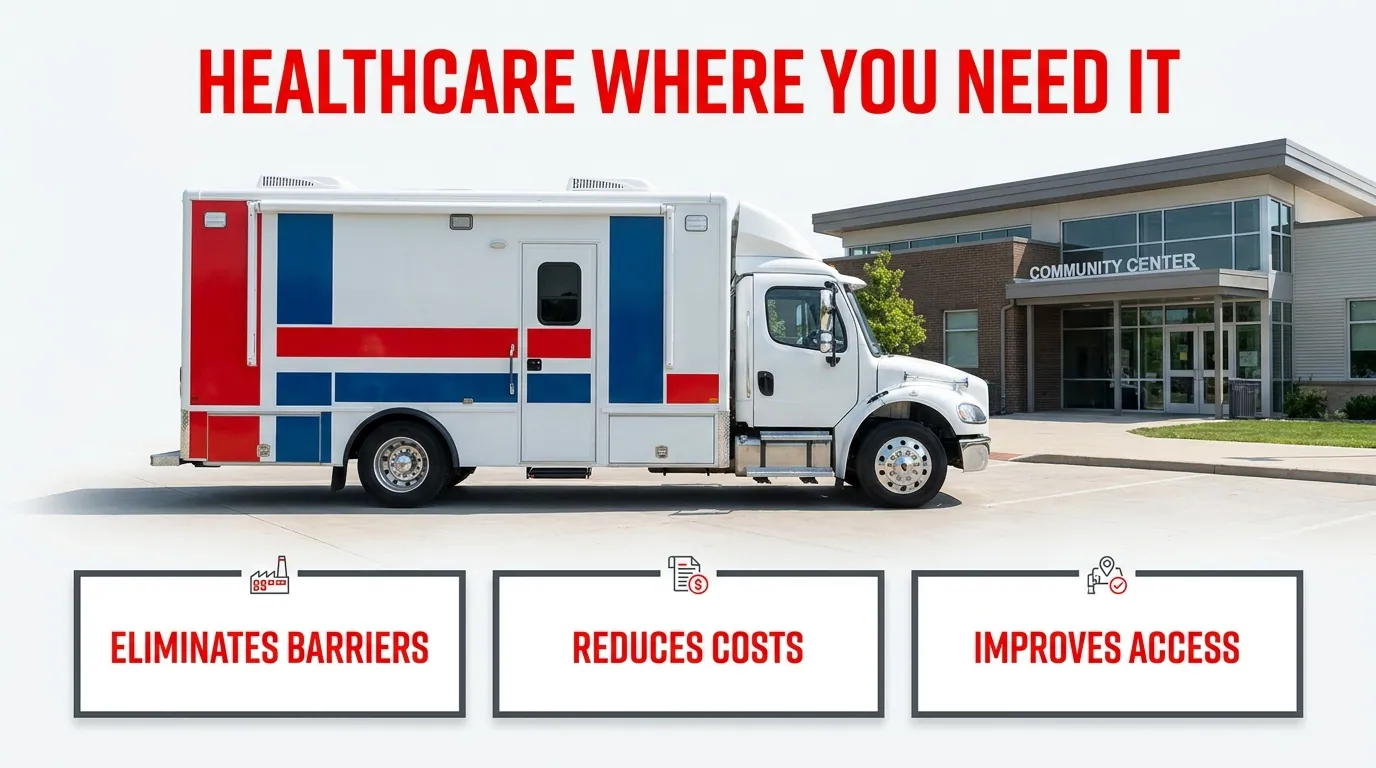
A mobile clinic is a vehicle converted into a fully equipped healthcare facility that delivers medical services directly to patients in underserved or hard-to-reach locations. Over 2,000 mobile clinics currently operate in the United States, providing millions of visits annually to populations that fixed facilities consistently fail to reach.
This guide covers access and cost barriers that mobile clinics solve, the populations and communities they serve, the clinical services they deliver, program planning and regulatory requirements, and how custom-built units translate healthcare goals into deployable assets.
Mobile clinics eliminate transportation, geographic, and financial obstacles by positioning primary care, screenings, and preventive services within walking distance of patients who would otherwise go without treatment. Millions of U.S. adults skip needed medical care each year simply because they lack reliable transportation to a fixed facility.
Cost efficiency runs through every layer of mobile clinic operations. Per-visit costs in mobile settings fall considerably below fixed-clinic equivalents, and preventive interventions like blood pressure management and chronic disease monitoring reduce expensive emergency department utilization while generating positive returns on investment.
The populations gaining the most from mobile clinics include rural residents isolated by distance, uninsured and underinsured individuals facing financial barriers, people experiencing homelessness, elderly homebound patients, and communities disrupted by natural disasters or public health emergencies. Federal regulations already recognize mobile units as eligible Rural Health Clinic and Federally Qualified Health Center sites.
Service versatility sets mobile clinics apart. A single unit can house primary care, dental operatories, behavioral health counseling, vaccination cold-chain storage, chronic disease management, and diagnostic imaging, all configured to match the target community’s needs.
Launching a mobile clinic program requires careful attention to medical fit-out, ADA accessibility, state-specific licensing, route optimization, and diversified funding streams that sustain operations beyond initial deployment.
What Is a Mobile Clinic?
A mobile clinic is a vehicle converted into a fully equipped healthcare facility that delivers medical services directly to patients in underserved or hard-to-reach locations. According to a review published in Population Health Management, a primary care mobile medical clinic is defined as a vehicle, such as a van, truck, or recreational vehicle, converted to a clinic to provide primary care, preventive care, and health care screening. More than 2,000 mobile clinics currently operate in the United States, providing an estimated 5 to 6.5 million visits annually and serving over 2.8 million uninsured individuals.
These units function as extensions of hospitals, community health centers, and public health departments. The World Health Organization regularly deploys mobile clinics and medical teams to reach people cut off from traditional health services, noting that for many populations, these units may be their only source of health care. Mobile clinics travel by van, truck, boat, motorcycle, or even on foot, offering flexible options for isolated, vulnerable, and newly displaced communities.
From routine screenings and chronic disease management to vaccinations and behavioral health, the scope of care delivered through mobile clinics continues to expand. Understanding what defines these units sets the foundation for examining their key benefits and the populations they serve most effectively.
What Are the Key Benefits of Using Mobile Clinics?
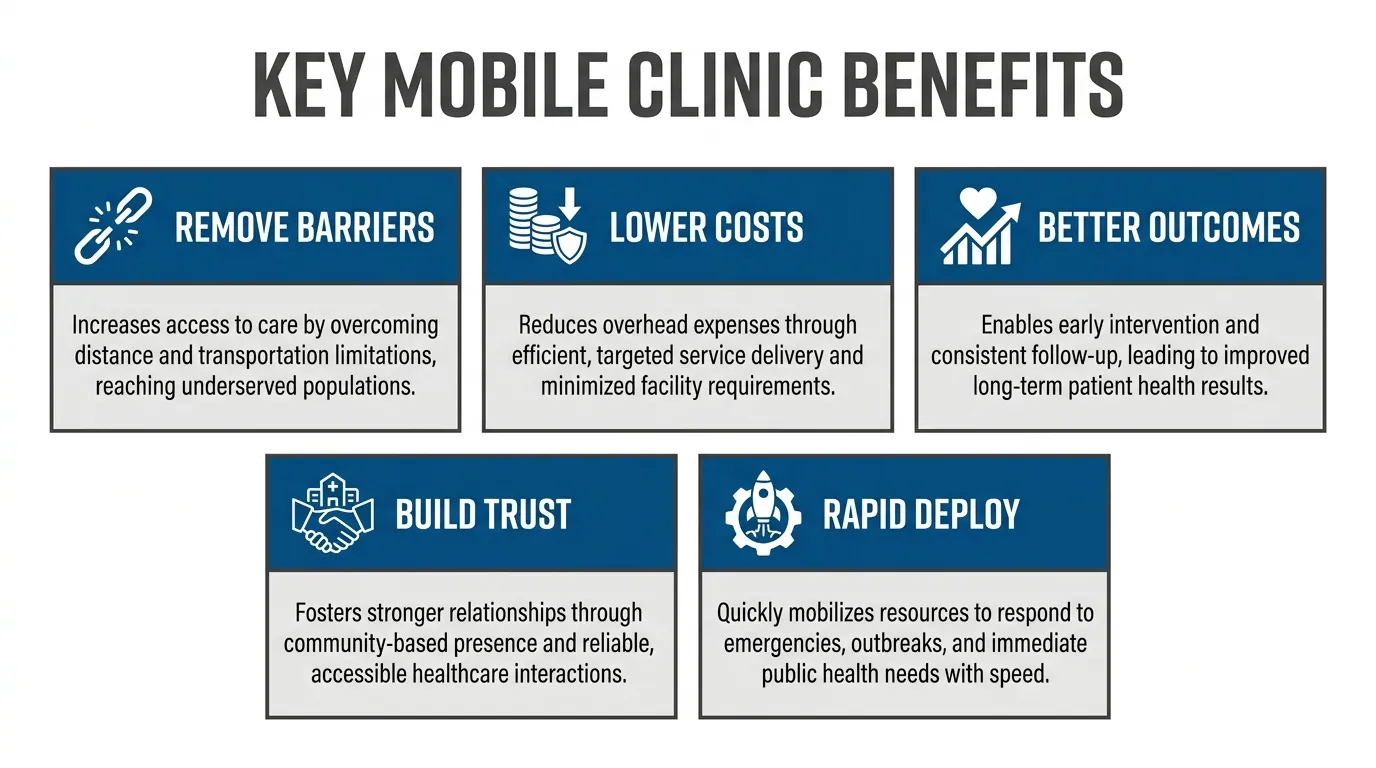
The key benefits of using mobile clinics include removing transportation barriers, lowering healthcare costs, improving health outcomes in underserved areas, building patient trust, and enabling rapid deployment to communities in need.
How Do Mobile Clinics Reduce Barriers to Healthcare Access?
Mobile clinics reduce barriers to healthcare access by bringing medical services directly to communities where transportation, geography, or financial constraints prevent people from reaching traditional facilities. For millions of Americans, the distance to a fixed clinic is the primary obstacle to receiving care.
According to the Robert Wood Johnson Foundation, 21% of U.S. adults without access to a vehicle or public transit went without needed medical care in the prior year. Even among those with neighborhood access to public transportation, 9% still skipped needed care. Mobile clinics eliminate this gap by positioning primary care, screenings, and preventive services within walking distance of the populations that need them most.
How Do Mobile Clinics Lower Costs for Patients and Providers?
Mobile clinics lower costs for patients and providers by delivering preventive care that reduces expensive emergency department visits and hospitalizations. Patients receive screenings, chronic disease management, and follow-up care at lower per-visit costs than traditional fixed-site facilities typically charge.
A study published in Health Affairs found that patients with high blood pressure who visited a Massachusetts mobile clinic experienced average reductions of 10.7 mmHg systolic and 6.2 mmHg diastolic blood pressure at follow-up. These improvements were associated with a positive lower-bound return on investment of 1.3, after accounting for reduced cardiovascular risk and avoided emergency department visits. For organizations weighing infrastructure investments, mobile clinics consistently demonstrate that upstream preventive care pays for itself.
How Do Mobile Clinics Improve Health Outcomes in Underserved Areas?
Mobile clinics improve health outcomes in underserved areas by delivering consistent primary care, vaccinations, and chronic disease management where fixed facilities are scarce or nonexistent. More than 2,000 mobile clinics currently operate in the United States, providing an estimated 5 to 6.5 million visits annually and serving over 2.8 million uninsured individuals, according to a review in Population Health Management.
The reach extends beyond basic primary care. From May to August 2021, mobile COVID-19 vaccination units held 130 sessions and administered 2,622 doses to 1,982 participants; 80% were non-White and 57% were Hispanic, as reported in the American Journal of Public Health. These results demonstrate that mobile clinics do not just provide convenient access; they actively close health equity gaps in the communities where disparities run deepest.
How Do Mobile Clinics Increase Patient Engagement and Trust?
Mobile clinics increase patient engagement and trust by meeting communities on familiar ground rather than requiring patients to navigate unfamiliar healthcare systems. Consistent presence in a neighborhood builds recognition and lowers the hesitancy that often accompanies first-time medical visits, particularly among uninsured or undocumented populations.
Acting New Jersey Health Commissioner Jeff Brown captured this principle: “Mobile Integrated Health programs represent a transformative step in how we deliver care in New Jersey. By bringing health services directly to patients where they live, we can close gaps in care, reduce unnecessary hospital visits, and improve health outcomes for our most vulnerable residents.” When healthcare comes to the patient repeatedly and reliably, the provider relationship shifts from transactional to trusted.
How Do Mobile Clinics Offer Flexibility for Rapid Deployment?
Mobile clinics offer flexibility for rapid deployment by functioning as self-contained medical facilities on wheels that can relocate based on shifting community needs, seasonal demand, or emergency situations. Unlike brick-and-mortar clinics, which require months or years of construction, a mobile unit can be operational in a new location within hours.
This adaptability proves critical during disease outbreaks, natural disasters, and public health campaigns where speed determines outcomes. Route optimization further enhances efficiency; a 2025 study published in PLOS ONE reported a 23% reduction in total distance traveled after implementing a collaborative scheduling approach for assigning mobile clinics to communities. That kind of logistical precision turns flexibility into measurable impact, making mobile units one of the most responsive tools in modern healthcare delivery.
Understanding these benefits clarifies which populations gain the most from mobile clinic services.
Who Benefits Most from Mobile Clinic Services?
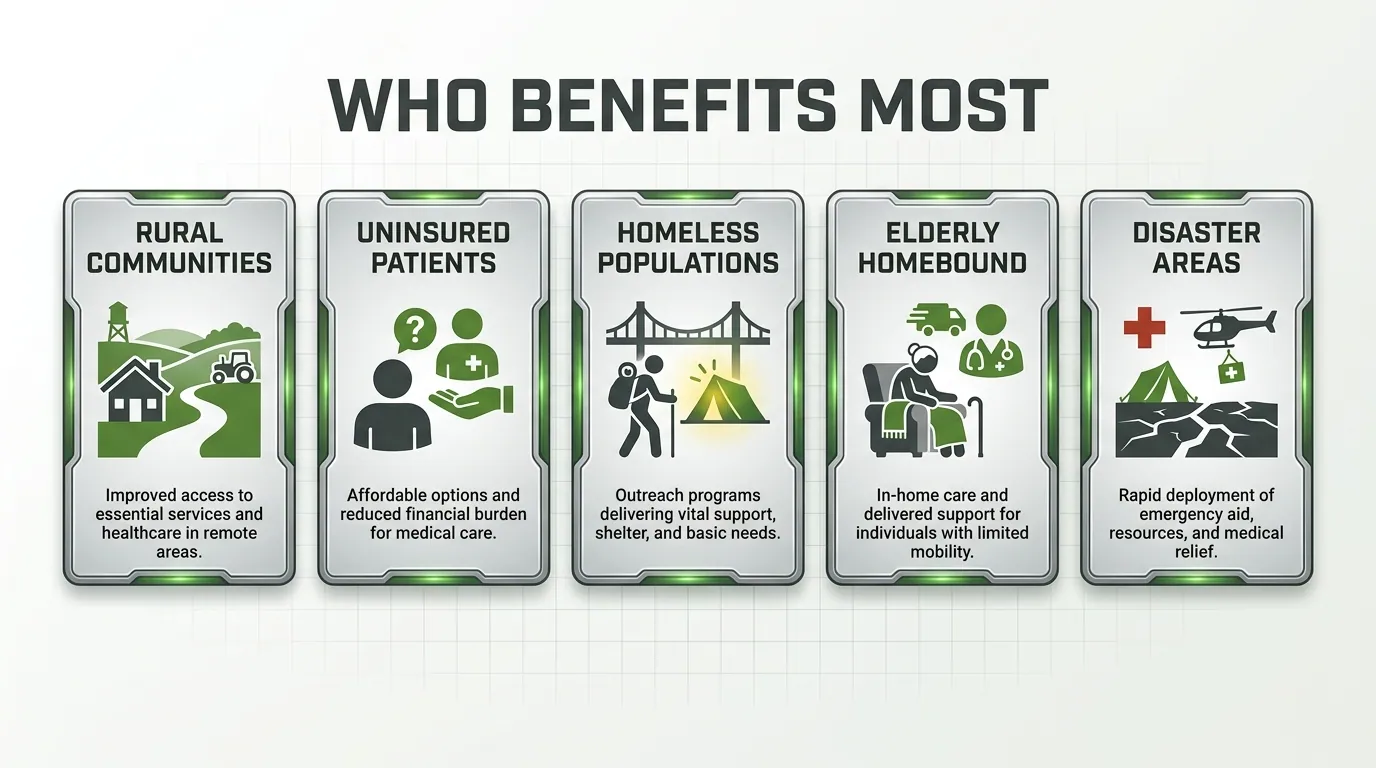
The populations that benefit most from mobile clinic services include rural residents, uninsured and underinsured individuals, people experiencing homelessness, elderly and homebound patients, and communities affected by disasters. The sections below detail how mobile clinics serve each group.
How Do Mobile Clinics Serve Rural Communities?
Mobile clinics serve rural communities by eliminating transportation, language, and income barriers that prevent residents from reaching fixed healthcare facilities. Under 42 CFR 491.5, both Rural Health Clinics and Federally Qualified Health Centers may operate as mobile units in designated shortage areas.
According to KFF, 30% of health-center patients in 2024 were rural residents, while 28% were best served in a language other than English. Georgetown University researchers reported that 42 states included mobile-health initiatives in their Rural Health Transformation Program applications, spanning eight models:
- Primary care
- Vision
- Dental
- Mental health and medication for opioid use disorder
- Mammography
- Stroke response
- Behavioral-health crisis response
- Community paramedicine or mobile integrated health
Rural mobile programs remain one of the most scalable solutions for closing persistent care gaps, though Georgetown’s researchers noted many state applications still lacked the operational and financial detail needed for long-term sustainability.
How Do Mobile Clinics Help Uninsured and Underinsured Populations?
Mobile clinics help uninsured and underinsured populations by delivering screenings, chronic-disease monitoring, and point-of-care testing directly to neighborhoods where financial and transportation barriers are highest.
According to the University of Central Florida, its mobile clinic focuses on low-income, uninsured, and underinsured residents with incomes at or below 300% of the Federal Poverty Level. Nearly 15% of residents in both Orange and Osceola counties are uninsured. Services offered include:
- Blood-pressure, diabetes, cholesterol, and hearing screenings
- Chronic-disease monitoring and fall-risk assessments
- Medication reviews and health education
- Point-of-care testing and audiology services
Almost 500 patients had already visited for blood-pressure checks, hearing screenings, and point-of-care blood-sugar and cholesterol testing. For populations without insurance, this direct-access model often represents the difference between managed chronic conditions and costly emergency-department visits.
How Do Mobile Clinics Support Homeless and Transient Populations?
Mobile clinics support homeless and transient populations by meeting individuals where they are, rather than requiring them to navigate complex healthcare systems or maintain consistent addresses for appointments. People experiencing homelessness frequently cycle between shelters, encampments, and temporary housing, making fixed-facility care difficult to access. Mobile units stationed at shelters, food banks, and encampment sites provide immediate primary care, behavioral health screenings, and social-service referrals. This approach is especially critical because transient populations face elevated rates of untreated chronic illness, mental health conditions, and substance-use disorders. Consistent mobile-clinic schedules at known gathering points also help build the trust necessary for ongoing care engagement.
How Do Mobile Clinics Reach Elderly and Homebound Patients?
Mobile clinics reach elderly and homebound patients by delivering primary care, chronic-disease monitoring, and preventive screenings directly to residences, senior housing facilities, and community centers. Many older adults face mobility limitations, lack reliable transportation, or live in rural areas where the nearest provider is hours away. Mobile units staffed with clinicians can perform blood-pressure checks, medication reviews, fall-risk assessments, and routine lab work on-site. This model reduces missed appointments and prevents condition deterioration that often leads to emergency hospitalizations. For aging populations managing multiple chronic conditions, in-person visits from a mobile care team can sustain continuity of care that would otherwise be impossible.
How Do Mobile Clinics Aid Disaster and Emergency Response Efforts?
Mobile clinics aid disaster and emergency response efforts by deploying rapidly to affected areas where fixed healthcare infrastructure may be damaged or overwhelmed. A 2022 peer-reviewed study published in the Journal of Industrial Engineering and Management found that a hybrid strategy combining a medical shelter with a mobile health clinic was the best option in modeled disaster scenarios. The study reported that mobile clinics could serve many locations within appropriate walking distance and be rerouted as conditions changed.
This flexibility makes mobile units invaluable during hurricanes, wildfires, and public health emergencies. When permanent facilities lose power or become inaccessible, mobile clinics provide triage, wound care, medication distribution, and chronic-disease management without requiring patients to travel long distances.
Understanding who benefits most from mobile clinic services clarifies the design requirements for effective mobile medical units.
What Types of Healthcare Services Can Mobile Clinics Provide?
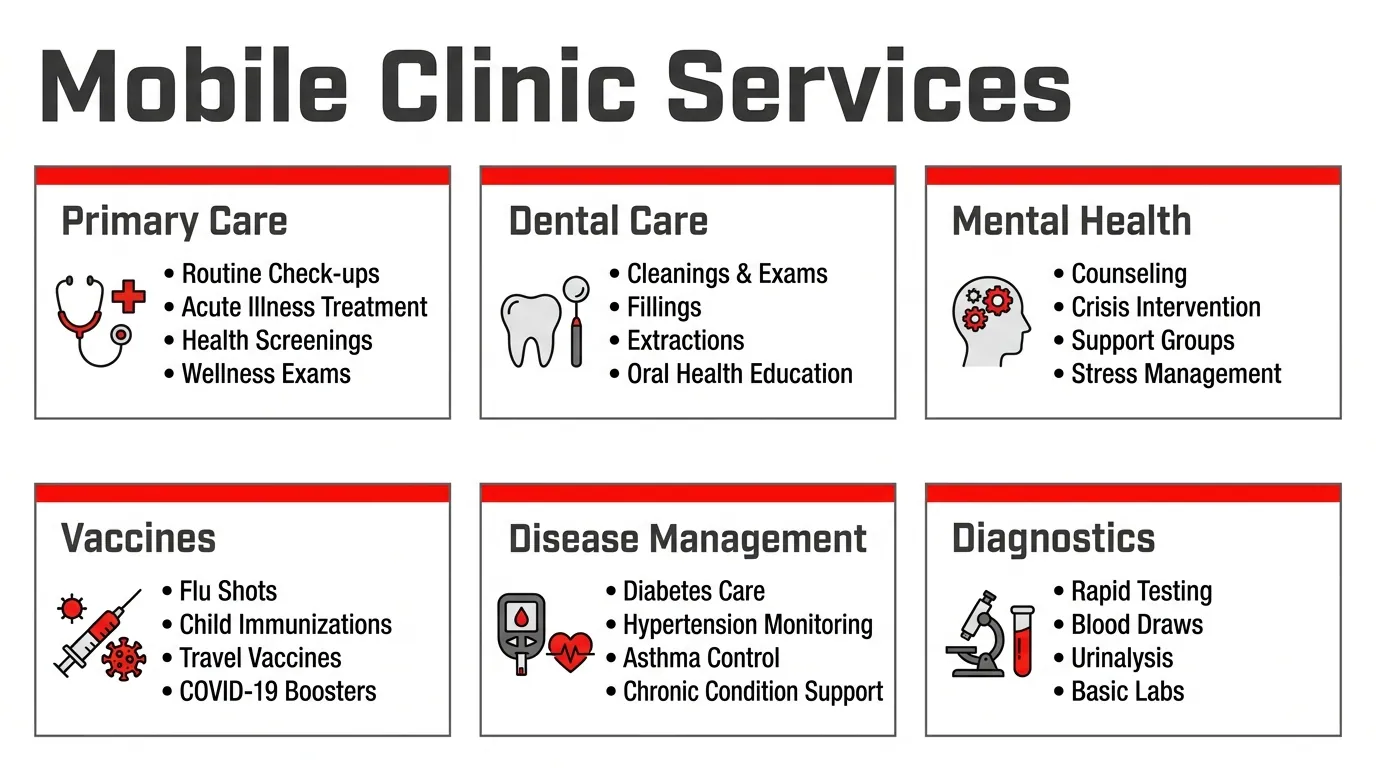
Mobile clinics can provide primary care, preventive screenings, dental care, mental health services, vaccinations, chronic disease management, and diagnostic testing. The following subsections detail each service category.
Primary Care and Preventive Screenings
Primary care and preventive screenings represent the most common services delivered through mobile clinics. Onboard clinicians perform physical examinations, manage acute illnesses, and conduct health education in communities that lack nearby fixed facilities. Preventive screenings typically include blood pressure checks, blood glucose testing, cholesterol panels, and cancer screenings. Minnesota defines a mobile health evaluation and screening provider as a unit transported in a motorized or trailered vehicle that regularly provides these services in more than one geographic location, requiring direct physician supervision and annual registration renewal, according to the Minnesota Department of Health. For populations facing transportation or insurance barriers, these routine touchpoints often prevent conditions from escalating into costly emergency visits.
Dental Care
Dental care is a high-demand mobile clinic service, particularly in areas designated as dental health professional shortage zones. Mobile dental units deliver cleanings, fillings, extractions, fluoride treatments, and oral health education directly to schools, senior centers, and underserved neighborhoods. Because dental disease disproportionately affects low-income and uninsured populations, bringing operatory chairs, digital X-ray equipment, and sterilization systems into a mobile setting closes a gap that traditional referral pathways often fail to address. For program planners, dental is one of the strongest justifications for a dedicated mobile build because demand consistently outpaces supply in rural and urban shortage areas alike.
Mental and Behavioral Health Services
Mental and behavioral health services delivered by mobile units include crisis intervention, case management, individual and family therapy, suicide prevention, patient education, peer support, and medication management, according to the Rural Health Information Hub. Some units also deliver primary care and telemedicine-based services alongside behavioral health. This integrated approach matters because rural and homeless populations face compounding access barriers. In 2021, the North Carolina Department of Health and Human Services awarded $4.4 million for 15 mobile units focused on screening, assessment, treatment, and recovery support for substance-use disorders. Mobile behavioral health units must also comply with HIPAA requirements; covered entities are obligated to protect patient health information and maintain written business-associate agreements for any partners handling that data.
Vaccination and Immunization Programs
Vaccination and immunization programs are among the most widely deployed mobile clinic services. Mobile units administer routine childhood vaccines, seasonal influenza shots, and outbreak-response immunizations in locations where residents face geographic or scheduling barriers to fixed-site clinics. Cold-chain integrity is critical; the CDC recommends a continuous-monitoring digital data logger for every vaccine storage unit, recording at intervals of at least every 30 minutes. During the COVID-19 pandemic, mobile vaccination units proved especially effective at reaching non-White and Hispanic communities that traditional distribution channels underserved. For any organization considering a mobile vaccination program, the vehicle’s refrigeration infrastructure and onboard storage design directly determine how many doses can be safely transported per deployment.
Chronic Disease Management
Chronic disease management through mobile clinics focuses on ongoing monitoring and treatment of conditions such as hypertension, diabetes, asthma, and heart disease. Clinicians perform follow-up visits, adjust medications, conduct point-of-care testing, and provide lifestyle counseling at recurring community stops. This model is particularly effective for patients who struggle with consistent appointment attendance due to transportation limitations or work schedules. By bringing longitudinal care directly to neighborhoods, mobile units reduce gaps between visits that often lead to disease progression and preventable hospitalizations. Chronic disease management is arguably the service area where mobile clinics create the most measurable long-term value, because consistent follow-up is the single biggest predictor of controlled outcomes.
Diagnostic Imaging and Lab Testing
Diagnostic imaging and lab testing services extend a mobile clinic’s capabilities beyond basic screenings. Mobile units can house digital X-ray systems, ultrasound equipment, mammography machines, and point-of-care lab analyzers for blood chemistry, hemoglobin A1c, lipid panels, and rapid infectious-disease tests. A 2024 scoping review published in the International Journal of Environmental Research and Public Health confirmed that mobile programs provide primary care, behavioral health, and social services to populations where 73% reported at least one unmet healthcare need in the previous year. Equipping a mobile unit with diagnostic tools transforms it from a screening vehicle into a comprehensive clinical platform capable of same-visit diagnosis and treatment initiation.
Beyond individual service lines, the ability to combine multiple specialties within a single custom-built vehicle is what makes mobile clinic design a strategic decision.
How Do Mobile Clinics Compare to Traditional Brick-and-Mortar Facilities?
Mobile clinics compare to traditional brick-and-mortar facilities by trading fixed infrastructure for geographic flexibility, lower per-visit costs, and direct community reach, while brick-and-mortar sites offer broader service capacity and permanent equipment installations. The differences span cost structure, deployment speed, patient reach, and service scope.
A 2020 analysis published in the Journal of Primary Care & Community Health found that across 96 mobile-clinic programs in four Southern states, cost per patient visit appeared considerably less than costs reported for fixed-clinic services. This cost advantage makes mobile units particularly effective for preventive care and chronic disease screening in areas where building a permanent facility is not financially viable.
That said, mobile clinics are not replacements for hospitals or large outpatient centers. They serve as strategic extensions that fill gaps traditional facilities cannot reach. For organizations weighing both options, the strongest healthcare programs often integrate mobile units with existing brick-and-mortar networks to maximize coverage without duplicating infrastructure.
With the comparison framework established, the next step is planning a mobile clinic program that fits your specific operational needs.
What Should You Consider When Planning a Mobile Clinic Program?
When planning a mobile clinic program, you should consider equipment fit-out, regulatory compliance, service-area routing, and long-term funding. Each factor shapes clinical capability, legal standing, and operational sustainability.
What Equipment and Medical Fit-Out Features Are Essential?
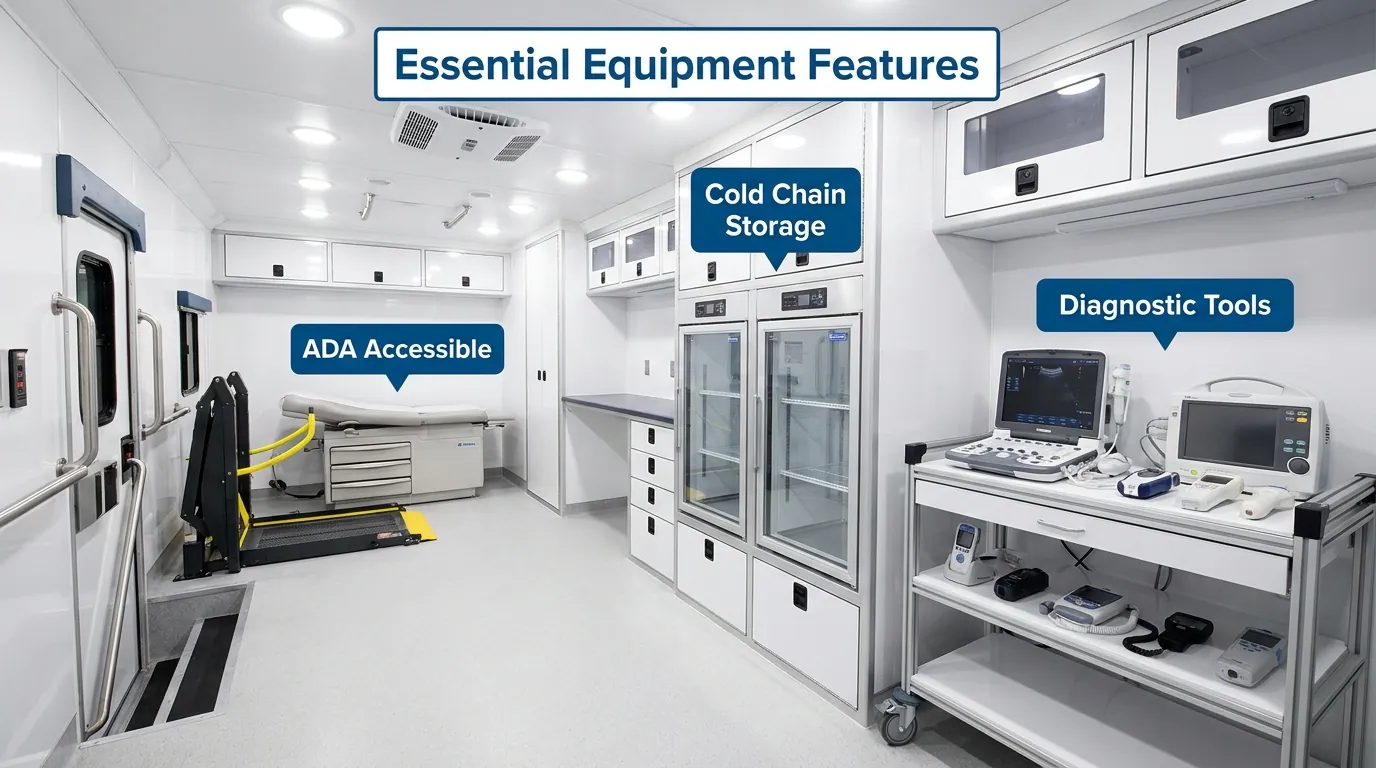
Essential equipment and medical fit-out features include examination tables, diagnostic instruments, point-of-care testing devices, and ADA-accessible configurations. The specific clinical services your program offers determine the exact equipment list, so aligning fit-out decisions with your target patient population is critical.
According to a 2024 U.S. Department of Justice rule, medical diagnostic equipment, including examination tables, examination chairs, weight scales, mammography equipment, and x-ray machines, purchased by state and local government entities after October 8, 2024, must be accessible. Covered entities using examination tables and weight scales must have at least one accessible item by August 9, 2026. Cold-chain storage, generator systems, and telehealth connectivity should also be evaluated during the design phase. Programs that skip ADA and cold-chain planning early often face costly retrofits later.
What Regulatory and Licensing Requirements Apply?
The regulatory and licensing requirements that apply to a mobile clinic program vary by state and service type. Most states require a specific clinic license, and some mandate certificate-of-need review before a mobile unit can operate.
California, for example, requires a Primary Care Clinic license and provides a consolidated initial application packet specifically for mobile clinics, according to the California Department of Public Health. New York treats mobile health vans as extension clinics that only Article 28 hospitals or diagnostic-and-treatment centers may operate. Minnesota requires direct physician supervision and annual registration renewal for mobile screening providers. Beyond state licensure, HIPAA compliance governs patient data security on every mobile unit. Operators should map all applicable federal, state, and local requirements before procurement begins, because retroactive compliance is far more disruptive than upfront planning.
How Do You Determine the Right Service Area and Route?
You determine the right service area and route by analyzing population health data, geographic barriers, and community need indicators such as health professional shortage designations and uninsured rates. Matching deployment locations to documented gaps ensures the mobile clinic reaches the patients who benefit most.
A 2025 operational-planning study published in PLOS ONE reported that a collaborative three-phase approach for assigning villages to mobile clinics and determining monthly visit schedules achieved a 23% reduction in total distance traveled and improved workload balance. Consistent scheduling at each site builds community trust and patient follow-through, which are just as important as geographic efficiency.
How Do You Fund and Sustain a Mobile Clinic Operation?
You fund and sustain a mobile clinic operation through a combination of federal grants, Medicaid and Medicare reimbursement, philanthropic support, and partnership agreements with health systems. Diversifying revenue sources is essential because no single funding stream reliably covers both start-up and ongoing costs.
A 2025 rural mobile-clinic cost analysis published in BMC Health Services Research reported start-up costs of $275,000 and operational costs of $308,000. Among 1,981 patient encounters, 31.3% were vaccinations, 27.0% were COVID-19 related, 12.8% were outside referrals, and 11.8% were point-of-care testing. HRSA requires each mobile van or unit to be separately listed as a service site, which is necessary for reimbursement eligibility. Programs that build detailed financial projections and track cost-per-encounter from day one position themselves for sustainable growth.
With these planning considerations addressed, the next step is selecting a build partner capable of translating clinical goals into a purpose-built mobile medical unit.
How Can Custom-Built Mobile Medical Units Strengthen Your Healthcare Program?
Custom-built mobile medical units strengthen healthcare programs by aligning vehicle design, clinical equipment, and deployment logistics to each organization’s specific service goals. The sections below cover how Craftsmen Industries meets clinical needs and the key takeaways on mobile clinic benefits.
Can Craftsmen Industries Mobile Medical Units Meet Your Clinical Needs?
Yes, Craftsmen Industries mobile medical units can meet clinical needs spanning primary care, diagnostics, vaccination, behavioral health, and chronic disease management. Craftsmen Industries designs, engineers, and fabricates each mobile medical vehicle in-house at its 127,000 sq. ft. facility near St. Louis County, Missouri, providing end-to-end project control from initial concept through final delivery. This vertically integrated process allows healthcare providers, government agencies, and nonprofits to specify exam room layouts, ADA-accessible entry systems, cold-chain vaccine storage, telemedicine connectivity, and diagnostic imaging equipment within a single custom build. Because every unit is purpose-built rather than adapted from a generic platform, organizations receive a vehicle configured for their exact patient population, regulatory environment, and deployment schedule. For programs requiring rapid scalability, Craftsmen Industries can incorporate modular interior components that accommodate future service expansions without a full retrofit.
What Are the Key Takeaways About Mobile Clinic Benefits and Healthcare Access?
The key takeaways about mobile clinic benefits and healthcare access center on five practical conclusions:
- Access reaches those who need it most. Mobile clinics eliminate transportation, geographic, and financial barriers for rural residents, uninsured populations, people experiencing homelessness, and elderly homebound patients.
- Cost efficiency is measurable. Per-visit costs in mobile settings run considerably lower than fixed-clinic equivalents, and preventive interventions reduce expensive emergency department utilization.
- Service versatility drives program value. A single unit can deliver primary care, mental health support, vaccinations, dental services, chronic disease monitoring, and diagnostic testing.
- Community trust accelerates outcomes. Meeting patients in familiar neighborhoods builds engagement, increases follow-through on treatment plans, and strengthens preventive care adoption.
- Purpose-built design matters. Clinical configuration, ADA compliance, cold-chain integrity, and telemedicine integration all depend on how well the vehicle matches the program’s operational requirements.
Organizations planning a mobile health program should prioritize a build partner that controls every phase of fabrication. Craftsmen Industries brings over 40 years of custom vehicle expertise to mobile medical projects, translating clinical specifications into deployable assets delivered on time and built to regulatory standards.
Filter Posts by Tag
related posts
A custom medical trailer is a mobile healthcare unit designed [...]

Mobile medical vehicle fleet management is the coordinated oversight of [...]
Discover how child-friendly mobile clinic interiors improve comfort, safety, and care with smart design, calming colors, and engaging features.
