
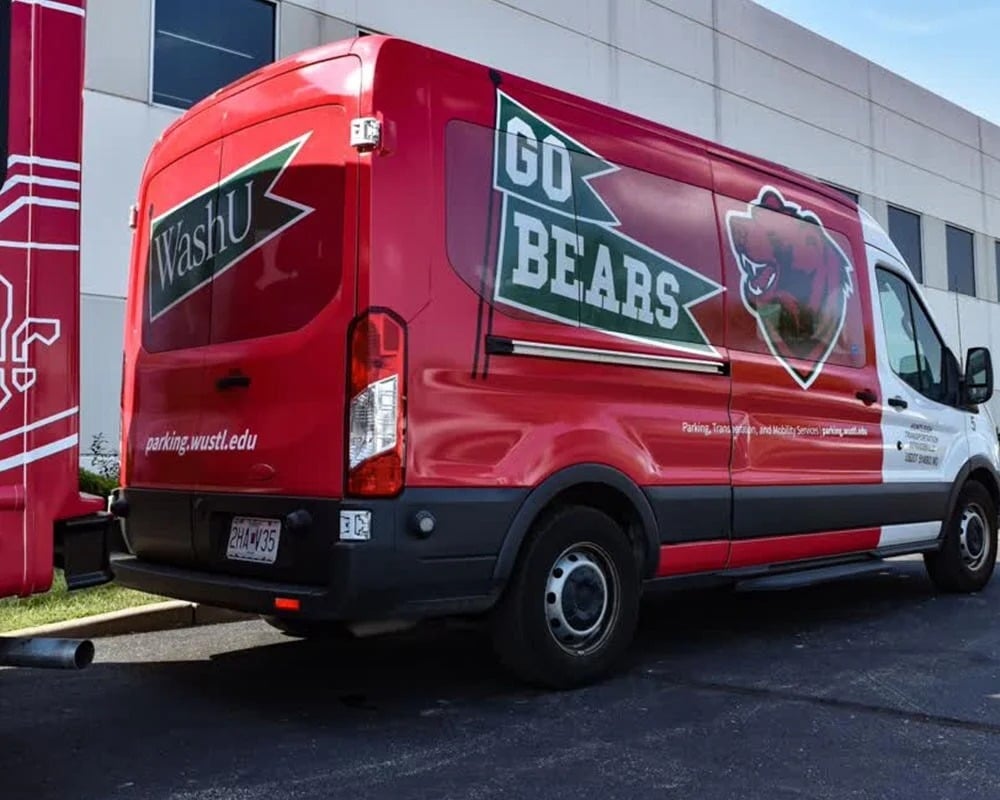
Fleet graphics for last-mile delivery vans are branded vinyl applications that turn everyday delivery vehicles into mobile advertising platforms operating directly in residential neighborhoods. A single wrapped van can generate tens of thousands of daily impressions at a fraction of the cost of digital or traditional media.
This guide covers residential exposure mechanics, graphic types and design strategy, materials and finishes, ROI benchmarking, route-level planning, fleet maintenance, and common mistakes that reduce visibility.
Last-mile delivery vans outperform highway vehicles for brand visibility because they travel at low speeds, stop frequently at curbside, and park within close viewing distance of homeowners and pedestrians. That combination of dwell time and proximity creates extended, repeated impressions no billboard or digital ad can replicate.
Choosing the right graphic type matters. Full wraps, partial wraps, spot decals, and reflective options each balance coverage, cost, and residential impact differently. Design decisions around high-contrast color pairings, properly scaled typography, and clean visual hierarchy determine whether a curbside glance converts into brand recall or gets ignored.
Material selection protects that investment over time. Cast vinyl conforms to complex van curves, calendered vinyl suits, flat panels, and laminate film shields printed graphics from UV exposure, abrasion, and road debris. Paired with weekly cleaning and monthly inspections, the right materials keep graphics sharp across years of daily routes.
Fleet graphics also deliver exceptional cost efficiency. CPM figures as low as $0.15 per thousand impressions dramatically undercut digital advertising, static signage, and mobile billboards. Repeated neighborhood routes then compound that value through the mere exposure effect, building familiarity and trust with the same households over weeks and months.
For fleets looking to combine cost efficiency with visual impact, partnering with a vertically integrated provider ensures design, printing, and installation quality remains consistent across every vehicle. Craftsmen Industries’ end-to-end large format graphics capabilities allow fleet operators to maintain brand standards from concept through final application.
Why Are Last-Mile Delivery Vans Ideal for Fleet Graphics?
Last-mile delivery vans are ideal for fleet graphics because they operate where customers live, generating repeated brand exposure at low speeds in high-density neighborhoods. The sections below cover daily residential impressions, route advantages over highway travel, and how dwell time multiplies graphic visibility.
How Much Daily Residential Exposure Do Delivery Van Graphics Generate?
Delivery van graphics generate substantial daily residential exposure by placing branded vehicles directly in front of homes, driveways, and neighborhood gathering points throughout each shift. A single wrapped vehicle can produce between 30,000 and 70,000 daily impressions, according to WPI Color. In residential settings, those impressions carry added weight because the same households encounter the same branded van on a recurring basis.
This repeated exposure triggers a well-documented cognitive response. According to The Decision Lab, the mere exposure effect shows that positive emotions generated by repeated exposure to information help facilitate stronger recall, with older adults in particular developing stronger preferences for familiar stimuli. For last-mile fleets, this means each delivery run compounds brand recognition among the residents who matter most.
Why Do Last-Mile Routes Outperform Highway Routes for Brand Visibility?
Last-mile routes outperform highway routes for brand visibility because of three key factors:
-
Lower vehicle speeds. Delivery vans travel 15 to 25 mph through residential streets, giving pedestrians and homeowners significantly more time to read graphics than a highway vehicle passing at 65 mph.
-
Closer viewing distances. Curbside stops position the van 5 to 15 feet from observers, well within the range where even smaller text and secondary messaging remain legible.
-
Higher stop frequency. Each delivery stop creates a stationary impression lasting 30 seconds to several minutes, compared to a fleeting highway pass that lasts roughly two seconds.
Highway fleet graphics rely on bold, simple designs because drivers have limited reading time. Residential routes, by contrast, reward layered messaging since viewers can absorb a logo, tagline, phone number, and website in a single glance.
How Does Dwell Time in Neighborhoods Increase Graphic Impressions?
Dwell time in neighborhoods increases graphic impressions by converting each delivery stop into a stationary advertising event. While the van is parked curbside during a package handoff, every passing neighbor, dog walker, and jogger receives an unobstructed view of the graphics. Premium cast vinyl films from manufacturers like 3M, with an expected performance life of eight years according to 3M’s 2080 Series product bulletin, ensure those graphics remain vibrant through years of daily stops.
Multiple stops per block compound this effect considerably. A van making 120 deliveries across a single zip code can accumulate 30 to 60 minutes of total parked dwell time in one shift. That cumulative stationary presence is something highway-routed vehicles simply cannot replicate, making neighborhood dwell time one of the most underutilized advantages in fleet advertising.
With residential exposure mechanics established, the next step is choosing the right graphic type for your delivery vans.
What Types of Fleet Graphics Work Best on Delivery Vans?
The types of fleet graphics that work best on delivery vans include full vehicle wraps, partial wraps, spot graphics and decals, and reflective high-visibility options. Each type balances coverage, cost, and residential impact differently.
Full Vehicle Wraps
Full vehicle wraps cover every exterior panel of a delivery van with printed vinyl, transforming the entire surface into a branded asset. Premium cast films like 3M Wrap Film Series 2080 use Controlac and Comply technologies for repositionable application and air-release channels that prevent bubbling, according to 3M’s product specifications. Arlon Fusion Wrap, a calendered alternative with FLITE Technology, offers unprinted durability of 10 years.
For last-mile delivery vans, full wraps deliver the highest visual impact because they remain readable from every angle in residential settings. Key design priorities include:
-
Place primary branding on the rear panel and front doors, the two highest-visibility zones.
-
Use bold color and scale rather than a small door logo to ensure curbside recognition.
-
Avoid heavy drop shadows or text outlines, which reduce legibility at distance.
-
Keep messaging minimal; too many images or words causes viewers to disengage.
Full wraps demand weekly washing to prevent grime from embedding in the film. For fleets running daily residential routes, that maintenance investment directly protects brand appearance.
Partial Vehicle Wraps
Partial vehicle wraps cover select panels, typically the rear doors, side panels, or cargo area, while leaving portions of the original paint exposed. This approach reduces material and installation costs compared to full wraps, making it practical for fleets scaling quickly across dozens of delivery vans.
The trade-off is reduced visual coverage from certain viewing angles. However, when designed strategically, partial wraps concentrate branding where it matters most: the rear cargo panel that trailing drivers see and the side panels visible to pedestrians and residents. For last-mile fleets prioritizing budget efficiency across a large number of vans, partial wraps often deliver the best cost-to-coverage ratio.
Spot Graphics and Decals
Spot graphics and decals are individual cut-vinyl elements, such as logos, phone numbers, URLs, or service descriptions, applied to specific locations on a delivery van. They represent the lowest-cost entry point for fleet branding.
Common applications include:
-
Company logo on driver and passenger doors.
-
Website URL and phone number on the rear panel.
-
Service-area identifiers or taglines on quarter panels.
While spot graphics lack the visual dominance of full or partial wraps, they provide clean, professional identification. For fleets that rotate vehicles frequently or lease short-term, decals offer easy removal and replacement without damaging the underlying paint.
Reflective and High-Visibility Graphics
Reflective and high-visibility graphics use retroreflective vinyl that illuminates under headlights, streetlights, or ambient light sources. Delivery vans operating during early morning, evening, or overcast conditions benefit significantly because standard printed vinyl loses readability in low light.
In residential neighborhoods, where streetlight spacing varies and vans park curbside at dusk, reflective elements keep branding visible during hours that conventional wraps cannot cover. Reflective accents work well as supplementary layers on full or partial wraps, highlighting logos, contact information, or brand colors.
For fleet managers evaluating these graphic types, the strongest residential branding strategies often combine two or more options tailored to route timing, fleet size, and budget.
How Should You Design Fleet Graphics for Maximum Residential Impact?
You should design fleet graphics for maximum residential impact by prioritizing high-contrast color combinations, scaled typography, essential contact information, and consistent branding across every vehicle.
What Color Combinations Stand Out in Residential Settings?
The color combinations that stand out in residential settings are high-contrast pairings that remain legible against varied suburban backdrops. According to SF Bay Signs, WCAG recommends a 4.5:1 contrast ratio for standard text and 7:1 for enhanced accessibility, with black on white and yellow on black ranking as the most effective combinations for vehicle graphics visibility.
Residential streets present a mix of earth tones, green landscaping, and neutral-colored homes. Bold primary colors or stark contrast pairings cut through that visual noise far more effectively than muted palettes. Choosing colors that align with your brand while meeting accessibility contrast thresholds is one of the simplest ways to ensure your delivery vans register with homeowners, even during a brief curbside glance.
How Large Should Text and Logos Be for Curbside Readability?
Text and logos should be sized using the sign industry’s 10-by-1 rule: for every 10 feet of viewing distance, letters need to be at least 1 inch tall. According to Ravony, a message viewed from 100 feet away requires 10-inch letters for legibility.
Most curbside encounters with delivery vans happen at 20 to 50 feet, so primary text such as company names should measure 3 to 5 inches minimum. Logos deserve even more generous scaling because they communicate brand identity faster than text. For residential routes specifically, where viewers are pedestrians or homeowners at mailboxes rather than highway drivers, slightly oversized typography outperforms compact layouts every time.
What Information Should Delivery Van Graphics Prioritize?
Delivery van graphics should prioritize the company name, logo, phone number, and website URL. These four elements give residential viewers everything they need to recall or contact the brand after a brief sighting.
Secondary details to include, ordered by importance:
-
A concise tagline or service descriptor (five words or fewer)
-
A QR code linking to a landing page or quote form
-
Social media handles, if the brand actively uses them
Avoid overloading side panels with lengthy service lists or multiple images. Residential viewers have seconds, not minutes. A clean hierarchy with one dominant visual element and minimal supporting text ensures the message lands before the van pulls away from the curb.
How Do You Maintain Brand Consistency Across an Entire Fleet?
You maintain brand consistency across an entire fleet by establishing a documented brand standards guide that specifies exact color codes, logo placement zones, font families, and sizing ratios for every vehicle type. According to National Fleet Graphics, consistent branding in commercial fleet graphics enhances visibility, builds recognition, and establishes trust while functioning as a cost-effective advertising tool.
Key consistency controls include:
-
Pantone or CMYK color specifications locked to your brand palette
-
Fixed logo placement on doors, rear panels, and side panels
-
Standardized font sizes tied to vehicle dimensions, not arbitrary aesthetics
-
A single approved template adapted per vehicle class (sprinter van, box truck, cargo van)
When every van in a fleet looks identical, repeated neighborhood sightings compound into strong brand familiarity rather than fragmented, forgettable impressions. With design principles locked in, selecting the right materials ensures those graphics hold up under daily delivery conditions. Achieving this level of consistency across dozens of vehicles requires coordinated production capabilities. Companies like Craftsmen Industries manage design, large format printing, and installation in-house, eliminating the color matching and quality control issues that emerge when multiple vendors handle different project phases.
What Materials and Finishes Perform Best on Delivery Van Wraps?
The materials and finishes that perform best on delivery van wraps include cast vinyl for curved surfaces, calendered vinyl for flat panels, matte or gloss finishes for brand tone, and laminate film for graphic protection.
How Does Cast Vinyl Perform on Delivery Vans with Complex Curves?
Cast vinyl performs exceptionally well on delivery vans with complex curves because the manufacturing process produces a thin, conformable film that stretches without distortion. According to Avery Dennison, their Supreme Wrapping Film is a dual-layered cast vinyl specifically manufactured to handle extreme curves, deep channels, and complex surfaces, available in 12 styles including gloss, matte, metallic, carbon fiber, and brushed finishes.
High-quality cast vinyl wraps typically last between five and seven years, though actual lifespan depends on maintenance, climate, and material quality. For fleets running daily delivery routes, that durability translates directly into sustained residential brand exposure without frequent replacements. Cast vinyl remains the strongest choice when van body panels include wheel arches, corrugations, or recessed handles that cheaper films cannot follow cleanly.
How Does Calendered Vinyl Perform on Flat-Panel Delivery Vans?
Calendered vinyl performs reliably on flat-panel delivery vans where complex contours are minimal. This material is produced by rolling vinyl through a series of heated cylinders, creating a thicker, more rigid film than cast alternatives. On box-style vans with large flat side panels, calendered vinyl adheres smoothly and delivers vibrant printed graphics at a lower material cost.
The trade-off is reduced conformability. Calendered films can shrink or lift when forced around tight curves, rivets, or deep recesses. For fleets operating flat-sided cargo vans, however, calendered vinyl offers a practical balance between budget efficiency and visual impact. Pairing it with proper surface preparation and professional installation minimizes the risk of premature edge lifting.
When Should You Choose Matte Versus Gloss Finishes?
You should choose matte finishes when your brand identity calls for a modern, understated look that minimizes glare, and gloss finishes when you need maximum color vibrancy and visual pop at curbside distances.
-
Gloss finishes reflect light, making colors appear more saturated and eye-catching in residential settings where sunlight hits parked vans directly.
-
Matte finishes reduce reflections, improving readability of text and logos under varying lighting conditions.
-
Gloss surfaces show scratches and swirl marks more readily, which matters for high-mileage delivery fleets.
-
Matte surfaces hide minor surface imperfections better, reducing the visible impact of daily wear.
For most last-mile delivery operations, the finish should align with existing brand guidelines rather than personal preference. Consistency across the fleet matters more than any single aesthetic choice.
How Does Laminate Film Protect Graphics from Daily Wear?
Laminate film protects graphics from daily wear by adding a transparent protective layer over printed vinyl that shields against UV fading, abrasion, chemicals, and road debris. Delivery vans encounter constant exposure to sun, rain, gravel spray, and frequent washing cycles; without lamination, printed graphics degrade significantly faster.
According to Caskey Transforms, 3M MCS Warranty certification is the most comprehensive vehicle graphics warranty in the industry, and that warranty requires the use of matched 3M laminates over 3M printed films. This system-level approach ensures each material component works together for maximum longevity. For fleet managers prioritizing long-term ROI, specifying laminated graphics at the outset prevents costly early replacements and keeps residential brand impressions consistently sharp.
With materials and finishes selected, calculating the return on that investment reveals how fleet graphics compare to other advertising channels.
How Do You Calculate the ROI of Fleet Graphics on Delivery Vans?
You calculate the ROI of fleet graphics on delivery vans by comparing cost per impression against alternative advertising channels. The sections below break down fleet graphic CPM versus mobile billboards, digital advertising, and static signage.
What Is the Cost per Impression Compared to Mobile Billboards?
The cost per impression for fleet graphics compared to mobile billboards is significantly lower across nearly every measurement method. According to Signature Graphics, fleet graphics deliver a CPM of $0.48, while billboards reach $3.56, magazine ads hit $21.46, and radio costs $7.75. Mobile billboards, by comparison, range from $1.50 to $7.50 CPM according to Nomadic Outdoor Media.
When calculated over a five-year lifespan at a total cost of $5,500, fleet graphics can drop below $0.002 per individual impression. That long-term amortization is what makes delivery van wraps one of the strongest cost-per-impression plays in out-of-home advertising. Mobile billboards require ongoing rental fees; fleet graphics are a one-time investment that keeps working every mile the van drives.
What Is the Cost per Impression Compared to Digital Advertising?
The cost per impression for fleet graphics compared to digital advertising is dramatically lower. According to 3M, online ads can cost up to $21 per thousand impressions, while fleet graphics can cost as little as $0.15 per thousand impressions. That gap represents a potential cost reduction of more than 99%.
Digital ads also disappear the moment a campaign budget runs out. Fleet graphics, once installed on a delivery van, generate impressions continuously for years without recurring spend. For last-mile fleets running daily residential routes, this passive exposure compounds over time in ways that paid digital simply cannot replicate at the same cost efficiency.
What Is the Cost per Impression Compared to Static Signage?
The cost per impression for fleet graphics compared to static signage is lower because delivery vans reach multiple locations daily. Static signs, such as storefront signs or fixed billboards, generate impressions only from foot or vehicle traffic passing a single fixed point. A delivery van with fleet graphics covers dozens of residential streets per shift, multiplying its audience reach without any additional placement cost.
Static signage also carries ongoing lease expenses for billboard locations or permitting fees for commercial signs. Fleet graphics require no rental agreements; the vehicle itself is the advertising platform. For brands focused on residential neighborhoods, a wrapped delivery van operating on last-mile routes consistently outperforms a single static placement in both geographic coverage and total impression volume.
With ROI benchmarks established, route-level strategy determines how to maximize those impressions across specific delivery zones.
How Do Last-Mile Routes Affect Fleet Graphic Strategy?
Last-mile routes affect fleet graphic strategy by determining how designs are optimized for viewing distance, exposure frequency, and seasonal conditions. The subsections below cover route density, repeated-route familiarity, and seasonal visibility planning.
How Should Route Density Influence Graphic Design Choices?
Route density should influence graphic design choices by dictating how much information a viewer can realistically absorb during each encounter. In tightly packed suburban neighborhoods, delivery vans stop frequently and remain visible at close range for extended periods. This proximity favors clean, uncluttered layouts with a single dominant logo and minimal supporting text.
According to Wrap Solutions, core branding should be planned on the flattest panel areas, with curved spaces reserved for supporting graphics, color blocks, or patterns. One main logo position ensures clarity and prevents visual confusion. Dense routes amplify this principle because residents see the same van repeatedly at short distances, making clutter even more damaging to recall. For high-density delivery zones, simplicity is not a compromise; it is the design strategy that converts fleeting glances into lasting brand recognition.
How Do Repeated Routes Build Brand Familiarity in Neighborhoods?
Repeated routes build brand familiarity in neighborhoods by triggering the mere exposure effect, a well-documented cognitive bias in which people develop preference for stimuli they encounter frequently. When a delivery van with consistent fleet graphics passes through the same streets daily, residents begin associating the brand with reliability and safety.
This psychological pattern is especially powerful in residential settings where the same households see the vehicle parked curbside, idling at intersections, or rounding familiar corners. Over weeks and months, that repeated visual contact reduces uncertainty about the brand. Perceptual fluency also plays a role; people process familiar designs more easily, which makes consistent graphic elements across the fleet critical. For fleet operators, maintaining identical branding on every van ensures each repeated sighting compounds recognition rather than creating confusion.
How Does Seasonal Routing Impact Graphic Visibility Planning?
Seasonal routing impacts graphic visibility planning by changing the environmental backdrop, lighting conditions, and viewing windows that fleet graphics must compete against. Winter routes through leafless neighborhoods offer longer sight lines, while summer foliage can partially obscure vans parked along tree-lined streets.
Color selection should account for these shifts. High-contrast combinations, such as bold primaries against white panels, maintain readability across seasons. Holiday-heavy delivery periods also compress route timing, meaning vans spend less dwell time at each stop during peak volume. Graphics designed for quick recognition at a glance perform better during these compressed windows than information-dense layouts requiring prolonged reading. Planning graphic refreshes or protective laminate inspections before high-volume seasons keeps brand presentation sharp when residential impression counts are at their highest.
With route strategy guiding design decisions, maintaining those graphics across the fleet ensures the investment holds its value.
How Do You Maintain Fleet Graphics Across a Delivery Van Fleet?
You maintain fleet graphics across a delivery van fleet through scheduled inspections, proper cleaning protocols, and timely repair or replacement decisions. The subsections below cover inspection frequency, cleaning methods, and repair-versus-replace criteria.
How Often Should Delivery Van Wraps Be Inspected for Damage?
Delivery van wraps should be inspected for damage at least once per month, with additional checks after severe weather, collisions, or prolonged exposure to road salt. Consistent inspection schedules prevent minor issues, such as lifting edges, fading, and small tears, from escalating into full-panel failures that compromise brand visibility.
Materials like Arlon SLX Cast Wrap, which features 1.3-mil cast vinyl with 200% or greater elongation and 7-year durability, hold up well under routine delivery conditions. Even with durable films, though, the daily stop-and-go of last-mile routes subjects van panels to unique stress points around door handles, rear bumpers, and cargo edges. Monthly walk-around inspections catch these vulnerabilities early, keeping every vehicle in the fleet looking uniform.
What Cleaning Methods Extend the Life of Fleet Graphics?
The cleaning methods that extend the life of fleet graphics include hand washing with pH-balanced soap, using soft cloths instead of brushes, and avoiding products containing alcohol, ammonia, or petroleum-based solvents. According to Fleet Wrap HQ, well-planned fleet graphics can achieve CPM as low as 15 cents, but routes and lifespan drive the final number, making proper maintenance essential to protecting that cost advantage.
Fleet vehicles should be washed at least once per week. After exposure to heavy dirt, bird droppings, or road salt, immediate washing prevents staining and embedded grime. If pressure washing is necessary, keep pressure under 2,000 PSI, water temperature below 140 degrees Fahrenheit, and maintain at least 12 inches of distance with a 40-degree spray pattern. Skipping regular cleaning is, in my experience, the single fastest way to shorten wrap life and erode the professional image your fleet projects in residential neighborhoods.
When Should You Replace Versus Repair Damaged Van Graphics?
You should replace van graphics when damage exceeds 30% of a single panel, when color fading creates visible inconsistency between vehicles, or when the vinyl has reached the end of its rated lifespan. Minor issues, such as small tears, lifted edges, or isolated scratches, can typically be repaired with patch panels or edge re-sealing.
According to 3M, when finished graphics are made entirely with 3M Graphics products, the 3M MCS Warranty provides the most complete and robust graphics warranty in the business. This warranty coverage makes repair-versus-replace decisions more straightforward: if the damage falls within warranty terms, replacement costs are offset. For fleet managers, the guiding principle should be brand consistency. A single van with mismatched or deteriorated graphics undermines the trust built by the rest of the fleet, especially on repeated residential routes where the same households see your vehicles daily.
With a solid maintenance program in place, avoiding common design mistakes protects that investment even further.
What Common Mistakes Reduce Residential Exposure for Van Graphics?
Common mistakes that reduce residential exposure for van graphics include cluttered design hierarchy, inconsistent branding across vehicles, and neglected rear-panel graphics. Each error wastes impressions in the exact neighborhoods where delivery vans spend the most time.
How Does Poor Design Hierarchy Waste Residential Impressions?
Poor design hierarchy wastes residential impressions by forcing viewers to work too hard to identify the brand. When a van carries too many competing elements, residents glance away before absorbing any message. According to Work Truck Online, fleets that use too many images or too much text cause viewers to decide it takes too long to decipher the service being offered, so they simply give up.
Residential viewing windows are brief. A delivery van parked curbside or rolling through a neighborhood at low speed gives residents only seconds to process the graphic. Effective hierarchy places the brand name and logo at the top of the visual order, followed by one clear service descriptor and a phone number or URL. Heavy drop shadows, decorative outlines, and excessive color blocks compete for attention rather than guiding it. For last-mile fleets, simplicity is not a limitation; it is the single most reliable way to convert a passing glance into brand recall.
Why Does Inconsistent Branding Across Vans Hurt Recognition?
Inconsistent branding across vans hurts recognition because it prevents the mere exposure effect from building neighborhood familiarity. When each vehicle in a fleet carries different colors, logo placements, or typography, residents perceive multiple unfamiliar brands rather than one trusted presence.
Consistent fleet graphics reinforce a single visual identity every time a van enters a delivery zone. As noted by National Fleet Graphics, consistent branding in commercial fleet graphics enhances visibility, builds recognition, and establishes trust while serving as a cost-effective advertising tool. Fleets that allow outdated wraps to run alongside updated designs fragment their visual footprint. Standardizing color palette, logo position, and font hierarchy across every vehicle ensures that each residential delivery compounds recognition from the last. This cumulative effect is especially powerful on repeated last-mile routes where the same households see the fleet daily.
How Does Neglecting Rear-Panel Design Miss Key Viewing Angles?
Neglecting rear-panel design misses key viewing angles because the rear of a delivery van is the surface most visible to pedestrians, following drivers, and residents watching from driveways or windows. In residential settings, vans are frequently seen from behind while parked at curbs or pulling away from stops.
The rear panel offers unobstructed flat space ideal for a large logo, website, and phone number. Despite this, many fleets concentrate their branding entirely on side panels and leave the rear blank or minimally branded. This oversight abandons what is often the longest and most direct viewing angle in a neighborhood context. Prioritizing rear-panel graphics with high-contrast text and a prominent logo ensures the brand registers during the most common residential sighting scenario.
Avoiding these design mistakes lays the groundwork for a cohesive fleet strategy that turns every delivery into measurable brand exposure.
How Can Large Format Graphics Elevate Your Delivery Fleet Strategy?
Large format graphics elevate your delivery fleet strategy by transforming every van into a consistent, high-visibility branding asset that works on every residential route. Below, explore how Craftsmen Industries’ end-to-end capabilities support last-mile branding and the key takeaways from this guide.
Can Craftsmen Industries’ End-to-End Fleet Graphic Solutions Improve Your Last-Mile Branding?
Yes, Craftsmen Industries’ end-to-end fleet graphic solutions can improve your last-mile branding by consolidating design, large format printing, and professional installation under one roof. This vertically integrated approach eliminates the inconsistencies that arise when multiple vendors handle separate stages of a fleet graphics project.
According to National Fleet Graphics, consistent branding in commercial fleet graphics enhances visibility, builds recognition, and establishes trust while serving as a cost-effective advertising tool. Craftsmen Industries manages every phase, from initial concept through final vehicle installation, ensuring color accuracy, material quality, and design cohesion remain uniform across an entire delivery fleet.
Clean, uncluttered designs resonate far more effectively with residential audiences than overloaded wraps competing for attention. Craftsmen Industries applies this principle at scale, producing graphics that communicate a brand message quickly to curbside viewers without visual noise.
What Are the Key Takeaways About Fleet Graphics for Last-Mile Delivery Vans and Maximizing Residential Exposure?
The key takeaways about fleet graphics for last-mile delivery vans and maximizing residential exposure center on five actionable principles:
-
Prioritize residential routes over highway miles. Neighborhood dwell time generates closer, longer viewing windows that highway speeds cannot match.
-
Design for simplicity and curbside legibility. Bold color contrast, properly sized text, and clean hierarchy ensure your message registers in seconds.
-
Choose materials matched to your van type. Cast vinyl handles complex curves; calendered vinyl suits flat panels; laminate film protects against daily delivery wear.
-
Maintain wraps consistently. Weekly washing and prompt damage repair preserve graphic quality and the professional image that builds trust.
-
Leverage repeated exposure. According to The Decision Lab, people develop preferences for stimuli they encounter repeatedly because familiarity reduces uncertainty and increases perceived safety.
Every branded van that follows these principles turns routine deliveries into compounding brand impressions across the neighborhoods that matter most.
