
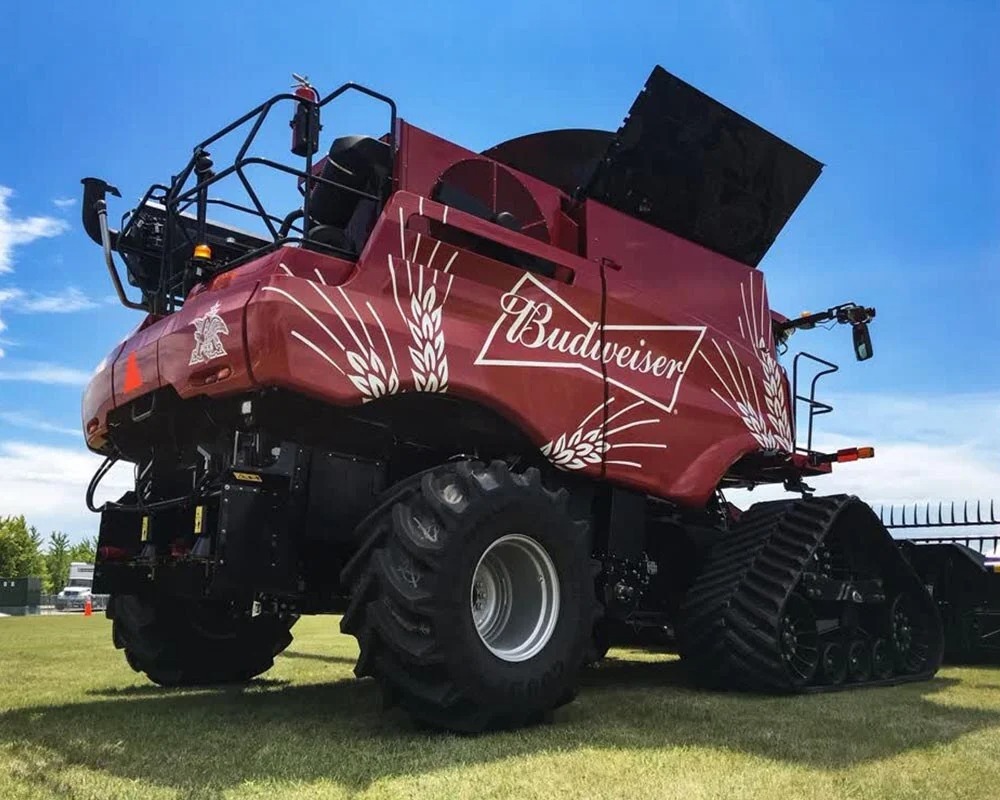
Fleet graphics for construction equipment and heavy machinery are vinyl-based branding systems applied to excavators, loaders, cranes, dump trucks, and other jobsite machines to display company identity and safety markings. These graphics range from simple cut-vinyl lettering to full printed wraps that transform every piece of equipment into a mobile billboard.
This guide covers equipment types and material selection, design and installation for irregular surfaces, durability and cost across fleet sizes, and jobsite safety, branding, and maintenance best practices.
Construction fleets span dozens of machine categories, from skid steers and compact loaders to large excavators and lowboy trailers. Each presents unique surface geometry that requires specific vinyl types and application techniques to achieve lasting adhesion.
Material choice directly determines graphic performance. Cast vinyl films conform to the compound curves, rivets, and textured panels common on heavy machinery, while calendered alternatives suit flat surfaces and shorter-term applications. Reflective films and magnetic panels serve specialized safety and temporary branding roles.
Installation on construction equipment follows a structured process of surface preparation, heat-applied vinyl conforming, and rivet detailing that differs significantly from standard vehicle wraps. Proper technique prevents the bubbling, peeling, and adhesive failure that plague rushed applications.
Durability ranges from 3 to 7 years depending on UV exposure, freeze-thaw cycles, dust abrasion, and chemical contact. Costs scale from $900 for compact equipment wraps to $5,000 or more for large machinery. At a cost per thousand impressions as low as $0.15, fleet graphics consistently outperform digital and traditional advertising channels.
Beyond branding, properly designed graphics improve jobsite safety by increasing equipment visibility, supporting OSHA compliance, and reducing struck-by accident risk in active work zones.
Why Do Construction Companies Invest in Fleet Graphics?
Construction companies invest in fleet graphics to maximize brand visibility, generate impressions at a fraction of traditional advertising costs, and strengthen professional credibility across every jobsite. The core reasons span advertising efficiency, daily exposure volume, and measurable return on investment.
Fleet graphics transform heavy equipment into mobile billboards that work continuously without recurring media spend. According to 3M, fleet graphics deliver a cost per thousand impressions (CPM) as low as $0.15, while online ads can reach up to $21 per thousand impressions. That cost gap makes wrapped equipment one of the most efficient branding channels available to construction firms.
The exposure potential is substantial. Vehicle advertising generates between 30,000 and 70,000 daily vehicular impressions, according to ARD Ventures data cited by 3M. When excavators, dump trucks, and loaders travel between jobsites or sit parked along high-traffic corridors, they accumulate views that no static billboard can replicate. A 2019 Nielsen Out-of-Home Advertising Study found that 64% of respondents noticed vehicle graphics, confirming that branded equipment captures real attention rather than blending into visual noise.
Return on investment extends beyond raw impressions. Key financial benefits include:
-
The Outdoor Advertising Association of America reports that one dollar spent on outdoor media returns almost three dollars in sales, outperforming other advertising formats.
-
Out-of-home advertising generates nearly four times more online activations per ad dollar than TV, radio, and print combined, according to a 2017 Nielsen survey.
-
Adding out-of-home to a broader media campaign increases search ROI by 40% and print ROI by 14%, based on the OAAA’s 2018 media mix optimization report.
For construction companies specifically, fleet graphics deliver a compounding advantage. Equipment already travels to highly visible locations, from highway projects to commercial developments in dense urban areas. Every machine becomes a repeated brand touchpoint for property owners, general contractors, and municipal decision-makers who evaluate subcontractors partly on professional appearance.
From a practical standpoint, this investment is one of the few marketing assets that require no ongoing media buy, no content calendar, and no audience targeting. The equipment does the work simply by operating. For fleet managers weighing where to allocate branding budgets, few channels match the combination of low CPM, high daily impressions, and passive lead generation that construction fleet graphics provide.
Understanding the investment case sets the stage for choosing which equipment types benefit most from graphic applications.
What Types of Construction Equipment Can Receive Fleet Graphics?
The types of construction equipment that can receive fleet graphics span nearly every machine in a contractor’s fleet. From earthmoving equipment to transport vehicles, each category presents unique surfaces and branding opportunities. For construction companies looking to brand multiple equipment types simultaneously, working with a vertically integrated provider like Craftsmen Industries (which operates a 127,000 sq. ft. facility handling design, engineering, and large format printing in-house) can streamline fleet graphics programs and ensure consistent quality across diverse machine categories.
Excavators and Backhoes
Excavators and backhoes offer large, flat panels on their counterweights, boom housings, and cab enclosures that serve as prime surfaces for fleet graphics. The counterweight area alone can display a company logo visible from hundreds of feet away on an active jobsite. Because these machines rotate 360 degrees during operation, branded graphics gain exposure from every angle. Cast vinyl is typically required to conform around hydraulic line routing and curved boom sections.
Bulldozers and Graders
Bulldozers and graders feature wide, accessible side panels on their engine compartments and ROPS (rollover protective structure) enclosures. The broad blade of a bulldozer, while frequently scraped, is sometimes branded with high-visibility markings for safety purposes. Graders offer long, relatively flat body panels along their frames. Given the abrasive conditions these machines endure, graphics on bulldozers and graders benefit from heavy-duty laminates that resist scratching from debris and contact with earthen materials.
Cranes and Boom Lifts
Cranes and boom lifts provide some of the most vertically prominent branding surfaces on any jobsite. The boom sections, counterweight housings, and outrigger covers all accept fleet graphics. Because crane booms extend high above surrounding structures, branded graphics on these sections are visible from significant distances. Boom lifts offer branding opportunities on their platforms, base units, and articulating arm covers. Wind exposure at elevation and constant mechanical flexion make conformable cast vinyl essential for lasting adhesion on these machines.
Dump Trucks and Haul Trucks
Dump trucks and haul trucks are among the most commonly wrapped construction vehicles because they travel public roads between jobsites. Their large, flat bed panels, tailgates, cab doors, and bumpers provide substantial surface area for full or partial wraps. This road exposure generates thousands of daily impressions from commuters and pedestrians. For construction fleets, dump trucks often represent the single highest-visibility branding asset because they operate both on-site and in transit throughout a service area.
Skid Steers and Compact Track Loaders
Skid steers and compact track loaders are compact machines with surprisingly effective branding surfaces on their rear engine doors, side panels, and loader arm housings. According to Heavy Equipment Wraps, skid steer or compact loader equipment wrap pricing ranges from $900 to $1,500. Despite their smaller footprint, these machines work in close proximity to clients, subcontractors, and the public on residential and commercial sites. That close-range visibility makes even a partial wrap highly effective for brand recognition.
Concrete Mixers and Pump Trucks
Concrete mixers and pump trucks present unique graphic application challenges due to their cylindrical drums and articulating boom sections. The rotating drum of a concrete mixer requires specially engineered graphics that maintain visual continuity as the barrel turns. Pump trucks offer more conventional flat surfaces on their cab and chassis, while their folding boom arms provide elevated branding similar to cranes. Both vehicle types travel public roads frequently, combining jobsite presence with mobile advertising during transit to pour locations.
Flatbed Trailers and Lowboys
Flatbed trailers and lowboys serve as mobile billboards when hauling equipment between construction sites. Side rails, mud flaps, rear bumpers, and removable side panels all accept fleet graphics. Lowboys, with their dropped deck design, offer long side surfaces close to eye level for passing motorists. Because these trailers spend significant time on highways, their branding potential rivals that of traditional over-the-road fleet vehicles.
With so many equipment categories available for branding, selecting the right materials ensures graphics perform under harsh jobsite conditions.
What Materials Are Used for Heavy Equipment Fleet Graphics?
The materials used for heavy equipment fleet graphics include cast vinyl wraps, calendered vinyl films, reflective and retroreflective sheeting, and magnetic panels. Each material suits different durability needs, surface types, and budget levels.
How Do Cast Vinyl Wraps Perform on Heavy Machinery?
Cast vinyl wraps perform exceptionally well on heavy machinery because their thin, conformable composition adapts to the complex curves, rivets, and textured surfaces common on construction equipment. Cast vinyl film measures just 1 to 2 mils thick, giving it superior stretch characteristics compared to thicker alternatives.
This conformability matters on equipment with recessed panels and irregular body lines. According to industry professionals on Signs101, 3M 7125 cast vinyl or Avery cast vinyl should be used on long-term heavy equipment projects, as the higher material cost builds a reputation for quality. Premium 2 mil cast films even conform to moderately textured surfaces like stucco and brick, making them reliable on rough equipment panels.
Durability is equally strong. Vinyl decals made from cast vinyl with proper installation withstand five to seven years of heat and UV exposure. Cleaning requires only mild automotive shampoo and a microfiber cloth; abrasive tools, oil-based cleaners, and engine degreasers should never contact the film. For any fleet that operates year-round in harsh conditions, cast vinyl remains the most dependable material choice.
How Do Calendered Vinyl Wraps Perform on Heavy Machinery?
Calendered vinyl wraps perform adequately on heavy machinery for short-term or flat-surface applications, though they carry significant limitations compared to cast alternatives. Calendered film thickness ranges from 2.4 to 4.0 mils (60 to 100 microns), making it stiffer and less conformable.
This rigidity means calendered vinyl is not suitable for complex surfaces. On excavator booms, loader arms, or any panel with deep curves and rivets, the film resists stretching and may lift at edges. Typical outdoor lifespan falls between three and six years, shorter than cast vinyl under equivalent conditions.
Where calendered vinyl makes sense is on large, flat equipment panels or temporary branding applications where cost savings outweigh longevity. Installing vinyl wraps not meant for vehicle-grade use results in premature color fading and adhesive failure, so specifying vehicle-rated calendered film is essential even for budget projects. For most heavy machinery fleets, calendered vinyl works best as a supplemental material on simple surfaces rather than the primary wrap solution.
How Do Reflective and Retroreflective Films Perform on Heavy Machinery?
Reflective and retroreflective films perform as both safety and branding assets on heavy machinery, returning light to its source and making equipment visible in low-light conditions. Retroreflective sheeting bounces light back toward headlights and flashlights, while standard reflective film simply redirects light in various directions.
According to ASTM D-4956 regulations, there are 11 types of retroreflective sheeting for signs, along with 5 classes of adhesive backings. This classification system helps fleet managers select the correct film grade for equipment that operates near roadways or in dimly lit jobsites.
Applying retroreflective striping or chevron patterns to boom arms, counterweights, and tailgates improves 360-degree equipment visibility. The material bonds well when paired with proper surface preparation, though textured or heavily riveted panels may require a cast-compatible retroreflective product. For fleets operating across dawn, dusk, or night shifts, retroreflective film is one of the most cost-effective safety investments available.
How Do Magnetic Panels Perform on Heavy Machinery?
Magnetic panels perform as a flexible, temporary branding solution on heavy machinery with smooth steel surfaces. Unlike permanent vinyl graphics, magnetic signs can be applied and removed by in-house staff without specialist installation services.
This removability suits companies that rent equipment, rebrand frequently, or share machines across project divisions. However, magnetic panels carry practical limitations on construction sites:
-
Wind can dislodge panels, especially on highway transport; some operators add extra magnets for security.
-
Storage between uses requires flat, dry conditions to prevent warping.
-
Textured, aluminum, or composite body panels do not hold magnetic material.
-
Dust and debris trapped beneath panels can scratch underlying paint.
Magnetic panels work best on dump truck doors, steel toolboxes, and flat cab surfaces where the magnetic bond stays strong. For permanent branding on irregular or non-ferrous surfaces, vinyl wraps remain the superior option.
With material selection clarified, the next consideration is how graphics conform to irregular equipment surfaces.
How Are Fleet Graphics Designed for Irregular Equipment Surfaces?
Fleet graphics for irregular equipment surfaces are designed through precise digital templating, material selection for conformability, and segmented panel layouts that accommodate curves, rivets, and recesses. The process addresses challenges unique to construction machinery geometry.
Construction equipment presents compound curves on engine housings, recessed panels behind track guards, protruding hinges on boom arms, and rows of exposed rivets across body panels. Designing graphics for these non-planar surfaces requires a workflow that differs fundamentally from flat-sided truck wraps. Designers begin by creating detailed digital templates of each machine, often using photographic measurements or 3D scanning to map every contour, recess, and fastener location. These templates identify which surface zones can accept continuous graphics and which require segmented panel sections with built-in relief cuts.
Material choice is central to the design process. Cast vinyl film, at just 1 to 2 mils thick, conforms to moderately textured and curved surfaces far more effectively than thicker calendered alternatives. According to SpeedPro Orlando South, cast vinyl films are suitable for complex surfaces and long-term applications, while calendered vinyl films are less conformable and not suitable for complex surfaces. For heavy machinery with powder-coated or textured finishes, specialty products like Gerber Permagrip vinyl offer enhanced conformability that standard films cannot match.
The graphic layout itself must account for visual continuity across discontinuous surfaces. Designers position logos, text, and brand colors on the flattest, most visible panels first, then extend secondary design elements onto curved or recessed areas using separate graphic segments. Each segment is cut to align precisely at panel edges, creating the illusion of a seamless wrap despite the underlying surface breaks. Relief cuts are pre-planned at rivet lines and hinge points so the vinyl can settle around obstructions without lifting.
This surface-driven design approach is what separates effective heavy equipment branding from standard vehicle wraps. Investing in accurate templates and conformable materials upfront prevents adhesion failures and ensures consistent brand presentation across an entire mixed fleet.
With the design finalized for each machine’s unique geometry, the next step is the physical installation process.
What Is the Installation Process for Fleet Graphics on Heavy Machinery?
The installation process for fleet graphics on heavy machinery follows a sequence of surface preparation, panel-specific application, and quality inspection. The PDAA Vehicle and Fleet Wrap Installation certification assesses an installer’s ability to manage these projects, including challenging rivets and complex surfaces.
How Is Equipment Surface Prepared Before Installation?
Equipment surface is prepared before installation through a three-step process: detergent washing, solvent cleaning, and a final wipe-down with isopropyl alcohol (IPA). Each step removes a different contamination layer that could compromise vinyl adhesion on heavy machinery.
The preparation sequence includes:
-
Detergent wash: Clean the equipment the day before application with detergent and water to remove water-soluble dirt, grease, and jobsite residue.
-
Solvent cleaning: Apply a solvent-based cleaner to eliminate oils, silicones, and other contaminants that detergent alone cannot dissolve.
-
IPA final wipe: Wipe all application surfaces with isopropyl alcohol to remove any remaining film and ensure a chemically clean bonding surface.
Skipping any step is one of the most common causes of premature adhesive failure on construction equipment, where dust and hydraulic fluid accumulate faster than on standard vehicles.
How Are Graphics Applied to Curved and Riveted Panels?
Graphics are applied to curved and riveted panels using heat guns, specialized squeegees, and cast vinyl films that conform to non-planar geometry. Installers stretch heated vinyl around compound curves, then work it into rivet heads and panel seams using detail tools that push the material into recesses without trapping air.
Riveted panels require particular attention because each raised fastener creates a potential lift point. Certified installers score relief cuts around rivets and apply post-heating to activate the adhesive’s flow properties. For equipment with removable panels or components that operators swap frequently, magnetic signs offer an alternative; according to InnoTech Digital, magnetic graphics can be applied and removed by in-house staff without specialist installation services.
How Long Does Installation Take per Machine?
Installation time per machine varies based on coverage level and equipment complexity. A typical partial graphics application takes 1 to 2 hours from start to finish, according to industry data from Signs101. Full wraps on large machinery, such as excavators or cranes, often require one to three days because of extensive panel coverage, rivet detailing, and cure time between sections.
Several factors extend timelines on heavy equipment:
-
Surface condition: Heavily rusted or previously wrapped machines need additional prep time.
-
Panel accessibility: Boom arms, engine housings, and undercarriage guards may require partial disassembly.
-
Design complexity: Multi-color layouts with safety markings and reflective elements demand precise alignment across irregular surfaces.
Rushing installation is a costly mistake; poorly applied wraps develop wrinkles, bubbles, and peeling edges that undermine both appearance and durability. Planning adequate installation windows keeps fleet downtime predictable and graphic quality high.
How Long Do Fleet Graphics Last on Construction Equipment?
Fleet graphics on construction equipment typically last 3 to 7 years, depending on material quality and environmental conditions. The subsections below cover how extreme heat, freeze-thaw cycles, dust and debris, and chemical exposure each affect graphic lifespan.
How Long Do Fleet Graphics Last in Extreme Heat and UV Exposure?
Fleet graphics last 5 to 7 years in extreme heat and UV exposure when made from cast vinyl with proper installation. According to DiRoseville, vinyl decals in California’s Central Valley withstand five to seven years of heat and UV exposure under these conditions. Standard outdoor vinyl and printed graphics lean toward a shorter 3 to 5 year range because UV laminates degrade faster with prolonged daily sun exposure. Equipment parked in direct sunlight without shade between shifts will experience accelerated fading and edge lifting. For fleets operating in high-UV regions, cast vinyl with a quality overlaminate is the single most effective way to protect your investment.
How Long Do Fleet Graphics Last in Cold and Freeze-Thaw Cycles?
Fleet graphics last closer to the lower end of their rated lifespan, often 3 to 5 years, in cold climates with frequent freeze-thaw cycles. Freeze-thaw cycles weaken wrap adhesion by repeatedly expanding and contracting the bond layer between the vinyl film and the equipment surface. This constant thermal stress causes micro-separations at edges and around rivets, where moisture can infiltrate and accelerate peeling. Equipment operating in northern climates or at high elevations faces this challenge seasonally. Scheduling inspections after winter months and resealing lifted edges promptly can extend graphic life by preventing small failures from spreading across entire panels.
How Long Do Fleet Graphics Last Under Heavy Dust and Debris Contact?
Fleet graphics last 2 to 5 years under heavy dust and debris contact, with abrasive particles acting as a constant threat to the vinyl surface. Construction sites generate fine particulate from grading, demolition, and material hauling that sandblasts exposed graphics during normal operation. Textured or matte-finish laminates tend to trap debris more readily than gloss finishes, which shed particulate more easily. Frequent cleaning with mild detergent and soft cloths helps remove abrasive buildup before it scratches through the protective overlaminate. In my experience, equipment working primarily in earthmoving or demolition environments needs graphic replacement roughly 30% sooner than units operating on paved jobsites.
How Long Do Fleet Graphics Last With Chemical and Fuel Exposure?
Fleet graphics last 3 to 5 years with regular chemical and fuel exposure, though aggressive solvents can shorten that timeline significantly. Cast vinyl film, at 1 to 2 mils thick, resists incidental fuel splashes and hydraulic fluid better than calendered alternatives because of its higher durability and stretch characteristics. Diesel, hydraulic oil, and degreasing agents break down adhesive bonds when allowed to sit on vinyl surfaces. Wiping spills promptly and avoiding petroleum-based cleaners directly on graphic panels preserves the adhesive layer. For fleets where chemical contact is unavoidable, specifying solvent-resistant overlaminate during production is a worthwhile upgrade that pays for itself in extended graphic life.
With durability expectations set, understanding overall fleet graphics costs helps construction companies plan their branding budgets.
How Much Do Fleet Graphics Cost for a Construction Fleet?
Fleet graphics for a construction fleet cost anywhere from $5 for individual decals to $5,000 or more for full wraps, depending on equipment size, material choice, and design complexity. The sections below break down pricing for small, mid-size, and large heavy machinery.
How Much Do Fleet Graphics Cost for Small Equipment?
Fleet graphics for small equipment cost between $900 and $1,800. Skid steers and compact loaders typically range from $900 to $1,500 for a full wrap, while mini excavators fall between $1,100 and $1,800. Custom decals for smaller machines can start as low as $5 to $500 or more, depending on size, material, and whether installation is included. Fleet programs that wrap multiple units often reduce the per-unit cost. For construction companies starting with branded graphics, small equipment offers the most affordable entry point into fleet-wide visibility.
How Much Do Fleet Graphics Cost for Mid-Size Equipment?
Fleet graphics for mid-size equipment cost between $1,500 and $2,500. According to Heavy Equipment Wraps, a mid-size excavator or loader wrap typically falls within this range. Factors that push pricing toward the higher end include complex surface geometry, premium cast vinyl materials, and multi-color printed designs. Compared to the advertising value these wraps deliver, the investment is remarkably efficient; fleet graphics produce a cost per thousand impressions as low as $0.15, while online ads can reach $21 per thousand impressions. For most mid-size fleets, this price range represents the best balance between branding impact and budget.
How Much Do Fleet Graphics Cost for Large Heavy Machinery?
Fleet graphics for large heavy machinery cost between $2,000 and $5,000 or more per unit. Full wraps on equipment such as large excavators, haul trucks, and cranes require significantly more material and labor than smaller machines, which drives the higher price. Design complexity matters too; overcrowded layouts increase production time without improving readability. Quantity discounts through fleet programs can offset these costs substantially when wrapping multiple large assets. Given that Americans spend an average of 20 hours per week on the road, branded heavy machinery operating near highways and populated areas generates consistent, high-frequency impressions that justify the upfront investment.
With costs outlined by equipment size, the next consideration is how fleet graphics contribute to jobsite safety and regulatory compliance.
How Do Fleet Graphics Improve Jobsite Safety and Compliance?
Fleet graphics improve jobsite safety and compliance by increasing equipment visibility, communicating hazard warnings, and meeting OSHA signage requirements. Properly designed graphics use high-contrast colors, reflective materials, and standardized safety markings that help workers and bystanders identify heavy machinery in active work zones.
OSHA’s construction signage standard (1926.200) requires that signs and symbols be visible at all times when work is being performed and removed or covered promptly when hazards no longer exist. Fleet graphics applied directly to equipment satisfy this requirement by keeping safety messaging permanently visible during operations. Caution signs, for example, must use yellow as the predominating color with black upper panels and borders, following specific OSHA color specifications that purpose-built equipment graphics can replicate precisely.
OSHA also mandates high-visibility measures for workers in areas with vehicle traffic, heavy equipment, or low visibility to prevent struck-by accidents. According to the Occupational Safety and Health Administration, high-visibility requirements extend beyond personal protective equipment to the work environment itself, which includes the visual identification of moving machinery. Fleet graphics using fluorescent and retroreflective films transform equipment into its own warning system, reducing reliance on separate signage that can be knocked over, obscured by dust, or forgotten during site setup.
For construction fleet managers, the compliance value of equipment graphics is often underestimated. Consistent, high-visibility markings across an entire fleet create a standardized safety environment that simplifies OSHA inspections and demonstrates a documented commitment to worker protection. This proactive approach to visual safety is one of the most cost-effective risk mitigation strategies available to construction operations.
With safety and compliance addressed through proper graphics, the next step is maintaining brand consistency across every jobsite.
How Do Fleet Graphics Strengthen Branding Across Multiple Jobsites?
Fleet graphics strengthen branding across multiple jobsites by turning every piece of equipment into a mobile billboard that reinforces visual identity wherever machines operate. Consistent logos, colors, and messaging across excavators, loaders, and haul trucks create unified brand recognition for contractors, developers, and the public.
Construction fleets move between projects constantly. Each relocation exposes the brand to new neighborhoods, commuters, and potential clients without any recurring advertising spend. According to a 2019 Nielsen Out-of-Home Advertising Study, 64% of respondents said they noticed vehicle graphics, which demonstrates just how effectively branded equipment captures attention in high-traffic environments.
A fleet with matching graphics signals professionalism and operational scale. When a dozen machines on a highway project all carry the same clean design, that repetition builds trust with general contractors evaluating subcontractors and property owners selecting builders. Inconsistent or unbranded equipment, by contrast, can suggest disorganization.
For companies operating across regions, fleet graphics also solve a practical problem: they identify ownership. Branded machines are easier to track across jobsites, reducing confusion on shared work zones. The branding doubles as an asset management tool while simultaneously generating impressions.
The cumulative effect is significant. A single wrapped excavator parked roadside generates thousands of daily views, and scaling that across an entire fleet compounds visibility exponentially. For construction firms competing in crowded markets, this persistent, passive brand exposure is one of the most cost-efficient marketing strategies available.
How Should You Maintain Fleet Graphics on Heavy Equipment?
You should maintain fleet graphics on heavy equipment through careful washing techniques, routine inspections, and prompt repair of damaged areas. The following guidance covers pressure washing limits, cleaning products, and inspection schedules.
Proper cleaning is the single most important factor in extending graphic life on construction equipment. Jobsite conditions expose wraps to mud, hydraulic fluid, and abrasive dust daily, so a reactive cleaning approach will always fall short. According to Arlon’s fleet graphics post-care guidelines, nozzle pressure should never exceed 1,300 PSI, water temperature should never exceed 140°F (60°C), and the nozzle tip should never be closer than five feet from the graphics during pressure washing. These thresholds matter because construction equipment is often cleaned with industrial pressure washers that easily surpass safe limits.
When selecting cleaning products, stick to mild, automotive-specific detergent shampoos applied with a clean microfiber cloth. Abrasive tools, oil-based cleaners, engine degreasers, and orange oil solvents should never contact vinyl surfaces. Always finish with a fresh-water rinse to remove residual detergent, which protects both the vinyl face film and the underlying adhesive bond.
Beyond washing, build routine graphic inspections into your equipment maintenance schedule:
-
Check edges and seams for lifting or peeling after each major project mobilization.
-
Look for cracking or discoloration on panels exposed to exhaust heat or direct sunlight.
-
Inspect areas around rivets, hinges, and hydraulic access panels where vibration concentrates stress.
-
Document damage with photos so replacement graphics can be templated quickly.
Addressing small edge failures early prevents moisture intrusion beneath the film, which accelerates adhesive breakdown across larger sections. For fleets operating in harsh conditions, scheduling a quarterly graphic condition review alongside routine mechanical service keeps branding consistent without adding separate downtime.
What Mistakes Should You Avoid With Construction Fleet Graphics?
The mistakes you should avoid with construction fleet graphics fall into three categories: design overload, improper surface preparation, and ignoring safety visibility standards. Each error compromises branding effectiveness, graphic longevity, or jobsite compliance.
Overcrowding the design is the most common mistake. According to Work Truck Online, the biggest mistake a fleet graphics provider or a business with a fleet can make is trying to do too much, as the wrap can look noisy or cluttered. On heavy machinery viewed from a distance on active jobsites, excessive text, multiple phone numbers, and competing visual elements reduce legibility to near zero. Limit your design to a logo, company name, primary phone number, and one call to action. Construction equipment moves slowly and operates in high-distraction environments, so bold simplicity outperforms complexity every time.
Skipping proper surface preparation leads to premature adhesion failure. Vehicles should be washed the day before vinyl application with detergent and water to remove water-soluble dirt. Detergent solutions must be blended at the correct ratio with a pH between 6 and 8, because a more concentrated solution can damage both the adhesive and vinyl. Heavy equipment accumulates hydraulic fluid, grease, and silica dust that standard washing misses, so a full three-step process of detergent wash, solvent cleaning, and isopropyl alcohol wipe-down is essential before any graphic application.
Neglecting safety and visibility standards creates compliance risk and real danger. From 1995 through 2002, NIOSH reported 844 fatal occupational injuries at road construction sites, with 82% classified as transportation incidents. Graphics that obscure reflective markings, block operator sight lines, or cover safety decals directly increase hazard exposure. NIOSH developed blind-area diagrams at three planes (ground level, 36 inches, and 59 inches above ground) to map operator visibility around equipment. Any fleet graphic layout should account for these blind zones and preserve all required OSHA signage, reflective striping, and warning labels.
Avoiding these mistakes protects both your brand investment and your crew, making proper planning the foundation for effective construction fleet graphics.
How Does Large Format Graphics Expertise Elevate Construction Fleet Branding?
Large format graphics expertise elevates construction fleet branding by combining high-resolution printing, durable materials, and precision installation for heavy equipment. The following sections cover Craftsmen Industries’ capabilities and key takeaways for fleet graphics programs.
Can Craftsmen Industries’ Large Format Graphics Help With Heavy Equipment Fleet Wraps?
Yes, Craftsmen Industries’ large format graphics can help with heavy equipment fleet wraps. Large format graphics providers with integrated facilities can handle design, printing, and installation under one roof, giving construction companies complete project control for fleet branding programs.
Large format printing produces graphics across multiple applications:
-
Vinyl and mesh banners for jobsite perimeters
-
Vehicle wraps for excavators, loaders, and haul trucks
-
Wall graphics and lettering for trailers and enclosures
-
Window graphics for cab and equipment enclosures
This production versatility matters on construction sites where equipment surfaces vary widely in size, curvature, and texture. Professional large format graphics providers typically use materials like 3M graphic films, which are engineered for durability, precise installation, simple maintenance, and easy removability. For a fleet manager balancing brand consistency with equipment uptime, having one provider handle everything from design through installation eliminates coordination gaps that often cause delays or quality issues.
With the added safety dimension on active jobsites, where OSHA mandates high-visibility measures for areas with heavy equipment traffic, well-designed fleet graphics serve double duty as both branding and visual identification tools.
What Are the Key Takeaways About Fleet Graphics for Construction Equipment and Heavy Machinery?
The key takeaways about fleet graphics for construction equipment and heavy machinery center on material selection, safety impact, and long-term brand value.
-
Choose specialty vinyl for textured surfaces. Gerber Permagrip vinyl is used by many construction and farm equipment manufacturers because it conforms to textured surfaces that standard films cannot reliably cover.
-
Prioritize safety through visibility. According to NIOSH, backing up accounted for at least 50 percent of fatalities from being run over by construction equipment; high-visibility graphics reduce blind-spot risk.
-
Use blind-area data for graphic placement. NIOSH provides blind-area diagrams for 38 pieces of construction equipment and 5 mining machines, offering valuable guidance for positioning safety markings and branded graphics where they improve operator and ground-worker awareness.
-
Invest in professional installation. Even premium materials fail when applied incorrectly, and construction equipment presents unique challenges with rivets, hydraulic lines, and irregular panels.
-
Plan for maintenance from day one. Dust, debris, and chemical exposure on jobsites accelerate wear, making routine cleaning and inspection essential to graphic longevity.
For construction companies managing diverse equipment fleets, partnering with an experienced large format graphics provider ensures brand consistency and graphics built to withstand demanding jobsite conditions.
